
2027 Clinical Mental Health Counselor vs. Clinical Psychologist: Explaining the Difference

Co-Founder and Chief Data Scientist
Choosing between clinical mental health counseling and clinical psychology is not just a question of job title. It affects how long you will be in school, what license you need, which clients you can serve, whether you can conduct psychological testing, how much debt you may take on, and what career options will be open to you later. It also matters if you are trying to decide which provider to see for therapy, assessment, diagnosis, or long-term treatment planning.
This guide explains the practical differences between a clinical mental health counselor and a clinical psychologist: education, licensure, scope of practice, treatment methods, salary, job outlook, work settings, advancement options, and emerging technology trends. It is designed for students comparing mental health careers, working professionals considering a graduate degree, and readers trying to understand which type of provider fits a particular mental health need.
Quick Answer: Clinical Mental Health Counselor vs. Clinical Psychologist
A clinical mental health counselor usually completes a master’s degree and focuses on counseling, psychotherapy, coping skills, crisis support, and behavioral interventions. A clinical psychologist usually completes a Ph.D. or Psy.D. and has deeper training in psychological assessment, diagnosis, research methods, and treatment of more complex mental health conditions. Both roles require state licensure, both provide therapy, and neither typically prescribes medication, except for psychologists in a few states who complete additional training and meet state requirements.
| Comparison Point | Clinical Mental Health Counselor | Clinical Psychologist |
| Typical degree | Master’s degree in counseling, psychology, or a related field | Doctoral degree, usually a Ph.D. or Psy.D. |
| Common training length | Two to three years for the graduate program, plus supervised hours for licensure | Four to seven years for the doctoral program, plus internship and supervised experience |
| Main focus | Therapy, coping strategies, emotional support, behavioral change, and client functioning | Assessment, diagnosis, therapy, psychological testing, research, and complex case formulation |
| Psychological testing | Limited and dependent on state law, employer policy, and training | Core part of training and practice for many clinical psychologists |
| Medication authority | Generally no prescriptive authority | Generally no prescriptive authority, except in a few states with additional training |
| BLS projected job growth | 19% from 2023 to 2033 for mental health counselors | 7% from 2023 to 2033 for psychologists |
| BLS salary data | Average annual salary of $60,080; median annual salary of $53,710 | Average annual salary of $106,600; median annual salary of $96,100 |
Key Things You Should Know Before Choosing Either Path
- Clinical mental health counselors typically need a master’s degree, while clinical psychologists usually need a doctoral degree. That difference can affect cost, time in school, training depth, and career flexibility.
- Both professions are licensed at the state level, but counseling and psychology boards use different exams, supervised-hour requirements, and renewal rules.
- The U.S. Bureau of Labor Statistics projects 19% employment growth for mental health counselors from 2023 to 2033, compared with 7% for psychologists during the same period.
- Clinical psychologists generally report higher earnings, but they also complete more years of graduate education and supervised training.
- Mental health counselors commonly provide talk therapy for concerns such as anxiety, depression, stress, trauma, relationship conflict, and life transitions.
- Clinical psychologists may also provide therapy, but they are more extensively trained in psychological testing, formal assessment, diagnosis, research, and complex treatment planning.
- Counselors often work in private practice, community mental health, schools, rehabilitation programs, crisis services, and outpatient clinics. Psychologists may work in clinical practice, hospitals, academic settings, forensic environments, research centers, and specialty assessment clinics.
- Medication management is usually handled by psychiatrists, psychiatric nurse practitioners, or primary care physicians. Counselors do not prescribe medication, and psychologists generally do not either, except in a few states with additional training and authorization.
- Education Requirements for Counselors and Psychologists
- Licensure and Certification Requirements
- Professional Role and Scope of Practice
- Treatment Approaches and Client Needs
- Salary, Employment, and Job Outlook
- Career Paths and Work Settings
- Skills Needed in Each Profession
- Transitioning From Counselor to Clinical Psychologist
- Mental Health Technology and Emerging Trends
- How to Choose the Right Career Path
- Fast-Tracking a Psychology Degree
- Benefits of Working in Mental Health
- Child and Adolescent Psychology Specialization
- Forensic Psychology Career Options
- Combined Master’s and Psy.D. Pathways
- Financial Considerations for Advanced Mental Health Degrees
- Certifications That Can Strengthen Clinical Practice
- Using ABA Alongside Counseling or Psychology
Clinical Mental Health Counselor vs. Clinical Psychologist: Education Requirements
The biggest structural difference between these careers is the level of education required. Counseling is typically a master’s-level pathway. Clinical psychology is typically a doctoral pathway. That distinction affects the length of training, admissions competitiveness, research expectations, supervised clinical experience, and total cost.
Clinical Mental Health Counselor Education
To become a mental health counselor, students usually complete a master’s degree in counseling, clinical mental health counseling, psychology, or a closely related field. These programs commonly take two to three years and include coursework in counseling theory, human development, ethics, multicultural counseling, assessment, diagnosis, group counseling, and crisis intervention.
Most programs also include supervised fieldwork through practicums and internships. The original training range often falls between 600 to 1,000 hours of supervised clinical experience before graduation, although exact requirements depend on the program and state licensing board. Students should verify that a program is designed to meet licensure requirements in the state where they plan to practice.
Clinical Psychologist Education
Clinical psychologists usually complete either a Doctor of Philosophy (Ph.D.) or Doctor of Psychology (Psy.D.). An on-campus or online doctorate in psychology can take four to seven years, depending on the institution, program model, dissertation or research expectations, internship placement, and specialization.
Ph.D. programs often place heavier emphasis on research, statistics, academic scholarship, and teaching. Psy.D. programs generally emphasize clinical practice, assessment, and applied intervention, although many still require research competency. Doctoral students also complete extensive practicum training, a year-long internship, and supervised clinical preparation. Training commonly includes 1,500 to 2,000 hours of supervised clinical training, depending on the jurisdiction and program structure.
| Education Factor | Clinical Mental Health Counseling | Clinical Psychology |
| Best fit for students who want | A faster route into therapy-focused practice | Advanced training in assessment, diagnosis, research, and specialized clinical work |
| Typical graduate credential | Master’s degree | Ph.D. or Psy.D. |
| Research intensity | Usually moderate, with emphasis on applying evidence-based practice | Higher, especially in Ph.D. programs |
| Clinical fieldwork | Practicum and internship during the master’s program, followed by postgraduate supervised hours | Multiple practica, doctoral internship, and often postdoctoral supervised experience |
| Important admissions question | Does the program meet counseling licensure requirements in my state? | Is the doctoral program accredited and aligned with psychology licensure requirements? |
Clinical Mental Health Counselor vs. Clinical Psychologist: Licensure or Certification
Both careers require licensure before independent clinical practice. However, counseling licensure and psychology licensure are separate processes. A counseling license does not qualify someone to practice as a psychologist, and a psychology license requires doctoral-level preparation.
Licensure for Clinical Mental Health Counselors
Clinical mental health counselors must obtain a state-issued counseling license. Requirements vary by state, but the typical path includes a qualifying master’s degree, postgraduate supervised clinical experience, and a passing score on a national counseling examination. Supervised experience often ranges from 2,000 to 4,000 hours.
Common exams include the National Counselor Examination (NCE) and the National Clinical Mental Health Counseling Examination (NCMHCE). Some professionals also pursue voluntary credentials through the National Board for Certified Counselors to demonstrate additional professional commitment, although voluntary certification is not the same as state licensure.
Licensure for Clinical Psychologists
Clinical psychologists must complete a doctoral degree, supervised clinical training, and state licensure requirements. After earning a Ph.D. or Psy.D., many candidates complete one to two years of supervised postdoctoral experience before taking the Examination for Professional Practice in Psychology (EPPP). Some states also require jurisprudence exams, oral exams, or additional documentation.
Board certification through the American Board of Professional Psychology is optional, but it can be useful for psychologists pursuing specialty recognition, hospital privileges, leadership roles, or advanced professional credibility.
Licensure Questions to Ask Before Enrolling
- Does this program meet educational requirements for the state where I want to practice?
- Is the program properly accredited for my intended license?
- How many supervised hours are required after graduation?
- Which licensing exam will I need to pass?
- Will online coursework, internships, or out-of-state placements be accepted by my licensing board?
- What are the continuing education requirements after licensure?
Clinical Mental Health Counselor vs. Clinical Psychologist: Professional Role
Clinical mental health counselors and clinical psychologists both help people manage mental, emotional, and behavioral concerns, but they are trained for different levels of assessment and clinical responsibility. The overlap is greatest in therapy. The difference becomes clearer in psychological testing, formal assessment, research, and complex diagnostic work.
What Clinical Mental Health Counselors Do
Clinical mental health counselors provide counseling and psychotherapy to individuals, couples, families, and groups. They help clients address anxiety, depression, stress, grief, trauma, substance use concerns, relationship problems, identity issues, and life transitions. Their work often centers on improving daily functioning, strengthening coping strategies, changing harmful patterns, and supporting measurable goals.
Counselors commonly use approaches such as cognitive behavioral therapy, dialectical behavior therapy skills, motivational interviewing, person-centered therapy, trauma-informed counseling, and solution-focused strategies. Depending on state law and workplace policy, licensed counselors may assess and diagnose mental health conditions within their scope of practice, but they generally do not perform the full range of psychological testing associated with clinical psychologists.
What Clinical Psychologists Do
Clinical psychologists are trained to evaluate, diagnose, and treat mental health conditions using therapy, psychological assessment, and evidence-based intervention planning. Many conduct structured psychological testing, personality assessment, cognitive evaluation, intelligence testing, neuropsychological screening, or diagnostic clarification for complex cases.
Clinical psychologists may treat severe depression, bipolar disorder, schizophrenia, personality disorders, trauma-related conditions, learning disabilities, and co-occurring disorders. They may also teach, supervise trainees, conduct research, develop interventions, consult with organizations, or work in hospitals and forensic settings. In a few states, psychologists with additional training may have limited prescriptive authority, but this is not the standard scope of practice in most jurisdictions.
| Client Need | Often a Good Fit: Counselor | Often a Good Fit: Psychologist |
| Ongoing therapy for anxiety, stress, grief, or relationship issues | Yes | Yes |
| Short-term coping skills and behavior change | Yes | Yes |
| Formal psychological testing | Usually limited | Yes, when trained and licensed for that service |
| Complex diagnostic evaluation | May be appropriate depending on license and setting | Often appropriate |
| Research or academic career | Possible, but not the main training focus | Common path, especially with a Ph.D. |
| Medication prescription | No | Usually no, except in a few states with additional training |
Clinical Mental Health Counselor vs. Clinical Psychologist: Approaches to Mental, Emotional, and Behavioral Disorders
The two professions can treat many of the same presenting concerns, but they often approach cases differently. Counselors tend to emphasize therapeutic relationship, emotional support, coping skills, and functional improvement. Psychologists often add deeper assessment, diagnostic formulation, testing, and research-based case conceptualization.
How Clinical Mental Health Counselors Approach Treatment
Clinical mental health counselors often use client-centered and goal-oriented methods. A counselor may help a client identify triggers, challenge unhelpful thoughts, develop emotional regulation strategies, rebuild relationships, manage trauma responses, or create a relapse-prevention plan. Sessions are usually structured around practical change and the client’s current concerns.
Common methods include cognitive behavioral therapy, dialectical behavior therapy skills, mindfulness-based strategies, motivational interviewing, family counseling techniques, and solution-focused therapy. Counselors do not prescribe medication, but they may coordinate care with psychiatrists, primary care physicians, schools, case managers, or community agencies when a client needs additional support.
How Clinical Psychologists Approach Treatment
Clinical psychologists are trained to integrate therapy with psychological theory, diagnostic criteria, assessment data, and research. A psychologist may begin with a detailed intake, administer standardized tests, examine developmental history, evaluate cognitive functioning, and use results to design a treatment plan. This can be especially important when symptoms are severe, long-standing, unclear, or complicated by medical, neurological, educational, or legal factors.
Psychologists may use cognitive behavioral therapy, psychodynamic therapy, trauma-focused therapies, behavioral interventions, neuropsychological evaluation, personality assessment, and other specialized tools. They often collaborate with psychiatrists when medication is part of the treatment plan.
When One Provider May Be More Appropriate Than the Other
| Situation | Provider to Consider First | Why |
| You want regular therapy for stress, anxiety, grief, relationship conflict, or life adjustment | Clinical mental health counselor or clinical psychologist | Both can provide psychotherapy when licensed and trained for the concern |
| You need testing for ADHD, learning concerns, personality functioning, or diagnostic clarification | Clinical psychologist | Psychologists receive more extensive training in standardized psychological assessment |
| You want a faster education path into counseling practice | Clinical mental health counselor | The counseling pathway usually requires a master’s degree rather than a doctorate |
| You want to teach at the university level or conduct clinical research | Clinical psychologist | Doctoral psychology training is more aligned with research and academic roles |
| You are interested in community mental health, crisis intervention, or rehabilitation services | Clinical mental health counselor | Counseling programs often prepare students for direct service roles in these settings |
Clinical Mental Health Counselor vs. Clinical Psychologist: Salary and Job Outlook
Salary and job outlook are important, but they should not be evaluated in isolation. Clinical psychologists generally earn more, while clinical mental health counselors often enter the workforce sooner. The better financial choice depends on tuition, debt, years out of the full-time workforce, licensure timeline, location, employer type, and long-term career goals.
Salary Differences
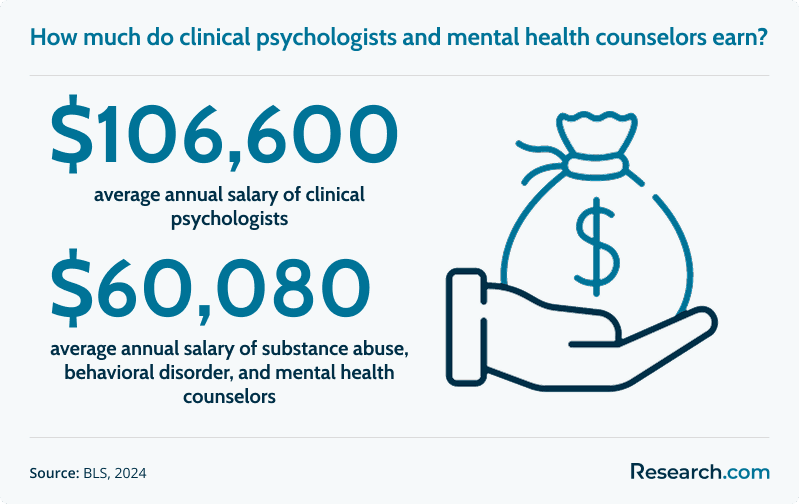
According to the U.S. Bureau of Labor Statistics, clinical psychologists have an average annual salary of $106,600, or $51.25 per hour. Their median annual salary is $96,100, and those in top-paying industries earn over $168,870. Clinical mental health counselors have an average annual salary of $60,080, or $28.89 per hour, with a median annual salary of $53,710.
These figures should be treated as national labor-market benchmarks, not personal salary guarantees. Actual earnings can vary by state, metro area, employer, license level, years of experience, specialty, private practice caseload, insurance reimbursement rates, and whether the role includes supervision or leadership duties.
Job Outlook and Demand
The BLS projects 19% job growth for mental health counselors from 2023 to 2033, which is much faster than the average for all occupations. For psychologists, projected growth is 7% over the same period. Demand is supported by greater public awareness of mental health needs, continued use of behavioral health services, and the need for care in outpatient clinics, hospitals, schools, rehabilitation settings, and community programs.
Employment Snapshot
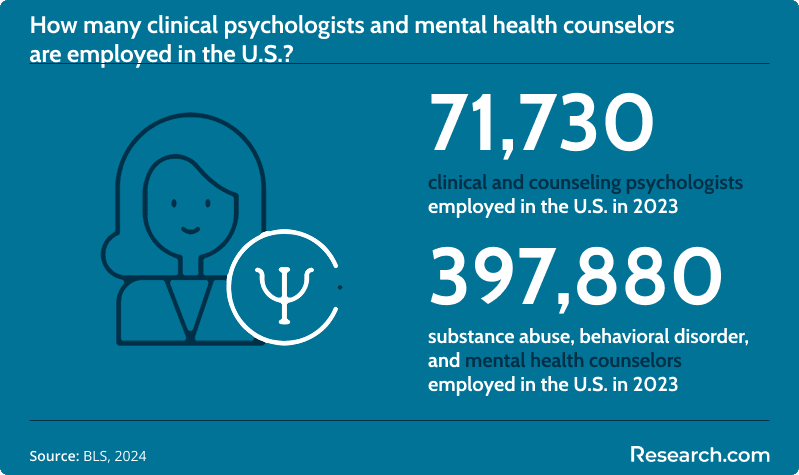
- There were 71,730 clinical and counseling psychologists employed in the United States in 2023.
- There were 397,880 substance abuse, behavioral disorder, and mental health counselors employed in the United States in 2023.
- California and New York have the two highest employment levels for both clinical psychologists and substance abuse, behavioral disorder, and mental health counselors in the United States.
How to Think About ROI
| Factor | Why It Matters | Question to Ask |
| Time in school | Doctoral study can delay full-time earnings longer than a master’s pathway | How many years will I be paying tuition instead of earning full-time income? |
| Licensure timeline | Both fields require supervised experience after or during graduate training | How long does the average graduate take to become independently licensed? |
| Program cost | Tuition is only one part of total cost | What are the fees, internship costs, travel costs, textbooks, exam fees, and lost wages? |
| Career ceiling | Psychologists may qualify for assessment, academic, and specialized clinical roles | Do I need doctoral-level scope for the work I want? |
| Local market | Salaries and opportunities vary by state and employer type | What do licensed professionals in my target region actually earn? |
Clinical Mental Health Counselor vs. Clinical Psychologist: Career Paths
Both careers can lead to meaningful clinical work, but the range of roles differs. Counselors are commonly prepared for therapy-focused and community-based practice. Psychologists have broader access to testing, research, teaching, and specialized assessment roles because of doctoral training.
Common Career Paths for Clinical Mental Health Counselors
- Private practice counselor. Licensed counselors may provide individual, group, couples, or family therapy in solo or group practices.
- Community mental health clinician. Many counselors work in outpatient programs serving clients who need accessible therapy, case coordination, and crisis support.
- Rehabilitation or addiction counselor. Counselors may support clients recovering from substance use disorders, disability-related challenges, trauma, or major life disruption. Students interested in this direction can also explore rehabilitation counseling careers.
- School, college, or career support roles. With the right credential, some counselors work in academic or vocational settings.
- Integrated healthcare clinician. Counselors may work in hospitals, primary care offices, and behavioral health teams alongside physicians, nurses, psychologists, and social workers.
- Crisis intervention specialist. Some work in mobile crisis units, hotlines, emergency programs, or stabilization services.
Common Career Paths for Clinical Psychologists
- Clinical psychologist in private practice. Many provide therapy, diagnostic assessment, consultation, and specialty services.
- Hospital or medical center psychologist. Psychologists may support patients dealing with chronic illness, trauma, pain, neurological conditions, or psychiatric disorders.
- Assessment specialist. Some focus on psychological, neuropsychological, educational, or personality testing.
- Researcher or professor. Ph.D.-trained psychologists may pursue university teaching, grant-funded research, or clinical training roles.
- Forensic psychologist. Some psychologists work with courts, corrections, competency evaluations, risk assessments, or expert testimony.
- Industrial-organizational or consulting role. Some psychology professionals apply assessment and behavioral science in workplace settings.
Clinical Mental Health Counselor vs. Clinical Psychologist: Required Skills
Both careers require strong ethics, emotional stability, cultural humility, and the ability to build trust with clients. The difference is in how those skills are applied. Counselors apply them primarily in therapy and client support. Psychologists apply them in therapy, assessment, diagnosis, research, supervision, and complex clinical decision-making.
Core Skills for Clinical Mental Health Counselors
Mental health counselors need strong interpersonal skills and structured therapeutic techniques. Students interested in behavioral intervention may also find overlap with behavior therapist career preparation, especially when working with behavior change plans and applied interventions.
- Active listening. Counselors must hear not only what clients say, but also patterns, emotions, risks, and unmet needs.
- Empathy with boundaries. Effective counseling requires compassion without over-identifying with the client or losing clinical objectivity.
- Therapeutic technique. Counselors need practical command of methods such as cognitive behavioral therapy, person-centered counseling, crisis intervention, and trauma-informed care.
- Risk assessment. Counselors must know how to respond to suicidal ideation, self-harm risk, abuse disclosures, and acute crisis situations.
- Documentation. Treatment plans, progress notes, consent forms, and records must be accurate, timely, and legally sound.
- Cultural responsiveness. Counselors must adapt care to clients’ identities, communities, values, and lived experiences.
Core Skills for Clinical Psychologists
- Psychological assessment. Psychologists must select, administer, interpret, and explain standardized tests appropriately.
- Diagnostic reasoning. They need to distinguish between overlapping symptoms, co-occurring conditions, developmental factors, and medical or neurological influences.
- Research literacy. Psychologists must evaluate evidence, apply research findings, and often contribute to clinical knowledge.
- Advanced case formulation. Complex cases require integration of history, assessment data, symptoms, risk factors, and treatment response.
- Supervision and teaching. Many psychologists train students, interns, postdoctoral fellows, or other clinicians.
- Ethical and legal judgment. Psychologists often handle sensitive evaluations, court-related work, testing data, and high-stakes documentation.
Skill Comparison: Where the Emphasis Differs
| Skill Area | Counselor Emphasis | Psychologist Emphasis |
| Therapeutic relationship | Very high | Very high |
| Psychological testing | Limited or specialized, depending on training and law | High in many clinical psychology roles |
| Research methods | Important for evidence-based practice | Central, especially in Ph.D. training |
| Crisis response | Common in community and outpatient settings | Common in hospitals, clinics, and specialty practice |
| Teaching and supervision | Possible with experience and credentials | Common in academic and clinical training settings |
Can You Transition From Clinical Mental Health Counselor to Clinical Psychologist?
Yes, a licensed clinical mental health counselor can become a clinical psychologist, but it is not a simple license upgrade. It requires doctoral education, psychology-specific supervised training, and psychology licensure. Prior counseling experience may strengthen an application and help clinically, but it usually does not replace doctoral psychology requirements.
If you are still exploring adjacent counseling fields, this career counselor career guide may also help you compare options before committing to a doctoral pathway.
Typical Steps to Move From Counseling to Clinical Psychology
- Complete prerequisite coursework if needed. Doctoral psychology programs may require research methods, statistics, abnormal psychology, developmental psychology, or other foundational courses.
- Apply to Ph.D. or Psy.D. programs. Choose a Ph.D. if you want stronger preparation for research and academia. Choose a Psy.D. if your main goal is advanced clinical practice.
- Complete doctoral practicum requirements. Counseling experience can be valuable, but doctoral programs still require psychology-supervised clinical training.
- Finish a doctoral internship. Clinical psychology licensure typically requires a formal internship, often completed near the end of the doctoral program.
- Meet postdoctoral requirements if your state requires them. Some states require additional supervised experience after the doctorate.
- Pass the EPPP and state-specific requirements. Counseling exams such as the NCMHCE do not substitute for psychology licensure exams.
When Transitioning Makes Sense
- You want to conduct psychological testing or complex diagnostic evaluations.
- You are interested in teaching, research, or clinical supervision at a higher level.
- You want to work in hospitals, academic medical centers, forensic settings, or specialized assessment clinics.
- You are willing to take on the time, cost, and admissions demands of doctoral study.
What Are the Emerging Trends in Mental Health Care and Technology?
Mental health care is becoming more digital, data-informed, and team-based. Telehealth has expanded access for many clients, while digital tools, app-supported care, and AI-assisted documentation or screening tools are changing how clinicians manage workflow and monitor progress. These tools can be useful, but they also raise important questions about privacy, clinical accuracy, bias, informed consent, and overreliance on automated recommendations.
Educational pathways are also changing. Some institutions offer more flexible formats, hybrid learning, and intensive schedules. For example, fast track PsyD programs may appeal to students who want a shorter doctoral timeline. However, accelerated does not mean easier, and it should never mean skipping accreditation, supervised training, internship quality, or licensure alignment.
Technology Trends to Watch
- Teletherapy and hybrid care. Remote therapy can improve access, especially for clients with transportation, scheduling, or geographic barriers.
- AI-assisted administrative tools. Some clinicians use technology to support note-taking, scheduling, screening, and outcome tracking, but clinical judgment remains essential.
- Digital therapeutics and mental health apps. These may supplement care, but they are not a replacement for licensed clinical treatment when risk or complex symptoms are present.
- Measurement-based care. More providers are using symptom scales and progress measures to evaluate whether treatment is working.
- Integrated behavioral health. Mental health professionals are increasingly working with primary care teams, schools, and community agencies.
How Do You Choose Between Becoming a Clinical Mental Health Counselor or a Clinical Psychologist?
The right path depends on the work you want to do every week, not just the title you prefer. If you want to provide therapy and enter practice sooner, counseling may be the better fit. If you want doctoral-level assessment, research, teaching, and broader clinical specialization, psychology may be worth the longer training path.
Choose Clinical Mental Health Counseling If You Want To:
- Start a therapy-focused career with a master’s degree rather than a doctorate.
- Work directly with clients on coping skills, relationships, trauma recovery, emotional regulation, and behavior change.
- Serve in community mental health, private practice, crisis programs, rehabilitation centers, schools, or outpatient clinics.
- Spend less time in graduate school than a doctoral psychology student.
- Build a career around ongoing counseling rather than testing or academic research.
Choose Clinical Psychology If You Want To:
- Conduct psychological testing, diagnostic assessment, or complex case evaluation.
- Pursue research, teaching, clinical supervision, or academic roles.
- Work with more complex mental health presentations in hospitals, specialty clinics, forensic settings, or medical environments.
- Earn a doctoral credential and accept the longer education timeline that comes with it.
- Keep more options open for assessment-based and research-oriented careers.
Decision Matrix
| Your Priority | Path That May Fit Better | Reason |
| Entering the workforce sooner | Clinical mental health counseling | The standard entry degree is a master’s degree |
| Conducting psychological assessments | Clinical psychology | Doctoral psychology training includes deeper assessment preparation |
| Providing weekly therapy | Either path | Both licensed counselors and psychologists can provide psychotherapy |
| Teaching or research | Clinical psychology | Doctoral training is more aligned with academic and research careers |
| Lower total education time | Clinical mental health counseling | Counseling programs are generally shorter than doctoral programs |
| Higher national salary benchmark | Clinical psychology | BLS salary data is higher for clinical psychologists |
The table below shows mental health conditions affecting adults in the U.S. These data points help explain why counseling careers, clinical psychology, and related behavioral health professions remain important parts of the healthcare system.
Can I Fast-Track My Psychology Degree to Enter the Mental Health Field Sooner?
Accelerated psychology programs can shorten the academic schedule, but they do not remove the need for quality training, supervised clinical experience, or licensure preparation. Students considering the fastest psychology degree options should look beyond speed and confirm that the program has appropriate accreditation, rigorous coursework, qualified faculty, field training, and a clear path toward the credential they want.
Fast-track options may be useful for motivated students who can handle intensive workloads, but they are not ideal for everyone. Mental health training requires reflection, supervised practice, ethical development, and clinical maturity. A program that is quick but poorly aligned with licensure can delay your career rather than speed it up.
Questions to Ask About Accelerated Programs
- Does the program meet licensure requirements in my state?
- Is the clinical training built into the curriculum, or will I need to find placements alone?
- Are accelerated courses compatible with my work and family responsibilities?
- Will credits transfer if I later pursue a master’s, Psy.D., or Ph.D.?
- Does the shorter schedule reduce depth, supervision, or faculty access?
What Are the Benefits of Working in the Mental Health Sector?
Mental health work can be challenging, but it offers a clear sense of purpose for people who want to help others manage distress, improve relationships, recover from trauma, and build healthier lives. The field also includes many educational routes, including the many types of counseling degrees available to students with different goals.
Major Benefits of Mental Health Careers
- Direct human impact. Counselors, psychologists, and related professionals help clients reduce symptoms, improve functioning, and regain stability.
- Varied work settings. Professionals can work in hospitals, schools, private practice, community agencies, correctional facilities, rehabilitation centers, colleges, and telehealth settings.
- Specialization options. The field includes clinical psychology, addiction counseling, marriage and family therapy, trauma counseling, school counseling, forensic psychology, child psychology, and other areas. Some students may also explore a spiritual counselor career guide if their interests include faith-informed support.
- Flexible practice models. Licensed professionals in private practice may have more control over schedule, caseload, and specialty, though business responsibilities increase.
- Continued learning. New research, therapies, technology tools, and policy changes keep the field intellectually active.
- Career growth potential. Experience, advanced credentials, supervision roles, and specialization can affect earnings. A clinical psychologist salary may differ substantially from a counselor salary, so students should compare the full education investment before choosing.
How Can Specialized Child and Adolescent Psychology Education Elevate My Practice?
Specialized study in child and adolescent psychology can help clinicians understand developmental stages, family systems, school pressures, trauma exposure, behavioral concerns, and age-specific assessment issues. This training can be especially valuable for professionals who want to work with children, teens, parents, schools, pediatric healthcare teams, or youth-serving agencies.
Specialization can also improve clinical decision-making because children and adolescents do not always show distress in the same way adults do. A cost-conscious student comparing options may want to review an affordable child psychology masters program and check whether it supports licensure, specialization, or professional advancement goals.
How Can Specializing in Forensic Psychology Enhance My Career Opportunities?
Forensic psychology connects mental health expertise with legal systems. Professionals in this area may work with courts, correctional settings, attorneys, law enforcement agencies, victims, defendants, or rehabilitation programs. Depending on training and licensure, work may involve risk assessment, competency-related questions, consultation, treatment planning, expert testimony, or evaluation of behavior in legal contexts.
An affordable forensic psychology online masters program may help students build foundational knowledge of legal procedures, criminal behavior, ethics, assessment, and mental health practice. However, students should be careful: a master’s in forensic psychology alone may not qualify someone for independent clinical practice unless it also meets licensure requirements.
What Are the Benefits of Pursuing Dual Master’s and Psy.D. Programs?
Combined pathways can appeal to students who want a structured route from graduate-level preparation into doctoral clinical training. Dual masters and PsyD programs may help students build clinical foundations while progressing toward advanced doctoral competencies. The potential benefit is continuity: students may avoid applying separately to multiple programs and may follow a more integrated curriculum.
The trade-off is commitment. These programs can be expensive, time-intensive, and demanding. Before enrolling, students should examine accreditation, internship match support, clinical placement quality, licensure outcomes, transfer policies, faculty expertise, and whether the Psy.D. is necessary for the career they want.
What Are the Financial Considerations for Pursuing Advanced Mental Health Degrees?
Advanced mental health education can be a strong investment, but only if the program aligns with licensure, career goals, and realistic earning expectations. Students should compare total cost, not just tuition. Fees, books, technology, travel for clinical placements, exam fees, background checks, liability insurance, lost work hours, and relocation can all affect affordability.
When comparing programs, resources that discuss how much is a masters in psychology can help students think through cost and funding options. Still, affordability should be weighed against accreditation, faculty support, clinical placement quality, and the program’s fit with state requirements.
Common Financial Mistakes to Avoid
- Looking only at tuition. Total cost includes fees, supplies, clinical placement expenses, exam costs, and time away from full-time work.
- Ignoring licensure alignment. A cheap program can become expensive if it does not qualify you for the license you need.
- Assuming online means flexible. Online mental health programs may still require synchronous classes, local internships, residencies, or campus visits.
- Borrowing without calculating timeline. Consider how long it will take to graduate, complete supervised hours, pass exams, and become independently licensed.
- Expecting guaranteed earnings. Salary depends on license level, location, employer, specialty, caseload, reimbursement, and experience.
How Can Additional Certifications Enhance My Clinical Practice?
Additional certifications can help licensed professionals deepen their skills, demonstrate focused expertise, and serve specific client populations more effectively. Certifications may be useful in trauma treatment, addiction counseling, play therapy, behavioral analysis, telehealth, supervision, or specialized therapeutic methods. They should complement—not replace—state licensure.
Behavior analysis credentials are one example. Professionals interested in applied behavior analysis may compare BCBA online master's programs to understand training routes, affordability, and fit with their clinical goals. Before choosing any certification, verify eligibility requirements, supervision expectations, renewal rules, and whether the credential is recognized by employers in your target setting.
How Can Applied Behavior Analysis (ABA) Complement Traditional Clinical Practices?
Applied Behavior Analysis can add structured, data-informed behavior intervention strategies to counseling or psychology practice. ABA focuses on observable behavior, reinforcement, skill-building, and systematic measurement. It can be especially relevant when working with developmental disabilities, autism-related needs, behavior plans, schools, caregiver training, or structured intervention programs.
ABA does not replace counseling or clinical psychology. Instead, it can complement therapy when behavior change needs to be tracked carefully and interventions must be consistent across home, school, or clinical environments. Students interested in this specialization can review the best ABA masters programs while checking accreditation, fieldwork requirements, certification alignment, and state practice rules.
Common Mistakes When Comparing Counseling and Clinical Psychology
| Mistake | Why It Can Hurt You | Better Approach |
| Choosing based only on salary | Higher earnings may come with more years of school, higher debt, and delayed full-time income | Compare salary with total cost, licensure time, and desired scope of practice |
| Assuming all therapists have the same training | Counselors, psychologists, social workers, and psychiatrists have different education and legal scopes | Match the provider or career path to the service you actually want to deliver or receive |
| Ignoring state licensure rules | Requirements vary and can affect whether your degree qualifies you to practice | Check the licensing board before enrolling in any program |
| Assuming online programs are automatically accepted | Some boards have specific rules for internships, residencies, supervision, or accreditation | Confirm online program approval with the state where you plan to practice |
| Relying only on rankings | A highly ranked program may not fit your budget, schedule, licensure state, or specialty | Use rankings as one input, not the entire decision |
| Overlooking supervised hours | Graduation alone does not usually equal independent practice | Plan for supervised experience, exams, and license processing time |
Mental Health Need and Workforce Context
Mental health demand is not abstract. According to the National Institutes of Health, the most prevalent mental illness for adults in the United States is anxiety disorder. Approximately 19.1% of adults have had an anxiety disorder within the last year. Anxiety disorders include several different conditions and presentations.
Major depression is also common. In 2021, 21 million adults reported having at least one episode of major depression, representing roughly 8.3% of the U.S. adult population. In 2022, 19.86% of adults in the U.S. were living with a mental health condition, and about 5% of American adults experienced a serious mental illness. Almost half of U.S. adults, or 46%, will experience a mental health condition during the course of their lifetime.
These figures help explain why both clinical mental health counselors and clinical psychologists are important. Counselors expand access to therapy and community-based support. Psychologists add advanced assessment, diagnostic, research, and specialty treatment capacity. The strongest mental health systems need both.
References
- Coelho, S. (2025, January 16). Mental Health Statistics. HelpGuide.org.
- United States Bureau of Labor Statistics. (2024, April 3). May 2023 National Occupational Employment and Wage Estimates: United States. BLS.
- United States Bureau of Labor Statistics. (2024, April 3). Occupational Employment and Wage Statistics: 19-3033 Clinical and Counseling Psychologists. BLS.
- United States Bureau of Labor Statistics. (2024, April 3). Occupational Employment and Wage Statistics: 21-1018 Substance Abuse, Behavioral Disorder, and Mental Health Counselors. BLS.
- United States Bureau of Labor Statistics. (2024, August 29). Occupational Outlook Handbook: Psychologists. BLS.
- United States Bureau of Labor Statistics. (2024, August 29). Occupational Outlook Handbook: Substance Abuse, Behavioral Disorder, and Mental Health Counselors. BLS.
- University of St. Augustine for Health Sciences. (2024, January 3). Mental Health Statistics [2024]. usa.edu.
Key Insights
- Clinical mental health counseling is usually the faster path into therapy-focused work because it typically requires a master’s degree rather than a doctorate.
- Clinical psychology is the stronger fit for students who want psychological testing, advanced diagnosis, research, teaching, forensic work, or specialized assessment roles.
- Both professions require state licensure, supervised clinical experience, and continuing education. Always check state rules before choosing a program.
- Clinical psychologists have higher BLS salary benchmarks, but the doctoral route requires more time and often more financial investment.
- Mental health counselors have a stronger BLS projected growth rate at 19% from 2023 to 2033, compared with 7% for psychologists.
- Neither path usually includes medication prescribing. Clients who need medication typically work with psychiatrists, psychiatric nurse practitioners, or physicians.
- The best career choice depends on the kind of work you want to do: choose counseling for direct therapy and accessible entry into practice; choose clinical psychology for doctoral-level assessment, research, and broader specialty options.
Other Things You Should Know About The Differences Between A Clinical Mental Health Counselor and A Clinical Psychologist
In 2027, clinical mental health counselors typically require a master's degree in counseling and state licensure, while clinical psychologists need a doctoral degree, such as a Ph.D. or Psy.D., along with additional supervised clinical training and licensure.
Clinical mental health counselors usually complete 2,000 to 4,000 supervised post-master’s hours before licensure, depending on the state. Clinical psychologists typically complete a predoctoral internship and a postdoctoral supervised year, often totaling about 3,000 hours. State boards and psychology licensing boards set the exact rules.
In 2027, clinical mental health counselors often use client-centered approaches, focusing on wellness and personal development. Clinical psychologists typically use evidence-based therapies, like cognitive-behavioral therapy, addressing complex mental health disorders. Counselors may emphasize short-term goals, while psychologists handle more severe psychological conditions, often incorporating research into their practice.





