2027 Texas Psychology Licensure Requirements – How to Become a Psychologist in Texas

Co-Founder and Chief Data Scientist
Earning a Texas psychology license is a major professional decision because it affects the degree you choose, the supervised experience you complete, the exams you must pass, and the populations you can serve. Texas has a large and diverse need for mental health services, and HRSA (2024) reports 475 Mental Health Professional Shortage Areas in the state. That shortage makes the pathway into psychology especially important for students comparing programs, graduates preparing for licensure, and licensed professionals considering specialization.
This guide explains how psychology education and licensure work in Texas, what to expect from the training timeline, how to compare programs, where psychologists may work, and which related credentials can expand career options. It also connects readers to relevant resources such as top Texas psychology degrees for those who want flexible academic options.
Use this article as a decision guide rather than a simple checklist. The right path depends on whether you want to become a licensed psychologist, school psychologist, counselor, behavior analyst, researcher, consultant, or another type of mental health professional in Texas.
- Texas psychology field overview
- Education requirements for becoming a psychologist in Texas
- Texas psychologist licensure, exams, and renewal
- Top psychology programs in Texas for 2027
- Psychologist salary and job market in Texas
- Managing caseloads and work-life balance as a Texas psychologist
- Using behavior analysis credentials to broaden practice
- Adding board-certified behavior analysis services
- Integrating spiritual psychology into clinical work
- Other mental health licensing options in Texas
- Preparing for Texas psychology licensing exams
- Becoming a school psychologist in Texas
- Specialized psychology careers and emerging trends in Texas
- Accelerating dual licensure in counseling
- Texas LPC license requirements
- Moving into criminal psychology in Texas
- Adding substance abuse counseling to a psychology practice
- How to choose the right psychology program in Texas
- Steps for integrating counseling services into practice
Quick Answer: How Do You Become a Licensed Psychologist in Texas?
To become a licensed psychologist in Texas, you generally need to complete undergraduate preparation, earn a doctoral degree in psychology, apply for provisional licensure, complete the required supervised professional experience, pass the Examination for Professional Practice in Psychology and the Texas Jurisprudence Examination, and maintain the license through continuing education. Texas requires at least 3,500 supervised internship hours, with 1,750 hours completed during the doctoral program and the remaining hours completed after the doctorate, usually under a provisional license.
| Stage | What It Involves | Why It Matters |
| Bachelor’s degree | Usually four years of undergraduate study, often in psychology or a related field | Builds the academic foundation for graduate admission |
| Graduate training | Doctoral study, commonly through PsyD or Ph.D. programs, often lasting four to seven years | Required for psychologist licensure and advanced clinical or research roles |
| Provisional license | Application to practice under supervision before full licensure | Allows candidates to complete postdoctoral supervised experience |
| Supervised experience | Minimum of 3,500 hours, split between doctoral internship and postdoctoral experience | Demonstrates readiness for independent professional practice |
| Licensing exams | EPPP and Texas Jurisprudence Examination | Confirms psychology knowledge and understanding of Texas rules |
| Renewal | Continuing education and periodic license maintenance | Keeps the license active and supports ethical practice |
Overview of the Psychology Industry in Texas
Psychology in Texas is not a single career track. Students and professionals can pursue clinical psychology, counseling psychology, school psychology, behavioral psychology, developmental psychology, educational psychology, industrial-organizational psychology, forensic psychology, neuropsychology, and community-based practice. The best route depends on the type of clients you want to serve, the setting where you want to work, and whether your goal is clinical practice, research, assessment, consulting, teaching, or program leadership.
The state’s mental health workforce needs are significant. HRSA (2024) identifies 475 Mental Health Professional Shortage Areas in Texas, which means many communities face limited access to care. This is especially relevant for students deciding whether the long education and licensure process is worth the investment.
Texas psychologists also have competitive earnings data in the sources cited for this guide. Psychologists in Texas earn a mean hourly salary of $54.25, or about $112,820 annually, according to U.S. Bureau of Labor Statistics data cited in the article. O*NET OnLine reports a projected employment growth rate of 10% from 2024 to 2034, with roughly 250 new job openings annually. These figures should be treated as labor-market indicators, not salary guarantees, because pay varies by specialization, employer, region, experience, and practice model.
If you are still comparing career directions, it helps to start with the broader question of what you can do with a psychology degree. Not every psychology graduate becomes a licensed psychologist, and not every mental health role requires the same degree or license.
| Psychology Path | Common Work Settings | Best Fit for Students Who Want To |
| Clinical psychology | Hospitals, clinics, private practice, community health settings | Assess, diagnose, and treat mental health conditions |
| School psychology | K-12 schools, districts, educational service organizations | Support student learning, behavior, assessment, and intervention |
| Industrial-organizational psychology | Companies, consulting firms, HR departments | Apply psychology to hiring, leadership, performance, and workplace culture |
| Forensic or criminal psychology | Courts, correctional settings, legal consulting, public agencies | Work at the intersection of psychology and the justice system |
| Behavior analysis | Schools, autism services, behavioral clinics, developmental services | Use behavior-based interventions with measurable treatment goals |
| Research psychology | Universities, labs, policy organizations, health systems | Study behavior, cognition, development, health, or social systems |
Educational Requirements for Psychologists in Texas
The academic route to Texas psychologist licensure is lengthy because independent psychology practice requires advanced training, supervised clinical experience, and examination. If you are asking how many years a psychology degree takes, the answer depends on the role you want. A bachelor’s degree may qualify you for entry-level human services, research assistant, or related roles, but psychologist licensure generally requires doctoral-level preparation.
Earn a Bachelor’s Degree
A bachelor’s degree is the starting point for most psychology careers. Students typically spend approximately four years completing general education, psychology coursework, statistics, research methods, and electives that prepare them for graduate study. A psychology major is common, but related fields may also be useful if the student completes prerequisite coursework required by graduate programs.
At this stage, students should focus less on the name of the major alone and more on building a strong graduate school profile. That means gaining research experience, developing writing and data skills, completing relevant internships or volunteer work, and forming relationships with faculty who can write detailed recommendations.
Some students choose a master’s degree before doctoral study, especially if they want to strengthen their academic record, specialize, or pursue a related mental health credential. A standalone graduate option, such as a master’s degree in psychology online, may require between 30 to 40 credit hours depending on the university and specialization.
Complete a Doctoral Degree in Psychology
Licensed psychologist preparation usually requires a doctorate, commonly a PsyD or Ph.D. in psychology. Doctoral timelines vary, but aspiring psychologists should be prepared for four to seven years of study. A PsyD often emphasizes applied clinical practice, while a Ph.D. often includes substantial research training, although program structures differ by institution.
Students interested in school psychology should pay close attention to accreditation and approval requirements. Those preparing to become school psychologists in Texas must complete a school psychology program accredited by the American Psychological Association or the National Association of School Psychologists (NASP). Because licensure and certification rules can change, students should verify current requirements before enrolling.
Costs can be substantial, so applicants should compare scholarships, assistantships, grants, tuition, fees, internship expectations, and time-to-completion. Texas Psychological Association grants and awards may help eligible students, but funding varies and should not be assumed.
Apply for Provisional Licensure
After meeting the required academic milestones, candidates may apply for provisional licensure through the Texas State Board of Examiners of Psychologists (TSBEP). A provisional license allows the candidate to work under the supervision of a licensed psychologist while completing supervised professional experience required for full licensure.
The application process includes a fee, two passport photos, official transcripts, and instructions for a fingerprint-based criminal history record check. Provisional licenses are valid for a maximum of two years, so candidates should plan supervised experience carefully and avoid delaying exam preparation or documentation.
Complete Supervised Professional Experience
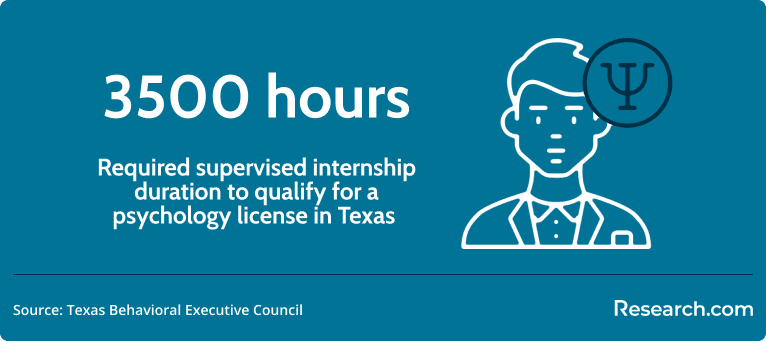
Texas requires a minimum of 3,500 supervised internship hours. The first 1,750 hours must be completed during the doctoral program through a formal internship, and the remaining hours are completed after the doctorate, typically under provisional licensure. This supervised experience often requires a full-time commitment and may take two years.
Supervised experience is more than a time requirement. It is where candidates learn how to conduct assessments, document treatment, manage ethical dilemmas, work with diverse clients, consult with other professionals, and apply psychological science in real clinical or organizational settings.
Texas Licensure Application and Renewal Process
The Texas psychology license process includes education, supervision, exams, application review, and renewal. Candidates should keep copies of transcripts, internship verification, supervision records, exam results, background check documentation, and correspondence from licensing authorities. Missing records can slow approval.
Pass the Required Psychology Licensing Exams
Texas psychologist licensure requires passing the Examination for Professional Practice in Psychology, commonly called the EPPP, and the Texas Jurisprudence Examination. The EPPP measures broad psychology knowledge. The Jurisprudence Exam focuses on the Texas Licensing Act and TSBEP rules. The Jurisprudence Exam is available online and may be taken before or after supervised experience.
| Exam | What It Tests | Preparation Focus |
| EPPP | General psychology knowledge across professional practice domains | Use a structured study calendar, practice questions, and review of weak areas |
| Texas Jurisprudence Examination | Texas psychology laws, rules, and ethical obligations | Study official Texas materials and understand how rules apply in practice |
Submit the Psychologist License Request
After completing the prerequisites, applicants can submit the required online request for the Texas psychology license. The request should be completed within two years of the initial application submission. The review process takes approximately six weeks on average, although timelines can vary based on application completeness and agency processing.
Receive and Verify the Texas Psychology License
Once TSBEP confirms that all requirements have been met, the licensee receives written notice of licensure status and a renewal permit by postal mail. A calligraphy license is mailed approximately four months after license issuance. Employers, clients, and other professionals can use Texas psychologist license verification to confirm a license holder’s status.
Renew the License and Complete Continuing Education
Texas psychology licenses expire on the last day of the licensee’s birth month. To keep the credential active, psychologists must complete at least 40 hours of relevant training during each renewal period. Continuing education helps psychologists stay current with ethical standards, assessment practices, treatment approaches, documentation expectations, and changes in state rules.

List of Top Psychology Programs in Texas for 2027
Texas offers psychology programs at the bachelor’s, master’s, and doctoral levels. The right program depends on your career goal. A bachelor’s program can prepare you for graduate study or entry-level roles. A master’s program may support advancement or alternative licensure paths. A doctoral program is typically necessary for licensed psychologist practice.
When comparing schools, consider accreditation, degree level, faculty expertise, research opportunities, clinical training access, cost, location, format, and whether the program aligns with your intended license. This program list is similar in purpose to Research.com’s comparison resources such as the best business colleges in Texas, but the psychology decision requires special attention to licensure outcomes.
1. University of Houston
The University of Houston offers both a Bachelor of Arts and a Bachelor of Science in Psychology. The B.S. route includes requirements such as Biological Psychology and a Bachelor of Science Special Degree, with a stronger emphasis on research methods and statistics. The B.A. route includes Communication and Bachelor of Art Core requirements and gives students broad exposure to psychology’s history, theories, and research foundations.
- Program Length: Four years
- Cost-per-Credit: $882.59
- Required Credits to Graduate: 120
- Accreditation: Southern Association of Colleges and Schools Commission on Colleges (SACSCOC)
2. Rice University
Rice University provides a B.A. in Psychology that combines foundational psychology courses with interdisciplinary study of the mind and behavior. Students complete courses such as Introduction to Psychology and Introduction to Social Psychology while also exploring scientific, social, and analytical approaches to psychological questions. The program also gives students access to faculty-led research and a rigorous academic environment.
- Program Length: Four years
- Cost-per-Semester: $28,605
- Required Credits to Graduate: 120
- Accreditation: SACSCOC
3. Lamar University
Lamar University offers an M.S. in Applied Psychology. The curriculum includes Professional Ethics and Issues in Psychology, Research Methods in Psychology, and Advanced Statistics in Psychology. Students may pursue concentrations in Community Psychology or Clinical Psychology, making the program useful for those seeking applied graduate training aligned with specific professional interests.
- Program Length: Two years
- Cost-per-Credit: $678.35 to $1,098.35
- Required Credits to Graduate: 44
- Accreditation: SACSCOC
4. The University of Texas at Austin
The University of Texas at Austin offers a Ph.D. in Psychology with specialized areas such as Behavioral Neuroscience, Clinical Psychology, and Cognition, Brain, and Behavior. The department brings together faculty, staff, graduate students, and undergraduates in research and teaching activities, making it a strong fit for students interested in intensive scientific training.
- Program Length: Seven years
- Cost-per-Credit: $1,310 to $2,050
- Required Credits to Graduate: 30
- Accreditation: APA
5. The University of Texas at Dallas
The University of Texas at Dallas offers a research-centered Ph.D. in Psychology where doctoral students work closely with faculty mentors in laboratory settings. The program is interdisciplinary and emphasizes developmental psychology, cognitive psychology, and social and personality psychology. Areas of study include human development, cognition, socio-emotional processes, cultural differences, and health disparities.
- Program Length: Six years
- Cost-per-Credit: $1,701 to $2,499
- Required Credits to Graduate: 75
- Accreditation: SACSCOC
Salary and Job Market Insights for Psychologists in Texas
Texas offers opportunities for psychologists in health systems, schools, community clinics, correctional settings, universities, government agencies, private practices, and businesses. The strongest career fit depends on specialization, location, willingness to serve shortage areas, and whether you prefer direct client care, assessment, research, consulting, or leadership.
Average Salary for Psychologists in Texas
Salary varies substantially by specialty, employer, region, experience, and whether a psychologist works in private practice or for an organization. The article’s cited data reports that psychologists in Texas earn a mean hourly salary of $54.25 and an annual average of approximately $112,820. Other salary examples in the article include:
- Clinical psychologists: Average salaries range from $75,000 to $95,000 annually, with higher earnings in large cities such as Houston, Dallas, and Austin.
- School psychologists: Typical earnings range from $65,000 to $85,000, depending on the district and experience level.
- Industrial-organizational psychologists: Earnings can exceed $120,000 annually, especially in major corporations or consulting settings.
- Private practice and advanced specialty roles: Some psychologists in areas such as forensic psychology or neuropsychology may see salaries exceeding $100,000.
Regional Job Market Trends
Texas demand is not evenly distributed. Large metro areas may offer more hospitals, universities, clinics, and corporate employers, while rural areas may have greater access gaps and fewer mental health providers. Professionals who are open to underserved communities may find mission-driven opportunities and may be able to explore loan forgiveness or other incentive programs when available.
- Urban markets: Houston, Dallas, San Antonio, and Austin tend to have more clinical, counseling, assessment, and organizational psychology opportunities because of population density and employer concentration.
- Rural communities: Need is often shaped by limited access to mental health services, fewer specialty providers, and travel barriers for clients.
- Corporate settings: Texas employers may use organizational psychologists for employee well-being, leadership development, workforce analytics, and performance improvement.
Factors Behind Demand
Demand for psychologists in Texas is influenced by population growth, greater public attention to mental health, school-based needs, healthcare system demand, and business expansion. These conditions create opportunities, but they do not eliminate competition. Candidates who combine licensure readiness with specialized training, strong supervision, assessment skills, telehealth competence, and cultural responsiveness may be better positioned.
How to Strengthen Career and Salary Potential
Psychologists and graduate students can improve career flexibility by choosing a specialization early, completing high-quality supervised experience, networking through professional organizations, and maintaining continuing education beyond the minimum requirement. Those interested in workplace behavior and business applications may compare affordable online master’s in organizational psychology programs to build skills relevant to corporate and consulting settings.
How can psychologists in Texas maintain work-life balance while managing client caseloads?
Work-life balance is a professional risk-management issue, not just a personal preference. Psychologists who consistently carry excessive caseloads may face burnout, weaker documentation, reduced clinical judgment, and lower quality of care. Texas demand can be high, so psychologists need systems that protect both clients and clinicians.
- Define work hours clearly: Set appointment, documentation, consultation, and emergency-response boundaries before the schedule becomes unmanageable.
- Use structured scheduling: Reserve blocks for clinical notes, supervision, billing, assessment scoring, phone calls, and case coordination instead of treating administrative work as an afterthought.
- Monitor caseload complexity: The number of clients is only one factor. Trauma cases, high-risk clients, court-involved cases, and extensive assessments may require more time and emotional bandwidth.
- Build consultation into practice: Peer consultation and supervision can reduce isolation and improve decision-making in difficult cases.
- Automate or delegate administrative tasks: Billing, reminders, scheduling, and intake paperwork can consume significant time if they are not systematized.
- Protect recovery time: Exercise, sleep, family time, hobbies, mindfulness, spiritual practices, and therapy for clinicians can all support long-term sustainability.
How can Texas psychologists leverage behavior analysis certifications to diversify their practice?
Behavior analysis training can help psychologists serve clients whose needs involve measurable behavior change, developmental concerns, autism spectrum disorders, disruptive behavior, or skills acquisition. A behavior analysis credential is most useful when it complements the psychologist’s existing scope of practice and is supported by appropriate training, supervision, and ethical boundaries.
Psychologists considering this direction can compare BCBA online programs to understand the coursework and preparation involved. Before enrolling, confirm whether the program aligns with current certification requirements and whether the credential supports your intended work setting.
How can Texas psychologists integrate board-certified behavior analysis into their practice?
Board-certified behavior analysis can expand services in clinical, school, and developmental settings. It may be especially relevant for psychologists who already work with children, families, disability services, or behavior intervention plans. Integration should be done carefully, with attention to credential requirements, documentation standards, treatment planning, insurance rules, and collaboration with schools or healthcare teams.
Professionals who want a state-specific roadmap can review how to become a BCBA in Texas before deciding whether the credential fits their practice goals.
How can integrating spiritual psychology enhance clinical practice in Texas?
Spiritual psychology may be useful when clients want therapy that acknowledges meaning, values, belief systems, grief, purpose, mindfulness, or existential concerns. In Texas, where clients may come from many religious, cultural, and spiritual backgrounds, psychologists must approach this area with humility and ethical care.
The key is client-centered integration. Psychologists should not impose beliefs, substitute spiritual practices for evidence-based treatment, or move beyond their competence. Used appropriately, spiritual themes may support emotional regulation, resilience, identity work, and therapeutic rapport. Those exploring this niche can learn more about spiritual psychology careers.
What are the other Licensing Options for Mental Health Professionals in Texas?
A Texas psychology license is not the only route into mental health practice. Some students may be better suited for counseling, marriage and family therapy, social work, behavior analysis, substance abuse counseling, or school-based services. These paths differ in degree requirements, supervised hours, scope of practice, exams, and client populations.
For example, the MFT license in Texas prepares professionals to provide therapy to individuals, couples, and families through a relational and systems-based lens. This can be a better fit for students who want to focus on family dynamics rather than doctoral-level psychological assessment or research.
| Credential Direction | Potential Fit | Important Question to Ask |
| Licensed psychologist | Students seeking doctoral-level assessment, diagnosis, treatment, research, or independent psychology practice | Am I prepared for a long doctoral and supervised training pathway? |
| LPC | Students focused on counseling and psychotherapy services | Does this path match the clients and settings I want? |
| MFT | Students interested in couples, families, and relational systems | Do I want family systems training as my professional foundation? |
| School psychology | Students who want to work with children, assessment, learning needs, and school systems | Does the program meet Texas school psychology requirements? |
| Behavior analysis | Students or clinicians interested in behavior intervention and developmental services | Will certification requirements align with my current education and practice? |
What are effective strategies for preparing for Texas psychology licensing exams?
Licensing exam preparation should begin before the final application stage. Candidates who wait until supervision is nearly complete may underestimate the time needed for review, practice exams, and remediation of weak areas.
- Map the exam content: Review the EPPP domains and the Texas Jurisprudence Examination materials before building a study calendar.
- Create a realistic schedule: Plan study blocks around clinical work, supervision, documentation, and personal obligations.
- Use practice questions strategically: Do not only count correct answers. Track why missed questions were missed.
- Study Texas rules directly: For the Jurisprudence Exam, focus on how rules apply to confidentiality, records, supervision, scope of practice, discipline, and professional conduct.
- Use peer support carefully: Study groups can help with accountability, but candidates should still verify answers against official materials.
- Consider alternate mental health paths if needed: Students comparing roles can review what degree is needed to become a social worker in Texas to understand a different helping-profession route.
How can I become a school psychologist in Texas?
School psychology is a specialized path focused on student learning, development, behavior, assessment, intervention, and collaboration with educators and families. It is different from general clinical psychology because the primary work setting is the educational system.
Students should look for programs that include child development, psychoeducational assessment, consultation, intervention, legal and ethical issues in schools, and supervised fieldwork. Because school psychology rules are state-specific, prospective students should review how to become a school psychologist in Texas before committing to a program.
Specialized Career Opportunities and Emerging Trends in Texas Psychology
Texas psychology careers are being shaped by workforce shortages, telehealth adoption, school mental health needs, population diversity, corporate demand for behavioral expertise, and the growing use of technology in assessment and service delivery. These trends create opportunities, but they also require psychologists to maintain competence and ethical judgment.
Forensic and Criminal Psychology
Forensic psychology applies psychological expertise to legal questions, correctional settings, evaluations, consultation, and justice-related services. Students interested in this field should seek coursework and supervised experience related to forensic assessment, legal standards, ethics, risk evaluation, and correctional populations. Flexible graduate options such as forensic psychology master's programs online may help students explore the field, although licensure requirements should be checked separately.
Cultural and Community Psychology
Texas’s population diversity makes cultural competence essential. Community-oriented psychologists may work with nonprofits, public health organizations, schools, clinics, or local agencies to address access barriers, prevention, outreach, and culturally responsive care.
Telepsychology and Digital Care
Telepsychology can improve access for rural and underserved communities, but it also raises questions about privacy, emergency planning, informed consent, interstate practice, technology reliability, and documentation. Psychologists should follow Texas rules, payer requirements, and ethical standards before offering remote services.
Neuropsychology and Brain-Behavior Work
Neuropsychology focuses on relationships between brain function, cognition, emotion, and behavior. Work may occur in hospitals, rehabilitation centers, research programs, or specialty clinics. This path usually requires advanced training and closely supervised assessment experience.
Industrial-Organizational Psychology
Industrial-organizational psychologists apply psychological science to workplace selection, training, leadership, engagement, organizational change, and employee well-being. Texas’s business environment can create opportunities in corporations, consulting firms, and human resources, particularly for professionals with strong analytics and communication skills.
AI and Mental Health Practice
Artificial intelligence tools are increasingly discussed in mental health screening, documentation support, predictive analytics, and digital interventions. Psychologists should treat AI as a tool requiring oversight, not a replacement for professional judgment. Ethical concerns include bias, privacy, explainability, informed consent, and appropriate clinical use.
How can licensed psychologists accelerate dual licensure in counseling?
Licensed psychologists who want to add counseling credentials should first confirm whether dual licensure is necessary for their goals. In some cases, a psychologist’s current license may already support the services they want to provide. In other cases, an additional counseling credential may help with role clarity, employment options, or service expansion.
Professionals considering this move should compare coursework gaps, supervised clinical hour requirements, exam obligations, and state application rules. Research.com’s guide to the shortest path to become a counselor in Texas can help psychologists evaluate whether dual licensure is practical.
What are the Texas LPC license requirements?
The Licensed Professional Counselor credential is a separate counseling pathway with its own education, supervised experience, and exam requirements. Psychologists considering LPC dual licensure should not assume that psychology training automatically satisfies every requirement. They should review state-specific rules, transcript requirements, practicum expectations, and supervision standards before applying.
For a focused overview, see the guide to Texas LPC license requirements.
How can I advance into criminal psychology in Texas?
Criminal psychology requires more than general interest in crime or profiling. Professionals need training in forensic assessment, legal systems, ethics, trauma, correctional environments, report writing, and expert consultation. Practical experience in courts, correctional facilities, law enforcement-adjacent settings, forensic hospitals, or research projects can help build credibility.
Students and licensed professionals can review how to become a criminal psychologist in Texas for a clearer picture of the academic and professional steps involved.
How can psychologists in Texas integrate substance abuse counseling into their practice?
Substance abuse counseling can complement psychological practice because addiction often overlaps with trauma, anxiety, depression, family stress, medical issues, and legal concerns. Psychologists who add this service area should pursue appropriate training in evidence-based addiction treatment, relapse prevention, motivational interviewing, co-occurring disorders, ethics, and referral coordination.
Before expanding services, psychologists should verify scope-of-practice rules, documentation expectations, insurance requirements, and whether additional certification or supervised experience is needed. For a dedicated pathway, see how to become a substance abuse counselor in Texas.
Essential Resources for Choosing the Right Psychology Program in Texas
Choosing a psychology program in Texas should be based on fit, licensure alignment, training quality, and cost—not reputation alone. A well-known university is not automatically the best choice if the program does not match your specialization, supervision needs, schedule, or financial limits.
Questions to Ask Before Enrolling
- Accreditation: Is the institution regionally accredited, and is the psychology program accredited or approved when required for my career goal?
- Licensure alignment: Does the program meet Texas requirements for the license or credential I want?
- Training model: Is the program research-focused, practice-focused, school-based, counseling-oriented, or organizational?
- Faculty expertise: Are faculty members active in the specialty area I want to pursue?
- Supervised experience: Does the program help students secure internships, practicums, or field placements?
- Total cost: What will I pay after tuition, fees, books, travel, lost work time, and living expenses?
- Funding: Are assistantships, grants, scholarships, or work-study options available?
- Format: Can I complete the program online, on campus, hybrid, full time, or part time?
- Career outcomes: What types of roles do graduates enter, and how does the school support placement?
Common Mistakes to Avoid
| Mistake | Why It Can Hurt You | Better Approach |
| Choosing a program without checking accreditation | It may not support licensure, transfer, or employer recognition | Verify institutional and program-level requirements before applying |
| Looking only at tuition | Fees, travel, internship costs, and lost wages can change affordability | Compare total cost of attendance and funding options |
| Assuming online programs always meet Texas rules | Some programs may not align with state licensure requirements | Ask the program to confirm Texas-specific licensure preparation in writing |
| Ignoring transfer credit policies | Lost credits can increase time and cost | Request a transfer evaluation before enrolling |
| Relying only on rankings | Rankings may not reflect your specialization, schedule, or licensing needs | Use rankings as one input, then verify fit and outcomes |
| Assuming salary outcomes are guaranteed | Earnings depend on specialty, region, experience, employer, and practice model | Use salary data as a planning tool, not a promise |
Students comparing options can also review Research.com’s guide to the best colleges for psychology in Texas to identify programs that may fit their goals and budget.
What steps can psychologists take to integrate counseling services into their practice?
Psychologists who want to add counseling services should begin with scope of practice. If the service is already within the psychologist’s license and competence, the priority may be continuing education, supervision, consultation, and documentation standards. If a separate counseling credential is desired, the psychologist should verify state requirements before spending money on coursework.
- Clarify the service expansion: Decide whether you want to offer general counseling, couples work, substance abuse counseling, school-based counseling, or another specialty.
- Check Texas requirements: Confirm whether additional licensure, certification, coursework, or supervised hours are required.
- Close training gaps: Complete targeted continuing education or formal coursework in the counseling area you plan to offer.
- Build referral relationships: Coordinate with counselors, physicians, schools, treatment centers, and community agencies.
- Update practice documents: Revise informed consent, service descriptions, billing processes, emergency procedures, and records policies.
- Monitor quality: Use supervision, consultation, and outcome measures to ensure the new service is clinically appropriate.
For professionals who want a counseling credential, Research.com’s guide on how to become an LPC in Texas outlines the steps and eligibility considerations.
Is a Texas Psychology License Worth It?
A Texas psychology license can be worth it for people who want doctoral-level authority to assess, diagnose, treat, consult, supervise, conduct research, or build an independent psychology practice. The pathway is demanding, but it can lead to a flexible and respected career in a state with documented mental health workforce shortages.
However, it is not the best fit for everyone. Students who want a shorter route into counseling may compare LPC, MFT, social work, or substance abuse counseling pathways. Students who want advanced clinical practice should compare doctoral programs carefully, including online PsyD programs where appropriate, while verifying whether the program supports Texas licensure goals.
Who Should Consider This Path?
- Students willing to complete doctoral-level education and extensive supervised experience
- Future clinicians who want to provide assessment, diagnosis, and evidence-based treatment
- Researchers and academics who want advanced psychology training
- Professionals interested in private practice, health systems, schools, forensic work, or consulting
- Students who are prepared for licensing exams, continuing education, and ethical regulation
Who May Want a Different Route?
- Students who want to enter practice sooner through counseling, social work, or MFT pathways
- People who are not interested in doctoral research, assessment, or long supervised training
- Applicants who need a lower-cost or shorter credential before committing to a doctorate
- Students whose main interest is coaching, human resources, case management, or community work rather than licensed psychology practice
Key Insights
- Texas has a substantial mental health access challenge: HRSA (2024) reports 475 Mental Health Professional Shortage Areas, which makes trained psychology professionals important across urban and rural communities.
- Licensure requires long-term planning: The path generally includes undergraduate study, doctoral education, provisional licensure, 3,500 supervised internship hours, the EPPP, the Texas Jurisprudence Examination, and continuing education.
- Program choice should follow career goals: A bachelor’s, master’s, PsyD, Ph.D., school psychology program, counseling program, or behavior analysis credential can lead to very different outcomes.
- Salary data is useful but not guaranteed: The cited Texas mean hourly wage is $54.25, or about $112,820 annually, but actual earnings depend on specialty, region, employer, experience, and practice model.
- Accreditation and licensure alignment are non-negotiable: Before enrolling, confirm that the program supports your intended Texas credential and supervised experience requirements.
- Specialization can improve career flexibility: Areas such as school psychology, forensic psychology, behavior analysis, telepsychology, neuropsychology, organizational psychology, and substance abuse counseling can broaden practice options when pursued ethically and with proper training.
- The best path is not always psychologist licensure: LPC, MFT, social work, school psychology, and substance abuse counseling may be better fits for some students depending on timeline, cost, scope of practice, and preferred client population.
Related Articles for Nearby States
- 2027 Louisiana Psychology Licensure Requirements – How to Become a Psychologist in Louisiana
- 2027 Oklahoma Psychology Licensure Requirements – How to Become a Psychologist in Oklahoma
- 2027 Arkansas Psychology Licensure Requirements – How to Become a Psychologist in Arkansas
- 2027 New Mexico Psychology Licensure Requirements – How to Become a Psychologist in New Mexico
- 2027 Kansas Psychology Licensure Requirements – How to Become a Psychologist in Kansas
- 2027 Missouri Psychology Licensure Requirements – How to Become a Psychologist in Missouri
- 2027 Colorado Psychology Licensure Requirements – How to Become a Psychologist in Colorado
- 2027 Mississippi Psychology Licensure Requirements – How to Become a Psychologist in Mississippi
- 2027 Tennessee Psychology Licensure Requirements – How to Become a Psychologist in Tennessee
- 2027 Arizona Psychology Licensure Requirements – How to Become a Psychologist in Arizona
References:
- Health Resources & Services Administration. (2024). Designated Health Professional Shortage Areas Statistics. https://data.hrsa.gov/topics/health-workforce/shortage-areas
- O*NET OnLine. (n.d.). Texas Employment Trends. https://www.onetonline.org/link/localtrends/19-3039.00?st=TX
- Texas Behavioral Health Executive Council. (n.d.). Apply or Renew Online (Online Licensing System). https://www.bhec.texas.gov/online-license-renewal-system/index.html
- Texas Behavioral Health Executive Council. (n.d.). Applying for a License. https://www.bhec.texas.gov/texas-state-board-of-examiners-of-psychologists/applying-for-a-license/index.html
- U.S. Bureau of Labor Statistics. (2025). Psychologists: Occupational Outlook Handbook. https://www.bls.gov/ooh/life-physical-and-social-science/psychologists.htm
Other Things You Should Know About Texas Psychology Licensure Requirements
To become a psychologist in Texas, you must complete a bachelor's degree, followed by a doctorate in psychology (PsyD or Ph.D.), which typically takes between four to seven years. Additionally, you need to fulfill 3,500 hours of supervised internship experience and pass the necessary licensure exams.
To apply for a provisional psychology license in Texas, you must submit an application to the Texas State Board of Examiners of Psychologists (TSBEP), along with two passport photos, official transcripts, and a fee. You will also need to complete a fingerprint-based criminal history record check.
To obtain a Texas psychology license, you must pass two exams: the Examination for Professional Practice in Psychology (EPPP) and the Jurisprudence Examination. The EPPP assesses your knowledge of various areas of psychology, while the Jurisprudence Exam tests your understanding of Texas laws and regulations related to psychology.
To gain supervised experience in Texas, you need to complete 1,750 hours during your doctoral program as part of a formal internship, followed by an additional 1,750 hours post-doctorate under a provisional license. This supervised experience typically takes about two years to complete.
Texas applicants must submit fingerprints for a criminal history record check through the Texas Department of Public Safety and the FBI. The Texas Behavioral Health Executive Council uses those results during licensure review. A disqualifying criminal history can delay or block approval, even when education and exam requirements are met.