2027 Fastest Online Bachelor's in Software Engineering

Co-Founder and Chief Data Scientist
Choosing a fast online bachelor’s in software engineering is not just about finishing quickly. The bigger question is whether the program can help you build credible coding, design, testing, and project skills fast enough to compete for developer roles without sacrificing accreditation, portfolio quality, or career support.
This guide is for students, transfer learners, working adults, and career changers comparing accelerated online software engineering degrees for 2027. You will learn what these programs cover, how long they take, what they cost, which schools are listed, how online study compares with campus study, and how to choose a program that fits your timeline, budget, and career goals.
Quick answer: What is the fastest online bachelor’s in software engineering?
The fastest online bachelor’s in software engineering programs may allow motivated students to graduate in about 2 to 3 years, especially when they study year-round, take accelerated terms, or transfer prior college credits. Western Governors University lists a 35-month program length, while many other online programs use flexible pacing, transfer-friendly policies, or career-focused concentrations to help students move faster than a traditional four-year schedule.
A fast program is worth considering if it is properly accredited, teaches current software engineering practices, includes substantial hands-on projects, and offers career support. Speed alone should not be the deciding factor. Employers still look for evidence that graduates can build, test, debug, document, and maintain software in real work settings.
What are the benefits of getting an online bachelor’s in software engineering?
- Career preparation: A bachelor’s program can prepare students for roles such as software developer, quality assurance analyst, systems engineer, full-stack developer, or technical project contributor.
- Strong earnings potential: The U.S. Bureau of Labor Statistics reports a median salary of about $127,260 per year for software engineers with a bachelor’s degree.
- Flexible learning: Online formats can make it easier to study while working, avoid relocation, and complete coursework through asynchronous classes, virtual labs, and project-based assignments.
- Faster completion options: Accelerated calendars, transfer credits, competency-based learning, and year-round enrollment may help students graduate sooner than a standard campus schedule.
What can I expect from an online bachelor’s in software engineering?
An online bachelor’s in software engineering teaches students how to design, build, test, deploy, and maintain software systems. The curriculum usually combines programming, algorithms, data structures, databases, operating systems, software architecture, software testing, requirements analysis, and project management. Many programs end with a capstone project that asks students to solve a realistic development problem from planning through implementation.
Most online courses use a mix of recorded lectures, coding assignments, discussion boards, virtual labs, team projects, and instructor feedback. Some programs include scheduled live sessions, but many are asynchronous, which allows students to complete coursework around work or family responsibilities. Students should still expect firm deadlines, group collaboration, and significant time spent debugging code and completing projects.
Tuition commonly ranges from $30,000 to $70,000 for the full program, depending on the institution, residency rules, fees, and transfer credits. Some accelerated formats can be completed in just 2.5 to 3 years, which may reduce total time in school and help students enter the job market sooner.
What you should be ready to do as an online learner
- Write and revise code regularly, not just watch lectures.
- Use developer tools such as version control, integrated development environments, testing tools, and collaboration platforms.
- Complete independent problem-solving assignments with limited hand-holding.
- Participate in team-based projects that simulate professional software development workflows.
- Build a portfolio that shows working applications, documented code, and practical technical decisions.
Where can I work with an online bachelor’s in software engineering?
Software engineering graduates are not limited to technology companies. Organizations in finance, healthcare, manufacturing, retail, logistics, government, education, and cybersecurity all rely on software systems. According to the U.S. Bureau of Labor Statistics, as of May 2022, the industries with the highest employment of software developers included the following:
| Industry | Software developer employment | What graduates may work on |
| Computer Systems Design | About 526,240 software developers, representing over 21.3% of the industry's workforce | Client applications, cloud systems, enterprise platforms, integrations, and custom software projects |
| Software Publishers | Over 162,130 developers | Commercial software, SaaS platforms, security features, performance improvements, and product updates |
| Company Management | Around 78,280 developers | Internal systems, automation tools, analytics platforms, and enterprise software support |
| Data Processing & Web Hosting | Approximately 67,690 developers | Web platforms, hosted applications, data systems, APIs, and infrastructure-connected software |
| Credit Intermediation (Banking) | About 50,640 developers | Banking platforms, financial applications, compliance tools, payment systems, and business software |
How much can I make with an online bachelor’s in software engineering?
Software engineering-related careers can offer above-average wages, but individual salaries vary by role, industry, location, employer, technical stack, internship experience, and portfolio strength. The 2023 median wages for related occupations were higher than the U.S. average of $23.11 per hour, according to the U.S. BLS, 2024.
| Role | 2023 median hourly wage | 2023 median annual wage |
| Software Developers | $63.20 per hour | $131,450 per year |
| Web Developers and Digital Designers | $45.85 per hour | $95,380 per year |
| Computer Systems Analysts | $49.90 per hour | $103,790 per year |
These figures should be treated as labor market benchmarks, not guarantees. New graduates may start below median pay, especially if they have limited internship experience or a weak project portfolio. Candidates who can show tested code, deployed applications, teamwork, documentation, and familiarity with modern development tools may be more competitive.
- Best Online Bachelor’s in Software Engineering Programs for 2027
- How long does an online bachelor’s in software engineering take?
- Online vs. on-campus software engineering degrees
- Average cost of an online bachelor’s in software engineering
- Financial aid options for online software engineering students
- Admission requirements and prerequisites
- How online software engineering programs respond to emerging trends
- How online software engineering programs connect with industry
- Pros and cons of an online bachelor’s in software engineering
- Graduate school options after an online software engineering degree
- Common courses in online software engineering programs
- Software engineering specializations
- How to choose the best online software engineering program
- Career paths after graduation
- Job market outlook for software engineering graduates
Best Online Bachelor’s in Software Engineering Programs for 2027
How do we rank schools?
Research.com rankings are designed to help students compare programs using transparent, data-informed criteria. For this list, we review online bachelor’s options using sources such as the IPEDS database, Peterson's database, the College Scorecard database, and The National Center for Education Statistics. To understand how Research.com evaluates schools and programs, review the methodology page.
| School | Program | Credits or courses | Listed cost | Accreditation |
| Western Governors University | Bachelor of Science in Software Engineering | 36 or 38 required courses | $4,085 per six-month term flat rate | Northwest Commission on Colleges and Universities (NWCCU) |
| Pennsylvania State University – World Campus | Bachelor of Science in Software Engineering | 126 required credits | $632 / $678 per credit hour | Middle States Commission on Higher Education (MSCHE) |
| Southern New Hampshire University | Bachelor’s in Computer Science with a Software Engineering concentration | 132 required credits | $330 per credit hour | New England Commission of Higher Education (NECHE) |
| University of Arizona | Bachelor of Science in Software Engineering | 120 required credits | $525 per credit hour | Higher Learning Commission (HLC) |
| University of Minnesota | Bachelor of Science in Software Engineering | 120 required credits | $448 per credit hour | Middle States Commission on Higher Education (MSCHE) |
| St. Cloud State University | Bachelor’s in Software Engineering | 122 required units | $350 per credit hour | Higher Learning Commission (HLC) |
| Kennesaw State University | Bachelor of Science in Software Engineering | 120 required credits | $530 per credit hour (Tuition + Student fee) | Southern Association of Colleges and Schools Commission on Colleges (SACSCOC) |
| Grand Valley State University | Bachelor of Science in Software Engineering | 120 required credits | $665 or $699 per credit hour (In-state) / $947 or $980 per credit hour (Nonresident) | Higher Learning Commission (HLC) |
| Fisher College | Bachelor of Science in Information Technology with a Software Engineering concentration | 120 required credits | $5,040 per module tuition cost (Full-time) / $2,520 per module tuition cost (Half-time) | New England Commission of Higher Education (NECHE) |
| Colorado Technical University | Bachelor of Science in Computer Science - Software Engineering | 183 required credits | $340 per credit hour / $65,450 total program cost | Higher Learning Commission (HLC) |
1. Western Governors University (B.S.S.E.)
Western Governors University offers an online Bachelor of Science in Software Engineering built around practical projects and competency-based progress. The program is designed for students who want flexibility and a direct connection between coursework and workplace development tasks. Its listed program length is 35 months, making it one of the clearest accelerated options in this group.
- Program Length: 35 months
- Required Courses to Graduate: 36 or 38
- Cost: $4,085 per six-month term flat rate
- Accreditation: Northwest Commission on Colleges and Universities (NWCCU)
2. Pennsylvania State University – World Campus (B.S.S.E.)
Penn State World Campus offers an online Bachelor of Science in Software Engineering that combines programming, engineering principles, design, testing, and collaborative development work. The program may appeal to students who want a recognized public university option with structured software engineering coursework and project-based learning.
- Required Credits to Graduate: 126
- Cost: $632 / $678 per credit hour
- Accreditation: Middle States Commission on Higher Education (MSCHE)
3. Southern New Hampshire University (B.S.C.S. with concentration in Software Engineering)
Southern New Hampshire University offers an online computer science bachelor’s degree with a Software Engineering concentration. Students study full-stack development, testing, user interface work, and software design while completing applied projects that can support an entry-level portfolio.
- Required Credits to Graduate: 132
- Cost: $330 per credit hour
- Accreditation: New England Commission of Higher Education (NECHE)
4. University of Arizona (B.S.S.E.)
The University of Arizona’s online Bachelor of Science in Software Engineering blends software development with engineering-based design and systems thinking. Students learn how to plan, create, maintain, and improve reliable software systems through technical coursework and collaborative projects.
- Required Credits to Graduate: 120
- Cost: $525 per credit hour
- Accreditation: Higher Learning Commission (HLC)
5. University of Minnesota (B.S.S.E.)
The University of Minnesota’s online Bachelor of Science in Software Engineering focuses on software development, systems design, project management, and agile methods. Its curriculum is suited to learners who want technical depth along with exposure to the team processes used in professional software work.
- Required Credits to Graduate: 120
- Cost: $448 per credit hour
- Accreditation: Middle States Commission on Higher Education (MSCHE)
6. St. Cloud State University (B.S.S.E.)
St. Cloud State University’s online software engineering bachelor’s program emphasizes the complete software development lifecycle. Students study design, programming, testing, systems analysis, and team-based problem solving to prepare for technical roles in software-centered organizations.
- Required Units to Graduate: 122
- Cost: $350 per credit hour
- Accreditation: Higher Learning Commission (HLC)
7. Kennesaw State University (B.S.S.E.)
Kennesaw State University offers an online Bachelor of Science in Software Engineering that combines computing, engineering principles, software architecture, agile development, and hands-on projects. The program is appropriate for students who want a broad foundation in building and maintaining complex software systems.
- Required Credits to Graduate: 120
- Cost: $530 per credit hour (Tuition + Student fee)
- Accreditation: Southern Association of Colleges and Schools Commission on Colleges (SACSCOC)
8. Grand Valley State University (B.S.S.E.)
Grand Valley State University’s online Bachelor of Science in Software Engineering includes programming, systems design, quality assurance, lab-based learning, and collaborative technical work. The program is designed to help students develop practical skills for software development and engineering roles.
- Required Credits to Graduate: 120
- Cost: $665 or $699 per credit hour (In-state) / $947 or $980 per credit hour (Nonresident)
- Accreditation: Higher Learning Commission (HLC)
9. Fisher College (B.S.I.T with Software Engineering Concentration)
Fisher College offers an online Bachelor of Science in Information Technology with a Software Engineering concentration. The program combines IT fundamentals with programming, systems analysis, database design, cybersecurity, and project management, making it a possible fit for students who want both software and broader IT preparation.
- Required Credits to Graduate: 120
- Cost: $5,040 per module tuition cost (Full-time) / $2,520 per module tuition cost (Half-time)
- Accreditation: New England Commission of Higher Education (NECHE)
10. Colorado Technical University (B.S. in Computer Science - Software Engineering)
Colorado Technical University offers an online Bachelor of Science in Computer Science with a Software Engineering concentration. The program covers programming, algorithms, software design, virtual labs, and applied projects for students seeking a computer science foundation with software engineering coursework.
- Required Credits to Graduate: 183
- Cost: $340 per credit hour / $65,450 total program cost
- Accreditation: Higher Learning Commission (HLC)
How long does it take to complete an online bachelor’s in software engineering program?
An online bachelor’s in software engineering can take about 2 to 3 years in an accelerated format, although many students still follow a four-year pace. The actual timeline depends on transfer credits, course load, term structure, prior experience, and whether the program allows year-round study.
Accelerated programs often use shorter terms of 7–8 weeks and may offer multiple start dates throughout the year. Students who complete six terms per year, carry a heavy course load, or enter with previous college credit can shorten the path significantly. Some programs accept up to 90 transfer credits, which may allow highly prepared students to finish in as little as 12 months.
Traditional full-time bachelor’s programs usually require about 120 credits and take about 4 years. A typical full-time student may spend around 15 instructional hours per week in courses, with additional time needed for projects, labs, reading, and debugging. Accelerated online learners should expect roughly 15 hours weekly in class-related activity, with total weekly work often exceeding 20+ hours when assignments and coding projects are included.
Students planning long-term technical specialization sometimes compare bachelor’s timelines with graduate options, including the fastest online master's programs in cybersecurity, to understand how undergraduate and graduate study can fit together.
| Student situation | Likely completion pace | Best strategy |
| First-time college student with no transfer credits | Often close to 4 years unless enrolled in an accelerated calendar | Choose a program with year-round terms and strong academic advising |
| Transfer student with substantial credits | Potentially 2 to 3 years, depending on accepted credits | Request an official transfer evaluation before enrolling |
| Working adult studying part time | May take longer than 4 years | Prioritize flexibility, predictable deadlines, and employer tuition support |
| Highly motivated accelerated student | May finish faster with heavy course loads | Confirm workload expectations and avoid overloading during advanced coding courses |
How does an online bachelor’s in software engineering program compare to an on-campus program?
Accredited online and campus software engineering programs often cover similar technical material, but the learning experience can feel very different. Online programs usually offer more scheduling flexibility, while campus programs may provide more face-to-face collaboration, lab access, and local networking.
- Employer perception: A 2024 NACE survey reported that 87.4% of employers hired graduates with online degrees in 2024 and reported equal starting pay compared with in-person graduates.
- Course content: Accredited online programs generally include programming, software design, algorithms, testing, databases, and project work similar to campus programs. Students comparing undergraduate and graduate software pathways may also review the fastest online software engineering degree options.
- Hands-on experience: About 22% of students participate in internships, both online and in person, with placements split roughly between remote and onsite formats.
- Career support: Many online learners can access career advising, résumé reviews, virtual events, and employer connections, but the quality varies by institution.
| Factor | Online bachelor’s | On-campus bachelor’s |
| Schedule | Often more flexible, especially with asynchronous courses | Usually follows fixed class meeting times |
| Networking | Requires more intentional outreach through virtual events, projects, and internships | May offer easier access to in-person student groups and local recruiting |
| Hands-on work | Usually completed through virtual labs, coding platforms, remote teams, and capstones | May include physical labs, campus hackathons, and in-person collaboration |
| Best for | Working adults, transfer students, remote learners, and self-directed students | Students who want campus life, structured routines, and face-to-face support |
What is the average cost of an online bachelor’s in software engineering program?
The average cost of an online bachelor’s in software engineering is approximately $40,500 at public in-state schools and $63,200 at private colleges. On a per-credit basis, that equals about $337 per credit hour at public institutions and $516 per credit hour at private institutions.
Online software engineering degrees can cost less than some traditional on-campus private programs, which may charge well over $1,100 per credit. However, the lowest tuition does not always mean the best value. Students should compare accreditation, transfer policies, required fees, academic support, internship access, graduation requirements, and career outcomes.
Many online students receive financial aid. About 55% receive federal aid, while 23% receive state assistance and 28% receive institutional grants. Across undergraduate formats, roughly 68–74% of students receive some form of aid.
Students should also budget for additional expenses. Technology, course materials, library access, and other fees typically add $100–$500 annually. Many graduates borrow to pay for college, and the average student loan debt for bachelor’s recipients is about $37,900.
If you are comparing online degree costs beyond software engineering, Research.com also provides cost-focused guides such as the fastest behavioral health science degree online, which can help you see how tuition structures differ across fields.
| Cost item | What to check before enrolling |
| Tuition | Confirm whether pricing is per credit, per term, per module, or flat-rate |
| Transfer credits | Ask how many credits will apply directly to the degree, not just to electives |
| Fees | Review technology, student service, lab, graduation, and course material fees |
| Time to completion | Compare total cost under full-time, part-time, and accelerated schedules |
| Financial aid | Use FAFSA results, scholarships, employer tuition benefits, and payment plans to estimate net price |
What are the financial aid options for students enrolling in an online bachelor’s in software engineering program?
Online software engineering students can usually use the same major financial aid options available to campus students, as long as the school and program meet eligibility requirements. The starting point is the FAFSA, followed by school-specific scholarship applications and state aid forms where applicable.
Federal aid
Students should complete the FAFSA to be considered for federal grants, loans, and work-study options. About 55% of undergraduates receive federal aid, and 40% receive Pell Grants.
Grants and scholarships
Need-based grants, merit scholarships, STEM scholarships, transfer scholarships, and diversity-focused awards may reduce out-of-pocket costs. Around 84% of college students receive need-based grants, and award amounts average over $15,750 per year for first-time four-year undergraduates. Students comparing funding models across graduate and professional programs may also look at guides such as the fastest online master's degrees in business law.
Employer tuition assistance
Some working adults can reduce costs through employer tuition reimbursement or education benefits. Around 56% of U.S. organizations offer tuition reimbursement, and companies such as Amazon and Starbucks cover up to $5,250 per year tax-free.
Institutional and state aid
Many colleges provide institutional grants, scholarships, payment plans, and advising for online students. State grants may also be available, especially for residents attending eligible in-state institutions. Students considering related STEM pathways can compare aid and program formats with a fast-track online data analytics degree.
Financial aid checklist
- Complete the FAFSA as early as possible.
- Confirm that the online software engineering program is eligible for federal aid.
- Ask whether scholarships are renewable and what GPA is required to keep them.
- Request a net price estimate after transfer credits are evaluated.
- Check whether employer tuition assistance can be used with federal or institutional aid.
What are the prerequisites for enrolling in an online bachelor’s in software engineering program?
Most online bachelor’s in software engineering programs require a high school diploma or GED. Many expect applicants to have a GPA around 3.0, though some schools review students with lower GPAs if they submit strong essays, recommendations, work experience, or prior college performance.
Prior coding experience is helpful but not always required. Many students begin these programs with limited programming knowledge, although roughly 70% of learners use online resources to learn to code before or during their studies. Strong preparation in algebra, geometry, calculus, and science can make the transition easier. More than 80% of students take STEM courses in high school, and students interested in adjacent computing fields may also compare an accelerated online bachelor's degree in computer science.
SAT or ACT scores are often optional, with over 2,000 colleges waiving them for online applicants. Some schools request test scores only when a student’s GPA falls below a specific threshold.
| Requirement | Common expectation | How to strengthen your application |
| Education | High school diploma or GED | Submit all transcripts, including dual-enrollment or prior college work |
| GPA | Around 3.0 at many schools | Use essays, recommendations, or transfer coursework to address weaker grades |
| Math readiness | Algebra, geometry, and sometimes calculus preparation | Review discrete math, functions, logic, and problem-solving before enrolling |
| Coding background | Often recommended but not always required | Complete beginner projects in Python, JavaScript, Java, or another common language |
| Testing | SAT or ACT often optional | Check school-specific policies before deciding whether to submit scores |
How do online bachelor’s programs in software engineering embrace emerging trends?
Strong online software engineering programs update coursework as development tools, employer expectations, and computing environments change. Students should look for current coverage of secure coding, cloud-connected applications, agile methods, software testing, data-driven systems, artificial intelligence concepts, augmented reality, Internet of Things development, and collaborative engineering practices.
AI is especially important for 2027. It is changing how developers write, review, test, and document code. That does not eliminate the need for software engineering fundamentals. Instead, it raises the value of graduates who understand architecture, debugging, security, human review, ethics, and maintainability. Students interested in interactive systems or simulation may also compare software engineering with online programs for game development.
How do online bachelor’s programs in software engineering collaborate with industry?
Industry-connected programs use employer input to keep assignments practical. Useful partnerships may include sponsored capstone projects, guest speakers, virtual hackathons, advisory boards, internship pipelines, mentoring, and curriculum alignment with common developer tools. Students should ask schools for specific examples rather than accepting broad statements about “industry relevance.”
Some students also explore interdisciplinary technical pathways, including life sciences, health technology, and data-heavy roles. For broader comparison, Research.com also covers options such as the most affordable online master's in biotechnology.
What are the pros and cons of an online bachelor’s in software engineering program?
An online software engineering bachelor’s can be a strong option for students who need flexibility and are comfortable managing their own schedule. It can be less effective for students who need constant in-person structure, immediate classroom support, or campus-based networking.
| Pros | Cons |
| Flexible scheduling can help students balance school with work or family responsibilities | Students need strong time management and self-discipline |
| Accelerated formats may shorten the time to graduation | Fast pacing can be difficult during advanced programming, math, or systems courses |
| Virtual labs and project-based assignments can build job-relevant skills | Students may need to create networking opportunities more intentionally |
| Online delivery can reduce relocation and commuting costs | Technical setup, software access, and troubleshooting may fall more heavily on the student |
| Career-focused learners can combine the degree with later credentials such as the fastest online masters in engineering management | Support quality varies widely, so advising, tutoring, and career services should be checked carefully |
Can an online bachelor’s in software engineering prepare you for advanced studies?
Yes. A well-designed online bachelor’s in software engineering can prepare graduates for master’s programs in software engineering, computer science, artificial intelligence, cybersecurity, data science, information systems, or engineering management. The strongest preparation comes from programs that include rigorous math, algorithms, systems design, software architecture, research-oriented assignments, and substantial projects.
Students considering graduate school should confirm whether the bachelor’s curriculum includes prerequisites expected by target master’s programs. They should also ask about bridge courses, combined bachelor’s-to-master’s pathways, and transfer or dual-enrollment policies. Those interested in artificial intelligence may compare graduate options such as the cheapest online masters in artificial intelligence.
What courses are typically in an online bachelor’s in software engineering program?
An online bachelor’s in software engineering usually includes computing foundations, programming, math, software design, testing, databases, general education, and a capstone. Students who want shorter nondegree training may also compare degree programs with fastest online software engineering bootcamps, but bootcamps do not replace the breadth of a bachelor’s degree.
Programming languages
Students may learn Python, JavaScript/TypeScript, Java, C#, Rust, Go, and SQL, which are widely used across AI, web, enterprise, and systems development in 2025.
Mathematics
Programs commonly include at least three math-focused courses, such as calculus, linear algebra, and discrete math. These courses support algorithmic thinking, modeling, logic, and technical problem solving.
General education
About 30% of credits often cover writing, humanities, social sciences, communication, and other general education subjects. These courses can help future developers explain technical decisions and work with nontechnical stakeholders.
Full-stack development
Many curricula combine front-end and back-end development so students understand how user interfaces, databases, APIs, and server-side logic work together.
Capstone or applied projects
Students typically complete a final project that resembles professional software work. A strong capstone should include planning, coding, testing, documentation, deployment, and a clear explanation of technical trade-offs.
Graduates interested in teaching, training, or learning technology may later consider an affordable low cost master's in instructional design online.
What types of specializations are available in an online bachelor’s in software engineering program?
Online software engineering programs may offer concentrations or electives in artificial intelligence, machine learning, cybersecurity, full-stack development, software architecture, data systems, cloud computing, or web and mobile development. The best specialization depends on the type of work you want after graduation.
| Specialization | Best fit | Typical focus |
| AI & Machine Learning | Students who enjoy math, models, automation, and data-heavy applications | Neural networks, data modeling, algorithms, AI-assisted systems, and predictive tools |
| Cybersecurity | Students interested in secure systems, risk, defense, and software protection | Secure coding, vulnerability testing, threat modeling, and system protection |
| Full-Stack Development | Students who want to build complete applications | Front-end interfaces, back-end services, databases, APIs, and deployment |
| Software Architecture | Students aiming for systems design or future technical leadership | Scalable design, maintainability, distributed systems, documentation, and technical decision-making |
AI & Machine Learning
AI and machine learning concentrations are increasingly visible in software engineering programs. LinkedIn reported a 59% increase in AI job postings by 2024, highlighting demand for skills in neural networks, deep learning, and data modeling. Just as students in the fastest online corrections degree programs choose specialized preparation within criminal justice, software engineering students can use concentrations to focus on a narrower technical path.
Cybersecurity
Cybersecurity coursework can be valuable for students who want to build secure applications or work in defense, finance, government, or infrastructure-related environments. Cybersecurity is projected to grow 33% between 2023 and 2033. Students interested in public-sector or defense contexts may also compare cybersecurity-related study with a military studies degree online.
Software development vs. software engineering tracks
Software development tracks often emphasize coding, application building, and implementation. Software engineering tracks usually place more weight on design, architecture, testing, requirements, quality assurance, and long-term maintainability. Both can lead to strong career options, but engineering-focused tracks may be better for students who want to work on complex systems.
Full-stack or architecture concentrations
Full-stack and architecture pathways prepare students to understand software from end to end. These tracks may include front-end development, back-end services, infrastructure-aware design, cloud deployment, database integration, and technical documentation.
Specialized graduates have strong employment-job placement rates near 95%, outperforming general software paths. Students should choose a specialization based on their strengths, not only market headlines. AI/ML requires comfort with math and data. Cybersecurity requires patience, attention to risk, and defensive thinking. Full-stack development suits students who like building complete products.
How to Choose the Best Online Bachelor’s in Software Engineering Program
The best online software engineering program is the one that is accredited, affordable after aid, realistic for your schedule, strong in hands-on projects, and aligned with your career target. Some students comparing technical bachelor’s degrees may also review the cheapest online applied sciences degree programs as an alternative applied pathway.
1. Verify accreditation
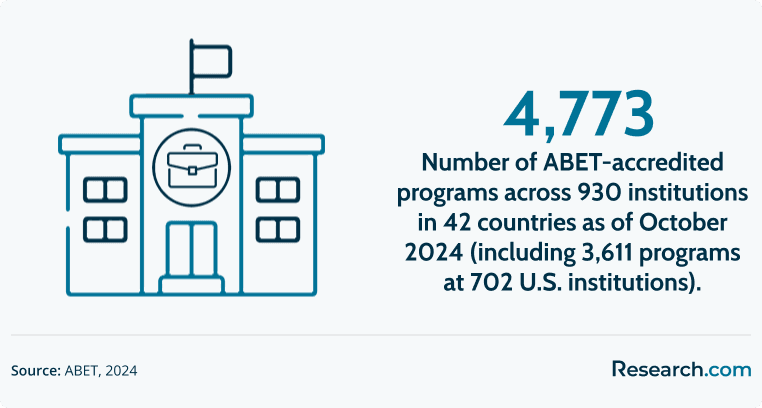
Start with institutional accreditation, then check whether the program has specialized accreditation where relevant. ABET accreditation is a useful signal in engineering-related fields. Only about 21 software engineering bachelor’s programs in the U.S. are ABET-accredited, so students should verify claims directly rather than assuming every software engineering degree has this status.
2. Review the curriculum in detail
Look beyond program titles. A strong curriculum should include programming, algorithms, data structures, databases, testing, secure coding, software design, architecture, requirements, teamwork, and a capstone. If a program is mostly general IT coursework with only a few development classes, it may not provide the depth you expect.
3. Check faculty and support quality
Faculty experience matters, especially in courses involving architecture, testing, security, and project work. Ask whether instructors have academic credentials, industry experience, or both. Also review tutoring, office hours, advising, technical support, and career coaching.
4. Look for internships, co-ops, and project pipelines
Internships and co-ops can make a major difference for new graduates. Nearly 100% of bachelor’s programs say employers actively recruit interns, and co-op experience raises job placement rates to over 90%. Ask schools how online students access internships and whether remote placements are available.
5. Match the format to your learning style
Online students can perform as well as or better than in-person peers when courses are structured, interactive, and supported by reliable technology. If you struggle without routine, choose a program with live sessions, frequent deadlines, proactive advising, and cohort-based progress.
Questions to ask before enrolling
- Is the institution regionally or nationally accredited by a recognized accreditor?
- Does the software engineering program have ABET accreditation or another specialized recognition?
- How many of my transfer credits apply directly to degree requirements?
- Can I complete the program fully online, or are campus visits required?
- What programming languages, frameworks, and developer tools are used?
- Are internships, capstones, or employer-sponsored projects available to online students?
- What is the total estimated cost after fees, books, transfer credits, and financial aid?
- What career services are available for remote learners?
What career paths are available for graduates of an online bachelor’s in software engineering program?
Graduates can pursue entry-level and early-career technical roles in software development, quality assurance, systems analysis, web development, product support, and technical project environments. The right role depends on the student’s portfolio, internship history, specialization, and technical strengths.
| Career path | Typical responsibilities | How to prepare while enrolled |
| Software Developer | Build, test, maintain, and improve applications or systems | Complete coding projects, use version control, and document your work |
| Full-Stack Developer | Work across front-end interfaces, back-end logic, databases, and APIs | Build deployed web applications that show end-to-end functionality |
| QA Analyst or Tester | Test software, identify bugs, write test cases, and support quality processes | Learn automated testing, debugging, and clear defect documentation |
| Computer Systems Analyst | Evaluate technology needs and help organizations improve software systems | Develop communication, requirements analysis, and systems thinking skills |
| IT Project Manager or Product Manager | Coordinate technical work, requirements, timelines, and stakeholder communication | Gain experience with agile methods, documentation, teamwork, and user needs |
| Technical Writer | Create documentation, tutorials, API references, and user guides | Pair software projects with clear written explanations and technical documentation |
Remote-first opportunities
Remote software roles remain common in technology hiring. About 35% of tech industry listings were remote in 2024. Online students can strengthen their remote-work readiness by practicing asynchronous communication, version control, issue tracking, code reviews, and virtual collaboration.
Career advancement options
With experience, graduates may move into lead developer, senior engineer, technical architect, project manager, product manager, or engineering management roles. Advancement usually depends on solving increasingly complex problems, mentoring others, improving systems, and communicating technical trade-offs clearly.
Industry variety
Software engineering skills can apply across tech, healthcare, finance, government, e-commerce, cybersecurity, education technology, and data-driven organizations. Students interested in applying software skills to mapping, defense, or environmental data may also explore how to become a geospatial analyst.
What is the job market for graduates with an online bachelor’s in software engineering program?
The job market for software engineering graduates is strong overall, but entry-level competition can still be challenging. A degree helps, but employers increasingly expect candidates to show practical work through internships, projects, GitHub repositories, deployed applications, technical interviews, and strong communication.
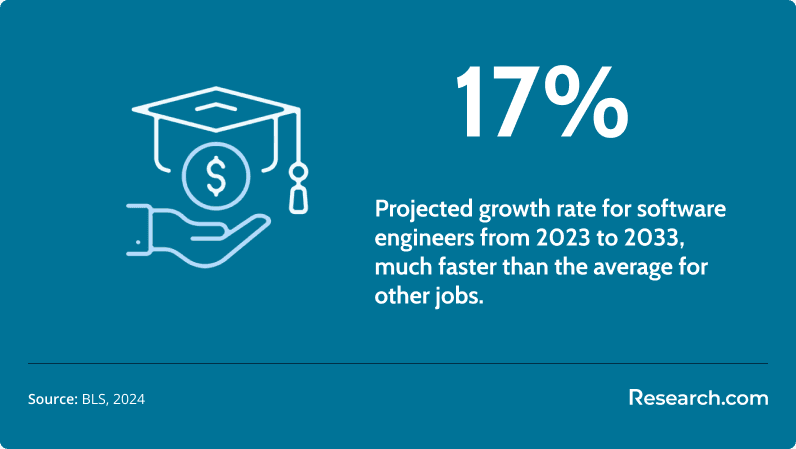
The U.S. Bureau of Labor Statistics projects 17.9% growth in software developer jobs between 2023 and 2033, compared with 4% average growth across all occupations. That growth reflects continued demand for software across industries, even as AI changes parts of the development workflow.
Online and traditional degree holders can compete for similar roles. NACE reported that 87.4% of employers hired recent graduates with online degrees and paid them equally to on-campus graduates. Still, students should evaluate each program’s reputation, accreditation, and career support instead of assuming all online degrees carry the same weight.
Common entry-level roles include software developer, QA tester, junior full-stack developer, web developer, systems analyst, and technical support roles that can lead into engineering teams. Remote work can reduce geographic barriers, but applicants may face wider national competition for the same openings.
Graduates who want to combine software skills with education-focused platforms, learning systems, or instructional technology may also compare graduate pathways such as the cheapest online master's in education technology.
Is an online bachelor’s in software engineering worth it?
An online bachelor’s in software engineering can be worth it if the program is accredited, the total cost is manageable, and you are willing to build a strong portfolio while completing the degree. It is especially practical for students who need remote access, want to keep working, have transfer credits, or prefer a structured academic path over a short bootcamp.
It may not be the best choice if you need a very low-cost, short-term credential; if you cannot commit to heavy technical coursework; or if the program lacks credible accreditation, career support, or hands-on projects. Students should compare the degree’s total net cost with expected career opportunities, not just advertised tuition or completion speed.
Common mistakes to avoid when choosing a fast online software engineering degree
| Mistake | Why it matters | Better approach |
| Choosing the fastest program without checking accreditation | A quick degree may have limited value if employers or graduate schools question its credibility | Verify institutional accreditation and ask about specialized accreditation where relevant |
| Comparing tuition only | Fees, transfer credit loss, books, software, and delayed graduation can raise total cost | Compare full net price and time to completion after transfer evaluation |
| Assuming online means easier | Software engineering requires sustained coding practice, math, debugging, and project work | Review weekly workload expectations before enrolling |
| Ignoring portfolio development | Employers often want proof of applied skills, especially for entry-level candidates | Build projects throughout the program, not only during the capstone |
| Relying only on rankings | A highly ranked school may not fit your schedule, budget, specialization, or support needs | Use rankings as a starting point, then compare curriculum, cost, support, and outcomes |
| Not asking about internships for online students | Some opportunities may be local, competitive, or not fully remote | Ask how online learners secure internships, co-ops, and employer-sponsored projects |
References
- Software developers, quality assurance analysts, and testers. Bureau of Labor Statistics. https://www.bls.gov/ooh/computer-and-information-technology/software-developers.htm
- Egusa, D. Online Software Engineering vs. On-Campus Software Engineering Courses: Which is Right for You? https://trotons.com/online-software-engineering-vs-on-campus-software-engineering-courses
- Why employers are preferring online degrees more than ever in 2025? https://www.onlinecu.in/blog/cu/why-employers-are-preferring-online-degrees-more-than-ever-in-2025.php
- McKenzie, L. Research paints disappointing picture of online internships. https://www.insidehighered.com/news/2021/05/19/research-paints-disappointing-picture-online-internships
- Hanson, M. Average cost of online college. https://educationdata.org/average-cost-of-online-college
- Hanson, M. Average Student Loan Debt. https://educationdata.org/average-student-loan-debt
- Knott, K. Report: students relying on more financial aid. https://www.insidehighered.com/news/quick-takes/2023/07/26/report-students-relying-more-financial-aid
- MyShortlister, & Bojkovska, V. Tuition reimbursement statistics. https://www.myshortlister.com/insights/tuition-reimbursement-statistics
- Cebs, S. M. Tuition benefits yield financial payback for employers. https://www.shrm.org/topics-tools/news/benefits-compensation/tuition-benefits-yield-financial-payback-employers
- Jack, A. Degrees for free: the employers funding tuition for staff. https://www.ft.com/content/926f291d-ad5d-4214-b3e8-fecea556c415
- Stack Overflow Developer Survey 2022. https://survey.stackoverflow.co/2022/
- Scholl, J. Test-Optional colleges not requiring SAT or ACT scores. https://www.accreditedschoolsonline.org/online-colleges/no-sat-or-act
- Pandey, A. Most in-demand programming languages for IT careers in 2025. https://www.kodnest.com/blog/what-are-the-most-in-demand-programming-languages-for-it-careers-in-2025
- Nabil, N. Top 10 programming languages in demand for 2025. https://enozom.com/blog/top-10-programming-languages-in-demand-for-2025
- Chan, B. Programming languages to know to land a tech job on Wall Street. https://www.businessinsider.com/top-programming-languages-work-wall-street-jobs
- Kloyd. Salary for security software developers. https://www.cyberdegrees.org/careers/security-software-developer/career-and-salary
- Coursera. Cybersecurity vs. Software Engineering. https://www.coursera.org/articles/cyber-security-vs-software-engineering
- ABET Accreditation | Software Engineering. https://www.softwareengineerinsider.com/articles/abet-accreditation.html
- Software Engineering Bachelor’s Degree Online - Penn State World Campus. https://www.worldcampus.psu.edu/degrees-and-certificates/penn-state-online-software-engineering-bachelor-of-science-degree
- Institute of Data. Careers in Software Engineering: Transitioning in 2025. https://www.institutedata.com/us/blog/careers-in-software-engineering-transitioning-in-2025
- Robert Half. 2025 In-Demand Technology Roles and Hiring Trends. https://www.roberthalf.com/us/en/insights/research/data-reveals-which-technology-roles-are-in-highest-demand
- AI impacts in BLS employment projections. Bureau of Labor Statistics. https://www.bls.gov/opub/ted/2025/ai-impacts-in-bls-employment-projections.htm
- Telford, T. Facing entry-level job crunch, new grads question the value of a degree. https://www.washingtonpost.com/business/2025/06/26/graduates-degree-value-job-market-ai
Key Insights
- A fast online bachelor’s in software engineering can shorten the path to a tech career, but speed should never outweigh accreditation, curriculum quality, hands-on projects, and career support.
- Accelerated students may finish in about 2 to 3 years, while transfer students with significant accepted credits may move even faster. Without transfer credits, many students still need about 4 years.
- Software developer roles are projected to grow 17.9% between 2023 and 2033, but entry-level candidates still need internships, portfolios, and practical experience to stand out.
- Costs vary widely. The average online bachelor’s in software engineering costs approximately $40,500 at public in-state schools and $63,200 at private colleges, before considering aid, fees, and transfer credits.
- Online and on-campus degrees can lead to similar opportunities when the program is credible. The best online learners are self-directed, comfortable with technical problem solving, and proactive about networking.
- Before enrolling, ask for a transfer credit review, total cost estimate, accreditation details, internship access information, sample course sequence, and examples of capstone or portfolio projects.
Other Things You Should Know About Online Bachelor's in Software Engineering Programs
Yes. Most accelerated online bachelor’s programs in software engineering require a capstone in the final term, usually worth 3 to 6 credits. Students apply programming, testing, and systems design skills in a project that is often completed with faculty supervision and sometimes an industry problem.
The fastest online Bachelor's in Software Engineering programs in 2027 typically require a high school diploma or equivalent, satisfactory standardized test scores, and prerequisite knowledge in mathematics and computer science. Some programs may also request a personal statement or letters of recommendation to assess a candidate’s readiness and enthusiasm for the field.