
2027 Best Online Military Studies Degree Programs

Co-Founder and Chief Data Scientist
An online military studies degree is designed for students who want to understand military history, national security, leadership, intelligence, strategy, and defense operations without relocating or pausing work, service, or family responsibilities. It can be especially useful for active-duty personnel, veterans, reservists, military spouses, public-sector professionals, and civilians preparing for careers connected to defense, emergency management, intelligence, logistics, public administration, or security.
The decision is not simply whether the subject is interesting. You need to know whether the program is accredited, whether it fits your military or civilian career goals, how much it may cost, whether your benefits can cover it, and what kinds of jobs graduates actually pursue. This guide explains what online military studies programs include, how long they take, what they cost, how online and campus formats compare, which schools stand out for 2027, and how to evaluate whether this path is worth your time and money.
Quick Answer: Is an Online Military Studies Degree Worth It?
An online military studies degree can be worth it if you want flexible training in leadership, military history, security policy, intelligence, strategy, emergency management, or defense-related operations. It is most practical for students who need an online format because of deployment, full-time work, family obligations, or geographic limits. It is less useful if your target job requires a different credential, such as a clinical license, engineering degree, law enforcement academy training, or a specialized cybersecurity certification.
Key benefits of an online military studies degree
- Career flexibility: Graduates may pursue military officer roles, intelligence analysis, defense contracting, emergency management, government service, law enforcement-related roles, education, museums, archives, logistics, and human resources.
- Salary range across related fields: Median annual salaries for relevant occupations range from $57,100 for archivists, curators, and museum workers to $140,030 for human resource managers. Emergency management directors earn around $86,130.
- Accessible format: Online programs can fit the schedules of active-duty service members, veterans, working adults, and military families who cannot commit to regular campus attendance.
What Is an Online Military Studies Degree?
An online military studies degree examines the role of armed forces in history, policy, national security, leadership, intelligence, logistics, and society. Depending on the school, the program may be called military studies, military history, military operations, national security studies, strategic intelligence, homeland security, military leadership, or a closely related field.
These programs are not all the same. Some focus heavily on history and research. Others prepare students for policy, intelligence, emergency planning, leadership, or security roles. A military leadership program may suit a service member seeking promotion or civilian defense management work, while a military history program may fit students interested in teaching, research, archives, museums, or doctoral study.
What Can I Expect From an Online Military Studies Degree Program?
Students can expect a curriculum that combines military theory, leadership, strategy, historical analysis, public policy, intelligence concepts, research methods, and social science. Graduate programs usually ask students to apply these skills through a capstone, thesis, research project, internship, or another practical experience tied to military or security topics.
Most online courses use a learning management system with recorded lectures, readings, discussion boards, assignments, faculty feedback, and group activities. Some courses are asynchronous, meaning students complete work on their own schedule within weekly deadlines. Others may include live class meetings, presentations, or scheduled exams. Tuition varies widely, often ranging from $10,000 to $30,000 depending on the institution.
Typical program features
| Feature | What it usually means for students | Why it matters |
| Online coursework | Classes are completed remotely through lectures, readings, assignments, and discussions. | Useful for active-duty students, veterans, working adults, and students outside commuting distance. |
| Military and security curriculum | Courses may cover leadership, strategy, intelligence, military history, geography, operations, or national security. | The focus should match your target career, not just your general interest in military topics. |
| Capstone, thesis, or research project | Many programs require a final applied or academic project. | This can become a writing sample for graduate study, government applications, or defense-related roles. |
| Internship or practical experience | Some schools include fieldwork, internship hours, or applied projects. | Practical experience can strengthen a resume, especially for students without prior military or public-sector experience. |
| Military student support | Schools may offer military tuition rates, benefit counseling, deployment accommodations, and credit for prior learning. | Support quality can affect cost, completion time, and your ability to stay enrolled during service obligations. |
Where Can I Work With an Online Military Studies Degree?
Military studies graduates can work in the armed forces, federal agencies, state and local government, defense contractors, emergency management offices, museums, archives, education, logistics, human resources, intelligence-related organizations, and security-focused roles. The best option depends on your experience, clearance eligibility, degree level, internships, military background, and any additional certifications or licenses.
Job outlook varies by occupation. Emergency management directors have a projected job growth rate of 4%, human resource managers are projected at 6%, and archivists, curators, and museum workers are projected at 11%. Cybersecurity and IT roles, which are common career pivots for some military-affiliated graduates, are expected to grow by 33% over the next decade. Veterans with a college degree have a low unemployment rate of 1.6%. In 2023, approximately 42.4% of male Gulf War-era II veterans and 52.0% of female Gulf War-era II veterans worked in management, professional, and related occupations.
How Much Can I Make With an Online Military Studies Degree?
Reported earnings for graduates with an online military studies degree vary by job title, employer, location, clearance status, years of experience, and whether the role is military, federal, contractor-based, nonprofit, or private-sector. Average salaries for graduates with an online military studies degree range from $52,548 to $83,960. Entry-level roles such as naval officer or marine science technician are around $49,945 to $60,975, while specialized and experienced positions, such as nuclear medical science officers, can reach up to $157,975 annually.
Students should treat salary data as a planning tool, not a guarantee. Programs rarely lead directly to one fixed job title. Your outcome will depend heavily on your service record, transferable skills, networking, internships, certifications, security clearance requirements, and willingness to relocate.
- Best Online Military Studies Degree Programs for 2027
- How long does an online military studies degree take?
- Online vs. on-campus military studies programs
- Average cost of an online military studies degree
- Financial aid options for military studies students
- Admission requirements for online military studies programs
- Common courses in online military studies programs
- Military studies specializations
- Accreditation and recognition
- Challenges of studying military studies online
- Military studies and military psychology careers
- Using military studies for graduate school preparation
- How consistent are admissions requirements?
- How to choose the right online military studies program
- Career paths for military studies graduates
- Job market for online military studies graduates
Best Online Military Studies Degree Programs for 2027
How Research.com Ranks Schools
Research.com rankings are designed to help students compare programs using transparent data rather than marketing claims alone. Our methodology draws from trusted sources, including the IPEDS database, Peterson's database, the College Scorecard database, and The National Center for Education Statistics. These sources help evaluate schools using measurable factors relevant to online graduate education. You can review the full process on Research.com's methodology page.
Program comparison at a glance
| Rank | School | Program | Credits | Listed cost | Accreditation |
| 1 | Liberty University | Master of Arts in Military Operations – Military Leadership | 36 | $275 per credit hour | SACSCOC – Southern Association of Colleges and Schools Commission on Colleges |
| 2 | University of New Haven | Master of Science in National Security | 30 | $1,092 per credit hour | NECHE - New England Commission of Higher Education |
| 3 | Walden University | MS in Human Services with a specialization in Military Families and Culture | 53 quarter credits | $555 per quarter hour | HLC - Higher Learning Commission |
| 4 | Saint Louis University | Master of Science in Strategic Intelligence | 33 | $810 per credit hour | HLC - Higher Learning Commission |
| 5 | American Public University | Master of Arts in National Security Studies | 36 | $455 per credit hour | HLC - Higher Learning Commission |
| 6 | Norwich University | Master of Arts in Military History | 36 | $550 - $698 per credit hour | NECHE - New England Commission of Higher Education |
| 7 | Regent University | Master of Arts in National Security Studies | 36-38 | $695 per credit hour | SACSCOC – Southern Association of Colleges and Schools Commission on Colleges |
| 8 | Citadel Military College of South Carolina | Master of Arts in Military History | 30 | $700 per credit hour | SACSCOC – Southern Association of Colleges and Schools Commission on Colleges |
| 9 | Embry-Riddle Aeronautical University | M.S. in Human Security and Resilience | 30 | $1,840 per credit hour | SACSCOC – Southern Association of Colleges and Schools Commission on Colleges |
| 10 | University of Texas El Paso | Master of Science in Intelligence and National Security Studies | 36 | $490 per credit hour | SACSCOC – Southern Association of Colleges and Schools Commission on Colleges |
1. Liberty University
Liberty University offers a 100% online Master of Arts in Military Operations – Military Leadership. Founded in 1971, the university designed this 36-credit program for students who want to strengthen leadership capacity for military, defense, or related professional settings. The curriculum is built for distance learners and taught with a military-focused perspective.
- Required credits to graduate: 36
- Cost: $275 per credit hour
- Accreditation: SACSCOC – Southern Association of Colleges and Schools Commission on Colleges
2. University of New Haven
The University of New Haven offers a Master of Science in National Security that has been available since 2001. Students study homeland and international security with faculty who bring professional experience from intelligence and security fields. The program is offered online and on campus, with internship, research, and thesis options for applied learning.
- Required credits to graduate: 30
- Cost: $1,092 per credit hour
- Accreditation: NECHE - New England Commission of Higher Education
3. Walden University
Walden University offers an online MS in Human Services with a specialization in Military Families and Culture. The program focuses on the needs of service members and families, including PTSD, deployment, relocation, and the pressures of military life. It is a better fit for students interested in human services and veteran support than for those seeking a strategy- or operations-heavy military studies program.
- Required credits to graduate: 53 quarter credits
- Cost: $555 per quarter hour
- Accreditation: HLC - Higher Learning Commission
4. Saint Louis University
Saint Louis University offers an online Master of Science in Strategic Intelligence through the School for Professional Studies. The program emphasizes intelligence analysis, strategic thinking, data-informed decision-making, and the relationship between intelligence and policy.
- Required credits to graduate: 33
- Cost: $810 per credit hour
- Accreditation: HLC - Higher Learning Commission
5. American Public University
American Public University offers an online Master of Arts in National Security Studies. The program covers modern security challenges, including intelligence, cybersecurity, terrorism, and policy analysis. It is taught by professionals with national security experience and is designed for students interested in evaluating threats and developing security responses.
- Required credits to graduate: 36
- Cost: $455 per credit hour (with discounts available for military, veterans, and through the APUS Opportunity Grant)
- Accreditation: HLC - Higher Learning Commission
6. Norwich University
Norwich University, the nation's first private military college, offers a fully online Master of Arts in Military History. Students examine warfare across chronological, geographic, political, and economic contexts while building historical research, writing, and analytical skills.
- Required credits to graduate: 36
- Cost: $550 - $698 per credit hour (additional fees and military discounts may apply)
- Accreditation: NECHE - New England Commission of Higher Education
7. Regent University
Regent University offers a Master of Arts in National Security Studies online and on campus. The program approaches security issues from a Christian perspective and offers concentrations for students preparing for public-sector, security, policy, or defense-adjacent roles.
- Required credits to graduate: 36-38
- Cost: $695 per credit hour
- Accreditation: SACSCOC – Southern Association of Colleges and Schools Commission on Colleges
8. Citadel Military College of South Carolina
The Citadel offers a fully online Master of Arts in Military History. The 30-hour program lets students study warfare, military institutions, theory, practice, and the influence of armed conflict on society. Students may also complete a Graduate Certificate in Military Leadership at the same time.
- Required credits to graduate: 30
- Cost: $700 per credit hour
- Accreditation: SACSCOC – Southern Association of Colleges and Schools Commission on Colleges
9. Embry-Riddle Aeronautical University
Embry-Riddle Aeronautical University offers an online M.S. in Human Security and Resilience. The program examines protection of populations, resilience, and sustainable responses to complex global threats. Its interdisciplinary structure may appeal to students interested in security, crisis response, and international resilience rather than traditional military history alone.
- Required credits to graduate: 30
- Cost: $1,840 per credit hour
- Accreditation: SACSCOC – Southern Association of Colleges and Schools Commission on Colleges
10. University of Texas El Paso
The University of Texas at El Paso offers a Master of Science in Intelligence and National Security Studies. The interdisciplinary program prepares students for work in the US Intelligence Community, private-sector security roles, research institutions, or further doctoral study.
- Required credits to graduate: 36
- Cost: $490 per credit hour
- Accreditation: SACSCOC – Southern Association of Colleges and Schools Commission on Colleges
How Long Does It Take to Complete an Online Military Studies Degree?
Completion time depends on degree level, transfer credits, deployment schedule, work obligations, course load, and whether the school uses traditional semesters or accelerated terms.
Bachelor’s degree timeline
- An online bachelor’s degree in military studies usually requires around 120 credit hours and takes about four (4) years for full-time students.
- Accelerated eight-week courses and several annual start dates can make scheduling easier, but they usually do not shorten the overall timeline unless students take heavier course loads or transfer in credits.
- Students with prior college coursework, an associate degree, or military training that qualifies for credit may finish sooner.
- Part-time students and active-duty students with changing service obligations may need six (6) to eight (8) years, depending on how many courses they can complete each term.
Master’s degree timeline
An online master’s in military studies typically takes 1.5 to 2 years for full-time students. Part-time enrollment may extend the timeline, but it can be the more realistic option for students balancing service, shift work, travel, or family responsibilities.
What can shorten or lengthen your timeline?
| Factor | May shorten completion | May lengthen completion |
| Transfer credits | Prior college credit, associate degree, or eligible military training accepted by the school | Low transfer-credit acceptance or repeated courses |
| Course load | Full-time enrollment or heavier course loads | One course at a time or frequent breaks |
| Program format | Multiple start dates and accelerated terms | Limited course availability or sequenced prerequisites |
| Military obligations | Stable duty schedule and school deployment policies | Deployment, relocation, field training, or unpredictable schedules |
| Final requirement | Clear capstone or thesis expectations | Delayed research approval, internship scheduling, or thesis revisions |
How Does an Online Military Studies Degree Compare to an On-Campus Program?
Online and campus-based military studies degrees can cover similar academic material, but the student experience is different. Online learning prioritizes access and flexibility. Campus learning often provides more face-to-face interaction, structured schedules, and local networking. Students interested in strategy beyond Earth-based operations may also compare related options such as the best online space studies degree programs.
Online vs. on-campus military studies programs
| Category | Online program | On-campus program | Best fit |
| Schedule | Often asynchronous or partly asynchronous, with flexible weekly deadlines | Usually scheduled at set class times and locations | Online is better for deployed, working, or geographically mobile students. |
| Cost considerations | May reduce commuting, housing, and relocation costs. Students avoid commuting expenses that can cost at least $1,290 annually. | May include room, board, campus fees, and transportation costs. | Online may be more cost-efficient for students who already have housing and employment. |
| Interaction | Uses discussion boards, video meetings, group projects, and digital office hours | Offers in-person conversations, campus events, and direct classroom discussion | Campus may be stronger for students who learn best through immediate in-person engagement. |
| Networking | Can connect students across military branches, regions, and professional sectors | Often builds stronger local networks with faculty and nearby employers | Choose based on where you expect to work after graduation. |
| Learning environment | Requires self-direction, reliable internet, and disciplined time management | Provides a more structured academic routine | Online suits independent learners; campus suits students who need external structure. |
Research and employer acceptance generally support online degrees when the institution is properly accredited and the program is academically rigorous. Students considering interdisciplinary training may also explore a dual masters program online to combine military studies with areas such as international relations, public administration, intelligence, or organizational leadership.
The chart below shows the 2025 Student Enrollment Forecast by Learning Mode.
What Is the Average Cost of an Online Military Studies Degree?
Costs vary by institution, degree level, transfer credits, military tuition policies, residency status, technology fees, and whether a student uses military education benefits. Published tuition is only part of the total cost, so students should ask each school for a full cost estimate before enrolling.
- Bachelor’s degree: Annual tuition for online bachelor’s programs at military-friendly schools typically ranges from about $6,000 to $12,000 per year, with total four-year program costs usually between $24,000 and $48,000.
- Master’s degree: Online master’s programs in military studies generally cost between $6,700 and $17,000 in total tuition. Some programs cost more, but many fall within this range.
- Per-credit pricing: Military tuition rates are commonly $250 per credit hour for undergraduate courses and $250–$336 per credit hour for graduate courses.
Cost factors students often overlook
| Cost factor | What to ask before enrolling |
| Technology fees | Are online course, platform, exam proctoring, or graduation fees charged separately? |
| Books and materials | Are textbooks included, low-cost, or charged separately each term? |
| Transfer credit policy | How many credits can transfer, and will military training be evaluated for credit? |
| Military tuition rate | Does the discounted rate apply to active-duty students, veterans, spouses, dependents, or all military-affiliated learners? |
| Time to completion | Will part-time enrollment increase total fees or delay career benefits? |
Students comparing costs may also review related accelerated or lower-cost graduate options, such as cheap one year master's programs online, although those programs may not offer the same military studies focus.
What Financial Aid Options Are Available for Online Military Studies Students?
Military-affiliated students may have several ways to reduce out-of-pocket costs. The right funding mix depends on eligibility, branch of service, school participation, enrollment intensity, degree level, and whether benefits have already been used.
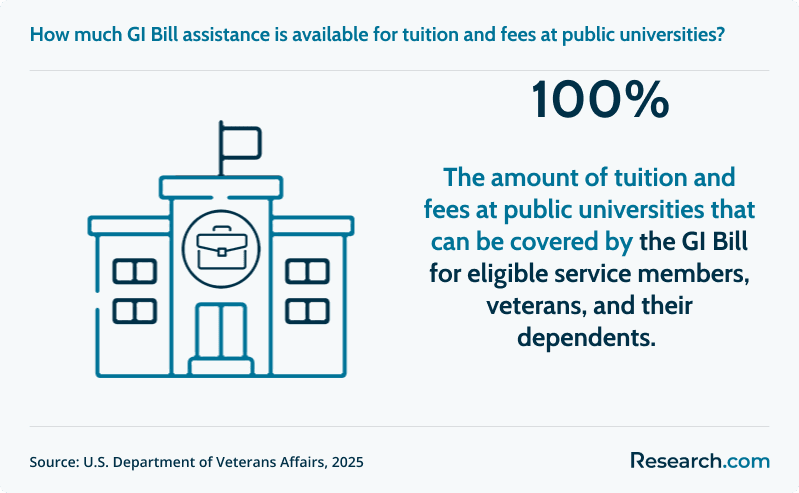
- GI Bill: Eligible service members, veterans, and dependents may use the GI Bill to cover up to 100% of tuition and fees at public universities and up to $28,937.09 per year at private institutions. It may also help pay for housing, books, supplies, and relocation expenses.
- Yellow Ribbon Program: Participating schools may provide additional support for costs not fully covered by the GI Bill, especially at private or out-of-state institutions. Funding differs by school and is tied to GI Bill eligibility.
- Military Tuition Assistance (TA): Each military branch has tuition assistance programs that may cover up to 100% of tuition expenses, typically up to $250 per credit hour, for active-duty and reserve members.
- Scholarships and grants: Students may qualify for military-specific scholarships for veterans, active-duty personnel, spouses, and dependents. They may also pursue Federal Pell Grants, state grants, and institutional scholarships.
- Reduced tuition and fee waivers: Many military-friendly online colleges offer tuition discounts, waived application fees, and reduced rates for military students and families.
- Support for spouses and dependents: Military families may qualify for scholarships, tuition discounts, transferred GI Bill benefits, state aid, and private aid programs.
- Federal financial aid: Students should submit the FAFSA to determine eligibility for federal grants, loans, and work-study opportunities.
When reviewing aid packages, compare how schools apply benefits, whether tuition discounts reduce the amount billed before or after aid, and whether fees are covered. Students exploring professional programs in other fields can compare funding structures in options such as ASHA online SLP programs, where federal aid, scholarships, and military tuition assistance may also affect affordability.
What Are the Prerequisites for Enrolling in an Online Military Studies Degree Program?
Admissions requirements depend on the school and degree level. Undergraduate programs usually focus on prior education and academic readiness, while graduate programs may evaluate bachelor’s transcripts, professional experience, purpose statements, and sometimes military or leadership background. Related online programs, including some of the best online urban planning degree programs, often use comparable admissions documentation.
- High school diploma or equivalent: Undergraduate applicants generally need a high school diploma or General Educational Development (GED) credential.
- Official transcripts: Schools usually require high school transcripts, GED scores, and transcripts from any previously attended colleges.
- Minimum GPA: Some programs set a minimum cumulative Grade Point Average (GPA), often around 2.0 or higher, for admission in good standing.
- Application and fee: Applicants typically complete an online application and may pay a non-refundable application fee, though schools may waive it for military-affiliated students.
- English proficiency: Applicants whose first language is not English may need Test of English as a Foreign Language (TOEFL) scores or an equivalent proof of proficiency.
- Alternative admission options: Some universities allow self-certification, provisional admission, or earned admission after successful completion of online courses.
- Age requirement: Certain institutions require students to meet a minimum age, such as 18 or 20, unless they are active-duty service members.
Some students question whether online programs are taken seriously. The same concern appears in other fields, such as students asking is an online psychology degree any good. For military studies, the more important question is whether the institution is accredited, the curriculum matches your goals, and the program has meaningful support for online and military-affiliated learners.
What Courses Are Typically in an Online Military Studies Degree Program?
Coursework differs by degree title and specialization. A military history program may emphasize archival research and historical interpretation, while a national security or intelligence program may focus on policy, threat analysis, strategy, and decision-making. Just as students may research a technology management degree salary before choosing a technology-focused path, military studies students should review course lists carefully to understand what skills the degree will actually build.
- Modern Military Geography: Explores how terrain, borders, climate, resources, and location influence strategy, defense planning, and military operations.
- Military Leaders and Leadership: Studies leadership principles through military figures, command decisions, organizational behavior, and historical case studies.
- Methods of Military Analysis: Introduces analytical tools used to evaluate operations, campaigns, strategy, and defense decisions. Topics may include operational research, campaign analysis, and decision-making frameworks.
- Dilemmas in Socialism and Marxism: Examines the development, debates, challenges, and real-world application of socialist and Marxist movements in political and historical contexts.
Skills these courses should help you build
- Strategic thinking and structured decision-making
- Research, writing, and evidence-based argumentation
- Policy analysis and national security awareness
- Leadership and organizational communication
- Historical interpretation and geopolitical reasoning
What Specializations Are Available in an Online Military Studies Degree Program?
Specializations allow students to connect military studies to a specific career goal. Before choosing one, compare course requirements, faculty expertise, internship options, and whether the specialization aligns with military, government, contractor, academic, or civilian-sector roles.
| Specialization | Primary focus | Good fit for students interested in |
| Military History | Wars, armed conflict, institutions, strategy, and social impact across time | Research, teaching, museums, archives, writing, or doctoral study |
| Military Science | Military systems, leadership, tactics, and organized operations | Military leadership, operations, training, or defense-related work |
| Intelligence | Information gathering, analysis, threat assessment, and security operations | Intelligence analysis, policy, homeland security, or government roles |
| Homeland Security | National security, emergency planning, counterterrorism, and public safety | Emergency management, security planning, public administration, or crisis response |
| Cybersecurity | Protection of military, government, and organizational information systems | Cyber defense, information security, digital risk, or systems protection |
| Leadership and Management | Decision-making, personnel management, leadership theory, and organizational effectiveness | Military leadership, human resources, management, or operations roles |
| Logistics and Supply Chain Management | Transportation, resources, acquisitions, inventory, and mission support | Military logistics, contracting, supply chain, and business operations |
| International Management | Global operations, coalition work, cross-cultural leadership, and international security | International affairs, multinational organizations, security policy, or global operations |
| Criminology and Forensic Psychology | Military-related legal issues, investigations, behavioral analysis, and justice systems | Law enforcement, investigations, policy, and careers in criminology |
| Strategic Leadership and Global Security | Advanced security strategy, warfare, global threats, and executive leadership | Graduate-level security leadership, defense policy, and senior analysis roles |
Cybersecurity is a growing interdisciplinary option because defense organizations increasingly rely on secure data systems. Students comparing technical pathways may benefit from understanding cybersecurity vs data science, especially when deciding whether to focus on threat defense, data analysis, or a combination of both.
Is an Online Military Studies Degree Accredited and Recognized?
Accreditation should be one of your first checks. An accredited institution has gone through an external review process for academic quality, governance, student support, and financial stability. Accreditation also affects federal financial aid eligibility, transfer credit, graduate admissions, and employer confidence.
Students should verify accreditation directly with the accreditor or recognized institutional listings rather than relying only on a school’s marketing page. Also check state authorization if you live outside the school’s home state, especially if the program includes internships, fieldwork, or any location-based requirement. Students who want a broader helping-professions pathway may compare accredited alternatives such as online MSW programs affordable, but military studies and social work prepare students for different professional outcomes.
Accreditation checklist
- Is the institution regionally or nationally accredited by a recognized agency?
- Does the school clearly state whether the program is fully online, hybrid, or campus-based?
- Are credits likely to transfer if you later change schools?
- Does the program meet employer, military, or graduate school expectations for your intended path?
- Will the degree qualify for federal financial aid and military education benefits?
What Challenges Might Students Encounter in an Online Military Studies Degree Program?
Online military studies programs can be flexible, but they are not effortless. Students need strong time management, consistent internet access, comfort with digital learning platforms, and the discipline to complete reading-heavy and writing-heavy coursework without weekly in-person reminders.
Common obstacles include asynchronous courses that feel isolating, delayed feedback compared with live classroom discussion, difficulty finding mentorship, deployment interruptions, technology issues, and balancing academic deadlines with duty schedules or full-time work. Programs with responsive faculty, online writing support, military advisors, and active discussion communities can reduce these challenges. Students comparing online support models may find it useful to review how structured advising appears in other professional programs, such as online clinical MSW programs.
Common mistakes to avoid
| Mistake | Why it can hurt you | Better approach |
| Choosing a program based only on the title | “Military studies” can mean history, leadership, intelligence, human services, or security policy. | Compare required courses and final projects against your career goal. |
| Ignoring accreditation | Unrecognized credentials may limit aid, transfer credit, and employer acceptance. | Verify institutional accreditation before applying. |
| Looking only at tuition | Fees, books, transfer-credit limits, and extra terms can increase total cost. | Ask for a full program cost estimate in writing. |
| Assuming online means self-paced | Many online programs still have weekly deadlines and scheduled requirements. | Review the academic calendar, course format, and participation rules. |
| Overestimating career outcomes | A degree alone may not qualify you for roles requiring clearances, certifications, academy training, or licensure. | Identify job requirements before enrolling and build experience while studying. |
Can an Online Military Studies Degree Lead to Military Psychology Careers?
An online military studies degree can support interest in military psychology, but it does not by itself qualify someone to practice as a psychologist. Military psychology careers often require graduate-level psychology education, supervised clinical training, and licensure, depending on the role. However, military studies can provide useful context for understanding service culture, deployment stress, leadership, crisis response, and veteran issues.
Students who want to provide counseling, assessment, or behavioral health services to service members and veterans should plan for additional psychology training. Those interested in clinical doctoral preparation may compare accredited PsyD online programs to understand the education required for advanced psychology practice.
How Can an Online Military Studies Degree Support Graduate Study?
A military studies degree can be a strong academic foundation for graduate work in national security, international relations, public administration, history, intelligence studies, homeland security, organizational leadership, emergency management, or psychology-related fields. The strongest preparation comes from programs that build research writing, policy analysis, leadership theory, and evidence-based decision-making.
Students aiming for interdisciplinary leadership roles may pair military studies with organizational psychology, public administration, or management training. For example, reviewing affordable masters organizational psychology online programs can help students understand how leadership, motivation, group behavior, and workplace systems connect to military and civilian organizations.
Are Admission Requirements in Online Military Studies Programs Clear and Consistent?
Admission requirements are usually straightforward, but they are not identical across schools. Some programs welcome civilians and military-affiliated applicants equally. Others may give greater weight to professional experience, military service, leadership background, prior academic performance, or a statement of purpose.
Before applying, build a checklist for each school: transcripts, GPA expectations, résumé, military documentation if applicable, recommendation letters, writing sample, application deadlines, and benefit-processing timelines. Students exploring programs with flexible admissions in other fields may compare options such as easiest master in social work programs, while remembering that admissions flexibility should not replace accreditation, student support, and career fit.
How to Choose the Best Online Military Studies Degree Program
The best program is the one that fits your career target, schedule, budget, learning style, and benefit eligibility. Do not rely only on rankings or reputation. A highly ranked program may still be a poor fit if the concentration, cost, or delivery format does not match your goals. The same decision logic applies when comparing career-oriented credentials in other fields, such as evaluating nursing leadership salary before choosing a healthcare leadership program.
- Accreditation: Confirm that the school is accredited and that the degree will be recognized by employers, graduate schools, and military-related organizations.
- Military friendliness: Look for tuition discounts, credit for military training, deployment flexibility, veteran services, military benefit counselors, and support for spouses or dependents.
- Curriculum fit: Review required courses. A military history program and a strategic intelligence program can lead to very different outcomes.
- Faculty background: Check whether instructors have relevant academic, military, intelligence, policy, or practitioner experience.
- Cost after aid: Compare net price after GI Bill, Yellow Ribbon, Tuition Assistance, scholarships, grants, transfer credits, and fees.
- Online format: Ask whether courses are asynchronous, synchronous, accelerated, self-paced, or cohort-based.
- Career services: Strong programs should help with résumés, federal applications, internships, networking, and translating military experience into civilian language.
- Graduate school preparation: If you plan to continue, look for thesis options, research methods, faculty mentorship, and strong writing expectations.
Questions to ask before enrolling
- How many credits can I transfer from prior college coursework or military training?
- What is the total estimated cost, including fees and books?
- Does the program help students use GI Bill, Yellow Ribbon, Tuition Assistance, or FAFSA-based aid?
- Are courses fully online, or are there residency, internship, or live-session requirements?
- What careers do graduates usually pursue?
- Does the program prepare students for a specific role, certification, clearance-dependent position, or graduate program?
- What happens if I am deployed, relocated, or unable to complete coursework during a term?
What Career Paths Are Available for Graduates of an Online Military Studies Degree?
Military studies graduates can move into military, government, nonprofit, education, cultural, emergency management, defense, logistics, human resources, and security-related roles. Some careers require additional qualifications beyond the degree, such as military commissioning, security clearance, professional certifications, law enforcement training, or a graduate degree.
| Career path | Typical work | Salary information provided |
| Military service and officer roles | Lead personnel, manage operations, plan missions, and supervise units or specialized functions. | Median annual wages for military occupations are around $76,000. |
| Military police | Support law enforcement and security on military installations. | National average salary of about $40,337 per year. |
| Intelligence analyst | Review data, assess threats, prepare reports, and support military or government decision-making. | National average salary of $42,995 per year. |
| Instructor | Teach military science, leadership, history, or related topics. | Average salary of $53,172 per year. |
| Emergency management director | Plan disaster response, coordinate agencies, and manage crisis preparation. | Median annual salaries around $86,130. |
| Archivists, curators, and museum workers | Preserve, interpret, and manage military history materials, exhibits, and collections. | Median annual salaries around $57,100. |
| Human resource managers | Lead hiring, staffing, personnel policy, training, and organizational development. | Median annual salaries reaching $140,030. |
| Business operations and logistics | Manage acquisitions, contracts, transportation, supply chains, or operational processes. | Salaries often range from $60,000 to $105,000 depending on role and experience. |
| Researcher | Conduct military, defense, policy, or historical research. | Average salary of $81,237 per year. |
| Naval officer | Lead personnel and operations in naval settings. | Average salary of $49,945 per year. |
Students interested in supporting the behavioral health of service members, veterans, and military families should review military psychologist career opportunities. Those interested in broader defense, leadership, security, or historical roles can explore additional military science careers. For students drawn to personnel leadership, a degree in human resources may be a more direct route to HR management roles.
The chart below shows the employment distribution of workers with a military degree, by occupational group.
What Is the Job Market for Graduates With an Online Military Studies Degree?
The job market is broad but uneven. Military-specific hiring can shift with defense budgets, branch needs, recruitment trends, and national security priorities. Civilian roles in emergency management, intelligence analysis, logistics, cybersecurity, museums, archives, public administration, and human resources depend on local demand, federal hiring cycles, clearance requirements, and applicants’ experience.
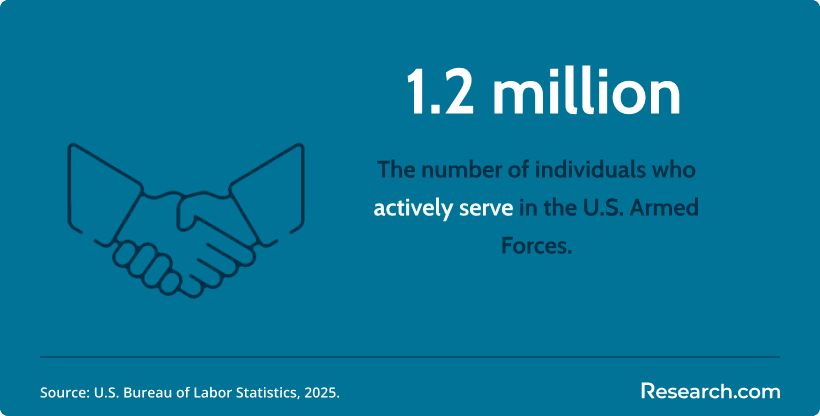
As of February 2024, the U.S. Armed Forces included over 2 million serving members, with over 1.2 million on active duty. The chart below breaks down active-duty subtotals by branch of the U.S. Armed Forces.
The force remains large, but it is smaller than some historical peaks because of recruitment challenges and changing defense priorities. For graduates, this means flexibility matters. The most competitive students usually combine the degree with experience, strong writing skills, leadership ability, data literacy, public-sector knowledge, internships, certifications, or a clear plan for roles that require security clearance.
Current Trends Affecting Online Military Studies Students
- Online learning is now mainstream: More students expect flexible online options, but quality still depends on course design, faculty engagement, advising, and accreditation.
- Cybersecurity and data skills are increasingly valuable: Military and defense-adjacent employers often need professionals who understand both security context and digital risk.
- Credential stacking is common: Students may pair a degree with certificates in cybersecurity, emergency management, intelligence, logistics, project management, or leadership.
- Military-to-civilian translation matters: Veterans and service members often need help converting military experience into civilian résumés, federal applications, and private-sector language.
- Cost scrutiny is rising: Students are comparing net cost, benefit eligibility, transfer credit, and return on investment more carefully before enrolling.
Here’s What Graduates Say About Online Military Studies Programs
-
: "
The online format made it possible to continue my education while meeting military obligations. The coursework gave me a wider strategic lens that I have already been able to use in my current role. - Vico
"
-
: "
I chose online study because I needed to balance professional development with family responsibilities. The course materials and discussions with students from different backgrounds made the experience more valuable than I expected. - Don
"
-
: "
Finishing my online military studies degree helped me see new possibilities in the defense sector. The emphasis on analysis and critical thinking gave me more confidence about advancement. - Ethan
"
Key Insights
- An online military studies degree is most useful when it aligns with a specific goal, such as military leadership, national security, intelligence, emergency management, defense contracting, military history, logistics, or public-sector work.
- Accreditation is non-negotiable. It affects financial aid, transfer credit, employer recognition, and graduate school options.
- Program names can be misleading. Always compare required courses, concentrations, capstone or thesis expectations, and faculty expertise before applying.
- Costs vary widely. Bachelor’s programs typically range from about $6,000 to $12,000 per year, while online master’s programs in military studies generally cost between $6,700 and $17,000 in total tuition.
- Military education benefits can substantially reduce costs, but students should confirm how GI Bill, Yellow Ribbon, Tuition Assistance, scholarships, grants, and FAFSA-based aid apply at each school.
- Career outcomes are not automatic. Salaries across related roles range widely, from positions around $40,337 per year to leadership roles with median annual salaries reaching $140,030.
- Veterans with a college degree had a low unemployment rate of 1.6%, and many Gulf War-era II veterans worked in management, professional, and related occupations in 2023.
- The strongest online students plan early: they verify accreditation, map the degree to job requirements, use transfer credits, control costs, build experience, and choose a specialization that matches their intended career path.
References
- Bureau of Labor Statistics. (2024, December). Employment Situation of Veterans - 2024 (USDL-24-2273). U.S. Department of Labor. Retrieved from https://www.bls.gov/news.release/pdf/vet.pdf
- Bureau of Labor Statistics. (2025). Emergency Management Directors. U.S. Department of Labor. Retrieved May 14, 2025, from https://www.bls.gov/ooh/management/emergency-management-directors.htm
- Bureau of Labor Statistics. (2025). Information Security Analysts. U.S. Department of Labor. Retrieved May 14, 2025, from https://www.bls.gov/ooh/computer-and-information-technology/information-security-analysts.htm#tab-6
- Bureau of Labor Statistics. (2025). Military Careers. Retrieved May 14, 2025, from https://www.bls.gov/ooh/military/military-careers.htm#tab-3
- Indeed Editorial Team. (2025, March 26). 10 Careers You Can Have With a Military Science Degree. Indeed. Retrieved May 14, 2025, from https://www.indeed.com/career-advice/finding-a-job/what-can-do-with-military-science-degree
- Lofton, N. (2024, August 31). Cost of Online Education vs. Traditional Education. EducationData.org. Retrieved May 14, 2025, from https://educationdata.org/cost-of-online-education-vs-traditional-education
- Payscale. (n.d.). Bachelor of Science (BS / BSc), Military Science Degree. Retrieved May 14, 2025, from https://www.payscale.com/research/US/Degree=Bachelor_of_SScience_(BS_%2F_BSc)%2C_Military_Science/Salary
- Quality Matters. (n.d.). The Changing Landscape of Online Education (CHLOE) Project. Retrieved May 14, 2025, from https://www.qualitymatters.org/qa-resources/resource-center/articles-resources/CHLOE-project
- U.S. Department of Veterans Affairs. (2024, November 15). Yellow Ribbon Program. Retrieved May 14, 2025, from https://www.va.gov/education/about-gi-bill-benefits/post-9-11/yellow-ribbon-program
- U.S. Department of Veterans Affairs. (2025). Part V: Chapter 10 - Tuition Assistance Top-up. Retrieved May 14, 2025, from https://www.benefits.va.gov/warms/docs/admin22/m22_4/part05/ch10.htm
- U.S. Department of Veterans Affairs. (2025). Post-9/11 GI Bill (Chapter 33) rates. Retrieved May 14, 2025, from https://www.va.gov/education/benefit-rates/post-9-11-gi-bill-rates
- University of Illinois, Chicago. (n.d.). Are online degrees respected by employers? Retrieved May 14, 2025, from https://onlineprograms.uic.edu/news-stories/are-online-degrees-respected-by-employers
Other Things You Should Know About Online Military Studies Degree Programs
Basic military qualification courses are practical trainings for military personnel, differing from academic military studies programs. In 2027, online military studies degrees focus on theoretical and strategic aspects, supplementing military experience rather than replacing basic qualifications.
The best online military studies degree programs in 2027 include offerings from institutions like Norwich University, American Military University, and Penn State World Campus. These programs provide comprehensive curricula covering military history, strategy, and leadership, catering to both active-duty personnel and civilians interested in military affairs.


