
2027 Cybersecurity vs. Data Science Degree Programs: Explaining the Difference

Co-Founder and Chief Data Scientist
Choosing between a cybersecurity degree and a data science degree is really a choice between two different ways of working with technology. Cybersecurity is about protecting systems, networks, and sensitive information from misuse, attacks, and operational risk. Data science is about using statistics, programming, and machine learning to turn large datasets into predictions, decisions, and products. Both fields offer strong employment prospects, but they reward different strengths, require different preparation, and lead to different day-to-day work. This guide explains how the programs compare, what students can expect from each path, how salaries and job outlook differ, and which questions to ask before investing in a degree, certificate, or bootcamp.
Quick Answer: Cybersecurity vs. Data Science Degree Programs
Cybersecurity is usually the better fit for students who want to defend systems, investigate threats, manage risk, and work in operational or compliance-heavy environments. Data science is usually the better fit for students who enjoy mathematics, programming, statistics, machine learning, and using data to solve business or research problems. Cybersecurity has more entry points through certifications, bootcamps, associate degrees, and bachelor’s programs, while many data science roles favor candidates with advanced quantitative training, often at the master’s level.
Key Things You Should Know About the Differences Between Cybersecurity and Data Science Degree Programs
- Cybersecurity is centered on protection, risk, and resilience; data science is centered on analysis, prediction, and insight. Cybersecurity professionals secure networks, applications, cloud environments, and sensitive data. Data scientists use programming, statistical methods, and machine learning to interpret complex datasets and support decision-making.
- Cybersecurity offers more flexible entry routes, while data science often expects deeper academic preparation. A cybersecurity career may begin with a bachelor’s degree, certifications, bootcamp training, or hands-on IT experience. Data science roles commonly require stronger preparation in mathematics, statistics, computer science, and machine learning, and many employers look for candidates with at least a master’s degree.
- Cybersecurity showed the higher median salary in 2023, but advanced data science roles can also pay very well. In 2023, cybersecurity professionals had a median annual salary of $120,360, compared with $108,020 for data scientists. However, specialized data science roles in high-paying industries can exceed $150,000 annually.
- Both fields have unusually strong projected job growth. Cybersecurity jobs are projected to grow by 33%, while data science jobs are projected to grow by 36%. These projections place both occupations among the faster-growing technology career paths.
- The highest-paying opportunities are often found in specialized industries. Information security analysts in computer and peripheral equipment manufacturing earned an average salary of $184,190, while data scientists in taxi and limousine services earned an average salary of $172,970.
- Cybersecurity vs. Data Science Degree Programs: Main Differences
- What to Expect from a Cybersecurity Degree Program in 2027
- Can You Start a Cybersecurity Career with a Certification or Bootcamp?
- Cybersecurity Career Paths for Degree Graduates
- Cybersecurity Salary Expectations
- What to Expect from a Data Science Degree Program
- Top Data Science Certificates and When They Help
- Data Science Career Paths for Degree Graduates
- Data Scientist Salary Expectations
- Trends Shaping Cybersecurity and Data Science Careers
- Can Bioinformatics Broaden Career Options?
- Can Interdisciplinary Study Improve Career Flexibility?
- Job Outlook for Cybersecurity and Data Science
- How to Choose Between Cybersecurity and Data Science
- Why Accreditation and Program Quality Matter
- Is Health Informatics a Useful Add-On?
- Is a Cyber Security Degree Worth It?
- Can Accelerated Online Programs Help You Move Faster?
- Can a Healthcare Administration Degree Strengthen a Tech Career?
Cybersecurity vs. Data Science Degree Programs: Main Differences
Cybersecurity and data science both sit within the broader technology economy, but they solve different problems. Cybersecurity asks, “How do we protect this system, reduce risk, and respond when something goes wrong?” Data science asks, “What does this data reveal, and how can we use it to predict, optimize, or automate decisions?”
That difference shapes everything else: curriculum, tools, work settings, employer expectations, and career progression. Students comparing these majors should look beyond salary and ask which type of problem they want to solve every week.
| Comparison Area | Cybersecurity Degree | Data Science Degree |
| Primary goal | Protect systems, networks, users, and data from threats | Analyze data to produce insights, forecasts, and automated models |
| Typical mindset | Risk reduction, defense, investigation, compliance, resilience | Experimentation, statistical reasoning, modeling, interpretation |
| Core technical skills | Network security, ethical hacking, incident response, cryptography, cloud security | Programming, statistics, machine learning, databases, data visualization |
| Common tools and environments | Security monitoring platforms, firewalls, intrusion detection, forensic tools, cloud security tools | Python, R, SQL, machine learning libraries, visualization tools, big data platforms |
| Common education pathway | Certifications, bootcamps, associate degrees, bachelor’s degrees, and master’s degrees | Bachelor’s degrees and master’s degrees, especially for advanced technical roles |
| Best fit for students who like | Solving urgent problems, defending systems, investigating suspicious activity, managing risk | Working with numbers, writing code, building models, explaining patterns in data |
Cybersecurity and Data Science: Security vs. Insights
Cybersecurity focuses on defending digital assets. Professionals in this field help organizations prevent attacks, detect intrusions, investigate suspicious activity, respond to incidents, and comply with security regulations. Core skills include network defense, encryption, identity and access management, ethical hacking, incident response, security governance, and risk management. Students exploring how to start a cybersecurity career should pay close attention to hands-on labs, certification alignment, and opportunities to build a portfolio of security projects.
Data science focuses on extracting value from data. Data scientists use programming, statistics, machine learning, and domain knowledge to identify patterns, build predictive models, evaluate uncertainty, and communicate findings. Their work may support product recommendations, fraud detection, healthcare analytics, financial modeling, logistics, marketing, or artificial intelligence systems. Strong preparation in Python, R, SQL, probability, statistical inference, and machine learning is central to this path.
Put simply: cybersecurity degrees train students to defend and secure; data science degrees train students to analyze and predict. Both require technical ability, but they attract different kinds of problem-solvers.
In 2023, there were around 192,710 data scientists and 175,350 information security analysts in the American workforce.
How Education and Work Settings Differ
Cybersecurity education is flexible because the field values verifiable skills. Some professionals begin in IT support, networking, or systems administration before moving into security. Others use certifications, bootcamps, bachelor’s degrees, or graduate programs to enter the field. Advanced degrees can help with management, policy, digital forensics, or security architecture, but they are not the only route.
Cybersecurity professionals often work in security operations centers, IT departments, consulting firms, financial institutions, government agencies, healthcare organizations, and cloud-first companies. Their daily work may include monitoring alerts, analyzing logs, implementing controls, documenting incidents, running vulnerability assessments, or helping teams meet compliance requirements.
Data science education is usually more academically demanding in quantitative subjects. Many employers prefer candidates with graduate-level preparation, especially for roles involving machine learning, artificial intelligence, or complex statistical modeling. Students considering a Masters degree should compare programs based on mathematical depth, project quality, faculty expertise, and access to real datasets.
Data scientists commonly work in technology companies, analytics teams, product organizations, research labs, healthcare systems, finance firms, consulting groups, and business intelligence departments. Their work often involves cleaning data, writing code, training models, testing assumptions, visualizing findings, and translating analysis into decisions that nontechnical stakeholders can understand.
The sections below compare degree content, alternative credentials, career paths, salary expectations, employment outlook, and decision factors so students can choose a path based on fit rather than hype.
What to Expect from a Cybersecurity Degree Program in 2027
A cybersecurity degree teaches students how digital systems are attacked, defended, monitored, and governed. The best programs combine technical depth with applied practice, because employers need graduates who can do more than define threats. They need people who can investigate alerts, secure infrastructure, communicate risk, and respond when systems are under pressure.
Core Courses: The Security Foundation
Cybersecurity curricula vary by institution and degree level, but most programs include a mix of computing fundamentals, defensive security, offensive testing, law, and risk management. Common course areas include:
- Network security. Students learn how data moves across networks and how to protect routers, endpoints, servers, wireless systems, and cloud-connected environments.
- Ethical hacking. Coursework introduces penetration testing methods used to find weaknesses before malicious actors exploit them.
- Cryptography. Students study encryption, hashing, authentication, and secure communication methods.
- Cyber law and compliance. Programs often discuss legal, regulatory, and governance issues, including frameworks connected to GDPR and HIPAA.
- Incident response and forensics. Students learn how to investigate breaches, preserve evidence, analyze attack methods, and reduce damage after an event.
Many programs also offer electives in cloud security, artificial intelligence in cybersecurity, malware analysis, security analytics, industrial control systems, or digital forensics. These electives matter because they can shape a student’s early specialization.
Hands-On Experience: Labs, Simulations, and Certification Preparation
Cybersecurity is difficult to learn through lectures alone. Strong programs include virtual labs, simulated attacks, capture-the-flag exercises, incident response scenarios, and applied projects. These experiences help students demonstrate practical ability when applying for internships or entry-level roles.
Some degree programs also build in preparation for credentials such as Certified Ethical Hacker and CompTIA Security+. Certification preparation can be useful, but students should verify whether exam fees are included, whether the credential matches their target role, and whether the coursework provides enough hands-on practice to pass the exam and use the skills at work.
Degree Levels and Online Options
Cybersecurity degrees are commonly available at the associate, bachelor’s, and master’s levels. An associate degree may support entry-level IT or security support roles. A bachelor’s degree is a common foundation for security analyst, SOC analyst, and security engineering pathways. A master’s degree can help professionals move into leadership, governance, digital forensics, cybersecurity management, or advanced technical specialties.
Online study can work well in cybersecurity if the program includes interactive labs, current tools, faculty support, and career services. Students comparing the cheapest online cyber security degree options should not choose on tuition alone. Accreditation, lab access, internship support, certification alignment, and transfer credit policies can affect both cost and career readiness.
Can You Start a Cybersecurity Career with a Certification or Bootcamp?
Yes, some people enter cybersecurity without completing a traditional degree first. This is more realistic in cybersecurity than in many other technical fields because employers often value demonstrable skills, certifications, IT experience, and hands-on lab work. However, “degree not required” does not mean “training not required.” Entry-level candidates still need a credible way to prove they can understand networks, identify risk, communicate clearly, and follow security procedures.
Certifications: When They Help
Certifications can validate specific cybersecurity knowledge and may help candidates pass resume screens, especially when combined with projects, internships, or prior IT experience. Common cyber security certifications online include:
- CompTIA Security+. A broad entry-level credential covering security concepts, network defense, risk, cryptography, and basic operations.
- Certified Ethical Hacker. A credential focused on ethical hacking and penetration testing concepts.
- Certified Information Systems Security Professional. An advanced certification generally suited to experienced security professionals.
- Certified Cloud Security Professional. A credential for professionals working with cloud security architecture, governance, and operations.
- GIAC Security Essentials. A certification emphasizing practical security knowledge beyond basic definitions.
Before paying for a certification, students should check job postings for their target roles and region. Some roles prefer Security+, some require vendor-specific cloud credentials, and others care more about a portfolio of labs, scripts, reports, and incident writeups.
Bootcamps: Faster, but Not Automatically Easier
Cybersecurity bootcamps can be useful for career changers who want a structured, compressed training path. They often cover SOC workflows, threat analysis, vulnerability assessment, penetration testing basics, and incident response. Many last from a few weeks to several months and may include projects, mock interviews, and employer connections.
A bootcamp is most useful when students already have some technical foundation or are willing to spend additional time building it. Candidates without networking, operating systems, or scripting knowledge may need preparatory study before they are ready for cybersecurity interviews.
| Path | Best For | Strengths | Limitations |
| Certification-first route | People with IT experience or strong self-study discipline | Lower cost, targeted credential, faster than a degree | May not provide broad academic foundation or career services |
| Bootcamp route | Career changers who need structure and practice | Hands-on labs, compressed timeline, portfolio potential | Quality varies widely; not all bootcamps have strong employer outcomes |
| Bachelor’s degree route | Students seeking broad preparation and long-term career mobility | More complete foundation, internships, general education, employer recognition | Higher cost and longer completion time |
| Master’s degree route | Professionals pursuing leadership or specialization | Advanced focus, management preparation, research or specialization options | Usually requires prior education or experience |
Cybersecurity professionals, with or without formal degrees, can find high-paying jobs in industries like computer manufacturing ($184,190) and web search portals and online services ($182,660).
Cybersecurity Career Paths for Degree Graduates
A cybersecurity degree can lead to technical, investigative, operational, compliance, and leadership roles. Graduates may work for private companies, government agencies, defense contractors, hospitals, banks, software firms, consulting companies, or managed security providers. The U.S. Department of Labor also encourages students to explore cybersecurity pathways through resources such as career paths in the field.
- Security analyst. Reviews alerts, monitors systems, investigates suspicious activity, and helps implement defenses.
- Penetration tester. Uses authorized ethical hacking methods to identify weaknesses in systems, networks, and applications.
- Security engineer. Builds, configures, and maintains security infrastructure such as firewalls, detection systems, encryption tools, and access controls.
- Incident response specialist. Investigates security events, coordinates containment and recovery, documents findings, and recommends prevention steps.
- Governance, risk, and compliance analyst. Helps organizations meet security policies, audit expectations, industry standards, and regulatory requirements.
- Cloud security specialist. Secures cloud platforms, identity systems, cloud applications, and distributed infrastructure.
- Forensic analyst. Examines digital evidence, reconstructs events, and supports internal investigations or legal processes.
- Chief information security officer. Leads security strategy, risk management, governance, budgeting, and executive-level security communication.
Cybersecurity careers often progress from support or analyst roles into engineering, architecture, forensics, threat intelligence, compliance, or leadership. Students should choose electives and certifications based on the type of role they want, not just on which credential sounds most impressive.
In 2023, the industries with the highest employment levels in information security analysts were computer systems design and related services (40,290) and management services (16,510).
Cybersecurity Salary Expectations
Cybersecurity can be a strong financial path for students who build marketable skills and continue learning as threats, tools, and regulations change. It is often discussed among majors that make the most money, but salary depends heavily on role, industry, location, experience, certifications, and responsibility level.
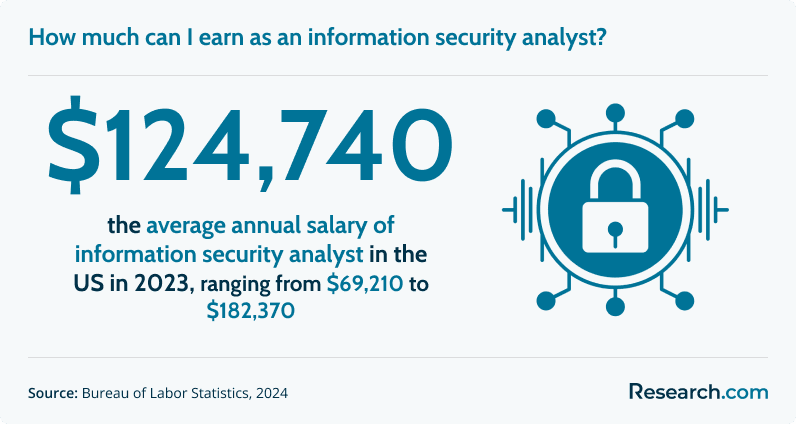
In 2023, information security analysts earned an average annual salary of $124,740, with entry-level positions starting at $69,210 and top earners making over $180,000. The median annual salary for cybersecurity professionals in 2023 was $120,360.
Pay can rise substantially in specialized industries and senior roles. Professionals in computer manufacturing, finance, software development, media, web services, cloud security, and security architecture may earn more than general analyst roles. Leadership positions such as security architect, director of security, and chief information security officer can also command higher compensation, though they usually require years of experience and strong communication skills in addition to technical expertise.
| Cybersecurity Salary Factor | Why It Matters |
| Experience level | Entry-level SOC and analyst roles usually pay less than senior engineering, architecture, and leadership roles. |
| Certifications | Relevant credentials can support advancement, especially when paired with hands-on experience. |
| Industry | High-risk and high-value sectors often pay more because security failures can be costly. |
| Specialization | Cloud security, incident response, penetration testing, and governance can lead to different compensation ranges. |
| Location and remote work | Pay may vary by labor market, employer size, and whether the role supports remote or hybrid work. |
What to Expect from a Data Science Degree Program
A data science degree prepares students to collect, clean, analyze, model, and communicate information from complex datasets. According to O*NET, the occupation requires technical and analytical skills connected to data analysis, modeling, and problem-solving. Unlike cybersecurity, which often emphasizes risk response and system defense, data science programs emphasize mathematical reasoning, statistical accuracy, programming fluency, and model interpretation.
Core Courses: Math, Computing, and Modeling
Most data science programs include a structured sequence of technical courses. Common subjects include:
- Machine learning. Students learn how algorithms classify data, detect patterns, predict outcomes, and improve through training data.
- Big data technologies. Programs may introduce distributed computing tools such as Hadoop and Spark, along with cloud platforms used for large-scale analytics.
- Statistical modeling. Students study probability, hypothesis testing, regression, Bayesian methods, and uncertainty.
- Data visualization. Coursework teaches students to communicate findings through charts, dashboards, and visual storytelling tools such as Tableau and Matplotlib.
- Database management. Students work with SQL and NoSQL systems to store, retrieve, organize, and query data.
Electives may cover deep learning, natural language processing, business intelligence, artificial intelligence, analytics engineering, or domain-specific applications such as healthcare, finance, marketing, or logistics.
Hands-On Experience: Projects, Internships, and Capstones
Project work is essential in data science because employers want evidence that candidates can move from raw data to usable findings. Strong programs require students to clean messy datasets, document assumptions, compare models, explain limitations, and present results to technical and nontechnical audiences.
Internships and capstone projects are especially valuable. A capstone may require students to solve a real analytics problem, build a predictive model, evaluate model performance, and recommend actions. These projects can become portfolio pieces for data analyst, data scientist, machine learning, or business intelligence roles.
Degree Levels and Online Options
Data science programs are available at the bachelor’s and master’s levels. A bachelor’s degree can support entry into analytics, database, or junior data roles. A master’s degree is common for students who want more advanced preparation in machine learning, statistical modeling, artificial intelligence, or applied research.
Students comparing affordable universities in USA for MS in data science should evaluate more than tuition. Key questions include whether the curriculum includes advanced statistics, whether students work with real datasets, whether faculty have applied or research expertise, whether the program includes career support, and whether students can build a portfolio before graduating.
Top Data Science Certificates and When They Help
A data science certificate can be useful for building specific skills, testing interest in the field, or adding technical credibility to an existing background. Certificates are not always a substitute for a full degree, especially for advanced data scientist or machine learning roles, but they can help career changers, business analysts, software professionals, and graduate students strengthen their resumes.
Industry-Recognized Certifications
Common data science and analytics credentials include:
- Certified Data Scientist. Covers topics such as statistical analysis, machine learning, and business applications.
- Microsoft Certified: Azure Data Scientist Associate. Focuses on machine learning workflows and artificial intelligence solutions in Azure environments.
- IBM Data Science Professional Certificate. Provides foundational training in Python, SQL, data analysis, and visualization.
- Google Data Analytics Certificate. Emphasizes data cleaning, analysis, visualization, and applied analytics workflows.
- SAS Certified Data Scientist. Focuses on predictive modeling, data mining, and big data analytics.
Short-Term Certificates: Useful for Skill Building, Not Guaranteed Advancement
Students searching for 6-month certificate programs that pay well should be realistic about what a certificate can and cannot do. A short program may help someone learn Python, SQL, visualization, or machine learning basics. It may also help an experienced professional move from reporting into analytics. But employers hiring for advanced data science roles often expect a portfolio, strong statistics, coding ability, and domain knowledge.
With the right certification, professionals can strengthen their credentials and improve their job prospects in a competitive field. In 2023, the highest-paying industries for data scientists include taxi and limousine services ($172,970) and computer manufacturing ($171,760).
Data Science Career Paths for Degree Graduates
A data science degree can lead to careers in analytics, artificial intelligence, business intelligence, finance, healthcare, research, consulting, and product development. The best role depends on how technical the student wants to be. Some graduates spend most of their time building models and data pipelines; others focus on dashboards, strategy, experimentation, or communicating insights to executives.
- Data analyst. Collects, cleans, interprets, and visualizes data to help organizations understand trends and make decisions.
- Machine learning engineer. A role connected to modern types of engineering careers, focused on building, deploying, and maintaining machine learning systems.
- Business intelligence analyst. Creates reports, dashboards, and metrics that help organizations monitor performance and plan strategy.
- Data engineer. Builds and maintains pipelines, databases, warehouses, and cloud infrastructure that support analytics and machine learning.
- Quantitative analyst. Applies programming and statistical models to finance, risk, trading, or investment problems.
- AI researcher. Studies and improves artificial intelligence methods, deep learning models, and algorithmic systems.
- Healthcare data scientist. Analyzes patient data, clinical outcomes, medical records, and operational data to improve healthcare decisions.
- Chief data officer. Oversees data governance, analytics strategy, data quality, and enterprise-wide data initiatives.
In 2023, the sectors with the highest employment levels for data scientists included computer systems design (23,150) and corporate management (19,060), showing that data science skills are used across both technology and business environments.
Data Scientist Salary Expectations
Data science salaries reflect the value employers place on people who can turn data into useful models, forecasts, and decisions. Compensation depends on technical depth, industry, education, experience, location, and whether the role focuses on analytics, machine learning, artificial intelligence, data engineering, or leadership.
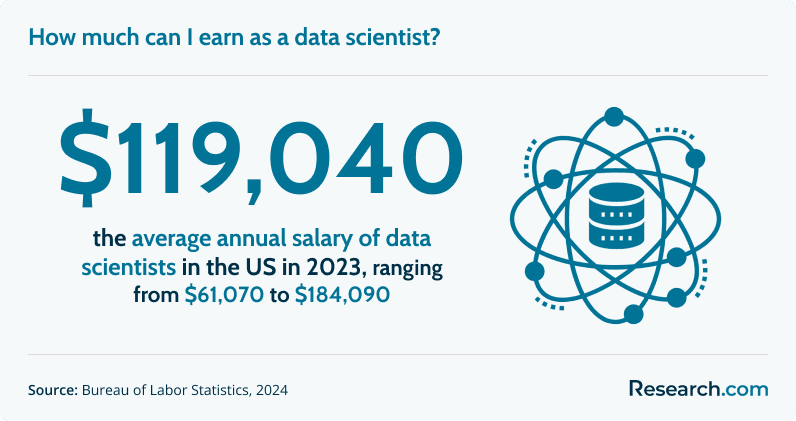
In 2023, the average annual salary for data scientists in the US was $119,040, with earnings ranging from $61,070 at the entry level to $184,090 for experienced professionals. The median salary for data scientists in 2023 was $108,020.
Higher-paying data science opportunities are often tied to specialized technical work, advanced manufacturing, financial services, algorithmic systems, artificial intelligence, cloud computing, and high-scale consumer platforms. However, salary should not be the only factor in choosing the field. Data science work can be mathematically demanding, and students who dislike statistics, coding, or ambiguous datasets may find the day-to-day work frustrating.
Trends Shaping Cybersecurity and Data Science Careers
Cybersecurity and data science are both being reshaped by artificial intelligence, automation, cloud computing, and growing regulatory expectations. Cybersecurity teams are using automation and machine learning to detect suspicious behavior, prioritize alerts, and speed up response. At the same time, attackers are also using more automated methods, which increases the need for skilled professionals who can interpret alerts, investigate incidents, and make judgment calls that tools cannot handle alone.
Data science is also changing quickly. Employers increasingly expect data professionals to understand model deployment, data governance, cloud infrastructure, responsible AI, and communication with business stakeholders. It is no longer enough to build a model in a notebook; professionals must explain why the model works, where it may fail, and how it affects real decisions.
Newer areas such as IoT security, privacy engineering, AI governance, real-time analytics, and quantum computing may create specialized roles. These trends can also influence overall computer science salary comparisons, especially for professionals who combine core technical skills with scarce specializations.
Can Bioinformatics Broaden Career Options?
Yes, interdisciplinary study can expand career options when it connects technical skill with a specific industry. Bioinformatics is one example: it blends data science, biology, statistics, and computing to analyze biological and medical data. For students interested in healthcare, biotechnology, genomics, or pharmaceutical research, this can create a more specialized path than general analytics.
Programs such as bioinformatics masters programs may be especially relevant for students who like data science but want to work on life science problems rather than general business analytics. The trade-off is specialization: it can make a candidate more competitive in certain sectors, but less broadly positioned than a general data science graduate unless the program also builds transferable analytics skills.
Can Interdisciplinary Study Improve Career Flexibility?
Interdisciplinary study can help when it is intentional. Combining cybersecurity or data science with healthcare, finance, public policy, business, biology, or software engineering can make a graduate more useful in roles that require both technical skill and domain understanding. The key is avoiding random credential stacking. Each additional degree or certificate should support a clear career goal.
For example, students interested in life sciences and computational research may consider options such as a bioinformatics master online. This type of program can be valuable for students who want to apply analytics to genomics, biomedical research, or healthcare data rather than remain in a general-purpose data role.
Job Outlook for Cybersecurity and Data Science
Both cybersecurity and data science have strong employment outlooks because organizations need to secure digital systems and make better use of data. These are not identical labor markets, however. Cybersecurity demand is driven by cyber threats, regulation, cloud adoption, and the need to protect critical systems. Data science demand is driven by artificial intelligence, automation, analytics, product optimization, and data-driven management.
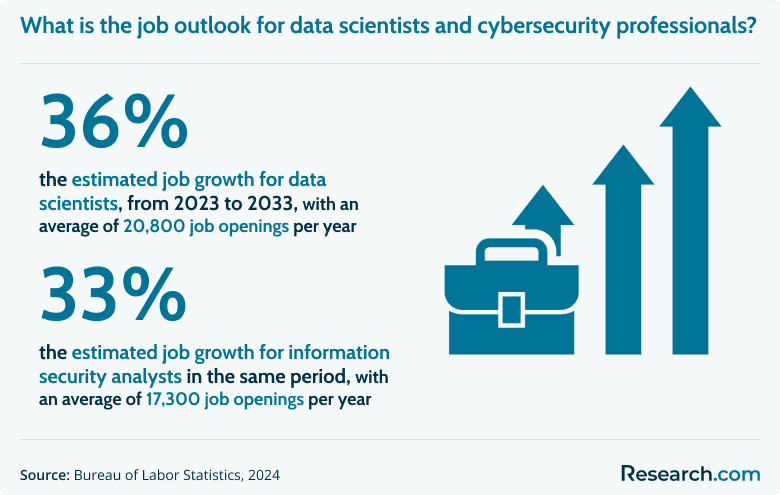
Employment for information security analysts is projected to grow by 33% from 2023 to 2033, adding an average of 17,300 job openings per year. Organizations in finance, healthcare, government, technology, and consulting continue to need professionals who can protect data, monitor systems, and respond to incidents.
Data scientist employment is projected to grow by 36% over the same period, with about 20,800 new job openings each year. Demand is especially connected to technology, finance, healthcare, and organizations investing in machine learning, artificial intelligence, and large-scale analytics.
Students comparing this choice with broader computing options may also find a data science and computer science programs comparison useful, especially if they are unsure whether they want a specialized data degree or a broader computer science foundation.
How to Choose Between Cybersecurity and Data Science
The right choice depends on fit, not just salary or job growth. Cybersecurity and data science can both lead to strong careers, but the work feels different. Cybersecurity is often more operational, investigative, risk-oriented, and time-sensitive. Data science is often more analytical, mathematical, experimental, and communication-heavy.
It may also help to compare this decision with the broader question of cyber security vs computer science, because some students may be better served by a broader computer science degree before specializing.
| Choose Cybersecurity If... | Choose Data Science If... |
| You enjoy protecting systems and finding vulnerabilities. | You enjoy identifying patterns in messy or complex datasets. |
| You like networks, operating systems, cloud security, and risk management. | You like statistics, programming, machine learning, and visualization. |
| You are comfortable with incident response, alerts, documentation, and compliance. | You are comfortable testing assumptions, explaining uncertainty, and refining models. |
| You want multiple entry points through certifications, bootcamps, or degrees. | You are willing to build a strong quantitative foundation, often through graduate study. |
| You can handle high-pressure work when systems are at risk. | You can handle ambiguity when data is incomplete, biased, or difficult to interpret. |
Questions to Ask Before Choosing a Program
- What kind of problems do I want to solve? If you want to defend systems, investigate threats, and reduce risk, cybersecurity may fit better. If you want to model behavior, predict outcomes, and inform strategy, data science may be a better match.
- How strong am I in math? Data science usually requires more statistics, probability, and mathematical modeling than cybersecurity.
- Do I want a faster entry path? Cybersecurity may offer more realistic entry options through certifications, bootcamps, and IT experience.
- Do I want to work with people, systems, or data most of the time? Cybersecurity often involves systems, users, policies, and incident coordination. Data science often involves datasets, models, code, and stakeholder presentations.
- Does the program include hands-on experience? Cybersecurity students need labs and simulations; data science students need portfolio projects and real datasets.
Common Mistakes to Avoid
- Choosing only by salary. Both fields can pay well, but the daily work is different enough that fit matters.
- Ignoring accreditation. A low-cost or fast program can become expensive if employers or graduate schools do not respect the credential.
- Assuming every online program is equal. Compare labs, faculty, career support, portfolio opportunities, and employer connections.
- Overvaluing rankings. Rankings can help with research, but curriculum quality and career outcomes matter more for individual fit.
- Assuming a certificate guarantees a job. Certificates help most when paired with projects, experience, networking, and interview preparation.
- Skipping transfer credit and total cost analysis. Tuition is only one part of cost. Fees, books, exam costs, time to completion, and lost income can change the real price.
Why Accreditation and Program Quality Matter
Accreditation and program quality can affect transfer credits, graduate school eligibility, employer confidence, and access to financial aid. Students should verify institutional accreditation, review the curriculum carefully, and look for evidence that the program prepares graduates for actual job tasks rather than only theory.
Important quality signals include qualified faculty, current technical tools, hands-on labs, internship support, career services, employer partnerships, capstone projects, certification preparation where relevant, and transparent information about outcomes. Students who want to broaden their technical foundation may also compare related options such as an affordable online software engineering degree, especially if they want stronger programming and systems design skills.
Is Health Informatics a Useful Add-On?
Health informatics can be a strategic add-on for students who want to apply cybersecurity or data science skills in healthcare. Healthcare organizations need professionals who understand sensitive patient data, analytics, privacy, regulatory compliance, health records, and secure digital systems. This can be especially relevant for cybersecurity professionals interested in HIPAA-related compliance or data scientists interested in clinical and operational analytics.
Students seeking a faster graduate route in this niche may explore a fast masters of health informatics online. Before enrolling, they should confirm that the program matches their target role, whether that is healthcare data analyst, health information manager, clinical analytics specialist, privacy analyst, or healthcare cybersecurity professional.
Graduate Perspectives on Cybersecurity vs. Data Science Choices
- After years in retail management, I wanted a career path with stronger technical growth. An online cybersecurity program let me keep working while completing labs, case studies, and certification preparation. The hands-on work helped me move into a SOC analyst role soon after finishing. George
- I could not leave my job to study full time, so an online data science program gave me the flexibility I needed. Working with real datasets and industry-style projects helped me show practical skills, and I later moved from business analyst work into a data scientist role. Mei
- I was drawn to cybersecurity because the field seemed practical and urgent. My program covered incident response, cloud security, and Security+ preparation, which gave me clearer talking points in interviews and helped me transition into the field. Kurt
Is a Cyber Security Degree Worth It?
A cybersecurity degree can be worth it for students who want structured training, access to labs, internship opportunities, career support, and a credential that may help with long-term advancement. The value depends on total cost, program quality, prior experience, certification plans, and the student’s target role.
Students should calculate return on investment by comparing tuition, fees, time to completion, transfer credits, certification costs, expected entry roles, and advancement potential. A degree may be especially useful for students who want leadership, government, consulting, or roles that prefer formal education. For a more focused discussion, see Is a cyber security degree worth it?.
Can Accelerated Online Programs Help You Move Faster?
Accelerated online programs can help motivated students complete credentials faster, but speed should not come at the expense of depth. In cybersecurity and data science, students need time to practice technical skills, complete projects, and prepare for interviews. A shorter program is only useful if it still provides rigorous coursework, faculty access, applied assignments, and credible career preparation.
Students considering an accelerated bachelor's degree computer science online should ask whether the program supports their intended specialization. A broad accelerated computer science program may be a strong foundation for either cybersecurity or data science, especially if students can choose electives in security, databases, machine learning, statistics, or cloud computing.
Can a Healthcare Administration Degree Strengthen a Tech Career?
A healthcare administration background can help technology professionals who want to lead digital transformation in hospitals, clinics, insurance organizations, health systems, or telehealth companies. Cybersecurity professionals may benefit from understanding healthcare compliance, patient privacy, and operational risk. Data science professionals may benefit from understanding clinical workflows, healthcare operations, and decision-making structures.
A healthcare administration degree online may be most useful for tech professionals who want management responsibilities in healthcare settings rather than purely technical roles. Students should compare curriculum, accreditation, healthcare industry connections, and whether the program includes health data systems, compliance, quality improvement, or healthcare analytics.
Key Insights
- Cybersecurity and data science are both strong technology paths, but they serve different purposes: cybersecurity protects systems and manages risk, while data science analyzes data and builds predictive insight.
- Cybersecurity generally offers more entry routes, including certifications, bootcamps, associate degrees, bachelor’s degrees, and graduate programs. Data science usually requires deeper preparation in mathematics, statistics, programming, and machine learning.
- In 2023, cybersecurity professionals had a median annual salary of $120,360, while data scientists earned $108,020. Average annual pay was $124,740 for information security analysts and $119,040 for data scientists.
- Both fields have strong projected growth from 2023 to 2033: 33% for information security analysts and 36% for data scientists.
- Students who enjoy networks, threat detection, incident response, and compliance should look closely at cybersecurity. Students who enjoy statistics, coding, modeling, and explaining patterns should look closely at data science.
- Program quality matters. Before enrolling, compare accreditation, hands-on learning, faculty expertise, career services, certification alignment, portfolio opportunities, and total cost.
- Do not choose based on salary alone. The better long-term choice is the field whose daily work matches your strengths, interests, and tolerance for pressure, ambiguity, and continuous learning.
References:
- Bureau of Labor Statistics. (2024). Computer and information technology occupations. U.S. Department of Labor. Retrieved March 18, 2025, from BLS.
- Bureau of Labor Statistics. (2024). Data scientists. U.S. Department of Labor. Retrieved March 18, 2025, from BLS.
- Bureau of Labor Statistics. (2024). Information security analysts. U.S. Department of Labor. Retrieved March 18, 2025, from BLS.
- Bureau of Labor Statistics. (2024). Math occupations. U.S. Department of Labor. Retrieved March 18, 2025, from BLS.
- Bureau of Labor Statistics. (2024). Occupational employment and wages, May 2023 - 15-0000 computer and mathematical occupations (major group). U.S. Department of Labor. Retrieved March 18, 2025, from BLS.
- Bureau of Labor Statistics. (2024). Occupational employment and wages, May 2023 - 15-1212 information security analysts. U.S. Department of Labor. Retrieved March 18, 2025, from BLS.
- Bureau of Labor Statistics. (2024). Occupational employment and wages, May 2023 - 15-2051 data scientists. U.S. Department of Labor. Retrieved March 18, 2025, from BLS.
- National Institute of Standards and Technology. (2025). Cybersecurity. U.S. Department of Commerce. Retrieved March 18, 2025, from NIST.
- United States Data Science Institute. (2025). USDSI homepage. Retrieved March 18, 2025, from USDSI.
Other Things You Should Know About Cybersecurity vs. Data Science Degree Programs
The choice depends on your career goals, interests, and job market trends. Cybersecurity focuses on protecting data and systems, while data science involves analyzing and interpreting complex data. Consider the demand for skills in each field and your passion for technology and data analysis.
In 2027, salaries for cybersecurity and data science graduates vary significantly with job role specialization. For instance, cybersecurity professionals focusing on threat analysis may earn differently than those in managerial roles, while data scientists working in machine learning versus database management will also see varied pay scales.
In 2027, a bachelor’s degree often suffices for entry-level roles in both cybersecurity and data science. However, specialization through certifications or advanced degrees like a master's can enhance career prospects, especially for roles requiring expertise or leadership skills.


