2027 How To Become an Information Security Officer

Co-Founder and Chief Data Scientist
Becoming an Information Security Officer in 2026 is not just a technical career move; it is a decision to take responsibility for how an organization protects its data, systems, users, and reputation. Data breaches and cybersecurity weaknesses exposed at least 422 million user accounts worldwide in the past year (Statista, 2024), and organizations in finance, healthcare, government, retail, education, and technology are under pressure to reduce risk before incidents occur.
This guide is for students, IT professionals, cybersecurity analysts, compliance specialists, and career changers who want a realistic path into information security leadership. You will learn what Information Security Officers do, which degrees and certifications are useful, what skills employers look for, how salaries vary, how to choose a career path, and how cloud computing, AI, remote work, privacy regulation, and ransomware are changing the role.
Quick answer: Is becoming an Information Security Officer worth it in 2026?
Yes, becoming an Information Security Officer can be worth it if you want a high-responsibility cybersecurity career that combines technical judgment, risk management, compliance, and leadership. The role is typically not an entry-level job. Most professionals build experience first in IT support, systems administration, network security, auditing, incident response, or security analysis before moving into an ISO position.
- Demand remains strong, with job growth projected to reach 33% from 2023 to 2033 (BLS, 2024).
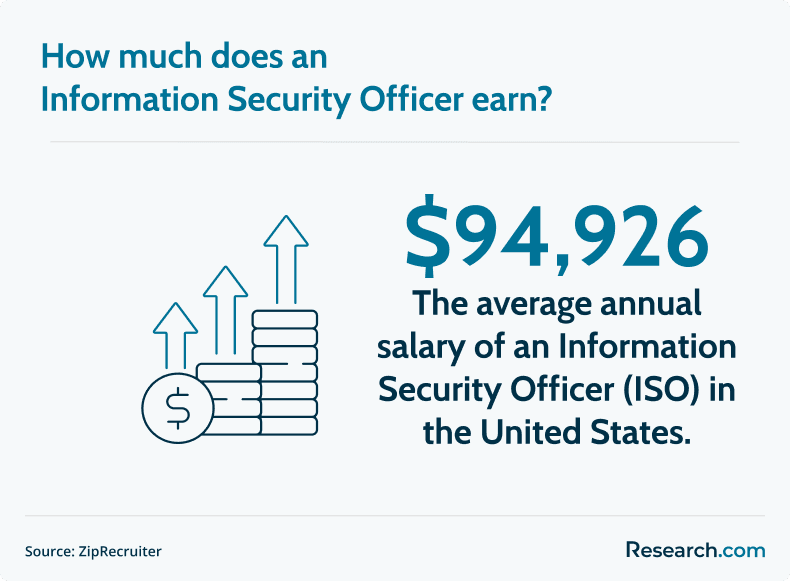
- The average annual salary for Information Security Officers is $94,926 (ZipRecruiter, n.d.).
- Cybersecurity talent is needed across finance, healthcare, government, technology, cloud services, and regulated industries.
- The role is best for professionals who can combine technical security knowledge with business communication and risk-based decision-making.
- What does an Information Security Officer do?
- How do you become an Information Security Officer in 2026?
- Which degrees are best for aspiring Information Security Officers?
- What skills do Information Security Officers need?
- Which certifications help Information Security Officers advance?
- How much does an Information Security Officer earn?
- What career paths lead to an Information Security Officer role?
- What cybersecurity trends should Information Security Officers watch?
- How does remote work change the Information Security Officer role?
- How can cross-disciplinary skills improve ISO performance?
- How can health informatics support cybersecurity work in healthcare?
- How does continuing education support ISO career growth?
- How can data science improve security decisions?
- How do regulation and budget limits affect ISO planning?
- How can interdisciplinary education strengthen cybersecurity strategy?
- How does Zero Trust support an Information Security Officer’s strategy?
- How does cloud computing affect Information Security Officer responsibilities?
- How is artificial intelligence changing the ISO role?
- What cybersecurity threats should Information Security Officers prepare for in 2026?
What does an Information Security Officer do?
An Information Security Officer protects an organization’s information assets by reducing cyber risk, setting security policies, managing compliance obligations, and coordinating responses to security incidents. The role goes beyond installing tools or monitoring alerts. ISOs translate technical threats into business risk and help leaders decide where to invest time, staff, and budget.
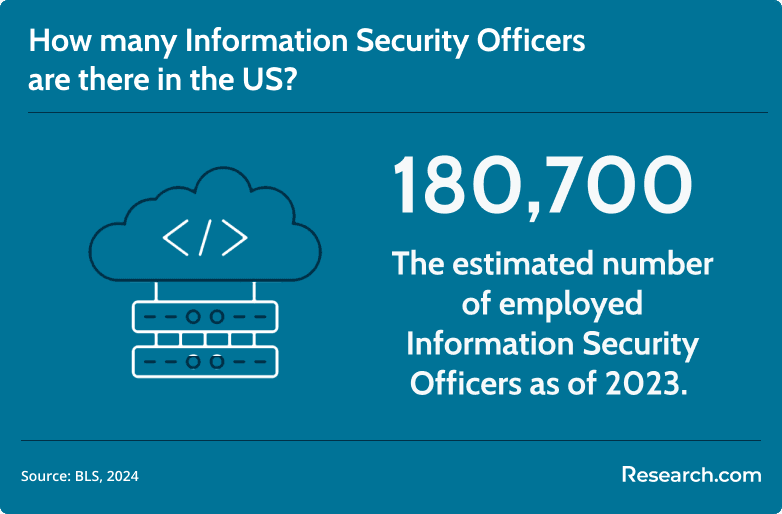
There are over 180,700 full-time ISOs in the US (BLS, 2024), and many work in roles that overlap with security analysts, IT risk managers, compliance officers, and security program managers. Daily responsibilities vary by organization size, industry, and maturity level, but most ISOs are accountable for the following work:
- Security policy and governance: Creating, updating, and enforcing rules for data protection, system access, acceptable use, vendor security, incident response, and employee behavior.
- Risk assessment: Identifying technical and operational weaknesses, estimating potential impact, and recommending controls that reduce the likelihood or severity of attacks.
- Incident response: Coordinating investigations, containing threats, documenting evidence, supporting recovery, and improving defenses after a breach or attempted attack.
- Regulatory compliance: Helping the organization meet requirements tied to General Data Protection Regulation (GDPR), Health Insurance Portability and Accountability Act (HIPAA), and International Organization for Standardization/International Electrotechnical Commission 27001 (ISO/IEC 27001).
- Employee security awareness: Training staff to recognize phishing, social engineering, unsafe file handling, weak passwords, and risky use of personal devices.
- Security technology oversight: Working with IT teams that manage firewalls, encryption, endpoint protection, identity systems, intrusion detection, vulnerability scanning, and monitoring platforms.
- Executive communication: Reporting risks, incidents, priorities, and trade-offs to leaders who may not have a technical background.
| ISO responsibility | What it means in practice | Why it matters |
| Risk management | Ranking security weaknesses by likelihood, impact, and business importance | Prevents teams from treating every alert as equally urgent |
| Compliance | Mapping policies and controls to legal, industry, and contractual requirements | Reduces legal exposure and audit failures |
| Incident response | Leading containment, communication, evidence collection, and recovery planning | Limits damage when attacks occur |
| Security awareness | Training employees and measuring behavior change | Reduces human-error risks such as phishing and credential theft |
| Security strategy | Aligning tools, people, policies, and budgets with business priorities | Turns cybersecurity into a long-term operational capability |
How do you become an Information Security Officer in 2026?
An Information Security Officer role usually requires a mix of education, technical experience, certifications, and leadership ability. It is one of the higher-paying computer science career paths, with an average annual salary of $94,926 (ZipRecruiter, n.d.), but most employers expect candidates to prove that they can manage real security risk before stepping into the role.
- Build a technical foundation. Start with computer science, cybersecurity, information technology, networking, systems administration, or a closely related field. A bachelor’s degree is common, while some senior roles prefer graduate study in cybersecurity, information assurance, IT management, or business administration.
- Gain hands-on IT or cybersecurity experience. Entry and mid-level roles such as security analyst, systems administrator, network administrator, IT auditor, help desk technician, or compliance analyst can help you understand how systems fail and how organizations respond.
- Develop risk and compliance judgment. ISOs need to evaluate business impact, not just technical severity. Experience with audits, policies, vendor assessments, access reviews, incident documentation, and regulatory frameworks is valuable.
- Earn certifications at the right time. Start with foundational credentials if you are new to cybersecurity. Pursue advanced certifications such as CISSP, CISM, CISA, or GCIH when you have enough experience for the credential to strengthen your case for leadership roles.
- Practice communication with nontechnical stakeholders. Learn how to explain why a vulnerability matters, what a breach could cost operationally, and which controls deserve funding first.
- Stay current. Cybersecurity changes quickly, so ongoing learning through conferences such as Black Hat, DEF CON, and RSA Conference, plus labs, vendor training, threat reports, and professional communities, is part of the job.
| Stage | Typical roles or actions | What to focus on |
| Early career | Help desk, junior systems administrator, SOC analyst, IT support | Networking, operating systems, scripting, ticket documentation, basic security tools |
| Cybersecurity foundation | Security analyst, vulnerability analyst, network security administrator | Threat detection, access control, SIEM tools, endpoint protection, incident handling |
| Risk and governance development | IT auditor, compliance analyst, security coordinator, risk analyst | Policies, audits, regulatory mapping, vendor risk, business impact analysis |
| ISO readiness | Security manager, incident response lead, security program lead | Leadership, budget prioritization, executive reporting, cross-functional planning |
| Advanced leadership | Information Security Officer, security director, Chief Information Security Officer | Security strategy, enterprise risk, board-level communication, long-term resilience |
Who should consider this career path?
- IT professionals who want to move from troubleshooting into security leadership
- Security analysts who want broader responsibility over governance, compliance, and strategy
- Auditors or compliance professionals who want deeper cybersecurity specialization
- Professionals who enjoy translating technical risk into business decisions
Who may want a different cybersecurity role?
- People who want mostly hands-on offensive security may prefer penetration testing or red teaming.
- People who dislike policy, documentation, and meetings may find an ISO role frustrating.
- People who want a purely entry-level cybersecurity job should first target analyst, technician, or administrator roles.
Which degrees are best for aspiring Information Security Officers?
The strongest degree for an aspiring Information Security Officer is usually cybersecurity, computer science, information technology, or a related technical field. However, the “best” degree depends on the kind of organization you want to serve. A hospital, bank, cloud provider, defense contractor, and university may all value different combinations of technical, compliance, and management knowledge.
| Degree area | How it supports an ISO career | Best fit |
| Computer Science | Builds knowledge of programming, algorithms, software systems, cryptography, and secure development | Students who want deep technical flexibility across security engineering, software security, and leadership |
| Information Technology | Covers systems, networks, infrastructure, support operations, security basics, and organizational IT management | Learners who want a broad IT foundation before specializing in cybersecurity |
| Network Administration | Focuses on routers, firewalls, wireless systems, network segmentation, access controls, and secure infrastructure | Future ISOs interested in network defense and infrastructure security |
| Cloud Computing | Develops knowledge of cloud platforms, shared responsibility, identity management, cloud data protection, and cloud risk | Professionals targeting organizations that rely on AWS, Azure, Google Cloud, or multi-cloud environments |
| Computer Programming | Teaches languages such as Python, Java, and C++, which can support automation, secure coding, vulnerability analysis, and security tooling | Students interested in application security, DevSecOps, or security automation |
| Computer Hardware Engineering | Explains computing devices, embedded systems, architecture, and hardware-level vulnerabilities | Professionals interested in secure systems design, device security, or hardware risk |
| Database Management | Emphasizes data storage, access control, encryption, database security, and protection against attacks such as SQL injection | Future ISOs focused on data governance, privacy, and enterprise information protection |
| Business Management | Supports budgeting, leadership, organizational strategy, risk communication, and governance | Technical professionals preparing for management or executive security roles |
| Law | Provides grounding in privacy, cyber law, compliance obligations, evidence, contracts, and regulatory risk | Professionals who want to work in privacy, governance, legal compliance, or regulated sectors |
Cost and format matter, too. If you already have a technical background, a focused cybersecurity or IT graduate program may be more efficient than starting over with a second bachelor’s degree. If you are comparing technical leadership options outside cybersecurity, Research.com also maintains guides such as the most affordable online master’s degrees in engineering management. Students beginning with business fundamentals can also compare lower-cost options such as an affordable online associate degree in business.
How to choose a degree program for an ISO career
- Check accreditation first. Make sure the institution is properly accredited before comparing tuition, rankings, or course titles.
- Look for hands-on security labs. Courses should include practical work with networks, cloud environments, incident response, access control, vulnerability management, or secure coding.
- Review faculty and industry connections. Instructors with cybersecurity, audit, compliance, or risk management experience can provide more useful career context.
- Compare transfer credit policies. Transfer credits can reduce cost and completion time, especially for students with prior college coursework or professional training.
- Ask how the curriculum maps to certifications. A strong program may help prepare students for credentials such as Security+, CISSP, CISA, CISM, or cloud security certifications.
What skills do Information Security Officers need?
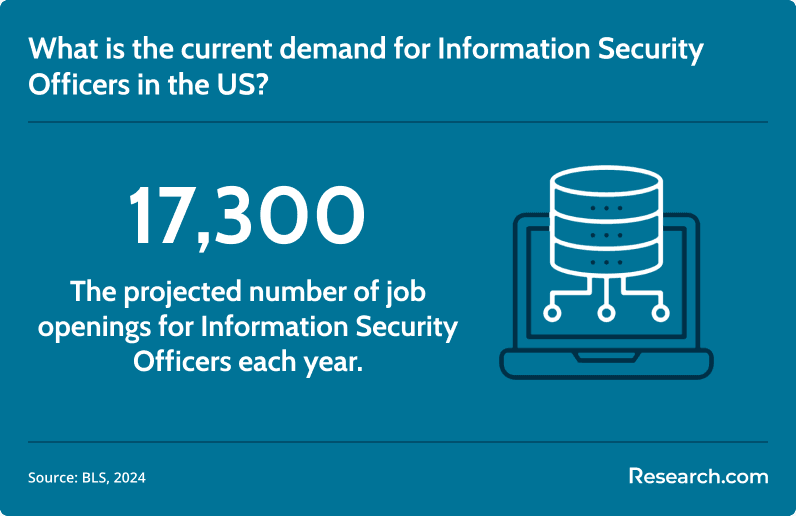
Employers are not looking only for people who can configure tools. Information Security Officers need the ability to understand systems, evaluate risk, influence behavior, document decisions, and communicate clearly during normal operations and high-pressure incidents. Computer science and IT graduates may be competing for 17,300 Information Security Officer job openings, so a stronger skill mix can help candidates stand out.
Technical security skills
- Network security: Understanding firewalls, VPNs, intrusion detection and prevention systems, traffic analysis, segmentation, and monitoring.
- Encryption and cryptography: Knowing how encryption, key management, certificates, and secure protocols protect sensitive information.
- Identity and access management: Managing user permissions, privileged access, authentication, multi-factor authentication, and account lifecycle controls.
- Cloud security: Securing infrastructure, applications, storage, identities, and configurations across AWS, Azure, Google Cloud, and hybrid environments.
- Penetration testing concepts: Understanding attacker methods well enough to prioritize vulnerabilities and evaluate remediation plans.
- Compliance knowledge: Applying GDPR, HIPAA, ISO 27001, and other relevant standards to policies, controls, audits, and reporting.
Analytical and investigative skills
- Risk assessment: Determining which weaknesses create the greatest business exposure.
- Security planning: Building practical controls that reduce future threats without blocking essential operations.
- Incident decision-making: Acting quickly during ransomware, credential theft, data leakage, or system compromise.
- Forensic thinking: Reconstructing what happened, what systems were affected, and what evidence supports the investigation. Students interested in investigative science can also explore Research.com’s guide to forensic science colleges.
Communication and leadership skills
- Security training: Explaining phishing, malware, data handling, passwords, mobile risk, and remote-work safeguards in language employees understand.
- Cross-functional collaboration: Working with IT, legal, compliance, finance, HR, operations, and executive teams.
- Incident documentation: Recording timelines, decisions, findings, containment steps, recovery actions, and lessons learned.
- Executive reporting: Turning technical vulnerabilities into clear risk statements, business impact, and funding priorities.
Some professionals preparing for senior leadership consider graduate or executive-level education. Research.com’s explanation of executive master’s degrees can help candidates understand how these programs differ from traditional graduate study.
| Skill category | Beginner evidence | ISO-level evidence |
| Technical security | Can use common tools and follow runbooks | Can evaluate controls, identify gaps, and recommend risk-based improvements |
| Risk management | Can identify vulnerabilities | Can rank risks by business impact and advise leadership on trade-offs |
| Compliance | Can collect documentation for audits | Can align policies, controls, evidence, and reporting with regulatory needs |
| Incident response | Can escalate alerts and document events | Can coordinate containment, communication, recovery, and post-incident changes |
| Leadership | Can explain technical findings to a team | Can influence executives, vendors, department heads, and nontechnical staff |
Which certifications help Information Security Officers advance?
Cybersecurity certifications can strengthen an ISO candidate’s credibility, but they should match your experience level and career goal. A foundational credential can help new professionals enter the field, while management and audit credentials are often more useful for those moving toward governance, risk, compliance, or security leadership.
- CompTIA Security+: A foundational credential covering core security concepts, threat detection, network security, and risk management.
- Certified Information Systems Security Professional (CISSP): A widely recognized advanced certification focused on security architecture, access control, cryptography, risk management, and security operations.
- Certified Ethical Hacker (CEH): A credential centered on ethical hacking, penetration testing methods, attacker behavior, and vulnerability identification.
- Certified Information Systems Auditor (CISA): A strong option for professionals working in IT governance, risk, compliance, auditing, and control assessment.
- Certified Information Security Manager (CISM): Designed for security leaders who manage governance, risk, incident response, and security programs.
- GIAC Certified Incident Handler (GCIH): Focuses on detecting, responding to, and remediating incidents involving malware, network threats, and attacks.
- Systems Security Certified Practitioner (SSCP): Supports practitioners responsible for authentication, access controls, cryptography, operations, and system security.
- GIAC Security Essentials Certification (GSEC): Covers essential security skills, including network defense, cryptography, policy, and operational security.
Certification cost comparison
| Certification | Estimated Cost | Best use case |
| CompTIA Security+ | $404 | Entry-level cybersecurity foundation |
| Certified Information Systems Security Professional (CISSP) | $749 | Advanced security leadership and architecture credibility |
| Certified Ethical Hacker (CEH) | $950–$1,199 | Penetration testing and attacker-method knowledge |
| Certified Information Systems Auditor (CISA) | $575—$760 | Audit, governance, risk, and compliance roles |
| Certified Information Security Manager (CISM) | $575—$760 | Security management, governance, and program leadership |
| GIAC Certified Incident Handler (GCIH) | $979 | Incident response and threat handling |
| Systems Security Certified Practitioner (SSCP) | $249 | System security operations and practitioner-level security work |
| GIAC Security Essentials Certification (GSEC) | $979–$1,299 | Broad entry-to-mid-level technical security validation |
Source: Coursera, 2025
How to decide which certification to pursue first
- If you are new to cybersecurity: Start with Security+ or another foundational credential before pursuing advanced management certifications.
- If you work in audit or compliance: CISA may align better than a penetration-testing credential.
- If you manage security programs: CISM can be more relevant than purely technical certifications.
- If you want senior cybersecurity leadership: CISSP is often useful because it signals broad security knowledge across domains.
- If you handle breaches: GCIH can support incident-response credibility.
Certifications are valuable in many professions, but their usefulness depends on the role. For readers comparing cybersecurity with education careers, Research.com also explains what teaching assistants do and how qualifications affect that path.
How much does an Information Security Officer earn?
Information Security Officer pay depends on experience, industry, location, certifications, scope of responsibility, and whether the role is individual-contributor, managerial, or executive. According to ZipRecruiter, the average annual salary is $94,926. At the executive level, a Chief Information Security Officer in the US earns an average of $341,265, with typical salaries ranging from $248,049 to $457,061.
According to the Bureau of Labor Statistics (2023), the highest-paying states for ISOs are Washington ($148,090), Iowa ($143,960), and New York ($140,770). These figures should be treated as benchmarks, not guarantees. Employers may pay more or less depending on sector, company size, security maturity, and the responsibilities attached to the title.
| Salary factor | How it can affect pay |
| Experience | Professionals with incident response, compliance, architecture, and leadership experience may qualify for higher-responsibility roles. |
| Industry | Regulated and high-risk industries such as finance, healthcare, government, and technology often need stronger security leadership. |
| Location | Salary benchmarks vary by state and metro area, with Washington, Iowa, and New York listed among the highest-paying states. |
| Certifications | Credentials such as CISSP, CISM, CISA, and GCIH may support advancement when paired with relevant experience. |
| Role level | A non-executive ISO, security manager, and CISO can have very different compensation ranges. |
What career paths lead to an Information Security Officer role?
There is no single path into an Information Security Officer job. Some professionals come from technical operations, while others come from auditing, compliance, risk management, or incident response. The best path depends on your current background and the kind of ISO role you want.
- Security Analyst: Monitors threats, reviews alerts, supports investigations, and recommends security improvements.
- IT Auditor: Reviews systems, policies, controls, and compliance evidence to determine whether security practices meet requirements.
- Network Security Administrator: Manages firewalls, intrusion detection tools, secure access, segmentation, and network defenses.
- Penetration Tester: Runs authorized attack simulations to identify vulnerabilities before malicious actors exploit them.
- Incident Response Manager: Coordinates investigations, containment, recovery, communication, and post-incident improvements.
- Security Architect: Designs secure systems, identity models, network structures, and technical controls.
- Cybersecurity Consultant: Advises organizations on risk reduction, program maturity, compliance, and security architecture.
- Information Security Officer: Leads or manages security programs, risk activities, policies, compliance, and incident readiness.
- Chief Information Security Officer: Sets enterprise security strategy, manages executive-level risk, and oversees organization-wide security governance.
| If your background is... | Likely next step | What to strengthen before applying for ISO roles |
| Help desk or IT support | Systems administrator, network administrator, junior security analyst | Networking, operating systems, scripting, endpoint security, documentation |
| Network administration | Network security administrator, security analyst | Firewall policy, segmentation, cloud networking, incident response, access control |
| Security operations | Senior analyst, incident response lead, security manager | Risk communication, compliance, executive reporting, program planning |
| Audit or compliance | IT risk analyst, security governance specialist, compliance security manager | Technical control validation, threat modeling, cloud security, incident coordination |
| Management | Security program manager, governance lead | Cybersecurity fundamentals, regulatory frameworks, vendor risk, security metrics |
Career ladders exist in other fields as well, but the competencies differ. For comparison, Research.com’s sales manager job description explains how leadership expectations look in a non-cybersecurity business role.
What cybersecurity trends should Information Security Officers watch?
Information Security Officers need to plan for today’s attacks while preparing for tomorrow’s operating environment. In 2026, the role is shaped by distributed work, cloud dependence, AI-enabled threats, privacy regulation, mobile risk, and rising expectations from executives, customers, insurers, and regulators.
- Remote and hybrid work require stronger identity and endpoint controls: In 2024, 99% of businesses worldwide with at least 2,000 employees fell victim to a data breach (Xalient, 2024). As work spreads across homes, offices, devices, and cloud tools, ISOs need policies for secure access, managed endpoints, personal-device risk, and employee training.
- Multi-factor authentication is becoming harder to treat as optional: By late 2025, Google will require MFA for all Google Cloud accounts (Upadhyay, 2024). The rollout includes optional adoption in November 2024, mandatory MFA for password logins in early 2025, and full enforcement for federated authentication by late 2025.
- Mobile attacks remain a major exposure point: In 2023, approximately 5.48 million mobile cyberattacks targeted smartphones and tablets (Statista, 2023). Mobile security policies, endpoint protection, app controls, and user education are increasingly important.
- Data privacy is becoming a formal security discipline: GDPR, California Consumer Privacy Act (CCPA), HIPAA, and other privacy rules require organizations to manage consent, data minimization, encryption, access, retention, and disclosure risks more intentionally.
- Zero Trust is moving from concept to operating model: Organizations are increasingly using least-privilege access, continuous verification, network segmentation, and stronger identity checks to limit lateral movement after compromise.
- AI is changing both attack and defense: ISOs must evaluate AI-enabled phishing, deepfakes, automated malware, and misuse of internal AI tools while also using AI-supported detection and response carefully.
Specialized qualifications are becoming more important in many professions. For readers comparing career standards across fields, Research.com also covers physical education teacher qualifications.
How does remote work reshape an Information Security Officer’s role?
Remote and hybrid work push Information Security Officers to protect users, devices, data, and applications outside the traditional office network. That changes the security model. Instead of assuming the office perimeter is trusted, ISOs must focus on identity, endpoint health, device management, secure access, and behavior monitoring.
- Require multi-factor authentication for high-risk systems and remote access.
- Use endpoint protection and detection tools on managed laptops and mobile devices.
- Define clear rules for personal devices, home networks, file sharing, and cloud collaboration.
- Train employees to recognize phishing, malicious links, fake login pages, and social engineering attempts.
- Monitor unusual access patterns, impossible travel alerts, privilege escalation, and suspicious file activity.
Professionals who need faster technical preparation can compare options such as a one-year computer science degree, especially if they are building the computing foundation needed for cybersecurity roles.
How can cross-disciplinary skills improve ISO performance?
Cybersecurity problems are rarely only technical. ISOs often need design thinking, behavioral insight, business planning, legal awareness, and crisis communication. Cross-disciplinary skills can help security leaders test assumptions, design better training, and anticipate how real users interact with systems.
For example, simulation, scenario design, and iterative testing are common in interactive media programs. Professionals interested in those methods can explore Research.com’s guide to online game design schools and consider how scenario-based learning can strengthen incident drills, phishing simulations, and tabletop exercises.
How can health informatics support cybersecurity work in healthcare?
Healthcare cybersecurity requires special attention because patient records, clinical systems, connected devices, billing data, and regulatory obligations are closely linked. Health informatics knowledge can help ISOs understand how healthcare data moves through electronic health records, care teams, insurance workflows, analytics platforms, and patient portals.
This background can improve risk assessments, HIPAA-aligned policies, access controls, downtime planning, and privacy governance. Readers interested in this intersection can review Research.com’s health informatics career outlook to better understand how informatics and security responsibilities overlap.
How does continuing education support ISO career growth?
Cybersecurity does not reward stale knowledge. New attack methods, cloud architectures, privacy laws, AI tools, and compliance expectations make continuing education essential for Information Security Officers. Ongoing learning can include certifications, labs, incident simulations, graduate coursework, vendor training, security conferences, professional associations, and mentorship.
Advanced technical study may be useful for professionals who want to specialize in emerging areas. For example, candidates interested in AI-enabled security tools can compare programs such as the most affordable online artificial intelligence degrees.
How can data science improve security decisions?
Data science can help Information Security Officers move from reactive security to evidence-based risk management. Security teams generate large volumes of logs, alerts, vulnerability findings, authentication events, endpoint data, and incident records. Analytical skills help ISOs identify patterns, prioritize risks, measure control effectiveness, and allocate resources more accurately.
- Use trend analysis to identify recurring vulnerabilities or departments with higher phishing risk.
- Apply anomaly detection to find unusual access or data movement patterns.
- Measure incident response times and recurring root causes.
- Use dashboards to communicate risk clearly to leadership.
Professionals who want deeper analytics training can compare options such as the most affordable online master’s in data science programs.
How do regulation and budget limits affect ISO planning?
Information Security Officers often work under two pressures at the same time: more regulatory expectations and limited budgets. That makes prioritization one of the most important parts of the job. ISOs need to decide which risks require immediate action, which controls can be phased in, and which investments produce the greatest reduction in exposure.
- Review legal and contractual obligations before choosing security tools.
- Map controls to multiple frameworks when possible to reduce duplicate work.
- Use risk rankings to defend budget requests.
- Track security metrics that executives can understand.
- Document accepted risks clearly when the organization chooses not to fund a control.
In healthcare and clinical technology environments, informatics knowledge can also help security leaders understand operational constraints. Research.com’s guide to a low-cost online nursing informatics degree may be useful for readers exploring that intersection.
How can interdisciplinary education strengthen cybersecurity strategy?
Interdisciplinary education can help Information Security Officers think beyond firewalls, alerts, and compliance checklists. Fields such as biotechnology, healthcare, business, law, psychology, and design expose security professionals to different risk models, ethical concerns, data types, and operational realities.
This broader perspective is especially useful in sectors where cyber incidents can affect safety, intellectual property, research data, or regulated information. Professionals comparing adjacent graduate pathways can review Research.com’s discussion of what you can do with a master’s in biotechnology.
How does Zero Trust support an Information Security Officer’s strategy?
Zero Trust is a security approach based on continuous verification rather than automatic trust. Instead of assuming users, devices, or network locations are safe, the organization verifies identity, device posture, access rights, context, and behavior before granting or maintaining access.
- Least privilege: Users receive only the access needed for their job.
- Continuous verification: Access decisions are reviewed based on risk signals, not granted permanently without oversight.
- Segmentation: Systems are separated so attackers cannot easily move laterally after compromising one account or device.
- Stronger identity controls: MFA, privileged access management, and identity governance become central defenses.
- Monitoring and analytics: Security teams watch for unusual behavior and policy violations in real time.
Students looking for a cybersecurity-focused academic path can compare options such as the most affordable online cybersecurity degrees.
How does cloud computing affect Information Security Officer responsibilities?
Research shows that 93% of enterprises integrate cloud services, with 81% leveraging them to strengthen security (Flexera, 2023). Cloud adoption changes the ISO role because data, applications, identities, vendors, and infrastructure may now sit across multiple platforms rather than inside one company-controlled environment.
- Managing a wider attack surface: Cloud environments can introduce misconfigurations, exposed storage, insecure APIs, unmanaged identities, and vendor dependencies.
- Applying the shared responsibility model: Cloud providers secure parts of the infrastructure, while organizations remain responsible for data, access, applications, configurations, and user behavior.
- Improving cloud governance: ISOs need policies for data residency, encryption, logging, vendor review, access management, backup, and retention.
- Supporting Zero Trust in cloud environments: Least-privilege access, MFA, conditional access, network segmentation, and continuous monitoring are central to cloud defense.
- Preparing cloud-specific incident response: Ransomware, account compromise, exposed storage, and supply chain incidents require tested playbooks that match the organization’s cloud architecture.
| Cloud issue | ISO question to ask | Security control to consider |
| Misconfigured storage | Who can access sensitive data, and is public access blocked? | Configuration monitoring, encryption, access reviews |
| Identity sprawl | Are unused accounts, excessive privileges, and service accounts reviewed? | IAM governance, least privilege, MFA |
| Vendor dependency | What happens if the provider or third-party service experiences an incident? | Vendor risk assessment, contracts, backup and recovery planning |
| Compliance | Where is regulated data stored and processed? | Data residency controls, audit logs, policy mapping |
| Incident response | Can the team investigate and contain cloud incidents quickly? | Cloud logging, playbooks, threat detection, tabletop exercises |
Just as cybersecurity salaries vary by location and specialization, other professions show geographic compensation differences. For comparison, Research.com provides a state-by-state guide to nursing salaries.
How is artificial intelligence changing the ISO role?
Artificial intelligence is now both a security tool and a security risk. ISOs can use AI-supported systems to identify suspicious activity faster, analyze large data sets, and automate repetitive tasks. At the same time, attackers can use AI to create convincing phishing messages, deepfakes, malware variants, and automated reconnaissance.
In 2025, 78% of CISOs reported being impacted by AI-driven cyber threats, a 5% increase from the previous year (Darktrace, 2025). That means Information Security Officers need AI governance, user training, monitoring, and incident plans that address both defensive use and attacker misuse.
- Threat detection and response: AI-assisted tools can process large volumes of events and identify anomalies faster than manual review alone.
- Predictive risk management: Machine learning can help detect patterns in vulnerabilities, incidents, and user behavior that may indicate future exposure.
- Identity and access monitoring: AI can support adaptive authentication and behavior-based detection for suspicious logins or account misuse.
- AI-enabled attacks: ISOs must prepare for deepfake fraud, AI-generated phishing, automated malware, and more convincing social engineering.
- Audit and reporting support: AI can assist with evidence collection, policy checks, and report generation, but human review remains necessary for accountability.
Professionals who want to build deeper AI expertise can explore Research.com’s guide to the most affordable online master’s in artificial intelligence programs.
What cybersecurity threats should Information Security Officers prepare for in 2026?
Information Security Officers in 2026 must prepare for both familiar threats and newer attack methods amplified by AI, cloud complexity, remote work, and vendor dependency. The biggest mistake is treating these threats as isolated technical problems. Each one can affect operations, reputation, legal exposure, customer trust, and executive decision-making.
- Malicious generative AI: Deepfake fraud reached new heights in 2024 when scammers cloned the identity of a CFO from Arup, a British engineering firm, successfully persuading another employee to transfer $25 million (CNN, 2024). Generative AI can also support phishing, impersonation, fake documents, and automated social engineering.
- Malware: Malware remains a major cybersecurity threat, with 6.06 billion recorded attacks worldwide in 2023 (Statista, 2023). ISOs need endpoint protection, patching, least privilege, monitoring, and recovery procedures.
- Supply chain attacks: Vendors, software providers, contractors, and managed service providers can become pathways into larger organizations. Vendor assessments and access restrictions are essential.
- Ransomware: Ransomware attacks have surged by 13% over the past five years, with the average financial impact reaching $1.85 million per breach. Experts estimate that by 2031, a ransomware attack will occur every two seconds. In just the first half of 2022, cybercriminals launched approximately 236.7 million ransomware attacks worldwide (Astra Security, 2025).
- Man-in-the-Middle attacks: According to IT Governance (2024), an estimated 35.9 billion cybersecurity attacks took place last year, with advanced MitM attacks enabling cybercriminals to bypass multi-factor authentication defenses. Strong encryption, secure authentication, VPNs, and user education can reduce exposure.
| Threat | Why it matters to ISOs | Practical defense priority |
| Generative AI fraud | Makes impersonation and phishing more convincing | Verification procedures, payment controls, awareness training |
| Malware | Can steal data, disrupt systems, and create persistence | Endpoint protection, patching, detection, backups |
| Supply chain compromise | Bypasses direct defenses through trusted third parties | Vendor review, least privilege, contract requirements, monitoring |
| Ransomware | Can stop operations and trigger major financial loss | Offline backups, segmentation, incident playbooks, access controls |
| Man-in-the-Middle attacks | Can intercept credentials, sessions, or sensitive data | Encryption, secure Wi-Fi, VPNs, MFA, certificate controls |
Common mistakes to avoid when preparing for an Information Security Officer career
| Mistake | Why it hurts your career or organization | Better approach |
| Choosing a degree without checking accreditation | An unrecognized program can limit transfer credits, graduate study, and employer confidence | Verify institutional accreditation before enrolling |
| Focusing only on tools | ISOs must manage risk, policy, compliance, budgets, and communication | Balance technical labs with governance, audit, and leadership experience |
| Collecting certifications without experience | Credentials alone do not prove that you can manage incidents or lead programs | Pair certifications with projects, labs, security work, and documented outcomes |
| Ignoring cloud security | Many organizations now operate across cloud and hybrid environments | Learn shared responsibility, IAM, logging, encryption, and cloud incident response |
| Assuming salaries are guaranteed | Pay varies by location, industry, employer, and role scope | Use salary data as a benchmark and compare local job postings |
| Relying only on rankings when choosing a program | A highly ranked program may still be a poor fit for your schedule, goals, budget, or transfer credits | Compare curriculum, cost, format, outcomes, labs, faculty, and support services |
| Underestimating communication skills | Security recommendations fail when leaders and employees do not understand them | Practice executive summaries, risk memos, tabletop briefings, and training delivery |
Questions to ask before choosing an ISO-focused degree, certificate, or training program
- Is the institution properly accredited?
- Does the curriculum cover networks, systems, cloud security, risk management, compliance, and incident response?
- Are there hands-on labs, projects, simulations, or capstone experiences?
- Does the program prepare students for certifications such as Security+, CISSP, CISA, CISM, GCIH, or cloud security credentials?
- Can prior credits, military training, professional certifications, or work experience reduce completion time?
- What career support is available for cybersecurity roles?
- Does the program publish outcomes or employer connections clearly?
- Will the schedule work for full-time employees?
- What is the total cost, including fees, books, exams, and technology requirements?
- Does the program align with your target industry, such as healthcare, finance, government, or cloud services?
Here's What Information Security Officers Say About Their Careers
- "Information security is rewarding because each day brings a different problem to solve. The work can be intense, but protecting sensitive data and helping organizations avoid serious harm gives the role real purpose." – Eric
- "My role combines technical analysis, policy decisions, and collaboration with teams around the world. I like that the work has a direct impact on people’s privacy and on the resilience of the business." – Aarav
- "Cybersecurity has given me stability and constant growth. Threats keep changing, so I am always learning, improving controls, and helping create safer digital environments." – Linda
Key Insights
- Information Security Officer is usually a mid-to-senior cybersecurity role, not a first job in tech. Build experience first in IT, networking, security analysis, audit, compliance, or incident response.
- The field has strong labor-market signals: over 180,700 full-time Information Security Officers in the US, approximately 17,300 openings each year, and projected job growth of 33% from 2023 to 2033.
- Salary potential is strong but variable. Information Security Officers average $94,926 per year, while a US Chief Information Security Officer averages $341,265, with typical salaries ranging from $248,049 to $457,061.
- The highest-paying states for Information Security Officers are Washington ($148,090), Iowa ($143,960), and New York ($140,770), but compensation depends on role scope, employer, industry, experience, and location.
- The best preparation combines technical depth, business communication, compliance knowledge, and leadership. Tools matter, but risk judgment matters more at the ISO level.
- Useful certifications depend on career stage. Security+ can support beginners, while CISSP, CISM, CISA, GCIH, SSCP, CEH, and GSEC serve different technical, audit, incident response, and leadership goals.
- Cloud computing, remote work, AI-enabled attacks, privacy regulation, mobile risk, ransomware, and supply chain compromise are central issues for ISOs in 2026.
- Before choosing a degree or training program, verify accreditation, compare total cost, check hands-on learning opportunities, review transfer policies, and make sure the curriculum fits your target cybersecurity path.
References:
- CNN. (2024). Deepfake CFO scam in Hong Kong. CNN.com. Retrieved 19 March 2025.
- Coursera. (n.d.). Popular cybersecurity certifications. Coursera.org. Retrieved 19 March 2025.
- Darktrace. (n.d.). The state of AI cybersecurity 2025. Darktrace.com. Retrieved 19 March 2025.
- Flexera. (2023). Cloud computing trends: Flexera 2023 state of the cloud report. Flexera.com. Retrieved 19 March 2025.
- GetAstra. (n.d.). Ransomware attack statistics. GetAstra.com. Retrieved 19 March 2025.
- IT Governance. (2024). Global data breaches and cyber attacks in 2024. ITGovernance.co.uk. Retrieved 26 March 2025.
- Statista. (2024). Number of user accounts exposed worldwide from 1st quarter 2020 to 3rd quarter 2024. Statista.com. Retrieved 19 March 2025.
- Statista. (2024). Mobile users targeted in cyber attacks worldwide. Statista.com. Retrieved 19 March 2025.
- Statista. (2024). Malware statistics and trends. Statista.com. Retrieved 19 March 2025.
- Upadhyay, M. (2024). Mandatory MFA is coming to Google Cloud. Here’s what you need to know. Cloud.Google.com. Retrieved 26 March 2025.
- Xalient. (2024). Prioritising network performance and security among driving factors for UK SASE adoption. Xalient.com. Retrieved 26 March 2025.
- ZipRecruiter. (n.d.). Information security officer salary. ZipRecruiter.com. Retrieved 19 March 2025.
- Zscaler. (n.d.). ThreatLabz mobile, IoT, and OT report. Zscaler.com. Retrieved 19 March 2025.
Other Things You Should Know About Information Security Jobs and Careers
Aspiring Information Security Officers in 2027 should focus on acquiring certifications such as CISSP or CISM, staying updated on cybersecurity trends through workshops and seminars, and gaining hands-on experience via internships or projects. Continuous education on emerging technologies and regulations will be crucial to align with evolving industry standards.
It typically takes 5-7 years to become an Information Security Officer. This includes obtaining a relevant bachelor's degree, gaining experience in entry-level cybersecurity roles, and acquiring certifications that enhance your expertise and credibility in the field.