2027 Affordable Online AI Master's Degrees by State

Co-Founder and Chief Data Scientist
Many working professionals and recent graduates face the challenge of transitioning into the artificial intelligence field without relocating or sacrificing their current jobs. High tuition fees and rigid program schedules often limit opportunities for those seeking affordable, accredited online master's degrees. This barrier can delay career advancement or prevent entry into a rapidly growing industry.
Understanding the variation in costs, program quality, and flexibility by state can help applicants identify viable education paths. This article explores affordable online AI master's degree options across the United States in 2026, aiming to guide prospective students toward accessible and reputable programs aligned with their goals.
Key Things You Should Know
- In 2026, online AI master's programs offer cost-effective options averaging $15,000-$25,000 annually, varying significantly by state and institution type.
- States like California, Texas, and New York lead in accredited programs, providing diverse specializations aligned with current industry demands.
- Most programs emphasize flexible schedules and interdisciplinary curricula, reflecting 2025's employment trends predicting 40% growth in AI-related jobs nationwide through 2030.
Which affordable online AI master's degree programs are accredited and available by state?
Affordable online ai master's degree programs accredited by recognized regional bodies such as the SACSCOC are widely accessible across many U.S. states, ensuring quality education and eligibility for federal financial aid. Over 2,000 institutions hold such accreditation, supporting a variety of online graduate programs. Notably, online master's degrees make up 34% of all master's awards according to the Southern Association of Colleges and Schools Commission on Colleges, highlighting the growing acceptance of remote graduate education.
States including Georgia, Florida, Texas, and North Carolina feature public universities with accredited online ai master's degree programs at competitive tuition rates. For instance, Georgia's Kennesaw State University offers a fully online, regionally accredited master's in Artificial Intelligence. The University of Texas at Arlington also provides an online M.S. in Computer Science with an Artificial Intelligence specialization accredited by the Southern Association. These options stand out among affordable online ai master's degree programs by state.
Private institutions in Pennsylvania and California, like Drexel University and California State University, East Bay, deliver flexible, accredited artificial intelligence master's degrees online. It is important for students to verify accreditation by regional bodies such as the Middle States Commission or WASC Senior College and University Commission to confirm program legitimacy. State authorization requirements may affect enrollment accessibility and financial aid eligibility, varying by state.
Prospective students should carefully evaluate curriculum alignment with career goals, affordability, and accreditation to ensure a sound educational investment. For those interested in expedited pathways, exploring a computer science degree accelerated may also be advantageous.
What is the typical cost and financial aid availability for online master's degrees in artificial intelligence?
The cost of online master's degrees in artificial intelligence typically ranges from $15,000 to $40,000 in total tuition, with public universities generally offering more affordable rates than private institutions. Public schools often charge between $18,000 and $22,000, while private universities frequently exceed $35,000. This variance influences how students plan their finances, especially when considering affordable online master's degrees in artificial intelligence by state, as some states offer lower in-state tuition for residents.
Financial aid options for online artificial intelligence master's programs vary widely. Many public universities provide merit-based scholarships and need-based grants that can reduce tuition costs by 20-50%. Federal student loans are available but require careful consideration of interest rates and repayment terms. Students should also request financial aid packages early and compare total costs after aid-including fees and technology expenses-for effective budgeting.
Assistantships or internships tied to AI programs may offer stipends or tuition waivers, but these are more common in traditional on-campus settings than fully online formats. Out-of-state students should be aware that residency rules can affect tuition rates, making it essential to confirm if in-state online tuition applies.
For those exploring related engineering fields, resources such as mechanical engineering online degrees provide valuable insights into affordability and program options.
What are the admission requirements and prerequisites for online AI master's degree programs?
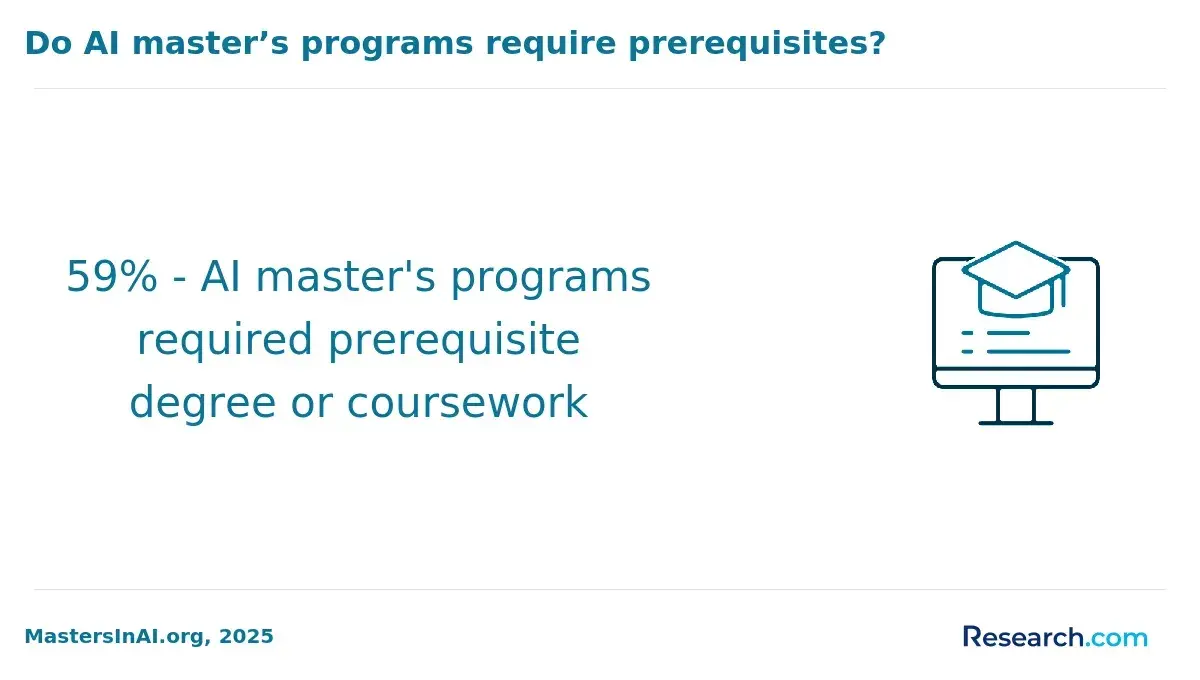
Admission requirements for affordable online AI master's degrees in each state typically include a bachelor's degree in computer science, engineering, mathematics, or a related discipline. Emphasis is placed on strong foundations in programming, statistics, and linear algebra. Applicants must often submit official transcripts confirming this background. Some programs permit enrollment from students with different undergraduate majors provided they complete prerequisites in essential topics such as data structures, algorithms, and calculus.
The Graduate Record Examination (GRE) remains a requirement for about 68% of AI and computer science master's programs. Prospective students should verify each program's specific GRE policy, as some may waive this requirement based on relevant work experience or prior graduate coursework. Letters of recommendation, typically two or three, are also commonly required and should originate from academic or professional supervisors who can attest to the applicant's technical skills and graduate study potential.
A statement of purpose must clearly articulate the applicant's interest in artificial intelligence, career ambitions, and alignment with the program. Additional prerequisites can include proficiency in programming languages like Python or Java and familiarity with machine learning concepts. Many programs require a minimum GPA near 3.0 on a 4.0 scale. For international applicants, proof of English proficiency via TOEFL or IELTS scores is usually necessary.
Prerequisites and qualifications for state-specific online artificial intelligence master's programs vary, so applicants should carefully review each institution's admissions webpage for precise criteria. Preparing documentation that directly addresses these requirements improves admission chances. For those considering related fields, exploring a game design and development degree can offer additional career pathways.
How long does it take to complete an online master's degree in artificial intelligence?
Completing an online master's degree in artificial intelligence typically takes about 24 months when enrolled full-time, consistent with the average duration of affordable online master's programs in artificial intelligence across states. Many STEM online graduate programs nationwide follow this two-year trend, according to data from the National Center for Education Statistics. In contrast, on-campus STEM master's programs often finish faster, averaging around 18 months.
Program length varies by factors including part-time study, which is common among working professionals and can extend completion to three years or more. Some schools offer accelerated tracks or intensive summer courses that may reduce the time to 12-18 months. However, programs with extensive capstone projects or thesis components might require additional months beyond the standard two years. Students should also consider whether synchronous sessions are required, as asynchronous coursework generally allows more flexible pacing.
The time required to complete an online master's degree in artificial intelligence by state can also differ based on available prerequisites. Students lacking foundational skills in machine learning, data science, or programming might need bridge courses before starting core topics, lengthening the overall timeline. This makes it important to review each program's curriculum carefully.
Prospective students seeking options can explore data science masters online programs, which often offer flexible scheduling and diverse pacing suited for various lifestyles.
What core coursework and specializations are included in online AI master's degree curricula?
Online AI master's degree programs primarily cover machine learning and deep learning, included in over 90% of curricula according to the Association for Computing Machinery (ACM) 2024 report. These fundamental courses teach algorithms, neural networks, and model training crucial for AI development across various industries. Complementary subjects often focus on data mining, natural language processing, and computer vision, addressing specific AI challenges like extracting insights from data, interpreting human language, or enabling visual recognition.
Students can specialize in areas such as robotics, autonomous systems, healthcare AI, or AI in cybersecurity to tailor their expertise to evolving job markets. Programs may also offer courses in reinforcement learning and explainable AI, supporting skills in adaptive systems and interpretable decision-making. Hands-on experience with Python programming and frameworks like TensorFlow or PyTorch is a typical component, enhancing practical skills through project-based learning.
Despite the strong technical focus, only about one-third of programs include ethics and responsible AI coursework. These classes are vital for addressing fairness, privacy, bias, and the societal impact of AI technologies, ensuring sustainable deployment and regulatory compliance. Prospective students should carefully check if programs provide comprehensive training in ethical AI.
Balancing rigorous technical content with applied skills, online AI master's degrees shape professionals ready for rapidly advancing fields. Exploring detailed curriculum and specialization options helps align education with career goals.
What career paths and job titles are available to graduates of AI master's degree programs?
AI master's degree graduates have diverse career opportunities across rapidly expanding job markets. According to LinkedIn's 2025 Jobs on the Rise report, AI/machine learning engineer roles make up 41% of master's-level AI job postings. These professionals design and implement machine learning models in fields like technology, healthcare, finance, and autonomous systems.
Data scientists represent 28% of AI-related job listings, focusing on analyzing large datasets with AI techniques to deliver actionable business insights. Their work spans marketing analytics, risk assessment, and product development, enhancing organizational decision-making.
Other career paths include AI research scientists who advance foundational AI theories, and AI product managers who apply technical expertise to guide AI product development and ensure market and regulatory alignment. Roles within AI ethics and policy are growing steadily, providing crucial oversight on responsible AI deployment and regulatory compliance.
Specializations such as natural language processing, computer vision, and robotics engineering highlight the field's diversity. Master's graduates should build skills in programming languages like Python and AI frameworks, alongside strong analytical capabilities, to increase their competitiveness in this dynamic landscape.
What is the average salary and job outlook for AI master's degree holders in the United States?
Master's degree holders in artificial intelligence in the United States earn a median salary of $145,000 annually, reflecting a 35% increase since 2019 according to the U.S. Bureau of Labor Statistics. This growth signals strong demand for advanced AI skills across industries such as technology, healthcare, finance, and manufacturing.
Employment for AI specialists, included in computer and information research scientists, is projected to grow 22% from 2022 to 2032-much faster than average for all occupations. This growth creates numerous job openings, making AI a promising career path.
Salaries vary based on location, experience, industry, and employer. Professionals in tech hubs like California, Washington, and New York often earn above the median, while emerging markets in the Midwest and Southeast offer competitive but lower pay. Specializations such as AI ethics, robotics, or autonomous systems often lead to higher compensation.
Advanced degrees paired with industry certifications and strong portfolios significantly improve job prospects and salary offers. Employers value applied skills and interdisciplinary knowledge combining AI with business or healthcare fields, often awarding premium salaries for such expertise.
How do online AI master's programs compare to campus-based programs in terms of format, flexibility, and outcomes?
Online AI master's programs provide flexible learning designed for working professionals and students with scheduling or location constraints. These programs generally offer asynchronous coursework that can be completed during evenings or weekends. In contrast, campus-based programs often require fixed class times and on-site attendance, which can limit flexibility for those balancing full-time jobs or family responsibilities.
The format influences networking and interaction opportunities. Campus programs allow direct access to professors, peers, and research facilities, enhancing hands-on learning and mentorship. However, many leading online programs now include live sessions, virtual labs, and discussion forums to replicate these experiences. Some hybrid options combine online study with occasional campus residencies, blending convenience with personal interaction.
Employment outcomes for graduates of online and campus AI master's programs are similar. A national study by the National Association for College Admission Counseling (NACAC) indicates an 89% job placement rate within six months for online graduates compared to 91% for campus graduates. Salary comparisons also show no significant differences, reflecting employer emphasis on skills and credentials over program delivery method.
When choosing a program, prospective students should prioritize accreditation, faculty qualifications, and industry ties. Online programs with strong employer partnerships can be equally effective at facilitating internships and career opportunities as traditional campus programs.
What professional certifications or credentials complement an online AI master's degree?
Professional certifications enhance the value of an online AI master's degree by validating specialized skills and boosting job prospects. Notable credentials include the AWS Certified Machine Learning Specialty and the Google Cloud Professional Machine Learning Engineer. A 2024 survey by the Cloud Credential Council found that 43% of AI master's graduates pursuing advanced roles hold one or both of these certifications, highlighting their industry relevance.
These certifications build practical expertise in cloud-based machine learning platforms, complementing theoretical knowledge. AWS certification focuses on designing, building, and optimizing models on Amazon's infrastructure, while Google Cloud certification emphasizes AI deployment within Google's ecosystem. Choosing certifications aligned with target employers or projects is crucial.
Other beneficial certifications include the Certified Data Scientist from the Data Science Council of America, focusing on advanced data analytics, as well as credentials in programming languages like Python and frameworks such as TensorFlow. Microsoft, IBM, and Coursera also offer certificates covering AI ethics, natural language processing, and computer vision.
Certifications demonstrate competence in production-level AI systems, addressing challenges in deployment, scalability, and maintenance. Employers often prefer candidates who combine advanced degrees with certifications to deliver end-to-end AI solutions.
Students should select certifications aligned with career goals, technology interests, and employer needs to maximize the return on their online AI master's investment.
How should prospective students evaluate and choose a reputable online AI master's degree program?
Accreditation is crucial when selecting online AI master's programs, as it assures academic quality and enhances employer recognition. According to the 2024 Society for Human Resource Management (SHRM) employer survey, 67% of hiring decisions in AI roles prioritize the reputation of the degree-granting institution, making it a pivotal factor in your choice.
Examine the curriculum carefully to ensure it aligns with current industry requirements. Essential topics include machine learning, neural networks, natural language processing, and AI ethics. Programs offering hands-on projects, research, or internships develop practical skills critical for career readiness. Specializations in areas like robotics, data science, or computer vision allow students to tailor their education toward specific goals.
Faculty expertise should be evaluated by considering professors' qualifications and research involvement. Connections to industry and active AI research often provide valuable mentorship and networking. Flexible scheduling options also support balancing studies with professional and personal obligations.
Look into graduate success metrics such as employment rates in AI roles, average starting salaries, and alumni networks. Financial considerations including tuition, scholarships, and employer tuition reimbursement are important to review. Reliable online platforms with strong technical support and virtual labs further enhance the learning experience and retention.
Other Things You Should Know About Artificial Intelligence
In 2027, states like Texas, Florida, and Georgia offer some of the most affordable online AI master's programs. These states provide a range of programs accredited by respected institutions, ensuring both quality education and cost-effectiveness for students pursuing a degree in artificial intelligence.
To gain admission to an affordable online AI master's program in 2027, applicants typically need a bachelor’s degree in computer science or a related field, transcripts, a statement of purpose, and letters of recommendation. Some programs may also require GRE scores.
Many affordable online AI master’s programs end with a capstone instead of a thesis. Typical capstones require 3 to 6 graduate credits and a final project approved by the department, while thesis options are more common in research tracks at regionally accredited universities.
References
- Finding Your Dream Master's Program in AI | Towards Data Science https://towardsdatascience.com/finding-your-dream-masters-program-in-ai-17f525c89151/
- Top 25 Online Master’s In AI Programs for 2026 - Programs.com https://programs.com/programs/online-masters-in-ai/
- Cheapest Master in Artificial Intelligence Online https://agtu.us/en/programs/graduate-programs/computer-science/cheapest-master-artificial-inteligence/
- Best AI Certifications to Boost Your Career in 2026 – Dataquest https://www.dataquest.io/blog/best-ai-certifications/
- 16 Artificial Intelligence Career Paths https://www.calmu.edu/news/artificial-intelligence-career-paths
- What Can I Do With a Master’s Degree in Artificial Intelligence (AI)? https://wp.wpi.edu/catalyst/2024/04/03/what-can-i-do-with-a-masters-degree-in-artificial-intelligence-ai/
- How to Find the Best Online MS in AI | University of Bridgeport https://www.bridgeport.edu/news/best-online-ms-ai-degree/
- Most Affordable Online Master's in AI for 2026 https://aidegreeprograms.org/rankings/affordable-online-ai-masters/
- Most Affordable Online Master's in AI for 2025 https://www.mastersinai.org/degrees/affordable-online-masters-in-ai/
- 11 Best AI Certifications in 2025 to Deepen Your Technical Knowledge | DigitalOcean https://www.digitalocean.com/resources/articles/ai-certifications