2027 AI Associate Degrees in Ohio: Best Online and On-Campus Options

Co-Founder and Chief Data Scientist
Many professionals with unrelated undergraduate degrees seek to enter the growing AI field but struggle to find flexible, accredited education that balances work and study. Choosing between online and on-campus associate degrees in Ohio adds complexity due to varying program structures and outcomes. Prospective students face challenges identifying programs that match their career goals while accommodating busy schedules. This article examines top online and on-campus AI associate degree options in Ohio, highlighting key program features, delivery modes, and accreditation to guide informed decisions for those aiming to pivot successfully into the AI industry.
Key Things You Should Know
- Ohio offers over 20 accredited AI associate degrees with flexible online and traditional campus options as of 2026, supporting diverse student needs and schedules.
- Graduates of Ohio's AI programs earn an average starting salary around $60,000, reflecting strong regional demand for AI technicians and developers in industries like manufacturing and healthcare.
- Institutions emphasize hands-on learning with state-of-the-art labs and internships, aligning curricula with evolving AI technologies and workforce requirements through 2025-2026.
What are the best accredited AI associate degree programs in Ohio?
Ohio offers some of the best accredited artificial intelligence associate degree programs in Ohio through community colleges and technical schools with strong connections to local tech industries. Lorain County Community College provides an associate of applied business in computer information systems featuring AI and machine learning electives. Sinclair Community College focuses on data analytics, which forms the foundation for AI development. Both institutions are accredited by the Higher Learning Commission, ensuring recognized and quality education.
Many prospective students seek top online and on-campus AI associate degrees in Ohio, with flexible options becoming more popular. Hybrid programs that mix on-campus labs with online coursework are ideal for working professionals and remote learners. However, purely online pathways may limit access to hands-on AI programming tools and collaborative projects essential for skill mastery.
When evaluating AI associate degrees, consider curriculum alignment with current AI technologies, availability of internships or co-op experiences, faculty expertise, class size, and access to computing resources. Strong programs typically cover programming languages like Python, machine learning basics, data structures, and the ethical aspects of AI. Technical colleges such as Cuyahoga Community College integrate real-world AI applications in cybersecurity and software development tracks, enhancing job readiness.
Students interested in flexible pathways may explore a 2-year computer science degree online as a stepping stone toward advanced AI studies or careers.
Can you earn an AI associate degree online in Ohio, and what are the tradeoffs?
Yes, you can earn an online AI associate degree program in Ohio, but these paths often involve tradeoffs. Schools such as Cuyahoga Community College and Owens Community College offer programs that include significant online coursework, although fully online degrees remain rare. Most programs use a hybrid format, blending online classes with in-person labs to deliver essential hands-on experience.
Benefits of earning an AI associate degree online in Ohio include flexibility for students balancing work or family. However, drawbacks are worth considering: limited access to specialized labs, software, and direct interaction with faculty and peers can affect skill development and networking opportunities.
Accreditation is crucial. Regional accreditation guarantees overall institutional quality, while programmatic accreditation like ABET signals rigor and industry relevance. Over 400 institutions hold ABET-accredited computing programs globally, but many Ohio online options lack this hallmark, potentially impacting credit transfer and employer recognition.
Students should carefully evaluate program curricula, faculty expertise, support services, and the extent of hands-on practice. Hybrid programs often offer a balanced approach. For prospective learners seeking affordable options, exploring the cheapest online master's mechanical engineering can also provide insights into competitive pricing and program standards.
What can you do with an AI associate degree in Ohio?
An AI associate degree in Ohio opens career paths such as AI technician, data analyst, machine learning assistant, and software developer support. These jobs focus on managing AI systems, analyzing data trends, and assisting in deploying AI models. Employers in sectors like manufacturing, healthcare, finance, and technology increasingly seek candidates with foundational AI skills to enhance automation and data-driven decision-making. Such degrees often lead to roles in IT support for AI applications, maintaining AI hardware and software infrastructure.
Graduates with AI associate degrees jobs in Ohio also find opportunities as AI system testers or quality assurance technicians ensuring AI applications meet required standards. Positions like business intelligence assistant, supporting data collection using AI tools, and automation technician for AI-driven robotics or process automation are practical career options.
- AI system tester or quality assurance technician ensuring AI applications meet standards
- Business intelligence assistant supporting data collection and reporting with AI tools
- Automation technician for industries implementing AI-driven robotics or process automation
This degree serves as a gateway to a bachelor's in computer science, data science, or AI, unlocking advanced roles such as AI engineer or data scientist. Admission requirements typically emphasize proficiency in math and English, with some programs expecting algebra and basic programming skills essential for AI coursework and careers. Prospective students interested in related fields may also explore a video game development degree as an alternative path.
Careers with artificial intelligence associate degree Ohio graduates pursue include entry-level jobs in AI research labs or collaboration with development teams to test AI applications, offering solid foundations for future advancement in this growing field.
How does regional and programmatic accreditation affect AI associate degrees in Ohio?
Regional accreditation impact on AI associate degrees in Ohio is significant for students seeking widely recognized credentials. Institutions with regional accreditation meet comprehensive academic standards, which facilitates credit transfer and enhances acceptance by employers and universities nationwide. Earning a degree from a non-regionally accredited college can hinder career advancement and further education opportunities.
Programmatic accreditation plays an important role in ensuring the quality of Ohio AI associate programs. This specialized accreditation, such as that from ABET, verifies that the curriculum adheres to industry standards and prepares students with relevant skills and certifications. Such recognition improves employer confidence and increases job placement prospects for graduates.
Prospective students should carefully check both types of accreditation before enrolling to avoid programs lacking academic rigor or industry relevance. Many community colleges in Ohio offer regionally accredited AI-related degrees, but fewer hold programmatic accreditation specific to computing technology or AI.
Complementing an accredited degree with certifications like the AWS Cloud Practitioner can further boost job market competitiveness. More than 1,000,000 individuals hold this certification, making it a trusted entry-level credential in cloud and AI-related fields. Additionally, students interested in related fields might explore options among cyber security schools online, which can also complement AI career paths.
What classes and skills are taught in an AI associate degree curriculum?
An AI associate degree in Ohio builds foundational and technical skills needed for roles such as AI technician, data analyst, and support specialist. Core coursework covers programming languages like Python and Java, essential for developing AI models and automating processes. Students gain knowledge of data structures, algorithms, and introductory machine learning to understand AI system functions.
Key curriculum components include programming fundamentals, database management, statistics, and entry-level courses on neural networks and natural language processing. Practical labs and projects often use popular frameworks like TensorFlow and PyTorch, providing hands-on experience in AI model training and deployment. Ethical issues and data privacy also form part of the training, preparing students for responsible AI use.
Strong communication and problem-solving skills are emphasized to enhance collaboration with data scientists and engineers. Graduates learn to interpret AI outputs and efficiently troubleshoot AI systems. This skill set aligns with growing demand in Ohio's tech industry for AI-related technician roles.
According to the U.S. Bureau of Labor Statistics Employment Projections 2023-2033, data scientist jobs are set to increase by 36% nationwide, driving a surge in supporting AI technical positions. Completing an AI associate degree can position students to meet these expanding career opportunities.
What are the admissions requirements and prerequisites for AI associate programs in Ohio?
Admissions requirements for AI associate degree programs in Ohio vary by school but generally include a high school diploma or GED, proof of proficiency in basic math and English, and sometimes placement test results. Most community colleges ask for official transcripts verifying secondary education completion. Some programs also require a minimum cumulative GPA, typically around 2.0 on a 4.0 scale.
Prerequisites focus on foundational skills such as algebra and computer literacy. Many institutions expect students to have completed coursework in these areas or demonstrate competency in logical reasoning. Introductory coding or computer science classes may be required before taking specialized AI courses.
Applicants with relevant IT or programming work experience or certifications can sometimes bypass certain prerequisites. Ohio schools often provide online assessments to evaluate readiness, accommodating nontraditional students without typical academic backgrounds.
International students must submit proof of English proficiency, commonly through TOEFL or IELTS scores, with minimums around 70 (TOEFL) or 6.0 (IELTS). Prior college credits related to computing can also accelerate program entry.
According to the National Center for Education Statistics, nearly 70% of students entering Ohio's associate technical programs meet placement requirements on their first attempt, reflecting the clarity and accessibility of these admissions standards.
How long does an AI associate degree take, and what does it cost in Ohio?
An AI associate degree in Ohio generally requires about two years of full-time study, matching national norms for associate programs. The curriculum emphasizes foundational AI skills, data science, and programming. Some schools offer part-time enrollment, extending completion to three or four years, which can accommodate working students.
Tuition rates vary depending on the institution and residency. Community colleges in Ohio typically charge between $4,000 and $6,000 per year for in-state students, while private or out-of-state schools may exceed $10,000 annually. Total tuition for the entire program ranges from roughly $8,000 to more than $20,000, not including fees or materials.
Online AI associate degrees offer additional flexibility, often maintaining similar tuition costs and increasing accessibility for those outside urban areas. Prospective students should consider the transferability of credits if planning to pursue a bachelor's degree later.
The National Center for Education Statistics reports the average associate degree completion time in Ohio at 2.1 years. Students benefit from selecting accredited institutions with strong AI programs and flexible scheduling options that fit their lifestyles.
Which certifications pair best with an AI associate degree in Ohio?
Certifications paired with an AI associate degree in Ohio significantly elevate technical expertise and job prospects in a competitive market. The Certified Artificial Intelligence Practitioner (CAIP) is a key credential that confirms hands-on knowledge of AI algorithms and deployment strategies. Ohio students can also benefit from vendor-recognized certificates such as Microsoft Certified: Azure AI Fundamentals, which highlights essential skills in cloud-based AI services needed for many mid-level roles.
Programming certifications, especially in Python like the PCAP - Certified Associate in Python Programming, build essential coding skills pivotal for AI development and data manipulation. Candidates aiming for specialization in machine learning will find Google's Professional Machine Learning Engineer certification especially valuable.
Data-centric certificates such as the IBM Data Science Professional Certificate enhance an AI associate degree by providing proficiency in data analysis and visualization-core components of AI workflows. According to the U.S. Bureau of Labor Statistics, computer and information research science jobs, including AI roles, are projected to grow 21% from 2022 to 2032, outpacing average job growth.
Additional recommended certifications include the Certified Ethical Emerging Technologist for AI ethics and governance and CompTIA Security+ to address critical security concerns in AI systems. Gaining practical experience through internships or hackathons further improves employability, meeting employer expectations in Ohio's emerging AI sectors.
What salaries can Ohio graduates expect with an AI associate degree?
Ohio graduates holding an associate degree in artificial intelligence typically earn entry-level salaries between $50,000 and $65,000 annually, influenced by job roles and industry sectors. Positions such as AI technicians, data analysts, and junior machine learning specialists generally fall within this salary range. With experience and additional certifications, earnings can rise to $75,000 or higher over time.
Salary variations depend on location, employer sector, and technical skills. For instance, graduates working in the Cleveland and Columbus metro areas often see higher wages due to greater demand and living costs. Industries like technology and healthcare, which invest heavily in AI, usually offer better compensation compared to manufacturing or administrative roles.
- Programming skills in Python and neural networks boost salary potential.
- Internships and practical portfolios improve employability and starting pay.
- Advancing from an associate to a bachelor's degree in STEM fields typically results in significant salary growth.
Data from the National Association of Colleges and Employers report a national average starting salary of about $57,000 for associate degree graduates in AI-related fields, aligning closely with Ohio's figures. This highlights Ohio's competitive position within the Midwest for those entering the artificial intelligence workforce.
What is the job outlook for AI-related roles in Ohio with an associate degree?
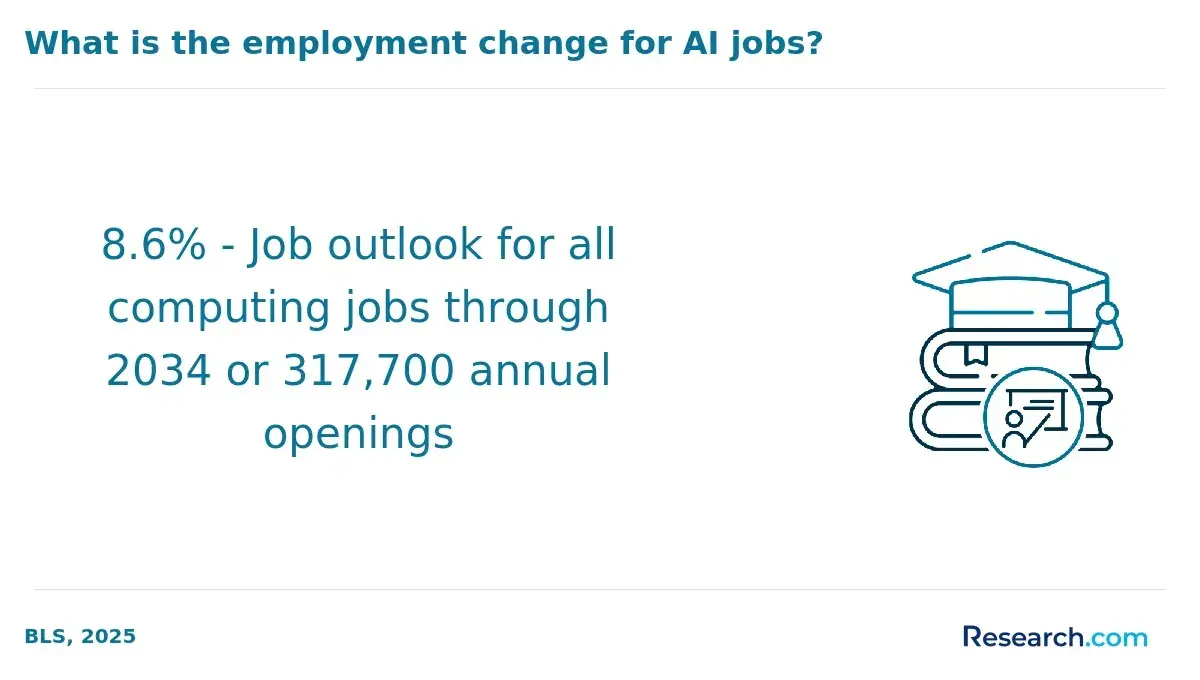
The demand for AI-related roles in Ohio with an associate degree is growing due to expansion in technology and manufacturing sectors. Employment for computer and information technology jobs in Ohio is expected to rise by 15% through 2031, outpacing the average growth for all occupations. This trend benefits positions such as AI technicians and support specialists that require an associate degree.
Ohio's diverse economy incorporates automotive manufacturing, healthcare, and finance industries, all increasingly adopting artificial intelligence solutions. Entry-level jobs often include AI data analysts, machine learning technicians, and automation specialists, primarily focusing on data preparation, algorithm support, and system monitoring. These roles typically require foundational technical skills achievable with an associate degree.
Additional career paths include system maintenance and AI hardware interfacing, demanding hands-on expertise. According to the U.S. Bureau of Labor Statistics, average starting salaries for these roles range from $45,000 to $65,000 annually, varying by employer and complexity.
While advanced AI research roles require higher degrees, associate degree holders are essential to the AI workforce. Certifications in programming languages like Python and familiarity with AI platforms improve job prospects. Employers in Ohio highly value practical skills and experience, making internships and cooperative education critical for gaining a competitive edge.
Other Things You Should Know About Artificial Intelligence
Yes, internships provide valuable hands-on experience with real-world AI applications and can significantly enhance a graduate's employability. Many associate degree programs in Ohio encourage or require internships as part of the curriculum to bridge theoretical knowledge with practical skills. They also offer networking opportunities with industry professionals and a chance to work on projects that showcase relevant expertise.
AI degree programs frequently update their course content to reflect the rapid advancements in AI technology, including new algorithms, tools, and ethical considerations. In Ohio, colleges often collaborate with tech companies and industry experts to ensure curricula remain aligned with current trends and workforce demands. This continuous adaptation helps students develop relevant, marketable skills upon graduation.
Many Ohio colleges and universities allow students to transfer credits earned from an AI associate degree toward a bachelor's degree in computer science, data science, or AI-related fields. Transferability depends on articulation agreements between institutions and the relevance of completed coursework. Prospective students should verify transfer policies early to ensure a smooth transition if they plan to pursue further education.
Prospective students typically need a high school diploma or GED. Basic proficiency in math and English is also required. Some programs may prefer applicants with prior coursework in computer science. A master’s in AI for humanities graduates is available for those diversifying their educational background.
References
- Artificial Intelligence Course Syllabus: Topics and Modules https://futurense.com/blog/artificial-intelligence-course-syllabus
- AI Programs and Courses | DeVry University https://www.devry.edu/online-programs/area-of-study/artificial-intelligence.html
- Ohio researchers predict the most critical job skills as AI gains traction https://www.statenews.org/news/2023-08-07/ohio-researchers-predict-the-most-critical-job-skills-as-ai-gains-traction
- How To Be an Agentblazer and Drive Agentforce Success With AI Certifications https://www.salesforce.com/blog/salesforce-ai-associate-data-cloud-consultant-certification/
- 11 Best AI Certifications in 2025 to Deepen Your Technical Knowledge | DigitalOcean https://www.digitalocean.com/resources/articles/ai-certifications
- New Use of Artificial Intelligence Accreditation Policy and Procedures - Middle States Commission on Higher Education https://www.msche.org/2025/07/02/new-use-of-artificial-intelligence-accreditation-policy-and-procedures/
- College Students Weigh AI's Impact on Majors and Careers https://news.gallup.com/poll/704087/college-students-weigh-impact-majors-careers.aspx
- Best Artificial Intelligence Degree Programs in Ohio — 2026 Rankings https://hakia.com/degrees/artificial-intelligence/ohio/
- Ohio Artificial Intelligence (AI) Degree Programs - AI Degrees Online https://aidegreesonline.com/state/ohio/ai-degree-programs-oh/
- Artificial Intelligence IT Certificate | CSCC https://www.cscc.edu/for-business/it-workforce-certificates/ai-artificial-intelligence-certificate.shtml