
2027 What is a Computer Programmer: Salary & Career Paths

Co-Founder and Chief Data Scientist
Choosing a computer programming career is no longer as simple as learning one language and applying for a coding job. Employers now expect programmers to understand software design, testing, security, collaboration tools, cloud platforms, and increasingly, AI-assisted development. At the same time, the traditional “computer programmer” job title is changing as some routine coding work becomes automated or moved into broader software development roles.
This guide is for students, career changers, and early-career tech workers who want a realistic view of what computer programmers do, how much they can earn, what education paths are available, and which career directions may offer stronger long-term prospects. You will learn how to compare programming roles, evaluate degree and training options, build a portfolio, reduce education costs, and prepare for a tech career that can adapt as the labor market changes.
Quick Answer: Is Computer Programming a Good Career Path?
Computer programming can be a strong career path for people who enjoy problem-solving, logic, and continuous learning. The field still offers solid earning potential, with computer programmer salaries generally ranging from $61,000 to $135,500 and an average annual salary of approximately $99,070 in the United States for 2027. However, the occupational outlook for the specific computer programmer title is challenging, with the U.S. Bureau of Labor Statistics projecting a 10% decrease in employment from 2023 to 2033. The best opportunities are likely to go to programmers who expand into software development, cloud computing, cybersecurity, data analytics, AI, or specialized industry applications.
Key Things You Should Know About a Computer Programming Career
- A degree is common, but not the only route. Many programmers enter the field with a bachelor’s degree in computer science or a related discipline, and 59.9% hold a bachelor's degree. Associate degrees, bootcamps, certificates, and strong portfolios can also support entry into some roles.
- Programming jobs exist far beyond tech companies. Programmers work in software firms, government agencies, healthcare organizations, colleges, business services, and education technology environments.
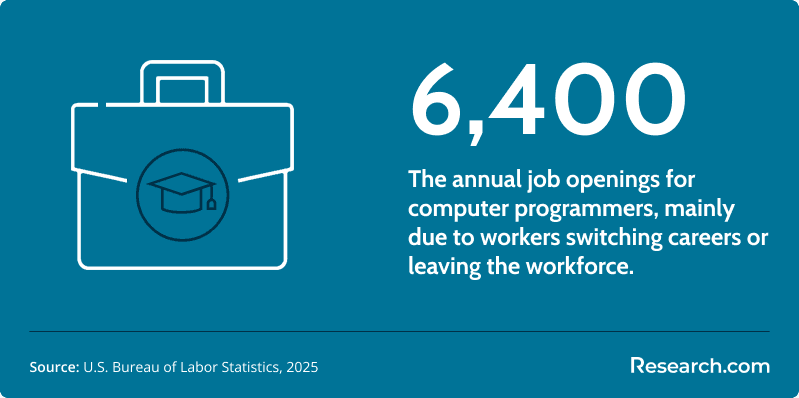
- Openings still occur despite a declining occupational outlook. About 6,400 job openings for computer programmers are expected each year, mostly because workers move into other roles or leave the labor force.
- Career direction matters. Related roles such as software developer, database administrator, web developer, systems analyst, and data analyst may offer different responsibilities, salary levels, and growth opportunities.
- Higher pay usually requires broader skills. Programmers who can work with cloud systems, databases, secure coding, AI tools, software architecture, or business-critical applications are often better positioned than those who only write basic code.
- What does a computer programmer do?
- How much does a computer programmer earn for 2027?
- What are the main career paths for computer programmers?
- What education do computer programmers need?
- How do you get a degree in computer programming?
- How can you build a competitive programming portfolio?
- Which programming-related paths lead to higher-paying computer jobs?
- How can programmers make their code more secure?
- Is game development a realistic path for programmers?
- How should you think about education cost and tech career ROI?
- What lower-cost education options can aspiring programmers consider?
- How can programmers use AI without becoming dependent on it?
- How can interdisciplinary skills improve a programming career?
- How can programmers advance their careers?
- Which industries hire computer programmers?
- What skills do computer programmers need?
- What is the job outlook for computer programmers for 2027?
What does a computer programmer do?
A computer programmer writes, reviews, tests, debugs, and updates the code that makes software work. In practical terms, programmers convert technical requirements into instructions a computer can follow. Some focus on maintaining existing systems, while others help build new applications, automate business processes, or improve performance in software products.
The work can vary by employer, but most programming jobs include some combination of the following responsibilities:
- Writing application code. Programmers use languages such as Python, Java, C++, or JavaScript to create software features, automate processes, or support larger development projects. Good code must be readable, efficient, and maintainable.
- Finding and fixing defects. Debugging is a major part of the job. Programmers trace errors, reproduce problems, test fixes, and make sure one change does not create new failures elsewhere in the system.
- Testing software behavior. Programmers often run unit tests, integration tests, and regression checks to confirm that software works as intended before and after updates.
- Working with technical and nontechnical teams. Programmers may collaborate with software developers, designers, quality assurance specialists, project managers, cybersecurity staff, and business users to make sure software meets real needs.
- Maintaining and improving existing systems. Many programmers spend time updating older code, improving speed, adding features, resolving compatibility issues, or adapting software to new platforms.
- Documenting code and decisions. Clear documentation helps future developers understand how a program works, why design choices were made, and how to safely update the codebase.
| Programming task | Why it matters in the workplace |
| Writing code | Creates the instructions that power applications, websites, databases, and business systems. |
| Debugging | Prevents software failures, performance problems, and poor user experiences. |
| Testing | Reduces the risk of releasing broken or insecure software. |
| Documentation | Makes code easier for teams to maintain, audit, and improve. |
| Collaboration | Connects technical work to business goals, user needs, and project deadlines. |
How much does a computer programmer earn for 2027?
For 2027, the average annual salary for a computer programmer in the United States is approximately $99,070. Typical pay ranges from $61,000 to $135,500, but actual earnings depend on experience, location, industry, technical specialization, and the complexity of the systems a programmer supports.
Entry-level programmers earn about $61,924 annually. Pay generally rises with experience, although salary growth is not automatic. Programmers who move into software engineering, cloud development, data systems, cybersecurity, or technical leadership often have stronger earning potential than those who remain in narrow maintenance roles.
| Experience Level | Median Salary (USD Per Year) |
| 0–1 years of experience | $61,924 |
| 1–3 years of experience | $68,507 |
| 4–6 years of experience | $74,175 |
| 7–9 years of experience | $75,658 |
| 10–14 years of experience | $78,512 |
| 15+ years of experience | $88,401 |
| Source: Glassdoor, 2025 |
Location can also create large pay differences. In Washington, for example, the average salary is $158,520 annually. Higher salaries in some regions often reflect higher living costs, stronger employer concentration, and greater competition for experienced technical workers.
What are the main career paths for computer programmers?
Computer programming skills can lead to several related career paths. The best option depends on whether you prefer building applications, managing data, designing user-facing websites, improving business systems, or turning information into insights. The table below compares common programming-related roles using the salary figures provided in the source article.
| Career path | Best fit for people who enjoy | Median salary |
| Software Developer | Building applications, designing features, and solving product problems | $111,845 per year |
| Database Administrator | Protecting, organizing, backing up, and optimizing data systems | $98,860 per year |
| Web Developer | Creating websites, user interfaces, and interactive online experiences | $93,848 per year |
| Systems Analyst | Connecting business needs with technical solutions | $89,296 per year |
| Data Analyst | Using data to find patterns, explain trends, and support decisions | $82,640 per year |
1. Software Developer
Software developers design and build applications, platforms, and systems. Compared with traditional programmers, they are often more involved in planning features, choosing technical approaches, reviewing architecture, and coordinating with stakeholders. An online software engineering degree can help students build a foundation in programming languages, development methods, testing, and software design.
Median salary: $111,845 per year
2. Database Administrator
Database administrators manage the systems that store and protect organizational data. Their responsibilities may include performance tuning, backups, access control, security monitoring, database recovery, and troubleshooting. This path is a strong fit for programmers who like structured systems, reliability, and data integrity.
Median salary: $98,860 per year
3. Web Developer
Web developers build and maintain websites and web applications. Some focus on front-end interfaces, while others specialize in back-end systems, APIs, databases, or full-stack development. Students who want an accelerated route into this field may compare the best full stack web development bootcamps to see whether an intensive skills-based program matches their goals.
Median salary: $93,848 per year
4. Systems Analyst
Systems analysts study how an organization uses technology and recommend ways to improve efficiency, performance, or user experience. They often translate business requirements into technical specifications and work closely with developers during implementation. This role suits programmers who communicate well and want to work closer to operations or strategy.
Median salary: $89,296 per year
5. Data Analyst
Data analysts collect, clean, interpret, and present information so organizations can make better decisions. Programming knowledge is useful for automating data work, querying databases, building dashboards, and supporting statistical analysis. This path is especially relevant for programmers who enjoy business questions and evidence-based decision-making.
Median salary: $82,640 per year
What education do computer programmers need?
Most computer programmers have formal postsecondary education, commonly in computer science, software engineering, information technology, or a related technical field. A bachelor’s degree is the most common route, but it is not the only way to enter the field. Employers may also consider candidates with associate degrees, coding bootcamp training, certificates, strong portfolios, open-source contributions, internships, or relevant work experience.
| Education option | When it may make sense | Key trade-off |
| Associate degree | You want a lower-cost or faster academic path into entry-level technical work. | Some employers may prefer a bachelor’s degree for software development roles. |
| Bachelor’s degree | You want a broader foundation in programming, algorithms, systems, and computer science concepts. | It usually requires a larger time and financial commitment. |
| Coding bootcamp | You want intensive, job-focused training in a specific area such as web development. | Quality and employer recognition can vary, so outcomes should be reviewed carefully. |
| Certificates and certifications | You already have some background and want to validate skills in cloud, databases, security, or development tools. | Credentials alone rarely replace a strong portfolio or practical experience. |
| Self-directed learning | You are disciplined and can build real projects independently. | You must work harder to prove skill level to employers. |
Before enrolling in any program, check accreditation, curriculum quality, faculty experience, career support, internship access, transfer credit rules, and whether the program teaches current tools rather than only theory. Also confirm whether the program helps students build portfolio-ready projects.
How do you get a degree in computer programming?
A computer programming degree can provide structure, academic credibility, and guided practice. The steps below can help you choose a program that supports your career goals instead of simply selecting the first available option.
- Identify accredited schools first. Start with institutions that offer programming, computer science, software engineering, or information technology programs. Accreditation matters because it affects credit transfer, employer recognition, and access to many forms of financial aid.
- Match the degree level to your goal. An easiest associates degree may be a faster entry point for some students, while a bachelor’s degree can provide deeper preparation for software development, systems work, and long-term advancement.
- Review admissions requirements early. Schools may ask for a high school diploma or GED, transcripts, standardized test scores, prerequisite coursework, or evidence of prior technical work. Check deadlines so you do not miss scholarship or financial aid opportunities.
- Compare the curriculum, not just the program title. Look for courses in Python, Java, C++, data structures, algorithms, databases, software testing, secure coding, and systems fundamentals. A strong program should teach both coding syntax and problem-solving.
- Prioritize hands-on experience. Internships, co-op programs, labs, capstone projects, and team-based development work can make your resume stronger. Employers want proof that you can build, test, document, and improve real software.
| Question to ask a school | Why it matters |
| Is the institution accredited? | Accreditation affects credibility, transfer options, and financial aid eligibility. |
| What programming languages and tools are taught? | The curriculum should prepare you for current employer expectations. |
| Are internships or capstone projects required? | Practical experience helps you compete for entry-level roles. |
| Can previous credits transfer? | Transfer policies can reduce time to completion and total cost. |
| What career services are available? | Resume help, employer connections, and interview preparation can improve job readiness. |
How can you build a competitive programming portfolio?
A strong programming portfolio should prove that you can solve practical problems, not just complete tutorials. Employers and hiring managers want to see readable code, working projects, clear documentation, and evidence that you understand trade-offs such as performance, usability, security, and maintainability.
Build a portfolio around several types of projects: one project that uses a database, one that includes a user interface, one that demonstrates problem-solving with algorithms or automation, and one collaborative project that shows you can use version control. For each project, explain the problem, the tools used, your specific contribution, how the project works, and what you would improve next.
- Use Git and a public code repository. Show clean commit history, meaningful README files, and organized project folders.
- Deploy at least one project. A live website, app, dashboard, or API is easier to evaluate than code alone.
- Document your decisions. Explain why you chose a language, framework, database, or architecture.
- Include tests when possible. Testing shows professional discipline and helps separate serious candidates from beginners.
- Update the portfolio regularly. Remove weak early projects as your skills improve and replace them with stronger examples.
If you need a structured path to build fundamentals quickly, a 1 year computer science degree program may help you strengthen your academic foundation while adding projects that support your job search.
Which programming-related paths lead to higher-paying computer jobs?
Higher-paying computer jobs usually require more than basic coding ability. Roles that combine programming with architecture, data systems, cloud infrastructure, cybersecurity, enterprise software, or artificial intelligence tend to command stronger compensation because they affect critical business operations.
If you are interested in data-heavy or infrastructure-focused work, comparing the best bachelor’s degrees in database management can help you understand how database training fits into technical careers. For a broader view of compensation across advanced roles, review Research.com’s guide to the highest paying computer jobs.
| If you want higher earning potential | Skills to build |
| Software engineering | System design, testing, APIs, architecture, and scalable development practices |
| Data and databases | SQL, database design, performance tuning, data modeling, and reporting |
| Cybersecurity | Secure coding, threat awareness, authentication, encryption, and vulnerability management |
| Cloud development | AWS, Azure, containers, deployment pipelines, and distributed systems |
| AI-related development | Machine learning libraries, data pipelines, model integration, and responsible AI use |
How can programmers make their code more secure?
Programmers strengthen cybersecurity by treating security as part of the development process rather than a final checklist. Secure coding involves validating inputs, managing authentication properly, protecting sensitive data, keeping dependencies updated, reviewing code for vulnerabilities, and testing applications under realistic conditions.
Programmers should also understand common risks such as weak access controls, exposed credentials, injection attacks, insecure APIs, and outdated libraries. Those who want deeper security training may consider an affordable cyber security degree online to build stronger knowledge in risk management, secure systems, and defensive programming.
Is game development a realistic path for programmers?
Game development can be a viable path for programmers who want to combine technical problem-solving with interactive design. It is not just “coding games.” The field can involve physics engines, graphics programming, real-time rendering, networking, tools development, artificial intelligence for gameplay, optimization, and cross-platform performance.
This path may appeal to programmers who enjoy creative products and are willing to build specialized skills. Online programs from game design schools online can help students learn how programming connects with design, storytelling, animation, and user experience. Game programming can also apply beyond entertainment, including simulation, training, and educational technology.
How should you think about education cost and tech career ROI?
Return on investment in tech education depends on more than tuition. You should compare total cost, time away from work, transfer credits, financial aid, graduation requirements, career support, and whether the program produces job-ready skills. A lower-cost program that lacks projects, advising, or employer connections may not be a better deal than a more structured program with stronger outcomes.
When comparing programming education with other technical fields, reviewing information on electrical engineering degree cost can provide a useful affordability benchmark. The goal is not to choose the cheapest option automatically, but to choose the pathway that balances cost, credibility, practical training, and career relevance.
What lower-cost education options can aspiring programmers consider?
Aspiring programmers can reduce education costs by comparing community colleges, online degree programs, transfer pathways, employer tuition assistance, certificates, bootcamps, and self-paced courses. The right option depends on your current background, time available, learning style, and target role.
Students who want an affordable technical education may also review inexpensive accredited engineering online colleges to compare how accredited online programs can lower costs while still providing structured instruction. Whatever path you choose, confirm that the program teaches practical skills, supports portfolio development, and has clear policies on credit transfer and completion requirements.
How can programmers use AI without becoming dependent on it?
AI tools can help programmers generate boilerplate code, explain unfamiliar syntax, suggest tests, summarize documentation, and identify possible errors. Used well, these tools can increase productivity. Used carelessly, they can create security issues, inaccurate code, licensing concerns, and shallow understanding.
Programmers should treat AI-generated code as a draft that must be reviewed, tested, and understood. The most competitive professionals will know how to combine AI assistance with strong fundamentals in algorithms, debugging, architecture, security, and domain knowledge. Those who want formal preparation in this area can explore the best online AI degrees to study machine learning concepts, AI development tools, and emerging applications.
How can interdisciplinary skills improve a programming career?
Programmers who understand another field can often solve more valuable problems. Combining coding with healthcare, finance, education, cybersecurity, data analytics, manufacturing, or public administration can make you more useful to employers because you understand both the technical system and the real-world context.
For example, programmers interested in healthcare technology may compare health informatics schools online to learn how data systems, clinical workflows, privacy, and analytics intersect. Interdisciplinary skills can also make it easier to move into product management, systems analysis, analytics engineering, or technical consulting.
How can programmers advance their careers?
Career advancement in programming usually comes from expanding your scope. Instead of only completing assigned coding tasks, advanced programmers learn to design better systems, mentor others, communicate with stakeholders, improve development workflows, and specialize in high-value technical areas.
Certifications can help when they match your target role, especially in cloud development, databases, agile teams, and infrastructure. They are most useful when paired with real projects and work experience.
- Certified Software Development Professional (CSDP). Offered by the IEEE Computer Society, this credential focuses on software engineering principles, including development, design, and testing.
- Microsoft Certified: Azure Developer Associate. This certification is designed for programmers who build applications on Microsoft Azure and want to strengthen cloud development skills.
- Oracle Certified Professional (OCP). This credential supports professionals who work with Oracle technologies, database-related development, or Java programming.
- Certified Scrum Developer (CSD). This certification demonstrates familiarity with agile development practices and collaboration in Scrum-based teams.
- AWS Certified Developer – Associate. This credential validates skills in developing and maintaining applications on Amazon Web Services.
- Certified Kubernetes Administrator (CKA). This certification is relevant for professionals working with containers, deployment, and cloud-native application environments.
If you want a quick way to add credentials, Research.com’s guide to easy certifications to get online can help you compare options. If your next step is data analysis or machine learning, the best data science bootcamps may offer a shorter, project-based route into data-focused work.
| Career goal | Best next move |
| Move from programmer to software developer | Build full applications, learn testing, study system design, and contribute to team projects. |
| Specialize in cloud development | Learn AWS or Azure, deployment pipelines, containers, and application monitoring. |
| Enter cybersecurity work | Study secure coding, authentication, vulnerability scanning, and incident prevention. |
| Shift into data roles | Build SQL, Python, visualization, statistics, and data cleaning skills. |
| Prepare for leadership | Improve communication, documentation, mentoring, code review, and project planning skills. |
Which industries hire computer programmers?
Computer programmers are needed in any organization that builds, maintains, customizes, or depends on software. While many people associate programming with technology companies, programming work also supports education, government, healthcare, business operations, and digital services.
- Computer systems design and related services. Programmers help build custom software, integrate systems, automate workflows, and support client technology needs.
- Colleges, universities, and professional schools. Educational institutions use programmers for academic platforms, administrative systems, data tools, and online learning technologies.
- Software publishers. Programmers help create, test, update, and maintain commercial software products, including applications, productivity tools, and gaming software.
- State government. Government agencies hire programmers to support public services, databases, internal systems, reporting tools, and citizen-facing applications.
- Management of companies and enterprises. Large organizations use programmers to maintain enterprise systems, improve business operations, and support internal software tools.
Students who want to enter the field sooner may compare quick online degrees that provide flexible study options while building technical qualifications for programming-related roles.
What skills do computer programmers need?
Computer programmers need both technical and workplace skills. Technical ability helps you write and maintain software. Professional skills help you work with teams, meet deadlines, understand requirements, and communicate solutions clearly.
Technical Skills Required for Computer Programming
- Programming languages. Python, Java, C++, and JavaScript are common examples. The best language to learn depends on whether you want to work in web development, software engineering, data work, systems programming, or another area.
- Algorithms and data structures. These concepts help programmers write efficient code and solve complex problems without wasting memory, time, or computing resources.
- Database management. Skills with SQL, NoSQL, MySQL, MongoDB, or similar systems help programmers store, retrieve, update, and protect data.
- Version control. Git, GitHub, and similar tools allow teams to track code changes, review work, roll back mistakes, and collaborate safely.
- Software development frameworks. Frameworks such as React, Django, and .NET help programmers build applications more efficiently using established patterns and reusable tools.
General Skills Required for Computer Programming
- Problem-solving. Programmers must break large problems into smaller pieces, test possible solutions, and think logically under constraints.
- Attention to detail. Small errors can cause major defects, so programmers need careful review habits and a willingness to test thoroughly.
- Communication. Programmers often explain technical issues to teammates, managers, users, and clients who may not read code.
- Time management. Development work requires prioritizing tasks, estimating effort, meeting deadlines, and adapting when requirements change.
- Adaptability. Languages, frameworks, tools, and employer expectations change quickly, so programmers must keep learning throughout their careers.
| Common mistake | Better approach |
| Learning syntax without building projects | Create complete, documented projects that solve real problems. |
| Choosing a school without checking accreditation | Verify accreditation before applying or paying tuition. |
| Focusing only on tuition | Compare total cost, transfer credits, career support, and portfolio opportunities. |
| Assuming an online program guarantees a job | Evaluate curriculum, outcomes, hands-on experience, and employer relevance. |
| Depending too heavily on AI coding tools | Use AI for support, but always review, test, and understand the code. |
The strongest candidates keep improving both categories of skills. A programmer who can code well, explain decisions clearly, use modern tools, and adapt to new technologies is better prepared for long-term career movement.
What is the job outlook for computer programmers for 2027?
The job outlook for the computer programmer occupation is mixed. The U.S. Bureau of Labor Statistics projects a 10% decrease in employment from 2023 to 2033, reflecting pressures such as automation and outsourcing. Even so, about 6,400 job openings for computer programmers are expected each year, largely because workers transfer to other occupations or leave the labor force.
This does not mean programming skills are becoming irrelevant. It means the job title is changing. Employers increasingly value professionals who can do more than write routine code. Stronger opportunities may be available for programmers who move toward software development, cybersecurity, cloud platforms, database systems, AI development, data analytics, and industry-specific technology roles.
How AI and automation are changing programming work
AI tools can now assist with code generation, debugging, testing suggestions, documentation, and repetitive development tasks. This may reduce demand for programmers who only perform narrow coding tasks. At the same time, AI increases the need for professionals who can evaluate generated code, secure applications, design systems, understand data, and apply programming to complex business problems.
The safest strategy is to build durable fundamentals: algorithms, data structures, testing, debugging, security, databases, and software design. Then add current tools, including AI-assisted development environments, cloud platforms, and collaborative workflows.
Here’s What People Have to Say About Computer Programming
“I used to think programming would be impossible for me, but the more I practiced, the more I saw that it depends on logic, patience, and persistence. I also like that programming skills can apply to remote work and many different industries.” — Vina
“I wanted a career where I could be creative and still have flexibility. Learning about software, websites, and game development helped me see that programming can lead to several different types of work.” — Dawei
“At first, I assumed programming was only about typing code. Now I understand that it is really about solving problems and making technology more useful for people and organizations.” — Rodge
Key Insights
- Programming is still valuable, but the narrow programmer role is changing. The BLS projects a 10% decrease in employment from 2023 to 2033 for computer programmers, so long-term planning should include related paths such as software development, cybersecurity, cloud, data, or AI.
- Salary potential is solid but varies widely. Computer programmers earn approximately $99,070 on average for 2027, with a common range from $61,000 to $135,500. Location, specialization, and experience strongly affect pay.
- Education should be chosen strategically. A bachelor’s degree is common, but associate degrees, bootcamps, certifications, and self-directed learning can also work when paired with a strong portfolio and practical experience.
- A portfolio is essential for entry-level candidates. Employers need proof that you can build, test, document, and maintain real software, not just complete coursework.
- AI should be a tool, not a substitute for fundamentals. Programmers who understand code quality, security, testing, and system design will be better prepared than those who rely on AI-generated output without review.
- The best career path depends on your strengths. Choose software development if you like building applications, database administration if you like structured data systems, web development if you prefer user-facing work, systems analysis if you enjoy business technology, and data analysis if you like turning information into decisions.
References:
- Coursera. (n.d.). Computer programmer salary. Retrieved from Coursera.
- Data USA. (n.d.). Computer programmers. Retrieved from Data USA.
- Glassdoor. (n.d.). Computer programmer salary. Retrieved from Glassdoor.
- ZipRecruiter. (n.d.). Database administrator salary. Retrieved from ZipRecruiter.
- ZipRecruiter. (n.d.). Data analyst salary. Retrieved from ZipRecruiter.
- ZipRecruiter. (n.d.). Software developer salary. Retrieved from ZipRecruiter.
- ZipRecruiter. (n.d.). Systems analyst salary. Retrieved from ZipRecruiter.
- ZipRecruiter. (n.d.). Web developer salary. Retrieved from ZipRecruiter.
- Zippia. (n.d.). Computer programmer jobs. Retrieved from Zippia
- Zippia. (n.d.). Computer programmer salary. Retrieved from Zippia
- U.S. Bureau of Labor Statistics. (2024, January 5). Occupational employment and wages, May 2022: Computer programmers. Retrieved from BLS.
- U.S. Bureau of Labor Statistics. (2024, January 5). Computer programmers. In Occupational outlook handbook. Retrieved from BLS.
Other Things You Should Know About Computer Programming
Python, Java, and JavaScript are the most common first languages for beginners entering computer programming careers in 2027. Python is widely used for automation and data work, Java for enterprise software, and JavaScript for web development. Strong basics in one language matter more than learning many at once.
In 2027, industries like finance and technology offer the highest salaries for computer programmers. Programmers in these sectors can earn upwards of $100,000 annually, with specialized roles in cybersecurity and AI development commanding even higher wages.
In 2027, most computer programmers hold a bachelor's degree in computer science or a related field. However, some positions accept an associate degree or coding bootcamp certificate, focusing on practical programming skills and relevant experience to meet evolving job market demands.


