
2027 Easiest Associate's Degree Programs

Co-Founder and Chief Data Scientist
Easy Associate Degrees: What “Easy” Really Means and How to Choose the Right Program
Choosing an associate degree is often a practical decision: you want a credential that is affordable, manageable, transferable, and useful in the job market. But the “easiest” associate degree is not always the shortest or least demanding program. A better way to think about it is this: the easiest associate degree for you is the one that fits your strengths, schedule, career goals, transfer plans, and budget without creating unnecessary barriers.
Associate degrees remain a major entry point into higher education and the workforce. In the academic year 2021-22, colleges in the US conferred 1,036,430 associate's degrees. Earnings data also shows a measurable difference by education level: associate degree holders earned a median weekly wage of $1,058 in 2023, compared with $992 for those with some college but no degree, $899 for high school graduates, and $708 for workers with less than a high school diploma.
This guide explains which associate degree programs are commonly considered easier, how online and campus formats compare, what costs and financial aid options to expect, how accreditation affects transfer and employment, and how to avoid choosing a program that looks convenient but does not support your long-term plans.
Quick Answer: What Are the Easiest Associate Degrees?
The easiest associate degrees are usually broad, flexible programs with fewer lab, clinical, licensing, or advanced math requirements. Common examples include general studies, liberal arts, English, communications, history, sociology, psychology, political science, art history, hospitality management, music, culinary arts, film studies, graphic design, and writing. These programs can be easier for students who are strong in reading, writing, communication, creativity, or social science coursework.
However, “easy” depends on the student. A graphic design program may feel natural to a visual learner but difficult for someone unfamiliar with creative software. A business or accounting degree may be straightforward for students who like structure and numbers but challenging for students who dislike quantitative work. Before enrolling, compare curriculum difficulty, transferability, accreditation, total cost, support services, and realistic career outcomes.
Key Things You Should Know About Easy Associate's Degrees
- Associate degree holders in the US earned a median weekly wage of $1,058 in 2023, compared with $992 for people with some college but no degree.
- In the academic year 2021-22, US institutions awarded 1,036,430 associate's degrees.
- Liberal arts and sciences, general studies, and humanities had the largest number of associate degrees awarded, with 383,300 conferred.
- Business remained one of the largest degree fields, with 375,400 awards.
- Health professions and related programs accounted for 177,400 degrees, reflecting continued student interest in healthcare pathways.
- Six fields accounted for 58% of all associate degrees conferred in SY 2021-22.
Most Popular Online Associate Programs for 2027
1. Online AS in Business Administration
An online Associate of Science in Business Administration introduces students to core business functions such as management, marketing, organizational behavior, accounting basics, and finance. It is a practical option for students who want a broad credential that can apply to office administration, sales support, customer service leadership, small business operations, or transfer into a bachelor’s degree in business. Students who enjoy problem-solving, communication, and workplace organization may find this path manageable and versatile.
2. Online AS in Accounting
An online Associate of Science in Accounting focuses on bookkeeping, financial statements, auditing concepts, cost analysis, payroll, and business math. It can prepare graduates for entry-level roles such as accounting clerk, auditing clerk, bookkeeper, or finance assistant. This program may not be the easiest option for students who strongly dislike numbers, but it can be straightforward for learners who prefer rules, procedures, and detail-oriented work.
3. Online AS in Medical Billing & Coding
An online Associate of Science in Medical Billing & Coding trains students to work with patient records, insurance documentation, reimbursement processes, and coding systems such as ICD-10 and CPT. Coursework commonly includes medical terminology, healthcare compliance, anatomy basics, coding procedures, and ethical standards in health information. Graduates may pursue roles as medical billers, medical coders, or health information support specialists. Some students also prepare for credentials such as Certified Professional Coder (CPC), which may strengthen employment prospects depending on employer requirements.
4. Online AS in Computer Science
An online Associate of Science in Computer Science gives students a foundation in programming, algorithms, data structures, systems concepts, and problem-solving with technology. Courses may include Python programming, database concepts, data structures, and introductory software development. This degree can support entry-level pathways such as computer support specialist, junior programmer, or transfer student in a bachelor’s computer science program. It is often more demanding than general studies or communications because it requires logical reasoning and sustained coding practice.
5. Online AS in Education
An online Associate of Science in Education is designed for students interested in schools, childcare, tutoring, classroom support, or early childhood settings. Typical courses cover child development, classroom management, teaching methods, education technology, and learning theory. Graduates may qualify for roles such as teacher assistant, childcare worker, tutor, or after-school program staff member, depending on state and employer requirements. Many students use this degree as a transfer pathway into a bachelor’s program in elementary education, special education, or educational administration.
6. Associate's Degree: Nursing (ADN/RN)
An Associate Degree in Nursing (ADN/RN) is a career-focused healthcare program that prepares students for registered nursing pathways. Coursework often includes pharmacology, patient care management, anatomy, physiology, clinical practice, and nursing fundamentals. Graduates commonly pursue work in hospitals, clinics, long-term care facilities, and community health settings after meeting licensure requirements. While this program can lead to strong healthcare opportunities, it should not be considered easy in the usual sense because it includes clinical expectations, science coursework, and licensing preparation.
7. Online AS in Psychology
An online associate degree in psychology introduces students to human behavior, development, mental health concepts, abnormal psychology, research methods, and social influences. Graduates may seek entry-level roles such as psychiatric technician, rehabilitation aide, case assistant, or human services support worker, depending on local requirements. This degree is also a common starting point for students who plan to continue into a bachelor’s program in psychology, counseling, social work, or human services.
8. Online AS in Criminal Justice
An online Associate of Science in Criminal Justice covers the justice system, criminal behavior, corrections, policing, legal procedures, investigations, and security operations. Students may prepare for roles such as security officer, corrections officer, public safety support worker, or crime scene technician assistant, depending on employer standards and location. This program may appeal to students who are interested in law, public service, procedure, and community safety.
9. Online AS in Finance
An online Associate of Science in Finance introduces students to financial management, accounting, economics, business mathematics, and market concepts. Graduates may pursue entry-level roles such as financial assistant, bookkeeper, or junior analyst. Many students continue into a Bachelor of Science (B.S.) in Finance, Accounting, Business Administration, or Economics to improve advancement options. This degree may be easier for students who are comfortable with numbers, spreadsheets, and business decision-making.
10. Healthcare Administration
An accelerated associate degree in Healthcare Administration focuses on the operational side of healthcare rather than direct patient care. Students may study health services management, medical billing, healthcare law, office procedures, and administrative systems. Common learning activities include case studies, simulations, and internships. Graduates may pursue roles such as medical office manager, health services coordinator, or healthcare administrative assistant, depending on employer expectations.
11. Online AS in Culinary & Pastry
An online Associate of Science in Culinary & Pastry teaches food preparation, baking methods, pastry techniques, culinary nutrition, international cuisine, and food service business principles. Graduates may start in roles such as line cook, pastry assistant, catering worker, or kitchen supervisor. Because culinary careers require hands-on skill, students should check whether the program includes in-person labs, externships, or practical training requirements before enrolling.
12. Online AS in Human Services
An online Associate of Science in Human Services prepares students to support individuals, families, and communities through social service systems. Coursework may include counseling foundations, mental health, community resources, ethics, crisis response, and case management basics. Graduates often pursue roles such as mental health aide, community outreach specialist, social services assistant, or case support worker. Many students later transfer into a Bachelor’s in Social Work or a related field.
13. Online AS in Engineering
An online Associate of Science in Engineering gives students early preparation in mathematics, physics, engineering design, CAD, and technical problem-solving. It may support entry-level roles such as engineering technician or CAD designer, especially when paired with applied technical experience. Students often use this degree as a transfer route into civil, mechanical, electrical, or other engineering bachelor’s programs. This is generally not one of the easiest associate degrees for students who struggle with math or science.
14. Online AS in Liberal Arts
An online Associate of Science in Liberal Arts offers a broad academic foundation in writing, humanities, social science, communication, natural science, and critical thinking. It is often a good fit for students who want flexibility, plan to transfer, or have not yet selected a specialized major. Graduates may pursue entry-level work in administration, communications support, research assistance, or customer-facing roles, while many continue into bachelor’s programs in humanities, social sciences, education, or related fields.
15. Online AS in Marketing
An online Associate of Science in Marketing teaches students how organizations promote products, understand consumers, conduct market research, manage sales strategies, and use digital marketing tools. Graduates may qualify for roles such as marketing assistant, social media coordinator, sales representative, or advertising support specialist. Students often continue into a Bachelor of Science (B.S.) in Marketing, Business Administration, or Communications, and some later pursue graduate options such as an MBA or a master’s degree in marketing.
- 15 easiest associate’s degree programs for 2027
- How long does it take to complete an easy associate degree?
- Online vs. on-campus associate degree programs
- Average cost of easy associate degree programs
- Financial aid options for associate degree students
- Common admission requirements and prerequisites
- General education courses in associate degree programs
- Specializations in easy associate degree programs
- How to choose the best easy associate degree
- Why accreditation matters
- Earnings and job prospects with an associate degree
- Most popular associate degree fields
- Is an associate degree a cost-effective investment?See related associate degree field data
- Can you finish an associate degree in six months or less?
- Mistakes to avoid when choosing an associate degree
- Career services and industry partnerships
- Skills developed in associate degree programs
- Online associate degrees for military students
- Using an associate degree as a path to higher-paying advanced degrees
- How an associate degree can support further education
- Emerging trends in associate degree programsReview skill outcomesExplore related planning considerations
15 Easiest Associate’s Degree Programs for 2027
The programs below are often considered easier because they tend to offer broad curricula, flexible transfer options, fewer lab or clinical requirements, and coursework that relies heavily on reading, writing, communication, creativity, or general academic skills. They are not automatically easy for every student. Use this list as a starting point, then compare curriculum requirements, school policies, costs, and career outcomes.
| Associate Degree | Why Students Often Find It Manageable | Possible Entry-Level Roles |
| General Studies | Broad course selection and flexible transfer planning | Administrative assistant, customer service representative, sales associate |
| Liberal Arts | Emphasis on reading, writing, communication, and critical thinking | Research assistant, social media coordinator, museum assistant |
| English | Strong fit for students who enjoy writing, analysis, and literature | Copywriter, editorial assistant, content creator |
| Communications | Practical focus on media, messaging, presentations, and interpersonal skills | Public relations assistant, marketing coordinator, social media specialist |
| History | Reading- and research-heavy curriculum with broad transfer value | Museum technician, archival assistant, historical researcher |
| Psychology | Introductory social science coursework with many transfer options | Case manager, behavioral health technician, human resources assistant |
| Sociology | Focus on social behavior, communities, institutions, and research basics | Community outreach coordinator, research assistant, social services assistant |
| Political Science | Discussion- and writing-based study of government, policy, and law | Legislative assistant, campaign coordinator, policy analyst |
| Art History | Visual analysis, cultural history, and research-based assignments | Gallery assistant, art museum educator, cultural program coordinator |
| Hospitality Management | Applied business and service training with practical workplace relevance | Hotel front desk clerk, restaurant supervisor, event coordinator |
| Music | Best for students with musical experience or strong creative interests | Music teacher, studio technician, music retail associate |
| Culinary Arts | Hands-on learning that suits students who prefer applied skills over lectures | Line cook, pastry assistant, catering assistant |
| Film Studies | Creative and analytical study of media, production, and film culture | Production assistant, film editor assistant, script reader |
| Graphic Design | Project-based creative training using visual communication and digital tools | Graphic designer, production artist, web content creator |
| Writing | Focused on creative, professional, technical, and editorial writing skills | Content writer, technical writer assistant, editorial assistant |
1. General Studies
An Associate of Arts (AA) in General Studies is one of the most flexible associate degree options because it allows students to complete courses across the humanities, social sciences, natural sciences, and general education areas. It is especially useful for students who want to explore majors before transferring to a bachelor’s program. Entry-level roles may include administrative assistant, customer service representative, and sales associate.
- Where to Get It:
- Santa Barbara City College
- Evergreen Valley College
- Northern Virginia Community College
2. Liberal Arts
An Associate of Arts (AA) in Liberal Arts builds broad academic skills, including writing, discussion, reasoning, cultural understanding, and problem-solving. It can be a smart choice for students who want a transfer-friendly foundation rather than a narrow career credential. Entry-level roles may include research assistant, social media coordinator, and museum assistant.
- Where to Get It:
- Los Angeles Mission College
- Grayson College
- Minneapolis Community and Technical College
3. English
An Associate of Arts (AA) in English strengthens writing, editing, interpretation, and communication skills. Students who enjoy reading, essays, research, and language-based assignments may find this degree more manageable than programs with heavy math or lab requirements. Entry-level roles may include copywriter, editorial assistant, and content creator.
- Where to Get It:
- San Jacinto College
- Hudson County Community College
- Spokane Community College
4. Communications
An Associate of Arts (AA) in Communications develops practical skills in public speaking, interpersonal communication, digital media, workplace writing, and message strategy. It can support careers in marketing, public relations, media support, and corporate communications. Entry-level roles may include public relations assistant, marketing coordinator, and social media specialist.
- Where to Get It:
- Phoenix College
- Illinois Central College
- Wake Technical Community College
5. History
An Associate of Arts (AA) in History teaches students how to analyze events, evaluate sources, understand societies, and write evidence-based arguments. It may appeal to students who prefer reading, research, and essay-based coursework. Entry-level roles may include museum technician, archival assistant, and historical researcher.
- Where to Get It:
- El Camino College
- Anne Arundel Community College
- Salt Lake Community College
6. Psychology
An Associate of Arts (AA) in Psychology introduces students to behavior, cognition, development, mental health, and research methods. It is a common first step for students interested in counseling, human services, social work, education, or human resources. Entry-level roles may include case manager, behavioral health technician, and human resources assistant.
- Where to Get It:
- San Diego City College
- George Mason University
- St. Petersburg College
7. Sociology
An Associate of Arts (AA) in Sociology examines social groups, inequality, institutions, culture, family systems, and community behavior. It can be a good fit for students interested in advocacy, social research, public service, or nonprofit work. Entry-level roles may include community outreach coordinator, research assistant, and social services assistant.
- Where to Get It:
- Austin Community College
- George Mason University
- Mt. San Jacinto College
8. Political Science
An Associate of Arts (AA) in Political Science studies government, policy, political theory, law, public administration, and international relations. Students who like debate, current events, public service, and analytical writing may find this program engaging. Entry-level roles may include legislative assistant, campaign coordinator, and policy analyst.
- Where to Get It:
- Miami Dade College
- Tacoma Community College
- Northern Essex Community College
9. Art History
An Associate of Arts (AA) in Art History explores visual culture, artistic movements, historical context, and interpretation. It is a reading- and analysis-focused degree that can support entry-level work in museums, galleries, education programs, and cultural organizations. Entry-level roles may include gallery assistant, art museum educator, and cultural program coordinator.
- Where to Get It:
- Fullerton College
- Broward College
- Montgomery College
10. Hospitality Management
An Associate of Applied Science (AAS) in Hospitality Management prepares students for service-oriented business roles in hotels, restaurants, tourism, and events. Courses may cover customer service, operations, event planning, food and beverage management, and supervision. Entry-level roles may include hotel front desk clerk, restaurant supervisor, and event coordinator.
- Where to Get It:
- Seattle Central College
- International College of Hospitality Management
- Suny Morrisville State College
11. Music
An Associate of Arts (AA) in Music develops musicianship, performance knowledge, music theory, composition, and production-related skills. This path is usually easiest for students who already have musical experience or strong creative motivation. Entry-level roles may include music teacher, studio technician, and music retail associate.
- Where to Get It:
- Monroe Community College
- Pima Community College
- Berklee College of Music
12. Culinary Arts
An Associate of Applied Science (AAS) in Culinary Arts provides applied training in food preparation, baking, kitchen safety, menu planning, and restaurant operations. Students who learn best by doing may find this program more accessible than lecture-heavy academic tracks. Entry-level roles may include line cook, pastry assistant, and catering assistant.
- Where to Get It:
- Westchester Culinary Institute
- Le Cordon Bleu College of Culinary Arts
- The Restaurant School at Walnut Hill College
13. Film Studies
An Associate of Arts (AA) in Film Studies examines film history, criticism, storytelling, production basics, and the role of cinema in culture. It may suit creative students who enjoy visual media, analysis, and collaborative projects. Entry-level roles may include production assistant, film editor assistant, and script reader.
- Where to Get It:
- Santa Monica College
- Full Sail University
- School of Visual Arts
14. Graphic Design
An Associate of Applied Science (AAS) in Graphic Design trains students in visual communication, typography, layout, branding, digital media, and design software. It is often project-based, which can benefit students who prefer portfolios and creative assignments over exams. Entry-level roles may include graphic designer, production artist, and web content creator.
- Where to Get It:
- Rochester Institute of Technology
- Savannah College of Art and Design
- Laguna College of Art and Design
15. Writing
An Associate of Arts (AA) in Writing focuses on creative writing, professional writing, technical writing, editing, and audience-focused communication. It can support careers in publishing, content, journalism support, communications, and business writing. Entry-level roles may include content writer, technical writer assistant, and editorial assistant.
- Where to Get It:
- Fullerton College
- Green River College
- Emerson College
Who Should Choose an Easy Associate Degree?
An easy associate degree can be a smart choice if your goal is to earn college credit efficiently, transfer to a four-year program, qualify for entry-level work, or build confidence after time away from school. It may also work well if you have work, caregiving, military, or financial responsibilities that make a highly demanding program unrealistic right now.
| Choose This Type of Program If... | Consider a Different Path If... |
| You want a transfer-friendly degree and have not chosen a bachelor’s major yet. | You need a license-specific credential such as nursing, radiologic technology, or another regulated healthcare role. |
| You are strongest in writing, communication, social science, or creative work. | You want a technical job that requires advanced math, coding, lab work, or industry certification. |
| You need online or part-time flexibility because of work or family responsibilities. | You require intensive hands-on training that is better delivered in person. |
| You want to reduce costs before transferring to a bachelor’s degree. | Your target bachelor’s program accepts only specific prerequisite courses, not broad electives. |
How long does it take to complete the easiest associate's degree programs?
Most associate degree programs require around 60 to 70 credits and take approximately two years of full-time study. Completion time can change based on course load, transfer credits, accelerated terms, placement requirements, and whether the student enrolls part time or year-round. Online programs may offer more scheduling flexibility, but flexibility does not always mean faster completion.
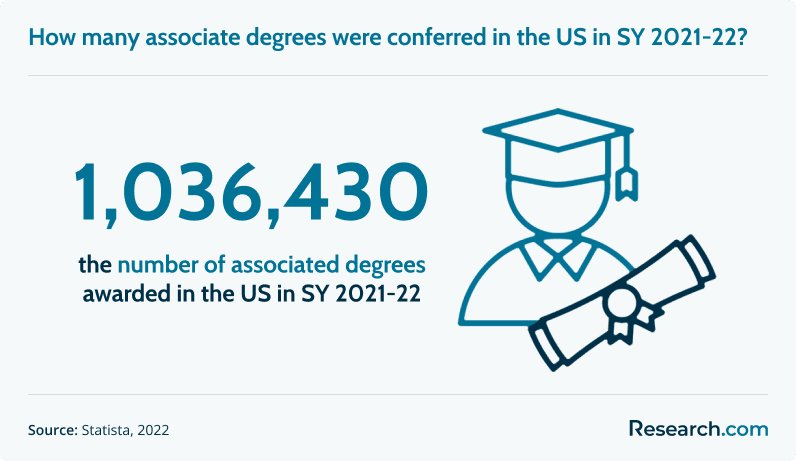
In SY 2021-22, there were a total of 1,036,430 associate's degrees conferred in the US.
| Enrollment Pattern | Typical Impact on Timeline | Best For |
| Full-time study | Often around two years for 60 to 70 credits | Students who can prioritize school each term |
| Part-time study | Usually extends completion time | Working adults, caregivers, and students balancing multiple obligations |
| Accelerated courses | May shorten the calendar time but increases weekly workload | Students with strong time management and prior academic confidence |
| Transfer credit or prior learning credit | Can reduce remaining requirements | Students with previous college coursework, exams, or eligible experience |
How do online associate's degree programs compare to an on-campus program?
Online associate degree programs are usually best for students who need flexibility, live far from campus, work while enrolled, or prefer asynchronous coursework. On-campus programs may be better for students who want face-to-face structure, direct access to labs, in-person tutoring, campus activities, or programs with hands-on requirements.
| Factor | Online Associate Degree | On-Campus Associate Degree |
| Scheduling | Often flexible, especially with asynchronous classes | Usually tied to set class meeting times |
| Location | Can be completed from anywhere with reliable internet | Requires commuting or living near campus |
| Costs beyond tuition | May reduce commuting, housing, and relocation expenses | May involve transportation, parking, housing, or meal costs |
| Interaction | Depends on discussion boards, video meetings, email, and online advising | Provides in-person access to instructors and classmates |
| Hands-on learning | May require local placements, hybrid labs, or practicums | Often easier for lab, clinical, studio, or shop-based training |
If your primary goal is to gain a job-ready credential quickly, compare associate degrees with shorter credential options. Some students may be better served by easy certifications to get online that pay well, especially when the target job values a specific skill or industry credential more than a degree.
What is the average cost of the easiest associate's degree programs?
The average cost of the easiest associate's degree programs depends on the college, residency status, program type, delivery format, and fees. On average, students can expect to pay approximately $22,816 for an entire associate's degree program. This estimate is based on an average cost per credit of $543, with total tuition commonly ranging from $7,154 to $34,965 depending on the institution and program requirements.
Tuition is only one part of the total cost. Students should also budget for textbooks, software, technology fees, supplies, graduation fees, placement exams, transportation, clinical or lab fees when required, and lost income if they reduce work hours.
Cost Factors to Compare Before Enrolling
- Tuition per credit: Compare in-district, in-state, out-of-state, and online rates.
- Required fees: Ask about technology, course, lab, exam, graduation, and student service fees.
- Books and materials: Some programs require software, kits, uniforms, design tools, or subscriptions.
- Transfer value: A cheaper program may cost more later if credits do not transfer.
- Program length: Extra prerequisites or remedial courses can increase total cost.
- Work flexibility: Online or evening options may help students keep earning while enrolled.
What are the financial aid options for students enrolling in the easiest associate's degree programs?
Students can often reduce the cost of an associate degree through federal aid, state aid, institutional grants, scholarships, work-study, employer tuition benefits, or military education benefits. The first practical step is usually completing the Free Application for Federal Student Aid (FAFSA), because many aid decisions use FAFSA information.
- Federal Aid: Eligible students may receive federal grants such as the Pell Grant or Federal Supplemental Educational Opportunity Grant (FSEOG), and may also qualify for Direct Loan Program options, including subsidized and unsubsidized loans.
- State Aid: Many states offer grants, scholarships, or tuition assistance for residents attending eligible in-state institutions.
- Institutional Aid: Colleges may provide scholarships or grants based on need, academic record, program enrollment, or other criteria.
- Work-Study Programs: Federal Work-Study (FWS) provides part-time employment opportunities for students with financial need.
- Scholarships: Private organizations, foundations, employers, and community groups may offer awards based on merit, need, demographics, career goals, or field of study. Students comparing business options can also review affordability-focused resources such as the cheapest online business degree guide.
- Employer Tuition Assistance: Some employers reimburse or help pay for education connected to an employee’s current or future role. For example, a student working in digital media may find employer support useful when considering an online graphic design degree.
- Military Benefits: Active-duty service members, veterans, and eligible dependents may qualify for education benefits such as the GI Bill or branch-specific tuition assistance.
What are the prerequisites for enrolling in the easiest associate's degree programs?
Admission requirements vary by institution and program, but many associate degree pathways are designed to be accessible. Broad degrees such as general studies, liberal arts, communications, English, and sociology often have fewer specialized prerequisites than nursing, engineering, or other technical programs.
- High School Diploma or GED: Most programs require proof of high school completion or an equivalent credential.
- Minimum GPA: Some colleges or selective programs may set a GPA threshold.
- Placement Tests: Schools may use math or English placement assessments to determine whether students are ready for college-level work. Many easiest online degree options are designed with accessible entry points, but students should still confirm placement policies.
- Specific Course Prerequisites: Some college majors require previous coursework. Nursing, for example, may require biology, anatomy, or related science preparation.
- Application Materials: Applicants may need to submit transcripts, forms, recommendations, or a personal statement, depending on the school.
- Technology Requirements: Online and hybrid programs usually require a reliable computer, internet access, and the ability to use learning management systems.
- Background Checks or Health Requirements: Healthcare, education, and criminal justice programs may require background checks, immunizations, drug screening, or other clearances before fieldwork.
According to the most recent data, in SY 2021-22, six fields dominate the choice for associate degrees—making up 58% of all degrees conferred. This is topped by business with 375,400 degrees conferred in the said year. See the chart below for more details.
What general education courses are typically in the easiest associate's degree program?
General education courses give associate degree students a broad academic base before or alongside major-specific courses. These classes are important for transfer because four-year colleges often expect students to complete foundational coursework in writing, math, science, social science, and humanities.
| General Education Area | What Students Usually Study | Why It Matters |
| English Composition | Academic writing, grammar, research, organization, and argument | Builds communication skills needed in nearly every field |
| Mathematics | Algebra, statistics, quantitative reasoning, or program-specific math | Supports problem-solving and data interpretation |
| Natural Sciences | Biology, chemistry, physics, environmental science, or lab-based science | Develops scientific literacy and evidence-based thinking |
| Social Sciences | Psychology, sociology, anthropology, economics, or political science | Helps students understand behavior, institutions, and society |
| Humanities | Literature, history, philosophy, art, or culture | Strengthens interpretation, ethics, and cultural awareness |
| Communication | Public speaking, interpersonal communication, or media studies | Improves professional presentation and collaboration skills |
| Computer Literacy | Productivity software, information systems, digital tools, or basic IT | Supports online learning and modern workplace expectations |
| Health and Wellness | Nutrition, fitness, personal wellness, or health decision-making | Promotes practical knowledge for personal and community well-being |
| Ethics and Critical Thinking | Reasoning, moral questions, logic, and decision-making | Helps students evaluate problems and choices more carefully |
Are there specializations available in the easiest associate's degree programs?
Some easy associate degree programs offer broad tracks, while others allow students to choose a concentration. Specializations can make a general degree more career-focused, but they may also add specific technical requirements. For example, business students might focus on marketing, finance, entrepreneurship, or management. Information technology students may choose software development, support, networking, or security-related coursework.
Specialization choices can also affect your weekly schedule and course difficulty. For example, an online computer science associate program with an IT security focus may include more online cybersecurity classes than a general technology pathway.
In SY 2021-22, select fields were female-dominated regarding degrees awarded. These are health professions and related fields (85%), Liberal arts and sciences, general studies, and humanities (64%), and business (61%). See the chart below for the percentage distribution of associate's degrees conferred by sex.
How do you choose the best and easiest associate's degree programs?
The best easy associate degree is not simply the one with the lightest workload. It is the program that helps you finish, transfer, qualify for relevant work, and avoid debt you cannot justify. Use the following decision process before applying.
- Start with your goal: Decide whether you want immediate employment, transfer to a bachelor’s program, career change preparation, or personal academic progress.
- Review the curriculum: Look at every required course, including math, science, labs, internships, practicums, and capstones.
- Check accreditation: Confirm that the school is accredited and that any program-specific accreditation or approval is appropriate for your field.
- Confirm transfer agreements: If you plan to continue to a bachelor’s degree, ask which credits transfer and whether the school has articulation agreements.
- Compare total cost: Include tuition, fees, books, software, technology, commuting, and possible extra terms.
- Evaluate support: Look for advising, tutoring, career services, technical support, disability services, and transfer counseling.
- Ask about outcomes: Request information about completion rates, transfer pathways, employer connections, internships, and job placement support when available.
| Question to Ask | Why It Matters |
| Is the institution accredited? | Accreditation affects financial aid, transfer credit, and employer recognition. |
| Will my credits transfer to my target bachelor’s program? | Transfer loss can add time and cost. |
| Are there hidden fees beyond tuition? | Technology, lab, exam, and graduation fees can increase the real price. |
| Does the program include labs, clinicals, internships, or fieldwork? | These requirements can affect scheduling and location flexibility. |
| What career services are available? | Resume help, internships, and employer partnerships can improve the transition after graduation. |
Why is accreditation crucial for associate's degree programs?
Accreditation matters because it signals that a college or program has been reviewed against recognized quality standards. It can affect whether students qualify for federal financial aid, whether credits transfer to another institution, and whether employers or licensing bodies recognize the credential. Students considering flexible formats should verify accreditation carefully, including when reviewing accredited self-paced online colleges.
How do earnings and job prospects differ with an associate's degree?
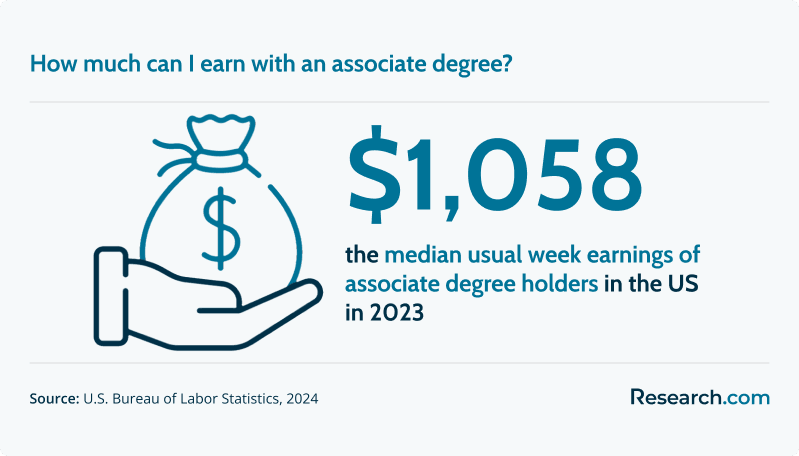
Education level is associated with differences in earnings and unemployment rates, although individual outcomes depend on field, location, experience, employer demand, licensure, and economic conditions. According to data from 2023, associate degree holders earned a median weekly income above $1,000. The median weekly income of associate's degree holders was $1,058 in 2023. Workers with some college but no degree earned $992, high school graduates earned $899, and workers with less than a high school diploma earned $708. The unemployment rate for associate degree holders was 2.7%, compared with 3.3% for those with some college but no degree, 3.9% for high school graduates, and 5.6% for workers with less than a high school diploma.
What are the most popular fields for associate’s degrees?
Associate degree students most commonly choose broad transfer fields and career-connected programs. In SY 2021-22, liberal arts and sciences, general studies, and humanities accounted for 38% of associate’s degrees awarded, while health professions and related programs made up 18%. Healthcare interest is also supported by labor market demand in certain occupations; for example, the U.S. Bureau of Labor Statistics reported 14% projected job growth for medical assistants from 2022 to 2032.
According to data from SY 2021-22, liberal arts and sciences, general studies, and humanities account for 38% of associate’s degrees awarded, while health professions and related programs make up 18%. See the chart below for details.
If you are still comparing degree levels or looking beyond associate programs, it may help to review other practical education paths, including simple PhD programs, easiest finance degrees to obtain, easiest healthcare degrees to obtain, and easiest and fastest RN degrees in healthcare and finance planning.
Is an Associate Degree a Cost-Effective Investment?
An associate degree can be cost-effective when the total price, completion time, transfer value, and career outcome make sense together. It is usually strongest as an investment when it helps students enter a stable occupation, complete lower-division bachelor’s requirements at a lower cost, or qualify for advancement with limited debt.
To evaluate return on investment, compare the full program cost with realistic earnings in your target field, not just the average earnings for all associate degree holders. Also consider whether an accelerated option would help you enter the workforce sooner. Students focused on speed and earnings may want to compare associate programs with easy online degrees that pay well.
Can you finish an associate degree in six months or less?
Completing an associate degree in six months is possible only in limited situations. It generally requires significant transfer credit, prior college coursework, exam credit, year-round enrollment, and a program designed for accelerated completion. Some best associate degree in 6 months online options may offer fast pathways, but students should confirm accreditation, workload, transfer policies, and whether the degree meets their career goals.
- Prior Credit: Transfer coursework or exams such as CLEP can reduce the number of credits still required.
- Full-Time Enrollment: A six-month timeline usually requires an intensive course load with little or no break between terms.
- Flexible Online Format: Self-paced or accelerated online courses may help motivated students move quickly.
- Program Type: Focused fields such as healthcare administration, business administration, or information technology may have more streamlined options than programs with clinical or lab requirements.
- Discipline and Time Management: Accelerated study requires consistent weekly effort and the ability to manage overlapping deadlines.
What pitfalls should you avoid when choosing an associate's degree program?
The biggest mistakes happen when students choose based on convenience alone. A program that looks easy can become expensive or limiting if it lacks accreditation, does not transfer, has poor advising, or fails to prepare students for the next step.
| Common Mistake | Better Approach |
| Choosing a school without checking accreditation | Verify institutional accreditation and any required program approval before applying. |
| Looking only at tuition | Compare the total cost, including fees, materials, technology, commuting, and extra terms. |
| Assuming every online program is easier | Review weekly workload, proctored exams, group projects, practicums, and deadlines. |
| Ignoring transfer policies | Ask your target bachelor’s program which credits will apply before you enroll. |
| Relying only on rankings or advertisements | Use rankings as one input, then verify curriculum, support services, costs, and outcomes. |
| Assuming salaries are guaranteed | Research local job demand, required experience, licenses, certifications, and employer expectations. |
Students planning long-term academic progression should also check how an associate degree fits into later credentials, including advanced options such as a cheap doctorate degree online.
How do career support services and industry partnerships influence post-graduate success?
Career services can make a major difference, especially for students using an associate degree to enter the workforce quickly. Strong programs often provide resume reviews, interview practice, job boards, internship connections, employer events, transfer advising, and help translating coursework into job-ready skills. Industry partnerships can also create access to apprenticeships, clinical placements, work-based learning, or hiring pipelines.
When comparing programs, ask whether career support is available to online students, alumni, part-time students, and evening students. Also ask whether the school tracks employment or transfer outcomes. Students comparing short associate pathways with longer earning-focused degree routes may find it useful to review what bachelor's degree makes 6 figures.
What skills can you develop through an associate's degree program?
Associate degree programs help students build both field-specific and transferable skills. Even broad programs such as liberal arts or general studies can be valuable when students learn how to communicate clearly, meet deadlines, solve problems, and work with others.
- Critical Thinking: Students learn to evaluate information, compare evidence, and make reasoned decisions.
- Time Management: Balancing deadlines is especially important in associates degrees online, where students must manage more independent work.
- Technical Expertise: Depending on the major, students may learn healthcare documentation, IT support, accounting procedures, design software, marketing tools, or office systems.
- Communication: Writing, speaking, listening, and digital communication are common outcomes across many associate programs.
- Collaboration: Group projects, discussions, labs, practicums, and workplace simulations help students practice teamwork.
Are online associate's degree programs suitable for military students?
Online associate degree programs can work well for military students because they often provide flexible schedules, asynchronous coursework, transfer credit opportunities, and remote access to advising. This flexibility can help service members continue studying despite duty changes, relocation, or unpredictable schedules. The best options also offer military-focused advising, clear transfer credit policies, and staff who understand military education benefits.
Prospective military students should compare schools carefully and confirm whether credits, tuition assistance, and benefits apply. A good starting point is an accredited online college for military students that offers affordable and accessible programs.
Can an associate’s degree unlock pathways to advanced degrees that pay well?
An associate degree can be the first step toward higher-paying advanced credentials when it transfers cleanly into a bachelor’s program and supports the prerequisites needed for graduate study. Students who plan ahead can use associate coursework to reduce bachelor’s degree costs, explore a field, and build academic momentum before pursuing graduate programs. For students thinking several steps ahead, Research.com’s guide to what masters degrees pay the most can help connect early education choices with long-term goals.
How can an associate's degree pave your way to further education?
An associate degree can support further education by completing general education requirements, building college-level study skills, and creating a transfer pathway into a bachelor’s program. Many community colleges and four-year schools use articulation agreements to define how credits transfer. Students should confirm these agreements before enrolling, especially if they already know their intended bachelor’s major.
Students aiming for an accelerated academic path should also ask how associate and bachelor’s credits align with future graduate study. Some learners eventually pursue options such as a one year masters degree, but the path is usually smoother when earlier credits are planned carefully.
What are the emerging trends in associate's degree programs?
Associate degree programs continue to change as students seek flexible, affordable, and career-relevant education. Several trends are shaping how colleges design programs and how students compare options.
- More Online and Hybrid Options: Online learning has expanded access for working adults, parents, military students, and students outside commuting range. Hybrid models are especially common in fields that require labs, clinicals, studios, or applied practice. Students considering nursing can also compare career outcomes through resources such as associate degree in nursing salary.
- Greater Focus on Practical Skills: Programs in areas such as medical billing and coding, graphic design, culinary arts, business, and IT increasingly emphasize workplace tools, portfolios, internships, and job-ready competencies.
- Shorter and Accelerated Pathways: Some colleges offer compressed terms or year-round schedules to help students finish faster, although accelerated formats require strong time management.
- New Specializations: Colleges are adding options connected to changing industries, including cybersecurity, data analytics, renewable energy, healthcare administration, and digital marketing.
- Technology and AI Integration: Programs in computer science, engineering, healthcare administration, design, and business are increasingly incorporating digital tools, automation concepts, and AI-related applications where relevant.
- Affordability Pressure: Students are comparing tuition, transfer value, employer reimbursement, scholarships, and community college pathways more carefully as education costs remain a major concern.
- Stronger Career Services: More associate programs are emphasizing job placement support, resume development, interview preparation, employer partnerships, and internship access.
Key Insights
- The easiest associate degree is the one that fits your abilities and goals, not simply the program with the fewest difficult courses.
- Broad programs such as general studies, liberal arts, communications, English, sociology, and writing are often more flexible and transfer-friendly.
- Career-focused associate degrees in healthcare, technology, accounting, and nursing may offer stronger job alignment but can be more demanding because of labs, clinicals, technical skills, or certification expectations.
- Most associate degrees require around 60 to 70 credits and take approximately two years of full-time study, though transfer credit and accelerated formats can change the timeline.
- Average total tuition is approximately $22,816, based on an average cost per credit of $543 and a tuition range from $7,154 to $34,965.
- Accreditation is essential for financial aid, credit transfer, employer recognition, and licensure-related pathways.
- Associate degree holders earned a median weekly wage of $1,058 in 2023 and had an unemployment rate of 2.7%, but outcomes vary by field, location, experience, and employer requirements.
- Before enrolling, ask about total cost, transfer agreements, online student support, career services, required fieldwork, and whether credits apply to your next degree.
References:
- National Center for Education Statistics. (2023). COE - Undergraduate degree fields. NCES.
- Statista. (2022, October 31). Number of associate's degree recipients U.S. 2032. Statista.
- U.S. Bureau of Labor Statistics. (2024). Education pays, 2023. BLS.
Other Things You Should Know About The Easiest Associate Degrees
Most associate’s degrees require 60 semester credits, usually completed in about two years of full-time study. Some accelerated programs use quarter credits instead, and schools may require a minimum grade of C in major courses to count toward graduation.
The curriculum of the easiest associate's degree programs in 2027 often includes foundational courses like English, Mathematics, and Introduction to Humanities. Some programs may also offer basic courses in Business, IT, or Health, depending on the specific degree focus.


