
2027 Best Online Dual Master’s Degrees

Co-Founder and Chief Data Scientist
Choosing an online dual master’s degree is a high-stakes decision because you are not just picking a graduate program; you are committing to two advanced credentials, a heavier workload, and a career strategy that should make sense financially and professionally. The right pairing can help you move into cross-functional leadership roles in fields such as healthcare, business, data, education, public administration, counseling, and technology. The wrong pairing can add cost and complexity without improving your job prospects.
This guide is for working professionals, career changers, and graduate applicants comparing online dual master’s programs for 2027. You will learn how these programs work, what they cost, how long they take, which degree combinations are common, what careers they can support, and how to evaluate whether a dual degree is better than earning one master’s degree first.
Quick Answer: Are Online Dual Master’s Degrees Worth Considering?
An online dual master’s degree can be worth it when the two degrees clearly support the same career direction, reduce duplicated coursework, and qualify you for roles that require both technical and managerial expertise. It is usually less useful if you are uncertain about your career goal, need a licensure-specific degree that may not transfer across states, or are choosing the second degree mainly because it sounds impressive.
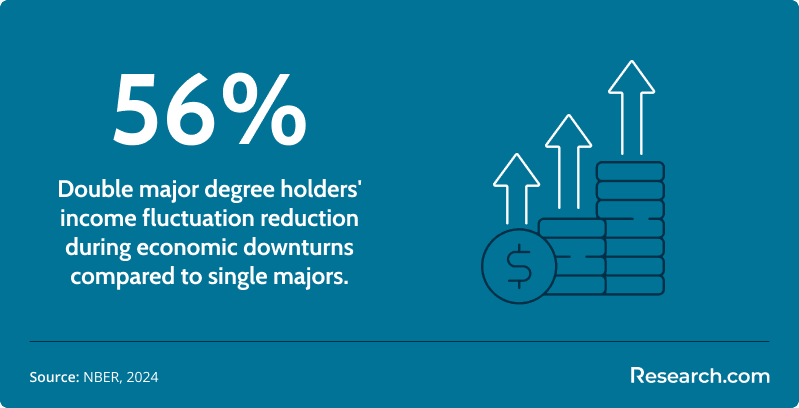
The strongest candidates are professionals who already know the type of role they want next, such as healthcare administration, public health leadership, business analytics, nonprofit management, IT management, counseling, or policy work. Reported outcomes vary, but some degree combinations have been associated with success rates up to 40% higher than single degrees.
What are the main benefits of earning an online dual master’s degree?
- Broader career eligibility: A dual degree can position you for roles that sit between two fields, such as healthcare leadership, business analytics, public policy, social services administration, or technology management.
- Potentially strong earnings: Depending on the role and industry, salaries cited for common career paths range from $101,000 to $156,000.
- Time and cost efficiency: Many dual programs share electives or reduce duplicated requirements, which can be faster and less expensive than completing two separate master’s degrees one after the other.
- Online flexibility: Remote coursework can make graduate study more realistic for students balancing work, family, military service, or geographic limitations.
What can I expect from an online dual master's degree?
An online dual master’s degree combines two graduate programs into one coordinated plan of study. Instead of completing two degrees independently, students usually take required courses from both fields and may be allowed to share a limited number of credits across the two credentials.
Most programs include field-specific core courses, interdisciplinary electives, applied projects, and a capstone or culminating experience. Some programs, especially in nursing, counseling, education, healthcare, and social services, may also include internships, practicums, clinical experiences, or supervised field hours.
Online delivery often includes recorded lectures, digital readings, discussion forums, live class meetings, group projects, virtual office hours, and online exams. Some programs are mostly asynchronous, while others require scheduled sessions. Before enrolling, confirm whether live attendance, campus visits, local placements, or proctored assessments are required.
Tuition ranges from $20,000 to $60,000, depending on the school and disciplines. Many programs take two to three years to complete, although the exact timeline depends on credit requirements, transfer policies, course availability, and whether you study full-time, part-time, or in an accelerated format.
How dual master’s programs usually work
| Program Element | What It Usually Means for Students | What to Verify Before Enrolling |
| Two credentials | You graduate with two master’s degrees rather than one combined certificate. | Confirm the exact degree titles printed on the transcript and diploma. |
| Shared credits | Some courses may count toward both degrees, reducing total time. | Ask how many credits are shared and whether policies can change. |
| Applied learning | Capstones, projects, practicums, or internships may connect both fields. | Check whether placements can be completed near your home. |
| Online format | Coursework may be asynchronous, synchronous, or a mix of both. | Ask about live class times, time zones, and residency requirements. |
| Accreditation | The institution and, in some fields, the program should hold recognized accreditation. | Review both institutional and programmatic accreditation before applying. |
Where can I work with an online dual master's degree?
Your employment options depend heavily on the degree combination. An MBA/MPH, for example, is built for a different labor market than an MS in Data Science/MBA, MPA/MSW, MBA/MPA, or counseling-focused dual degree. The main advantage is that dual-degree graduates can often speak the language of two departments: finance and clinical care, data and strategy, policy and community services, or technology and operations.
According to the U.S. Bureau of Labor Statistics, as of May 2023, several large sectors employ professionals in roles often aligned with dual graduate training:
- Healthcare and Social Assistance: Employs over 20 million workers, including professionals in healthcare administration, public health, social services, quality improvement, and clinical leadership.
- Professional, Scientific, and Technical Services: Employs 9.5 million workers, including consultants, analysts, project managers, data specialists, and technical leaders.
- Educational Services: Employs 3.5 million workers, with opportunities in academic administration, student services, curriculum leadership, and policy.
- Finance and Insurance: Employs 6.6 million workers, including financial managers, risk professionals, compliance specialists, and analysts.
- Public Administration: Employs 7 million workers, including professionals in planning, policy, program management, public affairs, and government operations.
How much can I make with an online dual master's degree?
A dual master’s degree does not guarantee a salary increase. Earnings depend on your occupation, employer, region, experience, licensure, management responsibility, and whether the second degree is directly relevant to the job. That said, several roles commonly connected to dual graduate training have strong reported wage data.
As of 2023, the following roles show high earning potential (US BLS, 2024):
| Career Path | Hourly Wage | Annual Wage | Dual Degree Pairings That May Fit |
| Medical and Health Services Managers | $61.25 per hour | $127,390 per year | MBA/MPH, MSN/MHA, healthcare management combinations |
| Management Analysts | $50.99 per hour | $106,050 per year | MBA/MPA, MBA/MS in Data Science, MBA/MS in MIS |
| Financial Managers | $75.29 per hour | $156,600 per year | MBA/finance, MBA/data, MBA/public administration combinations |
| Data Scientists | $60.97 per hour | $126,820 per year | MS in Data Science/MBA, IT/business combinations |
| Postsecondary Education Administrators | $48.57 per hour | $101,030 per year | Education/business, public administration/education, policy combinations |
- Best Online Dual Master's Degree Programs for 2027
- How long does an online dual master's degree take?
- Online vs. on-campus dual master's programs
- Average cost of an online dual master's degree
- Financial aid options for online dual master's students
- Admissions requirements and prerequisites
- Common courses in online dual master's programs
- Popular specializations and degree pairings
- Is an Online Dual Master’s Degree a Worthwhile Investment?
- Common challenges in online dual master's programs
- Student support in online dual master's programs
- Online dual master's vs. online doctoral programs
- How to choose the best online dual master's degree
- Career paths for online dual master's graduates
- Job market for online dual master's graduates
- References and sources
Best Online Dual Master's Degree Programs for 2027
How do we rank schools?
Research.com evaluates programs using education data sources that help compare access, affordability, academic structure, and student outcomes. Our ranking process draws from the IPEDS database, Peterson's database, the College Scorecard database, and The National Center for Education Statistics. These sources support a more transparent review of Online Dual Master's Degree programs. You can read more about our process on the Research.com methodology page.
1. Grand Canyon University — MS/MBA Dual Degree Program in Leadership
The online MS/MBA dual degree in leadership at Grand Canyon University is designed for professionals who want both business training and leadership development. Students study organizational strategy, ethical decision-making, management practice, and leadership theory with an emphasis on applying those concepts to workplace challenges.
- Required Credits to Graduate: 66
- Cost: $665 per credit hour
- Accreditation: Higher Learning Commission (HLC)
2. Johns Hopkins University — MBA/MA in Communication
The online MBA/MA in Communication from Johns Hopkins University blends business strategy with advanced communication training. The program may appeal to professionals pursuing leadership roles in corporate communication, media strategy, digital messaging, public relations, or organizations where business decisions and public communication overlap.
- Required Credits to Graduate: 36
- Cost: $1,985 tuition rate (Tuition from Advanced Academic Programs charged separately)
- Accreditation: Association to Advance Collegiate Schools of Business (AACSB)
3. Purdue Global — Master of Science in Nursing and Master of Health Care Administration Dual Degree Option
The online MSN/Master of Health Care Administration dual degree option from Purdue Global is structured for nurses who want to combine clinical expertise with administrative leadership. Coursework covers areas such as health systems, policy, quality improvement, organizational leadership, and healthcare management.
- Required Credits to Graduate: 74 quarter credits
- Cost: $420 per credit hour (MSN courses), $485 per credit hour (MHA courses)
- Accreditation: Commission on Collegiate Nursing Education (CCNE)
4. University of Arizona — MSM/MBA Dual Degree
The dual MBA/MS in Marketing program at the University of Arizona combines graduate business education with focused marketing study. Students explore business decision-making, analytics, consumer behavior, brand strategy, and market-focused leadership for roles that require both management and marketing expertise.
- Required Units to Graduate: 70
- Cost: $1,250 per unit (MBA) / $31,762 tuition (MS in Marketing Resident); $51,864 tuition (MS in Marketing Non-Resident)
- Accreditation: Association to Advance Collegiate Schools of Business (AACSB)
5. Benedictine University — Dual MPH/MSMOB Degree
The online MPH/MS in Management and Organizational Behavior at Benedictine University combines public health training with organizational leadership. The program is relevant for students interested in health initiatives, community programs, epidemiology-informed decision-making, behavioral science, and change management.
- Required Courses to Graduate: 26
- Cost: $800 per credit hour
- Accreditation: Higher Learning Commission (HLC) / Council on Education for Public Health (CEPH)
6. Eastern University — MBA/MS in Data Science Dual Degree
The online MBA/MS in Data Science dual degree listed by Eastern University is intended for students who want to connect business leadership with data-driven decision-making. Because program names and tracks can change, applicants should verify the current curriculum, degree titles, and course sequence directly with the university before applying.
- Required Credits to Graduate: 60
- Cost: $19,800 tuition rate
- Accreditation: Middle States Commission on Higher Education (MSCHE)
7. Walden University — MS Dual Degree in Clinical Mental Health Counseling and School Counseling
The online MS in Clinical Mental Health Counseling and School Counseling from Walden University prepares students for counseling work in school and clinical settings. Because counseling practice is licensure-based, students should confirm that the program’s curriculum, fieldwork, and accreditation meet requirements in the state where they plan to work.
- Required Credits to Graduate: 111 quarter credits
- Cost: $54,285
- Accreditation: Council for Accreditation of Counseling and Related Educational Programs (CACREP)
8. Hamline University — MBA/MPA Dual Degree
The online MBA/MPA in Nonprofit Management at Hamline University combines business administration with public and nonprofit management. It is designed for students who want to lead mission-driven organizations, manage budgets, oversee programs, support fundraising, and work across public service environments.
- Required Credits to Graduate: 72
- Cost: $792 per credit hour (MBA) / $610 per credit hour (MPA)
- Accreditation: Higher Learning Commission (HLC)
9. Lamar University — Dual MBA and M.S. in MIS
The online dual MBA and M.S. in MIS option at Lamar University is built for professionals who want to connect management training with information systems knowledge. Coursework may support careers in IT management, analytics, operations, project leadership, and technology-enabled business decision-making.
- Required Credits to Graduate: 48
- Cost: $22,965 tuition rate
- Accreditation: Association to Advance Collegiate Schools of Business (AACSB)
10. Emporia State University — MSIT/MBA Dual Degree
The online MS in Information Technology and MBA program at Emporia State University pairs technical graduate study with business leadership. Students examine topics such as IT project management, analytics, cybersecurity, operations, and strategic management for careers involving digital transformation or technology oversight.
- Required Credits to Graduate: 51
- Cost: $18,513 total tuition
- Accreditation: Association to Advance Collegiate Schools of Business (AACSB)
How long does it take to complete an online dual master's degree program?
Most online dual master’s programs take about three years, which is usually longer than a single online master’s degree because students must complete requirements for two graduate credentials. Some programs can be completed faster if they share credits efficiently, offer accelerated terms, or allow students to take a heavier course load.
Part-time students may need five or more years, especially if they work full time, have clinical or internship requirements, or take breaks between terms. Accelerated tracks may reduce the timeline to as little as 2.5 years, but that pace can be demanding and may not be realistic for students with intense work or family responsibilities.
Students in dual programs typically spend 15 to 25 hours per week on coursework. The workload can rise during capstones, internships, exams, group projects, or overlapping deadlines. Students considering a dual program should ask for a term-by-term plan before enrolling rather than relying only on the advertised completion time.
| Enrollment Format | Typical Timeline | Best For | Main Risk |
| Accelerated | As little as 2.5 years | Students with strong time management and fewer outside commitments | Heavy workload and limited flexibility |
| Full-time | About three years | Students who want a balanced but steady pace | May still be difficult with full-time employment |
| Part-time | Five or more years | Working professionals and caregivers | Longer time to graduation and possible tuition changes |
Online programs are often a practical option for professionals whose fields already support remote or hybrid work. For example, students comparing flexible graduate pathways may also research fields such as a masters in library science, where online learning can align with career needs.
How does an online dual master's degree program compare to an on-campus program?
Flexibility and access
Online dual master’s programs usually offer more scheduling flexibility than campus-based programs. Students may be able to review lectures after work, complete assignments from home, and avoid relocation. This can be especially important for professionals who cannot pause their careers to attend graduate school full time.
- Online advantage: Students can often study from any location and manage coursework around work schedules.
- Campus advantage: Students may benefit from structured class times, in-person advising, and easier access to facilities.
Networking and peer connection
On-campus programs make informal networking easier because students meet faculty, classmates, and alumni in person. Online programs can still offer strong professional connections, but students usually need to be more intentional.
- Participate actively in discussion boards and group work.
- Attend live sessions, webinars, and virtual career events.
- Use alumni platforms and faculty office hours early, not just near graduation.
Academic quality and employer perception
Accredited online programs should meet the same academic standards as comparable campus programs. Employer acceptance has improved, especially when the degree comes from a recognized institution and the program includes rigorous coursework, applied projects, and strong faculty involvement.
Completion rates and support
Online study requires more self-direction. A study by the National Center for Education Statistics (NCES) found that graduation rates for fully online graduate students trail those of traditional students by 10–15%, largely because online learners must manage their own schedules and may have less in-person support.
Students in licensure-focused areas should be especially careful. For example, applicants comparing online SLP programs ASHA should confirm accreditation, clinical placement rules, and state requirements before assuming an online format will meet professional licensing expectations.
What is the average cost of an online dual master's degree program?
The average cost of online dual master’s degrees ranges from $40,000 to $80,000, depending on the university, discipline, credit load, and fee structure. Public policy, business, data, healthcare, counseling, and education programs can vary widely in price. Students comparing policy-related pathways may also review online MPP programs to understand how costs differ by field and school type.
Online programs may be less expensive than campus programs if they reduce relocation, commuting, housing, and parking costs. Some universities also charge the same online tuition regardless of residency, which may benefit out-of-state students. However, lower tuition does not always mean lower total cost.
Students should calculate the full cost of attendance, not just tuition. Textbooks, digital materials, technology fees, graduation fees, background checks, clinical placement costs, travel for residencies, and internship-related expenses can add to the final price.
Costs to include in your budget
| Cost Category | Why It Matters | Question to Ask the School |
| Tuition | Usually the largest expense and may be charged by credit, unit, course, or program. | Is tuition locked in, or can it increase while I am enrolled? |
| Fees | Online, technology, graduation, and student services fees can change the total price. | Can you provide a full fee schedule for the entire program? |
| Books and materials | Some programs include digital resources; others require separate purchases. | What is the estimated materials cost per term? |
| Practicum or internship expenses | Healthcare, counseling, education, and social service programs may require local placements. | Will I need liability insurance, background checks, travel, or site fees? |
| Time away from work | Accelerated or fieldwork-heavy programs may reduce earning hours. | How many hours per week do successful students usually spend? |
What are the financial aid options for students enrolling in an online dual master's degree program?
Students in eligible online dual master’s programs may qualify for several forms of financial aid. The best strategy is to combine federal aid, institutional scholarships, employer benefits, and careful program selection rather than relying on one funding source.
Federal student loans
Graduate students enrolled at least half-time in an eligible degree program may be able to use federal loan options, including Direct Unsubsidized Loans and Grad PLUS Loans. Students should review federal borrowing rules and application requirements through the federal aid process, including information about Grad PLUS Loans.
Scholarships and institutional aid
Some universities and outside organizations offer scholarships for online graduate students. Awards may be based on merit, need, field of study, employer affiliation, military status, public service, or diversity goals. Scholarship availability changes frequently, so applicants should ask each program for current funding opportunities and deadlines.
Employer tuition assistance
Employer reimbursement can meaningfully reduce out-of-pocket costs. Under federal tax law, employers can provide up to $5,250 per year in tax-free educational assistance to employees. Students should ask human resources whether graduate tuition, online programs, books, fees, or only job-related courses qualify.
Application steps
- Confirm that the school and program are eligible for federal student aid.
- Complete the FAFSA or required federal aid application process.
- Ask the program about scholarships, assistantships, discounts, and payment plans.
- Check whether your employer offers tuition reimbursement before you enroll.
- Compare total debt against realistic salary outcomes in your target role.
What are the prerequisites for enrolling in an online dual master's degree program?
Most online dual master’s programs require a bachelor’s degree from an accredited institution, a minimum GPA, application materials, and evidence that the student can handle graduate-level work in both fields. Requirements vary significantly by program. This is true across broad fields such as public health and business as well as specialized areas like the cheapest online masters in construction management.
Common admissions requirements
- Bachelor’s degree: Applicants usually need a completed undergraduate degree from an accredited college or university.
- Minimum GPA: Many programs expect a 3.0 undergraduate GPA, although some review applicants holistically or offer provisional admission.
- Test scores: GRE or GMAT policies differ by school. Some programs require scores, while others waive them for applicants with work experience or prior graduate study.
- Professional background: Business, healthcare, education, counseling, and public administration programs may prefer or require relevant experience.
- Application documents: Students commonly submit a resume, statement of purpose, letters of recommendation, transcripts, and sometimes an interview or prerequisite coursework.
Accreditation matters during admissions and after graduation. MBA applicants, for example, should understand how business accreditors differ. Research.com’s guide to ACBSP vs AACSB explains why accreditation type can affect program reputation, transferability, and employer perception.
What courses are typically in an online dual master's degree program?
Online dual master’s programs usually combine required courses from each discipline with electives that connect the two fields. Students may also complete a capstone, practicum, internship, clinical placement, thesis, or applied consulting project. Similar applied structures can appear in specialized fields such as online masters applied behavior analysis, where theory is often tied to supervised practice.
Core courses from each degree
Students take foundational coursework in both disciplines. An MBA/MPH student might study finance, leadership, epidemiology, healthcare systems, and policy. An MSIT/MBA student might study cybersecurity, analytics, operations, and strategic management.
Interdisciplinary electives
Electives often help students connect their two areas of study. For example, students may choose courses in healthcare finance, nonprofit analytics, public sector leadership, digital transformation, organizational behavior, data governance, or communication strategy.
Practical requirements
Many dual programs ask students to prove they can apply both degrees in a real setting. This may involve a consulting project, capstone, supervised practicum, internship, portfolio, or field-based assignment.
What types of specializations are available in an online dual master's degree program?
Online dual master’s specializations are usually designed around career intersections. The goal is not simply to collect two degrees; it is to build a coherent professional profile. Students interested in mental health, education, or public service may also compare related options such as masters in psychology online before deciding whether a dual program is necessary.
Popular dual degree combinations
| Degree Pairing | Best Fit | Potential Career Direction |
| Business Administration (MBA) and Public Health (MPH) | Professionals interested in healthcare leadership and population health | Healthcare administration, public health management, consulting |
| Information Technology and Cybersecurity | Students focused on technology risk, systems, and security | IT leadership, cybersecurity management, digital operations |
| Education and Special Education | Educators working with diverse learning needs | Instructional leadership, special education coordination, school administration |
| Public Administration and International Affairs | Students interested in public service, government, and global issues | Policy analysis, nonprofit leadership, international program management |
| Social Work and Psychology | Students who want clinical, behavioral, and advocacy training | Community services, counseling-adjacent roles, social advocacy |
Emerging interdisciplinary options
Programs that combine data analytics with another field are becoming more visible because employers often need professionals who can interpret information and make operational decisions. Students interested in place-based analytics may also compare best GIS programs in the US, especially if they are considering public health, planning, emergency management, or environmental applications.
Is an Online Dual Master’s Degree a Worthwhile Investment?
An online dual master’s degree is most likely to be a worthwhile investment when it creates a clear bridge to a specific role, saves time compared with two separate programs, and is offered by an accredited school with strong student support. It is less likely to pay off if the second degree does not change your qualifications, licensing eligibility, promotion path, or earning potential.
Before enrolling, compare tuition, fees, borrowed debt, lost work time, and expected career benefit. Also review career services, alumni access, internship support, employer partnerships, and graduation outcomes. Students focused primarily on speed and earnings may also compare alternatives such as fast online degrees that pay well.
Who should choose an online dual master’s degree?
- Professionals targeting leadership roles that require knowledge from two fields.
- Students who already know their career goal and can explain why both degrees matter.
- Workers whose employer values or funds the additional credential.
- Applicants who can handle a heavier workload without sacrificing program quality.
Who should consider a different option?
- Students unsure of their career direction.
- Applicants who need one licensure-specific degree and do not benefit from a second program.
- Professionals who can reach the same goal through a certificate, single master’s degree, or employer training.
- Students who would need to borrow heavily without a realistic salary plan.
What are the common challenges of online dual master's degree programs?
Dual programs are demanding because students must satisfy two sets of academic expectations. Online delivery adds another layer: you must manage your calendar, technology, communication, and motivation without the built-in routine of campus attendance.
| Common Challenge | Why It Happens | Better Strategy |
| Underestimating workload | Two programs can create overlapping exams, projects, and readings. | Ask for sample weekly schedules and course sequences before enrolling. |
| Weak networking | Online students may not meet classmates informally. | Join live sessions, alumni events, and group projects early. |
| Licensure confusion | State rules may differ for counseling, nursing, education, and clinical fields. | Confirm requirements with the state board before applying. |
| Cost surprises | Fees, books, technology, and placement expenses may not be obvious. | Request a full cost-of-attendance estimate in writing. |
| Burnout | Many students work full time while completing intensive graduate study. | Choose a pace that fits your life, not just the fastest advertised timeline. |
If you are still building academic confidence, reviewing undergraduate planning resources such as Research.com’s guide to the easiest bachelor's degrees may help you think about workload, study habits, and scheduling before taking on graduate-level dual study.
Do Online Dual Master’s Degree Programs Offer Comprehensive Student Support?
Many online dual master’s programs provide academic advising, technical assistance, digital library access, career services, writing support, tutoring, mentoring, and virtual networking. The level of support varies, so students should evaluate services as carefully as curriculum and tuition.
Ask whether the school assigns one advisor for both degrees or separate advisors for each program. Also ask how the university helps students resolve course conflicts, internship placements, graduation audits, and degree requirement questions. Students comparing accelerated graduate options may also review quick masters degrees to understand how speed affects support needs.
How do Online Dual Master's Programs Compare to Online Doctoral Programs?
Online dual master’s programs and online doctoral programs serve different goals. A dual master’s degree is usually designed for professional breadth: it helps students combine two applied areas and move into management, specialist, or cross-functional roles. A doctoral program focuses more on advanced scholarship, research, high-level practice, or academic contribution.
A dual master’s program typically requires less time and lower financial commitment than doctoral study, while still strengthening professional qualifications. A doctorate may make more sense for students pursuing university teaching, original research, senior clinical practice, or executive-level expertise in a highly specialized field. If doctoral study is part of your long-term plan, compare structure and timeline carefully, including options such as the shortest doctorate degrees.
How to Choose the Best Online Dual Master's Degree Program
The best online dual master’s degree is the one that aligns with your career target, meets accreditation and licensure expectations, fits your schedule, and offers a total cost you can justify. Rankings can help narrow your list, but they should not replace direct program research.
1. Confirm accreditation first
Look for recognized institutional accreditation and, when relevant, programmatic accreditation. This is especially important in business, nursing, counseling, public health, education, and other regulated or reputation-sensitive fields.
2. Match the degree pairing to a specific role
Do not choose a dual degree because both subjects are interesting. Choose it because the combination supports a job title, promotion path, license, or industry transition. For example, business and data science may fit analytics leadership, while public health and management may fit healthcare systems work.
3. Review flexibility in detail
Ask whether courses are asynchronous, synchronous, self-paced, cohort-based, or offered in short terms. Eastern University's MBA/MS in Data Science dual degree, for example, is described as offering self-paced courses with 7-week terms, which may suit working professionals who need scheduling flexibility.
4. Evaluate faculty and professional relevance
Review faculty bios, research areas, industry experience, and availability to online students. In applied fields, instructors with current professional experience can help students connect theory to workplace practice.
5. Compare total cost and likely return
Build a spreadsheet that includes tuition, fees, books, travel, technology, internships, lost work hours, and expected debt. Then compare that total with realistic salary data for your intended occupation rather than general graduate-degree averages.
6. Ask the right questions before applying
- How many credits are shared between the two degrees?
- Can either degree be completed independently if my plans change?
- Are there any campus visits, residencies, or live class requirements?
- Does the program meet licensure or certification requirements in my state?
- What student support is available specifically to online dual-degree students?
- What happens if required courses from the two programs conflict?
- Can I use transfer credits, employer benefits, or military education benefits?
What career paths are available for graduates of an online dual master's degree program?
Graduates of online dual master’s programs can pursue roles that benefit from interdisciplinary training. The most relevant career paths depend on the degree pairing, prior experience, certifications, and industry.
Examples of career directions
- Healthcare Administrator: Often aligned with combinations such as MBA/MPH or MSN/MHA.
- Data Analyst or Business Intelligence Consultant: May fit students combining business with data science or information systems.
- Policy Advisor or Public Affairs Director: Often connected to public administration, international relations, social work, or policy training.
- Educational Leader: May suit students combining education, administration, business, or policy.
- Technology Manager: Commonly aligned with MS in IT/MBA or MIS/business combinations.
Career advantage depends on relevance
Employers may value dual-degree graduates because they can communicate across departments and solve problems from more than one perspective. However, the advantage is strongest when both degrees are directly connected to the job. A dual degree with no clear role alignment can be harder to explain in interviews.
Some institutions describe dual degrees as a way to reach leadership roles more swiftly, particularly when the curriculum develops both technical and strategic skills. Students should still compare claims against their own experience, market, and target occupation.
What is the job market for graduates with an online dual master's degree program?
The job market for dual master’s graduates is strongest in fields where employers need professionals who can connect disciplines. Healthcare, technology, public administration, education, finance, consulting, and social services are common examples.
Employer preferences and salary signals
A 2024 survey by the National Association of Colleges and Employers (NACE) revealed that 48% of employers prefer candidates with dual degrees, citing broader skill sets as a meaningful advantage. Professionals holding dual degrees earn, on average, 20% higher salaries compared to those with a single degree. These figures should be treated as directional, not as guaranteed individual outcomes.
Employment prospects
Research from Monash University indicates that pursuing a double degree can improve a graduate’s chances of securing full-time employment. Some degree combinations have been shown to increase success rates by as much as 40% compared to single-degree holders.
Online degree acceptance
Employer views of online degrees have improved. According to NACE's Job Outlook 2024 survey, 87.4% of employers have hired graduates with online degrees, and 100% of those employers reported offering the same starting salaries as those given to in-person degree holders.
Healthcare and advanced practice pathways
Healthcare is one field where combining credentials can be especially relevant. Nurses comparing clinical and administrative advancement may also review MSN to FNP online programs to understand how advanced nursing pathways differ from broader dual-degree options.
Here’s What Graduates Have to Say about Online Dual Master's Degrees
-
: "
Working full time while completing two graduate tracks was not easy, but the online format helped me stay organized. I could apply course concepts at work right away, and that helped me move into a new role soon after. — Lally
"
-
: "
Studying business and data analytics online gave me flexibility with my family schedule while helping me qualify for strategy-focused opportunities I had not been considered for before. — Esther
"
-
: "
The online environment connected me with classmates from different industries and regions. Combining public policy and social work gave me a more practical toolkit for community-focused work. — Thomas
"
Common Mistakes to Avoid When Choosing an Online Dual Master’s Degree
- Choosing based only on prestige: A well-known university is not enough if the degree pairing does not support your career goal.
- Ignoring accreditation: Always verify institutional and programmatic accreditation, especially for counseling, nursing, education, public health, and business.
- Looking only at tuition: Fees, books, technology, internships, residencies, and lost work time can change the real cost.
- Assuming online means self-paced: Some online programs require live attendance, group meetings, fixed deadlines, or campus visits.
- Overlooking licensure rules: Online programs do not automatically meet state requirements for regulated professions.
- Relying only on rankings: Rankings can help with discovery, but they cannot tell you whether a program fits your schedule, budget, state requirements, or career plan.
- Assuming salary outcomes are guaranteed: Published salary data reflects occupations, not automatic earnings for every graduate.
Key Insights
- An online dual master’s degree is most valuable when both credentials clearly support one career path, such as healthcare leadership, business analytics, public administration, nonprofit management, counseling, or IT management.
- Some degree combinations have been shown to improve graduate success rates by as much as 40% compared with single-degree pathways, but outcomes depend on the pairing, school, field, and student background.
- Most online dual master’s programs take about three years. Part-time students may need five or more years, while accelerated tracks may shorten completion to as little as 2.5 years.
- Students should expect a serious workload. Many dual-degree learners spend 15 to 25 hours per week on coursework, with higher demands during capstones, internships, practicums, or overlapping deadlines.
- The average cost of an online dual master’s degree ranges from $40,000 to $80,000, but total cost can rise with fees, books, technology expenses, travel, and field placement requirements.
- Salary potential can be strong in related occupations. BLS-cited roles connected to common dual-degree pathways include Medical and Health Services Managers at $127,390 per year, Data Scientists at $126,820 per year, and Financial Managers at $156,600 per year.
- Before enrolling, confirm accreditation, shared-credit policies, licensure eligibility, student support, course delivery format, and whether the second degree will actually improve your career options.
References:
- U.S. Bureau of Labor Statistics. Occupational Employment and Wages — May 2023. https://www.bls.gov/news.release/archives/ocwage_04032024.pdf
- Medical and health services managers. Bureau of Labor Statistics. https://www.bls.gov/ooh/management/medical-and-health-services-managers.htm
- Management Analysts. Bureau of Labor Statistics. https://www.bls.gov/ooh/business-and-financial/management-analysts.htm
- Financial Managers. Bureau of Labor Statistics. https://www.bls.gov/ooh/management/financial-managers.htm
- Data scientists. Bureau of Labor Statistics. https://www.bls.gov/ooh/math/data-scientists.htm
- Postsecondary education administrators. Bureau of Labor Statistics. https://www.bls.gov/ooh/management/postsecondary-education-administrators.htm
- Master’s Completion Project - CGS. https://cgsnet.org/project/masters-completion-project
- Top five factors to consider when choosing an online Master’s program. https://www.onlineeducation.com/features/top-considerations-for-choosing-online-masters-programs
- Understanding federal student loans. https://www.salliemae.com/college-planning/student-loans-and-borrowing/compare-federal-vs-private-loans/federal-student-loans
- Online learning scholarships. The University of Edinburgh. https://registryservices.ed.ac.uk/student-funding/postgraduate/e-learning
- What to know about the SAVE plan, the income-driven plan to repay student loans. AP News. https://apnews.com/article/student-loans-forgiveness-save-plan-debt-borrowers-313afd73cadc3cfc8ab3a6ee684fc3e4
- Employee tuition reimbursement: How it works. COMPT. https://compt.io/blog/employee-tuition-reimbursement
- 12 companies that will pay for your college education. Investopedia. https://www.investopedia.com/companies-pay-college-6829220
- Walsh Dual Degree Programs. https://mba.walshcollege.edu/dual-degrees
- Purdue Global dual MSN and Master of Health Care Administration information. https://www.purdueglobal.edu/degree-programs/nursing/dual-msn-masters-health-care-administration
- Baylor University M.S. in Interdisciplinary Studies. https://professionaleducation.web.baylor.edu/online-hybrid-programs/ms-interdisciplinary-studies
- Hands-on and online: flexible postgraduate courses for nurses. The Guardian. https://www.theguardian.com/the-university-of-notre-dame-australia-embracing-knowledge/2025/jan/31/hands-on-and-online-the-flexible-postgraduate-courses-for-nurses
- Interdisciplinary Studies. Data USA. https://datausa.io/profile/cip/interdisciplinary-studies
- How to capitalize on the rising demand for graduate-level interdisciplinary degrees. EAB. https://eab.com/resources/blog/adult-education-blog/rising-demand-graduate-interdisciplinary-degrees
- The rise of interdisciplinary degrees. QS GEN. https://qs-gen.com/the-rise-of-interdisciplinary-degrees
- Are online degrees accredited? UMass Global. https://www.umassglobal.edu/blog-news/are-online-degrees-accredited-how-to-identify-quality-distance-learning-programs
- MBA/MS in Data Science Dual Degree. Eastern University. https://www.eastern.edu/academics/graduate-programs/mba-ms-dual-degree
- MS in Data Science. Eastern University. https://www.eastern.edu/academics/graduate-programs/ms-data-science
- Online program rankings coverage. CT Insider. https://www.ctinsider.com/news/education/article/best-online-programs-ct-colleges-graduate-rankings-20153448.php
- The benefits of a dual degree program. https://moldstud.com/articles/p-the-benefits-of-a-dual-degree-program-expanding-your-academic-horizons
- Want to improve your chances of getting a full-time job? A double degree can do that. https://theconversation.com/want-to-improve-your-chances-of-getting-a-full-time-job-a-double-degree-can-do-that-157306
- Online degrees gaining new prominence because of the pandemic. ICEF Monitor. https://monitor.icef.com/2022/05/online-degrees-gaining-new-prominence-because-of-the-pandemic
- 37.9 percent of advanced degree holders teleworked in October 2023. Bureau of Labor Statistics. https://www.bls.gov/opub/ted/2023/37-9-percent-of-advanced-degree-holders-teleworked-in-october-2023.htm
- Employers see online degrees as comparable to in-person degrees. NACE. https://www.naceweb.org/talent-acquisition/candidate-selection/employers-see-online-degrees-as-comparable-to-in-person-degrees
- Dual Degrees: How Pursuing 2 Master's Programs Simultaneously Accelerates Success. Edgewood College. https://online.edgewood.edu/blog/dual-degrees-the-path-to-greater-flexibility-and-career-opportunities
Other Things You Should Know About Online Dual Master's Degree Programs
Students should have a reliable computer with updated software, high-speed internet, and access to learning platforms like Canvas or Blackboard. Some programs may also require specific applications for coursework, such as statistical software or video conferencing tools.
Admission requirements for online dual master's degrees in 2027 often include a bachelor's degree, a minimum GPA (usually 3.0), letters of recommendation, and relevant professional experience. Some programs may also require GRE or GMAT scores and a statement of purpose.
Most online dual master’s degrees require about 48 to 72 graduate credits, compared with roughly 30 to 36 for a single master’s. Students usually complete both degrees in 2.5 to 4 years, depending on transfer credits, course sequencing, and whether classes run in 8-week or 16-week terms.


