
2027 Best Online Master’s in Applied Behavior Analysis (ABA) Programs

Co-Founder and Chief Data Scientist
An online master’s in applied behavior analysis is designed for people who want advanced training in behavior assessment, intervention planning, and evidence-based support for clients with behavioral, developmental, social, or emotional needs. For many students, the bigger question is not simply whether ABA is interesting; it is whether the degree leads to the right credential, fits a work schedule, includes supervised practice, and supports a realistic career path.
This guide explains what to expect from online master’s in applied behavior analysis programs, how they connect to BCBA preparation, what coursework and fieldwork usually involve, how online and campus formats compare, and what to check before enrolling. It is written for working professionals, psychology and education graduates, career changers, and prospective behavior analysts who want a practical way to compare programs before making a financial and professional commitment.
Quick Answer: Is an Online Master’s in Applied Behavior Analysis Worth Considering?
An online master’s in applied behavior analysis may be a strong option if your goal is to work in behavior analysis, autism services, education, clinical support, social services, organizational behavior, or a related psychology career. The degree can help students build the academic foundation often needed for BCBA preparation, but the degree alone is not the same as certification. Prospective students should confirm institutional accreditation, ABAI recognition or verified coursework where relevant, supervised fieldwork options, total cost, and whether the program aligns with the credentialing rules they plan to meet.
- Online ABA programs can support career preparation in behavioral psychology, school-based services, social work-adjacent roles, forensic settings, and organizational behavior work.
- Several related occupations report median wages above the $53,664 median annual wage for full-time U.S. wage and salary workers in the third quarter of 2023. For example, school and career counselors and advisors earned a median annual wage of $60,140 in 2022, according to the U.S. Bureau of Labor Statistics.
- Online delivery may help students keep working while studying and may reduce some indirect costs, such as relocation, commuting, housing, and campus-based expenses.
What Should You Expect in an Online Master’s in Applied Behavior Analysis?
Most online ABA master’s programs combine graduate-level behavioral science coursework with applied practice, ethics, assessment, and intervention planning. Students usually complete readings, case analyses, discussion boards, recorded or live lectures, projects, exams, and supervised fieldwork or practicum experiences, depending on the program design.
- Many programs use asynchronous coursework, live virtual meetings, or a mix of both so students can study behavior-analysis concepts while staying connected to instructors and classmates.
- Graduate ABA training commonly includes fieldwork, internships, practicum courses, or supervised experiences guided by qualified behavior analysts.
- Programs that are aligned with BCBA preparation typically help students complete coursework relevant to Board Certified Behavior Analyst eligibility, though students must still verify current BACB requirements independently.
- A master’s degree plus certification may strengthen professional mobility and earning potential, but outcomes depend on location, employer type, experience, licensure or certification status, and demand in the student’s chosen setting.
Where Can You Work With an Online Master’s in Applied Behavior Analysis?
Graduates of online ABA master’s programs may work in schools, clinics, autism centers, hospitals, community agencies, residential programs, rehabilitation settings, correctional systems, government agencies, nonprofits, or business environments. Those who meet all requirements and pass the certification examination administered by the Behavior Analyst Certification Board may become BCBAs, which can expand the types of roles for which they qualify.
| Work Setting | How ABA Skills May Be Used | Who This Path May Fit |
| Healthcare and clinical services | Behavior assessment, intervention planning, caregiver training, treatment support, and progress monitoring in hospitals, clinics, nursing homes, community health centers, and rehabilitation facilities. | Students who want direct client-facing work and are comfortable with data-based intervention planning. |
| Education | Support for students with behavioral, developmental, or social-emotional needs; collaboration with teachers, families, and support teams. | Educators, paraprofessionals, and school-based professionals who want behavior-analysis expertise. |
| Government, legal, and correctional settings | Behavioral assessment, rehabilitation support, program design, and analysis of behavior patterns in structured environments. | Students interested in systems, public service, or the intersection of behavior and legal processes. |
| Nonprofit and social service organizations | Program evaluation, client support, family education, and behavior-change initiatives. | Professionals who want mission-driven work with diverse populations. |
| Business and organizational settings | Employee behavior, training systems, performance improvement, customer behavior, and organizational behavior management. | Students who want to apply behavior science beyond traditional clinical settings. |
| Private practice | Independent or group-based behavior-analysis services, subject to certification, business, state, and payer requirements. | Experienced professionals who understand ethics, supervision, billing, compliance, and client-care responsibilities. |
ABA-related skills can also transfer into adjacent psychology and human behavior fields. Graduates who pair ABA training with knowledge from an applied psychology degree or a business psychology degree may be able to work with consumer behavior, employee training, organizational development, or leadership systems. Students interested in behavioral foundations can also compare ABA programs with a behavioral psychology degree or a business psychology degree to understand how each path differs.
How Much Can You Make With an Online Master’s in Applied Behavior Analysis?
Salary depends on role, certification status, state, employer, years of experience, and whether the job is clinical, school-based, administrative, research-focused, or organizational. The original salary data below can help prospective students compare ABA-related earnings with broader psychology and counseling occupations, but no degree can guarantee a specific income.
- The median annual salary of 122.1 million full-time employees in the United States during the third quarter of 2023 was $53,664.
- Licensed social workers earned a median annual wage of $55,350 in 2022.
- Marriage and family therapists earned a median annual wage of $56,570 in 2022.
- School and career counselors and advisors earned a median annual wage of $60,140 in 2022, while BCBAs had a median annual wage of $86,990 by late 2023, according to Comparably.
- Psychologists, who must meet state licensure requirements to practice legally, earned a median annual salary of $85,330 in 2022.
Industrial-organizational psychologists had a 2022 median annual wage of $139,280, making IO psychology one of the higher-paying psychology-related fields listed in the original data. Students interested in that route should note that IO psychology usually requires specialized graduate training and may involve state-specific licensure or certification rules depending on the role and jurisdiction.
- Online master’s in applied behavior analysis programs for 2027
- How ABA supports behavioral therapy
- Accreditation and recognition to check before enrolling
- Common courses in online ABA master’s programs
- Typical admissions requirements for online ABA programs
- Program length and pacing options
- Online master’s in ABA cost considerations
- How online ABA learning platforms usually work
- Financial aid options for ABA students
- How to choose an ABA program based on your career goal and how funding affects that decision
- ABA master’s programs versus school counseling master’s programs
- Student support services in online ABA programs
- Online ABA programs compared with campus programs
- Job market considerations for ABA graduates
- Clinical training in online ABA programs
- Ethical responsibilities in ABA practice
- Technology in ABA education and professional practice
- Privacy and data security in online ABA programs
- Professional development and networking for ABA students
- Challenges online ABA students should plan for and networking strategies that can help
- Current trends in online master’s programs in ABA
- How programs bring emerging research into the curriculum
- How ABA can connect with forensic psychology, current ABA trends, technology skills, ethics, career demand, and related planning questions
List of Online Master’s Degrees in Applied Behavior Analysis for 2027
How Research.com Approaches Program Rankings
Choosing a graduate program requires more than comparing brand names. Students should look at accreditation, course alignment, fieldwork structure, affordability, student support, completion time, and how well a program fits their career objective. Research.com developed this list using our established ranking methodology and data from the IPEDS database, Peterson’s database including its Distance Learning Licensed Data Set, the College Scorecard database, and the National Center for Education Statistics.
1. University of Southern California
The University of Southern California offers a fully online 16-month graduate program related to ABA: the Master of Science in Applied Psychology through USC Online. USC Online delivers graduate programs, certificate programs, professional upskilling courses, and seminars through a distance-learning format.
The MS in Applied Psychology focuses on using psychological principles, research, and practice in business settings, especially consumer and organizational psychology. Students complete project-based learning in small classes and study topics such as human behavior, group dynamics and leadership, and internship-based application.
2. Northeastern University
Northeastern University offers an online Master’s in Applied Behavior Analysis that can be completed in 1.5 years to 2 years. The program has a verified course sequence approved by the Association for Behavior Analysis International. Its curriculum includes behavioral concepts and principles, systematic inquiry, programmed learning, and an optional four-course intensive practicum.
Northeastern also offers an online Master’s in Applied Psychology. Students may use this program for career advancement in applied psychology or as preparation for doctoral study and future psychology-related credentials. The program can be taken part-time or full-time, may last between 1 and 2 years, and includes courses such as community counseling psychology, human sexuality, and mental health education and program planning.
3. Pepperdine University
Pepperdine University offers an online Master’s in Applied Behavior Analysis with an ABAI-approved verified course sequence. The program requires 37 units and uses a mix of synchronous and asynchronous learning to prepare students to work with clients across settings.
Course topics include experimental analysis of behavior, ABA principles and applications, autism spectrum disorder, radical behaviorism, and multiculturalism and diversity in ABA. Students also complete practicum or clinical training supervised by a BCBA at a Pepperdine-approved ABA entity across three terms.
4. Simmons University
Simmons University, founded in 1899 in Boston, Massachusetts, began offering online graduate programs in 2012. Its online Master’s in Applied Behavior Analysis is designed to prepare mental health professionals for BCBA certification. The 20-month program combines advanced behavior-analysis coursework, research opportunities, and practical experience.
Students complete 30 credit units, including eight core courses and two practicum courses. The curriculum covers ethics and legal issues, behavioral assessment, and verbal behavior. Practicum requirements include supervised internships for behavior-analytic activities totaling 90 hours across two terms.
5. Shenandoah University
Shenandoah University, founded in 1875, offers a graduate-level online ABA program through a private U.S. institution. The four-semester program allows students to study part-time or full-time while completing education and training designed to support BCBA preparation. Courses include classroom management, the organizational context for applied behavior analysis, and advanced ABA concepts. The course sequence has been approved by ABAI, and the program has been certified by the International Behavior Analyst Organization.
Key Findings About Online Master’s in Applied Behavior Analysis Programs
- An online master’s in applied behavior analysis may take 1.5 years to 3 years to finish, depending on whether the student enrolls full-time, part-time, or in an accelerated format.
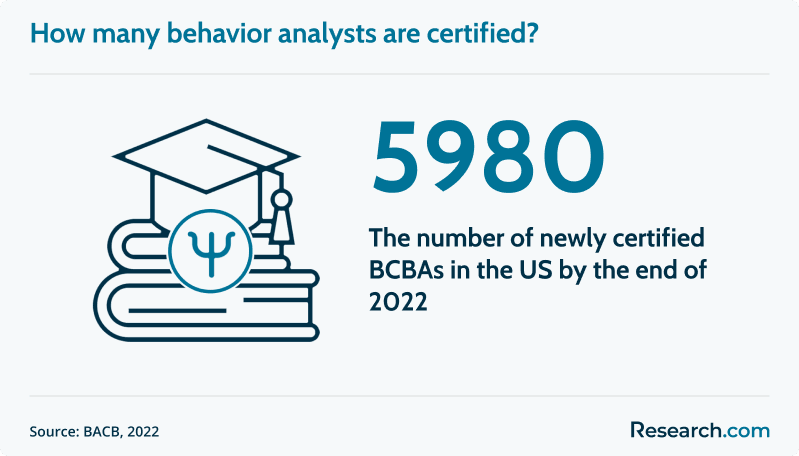
- By the end of 2022, 5,980 people in the United States became newly certified BCBAs, bringing the total number of U.S. BCBAs to 59,976. In the same reporting context, 55% of first-time BACB examination takers passed, while 24% of retakers passed.
- BCBAs had a median annual wage of $86,990 by the end of 2023, according to Comparably, compared with the $53,664 median annual wage of 122.1 million full-time U.S. employees in the third quarter of 2023.
- ABA training can apply to healthcare, schools, government agencies, social work settings, autism services, clinics, nonprofits, and some business environments.
- Research on ABA and autism spectrum disorder continues to develop. Existing studies suggest that extensive ABA-based interventions may improve intellectual functioning and adaptive behavior among children with ASD, but students should understand both the evidence base and the ethical debates around individualized, respectful care.
How Does ABA Contribute to Behavioral Therapy?
Applied behavior analysis is grounded in behaviorism, a learning theory that examines how environmental conditions influence behavior. Instead of focusing only on internal thoughts or emotions, ABA studies observable behavior, the events that happen before and after behavior, and how reinforcement, consequences, and skill-building can support change.
In practice, ABA often uses positive reinforcement. For example, a client may learn that completing a target task, using a communication skill, or engaging in a safer behavior leads to a meaningful reward or preferred outcome. ABA can also involve teaching clients to understand consequences, reduce harmful or interfering behaviors, and build adaptive skills.
The main aim of ABA is not simply to stop unwanted behaviors. High-quality ABA should help individuals build useful communication, social, emotional, learning, and daily-living skills in ways that fit their needs and respect their autonomy. ABA may be used with people who have autism spectrum disorder, depression, ADHD, anger management challenges, obsessive-compulsive disorder, and other behavioral or developmental needs. Research also notes that barriers related to ABA dosing and continuation can limit potential benefits, which is one reason program quality, ethics, supervision, and individualized planning matter.
What Accreditation Should an Online ABA Program Have?
Accreditation and professional recognition are among the most important factors to verify before enrolling. Students should first confirm that the institution is properly accredited. Then they should evaluate whether the ABA coursework is aligned with the credentialing pathway they intend to pursue.
It is important to distinguish between institutional accreditation, ABAI accreditation or verified course sequences, and BACB certification requirements. The BACB sets eligibility standards for credentials such as the BCBA, but students should not assume that a program automatically qualifies them for certification simply because it uses ABA language. ABAI recognition, a verified course sequence, supervised fieldwork arrangements, and current BACB rules should all be reviewed carefully.
| Quality Check | Why It Matters | Question to Ask the Program |
| Institutional accreditation | Confirms that the college or university meets broad academic quality standards. | Is the institution accredited, and by which accrediting body? |
| ABAI recognition or verified coursework | Helps students identify coursework aligned with behavior-analysis standards. | Does the program have ABAI accreditation or an ABAI-approved verified course sequence? |
| BACB alignment | Certification eligibility depends on meeting BACB requirements, not simply earning a degree title. | How does the program help students verify current BCBA coursework and fieldwork requirements? |
| Supervised fieldwork support | Students may need qualified supervision to complete credentialing requirements. | Does the school arrange practicum placements, approve sites, or require students to find their own supervisors? |
| State and employer requirements | Rules can vary by location and job type. | Will this program meet the requirements in the state or setting where I plan to work? |
What Courses Are Typically in an Online Master’s in ABA Program?
Online ABA master’s programs usually teach students to assess behavior, design interventions, measure progress, apply ethical standards, and communicate with clients, families, educators, and interdisciplinary teams. Some programs are tightly focused on ABA and BCBA preparation, while others are broader applied psychology programs that include behavior-related coursework.
- Applied Behavior Analysis. ABA courses introduce core and advanced behavior-analysis concepts, including reinforcement, extinction, punishment, antecedent strategies, and intervention design. Students may analyze cases, join group discussions, complete projects, and practice applying behavior-change procedures.
- Human Behavior. Human behavior courses examine how people act within consumer, employee, social, and organizational systems. Students may study motivation, personality, social-cognitive theory, cross-cultural behavior, and developmental perspectives.
- Consumer Psychology. Consumer psychology explores the internal and external factors that shape buying decisions and customer behavior. Students learn to apply psychological principles to marketing, strategy, and business decision-making, which may also appear in business psychology degree programs.
- Organizational Psychology. This course area studies how people think, feel, and behave in workplace teams and organizational systems. Topics may include individual assessment, decision theory, group process, task analysis, and interventions for workplace challenges.
- Methods for Behavior Change. Students study strategies used to increase helpful behaviors and reduce harmful or interfering behaviors. Topics may include stimulus control, antecedent interventions, reinforcement systems, and punishment procedures, with an emphasis on ethical and evidence-based use.
What Are the Prerequisites for Enrolling in Online ABA Programs?
Admissions requirements vary by university, but online master’s in ABA programs typically look for academic readiness, communication skills, professional maturity, and a clear reason for pursuing behavior-analysis training.
- Bachelor’s Degree. Many programs prefer applicants with undergraduate study in psychology, counseling, education, social work, human services, or a related field. Applicants from other backgrounds may still be considered, but they may need foundational coursework before starting advanced ABA classes.
- Professional Experience. Some programs value experience with developmental disabilities, behavioral intervention, classroom support, mental health services, or related client-facing work. Experience can help applicants show that they understand the demands of ABA practice.
- Letters of Recommendation. Recommendation letters from professors, supervisors, or professional colleagues help admissions teams evaluate academic ability, work ethic, interpersonal skills, and readiness for graduate study.
- Statement of Purpose. A strong statement explains why the applicant wants to study ABA, what populations or settings interest them, and how the program fits their professional goals.
How Long Does It Take to Complete an ABA Program?
Online master’s in ABA programs commonly take 1.5 years to 3 years. The exact timeline depends on credit requirements, term structure, fieldwork expectations, whether the student studies full-time or part-time, and whether the program offers accelerated or self-paced options.
Full-time students may finish faster because they can take more courses per term and focus heavily on school. Part-time students may need longer, but that format can be more realistic for working professionals or caregivers. Programs with practicum, internship, or supervised fieldwork requirements may also take longer because students must complete both academic and applied learning milestones.
| Program Pace | Typical Fit | Main Trade-Off |
| Accelerated | Students who can handle intensive coursework and have strong time-management skills. | Faster completion, but heavier weekly workload. |
| Full-time | Students who can prioritize graduate study and fieldwork. | Shorter timeline, but less flexibility for full-time employment. |
| Part-time | Working professionals who need a manageable course load. | More schedule flexibility, but longer time to graduation. |
| Self-paced or flexible online | Independent learners who need control over when they complete coursework. | Convenient format, but requires discipline and proactive planning. |
What Is the Average Cost of an Online Master’s in ABA Program?
Costs vary widely by school, credit load, fees, residency status, and whether students need additional supervision, travel, materials, or technology. In the programs discussed here, graduate students in the online master’s in applied behavior analysis program at the University of Southern California may pay $33,320 for 15 to 18 units, or $2,244 per unit. Northeastern University lists $40,200 for the entire ABA program and $30,000 for the entire applied psychology program. Pepperdine University lists tuition of $1,875 per unit. Students comparing other psychology-related options may also want to review affordable online psychology degree options.
The chart below summarizes tuition costs for selected universities offering master’s-level applied behavior analysis or related applied psychology programs.
How Is the Online Learning Platform Structured for ABA Programs?
Online ABA programs usually use a learning management system that organizes coursework, assessments, communication, and fieldwork documentation. The strongest platforms do more than host recorded lectures; they help students practice clinical reasoning, analyze data, discuss cases, and receive feedback.
- Course Modules. Weekly or unit-based modules often cover ABA principles, ethical standards, assessment procedures, intervention methods, and research skills.
- Discussion Forums. Students may discuss case studies, compare intervention strategies, and respond to peer analyses.
- Live Virtual Classes. Some programs require synchronous sessions for instructor Q&A, clinical examples, group work, or complex topic review.
- Practical Components. Programs may include in-person fieldwork, virtual simulations, tele-supervision, approved practicum sites, or internship activities.
- Assessment and Feedback. Quizzes, exams, projects, case reports, and instructor feedback help measure whether students can apply ABA concepts accurately.
- Research and Resource Access. Students may receive access to online libraries, journals, databases, and ABA-specific resources for deeper study.
What Financial Aid Options Are Available for ABA Students?
- Federal Student Aid. Eligible students can submit the Free Application for Federal Student Aid to apply for federal grants, loans, or work-study options.
- Scholarships and Grants. Universities, private organizations, professional groups, and foundations such as the BACB Foundation may offer funding opportunities for ABA students.
- Employer Tuition Reimbursement. Students already working in education, healthcare, behavioral services, or human services should ask whether their employer reimburses graduate tuition.
- Private Student Loans. Private loans may help cover remaining costs, but students should compare interest rates, repayment terms, and borrower protections carefully.
- Program-Based Aid or Payment Plans. Some ABA programs offer institutional aid, discounts, installment plans, or other financing options. Prospective students should ask each school for a full cost breakdown before applying.
How Do You Choose the Right ABA Program for Your Career Goal?
The best ABA program is the one that fits your intended credential, target population, work schedule, budget, and supervision needs. A program that is excellent for a full-time student pursuing autism services may not be the right match for a working teacher, a student interested in organizational behavior management, or someone planning to pursue doctoral study.
| If Your Goal Is... | Prioritize Programs With... | Be Careful About... |
| BCBA preparation | Clear BACB-aligned guidance, ABAI-recognized coursework where applicable, qualified supervision support, and transparent fieldwork expectations. | Assuming a degree title alone makes you certification-eligible. |
| School-based behavior support | Coursework in behavior assessment, classroom intervention, collaboration, ethics, and work with children or adolescents. | Ignoring state or district requirements for school-based roles. |
| Clinical or autism services | Strong practicum options, supervised experience with relevant populations, and faculty with applied clinical expertise. | Choosing a program without verifying placement availability. |
| Organizational behavior management | Courses in systems, performance improvement, workplace behavior, leadership, or applied psychology. | Enrolling in a program focused only on clinical practice if your goal is business or organizational work. |
| Affordability | Lower tuition, scholarships, employer reimbursement, transfer-credit policies, and predictable fees. | Looking only at tuition while ignoring technology, supervision, travel, and fee costs. |
- Check accreditation and course recognition first. Confirm institutional accreditation and ask whether the curriculum is connected to ABAI recognition or a verified course sequence when BCBA preparation is your goal.
- Match the delivery format to your life. Asynchronous programs may fit unpredictable work schedules, while synchronous programs can be better for students who want real-time instructor interaction.
- Study the practicum model before applying. Ask whether placements are arranged by the school, approved by the school, or fully student-sourced. Also ask whether supervision is included in tuition.
- Look for relevant specialization options. Some programs focus on autism spectrum disorder, pediatric behavior therapy, organizational behavior management, or education-based intervention.
- Compare total cost, not only tuition. Use net price, fees, supervision costs, technology requirements, books, and time away from work when calculating affordability. Students comparing BCBA pathways can review the best BCBA degree programs and schools.
- Ask about outcomes and support. Request information about BCBA exam preparation, advising, practicum support, alumni networks, and career services.
How Do Online ABA Programs Differ From Online Master’s Programs for School Counseling?
Online ABA programs and online school counseling master’s programs both involve human development and behavioral support, but they prepare students for different professional roles. ABA programs focus on behavior assessment, intervention design, data collection, reinforcement systems, and behavior-change procedures. School counseling programs focus more directly on academic planning, student mental health support, college and career readiness, crisis response, and schoolwide counseling services.
Students who want to become behavior analysts should look closely at ABA coursework and BCBA preparation. Students who want to support students through counseling, academic guidance, and school mental health systems may be better served by online master’s programs for school counseling.
What Student Support Services Do Online ABA Programs Offer?
Strong online ABA programs usually provide advising, faculty access, technical support, career guidance, and help navigating practicum or fieldwork expectations. These services matter because ABA students often balance graduate-level coursework with employment, supervised practice, and certification planning.
- Academic advising helps students map course sequences and avoid delays.
- Career counseling can support resume development, interview preparation, and job search strategy.
- Mentorship connects students with faculty, supervisors, or experienced practitioners.
- Technical support helps students use online platforms, video tools, databases, and assessment systems.
- Peer learning spaces such as study groups and virtual cohorts can reduce isolation and support accountability.
Students comparing program quality, services, and learning options can also review Research.com’s guide to online applied behavior analysis programs.
How Does an Online ABA Degree Program Compare to an On-Campus Program?
Online and campus ABA programs can cover similar academic content, but the student experience can differ significantly. The right format depends on how you learn best, whether you need flexibility, how much in-person interaction you want, and how fieldwork is arranged.
| Factor | Online ABA Program | On-Campus ABA Program |
| Flexibility | Often better for working professionals because lectures, assignments, and discussions may be accessible remotely. | Usually follows a more fixed classroom schedule. |
| Interaction | Relies on video meetings, forums, email, virtual office hours, and digital collaboration. | Offers more face-to-face contact with classmates, faculty, and campus resources. |
| Cost structure | May reduce commuting, relocation, student housing, and some campus-related expenses. | May involve additional transportation, housing, and campus fees. |
| Technology requirements | Requires a reliable computer, stable internet, video conferencing access, and comfort with online tools. | Technology is still used, but the classroom is not fully dependent on remote access. |
| Fieldwork | May require local placements, virtual supervision, approved sites, or student-arranged experiences. | May offer campus-affiliated sites or local placement networks. |
What Challenges Do Students Face in Online ABA Programs?
Online ABA programs can be flexible, but they also require discipline. Students must manage deadlines, complete readings independently, participate in virtual discussions, and coordinate fieldwork without the structure of a traditional campus schedule.
Common challenges include limited in-person mentorship, difficulty building peer relationships, technology problems, unclear practicum logistics, and the pressure of balancing work with intensive graduate study. Students should ask programs how they support fieldwork planning, whether instructors offer regular office hours, and what technical resources are available.
Students who want broader clinical psychology preparation in addition to ABA may also explore options such as the best PsyD programs, but they should compare degree purpose, licensure implications, time commitment, and cost before choosing that route.
What Is the Job Market for Graduates With an ABA Degree?
The job market for ABA therapists and related psychology careers is shaped by demand in schools, clinics, autism centers, mental health facilities, healthcare organizations, and community service settings. ABA professionals often help clients address behavioral challenges, build skills, and implement measurable intervention plans.
Research continues to evaluate the effectiveness and limitations of ABA, especially for autism spectrum disorder. A 2023 study found that extensive ABA-based interventions had a medium effect on intellectual functioning and adaptive behavior in children with ASD compared with usual treatment as well as little to no treatment. These gains may support children and families in daily life, although ethical, individualized, and client-centered implementation remains essential.
Telehealth has also changed ABA practice. Remote assessments, digital progress tracking, and virtual caregiver consultation became more common after the COVID-19 pandemic increased reliance on remote services. ABA graduates who are comfortable with technology, privacy rules, and virtual collaboration may be better positioned for hybrid or remote service models.
By the end of 2022, 5,980 people in the United States became newly certified BCBAs, bringing the total number of U.S. BCBAs to 59,976. Fifty-five percent of first-time BACB examination takers passed, while 24% of retakers passed. These professionals may also be part of a broader psychology labor market in which psychologists are projected to see 6% job growth from 2022 to 2032. Students comparing income paths can review the highest-paying psychology jobs, while those considering advanced education can compare a doctorate in psychology online with ABA-focused graduate training.
How Do Online ABA Programs Ensure Practical Clinical Training in a Virtual Environment?
Online ABA programs often combine digital learning with supervised applied experience. Practical training may include virtual simulations, tele-supervision, structured case studies, video-based observation, local field placements, or internships with approved agencies. The goal is to help students move beyond theory and learn how to assess behavior, design interventions, collect data, and revise plans based on client progress.
Prospective students should ask whether practicum sites are guaranteed, whether supervisors must hold specific credentials, how observation is documented, and how feedback is delivered. Students looking for shorter psychology-related pathways can also compare the best accelerated psychology programs online, while remembering that accelerated study does not remove professional supervision or credentialing requirements.
What Are the Ethical Considerations in Applied Behavior Analysis Practice?
Ethics are central to ABA because practitioners often work with children, people with disabilities, families under stress, and clients who may have limited ability to advocate for themselves. Ethical ABA practice should be evidence-based, individualized, culturally responsive, transparent, and respectful of client dignity.
- Informed consent and assent. Clients or legal guardians should understand the goals, methods, risks, benefits, and alternatives before services begin. When appropriate, clients should also be involved in decisions about their care.
- Privacy and confidentiality. ABA professionals must protect client records, communication, videos, and behavioral data, especially when telehealth or digital platforms are used.
- Evidence-based intervention. Practitioners should use methods supported by research and should monitor whether interventions are actually helping the client.
- Respect for culture and identity. Services should not ignore a client’s language, family context, disability identity, race, gender, age, culture, or values.
- Professional competence. ABA providers should practice only within their training and refer clients when needs exceed their expertise.
- Avoidance of conflicts of interest. Dual relationships, unclear financial arrangements, and personal relationships with clients can undermine objectivity and trust.
- Transparent goals. Families and clients should know what outcomes are being targeted, why those outcomes matter, and how progress will be measured.
Leveraging Technology in ABA Practice and Education
Technology now affects how ABA students learn and how behavior analysts deliver services. Online programs may use digital classrooms, simulation tools, remote supervision, electronic data systems, and collaborative platforms. In practice, ABA professionals may also use telehealth, digital behavior tracking, secure communication tools, and data-analysis software.
1. Virtual Learning Platforms for ABA Education
Online ABA programs often provide recorded lectures, live virtual classes, digital whiteboards, case simulations, discussion boards, and interactive assignments. These tools let students review difficult material, practice clinical reasoning, and collaborate with peers without relocating.
Students who want a shorter path can compare the fastest online master’s in applied behavior analysis programs, but they should still verify supervision, accreditation, workload, and credential alignment.
2. Telehealth for Remote ABA Therapy
Telehealth can expand access to ABA services for clients who live far from providers or need remote consultation. Secure video tools, virtual caregiver coaching, remote assessment, and digital progress tracking can support service delivery when used appropriately and in compliance with privacy expectations.
3. Data Collection and Analysis Tools
Behavior analysts rely on data to evaluate whether interventions are working. Digital data-collection apps and behavior-tracking software can make it easier to identify patterns, monitor change, and adjust intervention plans.
4. Virtual Reality for Skill Development
Virtual reality may be used in some settings to create structured environments for practicing social interaction, adaptive skills, or difficult scenarios. Students should treat VR as an emerging tool rather than a substitute for ethical assessment, supervision, and individualized intervention.
5. AI-Supported Personalization
Artificial intelligence may help analyze behavioral data, identify patterns, or suggest possible intervention adjustments. However, AI tools should not replace professional judgment, client consent, ethical review, or qualified supervision.
How Do Online ABA Programs Protect Data Security and Privacy in a Digital Environment?
Online ABA programs may handle student records, fieldwork documentation, video observations, and sometimes sensitive client-related information. Programs should use secure learning management systems, encrypted communication where appropriate, access controls, multi-factor authentication, and clear privacy policies.
Students should ask whether the program trains them on HIPAA-related responsibilities, digital consent, secure video storage, telehealth privacy, and ethical handling of behavior data. Cost-conscious students comparing advanced clinical psychology routes may also review cheap PsyD programs, while checking whether those programs match their licensure and career goals.
How Do Online ABA Programs Support Professional Development and Networking?
Professional development matters because ABA careers often depend on supervision, credentials, referrals, interdisciplinary collaboration, and continuing education. Online programs may support career growth through virtual job fairs, faculty mentorship, alumni groups, practitioner panels, professional association guidance, and internship connections.
Students can also build networks by joining virtual study groups, attending conferences, participating in research projects, and maintaining relationships with supervisors. Those interested in broader psychology training can compare an online master’s in psychology degree with an ABA-focused master’s to decide which option better fits their career plan.
What Are the Current Trends in Online Master’s Programs in ABA?
Online ABA education is changing as technology, employer expectations, telehealth, and credential-focused learning continue to influence graduate training. The most relevant trends are practical ones: students want flexible formats, clearer supervision pathways, stronger exam preparation, and better preparation for digital practice.
- More technology in training. Programs increasingly use behavior-tracking tools, virtual simulations, and digital data systems to mirror modern ABA practice.
- Greater flexibility. Online formats may include asynchronous coursework, accelerated options, part-time pacing, and hybrid learning models.
- More focused tracks. Some programs offer emphasis areas such as autism spectrum disorder or organizational behavior management.
- Broader access. Online education allows students to consider programs outside their immediate region, although fieldwork and state requirements still matter.
- Stronger collaboration tools. Virtual cohorts, group projects, peer review, and online professional events can help students build community from a distance.
Students focused specifically on certification affordability can explore online BCBA certification programs while confirming that each program’s structure supports their credentialing plan.
How Do Online ABA Programs Integrate Emerging Research Into the Curriculum?
Quality ABA programs update coursework as research, ethics, technology, and clinical practices evolve. Faculty may revise readings, add current case studies, incorporate new assessment tools, and connect students with research projects or evidence-based practice discussions.
Interdisciplinary learning can also strengthen ABA preparation. For example, students interested in mental health treatment systems may compare ABA coursework with a Master of Science in mental health counseling to understand how behavioral intervention and counseling preparation differ.
How Can ABA Intersect With Related Fields Such as Forensic Psychology?
ABA can connect with related fields when professionals use behavior principles to understand decision-making, environmental triggers, intervention design, skill development, and behavior change in specialized settings. In forensic psychology, behavior-analysis knowledge may support work in correctional programs, rehabilitation planning, risk-related behavior assessment, or structured intervention design.
Students interested in the legal and behavioral side of psychology may consider how ABA training could complement an affordable MS in forensic psychology. Before choosing an interdisciplinary path, they should compare required credentials, job titles, supervised experience, and state rules.
Common Mistakes to Avoid When Choosing an Online ABA Program
| Mistake | Why It Can Be a Problem | Better Approach |
| Assuming every ABA master’s leads to BCBA eligibility | Certification requirements depend on coursework, degree level, supervised experience, examination rules, and current BACB standards. | Ask the program to explain exactly how it supports BCBA preparation and verify requirements independently. |
| Looking only at tuition | Fees, supervision costs, books, travel, technology, and lost work hours can change the real cost. | Request a full cost-of-attendance estimate before applying. |
| Ignoring fieldwork logistics | Students may struggle to find approved placements or qualified supervisors after enrollment. | Ask who arranges placements, how supervision works, and whether support is guaranteed. |
| Relying only on rankings | A highly ranked program may not fit your schedule, state, budget, or career goal. | Use rankings as a starting point, then compare accreditation, coursework, fieldwork, and outcomes. |
| Assuming online means easier | Online ABA programs can be academically demanding and require strong self-management. | Plan weekly study blocks and confirm the expected workload. |
| Overlooking ethics and client-centered practice | ABA work involves vulnerable clients and sensitive data. | Choose programs with strong ethics training, supervised practice, and current evidence-based instruction. |
Other Things You Should Know About Applied Behavior Analysis Programs
Is a Master’s in ABA Worth It?
A master’s in applied behavior analysis may be worth it if you want graduate-level preparation in behavior assessment, intervention design, ethical practice, and data-based decision-making. It may also help you move toward BCBA certification if the program aligns with current credentialing requirements. The degree is less likely to be worth it if your preferred career does not require ABA training, if the program lacks appropriate recognition or fieldwork support, or if the cost is out of proportion to your expected career path.
How Fast Can You Get a Master’s in ABA?
Some working professionals can complete a master’s in applied behavior analysis in 15 months to 2 years, while other students may need closer to 3 years depending on enrollment status and fieldwork requirements. Accelerated programs can shorten the timeline, but students should make sure the pace is realistic and does not weaken their ability to complete supervised practice or prepare for certification.
Is a Master’s in ABA the Same as a BCBA?
No. A master’s in applied behavior analysis is an academic degree. BCBA certification is a professional credential awarded to individuals who meet BACB requirements, complete the required graduate education and supervised experience, and pass the certification examination. A degree can be part of the pathway, but it is not the credential itself.
How Can Students Effectively Engage in Collaborative Online Learning Environments?
Online ABA students can get more value from their programs by participating actively in discussion boards, joining virtual study groups, attending live sessions when available, asking faculty for feedback, and using case discussions to practice clinical reasoning. Collaboration is especially important in ABA because professional practice often involves teams, caregivers, teachers, supervisors, and other clinicians.
Key Insights
- An online master’s in ABA can be a practical route for students who need graduate training while continuing to work, but the program must align with the student’s certification, fieldwork, and career goals.
- BCBA preparation requires more than earning a degree. Students should verify institutional accreditation, ABAI recognition or verified coursework where relevant, supervised experience support, and current BACB requirements.
- Program length commonly ranges from 1.5 years to 3 years, with accelerated, full-time, part-time, and flexible online formats offering different trade-offs.
- Costs vary by institution. USC, Northeastern, and Pepperdine list different tuition structures, so students should compare total cost rather than tuition alone.
- ABA skills can apply in schools, clinics, autism services, healthcare, government, nonprofits, legal-related settings, and organizational behavior work.
- Technology, telehealth, digital data collection, privacy safeguards, and ethical client-centered care are now essential parts of ABA education and practice.
- The best program choice depends on fit: credential alignment, practicum access, affordability, faculty support, delivery format, and the population or setting where the student wants to work.
References
- Comparably. (2023, December). Board Certified Behavior Analyst Salary. https://www.comparably.com/salaries/salaries-for-board-certified-behavior-analyst
- US Bureau of Labor Statistics. (2023, April 25). Occupational Employment and Wages, May 2022, 19-3032 Industrial-Organizational Psychologists. Occupational Employment and Wage Statistics. https://www.bls.gov/oes/current/oes193032.htm
- US Bureau of Labor Statistics. (2023, September 6). Psychologists: Similar Occupations. Occupational Outlook Handbook. https://www.bls.gov/ooh/life-physical-and-social-science/psychologists.htm#tab-8
- US Bureau of Labor Statistics. (2023, September 6). School and Career Counselors and Advisors. Occupational Outlook Handbook. https://www.bls.gov/ooh/community-and-social-service/school-and-career-counselors.htm
- US Bureau of Labor Statistics. (2023, October 18). USUAL WEEKLY EARNINGS OF WAGE AND SALARY WORKERS THIRD QUARTER 2023. https://www.bls.gov/news.release/pdf/wkyeng.pdf
Other Things You Should Know About Applied Behavior Analysis Programs
An online master’s in ABA can prepare students for the Board Certified Behavior Analyst certification from the Behavior Analyst Certification Board. In 2027, candidates usually need a master’s degree, approved coursework, supervised experience, and to pass the BCBA exam.
Typical prerequisites for enrolling in a 2027 online Master's in ABA include a bachelor's degree in psychology or a related field, a minimum GPA of 3.0, and work experience in behavior analysis. Some programs may also require GRE scores and completion of specific undergraduate courses.


