
2027 Different Types of Psychology Degrees & Jobs Guide

Co-Founder and Chief Data Scientist
A note from Imed Bouchrika, PhD, career planning expert:
Psychology is not a single career track. A student choosing this major may be preparing for counseling, research, human resources, education, healthcare, law-adjacent work, or doctoral-level clinical practice. That choice matters because the degree level, specialization, licensure requirements, supervised experience, and state rules can determine which jobs are actually available after graduation. According to the U.S. Bureau of Labor Statistics data cited in this guide, psychologists earned a median pay of $100,230 per year in 2024, with projected employment growth of 12% from 2024 to 2034. This guide explains the main psychology degree types, the jobs connected to each path, online versus campus considerations, salary expectations, doctorate options, and practical questions to ask before enrolling.
Quick Answer: What Psychology Degree Should You Choose?
The best psychology degree depends on the job you want. An associate degree can introduce the field and support transfer into a bachelor’s program. A bachelor’s degree is useful for roles in business, social services, research assistance, and graduate school preparation. A master’s degree can lead to advanced counseling, organizational, research, or school-based roles, depending on state requirements. A doctorate, usually a Ph.D. or PsyD, is commonly required for independent psychologist licensure, university research, clinical leadership, and many specialized practice areas.
Key Takeaways
- Psychology offers many career routes, and the cited BLS data reports a median annual wage of $100,230 for psychologists in 2024.
- The psychology job market is projected to grow by 12% from 2024 to 2034, which indicates stronger-than-average demand for qualified professionals.
- About 12,800 psychologist job openings are projected each year over the decade, including both new positions and openings created by workforce turnover.
Types of Psychology Degrees and Jobs Table of Contents
- Psychology degree and job options for 2027
- Top-employing careers for psychology degree holders
- Highest-paying psychology career paths
- Business careers that use psychology training
- Clinical psychology versus counseling psychology
- Career trends shaping psychology majors
- Continuing education for psychology licensure
- Careers that usually require a doctorate in psychology
- PsyD versus Ph.D. in psychology
- Online psychology degrees versus campus programs
- How to evaluate an online psychology program
- When an online behavioral psychology degree makes sense
- How sociology strengthens psychology practice
- Using technology in psychology careers
- Whether accelerated doctoral programs can speed up psychology careers
- Advantages of an online doctorate in psychology
- Why neuropsychology matters in modern practice
- Admission requirements for online psychology programs
- Career value of a master’s in mental health counseling
- Ways to gain practical experience in a master’s program
- Affordable online psychology degrees and career impact
- Ethical issues in contemporary psychology practice
- Choosing an accelerated online bachelor’s in psychology
Psychology Degree and Job Options for 2027
If you are asking, “What can I do with a psychology degree?" the honest answer is: it depends heavily on the credential you earn and whether the role requires licensure. Psychology graduates work in mental health, education, healthcare, business, research, public service, and technology. However, not every psychology job is open to every degree level. Clinical diagnosis, psychotherapy, psychological testing, and independent practice usually require graduate education and state approval.
Before choosing a school or specialization, map the degree to the job you want. A student aiming for human resources may not need the same graduate pathway as someone planning to become a clinical psychologist. A future researcher may choose a different doctorate than a future therapist. Understanding this early can save time, tuition, and unnecessary coursework.
What Are the Main Types of Psychology Degrees?
Psychology education starts at the undergraduate level but often continues into graduate study for students who want licensed or specialized roles. At the bachelor’s level, many students compare the psychology BA vs BS because the BA often emphasizes liberal arts and social science breadth, while the BS often includes more science, math, statistics, and research preparation. Students can also choose campus-based programs or online schools for psychology degrees, provided the program fits their career and licensure goals.
| Degree Type | Best Fit | Typical Career Direction | Key Decision Point |
| Associate Degree in Psychology | Students testing interest in psychology or planning to transfer | Entry-level support roles or preparation for a bachelor’s degree | Confirm transfer agreements and whether credits apply to a four-year psychology major |
| Bachelor’s Degree in Psychology | Students seeking broad behavioral science training | Human services, business, research assistance, case support, graduate school preparation | Choose BA or BS based on whether you prefer applied social science, research, or science-heavy study |
| Master’s Degree in Psychology | Students seeking advanced applied, research, counseling, or organizational roles | Counseling-related work, research, education, industrial-organizational roles, or doctoral preparation | Check whether the program meets state licensure or certification requirements for your intended role |
| Doctoral Degree: Ph.D. or PsyD | Students pursuing licensed psychologist practice, research, academia, or advanced specialization | Clinical psychology, counseling psychology, school psychology, neuropsychology, research, academic careers | Decide whether your priority is research production, direct clinical practice, or both |
| Specialized Psychology Concentrations | Students with a focused career goal | Industrial-organizational, forensic, sports, health, behavioral, school, or neuropsychology careers | Verify that the specialization has internships, practicum options, and employer recognition |
- Associate Degree in Psychology: An associate program introduces major concepts in human behavior, development, cognition, and research. The best online psychology associate degree options can be practical for students who want a lower-cost starting point before transferring to a bachelor’s program.
- Bachelor’s Degree in Psychology: A bachelor’s degree builds foundational knowledge in psychological theory, statistics, research methods, social behavior, abnormal psychology, and development. It is useful for entry-level work and is also the common foundation for graduate study.
- Master’s Degree in Psychology: Master’s programs usually offer deeper study in research, counseling, assessment, organizational behavior, or a specialty area. Some are designed for workforce entry, while others are designed as preparation for doctoral study.
- Doctoral Degrees: A Ph.D. usually emphasizes research, theory, methodology, and academic contribution. A PsyD usually emphasizes professional practice and clinical application, although both may include research and both may support licensure depending on program design and state rules.
- Specializations: Psychology specializations help students align coursework, fieldwork, and research with a specific job market. Examples include forensic psychology, sports psychology, health psychology, school psychology, neuropsychology, and industrial-organizational psychology.
What Jobs Can You Get With a Psychology Degree?
The psychology workforce is broad. The cited data notes that more than 3,418,420 individuals are employed in psychology-related fields. Some roles require a psychology license; others use psychology training in business, social services, education, healthcare, or research without requiring the title “psychologist.” If you are weighing whether a psychology major is worth it, focus less on the major name alone and more on the degree level, field experience, licensure alignment, and target role.
| Role | What the Work Involves | Common Education or Credential | Salary Information Cited |
| Clinical Psychologist | Assesses, diagnoses, and treats mental, emotional, and behavioral disorders | Doctorate in psychology and licensure are typically expected | $80,000 to $110,000 |
| Counseling Psychologist | Helps clients address personal, interpersonal, emotional, and life-transition concerns | Master’s or doctoral degree plus licensure, depending on state and role | $70,000 to $95,000 |
| Industrial-Organizational Psychologist | Applies psychology to hiring, performance, workplace culture, productivity, and employee well-being | Master’s degree is common; some roles require a Ph.D.; a business psychology major may be relevant | $90,000 to $120,000 |
| Forensic Psychologist | Uses psychological expertise in legal, court, correctional, or investigative settings | Doctoral training is often expected for advanced forensic practice | $75,000 to $100,000 |
| School Psychologist | Supports student learning, development, assessment, mental health, and school-based interventions | Specialist-level training and state certification are typical | $65,000 to $90,000 |
| Sports Psychologist | Works with athletes and teams on motivation, performance, stress, and mental wellness | Master’s or doctoral degree is common | $70,000 to $100,000 |
| Health Psychologist | Examines how behavior, stress, coping, and psychological factors affect physical health | Master’s or doctorate in health psychology or a related area | $80,000 to $110,000 |
| Neuropsychologist | Studies and assesses brain-behavior relationships, often in medical or rehabilitation contexts | Ph.D. plus post-doctoral neuropsychology training is often required | $90,000 to $130,000 |
| Research Psychologist | Designs studies, analyzes data, and investigates psychological questions | Ph.D. is typically needed for independent research leadership | $70,000 to $110,000 |
| Social Worker | Connects individuals, families, and communities with services, advocacy, and support | Bachelor’s or master’s degree in social work is generally used; psychology background can help | $50,000 to $70,000 |
What Psychology Graduates Say Their Degrees Gave Them
My psychology coursework helped me understand behavior in a much more practical way. I use concepts from the degree in professional conversations, personal relationships, and decision-making every day. Emma
The online format made it possible to continue my education while managing other responsibilities. It required discipline, but the access to resources and classmates helped me stay engaged. Aiden
The most useful part of my program was the applied work. Case studies, projects, and research assignments helped me move from theory to workplace-ready skills. Sofia
Key Findings From the Psychology Education and Career Data
- Psychology-related employment includes 3,418,420 individuals, showing that psychology training can apply across many job categories.
- The cited median annual wage across psychology occupations is $53,000, which indicates meaningful earning potential but also variation by role, degree level, and licensure.
- Part-time employment accounts for 19% of psychology degree holders, which may appeal to professionals seeking schedule flexibility.
- Advanced education is common: 49% of workers in the field hold an advanced degree.
- Specialization is the norm, with 99% of psychology graduates focusing on a specific concentration.
- Substance abuse, behavioral disorder, and mental health counselors have 18% projected job growth, reflecting demand for behavioral health services.
What Are the Top-Employing Occupations for Psychology Degree Holders?
The BLS reports that psychologists held about 192,000 jobs in 2025. About 28% were self-employed, while others worked in clinical, counseling, school, organizational, and specialized settings. Many psychology graduates also enter occupations that are not officially classified as psychologist roles but still rely on behavior, communication, assessment, and people-centered problem-solving.
- Substance Abuse, Behavioral Disorders, and Mental Health Counselors: These professionals support clients dealing with addiction, mental health conditions, and behavioral challenges. The education needed to be a substance abuse counselor commonly includes a bachelor’s degree, and the cited median wage is approximately $47,660.
- Lawyers: Psychology can support legal careers related to mental health law, family law, criminal behavior, disability, or advocacy. This path typically requires a professional degree, with median earnings of around $126,930.
- Social Workers: Psychology training can be useful in social work settings, where professionals help clients navigate services, crises, and community resources. A bachelor’s degree is often enough to begin, and the cited median wage is about $51,760.
- Human Resources Specialists: Psychology graduates can apply knowledge of motivation, selection, training, and organizational behavior. A bachelor’s degree is the usual entry point, and median salary figures are near $63,490.
- Registered Nurses: Psychology knowledge can support psychiatric nursing and patient-centered care. A bachelor’s degree is often needed, and the cited median wage is about $75,330.
- Educational, Guidance, and Career Counselors and Advisors: These professionals help students and clients with academic planning, career exploration, and personal development. A master’s degree is usually required, and the cited median wage is around $58,120.
- Psychologists: Psychologists work across specialties including clinical, counseling, school, research, and organizational psychology. The cited median wage is typically $82,180, and many roles require graduate education.
- Postsecondary Teachers: Psychology faculty teach college courses, supervise research, mentor students, and publish scholarship. A doctoral degree is generally required, with median wages of around $80,790.
- Managers: A psychology background can help managers understand teams, conflict, motivation, performance, and organizational change. A bachelor’s degree may be enough for some roles, and the cited median wage is about $109,760.
- Elementary School Teachers: Developmental psychology can support classroom management and child learning. A bachelor’s degree is required, and the cited median wage is approximately $60,940.
- Social Worker: This role is not limited to psychology graduates, but psychological knowledge can be helpful for professionals focused on community support and social change. Estimated salary: $50,000 $70,000 per year.
Some of these careers require only a bachelor’s degree, while others require a graduate credential such as an on-campus or master’s in psychology online. Use the chart below as one input when comparing opportunity, but also review licensure, supervised hours, and state-specific requirements before committing to a program.
What Are the Highest-Paying Psychology Roles?
High-paying psychology careers usually require advanced training, specialized expertise, licensure, or work in medical, organizational, legal, or technical environments. Students comparing bachelor’s-level and master in psychology degree jobs should remember that salary figures vary by state, employer, experience, and credential.
| Career | Approximate Annual Salary Cited | Why It Can Pay More |
| Psychiatrist | $239,514 | Medical training, prescribing authority, and mental health specialization |
| Industrial-Organizational Psychologist | $135,688 | Direct value to workforce productivity, hiring, analytics, and organizational strategy |
| Neuropsychologist | $122,928 | Advanced expertise in brain-behavior assessment and clinical interpretation |
| Engineering Psychologist | $92,813 | Application of human behavior to technology, systems, and product design |
| Military Psychologist | $92,813 | Specialized work with military personnel, stress, trauma, assessment, and readiness |
| Clinical Psychologist | $91,872 | Diagnosis, psychotherapy, testing, and advanced clinical training |
| Counseling Psychologist | $89,359 | Licensed practice supporting emotional, relational, and life adjustment concerns |
| School Psychologist | $81,500 | Specialized student assessment, intervention, and educational support; see also child psychologist pay |
| Sports and Performance Psychologist | $79,575 | Specialized support for athletes, performance, motivation, and mental wellness |
| Forensic Psychologist | $78,869 | Psychological expertise applied to legal and correctional settings; students may compare forensic psychology undergraduate programs and colleges with criminal psychology programs |
What Business Roles Can You Pursue With a Psychology Degree?
A psychology degree can translate well into business because employers need people who understand decision-making, motivation, communication, group behavior, research, and conflict. Business-focused psychology graduates may work outside clinical settings and use their training to improve hiring, customer insight, product design, and organizational culture.
- Human Resources Manager: Uses knowledge of motivation, employee relations, training, selection, and workplace behavior to support teams and policies.
- Market Research Analyst: Studies consumer behavior, survey responses, buying patterns, and audience preferences to guide business decisions.
- Organizational Development Specialist: Helps organizations improve culture, leadership, communication, change management, and employee engagement.
- Consumer Psychologist: Applies behavioral science to marketing, branding, customer experience, and sales strategy.
How Does Clinical Psychology Differ From Counseling Psychology?
Clinical psychology generally focuses on the assessment, diagnosis, and treatment of mental, emotional, and behavioral disorders. Clinical psychologists often work with more complex psychopathology and may practice in hospitals, clinics, private practices, integrated health systems, or academic medical settings. Their training typically includes psychological testing, diagnosis, evidence-based intervention, ethics, research, and supervised clinical experience.
Counseling psychology also involves mental health support, but it often emphasizes personal development, adjustment, relationships, coping, vocational issues, and life transitions. Counseling psychologists may work in colleges, community agencies, private practice, schools, and wellness-oriented settings. The distinction is not always rigid, and both fields can lead to licensed psychologist practice depending on the program, training sequence, and state requirements. Students considering doctoral practice can compare options such as accredited online PsyD programs to see how programs structure clinical preparation.
What Emerging Career Trends Affect Psychology Majors?
The American Psychological Association has identified several key trends in psychology that point to a broader, more technology-aware, and socially responsive profession. These trends matter because psychology graduates increasingly need communication skills, digital literacy, cultural competence, ethical judgment, and the ability to work across disciplines.
- Clearer Public Communication of Psychological Science: Psychologists are expected to explain research in accessible, accurate ways. Programs such as a psychology degree online in Georgia may help students practice writing and communication for diverse audiences.
- Responding to Misinformation: As society continues to navigate the risks and benefits of the fourth industrial revolution, psychology professionals need to evaluate evidence, challenge misleading claims, and communicate responsibly. This is especially relevant in digital learning environments, including psychology degree programs in Texas offered online.
- More Inclusive Psychological Research: Research design is increasingly expected to account for diverse populations, identities, communities, and lived experiences.
- Equity, Diversity, and Inclusion Work: Psychologists are contributing to EDI strategy, assessment, training, and organizational change. Students comparing colleges in Texas for psychology may want to review how programs teach cultural competence and applied inclusion work.
- Worker Well-Being: Employers are paying more attention to stress, burnout, workplace mental health, and healthy organizational systems.
- Youth Mental Health: Schools, families, and healthcare organizations continue to need professionals who understand child and adolescent mental health challenges.
- Cross-Professional Partnerships: Psychology increasingly intersects with education, medicine, business, law, public health, social work, and technology.
- Suicide Prevention: Prevention, risk assessment, community education, and intervention remain critical areas of mental health practice.
- Faculty Career Mobility: Some psychology faculty are moving into nonacademic sectors, expanding the reach of psychological expertise.
- Changing Funding Priorities: Venture capital and private investment are influencing which mental health tools, platforms, and interventions scale quickly.
- Reframing the Public Image of Psychology: The field continues to communicate its relevance beyond therapy, including policy, organizations, technology, education, and health.
What Continuing Education Is Required to Maintain Psychology Licensure?
Psychology licensure does not end at graduation or the initial licensing exam. Licensed psychologists generally need continuing education to remain current, maintain ethical competence, and renew their licenses. Requirements vary by state, so professionals should rely on their state psychology board rather than assuming a national rule applies everywhere.
- Approved Continuing Education Courses: Psychologists often must complete a set number of CE hours during each renewal cycle. Some students and professionals also compare an affordable psychology degree online when looking for accredited education pathways or continuing learning options.
- Ethics Training: Many boards require ethics-focused coursework covering professional conduct, boundaries, documentation, confidentiality, and client welfare.
- Diversity and Cultural Competency: Some states require training related to cultural competence, diversity, equity, and responsive care.
- Renewal Cycle Compliance: Licenses are commonly renewed every one to two years, and CE must be completed within the required timeframe.
- Documentation: Psychologists should keep certificates, course descriptions, provider information, and renewal records in case of audit or board review.
What Careers Usually Require a Doctorate in Psychology?
A doctorate is typically needed when the work involves independent psychologist practice, advanced assessment, clinical leadership, academic research, or highly specialized expertise. Requirements vary by state and employer, but students should assume that many roles using the title “psychologist” require doctoral-level preparation and licensure.
- Clinical Psychologist: Provides assessment, diagnosis, psychotherapy, testing, and treatment planning in healthcare, private practice, or mental health settings.
- Counseling Psychologist: Supports clients with emotional, relational, academic, vocational, and adjustment-related concerns.
- School Psychologist: Works with children, adolescents, families, teachers, and schools; students interested in child development may also explore a child psychology degree.
- Forensic Psychologist: Applies psychological methods to court, correctional, competency, custody, risk, and legal questions.
- Neuropsychologist: Evaluates cognitive and behavioral effects of brain injury, neurological illness, developmental disorders, and medical conditions.
- Industrial-Organizational Psychologist: Uses advanced psychological science to address workplace selection, assessment, productivity, training, and organizational health.
- Research Psychologist: Designs and leads psychological research in academic, government, nonprofit, or private research environments.
- Academic Psychologist: Teaches university students, supervises research, publishes scholarship, mentors graduate students, and contributes to the discipline. Health psychologists may also need doctoral preparation when working in specialized clinical, research, or public health roles.
How Does a PsyD Differ From a Ph.D. in Psychology?
The PsyD vs Ph.D. in psychology decision usually comes down to professional goals. A PsyD is commonly designed for students who want intensive clinical training and a career centered on therapy, assessment, and direct service. PsyD programs often emphasize supervised practice, applied intervention, case formulation, and professional preparation.
A Ph.D. in psychology usually places more weight on research design, statistics, theory, scholarship, and the production of original research. It may be the stronger fit for students who want academic careers, research leadership, or roles where scientific investigation is central.
Both degrees can support psychologist licensure when the program and training sequence meet state requirements. The better choice is not the “more prestigious” label; it is the degree that matches your intended work. Choose a PsyD if your priority is clinical practice. Choose a Ph.D. if your priority is research, teaching, or a research-intensive clinical career.
How Do Online Psychology Degrees Compare to On-Campus Degrees?
Online psychology degrees can be credible when they are offered by properly accredited institutions and when they provide the same academic rigor, faculty quality, student support, and fieldwork access expected of comparable campus programs. For psychology, the key issue is not only whether classes are online. It is whether the program supports your next step, especially if your goal involves licensure, practicum, internship, or supervised clinical training.
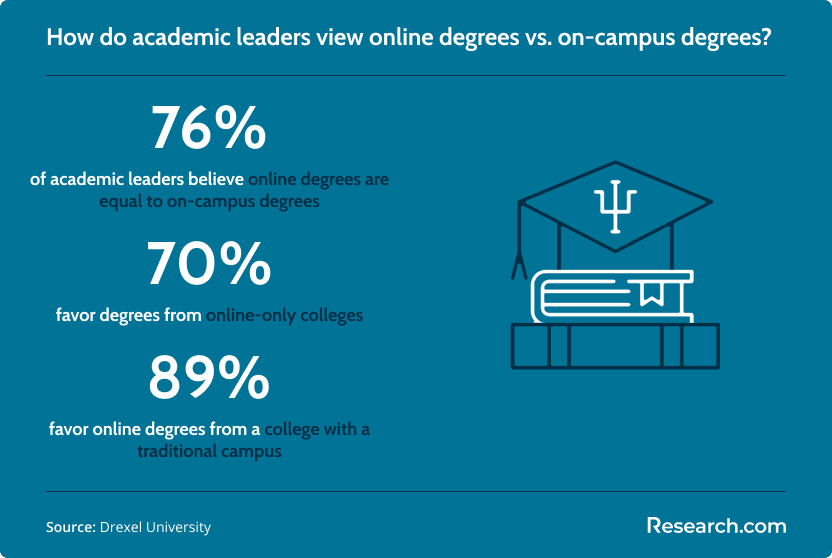
Regional accreditation is especially important because employers, graduate schools, financial aid systems, and licensing boards often use accreditation as a quality filter. According to the cited Drexel University discussion, 76% of academic leaders view online degrees as equivalent to on-campus degrees, and that figure rises to 89% when the online degree comes from an institution with a brick-and-mortar campus.
| Factor | Online Psychology Degree | On-Campus Psychology Degree | What to Check |
| Flexibility | Often better for working adults and students with caregiving responsibilities | More fixed class times and location requirements | Whether courses are asynchronous, synchronous, or hybrid |
| Field Experience | May require students to arrange local practicum or internship placements | May offer nearby campus-affiliated placements | Who secures placements and whether they meet state rules |
| Peer and Faculty Interaction | Depends on discussion tools, live sessions, advising, and cohort design | Often easier to access in-person mentoring and campus events | Faculty availability, advising model, and student support services |
| Employer Perception | Strongest when accredited and institutionally reputable | Often familiar to local employers | Accreditation, program outcomes, and institutional reputation |
| Licensure Preparation | Must be verified carefully, especially across state lines | May be designed around the home state’s requirements | Whether the program meets requirements in the state where you plan to practice |
The image below illustrates how academic leaders and employers may evaluate an online psychology credential.
What Should Students Look for in an Online Psychology Program?
An online psychology program should be evaluated like a career investment, not just a convenient schedule. A low price or fast completion time is not enough if the program lacks accreditation, fieldwork support, faculty access, or licensure alignment.
- Accreditation: Prioritize accredited institutions and confirm whether program-level requirements apply to your target career.
- Curriculum Fit: Review required courses, electives, concentrations, research training, and applied learning to make sure they match your intended role.
- Faculty Qualifications: Look for faculty with relevant scholarship, clinical experience, organizational experience, or specialization in your area of interest.
- Licensure Preparation: If you plan to become licensed, ask the program to identify exactly which state requirements it is designed to meet.
- Technology and Learning Support: Check the learning platform, library access, tutoring, technical help, writing support, and online advising.
- Flexibility and Student Services: Compare scheduling, part-time options, cohort structure, career services, placement support, and responsiveness to online learners.
Questions to Ask Before Enrolling
- Is the institution regionally accredited?
- Does the program meet licensure requirements in the state where I plan to work?
- Who helps arrange practicum, internship, or supervised field experience?
- What percentage of students complete the program, and what support exists for those who struggle?
- How are online students connected with faculty, peers, research opportunities, and career advising?
- Will transfer credits apply to major requirements or only to general electives?
- What is the total cost after fees, books, technology requirements, travel for residencies, and field placement expenses?
Is an Online Behavioral Psychology Degree the Right Career Step?
Behavioral psychology focuses on how behavior is learned, reinforced, measured, and changed. This can be valuable in education, healthcare, business, coaching, applied behavior settings, and program evaluation. Students who want practical tools for behavior change may benefit from a behavioral psychology degree online, especially if they need flexibility while building applied skills.
This path is strongest for students who want measurable intervention strategies and are comfortable with data, observation, assessment, and structured behavior plans. It may be less appropriate for students seeking a broad counseling identity unless the program also includes the supervised clinical preparation required for their target license.
How Can Sociology Improve Psychological Practice?
Psychology often focuses on individual thought, emotion, behavior, development, and mental processes. Sociology adds a wider view of institutions, culture, inequality, family systems, community patterns, and social structures. Together, the two fields help practitioners avoid treating people as isolated individuals when social conditions also influence mental health and behavior.
Students comparing sociology vs psychology can use the distinction to build stronger case formulation, research questions, and intervention planning. For example, a clinician may consider family stress, neighborhood conditions, discrimination, school systems, employment instability, and healthcare access alongside individual symptoms.
How Can Psychology Graduates Use Technology in Their Careers?
Technology is changing how psychology professionals deliver care, conduct research, analyze behavior, and design products. Graduates who combine psychological knowledge with digital skills may be better positioned for telehealth, behavioral data analysis, user experience research, digital mental health tools, and interdisciplinary work.
- Teletherapy and Online Counseling: Remote care platforms allow qualified providers to deliver services, manage appointments, and share resources across distance, subject to licensure and privacy rules.
- Virtual Reality in Therapy: VR tools can support controlled exposure experiences for concerns such as PTSD and phobias when used by properly trained professionals.
- Data Analysis and Artificial Intelligence: AI and machine learning can support research, pattern detection, and decision tools, but psychologists must evaluate accuracy, bias, privacy, and ethical limits.
- Mental Health Apps: Psychology graduates may help design or evaluate apps for mood tracking, mindfulness, cognitive behavioral tools, and behavior monitoring.
- Neurofeedback and Brain-Computer Interfaces: These tools may appear in neuropsychology and related settings for conditions such as ADHD, anxiety, and depression.
- User Experience Research and Design: Psychology graduates can work with technology teams to study user behavior, improve interfaces, and design products that better match human needs.
Can Accelerated Doctoral Programs Speed Up a Psychology Career?
Accelerated doctoral programs can shorten the time to degree, but speed should not be the only goal. Psychology doctorates involve demanding coursework, research, practicum, supervised clinical training, ethics preparation, and often internship requirements. A compressed schedule can be useful for highly prepared students, but it can also reduce flexibility and increase workload intensity.
Before choosing an accelerated option, compare accreditation, clinical placement structure, faculty support, internship outcomes, licensure alignment, dissertation or doctoral project expectations, and total cost. Students interested in shorter routes can review options such as 3-year PsyD programs online, but they should verify whether the format fits their state licensing plans and personal capacity.
What Are the Benefits of an Online Doctorate in Psychology?
An online doctorate can be attractive for students who need advanced training without relocating. It may offer schedule flexibility, access to faculty outside the student’s region, and continued employment while studying. However, doctoral psychology education still requires serious time, applied training, and close attention to licensure requirements.
Many online doctoral pathways combine remote coursework with research expectations, clinical or applied training, supervision, and sometimes in-person components. Students considering an online PhD in psychology should confirm how the program handles residencies, practica, internships, dissertation support, state authorization, and post-graduation licensing outcomes.
Why Neuropsychology Matters in Modern Psychological Practice
Neuropsychology connects psychology with neuroscience by examining how brain structure and brain function relate to cognition, emotion, and behavior. This specialization is especially relevant in healthcare, rehabilitation, aging, traumatic brain injury, stroke, developmental conditions, and neurodegenerative disease.
What Is Neuropsychology?
Neuropsychology studies brain-behavior relationships. Neuropsychologists evaluate cognitive functioning, emotional changes, attention, memory, executive functioning, language, and other abilities affected by neurological, medical, or developmental conditions such as traumatic brain injuries, strokes, neurodegenerative diseases, and learning disabilities.
Why Choose Neuropsychology?
Neuropsychology is one of the higher-paying psychology specialties cited in this guide, with salaries ranging from $90,000 to $130,000 annually. The work can be meaningful because neuropsychologists contribute to diagnosis, treatment planning, rehabilitation, disability documentation, and research on brain disorders.
How Do You Enter Neuropsychology?
Students typically need a doctoral degree in psychology with neuropsychology-focused training, followed by additional postdoctoral training in clinical neuropsychology. Those comparing specialty options can explore how neuropsychology careers align with their interests in healthcare, assessment, neuroscience, and research.
Where Do Neuropsychologists Work?
Neuropsychologists may work in hospitals, rehabilitation centers, private practices, academic medical centers, research institutions, and specialty clinics. They conduct cognitive assessments, interpret results, collaborate with physicians and therapists, and help design treatment or rehabilitation plans.
What Is the Future of Neuropsychology?
Brain imaging, neurofeedback, digital assessment tools, and AI-supported diagnostics are expanding the tools available to neuropsychology. Professionals in this specialty will need strong clinical judgment, research literacy, ethical awareness, and the ability to interpret technology without overrelying on it.
What Are the Admission Requirements for Online Psychology Programs?
Admission requirements vary by degree level and institution, but applicants should expect to document prior academic preparation, writing ability, professional goals, and readiness for online learning. Graduate and doctoral programs usually review fit more carefully because psychology training may involve research, ethics, clinical preparation, or fieldwork.
- Accredited Prior Degree: Applicants may need an accredited bachelor’s degree for graduate study or a high school credential for undergraduate admission.
- Competitive GPA: Programs often evaluate academic performance as evidence of readiness for psychology coursework.
- Standardized Tests: Some programs may require scores such as the GRE if specified by the institution.
- Recommendations: Letters from professors, supervisors, or professionals can help demonstrate preparation and maturity.
- Personal Statement: Applicants should explain career goals, research or practice interests, and why the program fits.
- Technical Readiness: Online students should verify technology requirements, learning platform expectations, and access to reliable internet.
- Program-Specific Documents: Some programs require interviews, writing samples, resumes, prerequisite coursework, or background checks.
Students comparing cost and doctoral access may also review options such as the most affordable online doctorate in psychology, while remembering that low cost should not outweigh accreditation, licensure alignment, and field training quality.
What Career Advantages Can a Master’s in Mental Health Counseling Offer?
A master’s program in mental health counseling can be a focused route for students who want clinical counseling skills, supervised practice, and preparation for counseling-related licensure. These programs typically emphasize evidence-based interventions, ethics, human development, diagnosis, multicultural practice, assessment, crisis response, and supervised client work.
The advantage of a specialized counseling master’s degree is clarity. Instead of a broad psychology curriculum alone, students receive structured preparation for helping roles in community agencies, clinics, schools, private practice settings, or integrated care environments, depending on state rules. Students can compare options through a masters degree mental health counseling program guide.
How Can Students Gain Practical Experience in a Master’s Psychology Program?
Applied experience is especially important in psychology because employers and licensing boards often value supervised practice, field exposure, research skills, and case-based learning. Even flexible programs such as forensic psychology master's programs online accredited may include ways to connect coursework with real-world settings.
- Internships and Practicums: Students may complete supervised placements with mental health facilities, courts, law enforcement agencies, schools, nonprofits, or community organizations.
- Fieldwork Requirements: Some programs require observation, interviewing, assessment support, program evaluation, or applied research connected to the specialty area.
- Capstone Projects: A capstone may ask students to apply psychology knowledge to a practical problem, case issue, organizational need, or research question.
- Virtual Networking and Conferences: Webinars, online conferences, professional association events, and alumni panels can help students learn about job options and current issues in the field.
Affordable Online Psychology Degrees and Career Impact
Affordable online psychology degrees can reduce barriers for students who need flexibility and lower overall education costs. The career impact depends on more than tuition. Accreditation, transfer credit, field placement access, faculty quality, licensure preparation, and employer recognition all influence whether the degree supports meaningful advancement.
- Cost-Conscious Study: Online programs may reduce expenses connected to housing, commuting, and campus-based fees. Students focused on graduate cost can compare online MS psychology cheap online programs.
- Flexible Scheduling: Online study can work well for employed adults, caregivers, military students, and learners who cannot relocate.
- Career Breadth: Graduates may move toward counseling-related work, human resources, market research, social services, clinical preparation, organizational roles, or specialized graduate study.
The best affordable program is not simply the cheapest one. It is the program that minimizes debt while still helping students meet academic, licensing, and career requirements.
What Ethical Issues Matter in Modern Psychology Practice?
Psychology professionals handle sensitive information and high-stakes decisions. Ethical practice includes confidentiality, informed consent, accurate documentation, scope of competence, cultural responsiveness, professional boundaries, and careful use of assessment tools. Digital practice adds additional concerns about privacy, platform security, cross-state licensure, emergency planning, and data handling.
Students should look for programs that teach ethics throughout the curriculum, not only in one isolated course. This matters in traditional programs and accelerated online options, including pathways such as a master's in psychology online. Ethical judgment becomes even more important as telehealth, AI tools, app-based care, and digital records become more common.
Is an Accelerated Online Bachelor’s in Psychology Right for You?
An accelerated online bachelor’s in psychology can be useful for disciplined students who want to finish faster, transfer prior credits, or continue working while studying. It can also be demanding. Shorter terms often mean heavier weekly reading, writing, testing, and project deadlines.
This path may be a good fit if you already have college credits, strong time management, reliable technology, and a clear goal. It may be a poor fit if you need extensive academic support, are new to online learning, or plan to work full time without protected study hours. Students comparing speed-focused programs can review the best accelerated online psychology bachelor's degree options while checking accreditation, advising, transfer policy, and graduate school preparation.
Common Mistakes to Avoid When Choosing a Psychology Degree
| Mistake | Why It Creates Problems | Better Approach |
| Choosing a program without checking accreditation | It can affect credit transfer, graduate admission, financial aid, employer trust, and licensure eligibility | Confirm institutional accreditation and any program-specific requirements before applying |
| Assuming any psychology degree leads to therapist licensure | Many therapy and psychologist roles require specific graduate coursework, supervised hours, exams, and state approval | Start with your state licensing board and work backward to the required degree |
| Looking only at tuition | Fees, books, residencies, travel, technology, and delayed completion can change the total cost | Compare total program cost and expected time to completion |
| Ignoring practicum or internship placement support | Clinical and applied roles often require supervised experience, and finding placements can be difficult | Ask who secures placements and whether sites are available near you |
| Choosing a specialization too early without career research | A narrow concentration may not match job requirements or graduate prerequisites | Review job postings, licensure rules, and graduate admission requirements before specializing |
| Assuming salary outcomes are guaranteed | Pay varies by degree level, license, location, employer, experience, and specialization | Use salary data as a planning tool, not a promise |
References
- BLS. (2025, July 23). Clinical and Counseling Psychologists. Bls.gov.
- BLS. (2025, August 28). Field of degree: Psychology: Occupational Outlook Handbook: U.S. Bureau of Labor Statistics. Bls.gov.
- BLS. (2025, July 23). Industrial-Organizational Psychologists. Bls.gov.
- BLS. (2025, July 23). Psychologists, All Other. Bls.gov.
- BLS. (2025, August 28). Psychologists : Occupational Outlook Handbook: U.S. Bureau of Labor Statistics. Bls.gov.
- BLS. (2025, July 23). School Psychologists. Bls.gov.
Key Insights
- Start with the job, not the major. The right psychology degree depends on whether you want business roles, counseling work, research, school services, clinical practice, or doctoral specialization.
- Licensure changes everything. If your goal involves therapy, diagnosis, psychological testing, or the title “psychologist,” verify state requirements before enrolling.
- A bachelor’s degree in psychology is versatile, but many higher-paying or independently licensed roles require a master’s, specialist credential, Ph.D., or PsyD.
- Online psychology degrees can be credible when accredited and well supported, but students must examine field placements, state authorization, and licensure preparation carefully.
- Specialization can improve career focus, especially in industrial-organizational psychology, forensic psychology, school psychology, behavioral psychology, health psychology, and neuropsychology.
- Do not choose based on salary tables alone. Pay depends on education, license, specialty, employer, location, experience, and whether the role is clinical, organizational, research-based, or academic.
Other Things You Should Know About Types of Psychology Degrees
In 2027, aspiring psychologists typically need a doctoral degree, such as a Ph.D. or Psy.D., from an accredited program, plus a state-issued license. Licensing often involves completing an internship, accruing supervised clinical experience, and passing the Examination for Professional Practice in Psychology (EPPP).
In 2027, a bachelor's degree in psychology provides the most diverse career opportunities. Graduates can explore roles in human resources, market research, social services, or education. A master's degree further broadens opportunities in clinical practice or advanced research roles, emphasizing the growing demand for psychological expertise across various sectors.
In 2027, psychology graduates can apply their expertise in unique industries such as technology, where they might work on AI-human interaction; public health, focusing on mental health programs; and entertainment, providing psychological insights for media development and audience engagement strategies.
Most U.S. states require 1,500 to 3,000 hours of supervised experience before licensure, usually completed during or after a doctoral program. The American Psychological Association also expects accredited doctoral training and supervised practice, and state boards verify the exact hours and setting before granting eligibility for the exam.


