
2027 Best Online Applied Behavior Analysis (ABA) Degree Programs

Co-Founder and Chief Data Scientist
An online applied behavior analysis degree is usually designed for people who want to use behavior science to support children, adolescents, adults, families, schools, clinics, and community programs. Many prospective students search for online ABA programs because they need a flexible route to graduate study, BCBA preparation, or career advancement without leaving a current job.
This guide explains what online ABA degree programs cover, how long they take, what they cost, how online study compares with campus-based learning, and which career paths may follow. It also helps you evaluate accreditation, supervised fieldwork, certification preparation, program quality, and long-term return on investment before you enroll.
Quick Answer: Is an Online Applied Behavior Analysis Degree Worth Considering?
An online ABA degree can be a strong option if you want flexible graduate training in behavior assessment, intervention planning, ethics, data collection, and evidence-based behavioral support. It is especially useful for students pursuing roles such as ABA therapist, behavior analyst, special education teacher, program manager, or future Board Certified Behavior Analyst, depending on the program’s certification alignment and supervised fieldwork structure.
- An ABA degree can support career paths such as ABA therapist, behavior analyst, and special education teacher.
- The average salary for an ABA therapist is around $42,000 per year.
- Online ABA programs may work well for students who need to continue working while completing coursework and fieldwork requirements.
- The best programs are not simply convenient; they should be accredited, transparent about certification preparation, and clear about supervised experience expectations.
What can I expect from an online applied behavior analysis degree?
An online applied behavior analysis degree teaches students how behavior is learned, measured, assessed, and changed through systematic intervention. Coursework typically covers behavioral principles, functional behavior assessment, research methods, ethics, intervention design, data analysis, and supervision. Many programs also include supervised fieldwork or practicum experiences so students can apply classroom concepts in schools, clinics, homes, healthcare settings, or community organizations.
Students should expect a program that is both technical and people-centered. ABA requires careful observation, accurate data collection, collaboration with families and professionals, and ethical decision-making. The strongest online programs make room for live discussion, case analysis, feedback from faculty, and structured practice rather than relying only on recorded lectures.
Where can I work with an online applied behavior analysis degree?
Graduates may work in public or private schools, autism service organizations, pediatric clinics, behavioral health agencies, hospitals, early intervention programs, residential programs, nonprofit organizations, or private practice settings. ABA professionals often support people with autism spectrum disorder, developmental disabilities, learning needs, communication challenges, or behavioral concerns that affect daily life and education.
Career settings can vary widely. In schools, ABA-trained professionals may support individualized education plans and classroom behavior strategies. In clinics, they may help implement treatment plans and track client progress. With experience and the right credentials, some professionals move into supervisory, consulting, training, or program leadership roles.
How much can I make with an online applied behavior analysis degree?
Pay depends on role, credentials, employer, location, degree level, and experience. The average salary for an ABA therapist is around $42,000 per year. Board Certified Assistant Behavior Analysts (BCaBAs) earn an average of $44,666 per year. ABA therapists with over 10 years of experience can earn $50,000 to $65,000 or more per year. ABA professionals with advanced credentials may qualify for higher-paying supervisory or clinical leadership roles.
| Role or credential | Salary information stated | What may affect earnings |
| ABA therapist | Average salary is around $42,000 per year | Experience, employer type, client population, and geographic area |
| Board Certified Assistant Behavior Analyst | Average salary is $44,666 per year | Certification status, supervision responsibilities, and work setting |
| Experienced ABA therapist | With over 10 years of experience, earnings can reach $50,000 to $65,000 or more per year | Advanced skills, leadership duties, and specialization |
| Behavior analyst | Average salary is around $56,914 per year | Board certification, graduate degree, supervisory role, and employer demand |
| BCBA-level opportunities | BCBAs can earn upwards of $75,000 annually | Private practice, leadership roles, and specialized services |
- 2027 best online applied behavior analysis programs
- How long online ABA programs usually take
- Online ABA degree vs. campus ABA degree
- Average cost of an online ABA degree
- Financial aid for online ABA students
- Admission requirements and prerequisites
- Common ABA courses
- Online ABA specializations
- How to choose the right online ABA program
- Career paths for ABA graduates
- Job market for online ABA degree graduates
- Challenges in online ABA programs
- ABA and child or adolescent psychology
- ABA with advanced psychology training
- ABA and forensic psychology pathways
- Employer views of online ABA degrees
- ABA in broader human services careers
- Industry trends affecting online ABA education
- How to evaluate long-term value
- Higher-earning ABA opportunities
- Accreditation and licensing standards
- Steps toward board certification
- Using ABA training in counseling pathways
- ABA as preparation for psychology study
- Cost-effectiveness of an online ABA degree
- Technology in online ABA programs
- Colleges with recognized ABA programs
- ABA as a route toward advanced psychology
- Online ABA compared with related graduate degrees
- Alternative graduate programs to compare
- ABA degrees and doctoral or research options
2027 List of the Best Online Applied Behavior Analysis Programs
Online ABA programs differ in cost, credit requirements, supervised fieldwork structure, certification alignment, and student support. A strong program should help students understand behavior-analytic theory while also building applied skills through practice, feedback, and ethical decision-making.
Research.com analyzed online degree options to help students compare programs using verified education data and institutional information. Students should still confirm current tuition, admission requirements, fieldwork rules, and certification eligibility directly with each school before applying.
How do we rank schools?
The ranking process uses a structured methodology based on recent and validated education data. Program quality is considered alongside practical factors that matter to students, such as affordability, academic structure, distance-learning availability, and institutional credibility.
- Integrated Postsecondary Education Data System (IPEDS database)
- Peterson’s database, including their Distance Learning Licensed Data Set
- College Scorecard database
- National Center for Education Statistics
| Rank | School | Program focus | Length | Cost per credit | Credits or courses | Accreditation listed |
| 1 | Endicott College | Applied Behavior Analysis | 2 years | $682 | 40 credits | New England Commission of Higher Education |
| 2 | Western Connecticut State University | Applied Behavior Analysis | 2 years | $458 | 22 credits | Behavior Analyst Certification Board, Inc. |
| 3 | Montana State University Billings | Applied Behavior Analysis | 2 years | $703 | 39 credits | Association for Behavior Analysis International Accreditation Board. |
| 4 | Saint Cloud State University | Applied Behavior Analysis | 2 years | $1,054 | 52 credits | Association for Behavior Analysis International Accreditation Board |
| 5 | University of Southern Maine | Applied Behavior Analysis | 2 years | $1,054 | 30 credits | Association for Behavior Analysis International Accreditation Board |
| 6 | Ball State University | Applied Behavior Analysis | 2 years | $464 | 30 credits | Association for Behavior Analysis International Accreditation Board |
| 7 | University of South Florida | Applied Behavior Analysis | 2 years | $600 | 30 credits | Association for Behavior Analysis International Accreditation Board |
| 8 | University of Washington | Applied Behavior Analysis | 2 years | $297 | 67 credits | Association for Behavior Analysis International Accreditation Board |
| 9 | University of West Florida | Applied Behavior Analysis | 2 years | $384 | 30 credits | Association for Behavior Analysis International Accreditation Board |
| 10 | Purdue University Global | Applied Behavior Analysis | 1 year | $420 | 9 courses | The Higher Learning Commission |
Program notes for the listed schools
- Endicott College: The online master’s program emphasizes theory, ABA ethics, behavioral assessment, fieldwork, and preparation for behavior analysis practice.
- Western Connecticut State University: WCSU’s online MS in ABA includes supervised fieldwork and a practical curriculum designed to connect behavioral concepts with professional settings.
- Montana State University Billings: The program includes courses such as principles of behavior analysis and behavioral assessment and intervention, with online collaboration built into the learning model.
- Saint Cloud State University: SCSU combines assessment, individualized intervention planning, practicum experience, and faculty involvement in the ABA field.
- University of Southern Maine: The program includes assessment training, intervention planning, practicum work, and mentorship opportunities.
- Ball State University: Ball State’s online MA in ABA covers behavioral assessment, intervention strategies, ethical issues, advising, technical support, and library access.
- University of South Florida: USF’s master’s program is structured around ethical scientist-practitioner training and can be completed in five semesters.
- University of Washington: UW combines ABA, research, and special education perspectives through its College of Education.
- University of West Florida: UWF offers an MA in Exceptional Student Education with an ABA concentration, community engagement, and faculty who are Board Certified Behavior Analysts.
- Purdue University Global: Purdue Global offers an MS in Psychology with an ABA concentration, adult-focused online learning, and a capstone project.
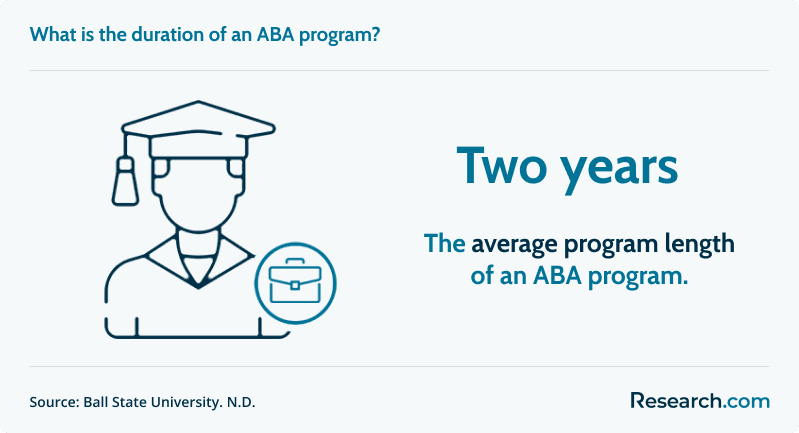
How long does it take to complete an online applied behavior analysis degree program?
The typical completion time for an online Applied Behavior Analysis degree program is one to two years, although some programs can take two years to complete. Completion time depends on enrollment status, credit load, fieldwork requirements, transfer credits, and whether the program uses accelerated, cohort-based, or self-paced scheduling.
ABA is not always the easiest psychology degree pathway because students must learn research, ethics, behavioral assessment, intervention design, and applied data collection. However, the structure can be manageable for working adults if the program offers predictable deadlines and clear fieldwork planning.
| Factor | How it affects completion time | Question to ask before enrolling |
| Program intensity | Accelerated formats may shorten the timeline, while part-time schedules may extend it. | Can I complete the program part time, full time, or on an accelerated schedule? |
| Course load | More credits or required courses usually mean a longer program. | How many courses must I take each term to graduate on time? |
| Field experience | Supervised fieldwork can add scheduling complexity, especially for working students. | Does the school help me secure supervision or placements? |
| Personal schedule | Work, caregiving, and commute demands can affect weekly study time. | How many hours per week should I expect to spend on coursework and fieldwork? |
How does an online applied behavior analysis degree program compare to an on-campus program?
Online and campus-based ABA programs can cover similar academic content, but the learning experience is different. Online programs are usually better for students who need location flexibility, asynchronous coursework, or the ability to keep working. Campus programs may be better for students who want in-person faculty access, local networking, and easier access to university-affiliated practicum sites.
Online ABA programs can be similar in convenience to the cheapest online graduate certificate programs, but convenience should not be the only factor. For ABA, fieldwork support, certification alignment, and supervision quality matter as much as course delivery format.
| Comparison point | Online ABA degree | On-campus ABA degree |
| Schedule flexibility | Often better for working adults and students outside commuting range | More fixed class times and location requirements |
| Peer and faculty interaction | Usually through discussion boards, video meetings, online groups, and virtual office hours | More spontaneous in-person interaction and campus networking |
| Fieldwork access | May require students to find local or approved placements | May provide more direct connections with nearby clinics, schools, or university partners |
| Cost considerations | May reduce relocation or commuting costs | May include campus fees, housing, or transportation costs |
| Best for | Self-directed students with strong time management skills | Students who benefit from in-person structure and campus resources |
What is the average cost of an online applied behavior analysis degree program?
The cost of an online ABA degree depends on the school, degree level, credit requirements, tuition rate, fees, fieldwork expenses, and whether the student qualifies for in-state pricing or financial aid. Students considering ABA at the graduate level should compare total program cost, not just tuition per credit.
Many online ABA programs range from $10,000 to $30,000 for a bachelor’s degree and $20,000 to $50,000 for a master’s degree. Some students also compare ABA master’s programs with related options, including the cheapest online doctorate in psychology, when planning a longer psychology career path.
The average cost of a master’s degree in science is $57,770. This has increased from the average cost of $49,855 from 1999 to 2020. STEM graduates tend to enter the most in-demand, high-paying jobs that help offset the cost of graduate school.
| Cost category | Why it matters | How to evaluate it |
| Tuition | Usually the largest direct cost | Multiply cost per credit by required credits or compare total program tuition |
| Fees | Technology, distance-learning, graduation, and course fees can add up | Ask for a complete fee schedule before applying |
| Fieldwork costs | Supervision, background checks, travel, or placement requirements may create extra costs | Ask whether fieldwork is included, arranged, or student-secured |
| Time to completion | A longer program may delay income growth or increase living expenses | Compare realistic graduation timelines, not only advertised timelines |
| Financial aid | Aid can reduce out-of-pocket cost but loans must be repaid | Review grants, scholarships, employer tuition benefits, and federal aid eligibility |
What are the financial aid options for students enrolling in an online applied behavior analysis degree program?
Students enrolling in an online Applied Behavior Analysis program may be able to use several forms of financial aid, depending on school eligibility, enrollment status, degree level, and personal circumstances. Always confirm whether the institution is eligible for federal aid and whether the program’s online format affects aid availability.
- Federal student aid: Eligible students may access grants, work-study, and federal loans through the U.S. Department of Education.
- Scholarships: Universities, professional organizations, community groups, and private foundations may offer awards for ABA, education, psychology, disability services, or behavioral health students.
- Grants: Grants do not need to be repaid and may come from government agencies, institutions, or private organizations.
- Work-study programs: These allow eligible students to earn money through approved part-time work while enrolled.
- Private loans: Private loans can help cover remaining costs, but they often have higher interest rates than federal loans and fewer borrower protections.
Ways to reduce the cost of an online ABA degree
- Ask whether transfer credits or prior graduate coursework can reduce the number of credits required.
- Compare total program cost, not just advertised tuition.
- Check whether your employer offers tuition reimbursement for behavioral health, education, or human services training.
- Prioritize accredited programs that maintain eligibility for federal aid.
- Ask whether fieldwork supervision is included in tuition or billed separately.
What are the prerequisites for enrolling in an online applied behavior analysis degree program?
Admission requirements vary by institution and degree level. Most graduate ABA programs expect applicants to hold a bachelor’s degree, submit academic transcripts, and demonstrate readiness for graduate-level psychology, education, or behavior science coursework. Some programs also request interviews, professional experience, or proof of relevant background in education, healthcare, psychology, or human services.
- Bachelor’s degree: Many programs prefer or require a degree in psychology, education, health science, or a related field. A student who completed one of the accelerated online communications degree programs may need to confirm whether additional prerequisite coursework is required.
- Undergraduate coursework: Some programs look for prior study in psychology, statistics, research methods, child development, or education.
- GRE or GMAT scores: Many programs require Graduate Record Examination or Graduate Management Admission Test scores, although some online options, including the easiest online graduate certificate programs, may not require them.
- Letters of recommendation: Schools often ask for academic or professional references who can speak to your readiness for graduate study and applied work.
- Statement of purpose: A focused statement should explain your career goals, interest in ABA, and understanding of the field’s ethical responsibilities.
What courses are typically in an online applied behavior analysis degree program?
Online ABA degree programs usually combine theory, assessment, intervention design, ethics, research, and supervised practice. The exact course sequence depends on the school, degree level, and certification goals, but most curricula are built around behavior-analytic principles and applied decision-making.
- Principles of behavior analysis: Students study core concepts such as classical conditioning, operant conditioning, reinforcement schedules, extinction, and stimulus control.
- Behavioral assessment: Coursework introduces techniques for assessing behavior, including direct observation, functional analysis, and standardized tools.
- Applied behavior analysis methods: Students learn how to design, implement, and monitor behavior intervention plans.
- Research methods: This course helps students evaluate evidence, design studies, and interpret behavior-analytic data.
- Ethics in ABA: Students examine professional conduct, client rights, supervision, confidentiality, consent, and responsible practice.
What types of specializations are available in an online applied behavior analysis degree program?
Some ABA programs allow students to focus on a specific population, setting, or practice area. These tracks can be useful if you already know where you want to work after graduation. Students comparing ABA with an online behavioral science degree should pay attention to whether the curriculum is general, clinical, school-based, autism-focused, or research-oriented.
| Specialization | Primary focus | Best fit for students interested in |
| Autism spectrum disorders | Assessment and intervention for individuals with autism spectrum disorder | Autism services, early intervention, clinics, and family support |
| Developmental disabilities | Behavioral support for people with intellectual disabilities, Down syndrome, cerebral palsy, and related needs | Community agencies, schools, residential programs, and disability services |
| Early childhood ABA | Language, social, communication, and adaptive skill development in young children | Early intervention and pediatric services |
| School-based ABA | Behavioral intervention in educational environments | Special education, school consultation, and classroom support |
| Clinical ABA | Behavioral services in clinics, hospitals, or private practice | Direct client services and treatment planning |
| Research ABA | Study design, applied research, and contribution to ABA knowledge | Doctoral study, academic research, and program evaluation |
How to choose the best online applied behavior analysis degree program?
The best online ABA program is the one that fits your career goal, certification plan, learning style, budget, and fieldwork needs. Rankings can be useful, but they should not replace your own verification of accreditation, curriculum, supervised experience, and graduate outcomes.
| Selection factor | Why it matters | What to ask |
| Accreditation | Institutional accreditation affects academic credibility and financial aid eligibility. | Is the institution regionally accredited, and is the ABA program aligned with recognized professional standards? |
| Certification preparation | Students pursuing BCBA or related credentials must meet specific coursework and fieldwork expectations. | Does the curriculum include a VCS approved by ABAI, and how does the program support certification readiness? |
| Fieldwork and supervision | ABA is an applied field; supervised practice is essential for skill development. | Does the school arrange placements, help identify supervisors, or require students to secure their own sites? |
| Cost | Tuition, fees, supervision, and time to completion affect ROI. | What is the total estimated cost, and what financial aid is available? |
| Student support | Online learners need advising, technical support, career services, library access, and faculty responsiveness. | What support is available for online students each term? |
| Outcomes | Pass rates, placement information, and alumni career paths help indicate program effectiveness. | What percentage of first-time candidates pass the BCBA exam, and what roles do graduates enter? |
| Program fit | A strong program on paper may not fit your schedule, location, or career goal. | Can I complete the program while meeting work, family, and fieldwork obligations? |
Students comparing ABA with related psychology programs should also review cost and specialization. For example, some affordable online master's in clinical psychology options can cost under $15,000 per year, but clinical psychology and ABA prepare students for different types of practice and credentials.
Common mistakes when choosing an online ABA program
- Choosing a program only because it is inexpensive without checking accreditation or certification alignment.
- Assuming every online ABA program prepares students for board certification in the same way.
- Ignoring supervised fieldwork logistics until after enrollment.
- Comparing cost per credit without calculating total credits, fees, and fieldwork expenses.
- Relying only on rankings instead of speaking with admissions advisors, faculty, and current students.
- Assuming online coursework will be easier than campus coursework.
What career paths are available for graduates of an online applied behavior analysis degree program?
Graduates of online ABA programs may qualify for direct service, school-based, clinical, supervisory, or program development roles, depending on their degree level, certification status, and state requirements. Whether a student completes the easiest master degree or a more intensive graduate program, employers will typically look closely at skills, supervised experience, and credentials.
| Career path | Typical responsibilities | Common work settings |
| ABA therapist | Implement behavior intervention plans, collect data, support skill development, and work directly with clients | Autism centers, homes, clinics, schools, and community agencies |
| Behavior analyst | Conduct assessments, design treatment plans, supervise ABA services, and evaluate intervention outcomes | Clinics, schools, healthcare organizations, nonprofits, and private practice |
| Special education teacher | Support students with disabilities, adapt instruction, and use behavioral strategies in the classroom | Public schools, private schools, and specialized education programs |
| School psychologist | Provide assessment, consultation, and intervention support for students, often including behavior management | K-12 schools, districts, and educational agencies |
| Program manager | Coordinate behavioral services, train staff, monitor quality, and support client outcomes | Behavioral health agencies, autism service providers, and nonprofit organizations |
Psychologists, in general, are expected to experience a growth rate of six percent, according to projections. Students comparing behavioral health roles may also review the speech-language pathologist salary range, especially if they are deciding between communication disorders, education, psychology, and ABA. The chart below is from the Bureau of Labor and Statistics and illustrates the projected growth of psychologists in comparison to other occupations.
What is the job market for graduates with an online applied behavior analysis degree?
The job market for ABA graduates is supported by demand across education, healthcare, autism services, disability services, nonprofit organizations, and private practice. Jobs for psychologists specializing in behavioral disorders are projected to increase by 23% over the next decade. Graduates may pursue roles such as Board Certified Behavior Analyst, school psychologist, program manager, or behavioral services supervisor, depending on their credentials.
ABA professionals earn competitive wages in many settings. The average salary for behavior analysts is around $56,914 per year. Students with additional credentials, specialized experience, and leadership responsibilities may qualify for higher pay. Some students also compare ABA careers with related behavioral health paths, including a substance abuse counseling certification, because both involve client support, assessment, and behavior change but lead to different professional roles.
Common Challenges in Online Applied Behavior Analysis Programs
Online ABA programs can be flexible, but they are not effortless. Students must stay organized, participate consistently, manage fieldwork expectations, and remain engaged without the daily structure of a physical classroom. Knowing the common challenges ahead of time can help you choose a program that provides the right support.
| Challenge | Why it happens | Better strategy |
| Time management | Online courses often require independent scheduling and consistent weekly work. | Block study time before each term begins and use assignment calendars. |
| Limited face-to-face interaction | Many discussions happen through virtual platforms rather than in person. | Attend live sessions, use office hours, and join study groups when available. |
| Technology problems | Course platforms, video meetings, and online assessments require reliable equipment and internet access. | Confirm technical requirements and keep a backup internet option. |
| Fieldwork planning | Online students may need local placements or approved supervision arrangements. | Ask about placement support before enrolling and start planning early. |
| Motivation | Students may feel isolated without campus routines. | Set term goals, seek faculty feedback, and use tutoring or advising services. |
| Balancing work and school | Many online students also manage jobs and family responsibilities. | Choose a realistic course load and confirm how many fieldwork hours are expected. |
Students who want a flexible program should still prioritize quality. A useful first step is to review accredited online colleges and then confirm whether each ABA option meets your academic, certification, and fieldwork needs.
What Accreditation and Licensing Standards Should I Consider?
Accreditation and licensing rules should be checked before applying, not after enrollment. Institutional accreditation affects financial aid eligibility and employer recognition. Program-level alignment matters if you plan to pursue board certification or a regulated role. Students should verify whether the curriculum meets board certification criteria, whether supervised fieldwork is built into the program, and whether the degree satisfies requirements in the state where they plan to work.
Licensure and certification rules can change, and they may differ by state. Ask each program for written information about coursework, fieldwork, exam preparation, and graduate eligibility. For a deeper look at applied behavior analysis career outcomes, review what you can do with a master's in behavior analysis.
How Do I Achieve Board Certification in Applied Behavior Analysis?
Students pursuing board certification should begin by confirming that their chosen program satisfies the coursework, fieldwork, and supervision requirements established by the Behavior Analyst Certification Board. A strong online program should explain how its curriculum maps to certification requirements, how supervised hours are documented, and what students must do after graduation to apply for the exam.
- Confirm certification goals before choosing a degree program.
- Verify that coursework and supervision requirements are clearly documented.
- Ask whether the school provides exam preparation or advising for the certification process.
- Track supervised fieldwork hours accurately from the beginning.
- Prepare for the certification exam with targeted study and practice.
- Complete continuing education requirements after certification to maintain professional standing.
Students looking for a streamlined certification-focused route may compare programs listed in Research.com’s guide to BCBA certification online.
Can an Online ABA Degree Help Me Become a Counselor?
An online ABA degree can strengthen skills that are useful in counseling-related environments, including assessment, individualized planning, ethical practice, data-informed decision-making, and behavior intervention. However, ABA training alone does not automatically qualify someone for counseling licensure. Counseling roles usually have their own degree, supervised practice, and licensing requirements.
If your goal is to become a counselor, compare the ABA curriculum with the counseling licensure rules in your state. ABA may complement counseling work, but it should not be treated as a substitute for a counseling degree when licensure is required.
Can an Online ABA Degree Complement Advanced Psychology Training?
ABA can pair well with advanced psychology study because it emphasizes measurable behavior, intervention outcomes, and data-based decisions. Students interested in clinical, educational, or research careers may use ABA training as one part of a broader psychology pathway.
For example, students considering doctoral clinical psychology training may compare ABA master’s study with an online Psy D degree. The right choice depends on whether your long-term goal is ABA practice, clinical psychology, research, supervision, or interdisciplinary work.
Is an Online ABA Degree a Cost-Effective Investment?
An online ABA degree can be cost-effective when the program is accredited, aligned with your credential goals, affordable relative to expected outcomes, and structured so you can complete coursework and fieldwork without unnecessary delays. It may be less cost-effective if the program has high tuition, weak supervision support, unclear certification alignment, or poor fit with your intended career.
Compare tuition, fees, fieldwork costs, likely completion time, available aid, and expected career path. Students weighing faster psychology-related options may also review the fastest psychology degree pathways, but speed should not outweigh accreditation or career fit.
How Do Emerging Technologies Enhance Online ABA Programs?
Technology can improve online ABA learning when it supports practice, feedback, observation, supervision, and data interpretation. Strong programs may use video-based case review, online data tools, virtual role-play, interactive discussion, and digital supervision workflows to help students connect theory with applied situations.
Technology should not replace meaningful practice or supervision. Instead, it should make online learning more interactive and accountable. Students interested in a broader psychology foundation may also compare ABA programs with an accelerated online psychology degree.
Which Colleges Offer Top-Ranked ABA Programs?
When comparing colleges, look beyond name recognition. The best ABA program for you should match your certification plans, budget, schedule, specialization interests, and fieldwork needs. Faculty expertise, student support, certification preparation, and graduate outcomes are more important than marketing language.
Students who want a broader list of institutional options can review Research.com’s guide to colleges with ABA programs, which can help with comparing curriculum structure, faculty background, and career support.
How Can an Online ABA Degree Propel Your Path to Advanced Psychology?
An online ABA degree can help students build a practical foundation in behavior science before moving into advanced psychology study. This can be useful for students who want to connect behavioral intervention with research, assessment, child development, clinical services, or education.
Students planning doctoral study should ask whether the ABA program includes research opportunities, faculty mentorship, and preparation for graduate-level writing and methodology. Those exploring accelerated doctoral psychology routes may compare options such as fast-track PhD psychology programs.
How Online ABA Degrees Compare with Related Graduate Programs
ABA is a specialized behavior science pathway. It focuses on observable behavior, assessment, intervention planning, data collection, and behavior change. Related graduate programs may emphasize counseling, family systems, mental health diagnosis, social work, education, or broader psychology theory.
| Program type | Main focus | Best for students who want to |
| Online ABA degree | Behavior assessment, intervention, data, and applied behavior science | Work in ABA services, autism support, schools, clinics, or behavior analysis roles |
| Marriage and family therapy | Relationships, family systems, communication, and mental health treatment | Support couples, families, and clients through relational or systemic therapy |
| Counseling | Mental health support, assessment, counseling theory, and licensure preparation | Pursue counseling roles that require state licensure |
| Psychology | Human behavior, cognition, development, research, and clinical or applied theory | Build a broader psychology foundation or prepare for doctoral study |
| Social work | Client advocacy, systems, services, community support, and social welfare | Work across healthcare, schools, nonprofits, and public service settings |
If your interest is relational therapy rather than behavior intervention, compare ABA with online marriage and family therapy graduate programs. If you want a broad helping-profession degree, compare licensure rules, fieldwork expectations, and job outcomes before choosing.
Can an Online ABA Degree Enhance Your Expertise in Child and Adolescent Psychology?
ABA training can be valuable for professionals working with children and adolescents because it provides tools for behavior assessment, intervention planning, progress monitoring, and collaboration with caregivers or school teams. It can complement developmental knowledge by adding structured methods for measuring change.
Students who want deeper training in youth development, emotional needs, and clinical frameworks may compare ABA with an affordable master’s in child and adolescent psychology online.
Is Combining an ABA Degree with Advanced Psychology Training the Best Career Move?
Combining ABA and advanced psychology can make sense if your goals involve clinical research, developmental services, assessment, or leadership in behavioral health. ABA adds data-driven intervention skills, while advanced psychology study may add broader theory, assessment, and clinical knowledge.
This path is not necessary for everyone. If you want to practice ABA, a certification-aligned ABA program may be the clearer route. If you want doctoral-level clinical or research roles, compare options such as masters and PsyD combined programs.
Could Combining ABA with Forensic Psychology Enhance Career Growth?
ABA and forensic psychology can intersect in settings where behavioral assessment, risk, intervention, and structured observation matter. This combination may interest students who want to work with justice-involved populations, correctional programs, behavioral assessment, or specialized intervention services.
Because forensic psychology and ABA lead to different roles, students should compare curricula carefully. If forensic work is a primary goal, review options such as the cheapest forensic psychology online masters programs and verify how each pathway connects to your intended career.
Do Employers Value Online ABA Degrees?
Employers generally care most about whether a degree is from an accredited institution, whether the program prepared the graduate for relevant credentials, and whether the applicant has practical skills. The online format itself is less important when the program includes rigorous coursework, supervised experience, and clear evidence of competency.
Applicants can strengthen employer confidence by documenting fieldwork, certification progress, assessment experience, intervention planning, and measurable client or program outcomes. Students planning doctoral or advanced clinical routes may also compare ABA with top APA-accredited PsyD programs.
How Can an ABA Degree Enhance Broader Human Services Careers?
ABA training can support broader human services work because it teaches students to identify behavioral patterns, use data, design interventions, and evaluate outcomes. These skills can apply to disability services, community programs, case coordination, nonprofit management, public health initiatives, and client-centered service planning.
Students who want a wider social services foundation may compare ABA with a cheap human services degree online accredited. ABA is more specialized, while human services programs may offer broader preparation for community and organizational roles.
How Will Emerging Industry Trends Shape the Future of Online ABA Education?
Online ABA education is increasingly shaped by telehealth, digital supervision, online data collection, video-based feedback, and interdisciplinary collaboration. These tools can make training more flexible and can help students practice analyzing behavior across real-world contexts. At the same time, programs must ensure that technology supports ethical and high-quality supervision rather than weakening applied learning.
Students should ask how a program handles virtual observation, privacy, client consent, supervision quality, and hands-on practice. Those comparing ABA with shorter psychology routes may also consider an online psychology masters 1 year program, while recognizing that timelines and career outcomes differ.
How Do I Evaluate the Long-Term Value of an Online ABA Degree?
Long-term value depends on more than tuition. Consider whether the degree helps you reach a credential, qualify for higher-responsibility roles, build supervised experience, and enter the settings where you want to work. A low-cost program with weak fieldwork support may be less valuable than a moderately priced program that directly supports certification and career goals.
To evaluate ROI, compare total cost, time to completion, salary expectations, certification preparation, employer demand, and the strength of alumni outcomes. Students comparing helping-profession routes may also examine the accelerated MSW program pathway if social work aligns more closely with their goals.
Top Earning Opportunities with an ABA Degree
ABA graduates may increase earning potential by moving from direct service roles into credentialed, supervisory, clinical, consulting, or leadership positions. Entry-level ABA therapists earn a respectable income, while advanced credentials and experience can open higher-paying opportunities. For example, BCBAs can earn upwards of $75,000 annually, with potential increases in private practice or leadership roles.
Higher-earning roles may appear where ABA intersects with healthcare, education leadership, organizational behavior, staff training, or program management. Students who are comparing income potential across majors may also review degrees that make the most money, while remembering that ABA salaries depend heavily on credential level, employer, location, and experience.
With demand for ABA professionals projected to grow by 23% over the next decade, graduates may find opportunities in both traditional therapy settings and emerging interdisciplinary roles.
What Alternative Graduate Programs Should I Consider?
ABA is not the only graduate route for students interested in helping professions, behavioral health, education, or mental health. The best alternative depends on whether you want to provide therapy, work in schools, support families, lead social service programs, conduct research, or pursue licensure.
- Counseling: Consider cacrep accredited online masters counseling programs if your goal is counseling licensure or mental health practice.
- Psychology: A psychology graduate program may be better if you want broader training in assessment, cognition, development, clinical theory, or research.
- Education: An education or special education program may fit students who want classroom, school support, or instructional leadership roles.
- Social work: Social work may fit students interested in advocacy, case management, community services, and systems-level support.
- Human services: Human services programs may be appropriate for students seeking broad preparation for nonprofit, community, or social service work.
Can an Online ABA Degree Lead to Advanced Research and Doctoral Opportunities?
An online ABA degree can support doctoral or research-oriented goals if the program includes strong research methods, faculty mentorship, applied projects, and opportunities to analyze behavioral data. Students interested in academic research, program evaluation, curriculum development, or clinical leadership should look for programs with a clear research component rather than a purely practice-focused curriculum.
Graduates who want doctoral-level psychology training may consider a doctorate in psychology online. Before applying, review whether your ABA coursework, research experience, GPA, recommendations, and professional goals match doctoral admission expectations.
Questions to Ask Before Enrolling in an Online ABA Program
- Is the institution accredited, and who accredits it?
- Does the curriculum meet the coursework expectations for my intended credential?
- How does the program handle supervised fieldwork?
- Will I need to find my own practicum or supervision site?
- What is the total cost, including tuition, fees, books, technology, and fieldwork expenses?
- What financial aid, scholarships, or employer tuition benefits can I use?
- What are the program’s first-time BCBA exam pass rates?
- How responsive are faculty and advisors to online students?
- Can I complete the program while working full time?
- Will the degree meet requirements in the state where I plan to work?
Key Insights
- An online ABA degree can be a practical route into behavior analysis, autism services, special education support, clinical settings, and human services when the program is accredited and aligned with your career goal.
- The typical completion time for an online Applied Behavior Analysis degree program is one to two years, but fieldwork, course load, and schedule flexibility can change the timeline.
- Many online ABA programs range from $10,000 to $30,000 for a bachelor’s degree and $20,000 to $50,000 for a master’s degree, so students should compare total cost rather than tuition alone.
- Salary outcomes vary by role and credential. The average salary for behavior analysts is around $56,914 per year, while BCBAs can earn upwards of $75,000 annually.
- Jobs for psychologists specializing in behavioral disorders are projected to increase by 23% over the next decade, but individual employment outcomes depend on credentials, experience, location, and employer demand.
- Fieldwork support is one of the most important differences among online ABA programs. Ask whether the school helps arrange supervision before you enroll.
- Online format alone does not determine quality. Employers are more likely to value accreditation, certification readiness, supervised experience, and demonstrated competence.
- Students should not assume an ABA degree leads to counseling, psychology licensure, or school roles automatically. Each profession has its own credential and state requirements.
References:
- American Psychological Association. (2024). The Counseling Psychologist. Retrieved from: https://www.apa.org/ed/ce/resources/counseling-psychologist
- Behavioral Today. (2023). Unlocking the Mysteries of the Mind: Navigating the Intriguing Worlds of Behavior Psychology and Behavior Analysis. Retrieved from: https://www.behavioraltoday.com/blog/unlocking-the-mysteries-of-the-mind-navigating-the-intriguing-worlds-of-behavior-psychology-and-behavior-analysis
- Bureau of Labor and Statistics. (2023). Occupational Outlook Handbook: Psychologists. Retrieved from: https://www.bls.gov/ooh/life-physical-and-social-science/psychologists.htm
- Hanson, M. (2024). Average Cost of a Master’s Degree. Retrieved from: https://educationdata.org/average-cost-of-a-masters-degree
Other Things You Need to Know About the Best Online Applied Behavior Analysis Program
Prerequisites for enrolling in a 2027 online ABA degree program typically include a bachelor's degree in psychology or a related field, a minimum GPA of 3.0, and letters of recommendation. Some programs may also require relevant work experience or specific coursework in behavioral science.
To qualify for BCBA certification, candidates need supervised fieldwork under the Behavior Analyst Certification Board: 2,000 supervised fieldwork hours or 1,500 concentrated supervised fieldwork hours. The hours must be documented, completed under approved supervision, and paired with a qualifying graduate program and verified coursework.


