
2027 What Can I Do With a Master’s in Applied Behavior Analysis (ABA)?

Co-Founder and Chief Data Scientist
A master’s in applied behavior analysis can lead to more than one career path, but the right choice depends on whether you want to provide direct therapy, supervise clinical teams, work in schools, move into organizational consulting, or pursue research and specialized practice. Many students associate ABA only with autism services, yet behavior analysis is also used in education, mental health, healthcare, corrections, workplace performance, and rehabilitation.
This guide explains what you can do with a master’s in applied behavior analysis, how BCBA certification affects your options, what salaries may look like, which industries hire ABA professionals, and how to choose a program or career path with fewer surprises. It is designed for prospective graduate students, current ABA students, career changers, and working professionals comparing clinical, school-based, business, and advanced practice routes.
Quick answer: What can you do with a master’s in applied behavior analysis?
- A master’s in ABA can prepare you for roles such as Board Certified Behavior Analyst, ABA therapist, school behavior analyst, clinical director, organizational behavior management specialist, forensic behavior analyst, behavioral science research analyst, and related counseling roles with additional credentials.
- Behavior analysts earn an average annual salary of around $89,075, though compensation varies by role, location, experience, work setting, licensure, and supervisory responsibilities.
- BCBA certification is not required for every ABA-related job, but it is commonly expected for independent practice, clinical supervision, program design, and many higher-level ABA positions.
- Before enrolling in an online ABA program, confirm accreditation, BACB coursework alignment, supervised fieldwork support, state licensure compatibility, faculty experience, and total cost.
- Careers you can pursue with a master’s in applied behavior analysis
- Is ABA a worthwhile career path?
- Average BCBA salary and what affects pay
- Highest-paying applied behavior analysis careers
- Steps to become a Board Certified Behavior Analyst
- Industries that hire ABA graduates
- BCBA vs. licensed behavior analyst: what changes?
- How to compare online ABA degree programs
- Trends changing applied behavior analysis careers
- Why location affects ABA and BCBA salaries
- Challenges ABA professionals should expect
- Advanced study options after a master’s in ABA
- Whether an accelerated degree can help your ABA career
- ABA applications in forensic psychology
- Skills that matter in ABA careers
- Using ABA experience to move toward counseling
- Why accreditation matters for ABA students
- When board certification is required in ABA
- How ABA is used in schools
- Job outlook for behavior analysts and related counselors
- Employment projection chart and supporting data
What jobs can you get with a master’s in applied behavior analysis?
A master’s in applied behavior analysis can qualify graduates for clinical, educational, administrative, research, and consulting roles. The most common route is becoming a BCBA, but it is not the only option. Your career path will depend on your certification status, state licensure rules, supervised experience, population of interest, and whether you prefer direct client work or systems-level leadership.
| ABA career path | Best fit for | Typical settings | Average salary listed |
| Board Certified Behavior Analyst | Professionals who want to assess behavior, design intervention plans, and supervise ABA services | Clinics, schools, hospitals, private practice, home-based services | $89,075 |
| ABA Therapist | Practitioners who prefer direct implementation of behavior plans with clients | Schools, homes, outpatient clinics, rehabilitation centers | $57,099 |
| Organizational Behavior Management Specialist | Graduates interested in applying behavioral science to workplace performance | Corporations, HR departments, healthcare organizations, consulting firms | $57,764 |
| Clinical Director | Experienced clinicians who want to manage programs and supervise teams | ABA clinics, hospitals, mental health centers, rehabilitation programs | $95,821 |
| School Behavior Analyst | Professionals who want to support students, teachers, and special education teams | Public schools, private schools, district offices, special education programs | $73,532 |
| Forensic Behavior Analyst | ABA professionals interested in criminal justice, rehabilitation, and risk-related behavior | Correctional facilities, courts, juvenile programs, law enforcement agencies | $86,474 |
| Mental Health Counselor with Additional Credentials | Graduates who want to combine behavioral methods with licensed counseling practice | Community agencies, private practices, hospitals, treatment programs | $53,710 |
| Research Analyst in Behavioral Science | Students who enjoy data, intervention evaluation, and behavioral research | Universities, research organizations, government agencies, private firms | $71,617 |
Board Certified Behavior Analyst
A BCBA evaluates behavior, identifies why behaviors occur, creates treatment goals, designs intervention plans, analyzes progress data, and supervises staff who deliver ABA services. BCBAs often work with autistic individuals, people with developmental disabilities, and clients with behavioral support needs, but the credential can also apply in schools, healthcare, rehabilitation, and consulting environments.
Average salary: $89,075
ABA Therapist
ABA therapists usually provide direct services under supervision. They help clients practice communication, social, academic, adaptive, and daily living skills through structured behavioral strategies. Many work with children with autism, while others support clients with ADHD, learning disabilities, behavioral disorders, or rehabilitation needs. Some professionals also build complementary counseling knowledge through options such as an affordable Christian counseling degree, especially when they want broader preparation for faith-informed or holistic support settings.
Average salary: $57,099
Organizational Behavior Management Specialist
Organizational behavior management, often called OBM, applies ABA principles to employee performance, training, safety, leadership, and workplace systems. Instead of focusing on clinical behavior plans, OBM specialists study how organizational practices shape employee behavior and use data to improve performance, engagement, and efficiency.
Average salary: $57,764
Clinical Director
Clinical directors lead ABA service delivery. They may supervise BCBAs and therapists, review treatment quality, monitor compliance, train staff, manage caseload systems, and help develop new programs. This path usually fits professionals with strong clinical judgment, leadership ability, and experience managing both client outcomes and team performance.
Average salary: $95,821
School Behavior Analyst
School behavior analysts use ABA-based strategies to support students with behavioral, social, developmental, or learning needs. They collaborate with teachers, families, school psychologists, administrators, and special education teams to design behavior intervention plans and support Individualized Education Programs. Professionals who want a broader student-support role may also compare ABA with a school counselor degree online.
Average salary: $73,532
Forensic Behavior Analyst
Forensic behavior analysts apply behavioral assessment and intervention methods in criminal justice and rehabilitation contexts. Their work may involve correctional programming, juvenile services, substance use behavior patterns, risk-related behavior, and strategies that support reintegration. This path is best suited for professionals who are comfortable working in highly regulated, high-stakes environments.
Average salary: $86,474
Mental Health Counselor with Additional Credentials
A master’s in ABA alone does not automatically qualify someone to practice independently as a licensed mental health counselor. However, ABA graduates who complete the required counseling education, supervised clinical hours, exams, and state licensure steps may use behavioral strategies with clients experiencing anxiety, depression, trauma-related symptoms, substance use issues, or other mental health concerns.
Average salary: $53,710
Research Analyst in Behavioral Science
Research-focused ABA graduates may study learning, behavior change, intervention outcomes, implementation quality, or treatment effectiveness. These roles often require strong data skills and may be found in universities, public agencies, research institutes, program evaluation teams, and private organizations that test or improve behavioral interventions.
Average salary: $71,617
Is applied behavior analysis a good career choice?
Applied behavior analysis can be a strong career choice for people who enjoy behavioral science, structured problem-solving, data-based decision-making, and work that directly affects clients’ daily functioning. It is especially relevant for professionals interested in autism services, special education, developmental disabilities, behavioral health, rehabilitation, and performance improvement.
The field is not ideal for everyone. ABA work can involve emotionally demanding cases, detailed documentation, family and school collaboration, changing insurance or state requirements, and close supervision standards. It is a better fit for people who are patient, ethical, data-oriented, and comfortable adjusting plans when the evidence shows that an intervention is not working.
| Choose ABA if you want... | Consider another path if you prefer... |
| Practical, measurable behavior-change work | A less data-heavy helping profession |
| Career options in clinics, schools, homes, and organizations | A role with minimal documentation or compliance requirements |
| Opportunities to supervise technicians or lead programs after certification | Independent counseling practice without additional licensure steps |
| Work with children, adults, families, educators, or staff teams | A career with limited direct client or stakeholder interaction |
ABA can also intersect with adjacent behavioral health roles. For example, professionals interested in substance use treatment may compare ABA-related work with careers in addiction recovery salary information to understand how different behavioral health paths vary in duties, credentials, and compensation.
What is the average salary for a Board Certified Behavior Analyst (BCBA)?
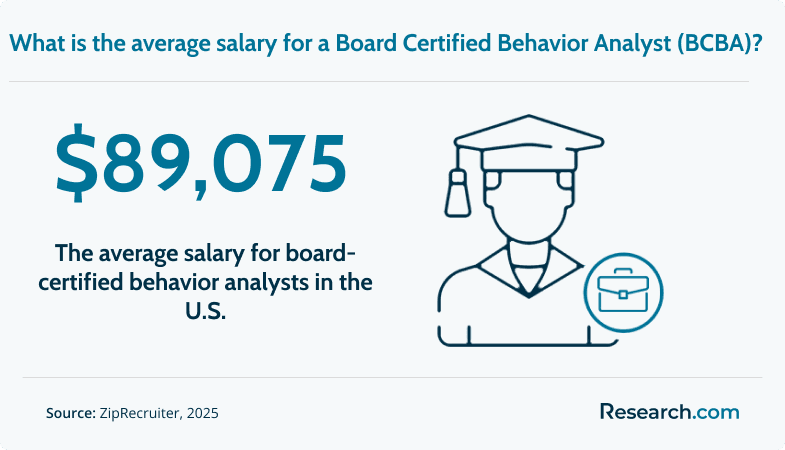
Based on the salary data used in this guide, BCBAs in the United States earn an average annual salary of approximately $89,075, or about $42.82 per hour. Reported salaries commonly range from $74,000 at the 25th percentile to $90,500 at the 75th percentile, while top earners may make up to $132,500 annually.
BCBA pay is shaped by more than the credential itself. Experience, state licensure, employer type, caseload complexity, supervisory duties, specialty area, and local demand all influence compensation. A BCBA who supervises multiple clinicians or directs a program will often have a different salary profile than a newly certified analyst providing direct clinical services.
Salary factors to compare before accepting an ABA job
- Role level: Direct-service, supervisory, director, consulting, and research jobs are compensated differently.
- Setting: Schools, private ABA clinics, hospitals, home-based providers, and corporate employers may use different pay structures.
- Location: Cost of living and regional demand can affect salary offers.
- Licensure: Some states require behavior analyst licensure in addition to BCBA certification.
- Caseload and productivity expectations: Higher pay may come with heavier documentation, billing, travel, or supervision requirements.
What are the highest-paying ABA careers?
The highest-paying ABA careers are usually roles with advanced supervision, clinical leadership, specialized expertise, administrative responsibility, or doctoral-level preparation. Salary potential is not guaranteed, but certain paths tend to offer stronger earning opportunities because they involve program oversight, complex cases, staff management, or high-demand services.
- Board Certified Behavior Analyst-Doctoral: Professionals with the BCBA-D designation often work in research, advanced supervision, teaching, consultation, or senior clinical roles. Senior BCBAs in strong markets can earn $100,000 or more annually. The average salary for this job role is $89,075.
- Clinical Director of ABA Services: Clinical directors oversee programs, supervise staff, monitor treatment quality, and help organizations maintain compliant service delivery. The average salary for this role is $145,409.
- Forensic Behavior Analyst: These professionals apply behavior analysis in corrections, legal systems, law enforcement contexts, rehabilitation, and risk-related programming. The average salary for this role is $86,474.
- Lead Behavior Analyst in Healthcare Settings: Senior analysts in hospitals, rehabilitation facilities, and autism treatment organizations may supervise teams and coordinate clinical programs. The average annual salary for this role is $98,089.
- Director of Special Education: ABA-trained professionals in district-level or school leadership positions may design behavioral systems, support special education compliance, and oversee intervention services. Some can earn $90,000 or more in administrative roles. The average salary for this job role is around $111,086.
How do you become a Board Certified Behavior Analyst (BCBA)?
Becoming a BCBA requires graduate education, approved behavior-analytic coursework, supervised fieldwork, an application to the Behavior Analyst Certification Board, and a passing exam score. State licensure may also be required depending on where you practice.
- Earn an eligible graduate degree. Complete a master’s or doctoral degree in behavior analysis, education, psychology, or another field that satisfies BACB requirements. Students comparing programs can start with Research.com’s guide to the best BCBA programs.
- Complete required ABA coursework. Coursework should cover assessment, intervention design, ethics, measurement, data analysis, behavior-change procedures, supervision, and foundational principles of behavior analysis.
- Finish supervised fieldwork. Aspiring BCBAs must complete either Supervised Fieldwork for 2,000 hours or Concentrated Supervised Fieldwork for 1,500 hours under an eligible supervisor.
- Apply for the BCBA exam. Submit documentation, meet BACB eligibility requirements, pay required fees, and prepare for the multiple-choice certification examination.
- Check state licensure rules. Some states require additional licensure steps, such as a state application, background check, continuing education, extra documentation, or other requirements before you can legally practice as a behavior analyst.
| Step | Why it matters | Common mistake to avoid |
| Degree selection | Your program must support your certification and career goals | Choosing a program before confirming BACB alignment |
| Coursework | Required content prepares you for supervised practice and the exam | Assuming every psychology or education master’s includes ABA coursework |
| Fieldwork | Hands-on supervised experience is required for BCBA eligibility | Enrolling without a clear fieldwork placement plan |
| Exam application | The BACB verifies whether you meet certification requirements | Waiting until graduation to organize documentation |
| Licensure check | State law may control whether you can practice independently | Assuming national certification is the only requirement |
What industries hire professionals with an ABA degree?
ABA graduates are hired in fields where behavior assessment, intervention planning, skill-building, and performance improvement are valuable. Autism services remain a major employment area, but the degree can also support roles in schools, healthcare organizations, mental health agencies, correctional systems, and business settings.
- Healthcare and mental health services: Hospitals, outpatient clinics, mental health centers, and rehabilitation providers may employ ABA professionals to support clients with developmental disabilities, autism, ADHD, anxiety-related behaviors, OCD-related behaviors, or other behavioral challenges.
- Education and special education: Schools use ABA strategies to support students with autism spectrum disorder, learning disabilities, emotional and behavioral needs, and social skills challenges. ABA professionals may work with teachers, families, IEP teams, and administrators.
- Autism and developmental disability services: Early intervention programs, autism centers, residential programs, and community providers hire ABA professionals to design and implement behavior intervention plans and teach communication, social, and daily living skills.
- Corporate and organizational behavior management: Businesses may use ABA-informed methods to improve training, safety, productivity, employee performance, and organizational systems.
- Criminal justice and corrections: ABA professionals may contribute to behavior-change programming, correctional rehabilitation, recidivism-reduction efforts, juvenile services, and reintegration support.
What is the difference between a BCBA and a licensed behavior analyst?
A BCBA and a licensed behavior analyst may perform similar work, but the credentials are not the same. The BCBA is a professional certification, while a licensed behavior analyst credential is issued by a state. In some states, you may need both to practice legally.
Certification vs. state licensure
The BCBA credential is awarded by the Behavior Analyst Certification Board. It shows that a professional has met national certification standards for education, coursework, supervised experience, and examination. A Licensed Behavior Analyst, often abbreviated LBA, is a state-issued license. Requirements vary by state and may include documentation, fees, background checks, continuing education, or other state-specific rules.
Practice authority
BCBA certification demonstrates professional competence under the BACB framework. Licensure determines whether a state allows you to provide behavior analysis services within its jurisdiction. In states that regulate behavior analysis, a BCBA may still need to apply for an LBA or equivalent state credential before practicing independently or supervising services.
Portability and local rules
BCBA certification is recognized nationally and internationally, but state licensure is jurisdiction-specific. If you relocate, provide telehealth across state lines, or supervise staff in another state, you should verify the rules that apply in each location.
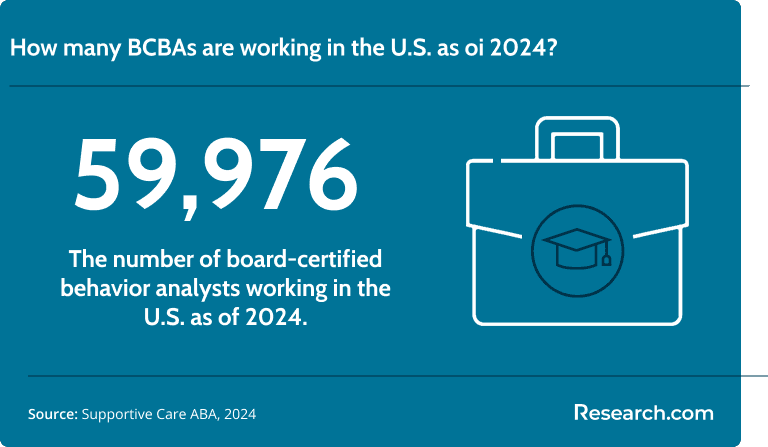
According to statistics, there are 59,976 BCBAs in the U.S. as of 2024. The total number of LBA-certified professionals is not as readily available and is likely a subset of the BCBA population because some states require both BCBA certification and state licensure.
Which factors should I consider when choosing an online applied behavior analysis degree program?
An online ABA program should be evaluated first on whether it can actually help you meet your certification, licensure, and employment goals. Flexibility matters, but it should not outweigh accreditation, coursework alignment, fieldwork support, faculty expertise, and state authorization. Students comparing distance options can review Research.com’s guide to an online applied behavior analysis degree for program examples and selection considerations.
| Program factor | What to verify | Why it matters |
| Accreditation | Institutional accreditation and any relevant program recognition | Employers, financial aid eligibility, transfer policies, and licensure boards may rely on accreditation status |
| BACB alignment | Whether coursework supports BCBA eligibility requirements | Not every psychology, counseling, or education program prepares students for BCBA certification |
| Supervised fieldwork | How placements, supervisors, documentation, and hours are handled | BCBA eligibility requires supervised experience, and online students may need local placement options |
| State compatibility | Whether the program meets rules in the state where you plan to work | Licensure requirements vary, and online programs may not meet every state’s expectations |
| Total cost | Tuition, fees, books, technology, travel, exam preparation, and fieldwork-related costs | The cheapest tuition is not always the lowest total cost |
| Student support | Advising, exam preparation, placement help, career services, and faculty access | Support services can affect persistence, certification planning, and job readiness |
What are emerging trends shaping the future of ABA?
ABA practice is changing as providers use telehealth, digital data collection, remote supervision tools, and technology-supported progress monitoring. These tools can improve access and documentation, but they also require careful attention to privacy, ethics, training quality, and whether remote service models are appropriate for a specific client.
Another trend is the growing expectation that ABA professionals work well with interdisciplinary teams. Behavior analysts may collaborate with educators, speech-language pathologists, occupational therapists, psychologists, physicians, counselors, and caregivers. Students preparing for certification should look for programs that teach ethical, culturally responsive, evidence-based practice rather than relying only on technical procedures. Those seeking flexible routes can compare lower-cost online options for ABA certification.
How do regional factors impact ABA and BCBA compensation?
ABA and BCBA salaries can differ significantly by location. Cost of living, state licensure rules, insurance reimbursement patterns, school district budgets, provider competition, and local demand for autism and behavioral health services all affect compensation. A higher salary in one state may not translate into greater purchasing power if housing, transportation, and taxes are also higher.
Before relocating or accepting a remote/hybrid ABA role, compare salary with caseload expectations, benefits, supervision duties, travel requirements, billable-hour targets, and licensure rules. For a state-by-state compensation comparison, see Research.com’s BCBA vs ABA salary resource.
What are the common challenges faced by ABA professionals?
ABA careers can be rewarding, but the work is not simple. Professionals must balance client progress, caregiver collaboration, ethical documentation, data review, scheduling, supervision, and compliance with payer or school requirements. Burnout can become a risk when caseloads are high, travel is extensive, or administrative demands reduce time for clinical planning.
- Regulatory complexity: Certification, state licensure, employer policies, insurance rules, and school requirements may all apply.
- Emotional demands: ABA professionals may support clients and families during stressful behavioral, developmental, or educational challenges.
- Documentation load: Data collection, session notes, progress reports, treatment updates, and supervision records are central to quality practice.
- Generalization of skills: Helping clients use skills across settings often requires coordination with families, teachers, and other providers.
- Technology changes: Telehealth, digital platforms, and remote data tools require ongoing learning and careful ethical use.
Some ABA professionals pursue advanced clinical training to broaden their understanding of assessment, treatment planning, and psychological practice. Research.com’s overview of PsyD online programs psychology can help readers compare doctoral options, though licensure outcomes should always be checked by state.
What are the advanced education options after a master’s in ABA?
After a master’s in ABA, professionals may continue into doctoral study, post-master’s certificates, specialized clinical training, educational leadership, research, or psychology-related pathways. The right option depends on whether you want to teach, conduct research, lead clinical programs, qualify for a different license, or specialize in a related field such as forensic psychology, school psychology, counseling, or organizational consulting.
| Advanced option | Best for | Decision point |
| Doctoral study in behavior analysis or psychology | Research, university teaching, advanced supervision, leadership | Confirm whether the degree supports your intended license or academic role |
| BCBA-D pathway | BCBAs who complete doctoral-level training and want advanced recognition | Understand that BCBA-D is not a separate license |
| Post-master’s certificate | Graduates who need missing coursework or a specialization | Verify whether coursework meets certification or state requirements |
| Clinical psychology or PsyD pathway | Professionals seeking broader clinical training | Licensure requirements are state-specific and may require in-person training components |
| Educational leadership or special education administration | School-based professionals moving into district or program leadership | Administrative licensure may be required |
Students comparing doctoral routes should examine accreditation, practicum expectations, residency requirements, internship structure, licensure alignment, and total cost. Research.com’s guide to the cheapest PsyD programs can support early cost comparisons.
Can an accelerated degree enhance my ABA career trajectory?
An accelerated degree can help if it shortens time to graduation without weakening academic quality, fieldwork preparation, or certification alignment. The benefit is strongest for motivated students who already understand their career goal, can manage a heavier workload, and have a realistic plan for supervised experience.
Speed should not be the only selection factor. A compressed program that lacks strong advising, fieldwork coordination, or state licensure compatibility may create delays later. Students interested in faster psychology-related pathways can compare models through Research.com’s guide to the fastest degree in psychology.
How can ABA support forensic psychology practices?
ABA can contribute to forensic psychology by helping professionals analyze behavior patterns, design structured interventions, measure behavior change, and evaluate rehabilitation or correctional programming. In forensic contexts, behaviorally informed approaches may be used with risk-related behaviors, substance use patterns, juvenile rehabilitation, compliance with treatment plans, and skill development for reintegration.
Professionals who want to work at the intersection of behavior analysis, psychology, and criminal justice should compare degree requirements carefully. Forensic psychology roles may require different credentials from ABA roles. Research.com’s guide to forensic psychology graduate programs online can help readers explore related graduate options.
What skills are essential for a successful ABA career?
Successful ABA professionals need more than knowledge of reinforcement, assessment, and intervention design. They must interpret data accurately, communicate clearly with families and teams, write defensible treatment plans, supervise ethically, and adapt interventions when client progress stalls.
- Behavioral assessment: Identifying patterns, triggers, consequences, and skill deficits.
- Data collection and analysis: Measuring behavior consistently and using evidence to guide treatment changes.
- Ethical judgment: Protecting client dignity, consent, privacy, and appropriate scope of practice.
- Communication: Explaining plans to caregivers, teachers, technicians, administrators, and other clinicians.
- Collaboration: Working with multidisciplinary teams without overstepping professional boundaries.
- Cultural responsiveness: Designing supports that respect family values, language, context, and lived experience.
- Supervision and training: Coaching technicians or staff to implement procedures consistently.
- Adaptability: Adjusting plans when data, setting demands, or client needs change.
ABA professionals who want to expand into family systems or relationship-focused clinical work may compare their training with a cheap MFT degree online, while remembering that marriage and family therapy licensure has its own requirements.
Can ABA Accelerate My Transition to a Counseling Career?
ABA experience can strengthen a future counseling career by building skills in behavior observation, goal setting, data-informed intervention, client progress monitoring, and structured treatment planning. However, ABA training does not automatically satisfy counseling licensure requirements. Most counseling roles require a qualifying counseling degree, supervised clinical hours, exams, and state approval.
If your long-term goal is counseling, compare the fastest path carefully. Look at transferability of coursework, practicum requirements, state licensure rules, and whether your ABA background reduces preparation time in any meaningful way. Research.com’s guide on how long to become a counselor can help you understand typical timelines and credential steps.
How important is program accreditation for career success?
Accreditation is one of the first things to verify before enrolling in an ABA, psychology, counseling, or education program. It affects credibility, financial aid eligibility, transfer options, employer confidence, and whether a licensing board or certification body recognizes your coursework. A program can be convenient and affordable but still create career problems if it does not meet the standards required for your intended credential.
For ABA students, accreditation should be reviewed alongside BACB coursework alignment, state authorization, fieldwork support, and licensure compatibility. Students considering psychology-related online programs can also review guidance on what accreditation should you look for in a psychology degree.
Do you need to be board-certified to work in ABA?
You do not need BCBA certification for every ABA-related role, but certification becomes important when you want to design behavior plans, supervise staff, practice independently, or qualify for many higher-level clinical and school-based positions. Entry-level and technician roles often operate under BCBA supervision.
| Role type | BCBA usually required? | Typical responsibility level |
| Behavior technician or ABA therapist | No, but supervision is typically required | Implements behavior plans and collects data |
| Registered Behavior Technician | No BCBA certification, but the RBT credential may apply | Provides direct services under qualified supervision |
| Board Certified Behavior Analyst | Yes | Assesses behavior, designs plans, supervises implementation, evaluates progress |
| Clinical supervisor or program lead | Often yes | Oversees teams, reviews cases, ensures treatment quality |
| Independent behavior analyst | Usually yes, and state licensure may also be required | Provides or supervises professional behavior analysis services |
What is the role of ABA in school settings?
In schools, ABA is used to support learning, reduce barriers to participation, teach replacement skills, and help students access instruction more successfully. It is most often associated with autism and special education, but ABA-based strategies can also support classroom behavior, social communication, academic routines, and individualized student goals. Professionals comparing child-focused psychology careers may also review child and adolescent psychologist salary information to understand how ABA, psychology, and school-based roles differ.
- Behavior intervention and management: ABA can help teams understand challenging behaviors such as aggression, refusal, self-injury, or disruption and teach safer, more functional alternatives.
- Skill development: Students may receive support with communication, following directions, academic readiness, independence, classroom routines, and daily living skills.
- Social interaction: ABA strategies may help students practice turn-taking, peer interaction, group participation, responding to social cues, and other social skills.
- IEP support: ABA methods may be incorporated into Individualized Education Programs when behavior goals, communication goals, or skill-building supports are needed.
Questions to ask before taking a school-based ABA role
- Will I be working directly with students, consulting with teachers, supervising staff, or writing behavior plans?
- How are ABA services integrated into IEPs and behavior intervention plans?
- Who supervises behavior technicians or classroom aides?
- What documentation system does the school or district use?
- Does the role require BCBA certification, state licensure, teaching credentials, or special education experience?
What is the job outlook for board-certified behavior analysts?
The outlook for BCBAs is closely tied to demand for autism services, special education supports, developmental disability services, behavioral health care, and evidence-based intervention programs. While BCBAs are not the same occupational category as substance abuse, behavioral disorder, and mental health counselors, the U.S. BLS category provides useful context for demand in related behavioral health work.
According to the U.S. BLS, demand for behavioral disorder counselors is expected to increase by 19% from 2023 to 2033. As of 2023, there are 449,800 substance abuse, behavioral disorder, and mental health counselors, and by 2033, the number is expected to reach 534,300. This growth reflects broader need for professionals who address behavioral and mental health challenges. Students interested in adjacent credentialed behavioral health roles can also review pathways related to addiction counselor certification.
The chart below shows employment projections data for substance abuse, behavioral disorder, and mental health counselors from 2023 to 2033.
What graduates say about earning a master’s in applied behavior analysis
-
: "
“My master’s in applied behavior analysis gave me career options I had not considered before. I learned how to use evidence-based strategies, support families, and lead with more confidence in therapeutic environments.” – Coleen
"
-
: "
“The ABA program changed the way I solve problems at work and in daily life. Learning to use data-driven methods with individuals with autism and developmental disabilities made my work feel more purposeful.” – Kyle
"
-
: "
“Studying ABA helped me understand behavior in a practical way that I could apply immediately. The degree expanded my career options and gave me a clearer sense of purpose in helping people improve their quality of life.” – Emily
"
Common mistakes to avoid when planning an ABA career
- Choosing a program based only on convenience. Online flexibility is helpful, but it does not replace accreditation, BACB coursework alignment, fieldwork planning, and state licensure compatibility.
- Assuming all ABA jobs require the same credential. Technician, therapist, BCBA, director, school consultant, and licensed behavior analyst roles have different requirements.
- Ignoring supervised fieldwork logistics. BCBA eligibility requires documented supervised experience, so students should know where and how they will complete hours before enrolling.
- Focusing only on salary. Caseload size, travel expectations, billable-hour requirements, benefits, supervision duties, and burnout risk also matter.
- Assuming BCBA certification replaces state licensure. Some states require a separate behavior analyst license.
- Overlooking career fit. ABA requires patience, data discipline, communication, ethical judgment, and comfort working with complex behavior needs.
- Relying only on rankings. Rankings can help you create a shortlist, but they should not replace direct questions about outcomes, fieldwork, faculty, costs, and licensure.
Key Insights
- A master’s in applied behavior analysis can lead to clinical, school-based, research, business, forensic, leadership, and related behavioral health roles.
- The BCBA path is the most recognized ABA career route, with an average annual salary of around $89,075, but salary depends heavily on setting, state, experience, and responsibility level.
- Higher-paying ABA roles often involve leadership or specialization, such as clinical director, lead healthcare analyst, director of special education, forensic behavior analyst, or BCBA-D-related work.
- To become a BCBA, you must complete eligible graduate education, approved coursework, supervised fieldwork for 2,000 hours or concentrated supervised fieldwork for 1,500 hours, and the BCBA exam.
- There are 59,976 BCBAs in the U.S. as of 2024, showing the scale of the profession and the continued demand for trained behavior analysts.
- Job growth in related behavioral health occupations is strong: demand for substance abuse, behavioral disorder, and mental health counselors is expected to increase by 19% from 2023 to 2033.
- Program choice matters. Before enrolling, confirm accreditation, BACB alignment, fieldwork support, state licensure compatibility, total cost, and student support services.
- ABA is a strong fit for people who enjoy measurable behavior change, collaboration, ethical practice, and data-informed decision-making. It may be less suitable for those who want a low-documentation or low-interaction role.
Resources
- Glassdoor. (2025). Salary: Behavioral Research Analyst in United States 2025. https://www.glassdoor.com/Salaries/united-states-behavioral-research-analyst-salary-SRCH_IL.0,13_KO14,41_IP4.htm
- Indeed. (2025). Clinical director salary in the United States. https://www.indeed.com/career/clinical-director/salaries
- Supportive Care ABA. (2024). ABA Therapist Statistics, Demographics & Facts. https://www.supportivecareaba.com/statistics/aba-therapist-demographics
- U.S. Bureau of Labor Statistics. (2024). Substance Abuse, Behavioral Disorder, and Mental Health Counselors. https://www.bls.gov/ooh/community-and-social-service/substance-abuse-behavioral-disorder-and-mental-health-counselors.htm
- ZipRecruiter. (2025). Salary: Bcba Behavior Analyst (Jan 2025) United States. https://www.ziprecruiter.com/Salaries/Bcba-Behavior-Analyst-Salary
Other things you should know about getting a master’s in ABA
Yes, but the degree must meet BACB coursework, supervised-fieldwork, and ethics requirements before you can sit for the BCBA exam. In 2027, candidates also need a qualifying graduate degree, documented supervision hours, and must pass the BACB certification exam.
In 2027, a Master's in Applied Behavior Analysis offers diverse career opportunities. You can work as a Board Certified Behavior Analyst (BCBA), consultant, or clinical supervisor. Growing demand is seen in schools, autism treatment centers, and private practices, focusing on behavior modification and skill development.
In 2027, to become certified as an applied behavior analyst, you need to complete a master's program from an accredited institution, pass the BCBA® exam, and meet the required supervised experience hours as outlined by the Behavior Analyst Certification Board (BACB).


