2027 Most Affordable Online Child Development Degree Programs

Co-Founder and Chief Data Scientist
Choosing an online child development degree is usually a cost, time, and career-fit decision at the same time. You may want to work with young children, support families, move into early childhood program leadership, or prepare for graduate study in counseling, psychology, social work, education, nursing, or child life. The right program should help you build practical knowledge of child growth while also fitting your schedule and budget.
This guide focuses on affordable online child development degree programs and the questions students should ask before enrolling. You will learn what these programs cover, how online study compares with campus learning, how much programs can cost, what financial aid may be available, which careers are realistic after graduation, and when additional certification or graduate education is required.
Quick Answer: Is an Online Child Development Degree Worth Considering?
An online child development degree can be a practical option if you want a flexible route into early childhood education, childcare administration, child advocacy, family services, or graduate study in a child-focused field. It is especially useful for working adults and caregivers who need asynchronous coursework. However, many public school teaching, counseling, psychology, therapy, and healthcare roles require additional licensure, supervised experience, or graduate education.
- Best fit: Students who want to work in childcare, early learning programs, family services, child advocacy, or child life preparation.
- Potential limitation: A child development bachelor’s degree by itself often does not lead directly to state teacher certification.
- Typical bachelor’s timeline: Four years and 120 credits for full-time students.
- Salary context: Pay varies by role, location, employer, education level, and licensure. Examples in this guide include $41,410 for preschool teachers, $49,427 for child life specialists, and $61,320 for preschool and daycare directors.
Key Benefits of Earning a Child Development Degree Online
- Career flexibility: Graduates can pursue roles in early childhood education, childcare centers, family support, child advocacy, nonprofit programs, and related human services settings.
- Graduate school preparation: The degree can support later study in counseling, psychology, social work, education, nursing, child life, and leadership fields.
- Flexible scheduling: Online delivery can make it easier to continue working, caring for family, or completing field experience near home.
- Applied knowledge: Students study developmental milestones, family systems, learning environments, child behavior, observation, communication, and inclusive practices.
What can I expect from an online child development program?
An online child development program studies how children grow physically, cognitively, socially, emotionally, and behaviorally from infancy through adolescence. Students learn how family, culture, health, education, trauma, community resources, and learning environments shape a child’s development.
Most online programs use a learning management system for lectures, assignments, discussion boards, exams, group projects, digital readings, and instructor feedback. Some courses are asynchronous, meaning students complete weekly work on their own schedule. Others may include live class meetings, virtual presentations, or scheduled advising sessions.
Many programs also include field-based learning. Depending on the school, students may complete observations, practicums, internships, or supervised field experiences in childcare centers, preschool classrooms, hospitals, community agencies, or family service organizations. These requirements matter because employers often value direct experience with children and families as much as academic coursework.
| Program feature | What it usually means for online students | Why it matters |
| Asynchronous coursework | Students complete readings, lectures, discussions, and assignments within weekly deadlines. | Helpful for working adults, parents, and part-time learners. |
| Synchronous sessions | Some courses may require live online meetings, presentations, or faculty check-ins. | Improves interaction but may reduce schedule flexibility. |
| Field experience | Students observe or work with children in approved local settings. | Builds practical skills and may be required for graduation or certification preparation. |
| Child development core | Courses cover growth, learning, family dynamics, psychology, safety, and education. | Creates the foundation for entry-level child-focused roles and graduate study. |
| Specialized electives | Students may focus on child life, advocacy, infant and toddler care, family studies, or leadership. | Helps align the degree with specific career goals. |
Where can I work with a child development degree?
A child development degree can lead to work in organizations that serve children, families, schools, healthcare systems, and communities. The degree is broad, so your career options depend heavily on your concentration, field experience, state requirements, and whether you continue into graduate study or professional certification.
- Early childhood education centers: Graduates may work as preschool teachers, assistant teachers, curriculum support staff, or program coordinators in settings focused on school readiness and early learning.
- Childcare facilities: Daycare centers, after-school programs, and infant-toddler programs hire professionals who understand developmental stages, safety, communication, and family engagement.
- Social service agencies: Family resource centers, child welfare programs, and community agencies may employ graduates in family support, case coordination, parent education, or resource navigation roles.
- Healthcare environments: Some graduates pursue child life or pediatric support roles, often with additional requirements, internships, or certification pathways.
- Nonprofit organizations: Child-focused nonprofits may hire graduates for outreach, advocacy, program coordination, youth services, and community education.
- Educational administration support: With experience, graduates may help with curriculum planning, staff training, childcare center operations, or early childhood program management.
How much can I make with a child development degree?
Income depends on job title, state, employer, experience, education, and licensure. According to PayScale, child life specialists earn $49,427 yearly, with base salaries ranging from $39,000 to $67,000. Bureau of Labor Statistics data cited in this guide show that kindergarten special education teachers can earn $71,770 each year, while school psychologists earn around $91,990. These higher-paying roles typically require advanced degrees, state credentials, or professional licensure.
Students should avoid assuming that a child development degree automatically produces a specific salary. The degree can open doors, but salary outcomes are shaped by the role you choose. For example, direct childcare positions may pay less than administrative, healthcare, counseling, psychology, or school-based specialist roles that require additional preparation.
| Career path | Salary figure cited | Important requirement note |
| Child life specialist | $49,427 | Often requires specialized preparation, internship experience, and certification eligibility. |
| Preschool teacher | $41,410 | Requirements vary by state, employer, and program type. |
| Preschool and daycare director | $61,320 | Usually requires experience and may require state-specific credentials. |
| Kindergarten special education teacher | $71,770 | Usually requires teacher preparation, state licensure, and special education credentials. |
| School psychologist | $91,990 | Requires graduate education and credentialing beyond a bachelor’s degree. |
- Most Affordable Online Child Development Degree Programs for 2027
- How long does it take to complete an online child development program?
- How does an online child development program compare to an on-campus program?
- What is the average cost of an online child development program?
- What are the financial aid options for students enrolling in an online child development program?
- What are the prerequisites for enrolling in an online child development program?
- What accreditation and certification standards ensure program quality?
- How does an online child development degree drive community and societal change?
- What courses are typically in an online child development program?
- Can an online child development degree lead directly to teacher certification?
- How do online child development programs promote cultural competence and inclusivity?
- What types of specializations are available in online child development programs?
- Can an online child development degree pave the way to advanced leadership roles?
- What is the return on investment of an online child development degree?
- How can creative writing enhance child development practices?
- How to choose the best online child development program?
- How can integrating UX design enhance online child development programs?
- What career paths are available for graduates of online child development programs?
- What student support services are available in online child development programs?
- How are online child development programs adapting to future industry trends?
- What challenges do students face in online child development programs?
- What is the job market for graduates with an online child development degree?
Most Affordable Online Child Development Degree Programs for 2027
How do we rank schools?
Affordability is only useful when the program is also credible, transparent, and aligned with student goals. Research.com’s team reviewed programs using a defined ranking methodology and drew on data sources such as the Integrated Postsecondary Education Data System, Peterson’s database and its Distance Learning Licensed Data Set, College Scorecard, and the National Center for Education Statistics (NCES). Students should still confirm tuition, fees, field placement rules, and program requirements directly with each school before applying.
| Rank | School and program | Format and focus | Cost and credits | Accreditation |
| 1 | West Virginia University Parkersburg — Bachelor of Applied Science in Child Development | Fully online program focused on planning, delivering, and assessing developmentally appropriate learning experiences; includes 70-hour field experience courses. | $188–$260 per credit; 120 credits; four years | Higher Learning Commission (HLC) |
| 2 | Northwestern State University of Louisiana — BS in Child and Family Studies | Online program covering child development, family systems, parenting, education, nutrition, and social work; includes Child Development and Family Relations and Consumer Services options. | $2,590 per semester for 12 credit hours; 120 credits; four years | Southern Association of Colleges and Schools Commission on Colleges (SACSCOC) |
| 3 | Fort Hays State University — Bachelor of General Studies, Child Development concentration | Liberal arts-based online degree with a 21-credit-hour Child Development concentration for students interested in early childhood care and services. | $257.33 per credit; 120 credits; four years | HLC |
| 4 | Central Methodist University — BS in Child Development | Designed for students pursuing early childhood settings that do not require public school certification; includes preparation for daycare center operations. | $275 per credit; 120 credits; four years | HLC |
| 5 | Southern New Hampshire University — BA in Psychology, Child and Adolescent Development concentration | Psychology-based program with 12 credits in child and adolescent development, plus an internship or experiential learning project option. | $330 per credit; 120 credits; four years | New England Commission of Higher Education (NECHE) |
| 6 | Jacksonville State University — BS in Family and Consumer Sciences, Child Development | Non-teacher-certification program combining child development, family and consumer sciences, nutrition, curriculum planning, and management-oriented coursework. | $333 in-state and $665 out-of-state per credit; 120 credits; four years | SACSCOC |
| 7 | American Public University System — BA in Human Development and Family Studies | Online degree exploring human development, family interaction, human sexuality, family communication, and parenting; includes 15-credit-hour concentration options. | $350 per credit; 120 credits; four years | HLC |
| 8 | University of Alabama Online — BS in Human Development and Family Studies, Child Life | Child life-focused program with theory, laboratory, practicum experiences, and an approved hospital internship requirement for the child life concentration. | $385 per credit; 120 credits; four years | SACSCOC |
| 9 | New Mexico State University Global Campus — BS in Human Development and Family Science | Online program for students interested in childcare, family life education, human services, and therapy-related pathways; approved by the National Council on Family Relations. | $395.40 per credit; 120 credits; four years | HLC |
| 10 | Florida Institute of Technology — BA in Applied Psychology, Child Advocacy concentration | Applied psychology program with coursework in child development, child advocacy, community psychology, and electives such as Victim Studies and Advocacy and Critical Issues in Child Advocacy. | $532.50 per credit; 121 credits; four years | SACSCOC |
Key Findings
- For the 2024-2025 academic year, Florida offered the most affordable in-state tuition at $6,360, while Vermont had the highest at $17,490.
- Graduates who become preschool and daycare directors earn $61,320.
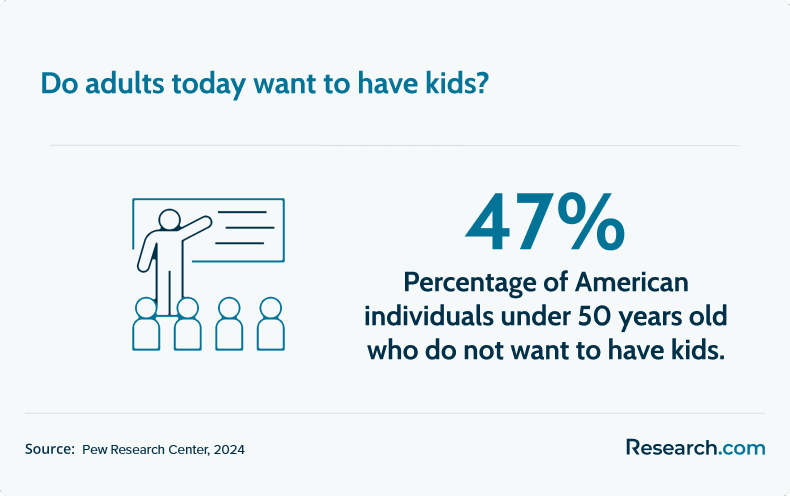
- 47% of U.S. adults under 50 indicated they were unlikely to have children, a 10-point increase since 2018.
- While 41% of parents found parenting tiring, 80% said it was rewarding.
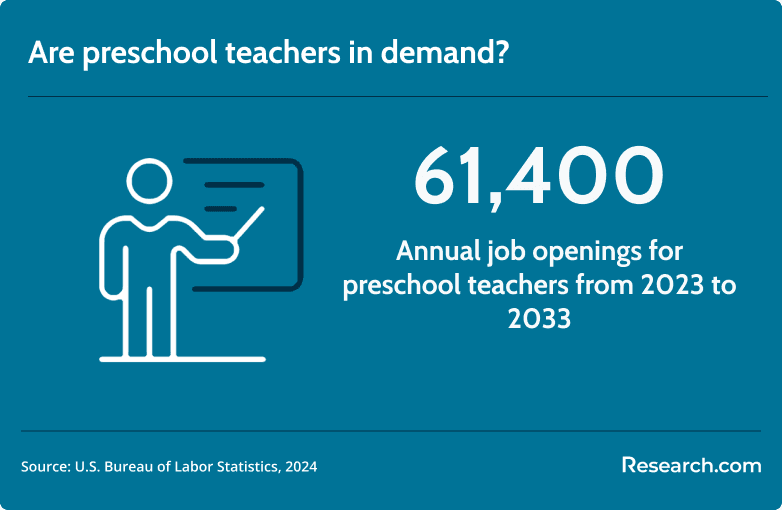
- Employment for preschool teachers (non-SpEd) is projected to grow by 4% from 2023 to 2033, with about 61,400 annual openings.
How long does it take to complete an online child development program?
The completion timeline depends on the credential, transfer credits, course load, and field placement requirements. A bachelor’s degree in child development typically takes four years of full-time study and requires 120 credits. Part-time students may need longer, especially if they take one or two courses per term while working.
An associate degree can often be completed in about two years and may help students move into assistant-level childcare roles or transfer into a bachelor’s program. Master’s programs in child development commonly take one to two years for full-time students and may require 30–45 credit hours, a capstone, internship, or research project. Doctoral programs can range from two to five years, depending on the structure and student pace.
| Credential | Typical time to complete | Common purpose |
| Associate degree | About two years | Entry-level childcare work or transfer into a bachelor’s program. |
| Bachelor’s degree | Four years | Early childhood education, family services, childcare administration, advocacy, or graduate school preparation. |
| Master’s degree | One to two years | Specialized practice, leadership, research, counseling-adjacent pathways, or advanced education roles. |
| Doctoral degree | Two to five years | Leadership, policy, research, higher education, or senior administrative roles. |
Students who want a faster graduate leadership path may compare accelerated doctoral formats, including the shortest EdD program online. If you are still comparing flexible undergraduate options outside child development, an affordable online English degree may offer another example of how online programs structure transfer credits, part-time pacing, and asynchronous study.
How does an online child development program compare to an on-campus program?
Online and campus-based child development programs can cover the same academic content, including child growth, psychology, family systems, observation, learning environments, and professional ethics. The biggest differences are delivery format, access to in-person activities, student support style, and how fieldwork is arranged.
| Factor | Online child development program | On-campus child development program |
| Schedule | Often more flexible, with asynchronous coursework and remote access. | Usually follows fixed class times and campus calendars. |
| Interaction | Uses discussion boards, video meetings, group projects, and online office hours. | Offers face-to-face interaction with classmates, faculty, and campus groups. |
| Field experience | May allow local placements near the student’s home, subject to school approval. | Often uses established campus-area partnerships. |
| Resources | Relies on digital libraries, recorded lectures, virtual tutoring, and remote advising. | Includes physical libraries, labs, campus events, and in-person mentoring. |
| Best for | Working adults, caregivers, rural students, and learners who need location flexibility. | Students who prefer structured routines and frequent in-person engagement. |
Online study is not automatically easier. It requires self-direction, consistent time management, and comfort with digital tools. Campus study may offer more immediate support but can be less convenient for students with work or family obligations. Students interested in adding business or management skills for childcare center ownership may also compare related options such as affordable online entrepreneur degree programs.
What is the average cost of an online child development program?
Program cost varies by institution type, residency status, credit requirements, fees, and whether students receive transfer credit. According to the College Board (Ma et al., 2024), average tuition for a bachelor’s degree at public institutions is $11,610 in-state and $30,780 out-of-state. At private nonprofit universities, tuition and fees average $43,350 annually.
Online programs may reduce commuting, room, board, relocation, and some textbook expenses, but they can still include technology fees, online course fees, digital materials, assessment fees, and field placement-related costs. For that reason, students should compare total cost of attendance rather than tuition alone.
Location can also affect costs. For the 2024-2025 academic year, Florida offered the most affordable in-state tuition at $6,360, while Vermont had the highest at $17,490. For out-of-state tuition, South Dakota and North Dakota were the most affordable, charging $12,740 and $14,790, respectively. In most other states, out-of-state tuition ranged from $20,000 to $42,000.
If you are considering future leadership roles after a child development bachelor’s degree, you may later compare graduate options such as the best online master’s programs in higher education. Students interested in developmental science, pediatric healthcare preparation, or related STEM pathways may also compare an affordable online biology degree.
The chart below outlines states with the most affordable in-state tuition and fees.
What are the financial aid options for students enrolling in an online child development program?
Online students may qualify for many of the same financial aid options as campus students if they attend an eligible accredited institution. Start by completing the FAFSA, then compare school-based aid, state programs, scholarships, employer benefits, and loans.
- Private scholarships: Professional associations, nonprofits, foundations, and community organizations may support students preparing for child development, early childhood education, or family service careers.
- University aid: Schools may offer institutional grants, scholarships, payment plans, work-study opportunities, or tuition discounts for eligible students.
- Work-study programs: Eligible students may earn money through part-time work while enrolled.
- Tuition reimbursement: Some employers help pay for job-related education, especially for employees working in childcare, education, healthcare, or human services.
- Federal and state programs: Some programs support students planning to teach or serve in underserved communities, while state aid may be limited to residents.
- Federal loans: Loans can help cover remaining costs, but they must be repaid with interest. Compare borrowing carefully before accepting the full amount offered.
| Cost-reduction strategy | Why it helps | Question to ask |
| Transfer credits | Reduces the number of credits you must pay for. | How many prior credits will the program accept? |
| In-state or online tuition rate | Some schools charge online students a different rate than campus students. | Do online students pay in-state, out-of-state, or flat-rate tuition? |
| Employer reimbursement | Can reduce out-of-pocket cost for working students. | Does my employer cover tuition, books, or fees? |
| Scholarships and grants | Do not need to be repaid if requirements are met. | What child development or early childhood scholarships are available? |
| Part-time enrollment | Can make payments more manageable while working. | Will part-time pacing affect financial aid eligibility? |
Students who already hold a bachelor’s degree and want a graduate early childhood credential may also compare the cheapest online masters degree in early childhood education.
What are the prerequisites for enrolling in an online child development program?
Admission requirements vary by school, degree level, and selectivity. Most bachelor’s programs require proof of high school completion or an equivalent credential. Transfer students may need college transcripts and minimum credit or GPA requirements.
- High school diploma or GED: Undergraduate applicants generally need proof of secondary school completion.
- Minimum GPA: Many programs set a minimum GPA, often ranging from 2.5 to 3.0.
- Standardized test scores: Some institutions may request ACT or SAT scores, though requirements vary.
- Prerequisite coursework: Certain programs may prefer or require courses in psychology, biology, sociology, education, or related subjects.
- Recommendation letters: Some schools request references from teachers, supervisors, mentors, or employers.
Graduate programs usually require more documentation, such as a bachelor’s degree, resume, statement of purpose, professional experience, or test scores. Students considering specialized graduate pathways can compare requirements for options such as the cheapest online special education master's degree.
Beyond admissions, students should consider whether they are suited to child-focused work. Strong communication, patience, cultural awareness, observation skills, and emotional steadiness are essential. A Johns Hopkins Children’s Center study found that infants and children under five experienced “modest” delays in developmental milestones due to the pandemic, which underscores the need for professionals who can recognize developmental concerns and respond appropriately.
What accreditation and certification standards ensure program quality?
Accreditation is one of the most important quality checks for an online child development degree. Institutional accreditation indicates that the school has been reviewed by a recognized accrediting agency. It can affect credit transfer, graduate school admission, employer recognition, and financial aid eligibility.
Students should also check whether the program aligns with professional certification goals. For example, a child life-focused program may need specific coursework and internship preparation, while public school teaching roles require state-approved teacher preparation routes. A general child development degree may be academically valuable but may not satisfy licensure requirements by itself.
| Quality check | What to verify before enrolling |
| Institutional accreditation | Confirm the school is accredited by a recognized agency and that accreditation is current. |
| Program outcomes | Ask where graduates work and whether the program tracks completion, placement, or certification outcomes. |
| Field placement approval | Find out who arranges placements and whether local sites must meet specific standards. |
| Certification alignment | Confirm whether the curriculum supports child life, family life education, teacher licensure, or other goals. |
| Transfer and graduate recognition | Ask whether credits are widely transferable and whether graduates are admitted to relevant graduate programs. |
Students comparing education-adjacent fields may also review a library science degree, particularly if they are interested in children’s literacy, youth services, or educational resource access.
How does an online child development degree drive community and societal change?
Child development professionals influence more than individual classrooms. They help design safer childcare environments, support parents, connect families with resources, advocate for children, and improve programs for underserved communities. Their work can affect school readiness, family stability, developmental screening, literacy, inclusion, and access to early learning.
Students interested in large-scale systems change may use a child development degree as a foundation for policy, nonprofit leadership, public health, social work, or community organizing. Careers connected to macro social work show how child and family expertise can be applied to broader systems, including program design, advocacy, and community-level intervention.
What courses are typically in an online child development program?
Child development programs usually combine psychology, education, family studies, health, safety, observation, and applied practice. Course names vary, but most programs aim to help students understand children in context: at home, in school, in care settings, in healthcare environments, and in the community.
| Common course | What students study | How it applies in practice |
| Child Growth and Development | Physical, cognitive, social, and emotional development from infancy through adolescence. | Helps professionals identify age-appropriate expectations and developmental milestones. |
| Child Psychology | Theories of behavior, motivation, emotional regulation, learning, and child mental processes. | Supports observation, behavior guidance, and communication with families. |
| Early Childhood Education | Teaching strategies, learning environments, play-based learning, and caregiver roles. | Prepares students for preschool, childcare, and early learning settings. |
| Family and Community Dynamics | Family systems, cultural influences, social structures, and community resources. | Builds skills for family engagement and community-based support. |
| Health and Safety for Children | Nutrition, injury prevention, emotional well-being, safety planning, and care standards. | Supports safe, healthy learning and care environments. |
| Family and Consumer Sciences | Family life, nutrition, budgeting, household management, and community relationships. | Useful for family support, parent education, and program coordination roles. |
| Children’s Literature | Age-appropriate books, literacy development, imagination, and emotional learning. | Helps professionals use stories to support language, creativity, and social-emotional skills. |
Students specifically interested in preschool teaching may compare the cheapest early childhood education degree, which may emphasize classroom methods more directly than a broader child development program.
According to a survey, 47% of U.S. adults under 50 indicated they were unlikely to have children, a 10-point increase since 2018 (Minkin et al., 2024). Even with changing family patterns, child development professionals remain important because families, schools, health systems, and communities still need trained specialists who can support children’s well-being.
Can an online child development degree lead directly to teacher certification?
Usually, no. Most online child development degrees do not automatically lead to public school teacher certification. They may include useful coursework in child development and early learning, but state teacher licensure typically requires completion of a state-approved teacher preparation program, student teaching, background checks, and required exams.
If your goal is to become a licensed public school teacher, ask the school whether the program is licensure-track, non-licensure, or designed only as preparation for future teacher education. You can also review how to get a teacher certification to understand state-specific requirements.
| Career goal | Is a child development degree alone enough? | What may be needed next? |
| Childcare worker or preschool support role | Sometimes, depending on employer and state rules. | Background checks, experience, state childcare training, or center-specific credentials. |
| Public preschool or elementary teacher | Usually not by itself. | State-approved teacher preparation, student teaching, exams, and licensure. |
| Special education teacher | No. | Special education teacher preparation and state licensure. |
| School counselor or school psychologist | No. | Graduate degree, supervised experience, and state credentialing. |
| Child life specialist | Not always. | Specific coursework, internship, and certification eligibility. |
How do online child development programs promote cultural competence and inclusivity?
High-quality child development programs prepare students to work with children and families from different cultural, linguistic, economic, racial, and family backgrounds. Courses may address bias, inclusive communication, trauma-informed care, disability awareness, family engagement, and culturally responsive learning environments.
This matters because child development work depends on trust. Professionals must avoid one-size-fits-all assumptions about parenting, behavior, language, disability, or family structure. Programs that include case studies, reflective assignments, and diverse field experiences can help students respond more effectively to real families. Students who want broader historical context for culture and society may also explore the best online history degree as a related academic pathway.
What types of specializations are available in online child development programs?
Specializations help students tailor a broad child development degree to a specific work setting or population. The right concentration depends on whether you want to work in childcare, hospitals, advocacy, family services, leadership, or graduate study.
| Specialization | Focus | Best fit for students interested in |
| Hospitalized Children and Youth | Supporting children and families during illness, injury, treatment, and healthcare experiences. | Child life, pediatric support, hospital-based programs, and family coping support. |
| Cultural Influences on Children, Youth, and Families | How culture, identity, values, traditions, and community shape child-rearing and development. | Inclusive practice, family engagement, community programs, and advocacy. |
| Infant and Toddler Programs | Development, care, and learning from birth to age three. | Infant-toddler classrooms, early intervention support, and childcare program design. |
| Child Welfare and Advocacy | Systems that support at-risk children and families, including protection, intervention, and prevention. | Child welfare agencies, nonprofits, family support, and advocacy roles. |
| Preschool Director Leadership | Administration, staffing, curriculum oversight, compliance, and program quality. | Childcare center management and early childhood leadership. |
| Loss and Bereavement | How children and families process grief, death, separation, and major life transitions. | Healthcare, counseling-adjacent support, family services, and trauma-informed programs. |
Students who want deeper expertise, research training, or advanced practice options may consider a masters in child development. Graduate study can support specialization in areas such as advocacy, trauma-informed care, child life preparation, leadership, or research.
A Pew Research Center report found that 41% of parents said parenting was tiring, while 80% said it was rewarding (Minkin & Horowitz, 2023). That combination helps explain why trained professionals are valuable: families often need both practical support and respect for the meaning they find in parenting.
The chart below displays parents’ views about parenthood.
Can an online child development degree pave the way to advanced leadership roles?
Yes, but leadership usually requires experience and often additional education. A bachelor’s degree can support entry into childcare coordination, family services, nonprofit programming, or early childhood administration. Over time, graduates may move into director, training, policy, advocacy, or program management roles.
Students aiming for executive-level education, nonprofit, or community leadership may later pursue graduate programs in educational leadership, organizational leadership, public administration, social work, or human services. For doctoral-level leadership preparation, one possible pathway is a PhD in leadership online.
What is the return on investment of an online child development degree?
The ROI of an online child development degree depends on total program cost, how much debt you take on, whether you can keep working while enrolled, your state’s labor market, and the role you pursue after graduation. Because many child-focused roles are mission-driven but not always high-paying at the entry level, affordability and credential alignment are especially important.
| ROI factor | Why it matters | How to evaluate it |
| Total cost | Low tuition can be offset by fees, books, travel for fieldwork, or lost work hours. | Ask for the full cost of attendance, not just tuition per credit. |
| Career alignment | A non-licensure degree may not qualify you for the role you want. | Match the curriculum to job postings and state requirements. |
| Field experience | Employers often value supervised experience with children and families. | Confirm placement hours, site requirements, and who arranges them. |
| Transfer credit | Accepted credits can shorten time to graduation and reduce cost. | Request a transfer evaluation before enrolling. |
| Graduate pathway | Advanced roles may require a master’s, doctorate, or licensure. | Ask whether graduates enter relevant graduate programs. |
Students focused on school or program administration may compare later graduate options such as a master of education leadership online.
How can creative writing enhance child development practices?
Creative writing can strengthen child development practice because stories, journaling, pretend play, and narrative activities help children build language, emotional expression, memory, perspective-taking, and problem-solving skills. Professionals who understand storytelling can design activities that encourage children to name feelings, sequence events, imagine solutions, and communicate with others.
This connection is especially relevant in early literacy, social-emotional learning, grief support, and family engagement. Students interested in writing-intensive creative pathways can also review careers for creative writing MFA, particularly if they want to combine education, children’s media, literacy programming, or curriculum development.
How to choose the best online child development program?
The best online child development program is not simply the cheapest one. It is the program that is accredited, affordable, realistic for your schedule, aligned with your target role, transparent about field experience, and honest about licensure limits.
- Define your career goal first. Decide whether you want childcare, preschool teaching, child life, family services, advocacy, graduate school, or leadership.
- Check accreditation. Confirm the institution’s accreditation status and whether the program has any relevant professional recognition.
- Verify licensure or certification alignment. Ask directly whether the program leads to teacher certification, child life eligibility, family life education preparation, or another credential.
- Compare total cost. Include tuition, fees, books, software, background checks, travel, and field placement costs.
- Ask about field placements. Find out whether placements can be completed near you and whether the school helps secure sites.
- Review faculty expertise. Look for instructors with experience in child development research, early childhood education, child life, family services, policy, or applied practice.
- Evaluate online support. Confirm access to advising, tutoring, library services, career support, disability services, and technical help.
- Study transfer policies. If you have prior credits, ask for an official evaluation before committing.
- Compare outcomes carefully. Ask what graduates do after finishing, but remember that salary and job outcomes are not guaranteed.
Common mistakes to avoid
- Choosing a program without checking accreditation: This can affect financial aid, transfer credit, graduate admission, and employer recognition.
- Looking only at tuition: Fees, books, technology costs, and field placement expenses can change the real price.
- Assuming online means self-paced: Many online courses still have weekly deadlines, group work, and scheduled requirements.
- Assuming the degree leads to licensure: Teacher certification, counseling, psychology, therapy, and school roles usually have additional requirements.
- Ignoring fieldwork logistics: A program may be online, but practicum or internship hours must often be completed in person.
- Relying only on rankings: Rankings can help narrow options, but your best choice depends on cost, location, goals, and credential needs.
How can integrating UX design enhance online child development programs?
User experience design matters in online child development programs because students learn through digital platforms. Clear navigation, accessible materials, intuitive course layouts, captioned videos, mobile-friendly readings, and interactive assignments can reduce frustration and improve engagement.
UX concepts can also help future educators and program designers think more carefully about children’s learning environments. A user-centered mindset encourages professionals to ask how children, families, and caregivers experience an activity, classroom, app, handout, or service. Students interested in digital learning design may compare the best online UX design degrees as a complementary field.
What career paths are available for graduates of online child development programs?
Child development graduates can pursue direct service, education, advocacy, healthcare-adjacent, administrative, and graduate-school-dependent roles. Some careers listed below are accessible with a bachelor’s degree and experience, while others require graduate degrees, state licensure, or professional certification.
| Career | Salary figure cited | What the role involves | Additional preparation note |
| Child Life Specialist | $49,427 | Helps children and families cope with illness, injury, hospitalization, procedures, and medical stress. | May require specific coursework, internship experience, and certification eligibility. |
| Preschool Teacher | $41,410 | Plans age-appropriate lessons, supports play-based learning, and promotes social-emotional development. | Requirements vary by state and employer. |
| School Counselor | $66,990 | Supports students’ academic, social, emotional, and personal development in K-12 schools. | Requires graduate education and state credentialing. |
| Family Support Worker | $40,877 | Connects families with resources, offers parenting support, and helps stabilize family systems. | Experience and human services training are often valuable. |
| Speech-Language Pathologist | $92,630 | Assesses and treats speech, language, communication, and related disorders. | Requires graduate education and licensure. |
| School Psychologist | $91,990 | Assesses learning, behavior, and mental health concerns and works with educators and families on interventions. | Requires graduate education and credentialing; it is one of several careers in child psychology. |
| Elementary School Teacher | $70,740 | Teaches foundational academic subjects and supports children’s classroom development. | Usually requires teacher preparation and state licensure. |
| K-12 School Administrator | $111,020 | Oversees school operations, staff, resources, and student support systems. | Typically requires teaching or school experience plus graduate-level preparation. |
Graduates may also use child development training as a foundation for social work, nursing, physical therapy, recreational therapy, and related helping professions. These paths usually require additional education or licensure, but the undergraduate foundation can be valuable for working with children and families.
The chart below outlines salary differences among child development-related jobs.
What student support services are available in online child development programs?
Student support can make a major difference in online success. Before enrolling, ask whether online learners receive the same advising, tutoring, library access, career services, and disability accommodations as campus students.
- Academic advising: Helps students plan courses, transfer credits, and graduation timelines.
- Virtual tutoring: Supports writing, research, statistics, psychology, and education coursework.
- Digital library access: Provides journals, ebooks, databases, citation tools, and librarian support.
- Technical support: Helps students solve login, software, video, testing, and learning platform problems.
- Career services: Can assist with resumes, internships, job searches, interview preparation, and graduate school planning.
- Field placement guidance: Helps students understand site approval, background checks, supervision, and documentation.
- Peer and alumni networks: Creates opportunities for mentoring, professional connections, and job leads.
Students planning to continue into graduate education may also compare support and transition options for an online master's in education.
How are online child development programs adapting to future industry trends?
Online child development programs are adapting to changes in education, technology, family needs, and child-focused services. Current program improvements often emphasize digital learning tools, inclusive practice, trauma awareness, developmental screening, family engagement, and data-informed decision-making.
AI and education technology are also changing how students learn and how professionals design instruction. For child development students, this makes digital literacy important. Graduates may need to evaluate online resources, communicate with families through digital platforms, document observations, and use technology without replacing human judgment, empathy, and relationship-based care.
Students seeking long-term leadership roles may eventually compare doctoral options, including cheap EdD programs, to build advanced skills in policy, administration, and systems improvement.
What challenges do students face in online child development programs?
Online learning can be flexible, but it is not effortless. Child development students must balance academic work with observation hours, group assignments, family responsibilities, and sometimes employment in childcare or human services settings.
| Challenge | Why it happens | Better strategy |
| Time management problems | Online courses may feel flexible until multiple deadlines overlap. | Use a weekly study schedule and block time for readings, discussion posts, and assignments. |
| Limited in-person connection | Remote students may have fewer spontaneous conversations with classmates and faculty. | Attend virtual office hours, join discussion groups, and participate in online events. |
| Field placement complications | Even online programs may require in-person experience with approved sites. | Ask about placement rules before enrolling and start site planning early. |
| Technology barriers | Learning platforms, video tools, online exams, and digital submissions can create friction. | Test systems early and confirm the availability of technical support. |
| Unclear licensure expectations | Students may assume the degree qualifies them for teaching or counseling roles. | Compare the program with state licensure and certification rules before applying. |
Online students in many creative and professional fields face similar issues with scheduling, feedback, and digital engagement. For comparison, students may review an affordable master of fine arts online degree to see how other online programs structure remote learning and interaction.
What is the job market for graduates with an online child development degree?
The job market varies by role. Employment for preschool teachers (non-SpEd) is projected to grow by 4% from 2023 to 2033, creating approximately 61,400 annual openings. Kindergarten and elementary school teachers (non-SpEd), by contrast, are expected to see declining job growth due to smaller class sizes, although the number of classes is expected to remain stable (BLS, 2024b).
Graduates who pursue advanced preparation in nursing, psychology, social work, counseling, or physical therapy may find stronger projected growth, with rates ranging from 5% to 18% over the decade. This is why students should think of child development as both a career-ready field and a possible foundation for advanced professional study.
There is also a broader social need for trained child development professionals. UNESCO and UNICEF report that global progress toward access to quality early childhood development, care, and pre-primary education by 2030 is significantly off-track (UNESCO & UNICEF, 2024). Professionals who understand child development can help close gaps in access, quality, inclusion, and family support, especially in underserved communities.
Key Insights
- An online child development degree is best for students who need flexibility but still want child-focused field experience. Look closely at practicum, internship, or observation requirements before enrolling.
- Affordability should be measured by total cost, not tuition alone. Include fees, books, technology costs, background checks, field placement expenses, and lost work time.
- Licensure is the biggest decision point. If you want to become a public school teacher, counselor, psychologist, therapist, or school specialist, confirm the additional degree, exam, supervised experience, and state credential requirements.
- Career outcomes vary widely. Entry-level childcare and preschool roles may pay less than licensed, graduate-level, healthcare, or administrative positions.
- Program quality depends on accreditation, support, and alignment. Choose an accredited school with strong advising, transparent outcomes, field placement help, and a curriculum tied to your career goal.
- The field is changing. Digital learning, inclusion, developmental screening, family support, and community-based services are increasingly important skills for child development professionals.
References:
- Ma, J., Pender, M., & Oster, M. (2024). Trends in College Pricing and Student Aid 2024. College Board. https://research.collegeboard.org/trends/college-pricing
- Minkin, R., & Horowitz, J. M. (2023, January 24). Parenting in America Today. Pew Research Center. https://www.pewresearch.org/social-trends/2023/01/24/parenting-in-america-today
- Minkin, R., Horowitz, J. M., & Aragão, C. (2024, July 25). The Experiences of U.S. Adults Who Don’t Have Children. Pew Research Center. https://www.pewresearch.org/social-trends/2024/07/25/the-experiences-of-u-s-adults-who-dont-have-children
- PayScale. (2024, November 21). Average Child Life Specialist (CCLS) Hourly Pay. Retrieved January 20, 2025, from https://www.payscale.com/research/US/Job=Child_Life_Specialist_(CCLS)/Salary
- U.S. Bureau of Labor Statistics. (2024a, August 29). Preschool Teachers. Occupational Outlook Handbook. https://www.bls.gov/ooh/education-training-and-library/preschool-teachers.htm
- U.S. Bureau of Labor Statistics. (2024b, August 29). Kindergarten and Elementary School Teachers. Occupational Outlook Handbook. https://www.bls.gov/ooh/education-training-and-library/kindergarten-and-elementary-school-teachers.htm
Other Things You Should Know About the Online Child Development Degree Programs
Most programs require 30 to 45 major credits in child development, including child growth and development, family systems, curriculum planning, guidance and behavior management, and child assessment. Many also require general education courses and a capstone or practicum, often completed during the final term.
Yes, many affordable online child development degree programs in 2027 include internships as part of their curriculum. These internships provide practical experience and can often be completed locally, allowing students to apply their knowledge in real-world settings while fulfilling degree requirements.
Yes, prerequisites typically include a high school diploma or equivalent. Some programs may require coursework in psychology or education. Check specific program requirements for exact prerequisites to ensure eligibility in 2027.