
2027 Best Master’s Programs in Mental Health Counseling

Co-Founder and Chief Data Scientist
A master’s degree in mental health counseling is a career and licensure choice, not simply a graduate credential. The school you select can influence whether you meet state licensing rules, how you complete practicum and internship hours, what client populations you are trained to support, and how much you spend before you begin full professional practice.
This guide is designed for future counselors, working professionals comparing online programs, and career changers who want a realistic path into mental health services. You will learn how these programs work, how long they take, what they cost, how online and campus formats differ, which careers they may support, and how to judge accreditation, supervised training, licensure fit, affordability, and long-term value.
Quick answer: Should you consider a master’s in mental health counseling?
A master’s in mental health counseling is worth considering if your goal is to provide counseling services, work toward professional licensure, and help clients manage concerns such as trauma, anxiety, addiction, relationship conflict, crisis situations, and behavioral health challenges. The Bureau of Labor Statistics projects 19% employment growth for mental health counselors through 2033, and the median annual salary for mental health counselors is $53,710 per year.
The degree is most valuable when it comes from a properly accredited program, aligns with the licensing requirements in the state where you want to practice, includes supervised practicum and internship experiences, and has a total cost you can manage based on realistic salary expectations.
Top reasons students choose this degree
- It can lead to multiple counseling-related career options. Depending on state rules, specialization, and clinical training, graduates may pursue roles such as clinical counselor, substance abuse counselor, school counselor, crisis intervention specialist, or behavioral specialist.
- It prepares students for a field with strong demand. Mental health counseling continues to be needed as individuals, families, schools, healthcare systems, and communities respond to addiction, trauma, anxiety, depression, and related behavioral health needs.
- Flexible formats can make graduate school more accessible. Online and hybrid programs may help working adults avoid relocation, reduce commuting, and manage school alongside employment or caregiving responsibilities.
| Student type | This degree may fit if... | Pause before enrolling if... |
| Aspiring licensed counselor | You want to provide therapy and are ready for graduate-level coursework, clinical training, and post-degree supervised practice. | You have not confirmed that the curriculum satisfies licensing requirements in your intended state of practice. |
| Career changer | You already hold a bachelor’s degree and want a defined graduate pathway into behavioral health work. | You are not sure that direct, emotionally demanding client work is the right long-term fit. |
| Working professional | You need online, hybrid, evening, or part-time study without sacrificing clinical quality or field placement support. | The school provides little help with practicum and internship placement logistics. |
| Budget-focused applicant | You are comparing tuition, fees, financial aid, assistantships, transfer rules, and total out-of-pocket cost. | You are choosing only by published tuition without checking accreditation, outcomes, and licensure alignment. |
What should I expect from a master’s program in mental health counseling?
A master’s program in mental health counseling prepares students to work clinically with individuals, groups, couples, families, and communities. Programs usually combine counseling theories, lifespan development, assessment, diagnosis, ethics, multicultural practice, crisis intervention, addiction counseling, and supervised field experience. The purpose is broader than studying psychology; students learn how to apply clinical judgment, build therapeutic relationships, document care, and practice within ethical and legal standards.
Expect substantial reading, case discussion, skills demonstrations, role-play, supervision, written reflection, and practicum or internship work. The field also shows strong labor-market demand: the BLS projects more than 200,000 annual mental-health service job openings through 2032, and mental health counselor roles are expected to grow by 19% over the next decade.
Where can graduates work with a master’s in mental health counseling?
Graduates of mental health counseling programs may work wherever clients need assessment, treatment planning, counseling, crisis support, addiction services, or behavioral health coordination. Your options will depend on your state license, supervised experience, specialization, internship placements, and preferred population.
BLS wage data shows that mental health counselors are employed across several industries with different compensation patterns:
- Outpatient Care Centers: This category employs the largest number of mental health counselors and reports an average annual salary of $58,480.
- Individual and Family Services: Counselors in these organizations earn an average of $58,210 per year and often support families, individuals, and community-based client needs.
- Offices of Other Health Practitioners: This setting reports an average annual salary of $66,500, which is among the stronger wage figures listed here.
Pay also differs by state. The listed top-paying states include:
- California: Mean annual wage of $66,970.
- New York: Mean annual wage of $67,240.
- Alaska: Mean annual wage of $77,430.
| Employment setting | Common work focus | What to check before pursuing it |
| Community mental health agency | Counseling, crisis response, case coordination, and care for underserved populations | Caseload size, supervision quality, documentation load, burnout risk, and licensure support |
| Outpatient care center | Assessment, treatment planning, counseling sessions, referrals, and care coordination | Clinical model, productivity standards, interdisciplinary teamwork, and recordkeeping expectations |
| School or college environment | Student mental health, academic support, social-emotional development, and crisis response | Whether your state requires a separate school counseling credential or endorsement |
| Private practice | Individual, group, family, couples, or specialized counseling services | Independent licensure rules, business setup, insurance credentialing, and supervision requirements |
| Substance abuse treatment program | Addiction counseling, relapse prevention, recovery support, and co-occurring disorder care | State addiction credential requirements and availability of addiction-focused coursework or supervision |
How much can I earn with a master’s in mental health counseling?
The BLS reports an average annual salary of $53,710 for mental health counselors. Actual earnings vary by state, employer, license level, specialization, years of experience, work setting, and whether the counselor works in an agency, healthcare organization, school, or private practice.
Other salary sources report similar but not identical ranges:
- Salary.com lists a typical range from $46,330 to $69,744, with differences tied to experience and industry.
- ZipRecruiter reports an average of $54,750, with annual salaries ranging from $41,000 to $73,000.
- Zippia lists an average salary of $49,471 and reports that higher earners make more than $70,000 per year.
Related wage benchmarks include:
- Counselors, Social Workers, and Other Social Service Specialists: $51,970
- Substance Abuse and Behavioral Disorder Counselors: $49,710
- All Occupations (U.S. Median): $48,060
Use these figures as planning references, not promises. Before you enroll, compare the full program cost with likely starting pay in your state and the type of organization where you plan to work.
- Best Master’s Programs in Mental Health Counseling for 2027
- Program length and licensure timeline
- Online versus campus counseling programs
- Typical cost of a counseling master’s degree
- Financial aid for graduate counseling students
- Admissions requirements and prerequisites
- Common courses in mental health counseling programs
- Available counseling specializations
- How to choose the right program
- Return on investment for counseling graduate study
- Career paths after graduation
- Doctoral study for counseling professionals
- Job market outlook for counseling graduates
- How to evaluate program quality
- Job search tips for new counselors
- Behavioral analysis in counseling practice
- Certifications and continuing education
- Accelerated online psychology degrees and counseling preparation
- Substance abuse counseling as a clinical focus
- Affordability checks for counseling degrees
- Telehealth skills for counselors
- Respect and credibility of online counseling degrees
Best Master’s Programs in Mental Health Counseling for 2027
How Research.com evaluates programs
Research.com uses a defined ranking methodology that combines data review, institutional research, and program analysis. Rankings can help you narrow your search, but they should not replace your own review of licensure rules, accreditation, cost, and clinical placement support.
Our data sources include the IPEDS database from the National Center for Education Statistics, which contains institutional information about U.S. colleges and universities. We also review Peterson's database, including its Distance Learning Licensed Data Set, for program and institutional details. The College Scorecard database is also used when reviewing cost and outcome information.
1. University of Florida – M.Ed./Ed.S. in Mental Health Counseling
The University of Florida, located in Gainesville, offers a combined Master of Education and Education Specialist program in Mental Health Counseling. The 72-credit pathway follows CACREP standards and is designed to prepare students for mental health counseling licensure in Florida. Students study topics such as trauma, crisis intervention, community counseling, and counseling across diverse populations. The program also requires 15 credits of fieldwork through practicum and internship training.
- Program Length: 2-3 years (full-time)
- Required Credits to Graduate: 72
- Tuition: In-state: $10,770 per year; Out-of-state: $27,335 per year
- Accreditation: CACREP-accredited
2. Fairfield University – MA in Clinical Mental Health Counseling
Fairfield University in Fairfield, CT, offers a CACREP-accredited Master of Arts in Clinical Mental Health Counseling. The 60-credit curriculum includes hands-on skills development through the Counselor Education Lab and Training Center, where students practice counseling methods under faculty supervision. The program emphasizes equity, diversity, and social justice while preparing graduates for Licensed Professional Counselor eligibility in Connecticut.
- Program Length: 30 months
- Required Credits to Graduate: 60
- Tuition: $20,034 per year for in-state and out-of-state students
- Accreditation: CACREP-accredited.
3. Johns Hopkins University – MS in Counseling
Johns Hopkins University in Baltimore, MD, offers an MS in Counseling with Clinical Mental Health Counseling and School Counseling options. The 60-credit program incorporates evidence-based practice, interactive learning, team-based activities, and supervised fieldwork. Students complete a 100-hour practicum and a 600-hour internship. The curriculum is built to support counseling licensure preparation in Maryland and many other states, with emphasis on advocacy, social justice, and multicultural counseling competence.
- Program Length: Up to 5 years (part-time or full-time)
- Required Credits to Graduate: 60
- Tuition: $60,480 per year; Out-of-state: $60,480 per year
- Accreditation: CACREP-accredited
4. George Washington University – MA in Clinical Mental Health Counseling
George Washington University in Washington, DC, offers a CACREP-accredited Master of Arts in Clinical Mental Health Counseling through 2030. The 60-credit program requires 100 practicum hours and 600 internship hours. Its Washington, DC setting may help students access varied urban and suburban clinical training sites that serve diverse communities.
- Program Length: 2-3 years (full-time or part-time)
- Required Credits to Graduate: 60
- Tuition: In-state: $33,930 per year; Out-of-state: $33,930 per year
- Accreditation: CACREP-accredited
5. CUNY Lehman College – MS in Clinical Mental Health Counseling
CUNY Lehman College offers a Master of Science in Clinical Mental Health Counseling for students preparing for mental health counseling licensure in New York. The 60-credit cohort program follows a full-time, year-round schedule and can be finished in two years. Field experiences begin during the second year through practicum and internship work, and the curriculum includes evidence-based clinical approaches and equity-focused counseling preparation.
- Program Length: 2 years
- Required Credits to Graduate: 60
- Tuition: In-state: $11,090 per year; Out-of-state: $20,520 per year
- Accreditation: CACREP-accredited
6. CUNY Bernard M. Baruch College – MA in Mental Health Counseling
Baruch College in New York offers a cohort-based Master of Arts in Mental Health Counseling. The 60-credit degree prepares students for New York mental health counseling licensure through study in counseling theory, ethics, clinical skills, and professional practice standards. Students complete 600 internship hours across two semesters and receive broad generalist preparation for clinical mental health work.
- Program Length: 2 years (full-time)
- Required Credits to Graduate: 60
- Tuition: In-state: $11,090 per year; Out-of-state: $20,520 per year
- Accreditation: approved by the New York State Education Department (NYSED)
7. University of Minnesota-Twin Cities – Ph.D. in Counseling Psychology
The University of Minnesota-Twin Cities offers a Ph.D. in Counseling Psychology that combines research preparation with practitioner training. The APA-accredited program has maintained accreditation since 1952 and prepares students for psychologist licensure. Students train through live clinical sessions at the university’s counseling services center and may complete up to 800 hours of advanced practica in the Twin Cities metropolitan area.
- Program Length: Approximately 6 years
- Required Credits to Graduate: Varies (doctoral-level requirements)
- Tuition: In-state: $18,468 per year; Out-of-state: $28,578 per year
- Accreditation: APA-accredited.
8. University of Illinois Urbana-Champaign – MS in Mental Health Counseling
The University of Illinois Urbana-Champaign offers an MS in Mental Health Counseling through its Counseling Psychology Program, which has been accredited by the American Psychological Association since 1985. The 53-credit program includes core counseling coursework and options in career counseling, counseling and developmental sciences, and mental health counseling. Students complete supervised practicum and internship experiences tied to their area of focus.
- Program Length: 2 years (full-time)
- Required Credits to Graduate: 53
- Tuition: In-state: $14,891 per year; Out-of-state: $29,176 per year
- Accreditation: APA-accredited
9. Boston College – MA in Mental Health Counseling
Boston College in Chestnut Hill, MA, offers a Master of Arts in Mental Health Counseling with a 60-credit licensure track and a 48-credit non-licensure track. The program emphasizes cultural humility, social justice, and evidence-based clinical practice. Students may focus on child and family mental health, youth development, or traumatic stress and intervention response. The program is MPCAC-accredited through 2027.
- Program Length: 2 years (full-time)
- Required Credits to Graduate: 48 (non-licensure) or 60 (licensure track)
- Tuition: In-state: $33,912 per year; Out-of-state: $33,912 per year
- Accreditation: MPCAC-accredited
10. University of Miami – M.S.Ed. in Mental Health Counseling
The University of Miami in Coral Gables, FL, offers an M.S.Ed. in Mental Health Counseling. The 20-course cohort program focuses on applied counseling skills, cultural responsiveness, ethical decision-making, evidence-based practice, and use of DSM-5-TR diagnostic criteria. Graduates are prepared for counseling-related work in private practice, hospitals, community organizations, and government agencies.
- Program Length: 24 months (full-time)
- Required Credits to Graduate: 60
- Tuition: In-state: $41,580 per year; Out-of-state: $41,580 per year
- Accreditation: MPCAC accreditation pending (effective December 2024)
How long does it take to complete a Master’s in Mental Health Counseling?
Most full-time mental health counseling master’s programs take two to three years. If you are researching how long it takes to become a certified mental health counselor, treat the degree as only one part of the process. In many states, graduates must also complete supervised post-graduate clinical hours and pass a licensing exam.
Two-year cohort programs, including CUNY Lehman College and Baruch College, typically require 60 credits and include practicum and internship experiences. Higher-credit programs, such as the University of Florida’s 72-credit M.Ed./Ed.S. pathway, may take closer to three years because they include additional coursework and clinical training.
Part-time students may take four or five years, particularly in flexible programs such as Johns Hopkins University and Fairfield University. Students who later want research, academic, or high-level leadership roles may eventually compare doctoral options, including some of the shortest PhD programs, although a doctorate is not required for many counseling positions.
| Study option | Common timeframe | Best suited for | Main trade-off |
| Full-time cohort | 2 years | Students who can make graduate school and fieldwork their main priority | Less control over course sequencing and scheduling |
| Full-time extended program | 2-3 years | Students in higher-credit or combined-degree pathways | More required credits and potentially higher total cost |
| Part-time enrollment | 4-5 years | Working adults, caregivers, and students balancing several obligations | Longer wait before reaching licensure eligibility milestones |
| Doctoral study after the master’s | Varies after graduate completion | Future researchers, faculty members, psychologists, or senior clinical leaders | Additional tuition, time, research demands, and career planning |
How does an online Master’s in Mental Health Counseling compare to an on-campus program?
An online master’s in mental health counseling can be a legitimate route when the institution is properly accredited, the curriculum is clinically rigorous, and the program meets the licensing standards in the state where you plan to work. Format is not the only issue. Accreditation, fieldwork quality, supervision, faculty access, synchronous skills training, and state licensure alignment are more important than whether lectures happen online or in person.
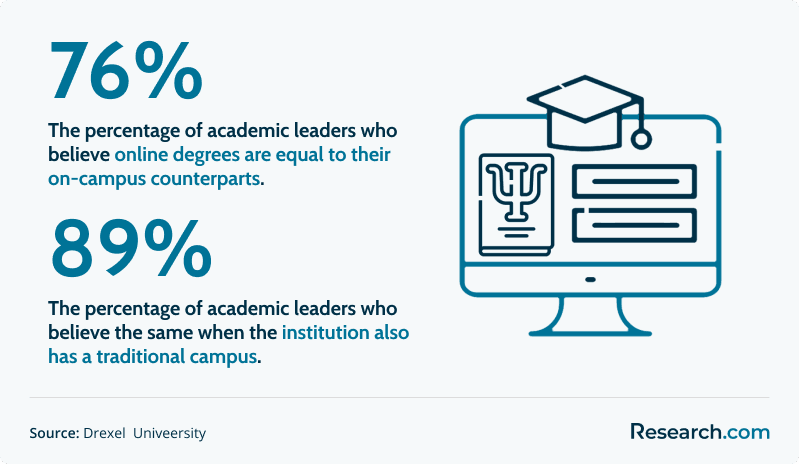
Research cited by Drexel University from a Sloan Consortium Study reports that 76% of academic leaders consider online degrees equivalent to campus-based degrees, and the share rises to 89% when the institution also has a traditional campus. The same source reports that 92% of hiring managers view degrees from brick-and-mortar institutions with online programs as favorably as traditional degrees.
If you are comparing a behavioral psychology online degree or another counseling-adjacent online program, ask exactly how the school manages local placements, supervisor approval, live skills labs, residency requirements, and licensure paperwork for your state.
| Comparison point | Online program | Campus program | How to decide |
| Schedule flexibility | Often easier for students who work or care for family | May involve commuting and fixed class meeting times | Online may be better if time and location are your biggest barriers. |
| Clinical experience | Usually completed at approved sites near the student | May use campus clinics or established local partners | Ask whether the school finds placements or expects you to do it. |
| Professional network | Depends on live sessions, cohort structure, advising, and alumni engagement | Face-to-face access to faculty and peers may be easier | Look for strong advising, active cohorts, and career connections in either format. |
| Licensure alignment | Requires careful review if the school is outside your state | Often built around the state where the campus is located | Get written confirmation that the program fits your intended state requirements. |
| Total cost | May reduce travel, commuting, and relocation costs | May add campus fees, housing, or transportation expenses | Compare the full cost of attendance, not only tuition. |
What is the average cost of a Master’s in Mental Health Counseling program?
The average tuition for master’s programs in mental health counseling is approximately $11,366 per year for in-state students and $19,982 per year for out-of-state students. That figure is useful for comparison, but it does not show the full price of attendance. Fees, books, software, transportation, clinical placement costs, lost work hours, campus residencies, and licensure expenses can all change the final amount you pay.
If your clinical interests involve relationships, couples, or family systems, compare counseling degrees with online MFT programs accredited to understand how curriculum, licensing pathways, supervised hours, and cost may differ.
Among the listed programs, CUNY Lehman College and CUNY Bernard M. Baruch College are among the lower-cost choices, with annual tuition of $11,090 for in-state students and $20,520 for out-of-state students. Johns Hopkins University and Boston College are higher-cost examples, with tuition of $60,480 and $33,912 per year, respectively, for both in-state and out-of-state students. For in-state learners, the University of Florida and University of Illinois Urbana-Champaign fall closer to the middle of the listed options, with annual tuition of $10,770 and $14,891, respectively.
| Expense category | Why it affects your budget | Question to ask before enrolling |
| Tuition | It is usually the largest direct academic cost. | Is tuition billed by credit, term, semester, or year? |
| Mandatory fees | Fees can make a program more expensive than the tuition page suggests. | Are there technology, online learning, lab, internship, graduation, or clinical fees? |
| Fieldwork costs | Practicum and internship may involve travel, background checks, liability coverage, or fewer paid work hours. | What out-of-pocket costs do students usually face during placements? |
| Residency or intensive requirements | Some online programs require travel to campus or another location. | Will I need to pay for transportation, lodging, meals, or time away from work? |
| Licensure costs | Graduates may need to pay for exams, applications, supervision, and continuing education. | Which licensure-related expenses should I plan for after graduation? |
What financial aid options are available for Master’s in Mental Health Counseling students?
Because counseling graduate programs can be expensive, students should create a funding plan before accepting an offer. Begin with federal aid eligibility, then compare school-based scholarships, assistantships, employer support, state programs, and private awards. The lowest tuition does not always produce the lowest net cost after aid.
- Federal Student Loans: Graduate students may qualify for Direct Unsubsidized Loans and Graduate PLUS Loans, which have fixed interest rates and structured repayment terms.
- Institutional Scholarships and Grants: Universities such as Johns Hopkins University and Fairfield University may offer merit-based or need-based aid to counseling students.
- Graduate Assistantships: Some schools, including the University of Illinois Urbana-Champaign, may offer tuition waivers and stipends in exchange for teaching or research responsibilities.
- State-Specific Aid: States such as New York and Florida may offer grants or scholarships for residents entering high-demand fields, including mental health counseling.
- Private Scholarships: Counseling associations, foundations, and professional groups may provide awards for graduate students preparing for mental health careers.
- Employer Tuition Assistance: Students already employed in healthcare, education, social services, human services, or behavioral health may be able to use tuition reimbursement benefits.
What are the prerequisites for enrolling in a Master’s in Mental Health Counseling program?
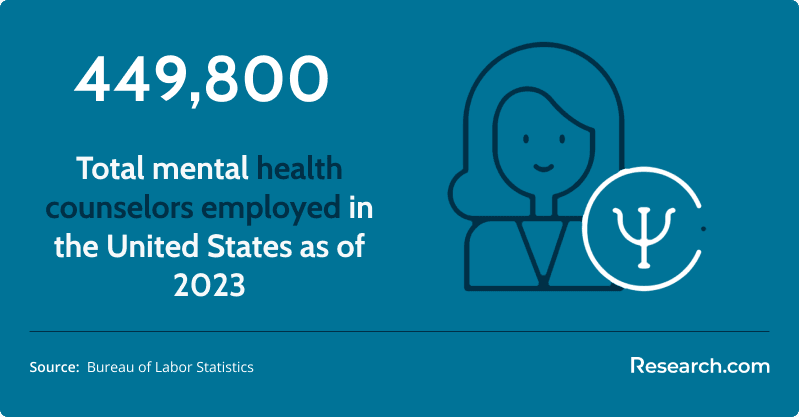
As of 2023, more than 449,800 mental health counselors worked in the United States. For students who want to enter the profession and pursue licensure, a master’s degree is a common required step in many states. To understand the full pathway, review the typical requirements to become a licensed mental health counselor.
Admissions requirements commonly include:
- Bachelor’s Degree: Applicants usually need a bachelor’s degree from an accredited college or university. Majors such as psychology, social work, human services, or related fields can help, but many programs consider candidates from other backgrounds.
- Minimum GPA: Many schools prefer a cumulative GPA near 3.0 on a 4.0 scale, while more selective programs may expect stronger academic records.
- Recommendation Letters: Programs often request two or three letters from faculty members, supervisors, or professionals who can discuss your readiness for graduate counseling study.
- Statement of Purpose: Applicants typically submit an essay describing their career goals, counseling motivation, relevant experience, and fit with the program.
- Relevant Experience: Volunteer work, social service experience, education roles, healthcare exposure, advocacy work, or mental health-related experience can strengthen an application even when not required.
- GRE Scores: Many programs have removed the GRE requirement, but some still ask for standardized test scores.
What courses are typically included in a Master’s in Mental Health Counseling program?
Mental health counseling programs are designed to build clinical reasoning, ethical awareness, assessment ability, cultural responsiveness, and supervised practice skills. Course titles differ by school, but licensure-focused curricula usually cover several core areas.
- Counseling and Psychotherapy Theories: Reviews major counseling frameworks and teaches students how theory informs treatment choices.
- Ethics and Legal Issues in Counseling: Covers confidentiality, informed consent, mandated reporting, boundaries, professional conduct, and ethical codes.
- Assessment and Diagnosis: Builds skill in intake assessment, diagnostic thinking, clinical documentation, and frameworks such as DSM-5-TR criteria.
- Multicultural Counseling: Prepares students to work effectively with clients across differences in culture, race, ethnicity, language, gender, identity, socioeconomic status, and lived experience.
- Group Counseling: Teaches group development, screening, facilitation, ethical leadership, and management of group dynamics.
- Trauma and Crisis Intervention: Focuses on counseling responses for clients facing trauma, grief, acute distress, crisis, or safety concerns.
- Substance Abuse Counseling: Examines addiction, relapse prevention, co-occurring disorders, recovery planning, and evidence-based interventions.
- Practicum and Internship: Gives students supervised field experience in real practice settings, often totaling 600-1,000 hours.
Students planning for future academic or research roles may later compare doctoral pathways, including 1-year PhD programs online, but most licensure-focused counseling careers begin with the master’s degree and required post-degree steps.
Graduates may also look for roles in top-paying industries such as outpatient care centers and clinical offices.
What types of specializations are available in Master’s Programs in Mental Health Counseling?
Specializations help students connect their training to the populations, problems, and work settings they care about most. Since 31% of mental health counselors hold a master’s degree, focused training can also help graduates communicate a clear clinical direction to employers and internship sites.
- Trauma and Crisis Counseling: Prepares students to support clients affected by trauma, grief, violence, disasters, or acute emotional distress.
- Substance Abuse Counseling: Builds skills for working with addiction, relapse risk, recovery planning, and co-occurring mental health conditions.
- Child and Adolescent Counseling: Focuses on developmental, behavioral, family, school, and emotional concerns affecting younger clients.
- Marriage and Family Therapy: Emphasizes relational patterns, family systems, communication, and couple or family interventions.
- Rehabilitation Counseling: Supports individuals with disabilities as they pursue personal, social, educational, and vocational goals.
- School Counseling: Prepares professionals to support students’ academic, emotional, social, and developmental needs in educational settings.
- Multicultural Counseling: Strengthens the ability to work with clients from varied cultural, ethnic, linguistic, and community backgrounds.
Counselors who want advanced teaching, research, or specialized leadership may later explore a PhD in counseling online, but they should first verify whether that path supports their licensing and career objectives.
How do you choose the best Master’s Program in Mental Health Counseling?
The best program is the one that matches your licensing goal, budget, learning style, clinical interests, location, and fieldwork needs. A well-known or highly ranked school may still be a poor choice if it does not meet your state’s requirements or if the clinical placement model does not work for your circumstances. Students considering related career directions can also review broader health psychology employment opportunities before committing to counseling.
- Start with accreditation: Review whether the program has CACREP, MPCAC, or another recognized accreditation status that fits your professional goals. Accreditation may affect licensure eligibility, employer trust, and doctoral admissions.
- Confirm licensure alignment by state: Ask whether the curriculum satisfies the education requirements where you plan to practice, especially if the program is online and based in another state.
- Study the fieldwork model: Determine whether the school helps students secure practicum and internship sites or expects students to find placements on their own.
- Compare full cost, not just tuition: Include tuition, fees, books, software, travel, residency requirements, reduced work hours, and licensure-related expenses.
- Match training to your intended clients: Look for coursework and field sites related to your interests, such as trauma, addiction, children, families, crisis counseling, or multicultural practice.
- Review faculty background: Examine faculty credentials, clinical experience, research areas, supervision approach, and availability to students.
- Choose the format realistically: Online, hybrid, and campus programs can all work well, but the right format depends on your schedule, support needs, learning preferences, and placement options.
| Question for admissions or program faculty | Why this question matters |
| Does the program meet the counseling licensure education requirements in my state? | State rules differ, and an out-of-state online program may not automatically qualify you. |
| Who helps students arrange practicum and internship placements? | Strong placement support can prevent delays and reduce stress during clinical training. |
| What are recent employment, graduation, or licensure exam outcomes? | Outcome information can show whether students are progressing toward professional goals. |
| What is the total program cost after tuition, fees, and required expenses? | Published tuition may not reflect what students actually pay. |
| How does the program support graduates who move to another state? | License portability can affect your future career flexibility. |
Common mistakes to avoid when choosing a counseling program
- Picking the lowest tuition without checking the full picture. A cheaper program may cost more in the long run if it delays fieldwork, lacks support, or does not meet licensure rules.
- Assuming online programs qualify everywhere. Always verify state-specific licensure alignment before enrolling in an online program.
- Overlooking accreditation. Accreditation can influence licensing, employer confidence, transfer options, and doctoral study.
- Underestimating practicum and internship demands. Fieldwork may require travel, schedule changes, unpaid hours, and reduced employment flexibility.
- Using rankings as the only decision tool. Rankings are helpful for discovery, but fit, cost, licensure alignment, and support services matter more.
- Treating salary data as a guarantee. Earnings depend on employer type, location, license level, specialization, experience, and career path.
What is the return on investment for a Master’s in Mental Health Counseling?
The ROI of a mental health counseling master’s degree depends on total cost, time to completion, speed of licensure progress, and realistic earnings in your target state and work setting. A lower-cost program can offer excellent value if it is accredited, licensure-aligned, clinically strong, and supportive of field placement. A higher-cost program may still be reasonable if it provides excellent supervision, specialized training, strong advising, and access to clinical networks that match your goals.
To estimate ROI, compare the full cost of attendance with realistic local salary data rather than national figures alone. Include tuition, fees, books, technology, travel, residency costs, licensing exam fees, application fees, and income you may lose during practicum or internship. Also weigh non-financial returns, such as meaningful work, client impact, career stability, autonomy, and alignment with your values.
If your primary interest is couples, families, and relational systems, a related pathway such as a marriage and family therapy degree online may be a better match. Compare licensure outcomes and scope of practice carefully before choosing.
What career paths are available for graduates of Master’s Programs in Mental Health Counseling?
A master’s in mental health counseling can support several direct-service, specialized, and leadership roles. Job titles and allowed responsibilities depend on state regulations, employer requirements, licensure status, specialization, and supervised experience.
- Crisis Counselor: Provides support during acute emotional distress, often through crisis lines, hospitals, mobile crisis teams, or emergency programs.
- Substance Abuse Counselor: Helps clients address addiction, relapse risk, recovery goals, and co-occurring mental health issues.
- School Counselor: Supports students with academic, social, emotional, developmental, and mental health concerns in educational settings.
- Marriage and Family Therapist: Works with couples and families on relationship-focused concerns, depending on training and licensure.
- Behavioral Specialist: Creates behavior-focused strategies in schools, clinics, treatment programs, or community settings.
- Juvenile Counselor: Supports youth facing behavioral, emotional, family, legal, school, or community challenges.
- Clinical Supervisor: Oversees counseling staff, monitors ethical practice, supports documentation quality, and helps train developing clinicians.
Graduates who become interested in employee well-being, workplace behavior, and organizational systems may also compare a degree in organizational psychology, which can lead to roles focused on performance, wellness, and workplace culture.
Should mental health counseling professionals pursue a doctoral degree?
A doctoral degree may make sense for counselors who want to teach, conduct research, lead clinical programs, move into policy or administration, supervise at an advanced level, or develop deep expertise in a specialized area. It is not required for many entry-level and mid-career counseling roles, so the decision should be based on career goals rather than prestige alone.
Before applying, compare tuition, time commitment, dissertation or research expectations, clinical training requirements, and likely career return. Counselors exploring advanced study can review online PhD programs in psychology to decide whether doctoral education fits their long-term plans.
What is the job market for graduates with a Master’s in Mental Health Counseling?
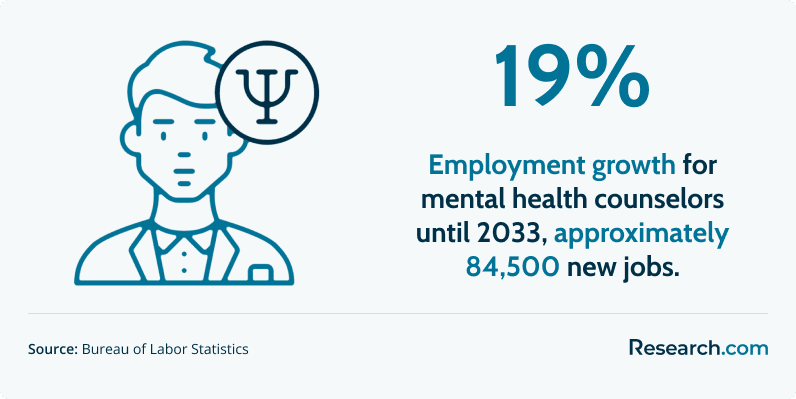
The employment outlook for mental health counselors is strong. The BLS projects 19% job growth for mental health counselors from 2023 to 2033, with approximately 84,500 new jobs. That rate is much faster than the 4% average for all occupations and reflects continued need for professionals who can address addiction, anxiety, behavioral health concerns, and emotional well-being.
Graduates may find opportunities in substance abuse counseling, community mental health, behavioral health programs, healthcare systems, schools, crisis services, and organizational wellness. Students interested in workplace mental health, employee behavior, and organizational systems can compare the industrial organizational psychology job outlook with counseling careers. Across mental health-related occupations, more than 200,000 job openings are projected annually.
What graduates say about their Master’s Program in Mental Health Counseling
- Studying counseling online allowed me to stay employed full time as a social worker while completing my graduate degree. Live virtual classes, instructor feedback, and structured discussions helped me feel connected, and the clinical training helped me transition into counseling work with more confidence. Sarah
- As a parent, I needed a program that fit around family responsibilities. The online structure gave me room to complete coursework on a realistic schedule, while my local placement gave me the in-person clinical experience required for the field. It opened a career path I did not think was possible. Michael
- I worried that an online counseling program might feel disconnected, but the case discussions, group assignments, and faculty interaction were more engaging than I expected. I developed relationships with classmates and built practical skills for licensed counseling work. Percy
How can I assess the academic quality of a counseling program?
Program quality should be judged by more than brochures and admissions claims. Review the curriculum, faculty qualifications, supervision structure, practicum and internship expectations, student support, licensure outcomes, and course descriptions. A strong program should clearly show how students move from classroom learning to supervised client care.
Accreditation is one of the most important signals to verify. Programs that follow recognized standards, such as CACREP accredited masters programs, may provide clearer licensing alignment in many states. Also ask about graduation rates, employment outcomes, exam preparation, and how frequently students complete the program on schedule.
How can I improve my job search strategy in mental health counseling?
An effective counseling job search should show your clinical hours, supervised experience, populations served, evidence-based approaches, internship achievements, documentation skills, and specialized training. Customize your resume and cover letter for each setting, whether you are applying to community mental health agencies, schools, addiction treatment programs, crisis services, or private practice support roles.
Build your network through supervisors, alumni, internship contacts, state counseling associations, conferences, and professional events. Resources such as counseling careers can help you compare roles, required skills, and advancement options. Employers often look for a combination of clinical competence and professional qualities such as empathy, reliability, cultural humility, documentation accuracy, and teamwork.
How can behavioral analysis strengthen a counseling practice?
Behavioral analysis can help counselors understand behavior patterns, triggers, reinforcement, and measurable change. Used appropriately, behavior-focused assessment can improve treatment planning and collaboration with schools, families, healthcare teams, and behavioral specialists.
Counselors who want additional training in applied behavior analysis can compare options such as affordable online BCBA programs. Before enrolling, confirm whether the coursework or credential fits your intended scope of practice and state requirements.
What certifications and professional development options can further enhance your career?
Continuing education helps counselors maintain competence, meet renewal requirements, and build targeted clinical skills. Common professional development areas include trauma-informed care, crisis response, substance abuse counseling, telehealth, ethics, multicultural counseling, and supervision.
Certifications can clarify your expertise, but they do not replace state licensure. If your goal is to become a mental health counselor, focus first on the required degree, supervised hours, exam, application process, and continuing education rules in your state.
Can an accelerated online psychology degree support a counseling career?
An accelerated online psychology degree can help students build foundational knowledge before entering graduate counseling study. It may be useful for career changers or undergraduates completing prerequisites, but it does not substitute for a licensure-focused master’s degree in mental health counseling.
If you are still comparing bachelor’s-level options, check whether an accelerated online psychology degree is accredited, affordable, transfer-friendly, and aligned with the admissions expectations of your intended graduate programs.
How can I integrate substance abuse counseling into mental health practice?
Substance abuse counseling is closely connected to mental health counseling because many clients experience addiction alongside trauma, anxiety, depression, family conflict, or other behavioral health needs. Training in addiction assessment, motivational interviewing, relapse prevention, and co-occurring disorders can broaden your clinical usefulness.
If addiction counseling is a major career goal, review your state’s credentialing rules and compare specialized pathways such as how to become a drug and alcohol counselor. Requirements may differ from general mental health counseling licensure.
How can I evaluate the affordability of a counseling degree program?
Affordability means more than choosing the lowest tuition. A genuinely affordable counseling program is one you can complete without avoidable delays, unexpected expenses, or licensing barriers. Compare tuition, fees, books, software, commuting, residencies, internship-related expenses, and the possibility of reduced work hours during clinical training.
For a more detailed cost comparison, use resources that explain how much a counseling degree costs. Then ask each school for a complete cost estimate, including scholarships, grants, assistantships, payment plans, and employer partnership discounts.
How can I integrate telehealth into counseling practice?
Telehealth is now an important part of mental health service delivery because it can reduce travel barriers, expand access, and support flexible scheduling. Counselors who provide telehealth must still meet ethical, clinical, privacy, documentation, emergency planning, and state practice requirements.
Students preparing for digital counseling should seek training in secure platforms, informed consent, emergency protocols, cross-state practice issues, documentation, and building rapport through virtual sessions. If you are still completing undergraduate psychology coursework, compare affordable options such as the cheapest online psychology degree programs.
Are online mental health counseling degrees respected?
Online mental health counseling degrees can be respected when they are offered by accredited institutions, include rigorous coursework, provide supervised clinical experience, and meet licensure requirements. Employers and licensing boards generally focus on whether the program meets professional standards, not simply whether courses were delivered online.
Before enrolling, verify accreditation, field placement quality, faculty availability, student support, residency requirements, and state licensure alignment. For broader context on online credentials in psychology-related fields, review whether online psychology degrees are respected.
Key Insights
- A master’s in mental health counseling should be evaluated first as a licensure pathway. Accreditation and state requirement alignment matter more than convenience, ranking position, or school name.
- The BLS projects 19% employment growth for mental health counselors from 2023 to 2033, with approximately 84,500 new jobs, making this a strong-demand field for students prepared for clinical work.
- Salary data is useful for planning, but earnings vary by license level, location, employer, specialization, experience, and whether you work in an agency, school, healthcare setting, or private practice.
- Program prices differ widely. CUNY Lehman College lists in-state tuition of $11,090 per year, while Johns Hopkins University lists tuition of $60,480 per year, so students should compare total cost after aid.
- Online counseling programs can be credible, but students must confirm accreditation, practicum and internship support, residency requirements, and eligibility in the state where they intend to practice.
- Strong counseling programs combine ethical training, multicultural counseling, assessment, diagnosis, crisis intervention, addiction content, supervised fieldwork, and preparation for real client care.
- The most common decision mistakes are ignoring accreditation, assuming every online program meets licensure rules, focusing only on tuition, and underestimating the time demands of practicum, internship, and post-graduate supervision.
References:
- Bureau of Labor Statistics. (2023). Careers in mental health services. BLS.
- Bureau of Labor Statistics. (2023). Occupational employment and wage statistics: Substance abuse, behavioral disorder, and mental health counselors. BLS.
- Bureau of Labor Statistics. (2023). Substance abuse, behavioral disorder, and mental health counselors. BLS.
- College Tuition Compare. (n.d.). Graduate programs: Mental health counseling. College Tuition Compare.
- Drexel University. (n.d.). Online degree vs traditional degree. Drexel University.
- National Board for Certified Counselors. (n.d.). Certification: NCC. NBCC.
- National Board for Certified Counselors. (n.d.). Certification: CCMHC required coursework. NBCC.
- National Board for Certified Counselors. (n.d.). Licensure. NBCC.
- Salary.com. (n.d.). Mental health counselor salary. Salary.com.
- ZipRecruiter. (n.d.). Mental health counselor salary. ZipRecruiter.
- Zippia. (n.d.). Mental health counselor demographics. Zippia.
- Zippia. (n.d.). Mental health counselor jobs and trends. Zippia.
- Zippia. (n.d.). Mental health counselor salary. Zippia.
Other Things You Should Know About the Best Master's Programs in Mental Health Counseling
The best master's programs in mental health counseling in 2027 typically require two years of full-time study, though program lengths can vary based on the institution and any specializations chosen. Part-time options may extend the duration to approximately three to four years.
Yes. Most CACREP-accredited master’s programs require at least 100 clock hours of practicum and 600 clock hours of internship, with direct client contact and weekly supervision. These fieldwork requirements are built into training standards used by many state licensure boards and counseling programs.


