2027 Industrial Organizational Psychologist Career Paths: Job Outlook, Required Skills, and More

Co-Founder and Chief Data Scientist
Choosing an industrial-organizational psychology career means deciding whether you want to use psychology in business settings rather than in a traditional counseling or clinical role. I/O psychologists study how people behave at work, then use evidence to improve hiring, training, leadership, performance, culture, employee well-being, and organizational change. The field matters more now because many employers are struggling with engagement, retention, hybrid work, and workforce trust. Gallup reported that employee engagement in the U.S. and Canada is only at 31%, with actively engaged employees at 17% (Gallup, 2025).
This guide explains what industrial-organizational psychology is, how to enter the field, which degrees and credentials matter, what jobs are available, how much professionals earn, and how to decide whether this path fits your goals. It is written for students comparing psychology specializations, working professionals considering a graduate degree, and HR or business professionals who want to move into evidence-based workplace strategy.
Quick Answer: Is Industrial-Organizational Psychology a Good Career Path?
Industrial-organizational psychology can be a strong career path for people who enjoy psychology, data, organizational strategy, and workplace problem-solving. I/O psychologists in the United States had a median annual wage of $109,840, and employment for all psychologists has been projected to grow by 6% through 2034. The field is also flexible: common career directions include human resources management, recruiting strategy, market research, executive coaching, behavioral analysis, consulting, research, and organizational development.
Key Points on Pursuing a Career in Industrial-Organizational Psychology
- I/O psychologists in the United States had a median annual wage of $109,840.
- Employment for all psychologists across the country has been projected to increase by 6% through 2034.
- Industrial organizational psychologist career paths include human resources manager, recruiting manager, market researcher, executive coach, and behavioral analyst.
- What is industrial-organizational psychology?
- What education do you need to become an industrial-organizational psychologist?
- What certifications or licenses are required for practicing I/O psychology?
- How important is ongoing professional development in industrial-organizational psychology?
- What are the different career paths for industrial-organizational psychologists?
- What industries typically employ industrial-organizational psychologists?
- What are the essential skills for success in industrial-organizational psychology?
- What is the average salary for industrial-organizational psychologists?
- Are there common stressors or challenges faced by industrial-organizational psychologists?
- What is the projected job growth rate for industrial-organizational psychologists?
- How can industrial-organizational psychologists promote diversity and inclusion in the workplace?
- How can industrial-organizational psychologists support remote work environments?
- Leveraging online education to enter industrial-organizational psychology
- How can practical experience and internships boost your career in industrial-organizational psychology? Online education options
- Should I pursue an online doctorate in industrial-organizational psychology?
- What factors should I consider when evaluating accelerated online accredited psychology programs?
- How does pursuing an advanced doctoral degree impact your career trajectory in industrial-organizational psychology?
- Can a mental health counseling perspective enhance industrial-organizational psychology practices?
- What alternative educational paths can aspiring industrial-organizational psychologists pursue?
- How can networking advance your career in industrial-organizational psychology?
- Can an accelerated online master's program expedite your career?
- What are the emerging trends in industrial-organizational psychology?
- How does industrial-organizational psychology compare to other psychology fields? Networking Online education Remote work
What is industrial-organizational psychology?
Industrial-organizational psychology, often called I/O psychology, is the application of psychological science to work and organizations. Instead of treating mental health conditions in a clinical setting, I/O psychologists study employee behavior, motivation, leadership, teamwork, job performance, hiring systems, training programs, organizational culture, and employee satisfaction.
The work is practical and research-driven. An I/O psychologist may help an employer build a fairer hiring process, evaluate whether a leadership program is working, diagnose why turnover is high, redesign onboarding, measure employee engagement, or advise leaders during a major organizational change. The goal is not simply to make employees happier or companies more profitable; the strongest I/O work improves both organizational outcomes and employee well-being through evidence-based decisions.
I/O psychology is especially relevant for people who want a career at the intersection of psychology, business, analytics, and human resources. It can lead to roles inside companies, consulting firms, research organizations, universities, government agencies, and professional services firms.
What education do you need to become an industrial-organizational psychologist?
Most industrial-organizational psychology careers require graduate-level preparation, but your starting point depends on whether you want to work in HR, consulting, research, teaching, or licensed psychological practice. A bachelor’s degree can qualify you for entry-level roles related to human resources, recruiting, research support, people analytics, training coordination, or business operations. A master’s degree is often the practical entry point for I/O psychology roles, while a doctorate can open doors to advanced consulting, independent practice, research leadership, and academic positions.
Education Pathways for I/O Psychology
| Education level | Typical purpose | Best fit for | Important considerations |
| Bachelor’s degree | Builds a foundation in psychology, research, business, HR, or social science | Students seeking entry-level HR, recruiting, training, research, or business roles | Industrial organizational psychologist career paths typically begin with four years of undergraduate study. Psychology is the most common undergraduate major among I/O psychologists in the Zippia database, at 42%. |
| Master’s degree in I/O psychology or a related field | Prepares graduates for applied workplace roles, consulting support, analytics, assessment, and organizational development | Professionals who want to practice in organizational settings without necessarily pursuing academic research | In I/O psychology, a master’s degree can function as a terminal professional degree, especially when combined with relevant work experience. |
| PhD or PsyD | Develops advanced expertise in research, assessment, consulting, teaching, and higher-level practice | People aiming for independent consulting, research leadership, university teaching, or licensure pathways | Doctoral education may be required for state licensure and is often preferred for advanced research or academic roles. |
1. Bachelor’s Degree
A bachelor’s degree is the first step for most future I/O psychologists. Psychology is a natural choice, but it is not the only useful major. Students can also build relevant preparation through business, human resources, statistics, sociology, communications, education, or organizational leadership. For students who want business fluency, business online degree programs may provide useful exposure to management, operations, and organizational decision-making.
After graduation, many students gain experience before entering graduate school. Helpful early roles include HR assistant, recruiter, training coordinator, research assistant, compensation analyst, employee engagement assistant, or marketing research associate. Students who need flexible study options can also compare location-specific online psychology pathways, such as this guide to online psychology degree Texas options.
2. Master’s Degree in Industrial-Organizational Psychology, PhD, or PsyD
Graduate education is where students usually begin specialized training in I/O psychology. A master’s program may cover personnel selection, psychometrics, organizational behavior, statistics, employee assessment, leadership, training design, consulting methods, and research methods. For many applied business roles, a master’s degree plus experience can be enough to move into senior HR, organizational development, talent management, or consulting positions.
A doctorate is more appropriate if you want to conduct original research, teach at the university level, pursue state licensure, or run an independent consulting practice with advanced psychological credentials. Doctoral graduates may teach in institutions such as the best psychology schools in Texas, lead research teams, or advise organizations on complex workforce issues.
Income can vary widely by role, degree level, employer, location, and experience. I/O psychologists earn annual wages between $51,880 and $224,590, so students should avoid assuming that a degree alone guarantees a specific salary.
What certifications or licenses are required for practicing I/O psychology?
Licensure rules for I/O psychologists can be confusing because many I/O professionals work in business roles rather than in clinical practice. Employers may not always require a psychology license for organizational consulting, HR analytics, recruiting strategy, or employee assessment work. However, state rules can still apply when someone uses the title “psychologist,” offers psychological services, or practices independently under regulated professional titles.
Common licensure requirements can include the following, depending on the state:
- Holding a doctorate in psychology.
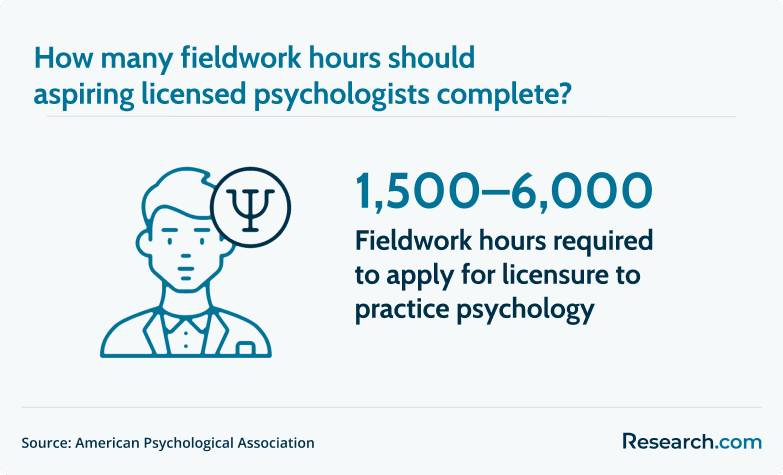
- Completing between 1,500 and 6,000 supervised fieldwork hours.
- Passing the Examination for Professional Practice in Psychology (EPPP).
Doctorate-level professionals can also pursue board certification through the American Board of Organizational and Business Consulting Psychology (ABOBCP). This credential signals advanced competence in applying psychological knowledge to organizational and business problems. It is not a substitute for checking state licensure rules, but it may strengthen credibility for consulting or senior advisory work.
Licensure and Certification Decision Guide
| Career goal | Likely credential need | What to verify before enrolling |
| HR, recruiting, training, or organizational development role | A license may not be required by the employer, but graduate training can be valuable | Whether the program teaches applied assessment, data analysis, consulting, and employment law context |
| Use of the psychologist title or independent psychological practice | State licensure may be required | Whether the degree meets doctoral, supervised experience, and EPPP-related requirements in your state |
| Senior organizational consulting | Doctoral training and ABOBCP certification may improve credibility | Whether the program includes consulting practice, research methods, assessment, and supervised applied work |
How important is ongoing professional development in industrial-organizational psychology?
Ongoing professional development is essential because I/O psychology changes with the workplace. New assessment tools, analytics platforms, remote work practices, diversity and inclusion expectations, leadership models, and ethical issues all affect how I/O psychologists make recommendations.
- Research changes practice. I/O psychologists need to keep up with new findings in motivation, selection, training, leadership, employee engagement, and organizational behavior so their advice remains evidence-based.
- Technology keeps raising the skill bar. People analytics, survey platforms, assessment software, and AI-supported HR tools require professionals who can evaluate both usefulness and risk.
- Ethical expectations are high. I/O psychologists often work with sensitive employee data, hiring assessments, performance systems, and leadership decisions. Continuing education helps professionals protect confidentiality, fairness, and validity.
- Business problems evolve quickly. Mergers, layoffs, remote work, burnout, retention concerns, and culture change require updated methods rather than one-size-fits-all interventions.
Useful development activities include attending professional conferences, reading peer-reviewed research, learning statistical software, improving consulting skills, joining I/O psychology associations, completing certifications, and seeking supervision or mentorship from experienced practitioners.
What are the different career paths for industrial-organizational psychologists?
I/O psychology does not lead to only one job title. Some professionals hold the title industrial-organizational psychologist, while others work in HR leadership, organizational development, talent analytics, consulting, research, assessment, employee experience, or leadership development. The best path depends on whether you prefer data analysis, coaching, program design, research, or executive-level strategy.
Common I/O Psychology Career Paths
| Career path | What the role focuses on | Best fit for people who enjoy |
| Human Resources Manager | Oversees hiring, training, employee relations, performance systems, and workforce planning | People strategy, policy, leadership, and organizational operations. Graduate-level business degrees online accredited pathways can also support business and HR preparation. |
| Recruiting Manager | Builds hiring systems, evaluates candidate pipelines, manages selection processes, and improves candidate fit | Talent acquisition, structured interviews, assessment design, and employment branding |
| Market Researcher | Uses behavioral research to study customers, markets, preferences, and decision-making | Survey design, statistics, consumer behavior, and strategic recommendations |
| Executive Coach | Works with leaders on communication, decision-making, emotional intelligence, performance, and team effectiveness | Leadership development, feedback, coaching conversations, and organizational influence |
| Behavioral Analyst | Studies patterns in employee behavior, performance, culture, and organizational systems | Data interpretation, workplace diagnostics, intervention design, and problem-solving |
Students should also think beyond job titles. A role may be a strong I/O fit if it involves measuring human behavior at work, improving organizational systems, designing employee programs, or using research to support better workforce decisions.
What industries typically employ industrial-organizational psychologists?
I/O psychologists are most visible in consulting and corporate environments, but their skills apply wherever organizations need to hire, develop, retain, and support people. According to the U.S. Bureau of Labor Statistics, professionals with the I/O psychologist title can be found in the following industries:
- Management, scientific, and technical consulting services
- Scientific research and development services
- Management of companies and enterprises
- Colleges, universities, and professional schools
Because many I/O-related roles sit under HR, people operations, analytics, leadership development, or business strategy, graduates may also work in industries that do not use the I/O psychologist title directly. For HR managers, the largest employers were:
- Professional, scientific, and technical services
- Management of companies and enterprises
- Manufacturing
- Healthcare and social assistance
- Government
For market research analysts, the largest employers were:
- Management, scientific, and technical consulting services (10%)
- Finance and insurance (9%)
- Information (9%)
- Wholesale trade (7%)
- Management of companies and enterprises (7%)
The practical takeaway is that I/O psychology is not limited to one sector. If an organization has employees, leaders, customers, culture challenges, hiring needs, or performance problems, I/O skills can be relevant.
What are the essential skills for success in industrial-organizational psychology?
I/O psychology requires a mix of psychological knowledge, research ability, business judgment, and communication skill. Students can begin building this foundation through psychology, human resources, statistics, business, sociology, and related social science coursework. A human resources track or even a specialized field such as a criminal psychology degree can help students understand behavior, systems, and evidence-based analysis, depending on their career goals.
- Statistical Methods. Statistical methods are the most common skill listed among I/O psychologists in Zippia, appearing on 43% of resumes. I/O professionals need data skills to interpret surveys, assess employee performance trends, evaluate interventions, and make recommendations that are more reliable than intuition.
- Research Design. Good I/O work depends on asking the right question, collecting appropriate evidence, and avoiding misleading conclusions. Research design skills help professionals evaluate whether a hiring test, training program, or engagement initiative is actually working.
- Program Design. I/O psychologists often design onboarding, training, employee engagement, leadership development, and assessment programs. The strongest programs are tied to clear goals, measurable outcomes, and organizational needs.
- Communication. Data only matters if leaders and employees can understand it. I/O psychologists must write clear reports, present findings persuasively, explain limitations, and translate research into decisions.
- Business Acumen. Workplace interventions must connect to organizational goals such as retention, productivity, safety, fairness, performance, or leadership effectiveness. I/O professionals need to understand how business priorities shape people decisions.
- Adaptability. Organizations change quickly. I/O psychologists may need to respond to layoffs, restructuring, new technology, remote work, leadership turnover, or shifting employee expectations.
- Problem-solving. Issues such as disengagement, turnover, bias, burnout, poor communication, or ineffective management rarely have simple causes. I/O psychologists need to diagnose problems carefully before recommending solutions.
What is the average salary for industrial-organizational psychologists?
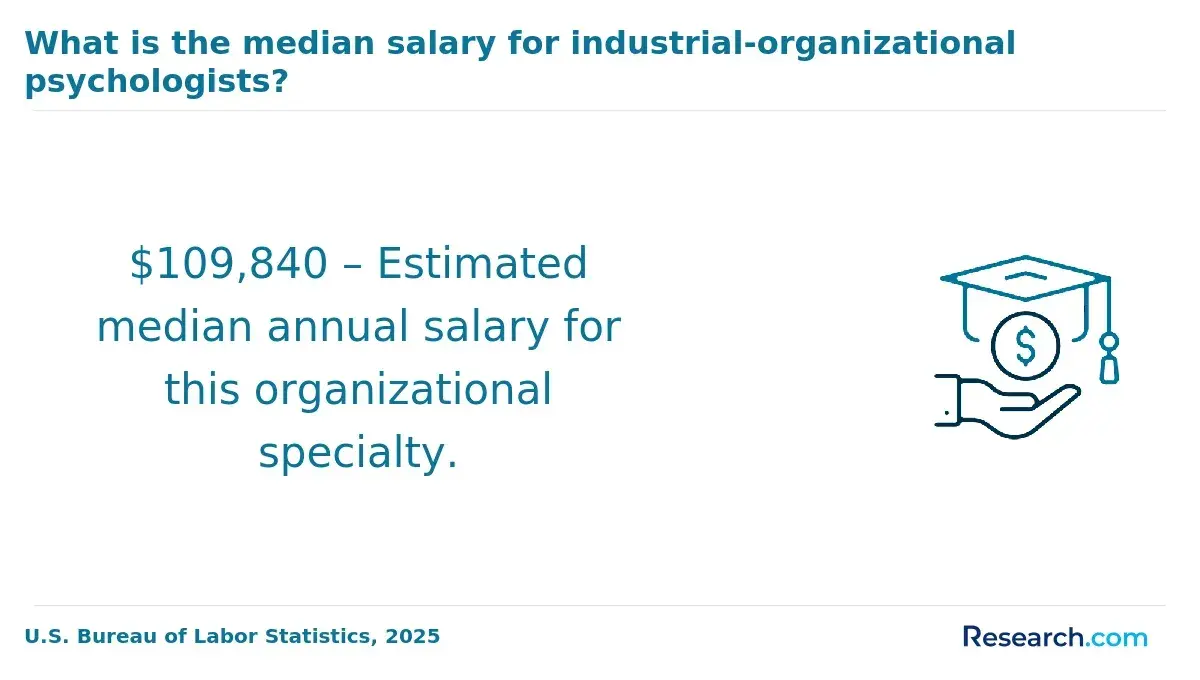
I/O psychologists in the U.S. had a median annual wage of $109,840. Related roles also show strong earning potential: HR managers had a median annual wage of $140,030, management analysts had $101,190, and market research analysts had $76,950. These figures are higher than the estimated $49,500 median annual wage of all full-time wage and salary workers in the U.S.
Salary should still be interpreted carefully. Pay depends on job title, employer, location, industry, degree level, experience, and whether the role is internal, consulting-based, academic, or executive-level. Many higher-paying roles require several years of experience in addition to a degree.
| Role | Median annual wage | Typical preparation noted in the article |
| Industrial-organizational psychologist | $109,840 | Often requires graduate education; doctoral credentials may expand research, teaching, consulting, or licensure options |
| HR manager | $140,030 | Usually requires a bachelor’s degree plus relevant professional experience; graduate study may improve competitiveness |
| Management analyst | $101,190 | Commonly requires business, analytics, or organizational experience |
| Market research analyst | $76,950 | Often requires research, statistics, consumer behavior, and communication skills |
| All full-time wage and salary workers in the U.S. | $49,500 | Used as a broad labor-market comparison, not a direct career benchmark |
Are there common stressors or challenges faced by industrial-organizational psychologists?
I/O psychology can be rewarding, but the work is not always easy. Professionals often operate between employees, managers, executives, legal teams, and HR leaders, which means recommendations may be politically sensitive or difficult to implement.
- Competing stakeholder priorities. Employees may want fairness and support, while executives may prioritize performance, cost control, or speed. I/O psychologists often have to balance both perspectives without compromising evidence or ethics.
- Ethical pressure. Hiring assessments, employee surveys, performance data, and leadership evaluations can affect people’s careers. Misusing data or ignoring confidentiality can cause real harm.
- Organizational resistance. Leaders may ask for evidence-based solutions but resist uncomfortable findings about culture, management behavior, or inequity.
- Heavy project loads. Consulting, analytics, and HR strategy roles can involve multiple deadlines, high expectations, and urgent business problems.
- Ambiguous outcomes. Workplace change takes time. Unlike a simple task with immediate completion, culture improvement or engagement work may require long-term measurement and patience.
Professionals can reduce these pressures by setting clear project scopes, documenting methods, explaining limitations, protecting confidential information, and building strong relationships with stakeholders before problems escalate.
What is the projected job growth rate for industrial-organizational psychologists?
Employee engagement remains a major concern for HR teams; Lattice identified employee engagement as the highest priority initiative among HR professionals. As organizations continue investing in engagement, retention, leadership, and performance systems, the need for I/O-related expertise is expected to remain relevant.
Employment for all psychologists in the U.S. has been projected to increase by 6% through 2034, which is faster than the average job growth rate for all occupations across the country. The median annual wage of I/O psychologists ($109,840) is also higher than the median annual wage for all psychologists ($94,310).
Related HR roles also show stable demand. HR managers have a projected job growth rate of 5%, while employment for HR specialists is expected to grow by 6%. HR specialists, a lower-level HR role that can be supported by a bachelor’s degree such as a human resources degree online, had a median annual wage of $72,910.
Students who are not ready for graduate school can begin with an undergraduate HR degree, psychology degree, or cheap business degree online. The key is to combine coursework with experience in hiring, training, analytics, research, employee engagement, or organizational operations.
How can industrial-organizational psychologists promote diversity and inclusion in the workplace?
I/O psychologists can support diversity and inclusion by helping organizations make people decisions more structured, measurable, and fair. Their value is especially strong when diversity initiatives move beyond slogans and become part of hiring, promotion, leadership accountability, and culture assessment.
1. Improve Recruitment and Selection
- Job analysis and role design: I/O psychologists can help employers write job descriptions that focus on essential competencies and avoid unnecessary barriers or biased language.
- Structured selection methods: Standardized interviews, validated assessments, and consistent scoring rubrics can reduce the influence of personal bias in hiring.
- Broader candidate pipelines: Organizations can build relationships with diverse educational institutions, professional associations, and community networks to reach candidates who may otherwise be overlooked.
2. Build Inclusive Training and Leadership Development
- Cultural competence training: Effective training helps employees understand communication styles, bias, conflict, and collaboration across differences.
- Inclusive leadership development: Managers need practical tools for psychological safety, equitable feedback, conflict resolution, and team decision-making.
3. Measure Culture and Climate
- Employee surveys and focus groups: I/O psychologists can collect data on belonging, fairness, trust, manager behavior, and employee voice.
- Diversity audits: Reviewing hiring, promotion, retention, and performance systems can reveal where policies and outcomes do not align.
4. Create Accountability
- Track diversity metrics: Representation, promotion, retention, and advancement patterns can help organizations identify gaps.
- Connect goals to leadership behavior: Inclusion work is stronger when leaders are evaluated on measurable actions rather than broad intentions alone.
How can industrial-organizational psychologists support remote work environments?
Remote and hybrid work have changed how organizations manage culture, performance, onboarding, leadership, and employee well-being. I/O psychologists can help employers avoid treating remote work as only a technology issue. The bigger challenge is designing systems that support communication, accountability, belonging, productivity, and boundaries.
- Strengthening remote team dynamics: I/O psychologists can recommend communication norms, meeting practices, collaboration tools, and team-building approaches that reduce isolation and confusion.
- Assessing productivity fairly: Remote productivity should not be measured only by visibility or online status. Better systems focus on outcomes, role expectations, workload, and barriers to performance.
- Supporting employee well-being: Remote work can blur work-life boundaries. I/O psychologists can help design policies around availability, breaks, workload, stress management, and disconnection after work hours.
- Improving virtual onboarding: New employees may need structured mentorship, scheduled check-ins, clear documentation, and early social connection to feel integrated.
- Updating performance management: Remote performance systems should use clear goals, regular feedback, and role-specific expectations instead of informal office-based observation.
- Developing remote leadership skills: Managers may need training in virtual communication, motivation, conflict resolution, psychological safety, and coaching from a distance.
- Addressing privacy and cybersecurity behavior: I/O psychologists can partner with IT and compliance teams to design training and policies that employees understand and follow.
Leveraging Online Education to Enter Industrial-Organizational Psychology
Online education can make I/O psychology training more accessible for working adults, career changers, and students who cannot relocate. The main advantage is flexibility, but flexibility should not be the only factor. Students should also evaluate accreditation, curriculum depth, faculty expertise, internship or practicum options, research training, student support, and whether the program aligns with career or licensure goals.
Affordable Online Master’s Degrees in Psychology
A master’s degree is often the practical minimum credential for applied I/O psychology work. Online programs may allow students to study workplace behavior, organizational development, assessment, employee well-being, research methods, and analytics while continuing to work. Students comparing cost should review options such as the most affordable online master's degree in psychology, but affordability should be weighed alongside quality, fit, and outcomes.
Online study can be especially useful for professionals already working in HR, recruiting, training, management, or research because coursework can often be applied immediately to workplace problems. However, students should confirm whether the program includes applied projects, faculty feedback, statistics training, and opportunities to build a portfolio.
Advantages and Trade-Offs of Online Education for I/O Psychology
| Factor | Potential advantage | What to watch for |
| Flexibility | Students can continue working while studying | Self-paced or asynchronous formats require strong time management |
| Cost | Students may avoid relocation or commuting expenses | Compare total program cost, fees, books, technology requirements, and time to completion |
| Networking | Online cohorts may include professionals from many industries and regions | Look for live sessions, group projects, alumni access, and faculty interaction |
| Applied learning | Students may use their workplace as a setting for projects | Confirm whether projects involve real data, consulting practice, and instructor feedback |
| Career alignment | Online programs can support HR, consulting, analytics, and organizational development goals | Licensure-oriented students must verify state requirements before enrolling |
Pathways to a Promising Career
After completing an online degree, graduates may pursue HR management, market research, executive coaching, organizational development, consulting, or people analytics roles. Advanced credentials, such as certification through the American Board of Organizational and Business Consulting Psychology (ABOBCP), may also support credibility for doctorate-level professionals.
The best online program is not always the fastest or cheapest one. It is the program that gives you the right mix of research training, applied workplace practice, faculty support, and career relevance.
How can practical experience and internships boost your career in industrial-organizational psychology?
Practical experience is one of the clearest ways to turn I/O psychology coursework into employable skills. Internships, assistantships, consulting projects, HR analytics assignments, survey research, and training design projects show employers that you can work with real organizational problems rather than only discuss theory.
Good experiential learning opportunities may involve employee engagement surveys, selection validation projects, leadership development support, onboarding redesign, performance management analysis, or organizational climate assessment. Students considering doctoral programs with applied practice components may also compare accelerated PsyD programs if that format aligns with their career goals.
How to Build Experience Before Graduation
- Seek internships in HR, talent management, organizational development, learning and development, or people analytics.
- Ask faculty about research assistant roles involving workplace behavior, assessment, leadership, or organizational culture.
- Create a portfolio with survey reports, literature reviews, data visualizations, training outlines, or consulting-style recommendations.
- Volunteer for internal workplace projects if you are already employed in a business or nonprofit setting.
- Learn statistics and data tools early; they make you more useful in applied projects.
Should I pursue an online doctorate in industrial-organizational psychology?
An online doctorate may make sense if you want advanced research training, stronger consulting credibility, teaching opportunities, or a possible pathway toward licensure depending on state rules and program design. It may be less necessary if your goal is an applied HR or organizational development role that can be reached with a master’s degree and experience.
Before applying, examine whether the program includes dissertation support, research methods, applied consulting experience, faculty expertise in I/O psychology, and any residency or internship requirements. Students exploring doctoral options can review psychology PhD programs online for program structure and comparison points.
What factors should I consider when evaluating accelerated online accredited psychology programs?
Accelerated programs can be useful, but speed should not come at the expense of rigor, accreditation, or career fit. In I/O psychology, students need enough time to build competence in statistics, research design, assessment, organizational theory, consulting, and applied project work.
- Accreditation: Confirm institutional accreditation and whether the program meets any state or professional requirements relevant to your goals.
- Curriculum fit: Look for courses in I/O psychology, assessment, research methods, statistics, organizational behavior, leadership, and data-informed decision-making.
- Applied learning: Prioritize programs with case studies, projects, practicums, internships, or consulting simulations.
- Faculty background: Faculty with research and business consulting experience can help connect theory to workplace practice.
- Student support: Accelerated study is demanding, so advising, tutoring, library support, and career services matter.
- Outcomes: Ask where graduates work and whether the program has employer relationships or alumni networks in I/O-related fields.
Students comparing fast-track options can review accelerated online accredited psychology programs as part of a broader evaluation.
How does pursuing an advanced doctoral degree impact your career trajectory in industrial-organizational psychology?
A doctoral degree can expand your options, particularly in research, teaching, independent consulting, executive assessment, and advanced organizational advisory work. It can also support professional credibility when working with senior leaders or complex organizational problems. However, doctoral study is a major investment of time, money, and effort, so the decision should be tied to a specific career goal.
Prospective students should compare cost, time to completion, dissertation expectations, faculty expertise, applied training, and licensure relevance. Those seeking lower-cost doctoral routes may explore options such as the most affordable doctor of psychology degree online, while still verifying quality and fit.
Can a mental health counseling perspective enhance industrial-organizational psychology practices?
A mental health counseling perspective can strengthen I/O practice when the work involves burnout, stress, resilience, workplace conflict, psychological safety, or employee support systems. I/O psychologists do not replace clinical or counseling professionals unless they are properly trained and licensed for that work, but understanding mental health can improve program design and referral awareness.
Professionals who want deeper preparation in employee well-being, stress management, and counseling-informed support may consider a masters degree in mental health counseling. This path is most relevant for people who want to combine organizational work with stronger knowledge of individual well-being and support practices.
What alternative educational paths can aspiring industrial-organizational psychologists pursue?
Not every student enters I/O psychology through a straight psychology-major-to-graduate-school route. Related degrees can also build useful foundations, especially when combined with research, statistics, HR, or business experience.
- Human resources: Useful for students who want to work in recruiting, employee relations, training, compensation, or people operations.
- Business or management: Helpful for understanding strategy, operations, leadership, and organizational goals.
- Statistics or data analytics: Valuable for people analytics, employee surveys, selection validation, and research-heavy roles.
- Education or instructional design: Relevant for training, learning and development, onboarding, and leadership programs.
- Human services: An affordable human services online degree can provide background in human behavior, support systems, and community or organizational services.
The best alternative path is one that still helps you build core I/O competencies: research literacy, measurement, data analysis, organizational behavior, and applied workplace problem-solving.
How can networking advance your career in industrial-organizational psychology?
Networking matters in I/O psychology because many opportunities are interdisciplinary and may not carry the exact title “industrial-organizational psychologist.” A strong network can help you learn which employers hire I/O talent, which skills are in demand, and how professionals move from HR, research, consulting, or analytics into more specialized roles.
Whether you study in person or through an affordable online master's in organizational psychology, networking should be part of your career plan.
- Job leads: Contacts may help you learn about consulting projects, HR analytics openings, research assistantships, or organizational development roles before they are widely advertised.
- Mentorship: Experienced professionals can explain degree choices, certifications, licensure considerations, and common career mistakes.
- Research and project collaboration: Networking can lead to survey projects, workplace studies, conference presentations, or consulting experiences.
- Industry awareness: Conversations with practitioners help students understand how I/O psychology is used in real organizations.
Practical Networking Steps
- Join professional groups related to I/O psychology, HR, organizational development, analytics, or consulting.
- Attend webinars, conferences, employer panels, and alumni events.
- Ask for informational interviews with practitioners in roles you are considering.
- Share applied projects or research interests in a professional portfolio.
- Maintain relationships with faculty, internship supervisors, classmates, and workplace mentors.
Can an accelerated online master's program expedite your career?
An accelerated online master’s program can help experienced professionals move faster into I/O-related roles, especially if they already work in HR, management, training, recruiting, or analytics. The advantage is speed and flexibility. The risk is choosing a program that moves quickly but does not provide enough depth in research, statistics, assessment, and applied organizational work.
This route is most appropriate for disciplined students who can manage intensive coursework and who have a clear plan for using the degree. Prospective students may compare options such as a 1-year master's in psychology online, while confirming accreditation, curriculum fit, faculty support, and applied learning opportunities.
What are the emerging trends in industrial-organizational psychology?
Several workplace shifts are shaping I/O psychology. Organizations are using more data to understand employee experience, performance, engagement, retention, and leadership effectiveness. Artificial intelligence and analytics tools are also influencing hiring, workforce planning, training, and employee listening systems. These tools can be useful, but they also require careful attention to fairness, privacy, validity, and ethical use.
Hybrid and remote work continue to create demand for better approaches to culture, collaboration, onboarding, performance evaluation, and manager training. Employers also increasingly expect I/O professionals to connect employee well-being, inclusion, engagement, and productivity to measurable business outcomes.
To stay competitive, aspiring professionals should build skills in statistics, survey design, assessment evaluation, ethical data use, consulting communication, and change management. For a step-by-step career overview, see Research.com’s guide on how to become an industrial organizational psychologist.
How does industrial-organizational psychology compare to other psychology fields?
I/O psychology differs from clinical, counseling, school, and forensic psychology because its primary setting is the workplace. The focus is not individual therapy; it is improving organizational systems and employee outcomes through psychological science.
| Psychology field | Main focus | Typical setting | How it differs from I/O psychology |
| Industrial-organizational psychology | Work behavior, hiring, performance, leadership, culture, engagement, and organizational effectiveness | Businesses, consulting firms, research organizations, universities, and government agencies | Applies psychology to organizations and employees at work |
| Clinical psychology | Assessment and treatment of mental health conditions | Healthcare systems, clinics, hospitals, private practice, and community settings | Usually requires extensive clinical training and licensure for practice |
| Counseling psychology | Emotional, personal, career, and life adjustment concerns | Colleges, clinics, private practice, and community organizations | More focused on individual well-being and counseling relationships |
| School psychology | Student learning, behavior, assessment, and school-based support | K-12 schools and educational systems | Centers on children, adolescents, learning environments, and educational interventions |
| Forensic psychology | Psychology in legal and criminal justice contexts | Courts, correctional settings, law enforcement, and forensic evaluation settings | Connects psychological expertise to legal questions and justice systems |
Students comparing psychology fields should start with the population and setting they want to serve. If you want to improve workplaces, advise leaders, analyze employee data, and design organizational systems, I/O psychology may be a better fit than a clinical path. If you want to diagnose or treat mental health conditions, a clinical route may be more appropriate. Students exploring clinical training can review options such as a clinical psychology degree online, while keeping in mind that clinical and I/O programs may have very different licensure and training requirements.
Common Mistakes to Avoid When Planning an I/O Psychology Career
| Mistake | Why it can hurt your plans | Better approach |
| Choosing a program only because it is fast or inexpensive | A weak fit may leave gaps in statistics, research, assessment, or applied experience | Compare accreditation, curriculum, faculty expertise, applied projects, and career outcomes |
| Assuming all online programs meet licensure requirements | Licensure rules vary by state and may require specific doctoral training and supervised hours | Check state requirements before enrolling if you plan to use the psychologist title or practice independently |
| Ignoring practical experience | Employers often want proof that you can apply theory to workplace problems | Pursue internships, research projects, HR analytics work, or consulting-style assignments |
| Relying only on psychology coursework | I/O professionals need business, data, communication, and organizational knowledge | Add coursework or experience in statistics, management, HR, analytics, and communication |
| Assuming salary outcomes are guaranteed | Pay varies by role, industry, location, experience, and degree level | Use wage data as a benchmark, then research specific roles and employers in your target market |
| Overlooking ethics and data privacy | I/O work can affect hiring, promotions, performance ratings, and employee trust | Learn ethical standards, confidentiality practices, assessment validity, and responsible data use |
Questions to Ask Before Choosing an I/O Psychology Program
- Is the institution properly accredited?
- Does the curriculum include I/O psychology, statistics, research methods, assessment, organizational behavior, and consulting practice?
- Are there internships, practicums, capstone projects, or applied research opportunities?
- Do faculty members have I/O psychology research, consulting, or organizational experience?
- Will the program support my intended path: HR, consulting, research, teaching, licensure, or doctoral study?
- What career services, alumni connections, and employer partnerships are available?
- How much will the full program cost, including fees and materials?
- If I study online, what live interaction, mentorship, and networking opportunities are included?
- If I need licensure, does the program meet the requirements in my state?
References
- Gallup. (2025). State of the Global Workplace 2025. https://www.gallup.com/workplace/349484/state-of-the-global-workplace.aspx
- U.S. Bureau of Labor Statistics. (2025). Occupational projections, 2024–2034, and worker characteristics, 2024. https://www.bls.gov/emp/tables/occupational-projections-and-characteristics.htm
- Zippia. (2025). Industrial/Organizational Psychologist Demographics and Statistics In The US. https://www.zippia.com/industrial-organizational-psychologist-jobs/demographics
Key Insights
- Industrial-organizational psychology is best suited for people who want to apply psychology to workplace systems, not provide traditional therapy.
- A bachelor’s degree can lead to entry-level HR, recruiting, research, or business roles, but a master’s degree is often the practical credential for applied I/O psychology work.
- A doctorate is most useful for research leadership, university teaching, advanced consulting, independent practice, or licensure-related goals.
- Salary potential is strong, but outcomes vary. I/O psychologists had a median annual wage of $109,840, while related roles such as HR manager, management analyst, and market research analyst had different earnings levels.
- The most valuable I/O skills combine psychology, statistics, research design, business judgment, communication, ethics, and applied problem-solving.
- Before choosing a program, verify accreditation, curriculum depth, applied experience, faculty expertise, total cost, and licensure relevance.
- Practical experience matters. Internships, research projects, people analytics work, and consulting-style assignments can make the difference between having a degree and being ready for an I/O career.
Other Things You Should Know about Industrial Organizational Psychologist Career Paths
Certifications such as the Certified Professional in Talent Development (CPTD) and Senior Professional in Human Resources (SPHR) can enhance career prospects for industrial-organizational psychologists in 2027 by demonstrating expertise in talent management, human resources strategies, and organizational development, making candidates more competitive in the field.
Most industrial-organizational psychologists need at least a master’s degree, and many employers prefer a doctorate for independent practice, research, or senior consulting roles. Graduate training usually includes statistics, research methods, and industrial-organizational psychology coursework, plus supervised applied experience or an internship.