
2027 Best MBA Acceptance Rates: New & Historical Data

Co-Founder and Chief Data Scientist
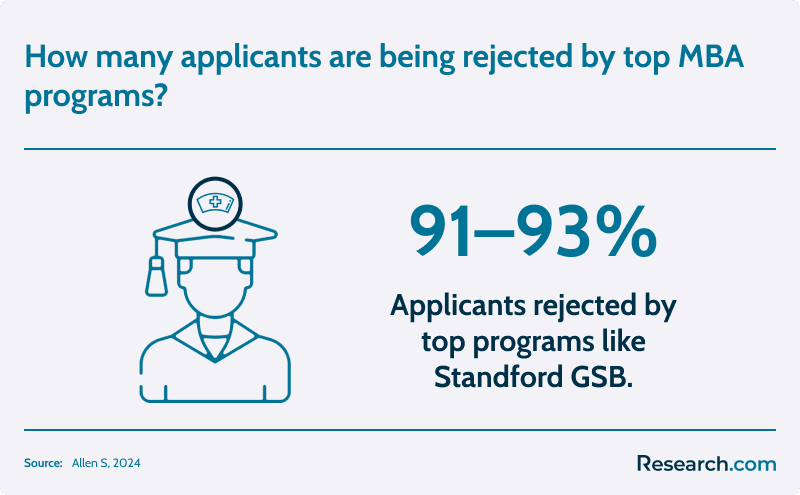
Choosing an MBA program is not only a prestige decision. It is an admissions, cost, schedule, career-fit, and return-on-investment decision. That matters because the average acceptance rate for the top 10 MBA programs in the US hovers around 15%, and over half of MBA applicants discover that they must apply to more than three schools to secure a place. For many working adults, career changers, international applicants, and cost-conscious students, a highly selective MBA is not the only practical route to a stronger business career.
This guide explains how MBA programs with high acceptance rates work, where they can lead, and how to evaluate them without relying on acceptance rate alone. You will find a ranking of high-acceptance MBA options, comparisons between online and campus formats, admissions strategies, cost and financial aid considerations, specialization guidance, and practical questions to ask before applying.
Quick Answer: Are MBA Programs With High Acceptance Rates Worth Considering?
Yes, an MBA with a high acceptance rate can be a strong option if the program is accredited, affordable, aligned with your career goals, and supported by credible faculty, career services, and alumni outcomes. A higher acceptance rate does not automatically mean lower quality. It may reflect a larger class size, an online or hybrid format, a regional recruiting market, or admissions criteria designed for working professionals.
The key is to treat acceptance rate as one data point. Before applying, compare curriculum, accreditation, total cost, employer connections, graduate outcomes, scheduling flexibility, and specialization options.
What are the benefits of getting into an MBA with a high acceptance rate?
Applying to MBA programs with higher acceptance rates can reduce admissions uncertainty while still giving students access to graduate-level business training. The main advantages include:
- More realistic admissions odds: These programs may be especially useful for applicants who do not want to build an application list made up only of highly selective schools.
- Broader career flexibility: MBA graduates can pursue roles in multiple sectors, including consulting, finance, technology, healthcare, operations, marketing, and entrepreneurship.
- Relevant employment pathways: Data from 2025 reveals graduates from such MBA programs are predominantly employed in the Consulting, Finance, and Technology sectors.
- Flexible learning formats: Many high-acceptance MBA programs offer online, hybrid, evening, or part-time options for working professionals.
- A simpler application strategy: Since over 50% of applicants apply to more than three schools, adding high-acceptance programs to your list can make your admissions plan more balanced.
What can I expect from an MBA with a high acceptance rate?
Most MBA programs with high acceptance rates still cover the standard business foundation expected from graduate management education. Students commonly study business strategy, financial accounting, managerial economics, corporate finance, organizational behavior, marketing, operations, analytics, and leadership. The difference is usually not the basic subject matter but the program’s selectivity, delivery format, class profile, cost, and career network.
Many of these programs are designed for accessibility. Some offer online courses through learning platforms that combine live sessions, discussion boards, team projects, recorded lectures, independent assignments, and applied business cases. Others use campus-based or hybrid formats that support networking, workshops, and in-person collaboration.
| What to Compare | Why It Matters | What to Look For |
| Curriculum | The MBA should build skills you can use in your target role. | Core business courses plus electives in your preferred field. |
| Format | Your schedule affects whether you can finish the program successfully. | Online, hybrid, evening, part-time, full-time, or accelerated options. |
| Accreditation | Accreditation can affect employer perception, aid eligibility, and transfer options. | Institutional accreditation and, when available, business school accreditation. |
| Career support | The value of an MBA depends heavily on post-graduation opportunities. | Career coaching, employer partnerships, internship access, alumni mentoring, and recruiting events. |
| Total cost | Tuition alone does not show the full financial commitment. | Fees, books, travel, residency costs, technology fees, and lost work time. |
Where can I work with an MBA with a high acceptance rate?
Your job options after an MBA depend more on your work history, specialization, school network, location, and career strategy than on the program’s acceptance rate alone. Common destinations include:
- Financial services: MBA graduates may pursue roles such as financial analyst, investment banker, portfolio manager, risk manager, or hedge fund manager. Quantitative analysis, corporate finance, and strategy coursework are especially relevant in this sector.
- Consulting: Management consulting firms value structured problem-solving, data analysis, communication, and leadership. MBA graduates often work on strategy, operations, organizational change, and business transformation projects.
- Technology: Tech companies hire MBAs for product management, project management, business operations, corporate strategy, partnerships, and growth roles. These positions often reward candidates who can connect technical teams with customer and business priorities.
- Entrepreneurship and small business leadership: An MBA can help founders and business owners strengthen financial planning, market analysis, operations, hiring, and growth strategy.
- Healthcare, nonprofit, and public-sector management: Graduates with industry experience may use the MBA to move into operations, administration, finance, or executive leadership roles.
Approximately 27% of MBA students are international students. That figure reflects the global appeal of the MBA credential and the international mobility it can support, although work authorization, local hiring conditions, and employer sponsorship policies vary by country.
How much can I make with an MBA?
MBA salaries differ widely by school, industry, location, prior experience, specialization, and job level. The median salary for MBA graduates is $115,000, and earnings can rise for graduates who move into senior management, executive, finance, consulting, technology, or high-growth leadership roles.
However, an MBA does not guarantee a specific salary. The best way to evaluate earnings potential is to compare a program’s career reports, alumni outcomes, regional employer connections, and salary data by concentration. Finance and Marketing are strong examples: an MBA graduate with a concentration in finance can have an annual salary of $104,000, while those specializing in marketing receive an annual salary of $99,000.
- Best MBA Programs with High Acceptance Rates for 2027
- How MBA rankings and acceptance rates are connected
- What MBA acceptance rates do not reveal
- Online versus on-campus MBA acceptance rates
- How to improve your MBA admission chances
- How tuition compares at high-acceptance MBA programs
- Financial aid options for MBA students
- Career outcomes for graduates of high-acceptance MBA programs
- Factors that influence MBA acceptance rates
- How specialization affects your MBA choice
- How leadership development improves MBA outcomes
- Why accreditation matters in an MBA program
- Extracurricular opportunities that strengthen the MBA experience
- Which MBA concentration delivers the highest salary?
- What to expect in the MBA admissions interview
- How to choose the best high-acceptance MBA
- Is a high-acceptance MBA a smart investment?
- Job market trends for MBA graduates
- Advancement opportunities with an online executive MBA
- How alumni networking improves MBA career outcomes
- Drawbacks to consider before choosing a high-acceptance MBA
- How acceptance rates vary by MBA specialization
How do we rank schools?
Research.com builds rankings from reliable education data sources, including the IPEDS database, Peterson's database, the College Scorecard database, and the National Center for Education Statistics. Our goal is to help students compare programs using transparent, decision-relevant information. For details about ranking criteria and data use, review research.com's methodology page.
Best MBA Programs with High Acceptance Rates for 2027
The following schools stand out for MBA acceptance rates that are substantially higher than the most selective business schools. Use this list as a starting point, not a final decision. After identifying programs that fit your admissions profile, compare accreditation, cost, course delivery, specializations, employer connections, and graduate outcomes.
| Rank | School and Business College | Acceptance Rate | Available Format | Best-Fit Consideration |
| 1 | Northern Arizona University - The W. A. Franke College of Business | 97% | In-campus | A strong option for students seeking a campus MBA with a very high reported acceptance rate. |
| 2 | Purdue University - Krannert School of Management | 90% | In-campus, online, hybrid | Useful for applicants who want multiple delivery choices and a business school with experiential and global learning options. |
| 3 | University of Kansas - School of Business | 89% | In-campus, online | Appropriate for students who want strategic leadership training and practical business learning. |
| 4 | University of Oklahoma - Michael F. Price College of Business | 85.5% | In-campus, online | Consider if you want a flexible MBA with practical coursework and faculty-guided business training. |
| 5 | Tulane University | 85.5% | In-campus | A fit for students seeking a full-time MBA with global business exposure and applied problem-solving. |
| 6 | University of Kentucky - Carol Martin Gatton College of Business and Economics | 84.5% | In-campus, online, hybrid | Best for students comparing multiple formats and looking for leadership and industry-focused options. |
| 7 | Appalachian State University - Walker College of Business | 84.5% | In-campus, online | A practical choice for students who value a supportive community, flexible scheduling, and experiential learning. |
| 8 | University of Oregon - Charles H. Lundquist College of Business | 83% | In-campus, online | Worth considering for students interested in entrepreneurship, innovation, and sustainable business practices. |
| 9 | Louisiana State University - E.J. Ourso College of Business | 83% | In-campus, online, hybrid | Suitable for applicants looking for business fundamentals, critical thinking, and multiple delivery options. |
| 10 | Belmont University - Jack C. Massey College of Business | 83% | In-campus, hybrid | A potential fit for students focused on entrepreneurship, leadership, and applied business preparation. |
Key Findings
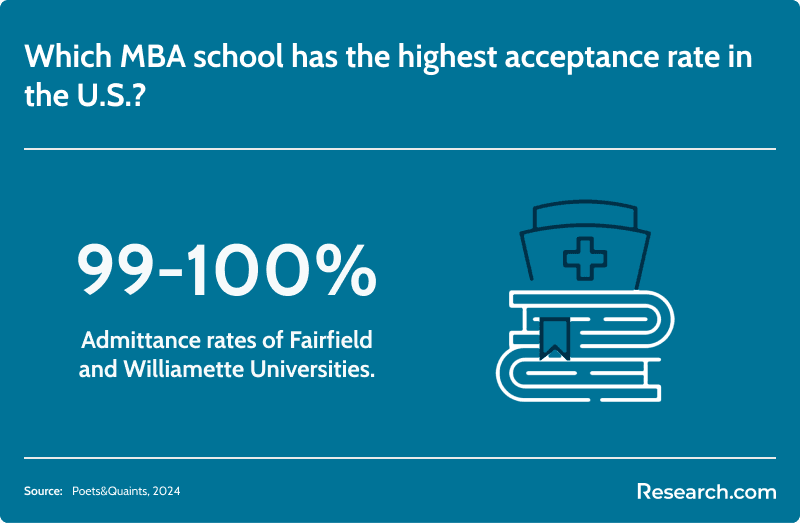
- Northern Arizona University - The W. A. Franke College of Business has the highest acceptance rate at 97%.
- Finance and Marketing top the MBA programs by median salary at $104,000 and $99,000, respectively.
- Over 50% of applicants apply to more than three schools.
- About 27% of MBA students in the U.S. are international students.
- 80% of students in the top 10 MBA programs are recipients of financial aid.
How do MBA program rankings correlate with acceptance rates?
MBA rankings and acceptance rates often move in opposite directions, but the relationship is not absolute. Highly ranked programs usually attract large applicant pools and can admit a smaller share of candidates. That selectivity can reinforce prestige, but it does not automatically mean every lower-ranked or higher-acceptance program is weak.
- Highly ranked schools often have lower acceptance rates: These programs may use strict admissions criteria and smaller cohorts to maintain selectivity.
- Higher acceptance does not always mean lower value: Some schools admit more students because they have more seats, serve working adults, offer online sections, or recruit from a specific region.
- Program mission matters: A business school may prioritize access, workforce development, part-time learners, or professional advancement instead of exclusivity.
The practical takeaway: do not use ranking or acceptance rate in isolation. A well-matched MBA with strong outcomes in your target industry may be more valuable than a famous program that does not fit your goals, budget, or schedule.
What do MBA acceptance rates not tell you?
Among the types of masters degrees, the MBA is one of the most career-driven. That makes acceptance rate useful but incomplete. A school can be easier to enter while still offering strong instruction, and a selective program can still be a poor fit for your goals.
- Academic focus: MBA programs vary by curriculum, electives, experiential learning, and industry emphasis. Some students may even compare alternatives such as MBA MSN dual degree programs online if they want business training connected to healthcare leadership. Specialization also affects outcomes: an MBA graduate with a concentration in finance can have an annual salary of $104,000, while those specializing in marketing receive an annual salary of $99,000.
- Instructional quality: Acceptance rate does not prove teaching quality. Review faculty expertise, course design, capstone requirements, employer projects, student support, and alumni feedback.
- Yield: A program may admit many applicants but enroll only a smaller share. Low yield can mean accepted students choose other schools, receive better aid elsewhere, or decide the program is not their best fit.
- Applicant profile: A high acceptance rate does not tell you whether admitted students have strong work experience, leadership backgrounds, technical skills, or clear career plans.
- Career return: The number that matters after graduation is not just acceptance rate. It is whether the MBA helps you change roles, earn promotions, strengthen management skills, or access better employers.
How do online MBA acceptance rates compare to on-campus programs?
Online MBA programs can have different acceptance patterns than campus programs because they often serve working professionals, career changers, military students, parents, and applicants who cannot relocate. Many online programs evaluate professional experience, leadership potential, and career goals alongside academic indicators.
Some online MBAs also offer test waivers or alternative admissions pathways. That can make them more accessible for applicants who have meaningful work experience but do not fit a traditional full-time MBA profile. For example, an affordable online MBA in data analytics may appeal to students who want a specialized business credential without pausing their careers.
| Format | Admissions Pattern | Best For | Potential Trade-Off |
| Online MBA | Often designed for broader applicant pools and working professionals. | Students who need schedule flexibility or cannot relocate. | Networking may require more intentional effort. |
| On-campus MBA | May be more selective, especially in full-time programs with limited seats. | Students who want in-person recruiting, campus life, and immersive networking. | May require relocation or reduced work hours. |
| Hybrid MBA | Often balances accessibility with required in-person engagement. | Students who want flexibility plus some face-to-face connection. | Travel or residency requirements can add cost. |
How to improve your chances of getting into an MBA program
More professionals have recognized the value of continuing education for skill development and career mobility. As MBA interest rises, applicants need more than a generic resume and a rushed essay. Use the steps below to build a stronger application.
- Research each target school carefully: Learn how the program defines fit, what industries it serves, and how its curriculum supports your goals. Understanding the goals of the MBA program helps you write more specific essays and prepare for interviews.
- Prepare for required exams early: If the program requires the GRE, GMAT, or EA, give yourself enough time to study, test, and retest if needed. If test waivers are available, confirm whether using one affects scholarship consideration.
- Choose recommenders who know your work: Strong recommendations come from people who can describe your leadership, judgment, teamwork, and growth. A credible professional recommendation is more persuasive than a generic note from someone with a title but little knowledge of your performance.
- Write a focused essay: Explain why you need an MBA, why now, why that school, and what you plan to do after graduation. Avoid vague claims about becoming a leader without evidence.
- Connect your experience to business impact: Applicants from major companies may have recognizable brands on their resumes, but candidates from smaller organizations can still show strong impact. For example, experience related to employment in jobs for economic majors can demonstrate analytical ability, market understanding, and quantitative reasoning.
- Apply with enough lead time: Start early so you can compare colleges with the highest acceptance rates, request transcripts, contact recommenders, revise essays, and prepare for interviews without rushing.
How do tuition fees for MBA programs with high acceptance rates compare to other programs?
MBA programs with high acceptance rates are often positioned as more accessible options, but affordability varies. Some public universities, regional programs, and online MBAs may cost less than highly selective private programs. Still, total price depends on residency, format, fees, length, travel, and whether you continue working while enrolled.
- Tuition may be more manageable: Some high-acceptance MBA programs are designed to reach a wider student population and may have lower tuition than elite, highly selective programs.
- Prestige can affect price: More competitive programs sometimes charge premium tuition connected to brand recognition, recruiting access, and alumni network strength.
- Financial aid still matters: A lower tuition program is not automatically the least expensive after scholarships, employer support, grants, and loan terms are included.
| Cost Factor | Why Students Miss It | Question to Ask |
| Program fees | Published tuition may exclude technology, student services, or course fees. | What is the total estimated cost from enrollment to graduation? |
| Residency requirements | Hybrid and online programs may still require travel. | Are campus visits required, and who pays for travel and lodging? |
| Pace of study | Part-time study can spread costs out but extend time to completion. | How does full-time, part-time, or accelerated enrollment affect total cost? |
| Work interruption | Leaving work can increase opportunity cost. | Can I keep earning while enrolled? |
| Employer benefits | Some students forget to ask about tuition assistance. | Does my employer reimburse graduate business education? |
What are the financial aid options for students enrolling in an MBA with a high acceptance rate?
Financial aid can make a major difference in MBA return on investment. In fact, 80% of students in the top 10 MBA programs are recipients of financial aid. Students considering high-acceptance MBA programs should compare aid packages rather than assuming the school with the lowest sticker price is automatically the best deal.
- Scholarships: Schools and outside organizations may offer merit-based, need-based, demographic, industry, or leadership scholarships.
- Fellowships: Competitive fellowships can reduce tuition and may include research, teaching, mentorship, or leadership opportunities. Examples include the Stanford Reliance Dhirubhai Fellowship, Harvard University's Boustany MBA Scholarship, and INSEAD's Pot Family Foundation Fellowship.
- Grants: Grants are typically need-based funds that do not need to be repaid.
- Student employment and internships: Assistantships, campus work, internships, or employer-sponsored projects can help offset costs while building experience.
- Loans: Loans can fill funding gaps, but students should model repayment before borrowing and compare expected post-MBA income carefully.
What are the typical career outcomes for graduates of MBA programs with high acceptance rates?
Graduates of MBA programs with high acceptance rates can move into many of the same broad career categories as other MBA graduates, especially when they pair the degree with relevant work experience and a clear job-search strategy.
- Management and executive roles: MBA graduates may pursue positions such as general manager, operations leader, director, CFO, CEO, or business unit leader, depending on experience.
- Management consulting: Consulting roles use MBA skills in strategy, process improvement, financial analysis, organizational design, and client communication.
- Entrepreneurship: Students interested in launching or growing a business can use MBA coursework to strengthen planning, finance, marketing, and operations.
- Finance roles: Common paths include financial manager, investment banker, financial analyst, risk manager, and corporate finance professional.
- Marketing and sales leadership: Graduates may pursue brand management, marketing analytics, product marketing, sales strategy, or sales director roles.
Since over 50% of MBA applicants apply to more than three schools, high-acceptance programs can help applicants expand their realistic options. The degree’s career value, however, depends on how well students use the curriculum, network, internships, career services, and alumni relationships.
Finance and Marketing are the top MBA programs by median salary, in general:
Factors that Influence the Highest Acceptance Rate Colleges
MBA acceptance rates are shaped by more than applicant quality. Class size, school reputation, program format, admissions criteria, and the type of students a program serves can all change selectivity.
Number of applications
Application volume has a direct effect on acceptance rates. According to the Association to Advance Collegiate Schools of Business (AACSB), MBA enrollment increased by 6.7% from previous years to 2024. When more students apply to a program without a matching increase in seats, admissions can become more competitive.
Some online MBA programs receive especially strong interest because they allow students to study without relocating or leaving full-time employment. That flexibility can increase application volume.
Reputation
Well-known MBA brands often attract more applicants than they can admit. Ivy League and globally recognized business schools usually post lower acceptance rates because demand is high. The lowest acceptance rate 2017 was from Stanford University at 6%. It increased to 8.9% in 2020 but still remains the most competitive MBA program.
Reputation is important, but it should not be the only measure of quality. Students should still examine curriculum, faculty, accreditation, career outcomes, and employer access.
Admission requirements
Some schools require a minimum GPA, test scores, essays, recommendations, interviews, and specific work experience. Others use more flexible criteria, especially for working professionals. Applicants comparing schools for the MBA with best ROI should review admissions requirements and the expected student profile before investing time and application fees.
Career goals
Programs may admit students whose goals match the school’s strengths. For example, an applicant seeking a higher finance major salary may be a stronger fit for a school with finance electives, investment clubs, and corporate finance recruiting than for a program focused mainly on entrepreneurship or public-sector management.
What role does specialization play in choosing an MBA with a high acceptance rate?
Specialization can matter more than acceptance rate if you are using the MBA to enter a specific field. A general MBA builds broad business ability, while a specialized MBA adds targeted coursework in areas such as finance, healthcare management, entrepreneurship, analytics, accounting, technology, or leadership.
For example, an MBA in accounting can support professionals who want deeper training in financial strategy, compliance, auditing, and corporate reporting. This may be more valuable for accounting, consulting, or finance roles than a general MBA with limited accounting coursework.
| Choose This MBA Type | When It Makes Sense | When to Be Careful |
| General MBA | You want broad management training or are not locked into one industry. | You may need additional electives or certificates for specialized roles. |
| Specialized MBA | You already know your target field and want a focused curriculum. | A narrow specialization may limit flexibility if your goals change. |
| Executive MBA | You have significant professional experience and want senior leadership preparation. | It may be less useful for early-career applicants. |
| Online MBA | You need flexibility while working or managing family responsibilities. | You must be proactive about networking and career engagement. |
How does targeted leadership development enhance MBA outcomes?
Leadership development helps turn MBA coursework into workplace performance. Strong programs do not simply teach finance, marketing, and strategy in isolation; they also train students to manage teams, make decisions under uncertainty, communicate with stakeholders, and lead change.
Look for leadership labs, simulations, coaching, executive mentorship, team-based projects, and applied consulting assignments. Students who want a flexible path focused on leadership may also compare MBA leadership online programs.
How does accreditation impact the quality of an MBA program?
Accreditation is one of the most important quality checks for an MBA. It signals that a school or program has been reviewed against recognized academic standards. Accreditation may also affect financial aid eligibility, credit transfer, employer confidence, and future educational options.
Before enrolling, confirm institutional accreditation and review any business-specific accreditation the school holds. If affordability is a priority, compare accredited options such as the most affordable online MBA programs rather than choosing solely by tuition or acceptance rate.
What extracurricular opportunities can enhance your MBA experience?
Extracurricular activities can improve the value of an MBA by helping students build networks, demonstrate leadership, and apply classroom concepts in real business settings. This is especially important in online or high-acceptance programs, where students may need to be more intentional about visibility and relationship-building.
- MBA clubs and associations: Finance, marketing, entrepreneurship, consulting, analytics, and industry clubs can connect students with speakers, peers, and alumni.
- Case competitions: Business case competitions help students practice strategy, analysis, presentation, and teamwork under time pressure.
- Leadership roles: Leading a student organization, committee, or project can strengthen management experience and provide resume evidence.
- Volunteering and nonprofit consulting: Community projects can build leadership, empathy, stakeholder communication, and operational problem-solving skills.
- Networking events: Alumni gatherings, employer panels, conferences, and industry meetups can lead to mentorship, referrals, and job leads.
Which MBA Concentration Delivers the Highest Salary?
MBA salary varies by concentration, employer, geography, prior experience, and role. Finance and Marketing are the top MBA programs by median salary at $104,000 and $99,000, respectively. Students comparing concentrations should look beyond averages and examine whether the specialization matches their background and target industry.
For a deeper comparison of salary outcomes by field, review Research.com's guide to which MBA field has the highest salary.
What should you expect during the MBA admissions interview?
MBA interviews usually test fit, maturity, communication, motivation, and leadership potential. High-acceptance programs may be less selective than elite schools, but applicants should still prepare carefully.
Expect questions about your work history, career goals, leadership examples, failures, teamwork, ethical judgment, and reasons for choosing that program. Use specific examples rather than broad claims. If you are applying to a specialized track, connect your goals to the curriculum. Students considering healthcare leadership options may also compare cheap online MBA healthcare management programs before interviewing.
How to choose the best MBA with a high acceptance rate?
The best high-acceptance MBA is not simply the easiest one to enter. It is the program that fits your goals, budget, schedule, and career market. Use the following decision points before applying.
- Clarify your career goal: Decide whether you want promotion, career change, entrepreneurship, industry specialization, or executive advancement. Without a clear reason, an MBA can become an expensive credential with unclear payoff.
- Choose the right program type: Ask whether you need a general MBA, specialized MBA, online MBA, part-time MBA, or executive MBA. If you are unsure, start by learning what is executive MBA programs and how they differ from traditional formats.
- Check schedule and delivery: Compare full-time, part-time, online, hybrid, and campus formats. Students in healthcare or nursing leadership may also compare MBA MSN dual degree programs online if a dual credential better supports their goals.
- Review admissions requirements: Confirm GPA expectations, test policies, work experience requirements, interviews, recommendations, prerequisites, and deadlines.
- Calculate total cost: Do not assume the most expensive MBA produces the best return. Compare tuition, fees, aid, employer support, loan repayment, and opportunity cost.
- Verify accreditation: Confirm institutional accreditation and any business-specific accreditation before applying.
- Evaluate career services: Ask about coaching, employer events, internships, alumni access, job placement support, and outcomes by concentration.
| Common Mistake | Why It Can Hurt You | Better Approach |
| Choosing only by acceptance rate | You may enter a program that does not match your career goals. | Compare fit, curriculum, accreditation, cost, and outcomes together. |
| Looking only at tuition | Fees, travel, books, and lost income can change the true cost. | Request a full cost-of-attendance estimate. |
| Ignoring accreditation | Employer recognition, aid eligibility, and transfer options may be affected. | Verify accreditation before applying. |
| Assuming online means easier | Online programs still require discipline, writing, teamwork, and time management. | Ask about weekly workload and support services. |
| Relying only on rankings | A highly ranked school may not be affordable or aligned with your target industry. | Use rankings as one input, not the final answer. |
| Expecting salary guarantees | MBA earnings depend on experience, industry, location, and job search execution. | Review career reports and speak with alumni in your field. |
Is a high acceptance rate MBA a smart investment?
A high-acceptance MBA can be a smart investment when it improves your career options at a cost and pace you can justify. It may be especially attractive if you can keep working while enrolled, receive employer tuition support, earn scholarships, or choose an accelerated format such as a one year MBA online.
To assess return on investment, compare expected benefits against total cost. Consider salary potential, promotion access, career change probability, network quality, time to completion, loan repayment, and whether the curriculum builds skills employers actually value. The right question is not “Is this MBA selective?” but “Will this MBA help me reach my next realistic career step?”
What is the job market for graduates with an MBA with a high acceptance rate?
The job market for MBA graduates is shaped by industry cycles, employer needs, technology, and economic conditions. The acceptance rate of the MBA program, including an online masters degree in management, may influence brand perception, but it does not determine career success by itself.
- Finance: As observed by Bloomberg, the finance sector, particularly Private Equity, had a challenging start in 2023. MBA graduates targeting finance should build strong analytical, valuation, risk, and networking skills.
- Technology: Job prospects in the technology industry saw an underwhelming period, but opportunities in mid-sized tech companies like Adobe persisted. Product, operations, analytics, and strategy roles remain relevant paths for business-trained professionals.
- Human resources: Human resource leadership remains important across organizations, especially as companies manage talent, restructuring, culture, compliance, and organizational change.
- AI and analytics: AI and data analytics advancements have become significant drivers of opportunity in the business landscape. MBA students should expect employers to value data literacy, automation awareness, and strategic use of AI tools.
- Sustainability: Business interest in sustainability and climate responsibility is creating new roles across sectors. Students interested in this area should look for coursework in ESG, supply chain, energy, risk, and sustainable finance.
What are the opportunities for advancement with an online executive MBA?
An online executive MBA can support advancement for experienced professionals who want leadership training without leaving their jobs. These programs often focus on strategy, finance, marketing, organizational leadership, and executive decision-making. Because students usually continue working, they can apply lessons immediately to workplace challenges.
If cost is a major concern, compare online executive MBA programs and ask whether the format, cohort model, faculty access, and alumni network match your advancement goals.
How does alumni networking enhance your MBA career outcomes?
Alumni networks can influence career outcomes through mentorship, referrals, industry advice, informational interviews, and access to roles that may not be publicly posted. A program with a high acceptance rate can still be valuable if its alumni community is active and connected to your target market.
When comparing programs, ask how alumni engage with current students, whether the school hosts industry events, and whether graduates are working in your preferred field. Students seeking affordability and recognized business accreditation may also compare the cheapest AACSB online MBA options.
Are there any drawbacks to choosing an MBA with a high acceptance rate?
There can be trade-offs. Some high-acceptance MBA programs may have less selective peer groups, fewer elite recruiting pipelines, smaller alumni networks, or less brand recognition in national markets. Others may be excellent regional or online options but less powerful for students targeting highly competitive consulting, investment banking, or executive-track roles.
The solution is not to avoid high-acceptance programs. It is to evaluate them carefully. If your goal is a targeted operational or project leadership role, a focused credential such as an affordable project manager degree online may even be more efficient than a general MBA.
How do acceptance rates differ between MBA specializations?
Acceptance rates can vary by MBA type and specialization because applicant pools differ. Some tracks attract broad interest, while others require relevant experience, technical skills, or leadership history.
- General MBA programs: These often admit a wider range of applicants because they serve students from many academic and professional backgrounds.
- Specialized MBA programs: Finance, data analytics, entrepreneurship, and similar tracks may be more competitive when they attract applicants with strong quantitative skills or direct industry experience.
- Executive MBA programs: EMBA admissions often emphasize professional accomplishments, leadership history, and management experience.
- Online and hybrid programs: These formats may have higher acceptance rates because they can serve larger or more diverse applicant pools, although competitiveness still depends on school reputation.
- One-year MBA programs: One year MBA programs can be more selective because their accelerated pace favors motivated applicants with relevant preparation and clear goals.
Key Insights
- A high MBA acceptance rate can improve your admissions odds, but it should never be the only reason you choose a program.
- The best high-acceptance MBA is accredited, affordable, career-aligned, and supported by meaningful faculty access, alumni engagement, and career services.
- Online and hybrid MBAs can be practical for working adults, but students must be intentional about networking, employer engagement, and time management.
- Specialization matters. Finance, marketing, accounting, analytics, healthcare, leadership, and executive tracks can lead to different career paths and salary outcomes.
- Total cost includes more than tuition. Include fees, travel, books, lost income, loan repayment, and the value of employer or scholarship support.
- An MBA does not guarantee a salary or promotion. The return depends on your experience, target industry, school network, location, and how actively you use the program.
References:
- Allen, S. (2024, April 17). Acceptance rates at the top 100 U.S. MBA programs. Poets&Quants. https://poetsandquants.com/2024/04/17/acceptance-rates-at-the-top-100-u-s-mba-programs/
- Association to Advance Collegiate Schools of Business. (2024). 2024 State of Accreditation Report. https://www.aacsb.edu/insights/reports/2024-state-of-accreditation-report
- Ethier, M. (2024, December 22). 2025 OMBA ranking: Acceptance rates at the top online MBA programs. Poets&Quants. https://poetsandquantsforexecs.com/news/2025-omba-ranking-acceptance-rates-at-the-top-online-mba-programs/
- Graduate Management Admission Council. (2025). Corporate Recruiters Survey 2025. GMAC. https://www.gmac.com/survey-research/corporate-recruiters-survey
- MIT Sloan. (2024). MBA program statistics. Retrieved from https://mitsloan.mit.edu/mba/admissions/mba-class-profile
- U.S. Bureau of Labor Statistics. (2025, August 28). Management occupations. Occupational Outlook Handbook. https://www.bls.gov/ooh/management/home.htm
Other Things You Should Know About MBAs with a High Acceptance Rate
In 2027, acceptance rates for top MBA programs are slightly more competitive compared to previous years, reflecting increased demand and improved program offerings. Notable universities have shown a trend toward lower acceptance rates, emphasizing the importance of strong applicant profiles and diversified experience.
In 2027, MBA programs with the highest acceptance rates were often found at universities with larger class sizes and regional schools. For example, the regional University of XYZ reported an acceptance rate of nearly 65%, making it among the most accessible options.
Round 1 usually has the highest MBA acceptance rate because schools have the most seats available and the strongest chance to shape the class early. Many top U.S. MBA programs also use three rounds, with Round 2 often the most crowded and selective.
Work experience significantly impacts MBA acceptance rates in 2027, with many top programs preferring candidates with 3 to 5 years of professional experience. This preference is due to the value of practical skills and leadership potential that experienced candidates bring to the program.


