
2027 Most Affordable Online Master's in Instructional Design Programs

Co-Founder and Chief Data Scientist
An online master’s in instructional design can be a practical next step if you want to move from teaching, training, curriculum work, HR, media production, or educational technology into higher-level learning design roles. The degree focuses on how people learn, how to build effective digital and blended learning experiences, and how to measure whether training or coursework actually improves performance.
This guide is for working educators, corporate trainers, career changers, and learning professionals comparing affordable online instructional design master’s programs for 2026 planning. You will learn what these programs include, how long they take, what they cost, which schools offer strong value, how online study compares with campus study, and how to judge whether the degree makes financial and career sense for your goals.
Quick answer: Is an affordable online master’s in instructional design worth considering?
Yes, an affordable online master’s in instructional design can be worth it when the program is accredited, portfolio-focused, reasonably priced, and aligned with the sector you want to enter. The degree is most useful for learners targeting instructional designer, learning experience designer, curriculum specialist, e-learning developer, training specialist, instructional coordinator, or learning and development manager roles.
| Question | Short answer |
| Typical length | Most programs require 30–36 credits and take 18–24 months, though some accelerated options can be completed faster. |
| Common format | Online programs usually combine asynchronous coursework, design projects, occasional live sessions, and a final portfolio or capstone. |
| Best fit | Working professionals who want to build learning design, e-learning, analytics, and training strategy skills without relocating. |
| Career value | The degree can support roles in education, corporate learning, government, healthcare, EdTech, consulting, and nonprofit training. |
| Main caution | Do not choose by tuition alone. Check accreditation, portfolio requirements, technology training, transfer policies, and career support. |
Why choose an affordable online master’s in instructional design?
- Strong career flexibility: Graduates can work in higher education, K–12 support, corporate training, learning analytics, e-learning development, EdTech product teams, consulting, and management.
- Competitive earning potential: Instructional design-related roles can begin near $70,000 and may reach six figures as professionals move into senior design, technology, consulting, or leadership positions.
- Employer preference for advanced preparation: Many instructional design and learning leadership roles favor candidates with graduate-level training, especially when applicants can show a strong portfolio.
- Online delivery matches the work itself: Studying online helps students practice the same remote collaboration, learning management system, multimedia, and learner-support skills used in modern instructional design jobs.
What can I expect from an Affordable Online Master's in Instructional Design?
An online master’s in instructional design teaches you to analyze learning problems, design effective instruction, build digital learning products, evaluate learner outcomes, and improve training or curriculum based on evidence. Most programs are designed for adults who are working full time, so coursework is often asynchronous with scheduled live discussions, design critiques, or group meetings.
Most online instructional design master’s programs include 30–36 credits and can be finished in 18–24 months. Accelerated programs may move faster, while part-time cohort programs may give students more time to balance work, family, and coursework.
| Program component | What it usually covers | Why it matters |
| Learning theory and design models | Frameworks such as ADDIE, SAM, cognitive science, constructivism, and adult learning theory. | These models help designers choose strategies based on how learners process, retain, and apply information. |
| Instructional technology | Authoring tools, learning management systems, multimedia development, accessibility, and interactive content. | Employers expect graduates to build usable digital learning assets, not just write lesson plans. |
| Needs analysis and assessment | Performance gaps, learner profiles, stakeholder interviews, objectives, and assessment design. | Good instructional designers solve the right problem before building a course or training module. |
| Learning analytics and evaluation | Data collection, outcome measurement, dashboards, surveys, and program improvement. | Organizations increasingly want evidence that learning programs improve performance. |
| Studio projects and capstone | Client-based projects, prototypes, revisions, portfolio artifacts, and final presentations. | A portfolio often matters as much as the degree when applying for instructional design jobs. |
| Specializations or certificates | K–12, higher education, corporate learning, e-learning, technology leadership, or performance improvement. | Focused coursework can help you signal the industry or learner audience you want to serve. |
Plan for about 12–15 hours of weekly work in a standard part-time format. Accelerated programs can require a heavier weekly commitment because readings, tool practice, group work, and project deadlines are compressed into shorter terms.
Where can I work with an Online Master's in Instructional Design?
Instructional design is used wherever organizations need people to learn new skills, follow procedures, adopt technology, meet compliance expectations, or improve performance. Because the core methods apply across settings, graduates can move between education, business, public service, and consulting over time.
- Corporate learning and development: Companies in technology, finance, healthcare, manufacturing, retail, and professional services hire instructional designers, learning experience designers, and training managers to build employee upskilling, onboarding, compliance, and software training programs.
- Higher education and K–12 support: Colleges, universities, community colleges, school districts, and virtual schools use instructional designers and instructional coordinators to support online courses, faculty development, curriculum quality, LMS administration, and standards alignment.
- EdTech and e-learning companies: Educational software providers, course platforms, publishers, and learning vendors hire curriculum strategists, learning UX designers, content developers, and product-focused learning specialists.
- Government and military training: Public agencies, federal employers, and military training units need designers who can create secure, competency-based, scalable training for complex systems and procedures.
- Healthcare and life sciences: Hospitals, insurers, pharmaceutical companies, and clinical training teams rely on instructional design for patient education, staff onboarding, regulatory training, and continuing education.
- Consulting, nonprofits, and freelance work: Experienced designers may support grant-funded initiatives, workforce development projects, global training programs, change management efforts, or short-term e-learning builds for multiple clients.
Remote and hybrid work are common in this field, especially for digital course design, LMS support, e-learning development, and corporate training projects. However, some roles still require on-site collaboration with faculty, subject-matter experts, trainers, or operational teams.
How much can I make with an Online Master's in Instructional Design?
Salaries depend on role, sector, location, seniority, technical skill, and portfolio strength. Corporate, technology, healthcare, analytics, and management roles often pay more than entry-level education support positions, but education-sector roles may offer stability, mission alignment, and advancement into curriculum or technology leadership.
| Role | Salary information stated in available sources | Typical direction of advancement |
| Instructional designer or instructional technologist | Average total pay of $83,000–$97,000, with corporate specialists often near the higher end. | Senior instructional designer, learning experience lead, learning strategist, consultant. |
| Training and development specialist | Median wage of $65,850, with the top 10% earning more than $105,000. | Training lead, learning consultant, training and development manager. |
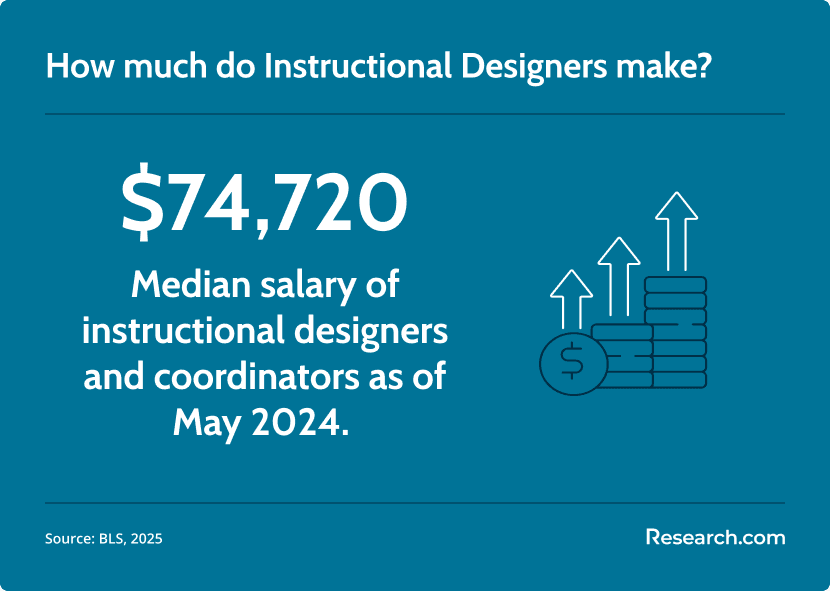
| Instructional coordinator | Median earnings of $74,720, with high earners exceeding $115,000. | Curriculum director, academic technology leader, district or institutional learning leader. |
| E-learning developer | Typical salary band of $82,000–$106,000. | Senior e-learning developer, learning technologist, multimedia learning lead. |
| Training and development manager | Median pay of $127,090, with compensation topping $220,000 in large enterprises. | Director of learning and development, talent development executive, organizational learning leader. |
The degree alone does not guarantee a specific salary. Your earning power improves when you can show strong project samples, authoring tool proficiency, needs-analysis skill, learning analytics experience, stakeholder communication, and evidence that your work improved measurable outcomes.
- Affordable Online Master’s in Instructional Design Programs for 2027
- How long does it take to complete an Online Master's in Instructional Design?
- How does an Online Master's in Instructional Design program compare to an on-campus program?
- What is the average cost of an Affordable Online Master's in Instructional Design program?
- What are the financial aid options for students enrolling in an Online Master's in Instructional Design program?
- What are the prerequisites for enrolling in an Online Master's in Instructional Design program?
- What courses are typically in an Online Master's in Instructional Design program?
- What types of specializations are available in Online Master's in Instructional Design programs?
- How to choose the best Affordable Online Master's in Instructional Design program?
- What trends are changing online instructional design?
- What career paths are available for graduates of Online Master's in Instructional Design programs?
- Is the return on investment justifiable for an online master's in instructional design?
- What is the job market for graduates with an Online Master's in Instructional Design?
- Should I consider an accelerated doctoral path after my online master's in instructional design?
- How can online programs support networking and career advancement?
- How does accreditation affect the quality and recognition of an online master's in instructional design?
Affordable Online Master’s in Instructional Design Programs for 2027
How do we rank schools?
The right instructional design program depends on your budget, timeline, career sector, and need for portfolio support. This list focuses on measurable criteria that help students compare programs more clearly, including total credits, delivery format, cost per credit, specialization options, applied project work, accreditation, and fit for working adults. You can review our methodology for more detail on how Research.com evaluates programs.
Program information is grounded in reputable education data sources, including the Integrated Postsecondary Education Data System (IPEDS), Peterson’s Distance Learning database, the U.S. Department of Education’s College Scorecard, and the National Center for Education Statistics (NCES).
1. Baylor University
Baylor University offers an online Master of Science in Learning Design and Technology through its School of Education. The program combines learning science, technology labs, design practice, and portfolio development for students interested in K–12, higher education, and workplace learning environments. The 30-credit curriculum uses seven-week courses on a trimester calendar, along with 15-week Technology Labs that give students applied experience with emerging learning tools. Students can pursue an accelerated schedule and complete the program in as few as twelve months.
- Program Length: Accelerated 12-month option with part-time schedules available
- Tracks/concentrations: Generalist degree featuring 3 Technology Labs and an embedded Certificate in Online Teaching and Learning
- Cost per Credit: $1,150 for the 2025-26 academic year
- Required Credits to Graduate: 30
- Accreditation: Southern Association of Colleges and Schools Commission on Colleges (SACSCOC)
2. California State University-Fullerton
California State University-Fullerton offers a fully online M.S. in Instructional Design and Technology built around a cohort structure. Students move through ten sequenced courses together, which can be helpful for learners who want peer support while still studying asynchronously. The five-semester plan includes two stackable Instructional Design Certificates, a practicum, research symposia, and a final applied project. The structure is especially appealing for working professionals who want a predictable part-time pace.
- Program Length: Five semesters, or about 21 months, in a part-time cohort
- Tracks/concentrations: Generalist curriculum with embedded Instructional Design Certificates Level I and II
- Cost per Credit: Approximately $484 in-state graduate tuition per unit, plus a $33 online distance fee (2024-25)
- Required Credits to Graduate: 30 units, or 10 courses
- Accreditation: WASC Senior College and University Commission (WSCUC)
3. Georgetown University
Georgetown University offers an online Master of Arts in Learning, Design, and Technology that blends learning science, analytics, design studio work, and technology innovation. The 30-credit degree includes five core courses, electives in areas such as analytics and technology prototyping, and a research-based capstone for a real client. The program is STEM-eligible, which can matter for international students seeking extended Optional Practical Training options.
- Program Length: 18–24 months full time; up to 3 years allowed for part time
- Tracks/concentrations: Elective clusters in Learning Analytics, Technology Innovation, Higher Education Leadership, and Learning Design
- Cost per Credit: $2,098 for cohorts beginning Summer 2025
- Required Credits to Graduate: 30
- Accreditation: Middle States Commission on Higher Education (MSCHE)
4. Grand Canyon University
Grand Canyon University offers a 32-credit Master of Science in Instructional Design through six-week online courses. The curriculum connects learning theory with practical technology work, including projects in Adobe Captivate, and concludes with a research-based capstone. The program is framed by the university’s Christian worldview and may be useful for teachers, trainers, and career changers who want a flexible non-licensure graduate pathway.
- Program Length: Approximately 18 – 24 months with six-week courses
- Tracks/concentrations: No formal tracks, generalist curriculum emphasizing technology integration
- Cost per Credit: $615 (2025 online graduate rate)
- Required Credits to Graduate: 32
- Accreditation: Institutionally accredited by the Higher Learning Commission (HLC)
5. Indiana University
Indiana University offers an online Master of Science in Education in Instructional Systems Technology. The 36-credit program is research-oriented but also includes studio projects, a client-based capstone, and an e-portfolio. Students complete 15 credits of IST core coursework, 12 credits of specialization electives, and 9 credits outside the major. The program can also allow students to stack a Graduate Certificate in Online Teaching and Learning Practices without adding time or cost. The School of Education’s online master’s suite recently earned the number three national ranking from U.S. News for overall quality.
- Program Length: Typical completion in about two years of part-time study
- Tracks/concentrations: Flexible IST electives. There is an option to embed certificates such as Online Teaching and Learning Practices or Instructional Systems Technology
- Cost per Credit: $500.36 Indiana resident; $600.43 non-resident, plus $39 distance fee (2024-25)
- Required Credits to Graduate: 36
- Accreditation: HLC
6. Loyola University Chicago
Loyola University Chicago offers a fully online Master of Professional Studies in Instructional Design. The program uses eight-week courses with evening synchronous meetings, making it a better fit for students who want live interaction while remaining online. Full-time students can finish the 10-course, 30-credit sequence in about 1.5 academic years, while part-time students can take about 2.5 years. Students may also complete Loyola’s Foundations and Professional Certificates in Instructional Design during the degree.
- Program Length: Approximately 18 months full time or 2.5 years part time
- Tracks/concentrations: Generalist curriculum with optional stackable Foundations and Professional Certificates in Instructional Design
- Cost per Credit: $825 (2024–25 academic year)
- Required Credits to Graduate: 30
- Accreditation: HLC
7. University of Central Florida
University of Central Florida offers a fully online Master of Arts in Instructional Design and Technology. Students choose from three tracks: e-Learning, Educational Technology, and Instructional Systems. The 36-credit program uses half-semester courses, includes a client-focused practicum, and ends with an e-portfolio capstone. Students may also add one of four graduate certificates without increasing the required 36-credit load.
- Program Length: About 2 years, with accelerated full-time options available
- Tracks/concentrations: e-Learning, Educational Technology, Instructional Systems
- Cost per Credit: $327.32 in-state; $1,151.72 out-of-state (2025)
- Required Credits to Graduate: 36
- Accreditation: SACSCOC
8. University of Georgia Online
University of Georgia offers an online M.Ed. in Learning, Design, and Technology with an emphasis in Instructional Design & Development. The 36-credit cohort program can be completed in two years when students follow the recommended sequence. Coursework covers needs assessment, evaluation, media production, and applied design. Students complete a scaffolded practicum and build a professional portfolio. The program is ranked third nationally for online instructional media design and uses a flat e-rate for all students.
- Program Length: 2 years, if the recommended course sequence is followed
- Tracks/concentrations: Area of Emphasis in Instructional Design and Development, with options to stack graduate certificates
- Cost per Credit: $629 (2024 e-tuition), regardless of residency
- Required Credits to Graduate: 36 semester hours
- Accreditation: SACSCOC
9. University of West Florida
University of West Florida offers a fully online M.Ed. in Instructional Design and Performance Technology. The program combines instructional technology with human performance improvement and includes three built-in graduate certificates: Current and Emerging Instructional Technology, Human Performance Improvement, and Online Teaching and Learning. Students complete a field-based capstone and develop a portfolio tied to corporate, education, and military training settings.
- Program Length: Estimated 24 months with 16-week courses
- Tracks/concentrations: Focus areas align with certificates in Current and Emerging Instructional Technology, Human Performance Improvement, and Online Teaching and Learning
- Cost per Credit: $384.60 in state, $478.83 for non-residents with waiver (2025 rate)
- Required Credits to Graduate: 36
- Accreditation: SACSCOC
10. Western Governors University
Western Governors University offers an M.Ed. in Education Technology and Instructional Design through a competency-based model. Students progress when they demonstrate mastery of course outcomes, which can shorten the timeline for self-directed learners. The curriculum includes twelve courses aligned with International Society for Technology in Education (ISTE) and Association for Talent Development (ATD) standards. Students can choose a K-12 Pathway, an Adult Learner Pathway, or complete both. The program includes monthly start dates, a program mentor, a design-based research capstone, and a portfolio.
- Program Length: Most students finish in 10–18 months, depending on term pace
- Tracks/concentrations: K-12 Pathway, Adult Learner Pathway, with an option to complete both
- Cost per Credit: $4,125 per six-month term, or roughly $275 per credit when completed in two terms
- Required Credits to Graduate: Twelve courses, equivalent to about 30 graduate credits
- Accreditation: Northwest Commission on Colleges and Universities (NWCCU)
How long does it take to complete an Online Master's in Instructional Design?
An online master’s in instructional design usually takes less time than many doctoral routes, such as the longer pathways discussed in EdD vs PhD comparisons. Most students finish in one to two years, depending on the number of credits, term length, transfer policy, and whether the program is cohort-based or self-paced.
| Pacing option | Typical timeline | Best for | Trade-off |
| Accelerated or competency-based | 10–12 months in some programs | Highly self-directed students with strong time availability and relevant experience. | Fast completion can mean heavier weekly workload and less time to polish portfolio projects. |
| Standard full-time | 15–20 months | Students who want steady progress without stretching the degree over several years. | May be demanding for learners working full time. |
| Part-time cohort | 24 months or more | Working adults who value structure, peer relationships, and predictable course sequencing. | Less flexibility to skip ahead or change pace. |
| Transfer-credit pathway | Potentially shorter by one semester | Students with previous graduate coursework or relevant certificates. | Transfer rules vary, and not all credits will apply. |
- Accelerated cohorts: Western Governors University reports that 62% of graduates finish in about 10 months, while Baylor University - Online School of Education offers a 12-month track in its 30-credit Learning Design and Technology program.
- Compressed course formats: Programs using six- or eight-week courses can help students move quickly, but the reading, design work, and peer collaboration may be intense.
- Two-year designs: Programs such as the University of Georgia’s recommended sequence can be more manageable for students balancing full-time employment.
- Stackable certificates: Built-in certificates, such as University of West Florida’s triple-certificate structure, can add transcript value without extending the program.
Before choosing the fastest option, estimate your weekly study time honestly. A rushed program can be a poor investment if you finish with a weak portfolio or limited tool proficiency.
How does an Online Master's in Instructional Design program compare to an on-campus program?
For many universities, online and campus students complete comparable coursework, use the same learning outcomes, and earn the same degree title. The better question is not whether online is automatically weaker or stronger; it is which format fits your learning style, schedule, networking needs, and career goals.
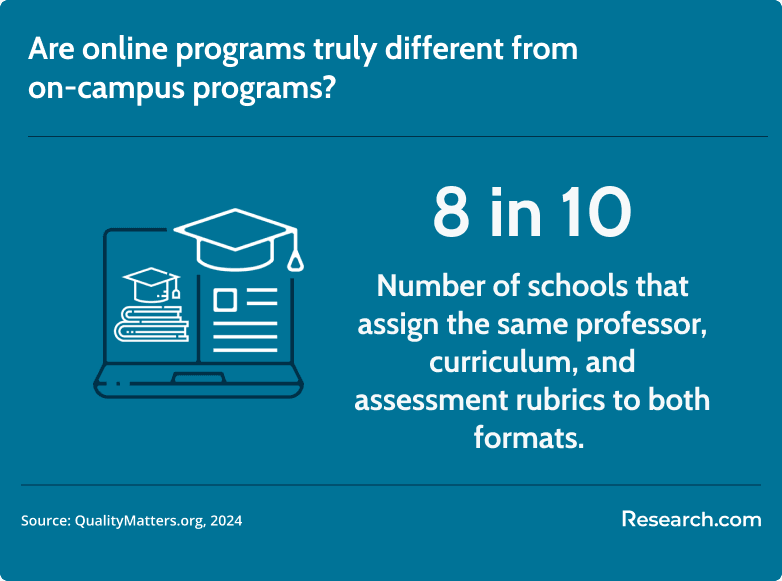
The Changing Landscape of Online Education Project (CHLOE) 9 survey in 2024 found that close to 8 in 10 institutions use identical faculty, syllabi, and assessment rubrics across online and campus formats, supporting curricular consistency when programs are well designed.
| Factor | Online master’s in instructional design | On-campus master’s in instructional design |
| Flexibility | Often better for full-time workers because courses may be asynchronous or offered in shorter blocks. | Usually requires commuting, relocation, or attendance at scheduled class times. |
| Learning environment | Builds comfort with LMS tools, remote collaboration, discussion boards, video meetings, and digital workflows. | Provides in-person access to studios, campus labs, faculty offices, and informal peer interaction. |
| Networking | Depends on live sessions, group projects, alumni communities, virtual events, and proactive outreach. | May make spontaneous networking easier through campus events and face-to-face collaboration. |
| Cost | May reduce commuting, relocation, and some campus fees, though tuition may be similar. | May offer more access to in-person graduate assistantships or physical resources. |
| Career relevance | Strong fit for remote instructional design, online learning, and hybrid workplace roles. | Strong fit for students who want campus-based research, assistantships, or local employer connections. |
In 2023, more than half of U.S. postsecondary students took at least one distance course, showing that online learning is now mainstream. Still, online study requires self-regulation. A 2024 report discussed by Inside Higher Ed found lower bachelor’s completion rates for students who remained fully online, which highlights the importance of advising, time management, and student support. Educators comparing graduate-level outcomes may also find context in resources such as teacher salary with a master’s degree.
What is the average cost of an Affordable Online Master's in Instructional Design program?
Affordable online master’s programs in instructional design often cost less than graduate programs in many other fields. IPEDS data place average yearly master’s tuition across all disciplines at about $20,513, while a 2024 survey of accredited instructional design programs found total tuition commonly between $15,000 and $25,000, with a median near $19,000.
Costs vary widely by institution type, residency policy, fees, and how quickly you complete the program. When comparing costs, look beyond the advertised tuition rate and calculate the total cost of attendance for your likely pace.
| Cost factor | Why it changes the final price | What to ask |
| Per-credit tuition | Most programs charge by credit, so a 36-credit program can cost substantially more than a 30-credit program at the same rate. | What is the full tuition cost for all required credits? |
| Residency rules | Public universities may charge different rates for in-state and out-of-state students, though some online programs use flat rates. | Do online students pay in-state, out-of-state, or a separate e-tuition rate? |
| Mandatory fees | Distance learning, technology, student service, and graduation fees can increase the net cost. | Which fees are required for online students? |
| Transfer credits | Accepted graduate credits can reduce the number of credits you must pay for. | How many credits can I transfer, and what documentation is required? |
| Time to completion | Finishing faster may reduce term-based fees, but accelerated schedules can be difficult while working. | What is the realistic completion time for employed students? |
- Public online divisions: University of Central Florida lists a graduate tuition rate of $288 per credit, keeping a 36-credit degree close to $11,000 before fees.
- Flagship campuses: Indiana University’s Instructional Systems Technology program charges $520 in-state and $623 out-of-state per credit, producing totals from $18,720 to $22,428.
- Private nonprofit universities: Loyola University Chicago estimates $24,750 for its 30-credit master’s, or $825 per credit.
- Elite private options: Georgetown University’s hybrid Learning, Design, and Technology degree posts a comprehensive price of $76,500.
Students comparing instructional design tuition with nearby analytics-focused programs may also want to review affordable online master’s degree programs in analytics, especially if they are weighing learning analytics or data-centered career paths. For students exploring technical careers outside education, Research.com also provides guidance on the systems analyst career path.
The table below shows what 283 schools are planning for their online tuition fees in the 2024 – 2025 academic year.
What are the financial aid options for students enrolling in an Online Master's in Instructional Design program?
Graduate students in online instructional design programs may be eligible for federal loans, employer assistance, institutional aid, professional scholarships, military benefits, and tax benefits. The first step is completing the Free Application for Federal Student Aid (FAFSA).
| Funding source | What it can cover | Important detail |
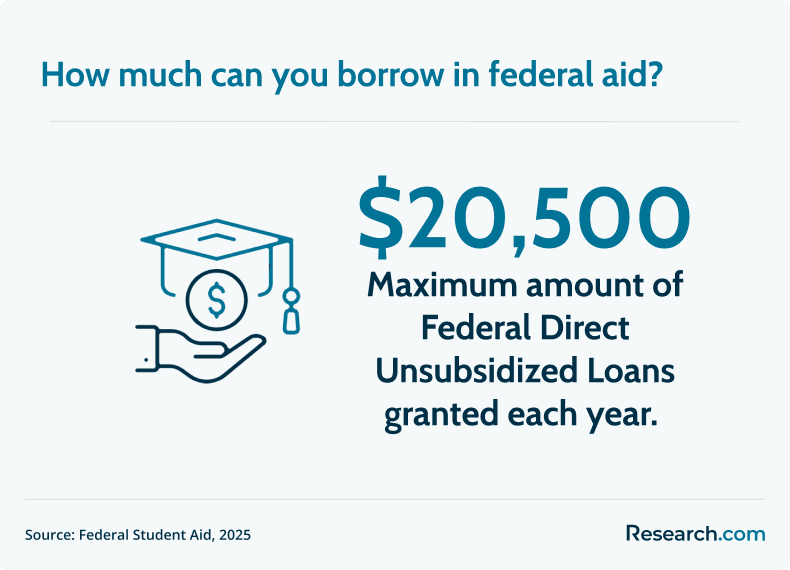
| Federal Direct Unsubsidized Loans | Graduate tuition and approved education costs. | Graduate students may borrow up to $20,500 each academic year at a fixed 8.08% interest rate for loans first disbursed between July 1, 2024 and July 1, 2025. |
| Graduate PLUS Loans | Remaining cost of attendance after other aid. | Grad PLUS borrowing is currently fixed at 9.08% and requires a basic credit check. |
| Assistantships and fellowships | Stipends, tuition support, or in-state tuition waivers. | Availability for fully online students varies by school and department. |
| Institutional and professional scholarships | Partial tuition support or merit-based awards. | Schools and professional groups such as the Association for Talent Development may offer competitions or scholarships. |
| Employer tuition assistance | Reimbursement or direct payment for graduate coursework. | The 2024 SHRM Employee Benefits survey reports that 46% of U.S. employers reimburse graduate tuition, with payments up to $5,250 per year remaining tax free for employees. |
| Military education benefits | Tuition and living stipends for eligible veterans. | Students with remaining GI Bill entitlement may be able to apply benefits to an online master’s program. |
| Lifetime Learning Credit | Federal tax offset for qualified tuition. | The IRS program can offset up to $2,000 in taxes each year. |
To reduce borrowing, ask each school for a full cost breakdown, scholarship deadlines, transfer-credit rules, and whether employer reimbursement can be deferred until grades are posted.
What are the prerequisites for enrolling in an Online Master's in Instructional Design program?
Admission requirements vary, but most online instructional design master’s programs look for applicants who can succeed in graduate coursework and contribute to applied design projects. A teaching license is usually not required unless the program is tied to educator licensure or a school-specific credential pathway. Applicants who already hold teaching certifications may be able to connect their classroom experience to instructional design goals.
- Bachelor’s degree from an accredited institution: Most programs require a completed undergraduate degree before enrollment.
- Minimum GPA: Programs may require a cumulative undergraduate GPA between 2.75 and 3.00, though some applicants below the threshold may be considered conditionally.
- Official transcripts: Schools use transcripts to verify degree completion, prior coursework, and academic readiness.
- Statement of purpose: A strong essay should explain why you want to study instructional design, which learners or sectors you want to serve, and how the program supports your goals.
- Letters of recommendation: Two references are typical, preferably from supervisors, faculty, or colleagues who can speak to your analytical, communication, and collaboration skills.
- Resume or portfolio: Some programs prefer evidence of teaching, training, curriculum work, multimedia production, or technology experience.
- GRE policy: Many programs are test-optional or waive GRE requirements for applicants who meet GPA or degree conditions.
- Technology readiness: Expect to need reliable internet, a webcam or microphone, and basic software fluency before the first course begins.
- English-language proficiency: International applicants may need minimum scores around 79 TOEFL iBT or 6.5 IELTS, with Duolingo accepted at some institutions.
If you are comparing graduate education pathways, the admission expectations in affordable online education specialist degrees in leadership can provide useful context because those programs also value professional experience, academic readiness, and leadership goals.
The chart below compares the likelihood of completion of online learners in their chosen degrees. Higher numbers mean students are less likely to finish and complete their program.
What courses are typically in an Online Master's in Instructional Design program?
Instructional design coursework usually combines learning theory, design process, technology production, assessment, research, and applied practice. The curriculum prepares graduates for roles related to instructional design, curriculum development, training, and educational consulting. Students interested in consulting-focused work can also review what educational consultants do and how to become one.
| Course area | Common topics | Portfolio value |
| Learning theory and instructional models | ADDIE, SAM, adult learning, cognitive load, motivation, constructivism, and learning transfer. | Shows employers that your design choices are grounded in learning science. |
| Needs analysis and learner assessment | Performance analysis, audience analysis, learning objectives, assessment alignment, and stakeholder interviews. | Demonstrates that you can diagnose problems before building instruction. |
| Multimedia and e-learning development | Video, audio, interactive modules, accessibility, authoring tools, mobile learning, and emerging media. | Produces tangible work samples for instructional design and e-learning developer roles. |
| Research, analytics, and evaluation | Survey design, data interpretation, evaluation models, learning outcomes, and continuous improvement. | Helps you prove whether a learning product worked and how it can be improved. |
| Design studio and prototyping | Rapid prototyping, peer critique, usability testing, client constraints, and iterative revision. | Builds project-based evidence of design thinking and collaboration. |
| Capstone or portfolio | Final project, client deliverable, reflective analysis, and curated work samples. | Gives you employer-ready artifacts for applications and interviews. |
Electives may cover leadership, adult training, mobile learning, augmented or virtual reality, accessibility, learning analytics, UX, or educational technology strategy.
What types of specializations are available in Online Master's in Instructional Design programs?
Specializations help you align the degree with the audience, sector, or technology focus you want to pursue. Some programs list a formal concentration, while others use elective clusters or embedded certificates.
- K–12 digital curriculum design: Focuses on standards alignment, Universal Design for Learning, classroom technology, assessment, and accessible digital materials for school settings.
- Higher education program development: Covers adult learning, faculty support, online course quality, accreditation-related documentation, LMS workflows, and continuous improvement. Students pursuing school-based career paths may also compare requirements for secondary teaching certification.
- Corporate learning and development: Emphasizes workforce training, performance consulting, competency mapping, compliance learning, rapid e-learning, and business outcome measurement.
- Learning analytics and artificial intelligence in education: Centers on data dashboards, learner behavior, AI-supported personalization, and evidence-based course improvement.
- Educational technology leadership: Prepares students to guide technology adoption, manage change, evaluate tools, and support digital learning strategy.
- Game-based and mobile learning: Explores simulations, serious games, microlearning, mobile-first design, and learner engagement.
- User experience and learning experience design: Combines UX principles with instructional methods to improve usability, accessibility, motivation, and learner flow.
- Workforce performance and adult training: Focuses on adult learners, organizational performance, scalable training, and competency-based learning.
- Health professions education: Applies instructional design to clinical onboarding, patient education, continuing medical education, and regulated training environments.
Most specializations add 9 to 12 credits or appear as a certificate without necessarily extending time to graduation. Choose a specialization only if it supports a clear career target; otherwise, a strong generalist program with a flexible portfolio may be more useful.
How to choose the best Affordable Online Master's in Instructional Design program?
The best affordable program is not always the cheapest. It is the accredited program that fits your schedule, teaches current tools and methods, helps you build a strong portfolio, and keeps total debt reasonable relative to your likely career path.
| Selection factor | What to verify | Red flag |
| Accreditation | Confirm institutional accreditation and, when relevant, educator-preparation recognition. | The school is unclear about accreditation or uses vague quality claims without verification. |
| Curriculum currency | Look for analytics, AI, accessibility, UX, multimedia, LMS, and evaluation content. | The curriculum focuses only on theory and lacks modern digital learning production. |
| Portfolio requirements | Ask whether students complete client projects, prototypes, e-portfolios, or capstones. | The program has few applied assignments and no employer-ready work samples. |
| Faculty experience | Review faculty backgrounds in K–12, higher education, corporate training, EdTech, research, or consulting. | Faculty profiles are limited or disconnected from current instructional design practice. |
| Student outcomes | Use College Scorecard and school disclosures to review debt, completion, and earnings information. | The school avoids outcome questions or provides only promotional anecdotes. |
| Delivery fit | Compare synchronous requirements, term length, cohort rules, and weekly workload. | The schedule conflicts with your job or caregiving responsibilities. |
| Net cost | Calculate tuition, fees, materials, transfer credits, employer aid, and scholarships. | The advertised price excludes required fees or assumes an unrealistic accelerated pace. |
Also consider whether you want a program tied to education, business, technology, or performance improvement. A teacher moving into digital curriculum may need a different program than an HR professional aiming for corporate learning strategy. If you want to compare how other graduate rankings evaluate cost, structure, and career fit, Research.com also covers affordable online master’s programs in homeland security.
For educator-preparation quality signals, check whether the program is recognized by the Council for the Accreditation of Educator Preparation (CAEP) when that recognition is relevant to your goals.
Common mistakes to avoid when choosing a program
- Choosing only by lowest tuition: A low-cost program can still be a poor value if it lacks applied projects, tool training, or career support.
- Ignoring accreditation: Accreditation affects employer recognition, transfer options, federal aid eligibility, and future doctoral study.
- Assuming every online program is flexible: Some online programs require live sessions, cohort sequencing, or fixed practicum schedules.
- Skipping the portfolio question: Instructional design hiring often depends on work samples. Ask what artifacts you will graduate with.
- Overlooking transfer-credit rules: Prior graduate credits or certificates can reduce cost, but only if the school accepts them.
- Confusing instructional design with teacher licensure: Most instructional design master’s programs do not automatically lead to teaching certification.
- Trusting rankings without checking fit: A highly ranked program may not match your sector, budget, time zone, or preferred learning format.
What are the emerging trends in online instructional design?
Instructional design is changing because organizations expect learning to be more accessible, measurable, personalized, and connected to job performance. Current online programs are responding by adding more work in analytics, accessibility, AI-supported design, multimedia, learner experience, and performance consulting.
- AI-supported design: AI tools are influencing content drafting, feedback, adaptive practice, tutoring support, and learning analytics. Programs that address AI responsibly can help students understand both efficiency gains and quality risks.
- Learning analytics: Employers increasingly want designers who can connect learning activities to outcomes, engagement, assessment data, and performance improvement.
- Accessibility and inclusive design: Online learning must serve varied learners, including students with disabilities, multilingual learners, adult learners, and workers with limited time.
- Learning experience design: More programs are blending UX concepts with instructional design so graduates can improve navigation, motivation, usability, and learner satisfaction.
- Immersive and simulation-based learning: Virtual reality, augmented reality, scenario-based learning, and simulations are expanding in fields where practice, safety, and decision-making matter.
- Workforce reskilling: Companies need shorter, targeted, performance-linked training rather than long courses that do not connect to measurable job outcomes.
Students comparing instructional design with broader education graduate options may find useful cost and structure comparisons in affordable online master’s degrees in teaching.
What career paths are available for graduates of Online Master's in Instructional Design programs?
Graduates can pursue hands-on design, technology development, curriculum leadership, analytics, training, management, consulting, or EdTech strategy. The best path depends on your prior experience and the portfolio you build during the program.
| Career path | What the role does | Who it fits best |
| Instructional Designer or Learning Experience Designer | Designs, prototypes, tests, and improves learning experiences for schools, companies, nonprofits, or agencies. | People who enjoy problem-solving, writing, visual design, collaboration, and learning science. |
| Instructional Coordinator | Oversees curriculum standards, supports educators, evaluates instructional quality, and improves programs. | Educators or curriculum professionals who want system-level impact. |
| Training and Development Specialist | Creates and delivers employee training, onboarding, compliance programs, and skills development initiatives. | Professionals interested in workplace learning and adult training. |
| E-learning Developer or Learning Technologist | Builds interactive modules, simulations, media assets, and digital course experiences. | Students who like tools, multimedia, production, and technical implementation. |
| Training and Development Manager | Leads training teams, budgets, strategy, vendor relationships, and enterprise learning initiatives. | Mid-career professionals moving into leadership. |
| Learning Analytics or Assessment Consultant | Uses data to evaluate learning effectiveness and recommend improvements. | Analytical professionals who want to connect learning to measurable outcomes. |
| Product or Curriculum Strategist in EdTech | Guides educational products, course strategy, user research, and market-aligned learning experiences. | Designers who want to work at the intersection of pedagogy, product, and technology. |
Graduates may move from hands-on instructional design into senior design, consulting, learning operations, curriculum leadership, or training management. Career mobility is one reason the degree appeals to people from varied backgrounds. For comparison, targeted online programs in other career fields, such as affordable online LVN programs, also show how focused training can prepare learners for defined roles across different work settings.
Is the Return on Investment Justifiable for an Online Master's in Instructional Design?
The ROI can be justifiable when the program’s net cost is reasonable and the degree helps you move into a better-paying or more stable role. The strongest ROI usually comes from programs that combine affordable tuition, transfer-credit options, accelerated pacing when appropriate, strong portfolio development, and career services connected to instructional design employers.
| ROI question | Why it matters | How to evaluate it |
| Will this degree help me change roles? | The degree is most valuable when it opens a realistic path into instructional design, e-learning, training, or learning leadership. | Compare job postings with the program’s courses, tools, and portfolio expectations. |
| Can I keep debt manageable? | High tuition can weaken ROI even if the program has a strong brand. | Calculate total tuition, fees, interest, employer assistance, scholarships, and transfer credits. |
| Will I graduate with strong work samples? | Employers often want proof that you can design and build effective learning products. | Ask for sample portfolios, capstone details, and examples of client-based projects. |
| Does the program fit my sector? | K–12, higher education, corporate learning, healthcare, government, and EdTech roles may value different skills. | Choose electives, certificates, or practicum work that match your target jobs. |
| Can I finish without pausing my career? | Leaving work to study full time may increase opportunity cost. | Compare part-time, accelerated, and competency-based models honestly. |
ROI should be measured against your actual career target, not against a generic salary promise. A low-cost program with a strong portfolio may outperform a more expensive program if employers can clearly see your skills. Students exploring ROI across unrelated degree fields can also compare how cost and outcomes are framed in programs such as affordable online political science degree programs.
What is the job market for graduates with an Online Master's in Instructional Design?
The job market is steady across education, corporate learning, government, healthcare, technology, and consulting. Demand is strongest where organizations must train workers quickly, document compliance, support remote or hybrid teams, adopt new software, or prove that learning programs affect performance.
- Training and development specialists: Projected 12% growth from 2023 to 2033, with about 42,200 openings each year.
- Training and development managers: Projected 7% growth from 2023 to 2033.
- Instructional coordinators: Projected 2% growth, with 20,100 annual openings as schools and institutions replace workers and continue curriculum improvement efforts.
- Remote instructional design: A 2024 hiring survey found that 62.4 % of employers already hire remote instructional designers, and another 12.9 % added remote talent in the past year.
For applicants, the practical takeaway is clear: the degree can help, but the portfolio is crucial. Build examples that show needs analysis, learning objectives, learner-centered design, accessibility, multimedia production, assessment, and evaluation. If you want remote roles, also document your ability to work with distributed teams, subject-matter experts, and digital project workflows.
Should I Consider an Accelerated Doctoral Path After My Online Master's in Instructional Design?
A doctorate may make sense if your goals include university teaching, senior research roles, executive educational leadership, high-level consulting, or system-wide learning innovation. It is less necessary if your immediate goal is to become an instructional designer, e-learning developer, or training specialist.
Consider an accelerated doctoral pathway only after you know why you need it. Doctoral study requires significant research commitment, writing, and time. If your goal is advanced leadership in education, Research.com’s guide to accelerated EdD programs can help you compare faster doctoral options after completing a master’s degree.
How Can Online Programs Enhance Professional Networking and Career Advancement?
Good online instructional design programs do more than post readings and assignments. They create structured opportunities to build a professional network, receive feedback, and connect coursework to career movement.
- Cohort interaction: Group projects and peer critiques can build relationships with classmates who later work in schools, corporations, nonprofits, and EdTech companies.
- Faculty mentorship: Instructors with current industry experience can help students translate academic work into employer-ready portfolio pieces.
- Virtual career services: Resume reviews, mock interviews, employer panels, and career fairs can support job searches without requiring campus attendance.
- Client-based capstones: Real-world projects give students both networking contacts and practical deliverables.
- Alumni communities: Active alumni networks can help graduates identify openings, freelance opportunities, and sector-specific expectations.
If long-term academic leadership is part of your plan, you may also compare online master’s-to-doctoral routes with affordable online EdD programs.
How Does Accreditation Influence the Quality and Recognition of My Online Master's in Instructional Design?
Accreditation matters because it verifies that an institution meets recognized standards for academic quality, faculty qualifications, student support, and continuous improvement. For students, accreditation can affect federal financial aid eligibility, employer recognition, transfer credit, and admission to future graduate or doctoral programs.
For instructional design, institutional accreditation is the baseline. Program-level educator-preparation accreditation may matter if your goals are tied to school systems, teacher leadership, or curriculum roles. For corporate learning, employers may care more about institutional accreditation, portfolio quality, tool skill, and applied project experience.
Before enrolling, confirm accreditation directly through the accreditor or recognized federal databases, not only through marketing pages. Students comparing accreditation across professional graduate fields may also find useful context in online speech pathology master’s programs, where recognition and professional standards are especially important.
Questions to ask before enrolling
- Is the university institutionally accredited?
- What is the total tuition and fee cost for the full degree?
- Can online students receive the same scholarships, assistantships, or career support as campus students?
- How many credits can I transfer, and how are transfer credits evaluated?
- Will I complete a client-based project, capstone, practicum, or e-portfolio?
- Which authoring tools, LMS platforms, analytics tools, and multimedia tools will I use?
- Are courses fully asynchronous, synchronous, or mixed?
- How many hours per week do successful students typically spend on coursework?
- What industries do graduates enter?
- Does the program align better with K–12, higher education, corporate learning, EdTech, or performance improvement?
Key Insights
- An affordable online master’s in instructional design is strongest when it combines accredited graduate study, applied projects, current technology training, and a portfolio that employers can review.
- Most programs require 30–36 credits and take 18–24 months, but accelerated and competency-based options can shorten the timeline for students with strong discipline and relevant experience.
- A 2024 TechGuide survey of accredited instructional design program tuitions places average total costs between $15,000 and $25,000, with a $19,000 median.
- In 2023, 53.2% of students were enrolled in distance education courses in postsecondary institutions, based on a study of 5,677 institutions (IPEDS, 2024), showing that online study is now a mainstream graduate option.
- The average salary for an Instructional Designer in the U.S. is $90,644, with average additional cash compensation of $7,010, making average total compensation $97,654. Salary ranges from $72,000 to $121,000, with a median of $83,000 (Built In, 2025).
- Training and development specialists and managers show stronger projected growth at 12 and 7% respectively, while instructional designers and coordinators are projected to grow slowly at 2% over the next decade (BLS, 2025).
- Remote work is a major advantage in this field: 62.4% of employers are hiring remote instructional designers, while 12.9% report that they already hired remote talent in 2024 (Peck, 2024).
- Do not rely on rankings or tuition alone. The best program for you should match your target sector, schedule, budget, and need for hands-on portfolio development.
References
- Built in (2025). 2025 Instructional Designer salary in US. https://builtin.com/salaries/us/instructional-designer
- Bureau of Labor Statistics (2025, April 18). Instructional coordinators. https://www.bls.gov/ooh/education-training-and-library/instructional-coordinators.htm
- Bureau of Labor Statistics (2025, April 18). Training and development managers. https://www.bls.gov/ooh/management/training-and-development-managers.htm
- Bureau of Labor Statistics (2025, April 18). Training and development specialists. https://www.bls.gov/ooh/business-and-financial/training-and-development-specialists.htm
- Fredericksen, E., Ed. D. (2024). Chloe 9: Strategy shift: Institutions respond to sustained online demand. In https://www.qualitymatters.org/. https://www.qualitymatters.org/sites/default/files/research-docs-pdfs/QM-Eduventures-EDUCAUSE-CHLOE%209-Report-2024.pdf
- Internal Revenue Service (2025). Learning Credit. https://www.irs.gov/credits-deductions/individuals/llc
- Glassdoor (2025). Salary: e-learning Developer in United States. https://www.glassdoor.com/Salaries/elearning-developer-salary-SRCH_KO0%2C19.htm
- Mowreader, A. (2024, January 12). Online learners less likely to complete compared to peers. Inside Higher Ed | Higher Education News, Events and Jobs. https://www.insidehighered.com/news/student-success/academic-life/2024/01/12/online-learners-less-likely-complete-compared-peers
- National Center for Education Statistics (2024). Student enrollment: What is the percent of students enrolled in distance education courses in postsecondary institutions in the fall https://nces.ed.gov/ipeds.
- Paulsen, J. (2024, September 13). Find online Master’s in Instructional Design. TechGuide. https://techguide.org/design/online-masters-in-instructional-design/
- Peck, D. The 21 Best Instructional Design Master’s Degree Programs | Devlin Peck. (30 April 2025). https://www.devlinpeck.com/content/instructional-design-masters
- SHRM. (2025, April 8). Designing and managing educational assistance programs. SHRM. https://www.shrm.org/topics-tools/tools/toolkits/designing-managing-educational-assistance-programs
Other Things You Should Know About Affordable Online Master's in Instructional Design Programs
Yes. Many 2027 programs require a capstone, portfolio, or practicum for graduation, often in the final 3 to 6 credit hours. These courses usually ask students to design an instructional product, document learning outcomes, and show competency in tools such as LMS platforms and e-learning authoring software.
Most affordable online master's in instructional design programs for 2027 typically require between 30 to 36 credit hours. Completing these credit hours generally takes around 1 to 2 years of full-time study, depending on the program and course load.
For the 2027 most affordable online master's in instructional design programs, applicants typically need a bachelor's degree from an accredited institution, a minimum GPA (usually around 2.5-3.0), letters of recommendation, a personal statement, and possibly relevant work experience. Some programs may also require GRE scores.





