
2027 Secondary Teaching Certification: Requirements, Career Paths, Salaries

Co-Founder and Chief Data Scientist
Secondary teaching certification is the credential pathway for people who want to teach middle school or high school subjects such as English, math, science, social studies, world languages, art, career and technical education, or special education. The decision matters because certification rules affect where you can teach, how long the process takes, what exams you must pass, and whether your program will qualify you for a state teaching license.
This guide is for college students planning a teaching career, career changers with a bachelor’s degree, substitute teachers who want full licensure, and current educators considering another endorsement or advanced credential. It explains how secondary certification works for 2027, how it differs from licensure and endorsements, what programs usually require, how much they may cost, and how to judge whether a pathway is worth your time and money.
Quick answer: What do you need for secondary teaching certification?
In most states, you need a bachelor’s degree, completion of an approved teacher preparation program, supervised student teaching, a background check, passing scores on required certification exams, and at least one subject endorsement. The exact process depends on your state, your subject area, and whether you use a traditional, alternative, emergency, or graduate-level route.
The career can offer stable employment and meaningful work, but certification is not automatic. Before enrolling, confirm that the program is approved by the state where you plan to teach, that it leads to the right grade level and subject endorsement, and that all exam, student teaching, and licensing requirements are clearly disclosed.
What are the main benefits of earning secondary teaching certification?
- Access to licensed teaching roles. Public schools generally require state authorization, and certification is typically part of the path to that license.
- Competitive earnings for qualified teachers. Secondary teachers had an annual median salary of $65,130 in May 2023, according to BLS data from 2023.
- A structured school-year schedule. Many secondary teachers work during school hours and have school breaks, although lesson planning, grading, meetings, and professional development often extend beyond classroom hours.
- Benefits tied to public education employment. Many states and districts offer health insurance and pension-related benefits to certified teachers. BLS data shows that over 83% of certified teachers had access to medical benefits in 2024.
- Professional support networks. Certified educators can join organizations such as the National Education Association (NEA) and the American Federation of Teachers (AFT), which may offer advocacy, mentoring, training, and classroom resources.
- What is secondary teacher certification?
- How does a secondary teaching certification differ from a teaching license?
- What is the difference between a secondary teaching certification and a secondary subject endorsement?
- What are the requirements for enrolling in secondary teaching certification for 2027?
- What courses are included in a secondary teaching certification?
- How do secondary teaching license requirements vary by state?
- How long does it take to get a secondary teaching certification?
- Can pursuing a master's degree boost my secondary teaching career?
- How can I prepare for secondary teaching certification exams?
- Should I pursue an advanced degree after obtaining secondary teaching certification?
- How much does a certificate in secondary teaching cost?
- What financial aid options can support my secondary teaching certification journey?
- What are the emerging trends in secondary teaching certification?
- Should I consider a complementary degree alongside my secondary teaching certification?
- Could a Secondary Teaching Certification Open Doors to Interdisciplinary Careers?
- Could an interdisciplinary studies bachelor's degree enhance my secondary teaching career?
- What can I do with a secondary teaching certificate?
- How much is the salary of those with secondary teaching certification?
- What is the job outlook of secondary school teachers?
- How can I evaluate the quality and accreditation of secondary teaching certification programs?
What is secondary teacher certification?
Secondary teacher certification is a state-recognized credential showing that a person has met preparation standards to teach students in grades 6–12. It is different from an early childhood education degree online, which focuses on much younger learners, typically ages 3-5.
For secondary education, certification usually combines three areas of preparation: subject knowledge, teaching methods, and supervised classroom experience. A future high school biology teacher, for example, must show knowledge of biology and learn how to plan lessons, assess student learning, manage a classroom, and teach adolescents effectively.
Certification also helps schools comply with state education rules and accreditation expectations. Districts use it as evidence that a teacher has completed required preparation, passed applicable exams, and can teach according to state academic standards.
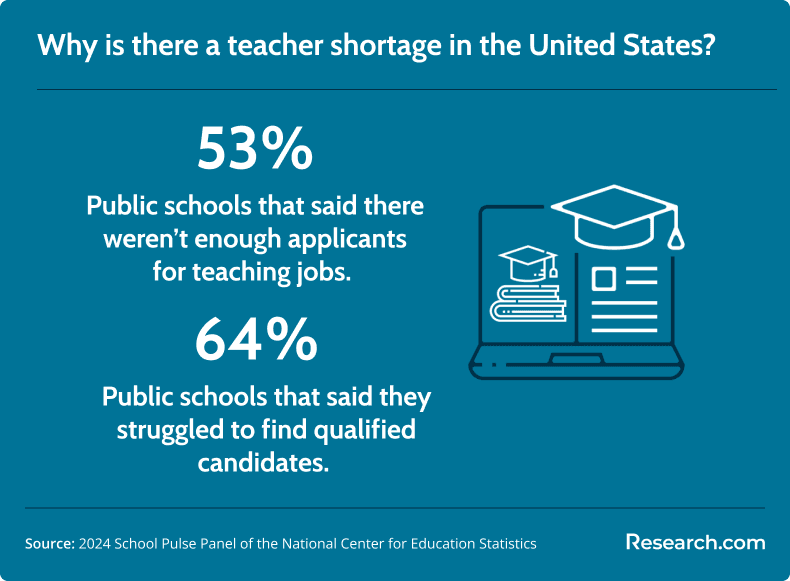
The credential is especially important because many schools continue to report hiring difficulties. A report on the growing teacher shortage in the US frames the issue as a labor-market challenge, and recent data shows similar pressure: 53% of public schools reported a lack of applicants for teaching positions, while 64% struggled to find qualified candidates (National Center for Education Statistics, 2024).
| Secondary certification component | What it proves | Why it matters |
| Bachelor’s degree | You have completed college-level academic preparation | States generally require a bachelor’s degree before full licensure |
| Teacher preparation program | You studied pedagogy, assessment, classroom management, and adolescent learning | It connects subject expertise to practical teaching skill |
| Student teaching | You can teach under supervision in a real classroom | Districts value evidence of applied classroom readiness |
| Certification exams | You meet state testing expectations for teaching and subject knowledge | Passing scores are often required before licensure |
| Subject endorsement | You are approved to teach a specific subject area | A general secondary credential does not automatically qualify you for every subject |
How does a secondary teaching certification differ from a teaching license?
A secondary teaching certification shows that you have completed a defined preparation process. A teaching license is the legal authorization issued by a state that permits you to teach in public schools. In practice, certification is often one requirement on the way to licensure.
Think of certification as proof of preparation and licensure as permission to work in a regulated public school teaching role. You may complete coursework and exams through a college, university, or alternative provider, but the state education agency decides whether you receive the license.
| Credential | Issued by | Main purpose | Typical use |
| Secondary teaching certification | Often tied to an approved preparation program or state process | Confirms that you completed academic, clinical, and testing requirements | Used to qualify for state licensure and subject approval |
| Teaching license | State education department or licensing authority | Grants legal authorization to teach in public schools | Required for most public middle and high school teaching jobs |
If you want to teach students with disabilities at the secondary level, you may need a separate or additional special education teaching certification. Requirements may include specialized coursework, field experience, and exams focused on disability law, instructional accommodations, and individualized education programs.
Private schools may have more flexibility than public schools. Some private institutions prioritize subject expertise, graduate study, or prior teaching experience, although many still prefer licensed or certification-eligible candidates. For example, someone with a political science background may teach civics, government, or social studies in certain settings. If you are weighing broader options, this guide on what can you do with a political science degree can help connect that major to education, public policy, and related careers.
What is the difference between a secondary teaching certification and a secondary subject endorsement?
A secondary teaching certification indicates that you are prepared to teach at the middle or high school level. A secondary subject endorsement identifies the specific subject or subjects you are authorized to teach, such as English, biology, mathematics, history, Spanish, art, or physical education.
This distinction matters because a secondary credential is not a blanket authorization to teach any class. A school hiring a chemistry teacher, for example, will usually look for a candidate with the correct science or chemistry endorsement, not simply a general secondary certification.
Many candidates choose endorsements that match their undergraduate major, professional background, or academic strengths. A student who completed an online history degree may pursue a social studies or history-related endorsement, while a candidate with a strong studio art background may review state-specific art teacher requirements.
Common secondary endorsement areas include:
- English/Language Arts
- Mathematics
- Science, including General Science, Biology, Chemistry, Physics, and Earth Science
- Social Studies, including History, Government, Geography, and Economics
- Foreign Languages, such as Spanish, French, German, and Mandarin
- Special Education
- English as a Second Language (ESL) or Bilingual Education
- Career and Technical Education (CTE), including Business, Technology, and Health Sciences
- Fine Arts, including Music, Art, and Theater
- Physical Education and Health
Most initial certification candidates apply with at least one endorsement. Some teachers add more endorsements later by completing additional coursework, passing subject exams, or meeting state content requirements. According to Data USA (2023), the most common majors held by secondary school teachers in 2022, across all academic degrees, were Education, followed by Business, and English.
| If your background is... | Likely endorsement direction | What to verify before enrolling |
| English, writing, or literature | English/Language Arts | Required literature, writing, grammar, and pedagogy credits |
| Math, engineering, or data-heavy fields | Mathematics | State expectations for algebra, calculus, statistics, and math pedagogy |
| Biology, chemistry, physics, or environmental science | Science | Whether the state uses broad science or single-subject science endorsements |
| History, political science, economics, or geography | Social Studies | Whether coursework must cover multiple social science disciplines |
| Professional trade, technology, business, or health background | Career and Technical Education | Work-experience requirements and any industry credential expectations |
What are the requirements for enrolling in secondary teaching certification for 2027?
Admission requirements vary by school, state, and pathway, but most secondary teaching certification programs screen for academic readiness, subject preparation, professional conduct, and classroom potential.
- Bachelor’s degree. Many applicants need a bachelor’s degree from an accredited institution. The degree may be in education or in a teachable subject such as Mathematics, Science, English, or Social Studies. Career changers may also qualify with unrelated majors, including communication, nursing, business, or a self-paced accounting degree, if they meet subject-matter and program requirements.
- Minimum GPA. Many programs use GPA thresholds between 2.5 to 3.0, although some institutions may offer conditional admission to applicants below the standard range.
- Prerequisite coursework. Applicants without an education background may need introductory courses in teaching, adolescent development, educational psychology, or subject pedagogy.
- Basic skills testing. Some states or programs require exams such as the Praxis Core, California Basic Educational Skills Test™ (CBEST), or Florida Teacher Certification Examinations (FTCE).
- Background check and fingerprinting. Most teacher preparation programs require a criminal background check and fingerprint clearance before field placements.
- Letters of recommendation. Programs often request two to three recommendations from faculty, supervisors, or mentors who can speak to your communication skills, responsibility, and potential as a teacher.
- Alternative certification eligibility. Career changers may enter alternative certification programs without an education degree if they can demonstrate subject-matter competence and meet state rules.
If you want an online option, do not choose based on convenience alone. Use a credible list of online schools as a starting point, then confirm state approval, student teaching arrangements, endorsement availability, and licensure outcomes.
Questions to ask before applying
- Is the program approved for secondary teacher preparation in the state where I plan to teach?
- Which grade bands does it cover: middle school, high school, or both?
- Does the program lead to the exact subject endorsement I need?
- Will the school help arrange student teaching placements near me?
- What exams must I pass before admission, before student teaching, and before licensure?
- Are there additional fees for background checks, testing, supervision, or license applications?
- If I move states, how portable will this credential be?
What courses are included in a secondary teaching certification?
Secondary certification programs are designed to turn subject knowledge into teachable classroom practice. The curriculum usually combines education theory, adolescent learning, instructional design, classroom management, content-area methods, assessment, and supervised teaching.
| Course area | What you learn | Why it matters in grades 6–12 |
| Foundations of Education | History, philosophy, policy, and the social role of schools | Helps future teachers understand the school system they are entering |
| Educational Psychology | How adolescents learn, develop, stay motivated, and process information | Supports age-appropriate lesson planning and student support |
| Classroom Management | Routines, behavior supports, engagement strategies, and conflict response | Builds the practical skills needed to maintain a productive classroom |
| Assessment and Evaluation | Designing tests, interpreting results, and using data to adjust instruction | Shows whether students are actually mastering the required standards |
| Teaching Methods and Instructional Strategies | Lesson planning, differentiated instruction, questioning, and active learning | Connects content knowledge to effective daily instruction |
| Technology in Education | Digital tools, online platforms, media literacy, and classroom technology use | Prepares teachers for blended, digital, and technology-supported classrooms |
| Special Education and Inclusive Teaching | Strategies for students with disabilities and English Language Learners (ELLs) | Helps teachers adapt instruction for diverse learners |
| Subject-Specific Pedagogy | How to teach your endorsement area, such as Math, Science, English, or Social Studies | Focuses on the methods, misconceptions, and assessment practices of your subject |
| Student Teaching Internship | Supervised full-time teaching in a secondary school, typically lasting 12–16 weeks | Provides the field experience most states and employers expect |
How do secondary teaching license requirements vary by state?
Every state sets its own licensing rules, but the general process is similar nationwide. According to TEACH.org, candidates usually move through a sequence that includes education verification, teacher preparation, student teaching, background checks, exams, and a formal license application.
- Submit proof of education. Applicants provide official transcripts showing completion of a bachelor’s degree, often in education or a relevant subject area such as mathematics, science, or English.
- Complete an approved teacher preparation program. States may require documentation that the candidate finished an accredited or state-approved educator preparation program.
- Verify student teaching experience. Candidates typically complete a supervised teaching placement, often lasting one semester, and submit verification from a supervisor, school administrator, or preparation program.
- Complete background checks and fingerprinting. States commonly require fingerprint-based checks through state and FBI records. Many also review the National Sex Offender Registry and child abuse or neglect databases.
- File the license application and pay fees. Applicants submit forms, transcripts, test scores, background clearance, and required payments to the state licensing agency.
- Pass licensure exams. Candidates demonstrate teaching and subject knowledge through exams such as the Praxis Series or state-specific tests.
Where states differ most is in the specific tests, required coursework, clinical experience model, and reciprocity rules for out-of-state teachers.
| Requirement area | How states may differ | Examples from the article |
| Licensure exams | Some states use national exams, while others use their own testing systems | California requires the CSET and CBEST, Texas mandates the TExES, and Florida requires the FTCE |
| Subject coursework | States may require additional credits in the endorsement subject | Teaching certification for math teachers may involve advanced work in algebra, calculus, or math-specific teaching methods |
| Student support training | Some states require training in safety, child protection, or school climate | New York and Pennsylvania require coursework in bullying prevention, school violence intervention, and child abuse identification |
| ESL preparation | States with large multilingual student populations may require English Learner preparation | California, Texas, and Arizona require coursework in ESL instruction and English Learner strategies |
| Student teaching length | Most states require a semester, but some require longer experiences | Most states require 12–16 weeks, while Massachusetts and Minnesota require a year-long residency program |
| Reciprocity | Some states accept out-of-state licenses more easily than others | Georgia, Arizona, and Nevada may have easier reciprocity; California and New York may require additional exams or training |
Before choosing a program, check the Department of Education website for the state where you plan to teach. If you may relocate, compare reciprocity rules before committing to a pathway.
How long does it take to get a secondary teaching certification?
The timeline depends on whether you already have a bachelor’s degree, whether your major matches your desired subject, and whether you choose a traditional, alternative, provisional, or graduate route.
| Pathway | Typical timeline stated | Best fit | Key caution |
| Standard secondary certification | 12 to 24 months | Candidates who already hold a bachelor’s degree in a teachable subject | Additional coursework or exams can extend the timeline |
| Alternative certification | 6 to 18 months | Career changers and non-education majors | You may need to teach while completing requirements, which can be demanding |
| Emergency or temporary certification | Usually valid for 1 to 3 years | Shortage-area candidates allowed to begin teaching while finishing requirements | Temporary status must be converted to full certification to continue teaching |
| Master’s degree route | 1.5 to 2 years | Candidates who want graduate study and certification together | Often costs more and may require careful ROI evaluation |
Some candidates complete a teaching degree online, but online study does not remove the need for in-person fieldwork, supervised teaching, background checks, and state exams.
Can pursuing a master's degree boost my secondary teaching career?
A master’s degree can be useful when it aligns with a clear career goal. It may deepen your knowledge of curriculum, assessment, literacy, educational technology, leadership, or subject-specific pedagogy. It can also support movement into department chair, instructional coach, curriculum specialist, or administrative pathways, depending on district rules and state requirements.
The decision should be financial as well as professional. Compare tuition, employer reimbursement, salary schedules, licensure benefits, and whether the program fits your schedule. If flexibility and cost are priorities, review master's degrees for teachers that are designed for working educators.
How can I prepare for secondary teaching certification exams?
Certification exams usually test two things: whether you understand how to teach and whether you know the subject you plan to teach. A strong preparation plan should start with your state’s official testing requirements, not with random study guides.
- Confirm the exact exams. Check whether your state requires a basic skills exam, pedagogy exam, subject exam, or all three.
- Download official test frameworks. Use the exam provider’s content outline to identify the topics that count most.
- Take a diagnostic practice test. Find your weak areas before spending weeks reviewing material you already know.
- Study subject knowledge and pedagogy separately. Knowing biology, English, or history is not the same as knowing how to teach it to adolescents.
- Schedule backward from deadlines. Leave time for score reporting, retakes, and application submission.
- Use state-specific guidance. Requirements change, so review current information on how to get a teacher certification before registering.
Should I pursue an advanced degree after obtaining secondary teaching certification?
An advanced degree can make sense if you want a defined role beyond classroom teaching, such as school leadership, district administration, curriculum development, research, policy work, or consulting. It is less useful if you enroll only because you feel pressured to add another credential without knowing how it will affect your career path or compensation.
Teachers interested in high-level leadership or systems improvement may consider doctoral study after gaining classroom and professional experience. For educators who need flexible scheduling, EdD online programs may be worth comparing, especially if the goal is administrative leadership, organizational change, or applied education research.
How much does a certificate in secondary teaching cost?
The cost of secondary teaching certification depends on the provider, credit requirements, program format, and whether certification is completed alone or as part of a degree. Tuition is only one part of the total cost. Candidates should also budget for textbooks, exam fees, background checks, fingerprinting, application fees, travel to field placements, and possible lost income during student teaching.
Online tuition often covers instruction, digital materials, virtual learning platforms, and academic support, but it may not include textbooks, certification exams, or state application costs. Campus-based tuition may include classroom instruction, library access, and student services, but housing, meals, commuting, and other expenses may be separate.
| Provider or pathway | Cost information stated | What candidates should check |
| University of North Dakota | Undergraduate tuition for most programs is approximately $460 per credit, depending on residency status. Estimated total cost for certification with a 15–30 credit is $6,900 – $13,8000. | Residency rules, total credits required, and any field placement fees |
| American College of Education | Certificate in Transition to Teaching in Secondary Education for those who have a non-education bachelor's degree costs $6,100 in total. | State eligibility, required exams, and whether the certificate leads to your desired license |
| University of Alabama Online | Offers an M.A. in Secondary Education (Science) with certification. Tuition details are not listed publicly, but graduate tuition at UA Online is estimated at $440 per credit hour. Estimated total cost (30–36 credit hours): $13,200 – $15,840. | Whether graduate tuition, certification requirements, and science endorsement rules match your state |
| American Board for Certification of Teacher Excellence | Alternative certification costing $1,900. | Whether your state accepts the pathway and what additional requirements apply |
Cost structures also differ by teaching level. For example, the steps to become a preschool teacher may involve a certificate or associate degree in early childhood education, which can have fewer credits and lower costs than many secondary certification routes.
What financial aid options can support my secondary teaching certification journey?
Financial aid for teacher certification may come from federal aid, state grants, institutional scholarships, educator-specific loan forgiveness programs, district partnerships, employer tuition assistance, or service-based programs tied to shortage areas. Availability depends on your enrollment status, program type, state, and whether the program is degree-granting.
Before borrowing, ask the program for a full cost sheet that includes tuition, fees, exams, books, student teaching costs, and licensing expenses. Also ask whether certification-only students qualify for the same aid as degree-seeking students. If you are thinking about long-term leadership roles, compare the financial implications of later graduate study, including options such as an organizational leadership PhD, with your expected career path in education.
What are the emerging trends in secondary teaching certification?
Secondary teaching certification is being shaped by several practical pressures: teacher shortages, expanded alternative pathways, online coursework, stronger attention to inclusive instruction, and growing expectations for digital literacy. States and districts still want subject competence, but they increasingly expect teachers to support diverse learners, use learning technology responsibly, and adapt instruction based on student needs.
Leadership preparation is also becoming more relevant for experienced teachers who want to move beyond one classroom. Some educators pursue online masters in educational leadership to prepare for roles in department leadership, school administration, instructional coaching, or program coordination.
Should I consider a complementary degree alongside my secondary teaching certification?
A complementary degree can help if it adds a skill set that schools need or supports a specific career direction. Useful pairings may include instructional technology, literacy, special education, library science, counseling-related preparation, educational leadership, or a second teachable subject.
For example, educators who are interested in school media centers, information literacy, digital resources, or research support may explore what can I do with a library science degree. The best complementary degree is not necessarily the most impressive one; it is the one that expands your qualifications in a direction you actually plan to use.
Could a Secondary Teaching Certification Open Doors to Interdisciplinary Careers?
Yes. Secondary teaching certification can support careers that rely on communication, curriculum design, assessment, training, youth development, or learning technology. Some certified teachers remain in classrooms, while others move into curriculum development, instructional design, tutoring, academic coaching, nonprofit education programs, corporate training, or school administration.
Teaching experience can also connect to library and information work, especially for educators who enjoy research support, academic resources, and information access. Candidates considering that direction can review jobs with a library science degree to understand how education and information science may overlap.
Could an interdisciplinary studies bachelor's degree enhance my secondary teaching career?
An interdisciplinary studies bachelor's degree may be helpful for secondary teaching if it includes enough coursework in a teachable subject and supports the endorsement you want. The advantage is breadth: interdisciplinary study can help teachers connect literature with history, science with policy, or technology with communication.
The risk is endorsement eligibility. Some states require specific credits in the subject you plan to teach, so an interdisciplinary degree should be planned carefully. Before enrolling, ask whether the degree will satisfy the content-area requirements for your intended certification.
What can I do with a secondary teaching certificate?
A secondary teaching certificate is most directly tied to middle and high school teaching, but the skills behind it can transfer to other education and training roles. Your options depend on your license status, subject endorsement, state rules, experience, and any additional credentials.
| Career option | What the role involves | When it may be a good fit |
| Public, charter, or private school teacher | Teach grades 6–12 in your licensed subject area | You want a classroom-based career with direct student impact |
| Substitute teacher | Cover classes, follow lesson plans, and maintain classroom routines | You want flexible experience before committing to full-time teaching |
| Instructional designer | Create lessons, training materials, online courses, and learning experiences | You enjoy curriculum, technology, and structured learning design |
| Corporate or nonprofit trainer | Develop and deliver training for adults, employees, or community learners | You want to use teaching skills outside K–12 schools |
| Academic coach | Help students build study strategies, organization, and academic confidence | You prefer one-on-one or small-group support |
| Tutor | Provide targeted academic help or test preparation | You want flexible, subject-specific teaching work |
| Camp director | Plan programs, supervise staff, manage activities, and support youth development | You enjoy leadership and student engagement outside the school calendar |
| International teacher | Teach in schools abroad where U.S. certification may be recognized | You want global teaching opportunities and may add TESOL or bilingual preparation |
How much is the salary of those with secondary teaching certification?
For people with secondary teaching certification who are working as secondary teachers, Salary.com reports a salary range from $62,578 to $75,257, depending on experience, expertise, and additional qualifications (Salary.com, 2025).
| Experience level | Salary stated | What may describe this stage |
| Entry-Level Teacher | $62,578 | Newly certified teachers who are learning school systems, classroom routines, and instructional practice |
| Intermediate-Level Teacher | $62,957 | Teachers with some experience, often between 2 to 5 years, and growing classroom confidence |
| Senior-Level Teacher | $67,962 | Educators with several years of experience, often 5-10, and stronger classroom management and instructional judgment |
| Specialist-Level Teacher | $74,771 | Teachers with specialized expertise, advanced credentials, mentoring duties, curriculum responsibilities, or leadership roles |
| Expert-Level Teacher (Secondary School) | $75,257 | Highly experienced teachers, often with more than 10 years of experience, advanced study, or instructional leadership responsibilities |
Advanced preparation may influence compensation in some districts, particularly when salary schedules reward graduate credits or specialized credentials. Examples include advanced study in literacy, math, science, or an online master's degree in reading. However, salary increases are not guaranteed and depend on district contracts, state rules, experience, location, and role.
Location also matters. According to ZipRecruiter, the highest-paying cities for high school teachers are Nome, AK ($112,102), Berkeley, CA ($110,651), and Sitka, AK ($108,865).
What is the job outlook of secondary school teachers?
The BLS projects employment for high school teachers to decline slightly by 1% from 2023 to 2033, but it also projects 64,000 job openings each year on average (BLS, 2023). That distinction is important: even when overall growth is flat or slightly negative, schools still need teachers to replace people who retire, change careers, relocate, or leave the labor force.
Demand varies by state, district, subject, and budget conditions. Shortage areas may create stronger opportunities for candidates in fields such as math, science, special education, ESL, bilingual education, and career and technical education, although candidates should verify local hiring conditions rather than relying only on national averages.
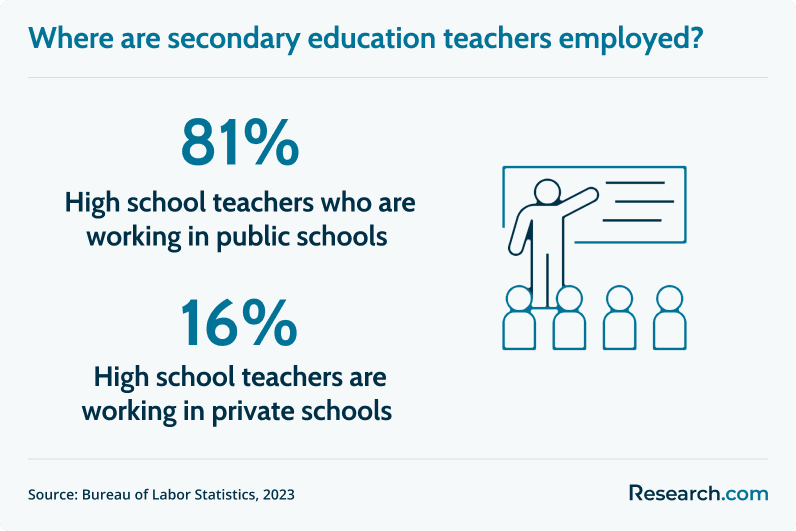
Long-range projections also point to continued need across public and private education. Projections for 2031 estimate a need for 487,000 private school teachers and 3.19 million public school teachers (Statista, 2024). In 2023, BLS data showed that about 81% of high school teachers worked in local public elementary and secondary schools.
| Job outlook factor | What it means for candidates |
| National growth rate | A 1% projected decline from 2023 to 2033 means candidates should pay attention to state and subject-level demand |
| Annual openings | 64,000 expected openings per year on average indicate continuing replacement demand |
| Subject area | Some endorsements may be more marketable than others depending on local shortages |
| Location | Hiring needs, salaries, benefits, and class sizes can differ widely by district |
| Public school employment | Because about 81% of high school teachers worked in local public elementary and secondary schools, state licensure remains central |
How can I evaluate the quality and accreditation of secondary teaching certification programs?
Program quality matters because the wrong choice can delay licensure, limit endorsement options, or leave you with credits that do not satisfy state requirements. Start with approval and accreditation, then evaluate outcomes, student teaching support, cost transparency, and exam preparation.
- Verify state approval. Confirm that the program is approved for secondary teacher preparation in the state where you plan to be licensed.
- Check recognized accreditation. Look for accreditation by relevant authorities, such as the Council for the Accreditation of Educator Preparation (CAEP), or approval by the appropriate state agency.
- Confirm endorsement alignment. Make sure the program leads to the subject and grade band you want, not just a general education credential.
- Review student teaching placement support. Ask who arranges placements, where they occur, and whether online students receive local placement help.
- Ask for exam pass-rate information. Strong programs should be able to explain how they prepare students for required licensure exams.
- Compare total cost, not only tuition. Include fees, testing, background checks, travel, technology, and unpaid student teaching time.
- Look at completion and placement data. Graduation rates, job placement statistics, and graduate outcomes can help you judge program strength.
- Evaluate faculty qualifications. Faculty should have relevant teaching, research, or school leadership experience tied to secondary education.
Educators who later want leadership or advanced specialization should also compare graduate options carefully. Cost-sensitive candidates may eventually explore the cheapest online EdD, but doctoral study should follow a clear professional goal rather than serve as a default next step.
Common mistakes to avoid when pursuing secondary teaching certification
| Mistake | Why it can hurt you | Better approach |
| Choosing a program before checking state approval | You may finish coursework that does not qualify you for licensure | Verify approval with your state education agency before enrolling |
| Assuming online means fully remote | Student teaching and fieldwork usually require in-person school placements | Ask how placements are arranged and supervised |
| Ignoring endorsement requirements | You may complete certification but lack authorization for your intended subject | Map your credits and exams to the endorsement you want |
| Looking only at tuition | Testing, applications, books, travel, and unpaid student teaching can raise total cost | Request a complete cost estimate from each program |
| Assuming reciprocity is automatic | Moving states may trigger extra exams, coursework, or training | Review reciprocity rules if relocation is possible |
| Expecting salary outcomes to be guaranteed | Pay depends on district, contract, degree level, location, and experience | Check local salary schedules and hiring demand |
| Waiting too long to prepare for exams | Failed or delayed exams can postpone student teaching or licensure | Start studying with official test frameworks early |
Practical next steps for becoming a secondary teacher
- Choose your subject area first. Your endorsement determines which coursework, exams, and jobs will fit.
- Check your state’s licensure rules. Use the state education department website to confirm degree, exam, background check, and student teaching requirements.
- Evaluate your transcript. Identify whether your prior credits already satisfy subject requirements or whether you need additional coursework.
- Compare approved programs. Look at state approval, accreditation, cost, format, placement support, exam preparation, and completion outcomes.
- Plan for fieldwork. Student teaching can affect work schedules, childcare, transportation, and income.
- Budget for the full pathway. Include tuition, fees, testing, books, fingerprinting, applications, and time away from paid work.
- Prepare for exams early. Use official frameworks and practice tests to avoid delaying your license application.
- Keep records organized. Save transcripts, test scores, background clearances, program completion forms, and placement verification.
- Build classroom experience. Substitute teaching, tutoring, youth programs, and paraprofessional roles can strengthen your readiness and resume.
Key Insights
- Secondary teaching certification prepares you to teach grades 6–12, but you also need the correct subject endorsement and, for public schools, a state teaching license.
- The most common route includes a bachelor’s degree, approved teacher preparation, student teaching, background checks, certification exams, and a license application.
- State rules differ significantly. Exams, ESL coursework, student teaching length, reciprocity, and subject requirements can all change depending on where you plan to teach.
- Timelines range from 6 to 18 months for many alternative certification programs, 12 to 24 months for standard certification after a bachelor’s degree, and 1.5 to 2 years for some master’s-with-certification routes.
- Costs vary widely. Compare total expenses, not just tuition, and confirm whether the program is eligible for financial aid or employer support.
- Salary and job prospects depend on location, subject area, experience, district budgets, and additional credentials. National data is helpful, but local salary schedules and hiring needs matter more for your decision.
- The safest program choice is one that is state-approved, endorsement-aligned, transparent about costs, strong in student teaching support, and clear about exam and licensure outcomes.
References:
- American Board for Certification of Teacher Excellence. (2024). Programs & prices. Retrieved from https://www.americanboard.org/programs-and-prices/
- American College of Education. (2024). Certificate in transition to teaching in secondary education. Retrieved from https://ace.edu/degree-programs/certificates/certificates-education/certificate-in-transition-to-teaching-in-secondary-education/
- Bureau of Labor Statistics. (2023). Employee benefits in the United States - March 2024. U.S. Department of Labor.
- Bureau of Labor Statistics. (2023). High school teachers: Occupational outlook handbook. U.S. Department of Labor.
- Data USA. (2023). Secondary school teachers. Data USA.
- Department of Defense Education Activity (DoDEA). (2024). Teaching licensure requirements for DoDEA schools. Retrieved from https://www.dodea.edu/offices/human-resources/work-dodea/licensure
- J1 Visa Exchanges. (2024). Basic requirements to become an international teacher in the USA. Retrieved from https://www.j1visaexchanges.com/blog/basic-requirements-to-become-an-international-teacher-in-the-usa/
- National Center for Education Statistics. (2023, October 17). Press release: New data on the condition of education 2023. U.S. Department of Education.
- National Center for Education Statistics. (2024). 2024 School Pulse Panel results. U.S. Department of Education.
- Salary.com. (2025). Teacher secondary school salary in the U.S. Retrieved from https://www.salary.com/research/salary/benchmark/teacher-secondary-school-salary
- Statista. (2024). Number of teachers in elementary and secondary schools in the U.S. from 1955 to 2031. Retrieved from https://www.statista.com/statistics/185012/number-of-teachers-in-elementary-and-secondary-schools-since-1955/
- TEACH.org. (2023). Becoming a teacher: Teaching certification. TEACH.org.
- University of Alabama. (2024). Tuition & financial aid. Retrieved from https://online.ua.edu/tuition-financial-aid-scholarships/tuition/
- University of North Dakota. (2024). Secondary education B.S.Ed. cost. Retrieved from https://und.edu/programs/secondary-education-bsed/cost.html
- ZipRecruiter. (2024). Secondary teacher salary in the U.S. Retrieved from https://www.ziprecruiter.com/Salaries/Secondary-Teacher-Salary
Other Things You Need To Know Before Getting A Secondary Teaching Certification
Most states require a subject-area Praxis exam or a state-specific content test, and many also require a basic skills test such as the Praxis Core or an exempting SAT/ACT score. Passing scores are set by each state education department and licensing board.
In 2027, obtaining a secondary teaching certification typically requires passing exams such as the Praxis Subject Assessments or state-specific tests. These exams evaluate the candidate's knowledge and pedagogical skills pertinent to the secondary education subject they wish to teach.





