
2027 Best Online History Degree Programs

Co-Founder and Chief Data Scientist
Online learning platforms have revolutionized the way we acquire new skills and delve into fascinating subjects. For history enthusiasts, the internet offers a treasure trove of resources, including a growing number of high-quality online history programs.
Understanding the best online history programs allows you to learn at your own pace and on your own schedule. Whether you are a busy professional, a stay-at-home parent, or simply someone with a passion for history, online programs offer the convenience of studying from anywhere with an internet connection. Online history programs can offer a diverse range of courses, covering various historical periods, regions, and themes.
In this guide, we will explore some of the top online history programs available, highlighting their unique features, course offerings, and benefits. By the end, you will have a better understanding of how online learning can help you deepen your knowledge of history and expand your worldview.
What are the benefits of getting a degree in History?
- A history degree can lead to a variety of careers, including teaching, research, law, journalism, public relations, and museum work.
- While salaries can vary depending on factors like experience and location, historians and related professionals typically earn $72,890 per year.
- Pursuing a history degree online offers the flexibility to balance your studies with other commitments and access a wider range of programs from institutions around the world.
What can I expect from a History Degree?
A history degree can provide you with a valuable foundation for a successful career. By honing your analytical, critical thinking, and communication skills, you will be well-prepared to tackle complex challenges in various fields. The knowledge of human society and culture gained from studying history can also offer unique perspectives and insights.
Where can I work with a History Degree?
While traditional roles like teaching and museum work are well-known, the skills acquired through history studies can be applied to many other fields. For instance, the analytical and critical thinking skills developed in history courses are highly valued in law, government, and business. The ability to research, gather evidence, and communicate complex ideas effectively makes history graduates well-suited for careers in journalism, writing, and editing.
How much can I make with a History Degree?
A history degree can lead to a variety of career paths with varying salaries. On average, history majors earn about $72,890 per year. While entry-level positions may offer lower salaries, history majors often see better long-term earnings compared to some other fields.
- 2025 List of the Best Online History Degree Programs Best Online History Programs
- How long does it take to complete an online history degree program? Completion Time
- How does an online history degree program compare to an on-campus program? On campus vs. Online
- What is the average cost of an online history degree program? Average Cost
- What are the financial aid options for students enrolling in an online history degree program? Financial Aid
- What are the prerequisites for enrolling in an online history degree program? Prerequisites
- What courses are typically in an online history degree program? What courses are typically in an online history degree program?
- How can an online history degree enhance earning potential? How can an online history degree enhance earning potential?
- Tips for Financing Your Online History Degree Tips for Financing Your Online History Degree
- What types of specializations are available in an online history degree program? Specializations
- How do accreditation and academic rigor impact the quality of online history programs? How do accreditation and academic rigor impact the quality of online history programs?
- What advanced degree opportunities are available for history graduates? What advanced degree opportunities are available for history graduates?
- What innovative technologies shape online history education? What innovative technologies shape online history education?
- What are the potential challenges of pursuing an online history degree? What are the potential challenges of pursuing an online history degree?
- What is the return on investment of an online history degree? What is the return on investment of an online history degree?
- How can combining complementary online programs boost my history career? How can combining complementary online programs boost my history career?
- How do online history programs ensure robust student support and engagement? How do online history programs ensure robust student support and engagement?
- Can an online history degree fast-track career advancement? Can an online history degree fast-track career advancement?
- Are online history degree programs adapting to digital advancements? Are online history degree programs adapting to digital advancements?
- Can combining disciplines enhance the value of an online history degree? Can combining disciplines enhance the value of an online history degree?
- How to choose the best online history degree program? How to choose the best online history degree program?
- What career paths are available for graduates of an online history degree program? What career paths are available for graduates of an online history degree program?
- What resources are available to history majors? What resources are available to history majors?
- What is the job market for graduates with an online history degree? What is the job market for graduates with an online history degree?
- The Value of Online History Degrees in the Job Market The Value of Online History Degrees in the Job Market
- How do online history programs bolster professional networking and mentorship? How do online history programs bolster professional networking and mentorship?
- Can integrating library science boost my career prospects? Can integrating library science boost my career prospects?
- Can an accelerated associate’s degree accelerate my history career advancement? Can an accelerated associate’s degree accelerate my history career advancement?
- Can integrating courses from distinct academic domains broaden my historical research methodologies? Can integrating courses from distinct academic domains broaden my historical research methodologies?
- Can a fast track college degree expedite my online history studies? Can a fast track college degree expedite my online history studies?
2027 Guide to the Best Online History Degree Programs
Choosing an online history degree is not just about finding a flexible program. You need to compare accreditation, transfer policies, tuition, course depth, faculty support, and career relevance before committing time and money. A strong history program should help you build research, writing, source analysis, and argumentation skills that can transfer into education, public history, archives, law, communications, government, nonprofits, and graduate study.
This guide is designed for students comparing online bachelor’s programs in history, working adults returning to college, transfer students looking for credit-friendly options, and learners who want to understand whether a history degree fits their career goals. You will find a ranked program list, cost and timeline guidance, online-versus-campus comparisons, admissions expectations, career paths, salary data, and practical questions to ask before enrolling.
Quick Answer: Is an Online History Degree Worth Considering?
An online history degree can be a good fit if you want a flexible bachelor’s program that develops research, writing, critical thinking, and evidence-based analysis skills. It is especially useful for students interested in teaching, public history, archival work, communications, nonprofit roles, government work, or graduate school. The degree is less direct than career-specific majors, so students should choose programs carefully, seek internships or applied projects, and consider complementary coursework in education, digital humanities, public administration, communication, library science, or data analysis.
When comparing programs, start with accreditation, total cost, transfer-credit acceptance, course availability, faculty expertise, online student support, and whether the curriculum includes research-heavy writing assignments. Research.com uses verified education datasets and a transparent methodology to help students evaluate online history programs with more confidence.
How Research.com Evaluates Schools
Research.com rankings are built to help students compare programs using reliable education data rather than marketing claims alone. For online history degrees, the most useful ranking factors include institutional credibility, program affordability, online delivery, graduation requirements, transfer options, curriculum structure, and student support. No ranking can decide for you, but it can narrow your search and highlight programs worth deeper review.
- Integrated Postsecondary Education Data System, also known as the IPEDS database
- Peterson’s database, including the Distance Learning Licensed Data Set
- College Scorecard database
- National Center for Education Statistics and NCES institutional data
Best Online History Degree Programs at a Glance
| School | Program Length | Cost per Credit | Credits to Graduate | Accreditation |
| Eastern Oregon University | 4 years | $316 | 180 credits | Northwest Commission on Colleges and Universities |
| Oregon State University | 4 years | $366 | 180 credits | Northwest Commission on Colleges and Universities |
| Bellevue University | 4 years | $449 | 127 credits | Higher Learning Commission |
| Eastern New Mexico University-Main Campus | 4 years | $175 | 120 credits | Higher Learning Commission |
| Sam Houston State University | 4 years | $244 | 120 credits | Southern Association of Colleges and Schools Commission on Colleges |
| Utah State University | 4 years | $394 | 60 credits | Northwest Commission on Colleges and Universities |
| SUNY Empire State College | 4 years | $295 | 124 credits | Middle States Commission on Higher Education |
| University of Memphis | 4 years | $295 | 124 credits | Middle States Commission on Higher Education |
| Northwestern State University of Louisiana | 4 years | $375 | 120 credits | Southern Association of Colleges and Schools Commission on Colleges |
| University of New Hampshire | 4 years | $314 | 120 credits | New England Commission of Higher Education |
1. Eastern Oregon University
Eastern Oregon University offers a fully online bachelor’s degree in history with both B.A. and B.S. options. Students study lower- and upper-division coursework across U.S. history, European and world history, and Western and comparative history. The B.A. route includes a foreign language requirement, while the B.S. option adds science coursework. The program may be especially useful for transfer students because EOU allows students to transfer up to 135 credits from previous college coursework, which can reduce both time and cost.
- Program Length: 4 years
- Tracks/concentrations: History
- Cost per credit: $316
- Required credits to graduate: 180 credits
- Accreditation: Northwest Commission on Colleges and Universities
2. Oregon State University
Oregon State University delivers its online history degree through OSU Ecampus. The curriculum emphasizes historical research, analytical reading, writing, and interpretation, which are core skills for students planning to work in education, public service, museums, research, or graduate study. Online learners can also connect with a broader academic community through resources such as the History Students Association, which supports networking among history majors.
- Program Length: 4 years
- Tracks/concentrations: History
- Cost per credit: $366
- Required credits to graduate: 180 credits
- Accreditation: Northwest Commission on Colleges and Universities
3. Bellevue University
Bellevue University offers an online B.S. in history that blends historical study with attention to modern social and political issues. The program is structured for students who want flexibility while still engaging with classmates and instructors through online learning tools. Its curriculum encourages learners to connect historical patterns with current events, making it relevant for students interested in communication, policy, education, or civic-focused careers.
- Program Length: 4 years
- Tracks/concentrations: History
- Cost per credit: $449
- Required credits to graduate: 127 credits
- Accreditation: Higher Learning Commission
4. Eastern New Mexico University-Main Campus
Eastern New Mexico University provides an online history bachelor’s program focused on major developments in American history, including political, social, and economic change from the colonial period to the present. Students can use the degree as preparation for roles in education, public history, archives, government, nonprofit organizations, or graduate programs in history and related fields.
- Program Length: 4 years
- Tracks/concentrations: History
- Cost per credit: $175
- Required credits to graduate: 120 credits
- Accreditation: Higher Learning Commission
5. Sam Houston State University
Sam Houston State University offers a Bachelor of Arts in History that trains students to evaluate historical arguments, interpret evidence, and understand human experience across different periods and communities. The program emphasizes faculty interaction and includes opportunities connected to internships and professional development. Students interested in museums or public history may benefit from the university’s relationship with the Sam Houston Memorial Museum.
- Program Length: 4 years
- Tracks/concentrations: History
- Cost per credit: $244
- Required credits to graduate: 120 credits
- Accreditation: Southern Association of Colleges and Schools Commission on Colleges
6. Utah State University
Utah State University offers an online history program built around research, evidence evaluation, and clear historical communication. Students learn to locate credible sources, assess historical claims, and develop arguments supported by evidence. This structure can be useful for learners who want to strengthen writing, research, and critical-thinking abilities for professional or graduate-level work.
- Program Length: 4 years
- Tracks/concentrations: History
- Cost per credit: $394
- Required credits to graduate: 60 credits
- Accreditation: Northwest Commission on Colleges and Universities
7. SUNY Empire State College
SUNY Empire State College is designed with adult and nontraditional learners in mind. Its historical studies program allows students to explore political, social, cultural, and economic history while connecting academic work to prior professional and personal experience. This can be a practical choice for students who need individualized planning and flexible online study.
- Program Length: 4 years
- Tracks/concentrations: History
- Cost per credit: $295
- Required credits to graduate: 124 credits
- Accreditation: Middle States Commission on Higher Education
8. University of Memphis
The University of Memphis offers an online history program that gives students access to a wide range of faculty perspectives and course formats. Learners may combine online courses with approved on-campus or transfer coursework, depending on their academic plan. With more than two dozen faculty members involved in the program, students can explore multiple historical areas and develop a broader understanding of complex historical contexts.
- Program Length: 4 years
- Tracks/concentrations: History
- Cost per credit: $295
- Required credits to graduate: 124 credits
- Accreditation: Middle States Commission on Higher Education
9. Northwestern State University of Louisiana
Northwestern State University of Louisiana offers an online Bachelor of Arts in History with a strong emphasis on primary and secondary source work. Students learn how to evaluate evidence, build historical interpretations, and conduct research. The university also hosts one of the oldest chapters of Phi Alpha Theta, the international history honor society, which can support academic recognition and networking for eligible students.
- Program Length: 4 years
- Tracks/concentrations: History
- Cost per credit: $375
- Required credits to graduate: 120 credits
- Accreditation: Southern Association of Colleges and Schools Commission on Colleges
10. University of New Hampshire
The University of New Hampshire offers an online Bachelor of Arts in Historical Studies with access to online library services, research databases, and advanced history electives. Students may choose courses such as Themes in World History, History of World War II, or Vietnam War: An Historical Perspective, allowing them to align coursework with their interests.
- Program Length: 4 years
- Tracks/concentrations: History
- Cost per credit: $314
- Required credits to graduate: 120 credits
- Accreditation: New England Commission of Higher Education
How Long Does It Take to Earn an Online History Degree?
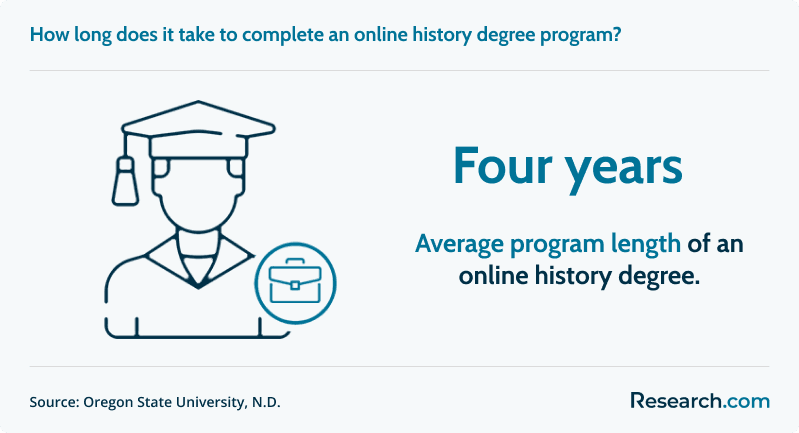
Most online bachelor’s degrees in history are designed to take about three to four years for full-time students, while part-time learners may need five to six years. The exact timeline depends on the number of accepted transfer credits, the program’s total credit requirement, course availability, and how many classes a student can take each term. Similar planning issues apply to other flexible social science programs, including an online degree in political science.
| Student Situation | Typical Timeline | What to Check Before Enrolling |
| First-time full-time student | 3 to 4 years | Total credits, general education requirements, term structure, and course sequencing |
| Part-time working adult | 5 to 6 years | Evening or asynchronous options, advising support, and maximum time-to-completion rules |
| Transfer student | Varies by accepted credits | Credit-transfer limits, residency requirements, and whether prior coursework applies to the major |
| Accelerated learner | Potentially shorter | Course load expectations, academic intensity, and availability of required history courses each term |
Online History Degree vs. On-Campus History Degree
Online and campus-based history programs usually cover similar academic foundations: historical interpretation, research methods, primary source analysis, writing, and regional or thematic history courses. The difference is mainly how students learn, interact, and access support. This same trade-off appears in other education-focused online programs, such as an online degree for elementary education.
| Factor | Online History Degree | On-Campus History Degree |
| Flexibility | Best for students balancing work, family, military service, or location constraints | Best for students who can attend scheduled in-person classes |
| Interaction | Discussion boards, video meetings, virtual advising, and online group projects | Face-to-face lectures, campus events, office hours, and in-person peer relationships |
| Research access | Digital libraries, online databases, scanned archives, and remote librarian support | Campus libraries, physical archives, museums, and local research collections |
| Best fit | Independent learners who can manage deadlines without daily classroom structure | Students who want a traditional campus environment and frequent in-person engagement |
Neither format is automatically better. The stronger choice is the one that fits your schedule, learning style, career goals, and support needs. Before choosing an online program, ask whether courses are asynchronous, how faculty feedback works, and whether online students receive the same library, tutoring, and career services as campus students.
How Much Does an Online History Degree Cost?
The average total cost for a four-year program is approximately $46,400, though students may pay anywhere from $33,000 to $69,000 depending on the school and related expenses. Per-credit costs typically range from $275 to $575, a cost structure students may also see when comparing programs such as a library science degree cost. The most affordable option is offered by Sterling College at $4,350, while some programs can cost as much as $88,800.
For school-year 2023-2024, Education Data reports that tuition for a private four-year program is around $35,248. Students should compare more than tuition alone. Technology fees, books, transfer-credit acceptance, residency requirements, and financial aid can significantly change the real out-of-pocket price.
| Cost Factor | Why It Matters | Question to Ask |
| Tuition per credit | Small per-credit differences become significant across 120, 124, 127, or 180 credits | Is the listed tuition the same for online, out-of-state, and part-time students? |
| Transfer credits | Accepted credits can reduce the number of courses you must pay for | How many credits can I transfer, and how many will count toward the major? |
| Fees | Online, technology, graduation, and course fees can raise total cost | What is the full estimated cost of attendance, not just tuition? |
| Financial aid | Grants, scholarships, and federal loans can lower upfront costs | What aid do online history students typically receive? |
Financial Aid Options for Online History Students
Students in eligible online history programs can often use the same major types of financial aid available to campus students. To begin, complete the Free Application for Federal Student Aid (FAFSA), which determines eligibility for federal student aid. Students considering graduate study later, including options such as online masters in communications programs, should also compare aid rules by degree level because undergraduate and graduate funding can differ.
- Federal grants: Need-based grants, including the Pell Grant and Federal Supplemental Educational Opportunity Grants (FSEOG), generally do not need to be repaid.
- Federal student loans: These loans can help pay for tuition, fees, books, and living expenses. Terms vary depending on whether loans are subsidized or unsubsidized.
- Private loans: Private lenders may offer education loans, but these often have different borrower protections and may carry higher interest rates than federal loans.
- Institutional scholarships and grants: Colleges may award aid based on academic performance, financial need, leadership, transfer status, military affiliation, or other criteria.
- Employer tuition assistance: Working adults should ask whether their employer reimburses tuition for approved degree programs.
Online History Degree Admissions Requirements
Admissions requirements vary by institution, but most online bachelor’s programs in history ask for evidence that applicants are prepared for college-level reading and writing. Requirements may be similar to other undergraduate or education-related pathways, including affordable degrees in elementary education online, although graduate-level programs have different standards.
- High school diploma or GED: Most bachelor’s programs require a completed high school credential or recognized equivalent.
- GPA requirements: Many programs set a minimum GPA, commonly ranging from 2.0 to 2.5, while more selective options may expect a GPA of 3.0 or higher.
- Standardized test scores: Some schools may request ACT or SAT scores, but many institutions have adopted more flexible admissions policies.
- Application documents: Applicants are usually asked to submit an application, official transcripts, and sometimes a personal statement or recommendation letters.
- Writing sample: Some programs may request a writing sample because history coursework depends heavily on reading, analysis, and written argumentation.
Common Courses in an Online History Degree
Online history curricula typically combine survey courses, regional history, research methods, historiography, and advanced electives. The best programs move beyond memorizing dates and require students to interpret sources, compare perspectives, evaluate arguments, and write clearly. Some programs also allow students to connect history with environmental, cultural, or policy questions, which may overlap with topics explored in online forestry degrees when studying environmental history.
| Course Area | What Students Learn | Why It Matters |
| World History I and II | Major global civilizations, movements, conflicts, and social changes | Builds broad historical context across regions and eras |
| American History | U.S. history from colonial origins through modern developments | Supports careers in teaching, civic education, public policy, and public history |
| European History | European societies from ancient Greece and Rome through modern periods | Provides context for political, cultural, intellectual, and military developments |
| Asian, African, and Latin American History | Regional histories, societies, empires, revolutions, and contemporary issues | Expands cultural literacy and helps students avoid a narrow historical lens |
| Historiography | How historians interpret the past and how interpretations change over time | Prepares students for advanced research and graduate-level historical thinking |
| Research Methods | Primary and secondary source analysis, citation practices, and research design | Develops practical skills for archives, policy research, writing, and graduate school |
| Historical Writing | Argument development, evidence use, structure, and analytical writing | Strengthens communication skills used across many professions |
| Special Topics | Focused study in areas such as military history, women’s history, cultural history, or environmental history | Allows students to tailor the degree to career interests or graduate study plans |
Can an Online History Degree Improve Earning Potential?
A history degree is not usually a direct path to one specific high-paying occupation, but it can improve earning potential when students use it strategically. The degree develops transferable skills—research, analysis, writing, documentation, interpretation, and communication—that employers use in many fields. Earnings often depend on the role pursued, location, experience, internships, graduate education, and whether the student pairs history with another marketable skill set.
Students who want stronger financial outcomes should consider combining history with practical areas such as digital humanities, archival management, public history, education, communication, public administration, law, or business. Comparing history with majors that make the most money can also help students set realistic expectations and identify complementary coursework that may improve career mobility.
How to Finance an Online History Degree Without Overpaying
Affordability should be evaluated before enrollment, not after the first bill arrives. The best approach is to estimate total program cost, subtract likely grants and scholarships, compare loan requirements, and calculate how transfer credits affect completion time. Students looking for lower-cost options can also compare the cheapest online history masters degree options if they are planning graduate study after the bachelor’s degree.
- File the FAFSA early. This is the gateway to federal grants, loans, and many institutional aid programs.
- Ask for a transfer-credit evaluation before enrolling. A school may accept credits generally but not apply all of them toward your history major.
- Compare total cost, not sticker price. Include fees, textbooks, technology requirements, and how long you expect to study.
- Look for history-specific scholarships. Departments, historical societies, and private organizations may support students pursuing history or public history.
- Consider part-time study carefully. Working while studying can reduce borrowing, but a longer timeline may affect motivation and total expenses.
- Check employer benefits. Some employers reimburse tuition for degrees that improve writing, research, communication, or public-facing skills.
History Degree Specializations to Consider
Specializations help students connect historical study to academic interests and career goals. Not every school offers formal concentrations, but many allow students to shape the degree through electives, research papers, internships, or capstone projects.
- American History: Focuses on U.S. political, social, cultural, economic, and constitutional development.
- European History: Examines Europe from classical civilizations through modern societies and conflicts.
- Asian History: Covers regions such as China, India, Japan, and other Asian societies.
- Latin American History: Studies Latin America from pre-Columbian societies through contemporary developments.
- African History: Explores African kingdoms, colonialism, independence movements, and modern challenges.
- Military History: Analyzes warfare, strategy, institutions, conflict, and the social effects of war.
- Women’s History: Investigates women’s roles, gender systems, activism, labor, family, and social change.
- Environmental History: Studies how humans and natural environments have shaped one another over time.
- Cultural History: Examines beliefs, art, literature, religion, music, identity, and everyday life.
- Public History: Prepares students to present history to public audiences through museums, archives, historic sites, and preservation work.
Why Accreditation and Academic Rigor Matter
Accreditation is one of the first checks students should make before applying. It signals that an institution has been reviewed against recognized academic and operational standards. Accreditation can affect credit transfer, financial aid eligibility, graduate school admission, and employer perception. Academic rigor matters just as much: a credible history program should require sustained reading, source evaluation, research writing, and faculty feedback.
Students who plan to continue beyond a bachelor’s degree should pay extra attention to research expectations and faculty expertise. Those interested in advanced scholarly routes may later compare online PhD programs, but doctoral preparation generally depends on strong undergraduate research and writing foundations.
Advanced Degree Options for History Graduates
History graduates can pursue graduate study in history, education, law, public administration, library science, museum studies, archival studies, communication, business, or public policy. The right graduate degree depends on the career target. For example, future educators may consider education leadership or teaching-focused pathways, while students interested in archives may look toward library and information science.
An online EdD program may appeal to history graduates who want to move into education leadership, curriculum design, or applied research roles. Before enrolling in any graduate program, compare curriculum focus, accreditation, admissions requirements, fieldwork expectations, faculty background, and career outcomes.
Digital Trends Changing Online History Education
Online history education is increasingly shaped by digital archives, searchable databases, virtual museum materials, collaborative annotation tools, and online discussion platforms. These tools can make primary-source research more accessible to students who are not near a major archive or campus library. Some programs also incorporate digital humanities skills, which can help students analyze historical materials using technology-supported methods.
Students interested in education-focused technology and leadership may also compare affordable EdD programs if they plan to move into curriculum, instructional design, or academic administration later.
Challenges of Earning a History Degree Online
Online history degrees offer flexibility, but they also require discipline. Students must keep up with heavy reading, long writing assignments, research deadlines, and independent work without the daily structure of a physical classroom. Limited face-to-face contact can also make networking more difficult unless students intentionally attend virtual events, contact faculty, and join professional organizations.
- Time management: History courses often require extensive reading and writing, so falling behind can quickly become difficult to fix.
- Research access: Online students should confirm they can access digital libraries, databases, interlibrary loan, and librarian help.
- Technology reliability: A stable internet connection and comfort with learning platforms are essential.
- Networking: Students may need to be proactive about internships, faculty meetings, alumni events, and online communities.
- Writing support: Strong programs should offer tutoring or writing center access for online learners.
Students who enjoy writing-intensive disciplines may also explore adjacent programs, including online creative writing degrees, as a way to strengthen narrative and communication skills.
Return on Investment: How to Judge an Online History Degree
The return on investment of an online history degree depends on the cost of attendance, how long it takes to graduate, the career path pursued, and whether the student builds applied experience during the program. A low-cost accredited program with strong transfer-credit acceptance may offer better value than a more expensive program with similar outcomes.
Students should not judge ROI by tuition alone. They should consider salary potential, graduate school plans, internship access, writing and research portfolios, employer tuition support, and the value of adding a complementary credential. Some graduates may later pursue 1 year master programs online to add career-specific expertise after completing a history degree.
Complementary Fields That Can Strengthen a History Career
History becomes more career-flexible when paired with another field. Writing, communication, education, public administration, digital humanities, library science, and data skills can help students translate historical training into specific job functions. For example, an online degree creative writing pathway can strengthen storytelling, editing, and audience engagement skills for students interested in publishing, museum interpretation, educational media, or cultural programming.
| Complementary Area | How It Helps History Students | Possible Career Direction |
| Education | Adds teaching methods, curriculum planning, and classroom-focused preparation | Teaching, curriculum design, educational programming |
| Communication | Improves public messaging, audience analysis, and media writing | Public relations, nonprofit communications, journalism, outreach |
| Library science | Builds skills in information organization, archives, records, and digital collections | Archives, records management, libraries, digital curation |
| Public administration | Connects historical analysis with policy, governance, and organizational leadership | Government, nonprofits, civic institutions, public policy |
| Creative writing | Strengthens narrative structure, clarity, and storytelling | Publishing, interpretation, content development, cultural media |
Student Support and Engagement in Online History Programs
Strong online programs do more than post lectures and assignments. They provide advising, library access, writing support, tutoring, career services, technical help, and ways to connect with faculty and classmates. Online learners should ask whether they can meet with advisors virtually, receive timely feedback on papers, participate in internships, and access alumni or career networks.
Students comparing education-related support structures may also review the cheapest online master's in education options to understand how online programs organize advising, field experience, and learner support across disciplines.
Can an Online History Degree Speed Up Career Advancement?
An online history degree can support career advancement when it helps a student complete a credential while continuing to work. The flexibility can be especially valuable for adults who need a bachelor’s degree for promotion, career change, graduate admission, or professional credibility. However, the degree alone does not guarantee faster advancement. Students should add internships, writing samples, research projects, certifications, or complementary skills that match target jobs.
For students who mainly want the fastest possible credential, comparing quick online degrees can help clarify whether history is the best fit or whether a more career-specific program would better match short-term goals.
How Online History Programs Are Adapting to Digital Work
Digital literacy is increasingly relevant in historical study. Online programs may use digital archives, electronic databases, virtual exhibits, citation tools, collaborative platforms, and research management software. These tools help students practice the kind of source discovery, documentation, and analysis used in archives, libraries, media, education, and research roles.
Students seeking higher-paying advanced pathways after a bachelor’s degree can compare history-adjacent graduate options with high paying master's degrees to understand how specialized graduate credentials may affect long-term opportunities.
Should You Combine History With Education?
Combining history with education can be a strong option for students who want to teach, design curriculum, work in museums, lead educational outreach, or develop public-facing historical programs. History provides content knowledge and analytical depth, while education coursework adds pedagogy, assessment, and learner-focused design. Students exploring this route can compare education degree programs online to see how teaching and curriculum preparation may complement a history major.
How to Choose the Best Online History Degree Program
The best online history degree is the one that fits your academic goals, budget, schedule, and career plan. Do not choose based on ranking position alone. Use rankings as a starting point, then verify program details directly with the school.
- Confirm accreditation: Check that the institution is accredited by a recognized accreditor, such as the Southern Association of Colleges and Schools Commission on Colleges (SACSCOC) or another appropriate regional accreditor.
- Review the curriculum: Look for courses in research methods, historiography, historical writing, regional history, and advanced electives that match your interests.
- Compare total cost: Evaluate tuition, fees, books, transfer credits, and aid. Students comparing affordability may also review the cheapest online political science programs for a related social science benchmark.
- Ask about transfer policies: Find out how many credits can transfer and whether they apply to general education, electives, or major requirements.
- Check faculty expertise: Faculty specializations matter if you want to study a particular region, period, or methodology.
- Evaluate online support: Confirm access to advising, library databases, research help, technical support, tutoring, and career services.
- Look for applied learning: Internships, capstones, digital projects, museum partnerships, or archival assignments can strengthen your resume.
- Research career outcomes: Use credible sources to review career opportunities for history graduates and compare them with your goals.
| Common Mistake | Why It Can Hurt You | Better Approach |
| Choosing the cheapest program without checking accreditation | Credits, aid eligibility, or employer recognition may be affected | Verify accreditation before comparing price |
| Looking only at tuition per credit | Fees, books, and extra required credits can raise the final cost | Request a full cost estimate for your expected enrollment plan |
| Assuming online means self-paced | Many online courses still have weekly deadlines | Ask whether classes are asynchronous, synchronous, or mixed |
| Ignoring transfer-credit rules | You may need to repeat courses or take more credits than expected | Get a written transfer evaluation before committing |
| Skipping career planning until senior year | History careers often require internships, portfolios, or graduate preparation | Build work samples and professional contacts early |
Career Paths for Online History Degree Graduates
History graduates can work in many fields because the degree develops skills that employers use across roles: research, writing, analysis, interpretation, documentation, and communication. Career outcomes vary widely, and some roles require graduate education, teacher certification, specialized training, or related experience.
- Teacher: Some graduates pursue history or social studies teaching, though licensure requirements vary by state and school level.
- Historian: Historians research, analyze, interpret, and communicate historical evidence, often in museums, government agencies, research organizations, or academic settings.
- Archivist: Archivists preserve, organize, and provide access to historical records, manuscripts, photographs, and institutional documents.
- Curator: Curators manage collections, exhibits, interpretation, and public education in museums or cultural organizations.
- Records manager: Records managers oversee organizational records, retention policies, compliance, and information systems.
- Research analyst: Graduates may use historical context, document analysis, and research methods in business, policy, nonprofit, media, or government settings.
- Communications specialist: History training can support work in public relations, content strategy, nonprofit messaging, and organizational communication. A communications salary may range from $45,000 to $75,000 annually, depending on experience and location.
According to data from the Bureau of Labor and Statistics cited in the original source material, a historian can earn $72,890 per year. Salary depends on role, education level, employer, experience, and location.
| Job | Salary |
| Historians | $72,890 |
| Archivists | $54,400 |
| Curators | $71,800 |
| Records managers | $133,400 |
| Researchers | $93,750 |
| Educators | $59,166 |
Resources for History Majors
History students should use academic and career resources early. Helpful resources may include university writing centers, online library databases, librarian consultations, citation tools, digital archives, historical associations, internship offices, alumni networks, and faculty mentoring. Students can also review Research.com’s guide to history majors for a broader look at degree options and career applications.
Job Market Outlook for Online History Graduates
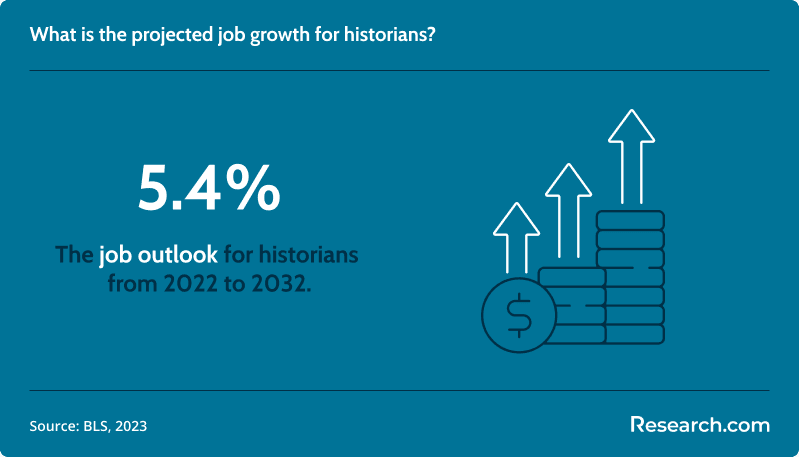
The job market for online history graduates includes education, research, cultural institutions, media and communication, government, nonprofits, and public history organizations. The cited outlook projects a 5.4% job growth for historians and related positions from 2016 to 2026. This indicates stable demand for professionals who can analyze, contextualize, and communicate historical information.
Students should remember that “history graduate” is not one single job category. Outcomes depend on chosen role, location, work experience, internships, graduate education, and technical skills. Students interested in public-sector leadership may later compare programs such as the cheapest online doctorate in public administration, although degree level and career fit should be reviewed carefully before enrolling.
How Employers View Online History Degrees
Employers are most likely to value an online history degree when it comes from an accredited institution and when the graduate can demonstrate relevant skills. For many roles, the format of the degree matters less than the credibility of the school, the student’s writing and research ability, internships, work experience, and fit for the position.
Students asking whether online degrees are worth it should focus on three practical questions: Is the school accredited? Does the program build skills employers or graduate schools recognize? Can I complete it at a cost that makes sense for my goals?
Networking and Mentorship in Online History Programs
Online students should not assume networking will happen automatically. Strong programs create structured ways to connect through faculty office hours, alumni events, discussion groups, internships, virtual career fairs, and student organizations. Working adults may also benefit from comparing flexible institutions, including cheap online colleges for working adults, when balancing school with employment.
Should You Add a Complementary Online Degree?
A second degree or graduate credential can make sense if it clearly supports a target career. Education can help future teachers and museum educators. Communication can support outreach and media roles. Public administration can help students move toward government or nonprofit leadership. Early childhood education may be relevant for students interested in children’s museums, cultural outreach, or educational programming; compare cheap early childhood education master's degrees online if that path fits your goals.
Can Library Science Strengthen a History Career?
Library science is one of the most practical complements to history for students interested in archives, records, digital curation, special collections, and information organization. Historical training helps students interpret records; library science adds systems for preserving, classifying, and providing access to information. To explore related outcomes, review what jobs can you get with a library science degree.
Can an Accelerated Associate Degree Help History Students?
An accelerated associate degree may help students build general education credits or foundational academic skills before entering a bachelor’s program. This route can be useful for students who want to lower costs, test online learning, or improve academic readiness. Students considering a shorter credential can review associate's degree online in 6 months options, but they should confirm whether credits will transfer into a future history bachelor’s program.
Can Interdisciplinary Study Improve Historical Research?
History benefits from interdisciplinary thinking. Courses in political science, sociology, anthropology, economics, literature, environmental studies, education, and communication can help students ask better research questions and interpret evidence from multiple perspectives. Students who want a broader academic structure may compare online interdisciplinary studies programs.
Student Perspectives on Online History Study
- Marian: "Earning a history degree online allowed me to keep working while studying a subject I cared about. The flexibility helped, but the workload still required planning and steady effort."
- Lenny: "I expected online classes to feel disconnected, but the discussions and faculty feedback made the experience more engaging than I anticipated. The writing and research skills have been useful in my work."
- Hannah: "Studying online helped me avoid relocation costs and continue my degree from home. For me, the format made college more realistic financially and logistically."
Can a Fast-Track Degree Shorten Online History Studies?
Accelerated programs can help disciplined students complete degree requirements more quickly, but speed should not come at the expense of research quality, writing development, or career preparation. A fast-paced format may be useful for transfer students, working adults with strong time-management skills, or learners who need a bachelor’s degree for advancement. Before enrolling, compare course load, writing expectations, term length, and support services. Students interested in accelerated formats can review fast track college degree options.
References:
- BLS. (2022). Historians: Occupational outlook handbook. U.S. BLS
- Hanson, M. (2023, August 23). Cost of online education vs. traditional education. Education Data Initiative
- Indeed Editorial Team. (2020, March 31). 10 popular history degree jobs. Indeed
- Salary.com. (2021). High school history teacher salary. Salary.com
- Sam Houston State University. (2021). Bachelor’s degree in history. SHSU
Key Insights
- An online history degree is strongest for students who want flexible study while building research, writing, analysis, and communication skills.
- Accreditation, transfer-credit rules, total cost, faculty expertise, and online student support should matter more than name recognition alone.
- Most full-time students complete a bachelor’s degree in three to four years, while part-time students may need five to six years.
- The average total cost for a four-year program is approximately $46,400, but actual costs can vary widely by institution, fees, aid, and accepted transfer credits.
- History graduates can pursue roles in teaching, archives, museums, research, communications, nonprofits, government, and public history, but some paths require additional credentials or graduate education.
- Students who want stronger career outcomes should add internships, writing samples, digital skills, or complementary study in education, communication, public administration, library science, or digital humanities.
- The best program is not simply the cheapest or highest ranked. It is the accredited option that fits your budget, schedule, learning style, transfer history, and career plan.
Other Things You Should Know About the Best Online History Degree Programs
Yes. Many accredited online history programs accept up to 60 transfer credits from regionally accredited colleges, and some require a minimum 2.0 or 2.5 GPA for transfer work. Upper-division history major courses are often completed at the degree-granting school.
Online history degree programs in 2027 typically require a reliable internet connection, a computer with updated operating systems, and specific software like Microsoft Office or digital learning platforms. Some programs may also require a webcam for interactive classes or assessments.
In 2027, many online history degree programs are accredited by recognized bodies such as the Accrediting Commission for Community and Junior Colleges (ACCJC) or the Higher Learning Commission (HLC). Accreditation ensures that programs meet specific educational standards and are widely accepted.








