
2027 Most Affordable Online Master's Degrees in Elementary Education

Co-Founder and Chief Data Scientist
Choosing an affordable online master’s degree in elementary education is usually a practical career decision, not just an academic one. Teachers and aspiring educators often want stronger instructional skills, a possible salary step increase, added endorsements, or a pathway into curriculum, literacy, coaching, or school leadership roles—but they also need to avoid taking on unnecessary debt. This guide explains what an online master’s in elementary education can realistically do for your career, how much the listed programs cost, how to compare online and campus options, what accreditation and licensure issues to check, and which questions to ask before enrolling.
Quick Answer: Is an Affordable Online Master’s in Elementary Education Worth It?
An affordable online master’s in elementary education can be worth it for licensed teachers who want advanced classroom skills, endorsement options, leadership preparation, or possible salary movement. It can also help career changers when the program is designed for initial licensure. The best choice depends on three things: whether the program is accredited, whether it meets your state’s licensure or endorsement rules, and whether the total cost is reasonable compared with your expected career benefit.
What are the benefits of getting an online master's degree in elementary education?
- More career options: A graduate degree can support movement into specialized teaching, literacy support, instructional coaching, curriculum work, or some administrative pathways.
- Potential salary value: Wage gap reports from Zippia and the BLS indicate that teachers with a master's degree make approximately 25% more than teachers with a bachelor's degree, although individual pay depends on district contracts, state salary schedules, experience, and role.
- Flexible study format: Online programs can reduce relocation and commuting costs while allowing working educators to continue teaching during the degree.
- Classroom impact: Graduate coursework often focuses on literacy, assessment, classroom management, curriculum design, technology integration, and support for diverse learners.
What can I expect from an affordable online master's degree in elementary education?
An online master’s in elementary education is designed to deepen a teacher’s ability to plan instruction, assess student learning, manage classrooms, adapt lessons for different learners, and use research-based teaching strategies. Some programs are built for already licensed teachers who want professional advancement. Others are transition or initial-licensure programs for students who hold a bachelor’s degree but are not yet licensed in elementary education.
Graduates may remain in traditional K–6 classrooms, move into reading or STEM-focused roles, support curriculum development, work in private or charter schools, or pursue educational consulting. The degree may also serve as preparation for future leadership study, including affordable online master’s programs in educational leadership or doctoral-level work.
| Program feature | What it means for you | Why it matters |
| Licensure track | May prepare unlicensed students for teacher certification or help licensed teachers add endorsements | Licensure requirements vary by state, so this is one of the first details to verify |
| Advanced teaching coursework | Usually includes literacy, assessment, classroom management, curriculum, research, and inclusive teaching | These courses should connect directly to the realities of elementary classrooms |
| Fieldwork or practicum | Some programs require supervised classroom experience, internship work, or performance tasks | Field requirements can affect scheduling, especially for out-of-state online students |
| Online delivery platform | Programs may use Blackboard, Brightspace, Moodle, or another learning system | The platform affects weekly participation, assignments, discussion boards, and access to faculty |
| Capstone, exam, or final project | Many programs end with a comprehensive exam, practicum, portfolio, or applied project | The final requirement should align with your career goals and state expectations |
Where can I work with an affordable online master's degree in elementary education?
Most graduates work in elementary and secondary schools. According to the Bureau of Labor Statistics, elementary and secondary schools are the largest employers in this field, employing 85% of elementary school teachers and 81% of kindergarten teachers locally, and 13% and 15% privately. California, Texas, and New York are among the states with the most employment opportunities for these teachers. Zippia also reports notable demand in New York, with 101 current job openings.
Common employment settings include:
- Public schools: The most common setting for elementary educators, often with structured salary schedules, benefits, tenure rules, and district-based advancement opportunities.
- Private schools: Requirements vary by school, but some private institutions value graduate preparation, specialized teaching skills, or experience with specific curricula.
- Charter schools: These schools may offer classroom, intervention, curriculum, or instructional leadership roles depending on their model and state regulations.
- Child day care services: Some graduates use their elementary education background in early learning or child care settings, especially when their coursework includes developmentally appropriate instruction.
- Government and nonprofit organizations: Education-focused agencies and nonprofits may hire graduates for program design, outreach, family engagement, teacher training, or curriculum support.
How much can I make with an affordable online master's degree in elementary education?
Salary depends heavily on state, district, years of experience, licensure, union contracts, and whether the graduate remains in the classroom or moves into a specialized or leadership role. The BLS reported that, as of May 2022, elementary school teachers, except special education, earned a median annual wage of $61,690. Kindergarten teachers earned a median annual wage of $60,490.
Location can make a major difference. California, New York, and Washington are among the highest-paying states for teachers, and California has the highest average annual salary for elementary school teachers at $90,470. Large metropolitan areas may also offer higher wages: New York-Newark-Jersey City, NY-NJ-PA, reported an average annual salary of $91,100, while Los Angeles-Long Beach-Anaheim, CA, reported $93,310.
| Career or salary factor | Figure stated in the source material | How to interpret it |
| Elementary school teacher median annual wage | $61,690 | National median wages are useful for context but do not predict your local salary schedule |
| Kindergarten teacher median annual wage | $60,490 | Pay varies by employer, state, and years of service |
| California average annual salary for elementary school teachers | $90,470 | High-paying states may also have higher living costs and different licensure rules |
| New York-Newark-Jersey City, NY-NJ-PA average annual salary | $91,100 | Metro wages can exceed national medians but may come with stronger competition |
| Los Angeles-Long Beach-Anaheim, CA average annual salary | $93,310 | Local district salary schedules matter more than national averages when estimating ROI |
- 2027 best affordable online master's degrees in elementary education
- Should you start with an online bachelor’s teaching degree?
- How long does an online master's in elementary education take?
- Online versus on-campus master’s programs
- Average cost of affordable online programs
- Financial aid options for graduate education students
- Admission requirements and prerequisites
- Common courses in elementary education master’s programs
- Current trends shaping online master’s in teaching programs
- Available specializations and endorsements
- How to choose the right affordable online program
- Career paths after graduation
- Common challenges in online graduate study
- Comparing cost and value with other fields
- Using creative disciplines in elementary classrooms
- Career support and post-graduation planning
- How to evaluate return on investment
- Why accreditation matters
- How special education training improves instruction
- Leadership training for experienced teachers
- Next steps after a master’s in elementary education
2027 Best Affordable Online Master's Degrees in Elementary Education
The programs below are examples of lower-cost online master’s options in elementary education. When comparing them, look beyond the per-credit price. A program that appears inexpensive may cost more if it requires extra credits, has out-of-state tuition differences, includes travel or field placement expenses, or does not meet your state’s licensure requirements. If you are still completing undergraduate preparation, Research.com also provides information on an elementary education degree online.
How do we rank schools?
Research.com evaluates programs using institutional and program data from recognized education sources. You can review the ranking process in our methodology section. Sources used for the broader analysis include:
- IPEDS database
- Peterson’s database
- Distance Learning Licensed Data Set, College Scorecard database
- National Center for Education Statistics
| School | Online program | Credits | Per-credit cost | Best fit |
| Fort Hays State University | Master of Science in Education with an elementary education focus | 36 | $319.45 | Students seeking a Kansas-connected transition, traditional certification, or endorsement pathway |
| Fitchburg State University | Master of Education in Elementary Education 1-6 | 39 | $347.00 | Bachelor’s degree holders pursuing Massachusetts initial teaching licensure |
| Missouri State University | M.S. in Education - Elementary Education | 36 | $348 | Certified teachers who want a flexible, customizable graduate program |
| Columbus State University | Online M.Ed. in Elementary Education | 30 | $393 in-state and $1,125 for out-of-state plus all mandatory fees | Georgia educators with a T-5 certificate and teaching experience seeking a T-6 certification upgrade |
| Southeast Missouri State University | Master of Arts in Elementary Education | 30 | $409.50 | Teachers interested in Early Childhood, Math/Science, or Reading concentrations |
1. Fort Hays State University
Fort Hays State University offers an online Master of Science in Education with an elementary education emphasis delivered through Blackboard. The program serves different groups, including unlicensed candidates and educators who already hold a non-elementary license. Students complete 36 credit hours, usually over about two years, and take courses such as Advanced Literacy, Classroom Management, and Technology Use. The degree also includes a comprehensive exam and practicum. Students outside Kansas should confirm how Kansas certification transfers to their own state before enrolling.
- Program Length: Approximately two years
- Tracks/Concentrations: Elementary Education PreK-6 Transition to Teaching (ELED T2T) for candidates with a sponsoring school district in Kansas; Elementary Education PreK-6 Traditional Certification for candidates without a sponsoring district; Track 3: Elementary Education PreK-6 for currently licensed teachers looking to add an elementary education endorsement
- Per Credit Cost: $319.45
- Required Credits to Graduate: 36
- Accreditation: Higher Learning Commission
2. Fitchburg State University
Fitchburg State University offers an online Master of Education in Elementary Education 1-6 through Blackboard. The program is intended for students with a bachelor’s degree who are seeking Massachusetts teaching licensure. Students complete 39 credits over as short as two-and-a-half years, including coursework in Child Development and Sheltered English Immersion, plus required field experiences and assessments. FSU anticipated accreditation from the Association for Advancing Quality in Educator Preparation by fall 2023.
- Program Length: As short as two-and-a-half years
- Tracks/Concentrations: N/A
- Per Credit Cost: $347.00
- Required Credits to Graduate: 39
- Accreditation: Association for Advancing Quality in Educator Preparation (AAQEP)
3. Missouri State University
Missouri State University provides an online M.S. in Education - Elementary Education for certified teachers. The program is flexible and self-paced, and students can customize half of their coursework around their professional goals. Students complete 36 credit hours, may finish in approximately two years, and use Blackboard for online learning. Coursework may include Instructional Coaching, and the program requires a final project and internship. It may also support preparation for doctoral study.
- Program Length: Approximately two years
- Tracks/Concentrations: N/A
- Per Credit Cost: $348
- Required Credits to Graduate: 36
- Accreditation: Missouri Department of Elementary & Secondary Education
4. Columbus State University
Columbus State University in Georgia offers an online M.Ed. in Elementary Education for educators who already have a T-5 certificate and teaching experience. The 30-credit program takes approximately two and a half years and includes coursework such as Community-Based STEM Education through Brightspace LMS. Students complete three professional tasks, and graduates may qualify for a T-6 certification upgrade.
- Program Length: Approximately two and a half years
- Tracks/Concentrations: N/A
- Per Credit Cost: $393 in-state and $1,125 for out-of-state plus all mandatory fees
- Required Credits to Graduate: 30
- Accreditation: Southern Association of Colleges and Schools Commission on Colleges (SACSCOC) and Georgia Professional Standards Commission
5. Southeast Missouri State University
Southeast Missouri State University offers an online Master of Arts in Elementary Education for teachers pursuing professional development and possible licensure renewal. The 30-credit program can be completed in as short as two-and-a-half years and includes concentrations in Early Childhood, Math/Science, and Reading. Courses such as Multicultural Curriculum Construction and Literacy Leadership are delivered through Moodle. Students complete practicum requirements and may pursue optional specialist certifications.
- Program Length: As short as two-and-a-half years
- Tracks/Concentrations: Early Childhood, Math/Science, and Reading
- Per Credit Cost: $409.50
- Required Credits to Graduate: 30
- Accreditation: National Council for the Accreditation of Teacher Education (NCATE)
What Graduates Often Value in Online Master’s Programs
Graduates of online elementary education master’s programs commonly point to three advantages: the ability to keep teaching while studying, immediate classroom application of new strategies, and access to faculty and peers outside their local school system. These benefits are strongest when the program includes active instructor feedback, practical assignments, and field experiences that connect directly to elementary classrooms.
Key Findings
- Teachers with a master's degree make approximately 25% more than teachers with a bachelor's degree, according to the cited wage gap reports from Zippia and the BLS.
- Over 40 years, the degree's average ROI climbs to 46.4%, with lifetime earnings reaching $3.13 million against education expenditures of $334,312.
- The number of 25–29-year-olds with degrees in education is going down by 0.8% each year, while demand for educators remains strong in some places, including New York, NY.
- The unemployment rate for people with an education degree is 57.7% lower than the rate for people with a bachelor's degree.
- A bachelor's degree is the most common credential among teachers at 65%, while 17% hold a master's degree.
- Many K–12 teachers consider leaving because of pay and workload, but nearly two-thirds of those considering leaving chose to stay in education, showing that many educators remain committed despite workplace pressures.
Should you start with an online bachelor’s teaching degree?
If you do not already have a bachelor’s degree or teacher preparation background, an online bachelor’s teaching degree may be the correct first step before graduate study. A bachelor teaching degree online can provide the foundational coursework and, in many cases, the teacher certification preparation needed for entry into elementary education.
| If your current status is... | Best next step | Why |
| No bachelor’s degree | Begin with an accredited bachelor’s program in education or a related teacher preparation path | Most master’s programs require a completed undergraduate degree |
| Bachelor’s degree in another field | Look for an initial-licensure master’s or transition-to-teaching program | Some graduate programs are designed for career changers |
| Licensed teacher | Choose a master’s program aligned with endorsement, salary, or leadership goals | You may not need an initial certification track |
| Teacher seeking faster advancement | Compare master’s programs with endorsement, literacy, STEM, special education, or leadership options | Specialized study can make the degree more useful than a general program |
Undergraduate programs typically introduce educational psychology, classroom management, curriculum planning, assessment, instructional methods, and field experience. They can also help students prepare for graduate-level research and writing. If cost is your main concern, compare public university options, transfer policies, and programs listed among the most affordable online education degrees.
How long does it take to complete an affordable online master's degree in elementary education?
Many online master’s degrees in elementary education take about two to two and a half years, depending on credit load, fieldwork, licensure requirements, and whether the student enrolls full time or part time. This timeline is similar to many high-quality but cheap online graduate courses for teachers.
Fort Hays State University and Missouri State University list program lengths of approximately two years. Fitchburg State University and Southeast Missouri State University list completion in as short as two-and-a-half years. Columbus State University’s program takes approximately two and a half years. Students should ask whether summer courses are available, whether fieldwork can be completed in their own school, and whether part-time enrollment changes financial aid eligibility.
| Timeline factor | How it can affect completion |
| Number of required credits | Programs in this guide require 30, 36, or 39 credits |
| Licensure requirements | Initial-licensure programs may include more fieldwork and assessments |
| Teaching schedule | Working teachers may need part-time enrollment during the school year |
| Course availability | Some required courses may run only in certain terms |
| Capstone, exam, or practicum | Final requirements can add planning time near graduation |
How do affordable online master's degrees in elementary education compare to an on-campus program?
Online and on-campus master’s programs can have comparable academic value when the institution is properly accredited, the curriculum is rigorous, and the program meets licensure or endorsement requirements. The main differences are usually schedule, location, networking format, field placement logistics, and cost structure.
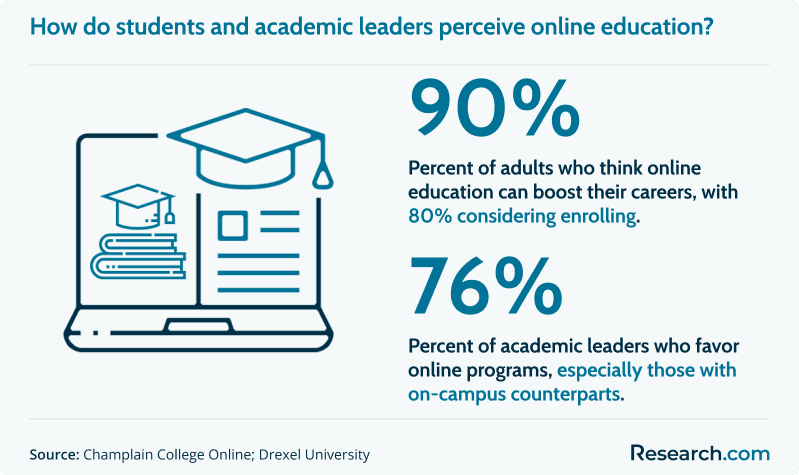
Champlain College Online reported that 90% of adults believe online education can support career advancement, while 80% would consider enrolling in such programs. The same source reported that 76% of academic leaders value online programs, especially those connected to campus-based institutions. Drexel University also notes that an online degree from an established university can be as valuable as a traditional degree. Champlain College Online data also show that the perceived value of online degrees compared with on-campus degrees has grown by 20% since 2017.
| Comparison point | Online master’s | On-campus master’s |
| Schedule | Often designed for working teachers with asynchronous or hybrid coursework | May require scheduled evening, weekend, or daytime campus attendance |
| Location | No relocation required, but fieldwork rules may still apply locally | Best for students who live near campus or want in-person access |
| Cost | Can reduce commuting and relocation expenses | May include campus fees, travel, or housing costs |
| Networking | Built through discussion boards, cohort meetings, virtual advising, and online projects | Built through face-to-face classes, campus events, and local placements |
| Licensure fit | Must be checked carefully for your state | Often designed around the state where the campus is located |
The image below shows how many adults and educators recognize online education as a credible route for career development and academic innovation.
What is the average cost of an affordable online master's degree in elementary education?
The lowest-cost programs in this guide cluster around the low $300s per credit, though total cost depends on credit requirements and residency status. Fort Hays State University charges $319.45 per credit for 36 credits, or about $11,500. Fitchburg State University charges $347.00 per credit for 39 credits, or about $13,500. Southeast Missouri State University charges $409.50 per credit for 30 credits, or $12,285. Missouri State University charges $348 per credit, while Columbus State University charges $393 in-state and $1,125 for out-of-state plus all mandatory fees.
For context, College Tuition Compare lists traditional graduate tuition in this field at $11,184 for in-state students and $19,468 for out-of-state students. Online programs can be cost-competitive, but students should calculate total program cost, not only per-credit tuition.
| School | Credits | Per-credit cost stated | Approximate tuition figure stated |
| Fort Hays State University | 36 | $319.45 | about $11,500 |
| Fitchburg State University | 39 | $347.00 | about $13,500 |
| Southeast Missouri State University | 30 | $409.50 | $12,285 |
| Missouri State University | 36 | $348 | about $10,440 |
| Columbus State University | 30 | $393 in-state and $1,125 for out-of-state plus all mandatory fees | about $11,790 for in-state tuition |
What are the financial aid options for students enrolling in online master's degrees in elementary education?
Financial aid can make the difference between a sensible investment and an unaffordable degree. People with a master's degree, including graduates of related programs such as educational psychology masters, usually owe $31,130 in student loans. Because debt can reduce the value of any salary increase, students should compare aid packages before committing.
- Federal student loans: Graduate students may qualify for federal loans such as the Direct Unsubsidized Loan, regardless of financial need.
- Scholarships and grants: These do not need to be repaid and may be offered by universities, districts, professional associations, nonprofits, or private organizations.
- Work-study: Some schools offer part-time work opportunities that can help students offset costs while enrolled.
- Employer tuition assistance: Districts and employers may provide tuition reimbursement or professional development funding.
- Military education benefits: Active-duty service members, veterans, and eligible family members may be able to use GI Bill® benefits or other military aid.
Ways to reduce your total cost
- Ask whether online students pay the same tuition regardless of residency.
- Confirm whether fees are charged per credit, per term, or per program.
- Ask if transfer graduate credits are accepted.
- Compare 30-credit programs with 36- or 39-credit programs carefully.
- Check whether your district offers salary advancement only for certain accredited or approved programs.
What are the prerequisites for enrolling in affordable online master's degrees in elementary education?
Admission requirements vary by institution and track. Initial-licensure programs may have different prerequisites than programs designed for already licensed teachers. Applicants may be asked to provide the following:
- Bachelor's degree: Most programs require a completed undergraduate degree, often in education or a related field. Applicants may come from general education, an online physical education bachelor's degree online, or an undergraduate elementary pathway such as the cheapest online elementary education degree.
- Minimum GPA: Many programs expect an undergraduate GPA around 3.0.
- Letters of recommendation: Schools may request recommendations from supervisors, faculty, or education professionals who can speak to the applicant’s potential.
- Goal statement: A written statement may be required to explain teaching goals, motivation, and professional fit.
- Prerequisite courses: Some programs require prior coursework such as English composition and college-level math with minimum grades.
- Teaching experience or licensure: Some programs require current teacher certification or classroom experience, while initial-licensure programs may not.
- Standardized test scores: Depending on the school, applicants may need GRE scores or state-specific educator licensure exam results.
What courses are typically included in affordable online master's degrees in elementary education?
Graduate elementary education courses build on undergraduate teacher preparation and focus on advanced instructional decision-making. Students who already completed an affordable early childhood education degree online may recognize some themes, but master’s-level courses usually require more research, analysis, and classroom application.
- Research Methods in Education: Teaches educators how to read, evaluate, and apply educational research.
- Advanced Classroom Management: Focuses on creating structured, respectful, and productive elementary learning environments.
- Literacy for Elementary Grades: Covers reading and writing instruction, assessment, and intervention strategies.
- Curriculum Integration: Examines how to connect subjects and design cohesive learning experiences.
- Mathematics and Science for Elementary Grades: Develops advanced methods for teaching STEM concepts to young learners.
- Diverse & Exceptional Learners: Prepares teachers to support students with varied abilities, language backgrounds, and learning needs.
How are recent education trends shaping online master's in teaching programs?
Online elementary education master’s programs are increasingly shaped by classroom realities: technology use, hybrid learning, teacher workload, inclusive instruction, and student well-being. Many online master's in teaching programs now include coursework on digital tools, instructional technology, virtual collaboration, and online assessment because teachers are expected to use learning platforms and digital resources effectively.
Social-emotional learning is also influencing graduate coursework. Teachers need strategies for classroom climate, student motivation, self-regulation, and relationship-building, especially when students arrive with different academic and emotional needs. Inclusive education remains another major focus, with programs adding content on students with disabilities, English language learners, culturally responsive teaching, and differentiated instruction.
AI and education technology are also changing expectations for teachers. Programs that address responsible technology use, lesson design, student data, academic integrity, and adaptive learning tools may better prepare graduates for modern classrooms. Students should ask programs how often curriculum is reviewed and whether faculty have current K–12 experience.
What types of specializations are available for affordable online master's degrees in elementary education?
Specializations help teachers align graduate study with a specific classroom need or career goal. Common options include:
- Early Childhood Education: Emphasizes child development and instruction for young learners, often from birth through third grade.
- STEM Education: Focuses on science, technology, engineering, and mathematics instruction for elementary students.
- Reading and Literacy: Builds advanced skills in reading assessment, literacy intervention, and writing instruction.
- Special Education: Prepares teachers to support students with disabilities and other learning differences in inclusive classrooms.
- English as a Second Language (ESL): Develops skills for supporting English language learners through language acquisition and culturally responsive instruction.
Some students may be better served by a more targeted degree. For example, educators focused on younger learners may compare an early childhood education degree, while teachers moving toward administrative work may consider the cheapest online masters educational leadership programs.
How to Choose the Best Affordable Online Master's Degrees in Elementary Education
The best program is not always the cheapest one. A strong choice should be affordable, accredited, aligned with your state’s licensure rules, realistic for your schedule, and relevant to your career goal. The source material notes that only 164 graduate schools offer these programs, so students should compare options carefully rather than assuming every online education degree will meet the same professional requirements.
| Decision factor | Questions to ask before enrolling |
| Accreditation | Is the university institutionally accredited? Is the educator preparation program approved for my state or credential goal? |
| Licensure alignment | Does this program lead to initial licensure, endorsement, renewal, salary advancement, or only a graduate degree? |
| Total cost | What is the full tuition, including fees, textbooks, technology costs, and field placement expenses? |
| Format | Are courses asynchronous, synchronous, hybrid, cohort-based, or self-paced? |
| Fieldwork | Can I complete practicum or internship requirements in my local school or district? |
| Faculty and support | Do online students receive advising, library access, technology support, and career services? |
| Specializations | Does the program offer a track in literacy, STEM, special education, ESL, or early childhood if that is my goal? |
Who should choose this degree?
- Licensed teachers who want advanced instructional skills and possible salary advancement.
- Career changers who find an initial-licensure program approved for their state.
- Teachers who want to specialize in reading, STEM, ESL, early childhood, or inclusive instruction.
- Educators who need an online format because of work, family, or location constraints.
Who should consider a different path?
- Students without a bachelor’s degree should begin with undergraduate teacher preparation.
- Teachers who want principal roles may need educational leadership preparation instead.
- Educators focused only on special education may benefit from a dedicated program such as the cheapest online masters in special education.
- Students who need the fastest possible route should compare approved accelerated pathways, including a teaching accelerated program.
What career paths are available for graduates of affordable online master's degrees in elementary education?
A master’s in elementary education can support classroom advancement and open doors to specialized roles, depending on licensure, experience, district rules, and additional endorsements. Students with only an undergraduate credential, such as an online bachelor of education, may eventually need graduate study or certifications for some advanced roles.
| Career path | Typical focus | Salary range stated in the source material |
| Elementary School Teacher | Teach K–6 students, plan lessons, assess learning, and manage classroom instruction | $40,000 to $60,000 |
| Reading Specialist | Support reading growth through assessment, small-group instruction, and literacy intervention | $45,000 to $65,000 |
| Instructional Coordinator | Design curriculum, train teachers, review instructional materials, and evaluate programs | $50,000 to $75,000 |
| School Administrator | Oversee school operations, staff, policies, and instructional goals | $75,000 to $100,000+ |
| Educational Consultant | Advise schools, nonprofits, publishers, or education companies on teaching and curriculum | $60,000 to $90,000 |
The chart below shows how earning potential can rise with advanced education.
What is the job market for graduates with an affordable online master's degree in elementary education?
The job market for kindergarten and elementary school teachers is stable but not fast-growing. The BLS projects 1% growth from 2022 to 2032 for kindergarten and elementary school teachers. Even with limited growth, the field is expected to have about 109,000 openings yearly, largely because workers retire or move into other careers.
Graduate education can help teachers compete for specialized opportunities, especially in areas such as special education, STEM, literacy, and instructional support. However, a master’s degree does not guarantee employment or a specific salary. Local teacher shortages, district budgets, certification rules, and state salary schedules will affect outcomes.
Common Challenges in an Online Master’s Program—and How to Handle Them
Online graduate study can be demanding because students often juggle teaching, family responsibilities, coursework, practicum requirements, and technology platforms. The most common challenges are time management, isolation, unclear field placement expectations, and difficulty staying motivated during asynchronous courses.
| Challenge | Better approach |
| Underestimating weekly workload | Ask the program how many hours students typically spend per course each week |
| Feeling disconnected | Choose programs with cohort interaction, live faculty access, peer groups, or virtual study sessions |
| Technology problems | Confirm technical support hours and platform requirements before classes begin |
| Fieldwork conflicts | Ask whether placements can be completed at your current school or in your home state |
| Losing momentum | Use term-by-term degree plans and set assignment milestones early |
How Does the Cost and Value of an Elementary Education Degree Compare with Other In-Demand Fields?
Comparing graduate degrees across fields can clarify whether an elementary education master’s fits your financial and career goals. Look at tuition, time to completion, licensure value, salary expectations, employer demand, and whether the degree is required for the role you want. For example, students comparing education with information-focused careers may review the library science degree online cost and the master's in library science online cost to understand how program prices and career pathways differ.
The key is not to choose the lowest tuition automatically. Choose the credential that is most likely to support your target role while keeping debt manageable.
How Can Integrating Creative Disciplines Enhance Classroom Innovation?
Elementary teachers often benefit from creative instructional strategies because young learners respond to stories, movement, art, discussion, and hands-on activities. Creative writing, for example, can strengthen literacy, communication, sequencing, vocabulary, and student voice. Teachers who want deeper training in writing-centered instruction may explore related resources on creative writing online degrees or compare flexible completion options such as the fastest creative writing degree online.
How Do Career Support Services Enhance Your Post-Graduation Success?
Career support matters because many teachers pursue a master’s degree while planning a specific move: salary advancement, endorsement, instructional coaching, reading support, curriculum work, or administration. Strong online programs provide advising, resume support, licensure guidance, interview preparation, alumni networks, and job-search resources tailored to educators. Before enrolling, ask whether career services are available to online students and whether advisors understand teacher salary schedules, state certification rules, and district hiring practices.
How Can You Evaluate the Return on Investment of an Affordable Online Master’s Degree?
Return on investment should be calculated using your likely local outcome, not national averages alone. Compare total program cost with expected salary movement, district pay lanes, endorsement value, career advancement potential, and long-term debt. A program may be affordable on paper but less valuable if it does not qualify you for the credential, salary step, or role you want.
- Find the full program cost, including tuition, fees, books, technology, and fieldwork expenses.
- Ask your district or state whether the degree qualifies for salary advancement, renewal, or endorsement.
- Compare program length and credit requirements.
- Estimate loan payments before borrowing.
- Confirm whether the degree supports your target role, such as reading specialist, instructional coordinator, or administrator.
- Compare alternatives, including certificates, endorsements, or lower-cost public university programs.
How does accreditation influence program success?
Accreditation is one of the most important quality checks for online education degrees. Institutional accreditation helps verify that the university meets recognized academic standards. Program approval or educator preparation accreditation can also matter for licensure, endorsements, financial aid, and transfer credit. Students should never assume that an online program automatically meets certification rules in their state.
To understand how education credentials differ, review Research.com’s guide to education degree options. Then verify accreditation directly with the university, the accreditor, and your state education agency.
How Can Special Education Components Enhance Overall Teaching Effectiveness?
Special education training can improve any elementary teacher’s practice because inclusive classrooms require differentiation, behavior support, individualized instruction, collaboration with specialists, and legal awareness. Even teachers who do not plan to become special education teachers benefit from understanding accommodations, interventions, and student support plans. If this is your primary career goal, compare a general elementary education master’s with a dedicated special education master’s before enrolling.
How Can Advanced Leadership Training Elevate Your Teaching Career?
Teachers who want to move into department leadership, curriculum coordination, coaching, assistant principal roles, principal roles, or district-level work may need leadership preparation beyond elementary education coursework. Leadership programs typically focus on policy, supervision, school improvement, data-informed decision-making, staff development, and organizational strategy. Experienced educators considering system-level impact may compare options such as an Ed D in educational leadership online.
What are the next steps for specialization after a master’s in elementary education?
A master’s degree can be a strong foundation, but many educators continue building specialized credentials after graduation. The right next step depends on whether you want to deepen classroom expertise, move into leadership, or shift into consulting or curriculum work.
- Doctorate in Educational Leadership: Educators interested in district leadership, policy, curriculum direction, or system-level change may consider doctoral study. A cheapest online doctorate in educational leadership pathway may help reduce the cost of this advanced credential.
- Specialized certifications in literacy, STEM, or ESL: These shorter credentials can sharpen expertise in high-need instructional areas and may be more targeted than another full degree.
- National Board Certification: National Board Certified Teacher status is a respected professional credential and may come with financial incentives in some districts.
- Educational consulting and curriculum development: Experienced teachers can use graduate training to advise schools, nonprofits, publishers, or education companies on instructional materials and teaching strategies.
Common Mistakes to Avoid
- Choosing by tuition alone: Low per-credit tuition does not always mean the lowest total cost.
- Ignoring accreditation: Accreditation can affect financial aid, employer recognition, credit transfer, and licensure eligibility.
- Assuming online programs meet every state’s licensure rules: Always verify with your state education agency before enrolling.
- Overlooking fieldwork requirements: Practicum or internship rules can create scheduling and placement challenges.
- Relying only on rankings: Rankings can help narrow options, but your best program depends on licensure fit, cost, support, and career goals.
- Assuming salary increases are automatic: Salary movement depends on district policy, contracts, state rules, and role changes.
Key Insights
- An affordable online master’s in elementary education is most valuable when it aligns with your state licensure rules, district salary policy, and specific career goal.
- The listed programs range from 30 to 39 credits, and per-credit tuition alone does not show the full cost.
- Online programs can be as credible as campus programs when they are properly accredited and professionally aligned.
- Salary potential varies widely by location, employer, experience, and role; national averages should be used only as a starting point.
- Teachers seeking advancement should compare specializations such as literacy, STEM, ESL, early childhood, and special education before choosing a general track.
- The smartest enrollment decision is practical: verify accreditation, confirm licensure fit, calculate total cost, ask about fieldwork, and compare expected career value before applying.
References:
- Bryant, J., Ram, S., Scott, D., & Williams, C. (2023, March 2). K–12 teachers are quitting. What would make them stay? McKinsey & Company.
- Data Reveals New Insights on Online Higher Education Post-Pandemic. (2023, November 9). Champlain.edu.
- Education pays, 2022: Career Outlook. U.S. Bureau of Labor Statistics. (2023, May 5).
- Educator Demographics and Statistics [2024]: Number of Educators in the US. (2021, January 29). Zippia.com.
- Elementary School Teachers, Except Special Education. (2023, April 25). Bls.gov.
- Field of degree: Education: Occupational Outlook Handbook. U.S. Bureau of Labor Statistics. (2023, September 6).
- Hanson, M. (2021, December 9). Is College Worth it? | Return on Investment Analysis of College Degree. Education Data Initiative.
- Kindergarten and Elementary School Teachers: Occupational Outlook Handbook. U.S. Bureau of Labor Statistics. (2023, September 6).
- McNair, K. (2023, March 16). New bill in Congress would give U.S. teachers a $60,000 minimum wage—these 5 states currently pay teachers best. CNBC.
Other Things You Should Know About Online Master's Degrees in Elementary Education
In 2027, students pursuing an online master's in elementary education need a reliable computer with high-speed internet, a webcam, and software like Microsoft Office. Certain programs may require specific digital tools for interactive activities or virtual classrooms.
Most affordable online master's programs in elementary education can be completed in approximately 18 to 24 months in 2027. Programs typically require around 30 to 36 credit hours, depending on the institution's specific curriculum and structure.
Most states require a valid teaching license plus a state-approved elementary education master's program or endorsement for advanced placement. Licensure is issued by the state education department, and many states also require passing Praxis content or pedagogy exams before adding graduate-level credentials.


