
2027 Fastest Online Creative Writing Degree Programs

Co-Founder and Chief Data Scientist
Choosing a fast online creative writing degree is really a pacing decision: you want a program that helps you finish sooner without reducing your time in workshops, revision, reading, and portfolio development. The right program can help you build a stronger writing practice, earn a recognized credential, and prepare for writing-related roles in publishing, marketing, media, education, entertainment, nonprofit work, and digital content.
This guide is for students who want an online creative writing degree but need flexibility because of work, family, military service, caregiving, or location. It explains what accelerated online creative writing programs include, how long they take, how they compare with campus programs, what they cost, how to evaluate accreditation and career value, and which questions to ask before enrolling.
Fast does not always mean better. A shorter course format can help motivated students move quickly, but writing still requires feedback, revision, discipline, and time on the page. Use this guide to compare programs based on speed, academic quality, affordability, creative fit, and career support.
Quick answer: Are fast online creative writing degrees worth it?
- A fast online creative writing degree can be worth it if the school is properly accredited, the curriculum includes workshops and portfolio development, and the schedule fits your writing habits and weekly availability.
- Creative writers and authors earn an average salary of $72,270, but individual outcomes depend heavily on role, industry, location, experience, portfolio quality, and whether you work as an employee, freelancer, or author.
- Employment for creative writers is expected to grow 4% from 2024 to 2034, which makes the field competitive but stable for writers who can adapt to digital media, content strategy, editing, technical communication, and AI-supported workflows.
- The strongest online creative writing degrees develop transferable skills in storytelling, editing, audience awareness, research, communication, critical reading, and revision.
What can I expect from an online creative writing degree?
An online creative writing degree teaches students how to write, revise, critique, and analyze creative work across different forms. Instead of focusing only on inspiration, these programs usually combine craft instruction, literary study, peer workshops, genre exploration, and portfolio-building assignments.
Most programs are built around the writing workshop model. You submit original work, receive comments from classmates and instructors, revise your draft, and learn how to give useful feedback to others. This process can be demanding, but it is one of the most valuable parts of a creative writing education because it mirrors the editing and revision cycles used in publishing, media, and professional content work.
| Program component | What it usually involves | Why it matters |
| Writing workshops | Submitting drafts, critiquing classmates’ work, and revising based on feedback | Helps you develop discipline, editorial judgment, and resilience |
| Genre courses | Study in fiction, poetry, creative nonfiction, screenwriting, or related areas | Lets you test different forms before choosing a specialization |
| Literary analysis | Reading classic and contemporary works through a craft-focused lens | Shows how successful writers use structure, voice, point of view, pacing, and theme |
| Portfolio development | Creating polished writing samples for jobs, graduate school, fellowships, or publication | Gives you evidence of your skills beyond the degree itself |
| Publishing and career preparation | Learning about submissions, query letters, literary markets, editing, and professional writing paths | Connects creative training to practical next steps |
| Flexible online delivery | Asynchronous classes, short terms, discussion boards, video sessions, or shared documents | Makes the degree more accessible for working adults and remote learners |
Where can I work with an online creative writing degree?
A creative writing degree does not lead to one single career. It prepares you for roles where language, audience, story, persuasion, editing, and clarity matter. Some graduates pursue book publishing or literary writing, while others use the degree in marketing, UX writing, grant writing, technical communication, education, or entertainment.
Strong writers are needed wherever organizations must explain ideas, move audiences, build trust, or translate complex information into clear language. Your portfolio, internships, industry knowledge, and technical skills often matter as much as the degree title.
- Publishing and media: Work with book publishers, magazines, news organizations, literary journals, digital publications, or editorial teams.
- Marketing and advertising: Write campaign copy, brand stories, email content, web pages, social media scripts, and product messaging.
- Film, television, games, and entertainment: Develop scripts, character arcs, dialogue, narrative concepts, and story worlds.
- Technology and UX: Create user interface copy, help content, onboarding flows, chatbot scripts, product documentation, and plain-language guidance.
- Education and literacy organizations: Teach writing where qualified, support writing centers, design curriculum, or work with nonprofit literacy programs.
- Nonprofits and advocacy groups: Write grants, donor communications, campaign narratives, impact stories, reports, and public-facing content.
How much can I make with an online creative writing degree?
Creative writing income varies widely because graduates enter many different roles. A novelist, freelance copywriter, technical writer, editor, grant writer, content strategist, and screenwriter may all use creative writing skills, but their pay structures can be very different. Some roles are salaried, some are contract-based, and some depend on publication income, royalties, commissions, or project volume.
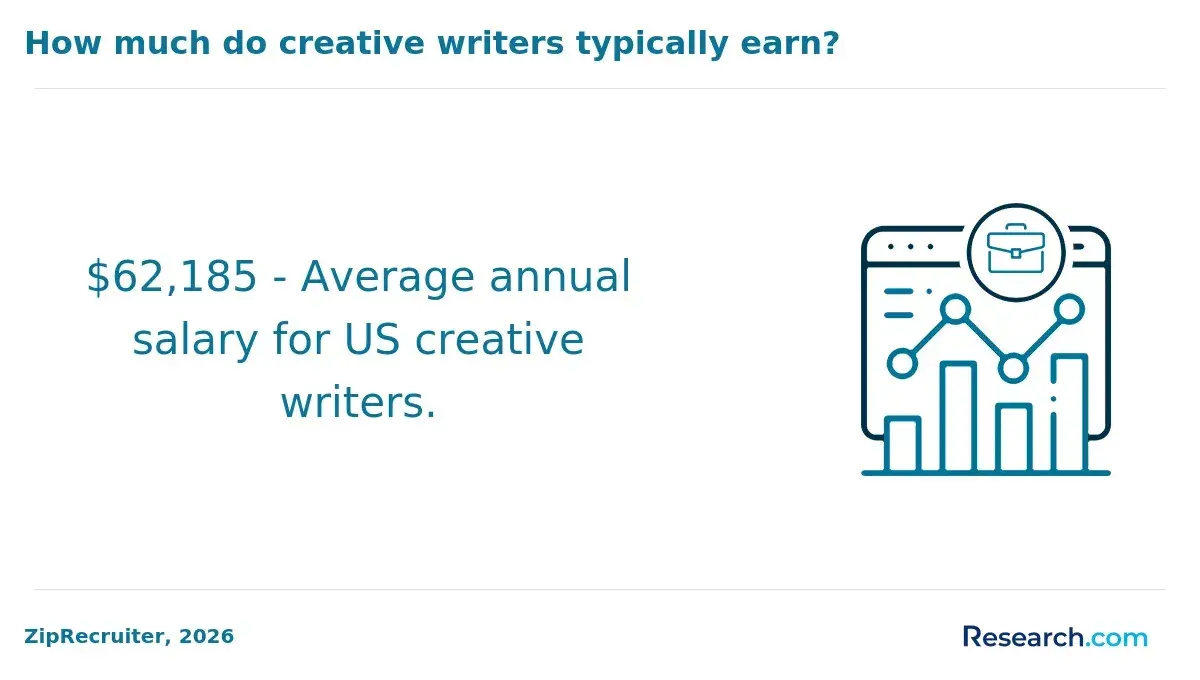
- Average Salary: Writers and authors earn an average of $62,185 per year across all industries.
- High Earners: The top 25% of writers can make up to $85,000–$89,500, especially in marketing, tech, or media.
- 25th Percentile: Entry-level writers and those in early-stage roles typically earn around $46,500 per year.
- 75th Percentile: More experienced writers in higher-paying sectors can earn up to $85,000 per year or more.
When comparing programs, avoid assuming that the degree alone will produce a specific salary. Look for evidence that the program helps students build a portfolio, get feedback from experienced writers, access internships, understand publishing pathways, and translate creative skills into marketable professional writing abilities.
- Fastest online creative writing degree programs for 2027
- How long online creative writing degrees take
- Online vs. on-campus creative writing degrees
- Financial aid for online creative writing students
- Admissions requirements and prerequisites
- Common online creative writing courses
- How to finish faster without a formal fast-track program
- Networking and mentorship in online programs
- Challenges online creative writing students should expect
- Internships and real-world experience
- Advanced academic and research pathways
- Creative writing specializations
- How to choose the right online creative writing degree
- Career paths for creative writing graduates
- Job outlook for writers and authors
List of the Best Universities for the Fastest Online Creative Writing Degree Programs for 2027
How do we rank schools?
A fast degree can save time, but only if the program also offers credible instruction, recognized accreditation, flexible delivery, and meaningful writing development. Research.com evaluated online creative writing options with those practical student concerns in mind.
Our review used information from the IPEDS database, Peterson’s database, including the Distance Learning Licensed Data Set, the College Scorecard database, and the National Center for Education Statistics. Programs were assessed using factors such as completion speed, accreditation, affordability, and flexibility.
For more detail about how Research.com evaluates programs, review our methodology section.
| School | Program length | Tracks or concentrations | Estimated cost | Accreditation |
| University of Pennsylvania (Penn LPS Online) | 8 weeks | Fiction, poetry, creative nonfiction, and screenwriting | Up to $11,096 | Middle States Commission on Higher Education |
| Liberty University | 8 weeks | English and creative writing | $2,850 per semester | Southern Association of Colleges and Schools Commission on Colleges (SACSCOC) |
| Colorado Christian University | 5 weeks | Creative writing | $494 per credit hour | Higher Learning Commission (HLC) |
| Full Sail University | 108 weeks | Creative writing and communication | Up to $15,000 | Accrediting Commission of Career Schools and Colleges (ACCSC) |
| Southern New Hampshire University | 8 weeks | Creative writing and English | $330 per credit | New England Commission of Higher Education (NECHE) |
1. University of Pennsylvania (Penn LPS Online)
University of Pennsylvania (Penn LPS Online) offers a BAAS Course Block in Creative Writing for students who want structured practice in multiple forms of writing. The course block uses a workshop-centered model, giving students opportunities to generate new material, test craft techniques, and strengthen their individual voice through instructor and peer feedback.
- Program Length: 8 weeks
- Tracks/concentrations: Fiction, poetry, creative nonfiction, and screenwriting
- Estimated Cost: Up to $11,096
- Accreditation: Middle States Commission on Higher Education
2. Liberty University
Liberty University offers a Bachelor of Science in English and Writing with a creative writing focus. The program is designed for students who want broad English studies along with writing-focused coursework in areas such as literary analysis, research, technical writing, and creative composition.
- Program Length: 8 weeks
- Tracks/concentrations: English and creative writing
- Estimated Cost: $2,850 per semester
- Accreditation: Southern Association of Colleges and Schools Commission on Colleges (SACSCOC)
3. Colorado Christian University
Colorado Christian University offers a 100% online Bachelor of Arts in Creative Writing. The curriculum was developed under the leadership of bestselling author Jerry B. Jenkins, giving students exposure to craft instruction shaped by professional publishing experience.
- Program Length: 5 weeks
- Tracks/concentrations: Creative writing
- Estimated Cost: $494 per credit hour
- Accreditation: Higher Learning Commission (HLC)
4. Full Sail University
Full Sail University offers a Creative Writing program for students interested in storytelling across entertainment and digital platforms. The curriculum emphasizes narrative development for film, television, games, websites, mobile media, and other contemporary formats.
- Program Length: 108 weeks
- Tracks/concentrations: Creative writing and communication
- Estimated Cost: Up to $15,000
- Accreditation: Accrediting Commission of Career Schools and Colleges (ACCSC)
5. Southern New Hampshire University
Southern New Hampshire University offers a Bachelor of Arts in Creative Writing and English in a flexible online format. The program is designed for students who want to develop creative work while also strengthening literary analysis, communication, and professional writing skills.
- Program Length: 8 weeks
- Tracks/concentrations: Creative writing and English
- Estimated Cost: $330 per credit
- Accreditation: New England Commission of Higher Education (NECHE)
How long does it take to complete an online creative writing degree program?
The completion time for a creative writing online degree depends on the degree level, transfer credits, course load, term length, and whether the school offers accelerated sessions. A typical bachelor’s program requires around 120 credits and takes about four years to complete, according to Southern New Hampshire University (n.d.) and Harvard Extension School (n.d.).
Accelerated online formats may shorten the timeline through 5-week or 8-week courses, year-round enrollment, and flexible scheduling. However, a faster program still requires steady weekly writing, reading, discussion, and revision. Students should be realistic about how many courses they can handle while maintaining writing quality.
Students comparing creative programs may also look at the shortest digital photography online programs to see how other arts-focused degrees use compressed, skills-based formats.
| Path | Typical timeline | Best for | Watch out for |
| Traditional Bachelor’s | About 4 years at a standard full-time pace | Students who want a predictable workload and full college experience online | May take longer if you study part time or need developmental/general education courses |
| Accelerated Bachelor’s | As few as 2.5 to 3 years with compressed course formats | Motivated students with strong time management or transfer credits | Short terms can be intense, especially in workshop-heavy courses |
| Part-Time Bachelor’s | Typically 5 or more years, depending on your course load | Working adults, caregivers, and students who need a lighter schedule | Longer timelines can increase total fees and delay career transitions |
| Master’s | Anywhere from 2 to 5 years, based on enrollment status and course scheduling | Students seeking advanced craft study, teaching preparation, or a stronger professional portfolio | Graduate programs may require a substantial portfolio, thesis, or residency component |
The best timeline is the one you can sustain. If you rush through workshops without revising seriously, you may graduate faster but leave with a weaker portfolio. If you move too slowly without a clear plan, you may lose momentum and pay more over time.
How does an online creative writing degree compare to an on-campus program?
An online creative writing degree and an on-campus program can cover similar academic content, but the learning experience differs. Online programs often emphasize written critique, asynchronous discussion, annotated drafts, and virtual collaboration. Campus programs may offer more spontaneous conversations, in-person readings, informal faculty contact, and local literary events.
Online learning works especially well for students who are self-directed and comfortable sharing drafts in digital spaces. Campus learning may be better for students who want face-to-face workshop energy, live readings, and a built-in writing community. Students considering other creative online pathways can compare this flexibility with accelerated online graphic design degrees.
| Factor | Online creative writing degree | On-campus creative writing degree |
| Workshop format | Discussion boards, shared documents, recorded feedback, and video sessions | Live classroom critique, group discussion, and immediate back-and-forth conversation |
| Schedule | Often more flexible, especially in asynchronous courses | More structured, with fixed class times and campus-based expectations |
| Faculty access | Email, LMS messaging, virtual office hours, and annotated drafts | Office visits, informal conversations, workshops, and campus events |
| Peer community | Digital cohorts, online critique groups, forums, and virtual readings | In-person workshops, writing clubs, open mics, and campus publications |
| Publishing practice | Digital portfolios, online journals, web publishing, and multimedia writing | Campus journals, live readings, student presses, and local literary communities |
| Best fit | Working adults, remote students, independent learners, and students needing flexibility | Students who prefer face-to-face critique, campus life, and live literary events |
The digital collaboration used in online writing programs is also common in creative technology fields, including fast-track online animation degrees. In both fields, students must learn how to give and receive critique, manage deadlines, and produce portfolio-ready work through online tools.
What are the financial aid options for students enrolling in an online creative writing degree program?
Financial aid for online creative writing students can include federal aid, institutional aid, scholarships, employer tuition assistance, military benefits, payment plans, and private scholarships. Before comparing scholarships, confirm whether the school participates in federal financial aid and whether the program is eligible for aid at your enrollment level.
Some awards support writing directly, while others support broader creative, academic, or service-oriented work. Students in related arts programs, including accelerated audio and music degrees online, may find overlapping scholarship opportunities.
| Funding option | Amount stated | Who it may help | Deadline stated |
| L. Ron Hubbard Writers of the Future Contest | $5,000 | Emerging science fiction and fantasy writers | Last week of June 30 every year |
| Barbara Caras Memorial Scholarship for Film Studies | $2,000 | Students interested in film, screenwriting, or related storytelling fields | Last week of July 31 every year |
| Horror Writers Association (HWA) Scholarships | $2,500 | Students pursuing horror writing or literature | First week of August every year |
| Apprentice Ecologist Scholarship | Three scholarships totaling to $1,750 | Students combining environmental activism with essays or creative writing | Last week of December every year |
| Charlotte W. Newcombe Dissertation Fellowships | $31,000 | Doctoral candidates writing dissertations on ethical or religious values, including literature or creative nonfiction topics | First week of November every year |
When estimating affordability, look beyond tuition. Add technology fees, books, residency costs if any, graduation fees, transfer credit limits, and the cost of taking longer than planned. If cost is your main concern, compare the cheapest online creative writing degree programs before committing.
What are the prerequisites for enrolling in an online creative writing degree program?
Admissions requirements depend on whether you are applying to an undergraduate creative writing program, a graduate writing program, or an MFA. Bachelor’s programs usually focus on academic readiness, while graduate programs may place more weight on the writing sample, statement of purpose, and fit with the program’s faculty or genre strengths.
Students looking at adjacent creative disciplines, such as the shortest cinematography programs online, may notice similar admissions patterns: schools want evidence that applicants can handle college-level work and show creative potential.
- High school diploma or GED: Usually required for bachelor’s degree admission.
- Minimum GPA: Many programs expect a cumulative GPA of 2.5 or higher for undergraduate applicants and 3.0 for graduate applicants.
- Official transcripts: Schools use transcripts to verify prior coursework, credits, grades, and transfer eligibility.
- Writing sample or portfolio: Some programs, especially graduate programs, ask for creative work to evaluate readiness and fit.
- Letters of recommendation: Master’s programs may request 1–3 letters from instructors, mentors, supervisors, or writing professionals.
- Personal statement or essay: Applicants may need to explain their goals, writing interests, and reasons for choosing the program.
- English proficiency: Non-native English speakers may need TOEFL or IELTS scores.
If you plan to continue into online MFA programs, start saving your strongest work early. A polished portfolio can matter more than a long list of courses, especially for competitive graduate programs.
What courses are typically in an online creative writing degree program?
Online creative writing curricula usually combine creative workshops with literature, composition, genre study, editing, and professional preparation. The goal is not only to produce original writing but also to understand how texts work, how audiences respond, and how revision turns an idea into publishable or professional-quality work.
With 1.54 million people already working in creative writing-related roles—and the field growing by 1.44%—students benefit from coursework that connects artistic craft with practical communication skills.
| Course area | What students learn | Career relevance |
| Introduction to Creative Writing | Voice, character, image, scene, narrative structure, and genre fundamentals | Builds a foundation for fiction, nonfiction, poetry, and script-based work |
| Fiction | Plot, dialogue, point of view, setting, conflict, pacing, and revision | Useful for authorship, editing, game narrative, branded storytelling, and entertainment writing |
| English Composition | Grammar, clarity, argument, organization, and rhetorical choices | Supports professional writing, editing, teaching, and content roles |
| Film or Screenwriting | Script formatting, scene construction, visual storytelling, dialogue, and pacing | Prepares students for screenwriting, video content, advertising, and multimedia storytelling |
| Literary Theory and Criticism | Close reading, interpretation, cultural context, and critical frameworks | Strengthens analytical thinking for editing, teaching, graduate study, and publishing |
| Publishing | Submissions, revision standards, literary markets, query letters, and professional practices | Helps students understand how writing moves from draft to audience |
Some graduates later move toward teaching or writing instruction. If that is your goal, review licensure and state requirements carefully and see our guide answering can I become a teacher with an online degree?
How can students accelerate earning an online creative writing degree program without fast-track options?
If your preferred school does not advertise an accelerated creative writing degree, you may still be able to shorten your timeline. The key is to reduce unused credits, avoid scheduling gaps, and choose a course sequence that keeps you moving without overloading your workshop and revision time.
- Transfer as many eligible credits as possible: Ask whether prior college coursework, AP, IB, CLEP, military training, or other evaluated learning can reduce your remaining requirements.
- Use year-round enrollment: Summer and winter sessions can help you earn credits while keeping momentum.
- Increase your course load carefully: Taking more courses per term can speed completion, but only if you can still produce strong writing and meet deadlines.
- Choose shorter terms when available: 5-week and 8-week courses can help you complete credits faster than traditional 16-week terms.
- Ask about prior learning assessment: Some schools may award credit for relevant professional experience, portfolios, assessments, or documented learning.
- Avoid withdrawals and retakes: Dropped or failed courses slow progress and may affect financial aid eligibility.
- Plan prerequisites early: Map required courses in advance so one missing prerequisite does not delay graduation.
- Meet with advisors regularly: Advisors can identify transfer opportunities, course substitutions, and sequencing problems before they cost you time.
| Acceleration strategy | Best use | Possible risk |
| Transfer credits | Students with previous college coursework | Not all credits may apply to the major or degree plan |
| Short course terms | Students who can manage intensive weekly deadlines | Less time between draft, feedback, and revision |
| Year-round study | Students who want steady progress without long breaks | Burnout if you do not schedule rest |
| Heavier course loads | Students with strong time management and fewer outside obligations | Workshop quality may suffer if you take too many writing-heavy courses at once |
| Prior learning assessment | Students with professional writing, editing, military, or training experience | Credit policies vary widely by school |
Some students also combine writing with digital communication skills, including a fast-track online social media management degree, especially if they want careers in brand storytelling, content marketing, freelancing, or digital publishing.
What networking and mentorship opportunities do online creative writing degree programs offer?
Strong online programs do more than post assignments. They create structured ways for writers to meet peers, receive mentorship, and connect their work to professional communities. These opportunities may include virtual workshops, faculty office hours, visiting writer events, alumni panels, online literary magazines, critique groups, and career services.
Networking matters because many writing opportunities are relationship-driven. Editors, publishers, nonprofit directors, content managers, and media teams often want to see not only a degree but also a reliable portfolio and professional communication habits. Students seeking low-cost online study options can also review cheap online degrees fast programs that may offer flexible support for working adults.
- Ask whether workshops are capped: Smaller workshop groups often allow more detailed feedback.
- Look for faculty engagement: Published authors, editors, and industry professionals can provide practical insight.
- Check alumni access: Alumni networks can help with informational interviews, referrals, and career exploration.
- Review student publication options: Online journals, magazines, or capstone showcases can help you publish or present work.
- Ask about mentorship frequency: A program that promises mentorship should explain how often it occurs and who provides it.
What challenges should students expect in an online creative writing degree program?
Online creative writing programs can be flexible, but they are not effortless. Students must manage deadlines, read carefully, write consistently, revise deeply, and participate in critique without the automatic structure of a physical classroom. The hardest part for many students is not logging in—it is maintaining a serious writing routine week after week.
Common challenges include limited real-time interaction, isolation, uneven peer feedback, technology issues, and balancing school with work or family. Students who want a lighter academic path may find it useful to compare expectations with resources such as Which is the easiest bachelor degree?, but they should remember that “easiest” does not necessarily mean “best” for long-term writing goals.
| Common mistake | Why it hurts students | Better approach |
| Choosing only the fastest program | You may sacrifice workshop quality, faculty access, or portfolio development | Compare speed with accreditation, curriculum depth, and student support |
| Ignoring accreditation | Credits may not transfer, and graduate schools or employers may question the credential | Verify institutional accreditation before applying |
| Underestimating weekly workload | Short courses can require frequent reading, drafting, and critique | Ask for sample syllabi and estimate weekly hours honestly |
| Expecting guaranteed publication or income | Writing careers depend on skill, persistence, market fit, networking, and portfolio quality | Use the degree to build strong samples and professional habits |
| Skipping career services | You may graduate without a clear path beyond coursework | Use internships, advising, portfolio reviews, and alumni connections early |
| Focusing only on tuition | Fees, books, technology, transfer policies, and extended enrollment can change total cost | Calculate total program cost before enrolling |
Can online creative writing degree programs offer practical internships and real-world experience?
Yes, some online creative writing programs include internships, capstones, professional projects, online publications, editorial practicums, or partnerships with publishers, nonprofits, media organizations, and content teams. These experiences are important because writing employers and clients usually want proof that you can complete polished work for real audiences.
Before enrolling, ask the school what practical experience is guaranteed, what is optional, and what students must arrange on their own. Some programs describe career preparation broadly but do not provide formal placements. Students looking at accelerated graduate study can also compare how experiential learning appears in programs discussed in What is the shortest masters degree?
- Ask whether internships are built into the curriculum: A required internship may offer more structure than an optional opportunity.
- Review capstone expectations: A strong capstone should produce a polished portfolio piece or professional project.
- Look for editorial experience: Student journals, publishing labs, and writing centers can build practical editing skills.
- Confirm remote internship support: Online students should know whether placements are available outside the school’s local area.
- Request examples of student outcomes: Ask what kinds of projects recent students completed and how those projects supported career goals.
What advanced academic research opportunities can I pursue after an online creative writing degree?
Graduates who want advanced study may pursue an MFA, master’s degree in English, literature, rhetoric and composition, publishing, communications, education, or doctoral work. The right path depends on whether you want to publish creative work, teach, conduct literary research, study rhetoric, or combine creative practice with scholarly inquiry.
Doctoral study is usually more research-focused than a bachelor’s degree or many MFA programs. Students interested in a faster terminal degree can explore the shortest PhDs, but they should compare program quality, funding, dissertation expectations, faculty expertise, and whether the degree supports their academic or professional goals.
| Next academic path | Best for | Key consideration |
| MFA in Creative Writing | Writers seeking intensive workshop study, manuscript development, and teaching preparation in some settings | Portfolio strength is often central to admission |
| Master’s in English or Literature | Students interested in literary analysis, research, editing, or teaching pathways | May be less workshop-focused than an MFA |
| Master’s in Communication or Publishing | Students aiming for media, editorial, content strategy, or publishing careers | Look for internships and industry partnerships |
| Doctoral Programs | Students pursuing scholarship, higher education roles, or advanced research | Research fit, faculty mentorship, and dissertation expectations matter heavily |
What types of specializations are available in online creative writing degree programs?
Specializations help you focus your portfolio and career direction. A student who wants to write novels needs different practice than someone aiming for UX content, technical documentation, screenwriting, or game narrative. Choose a concentration based on the type of writing you want to produce and the audience you want to serve.
- Poetry: Focuses on imagery, form, rhythm, compression, line, sound, and the development of a distinctive poetic voice.
- Screenwriting: Prepares students to write scripts for film, television, stage, or streaming formats, with emphasis on dialogue, scene structure, and visual storytelling.
- Technical Writing: Builds skills in clear instructional communication for fields such as healthcare, IT, engineering, software, and regulated industries.
- Business Writing: Emphasizes professional communication, marketing copy, digital content, proposals, reports, and brand messaging.
- Game Writing: Covers branching narratives, dialogue systems, character development, lore, world-building, and interactive storytelling. Students who want a broader interactive media background may also explore the fastest online game art and design degree programs.
Based on data from Zippia, students should match their specialization to the skills they want to develop and use professionally. The best choice is not always the most artistic or the most commercial; it is the one that helps you build a coherent portfolio for your next step.
How to choose the best online creative writing degree program?
The best online creative writing degree is not simply the shortest or cheapest option. It is the program that gives you credible academic training, enough feedback to improve, a realistic schedule, and a portfolio that supports your career or graduate school goals. Practical outcomes matter, especially when top-paying roles like Lead Technical Writer average $87,435 a year.
| Selection factor | What to check | Why it matters |
| Accreditation | Verify that the institution is recognized by an appropriate accreditor | Supports credit transfer, graduate admission, and credential credibility |
| Faculty background | Look for published authors, editors, screenwriters, technical writers, or industry professionals | Experienced instructors can provide craft guidance and career insight |
| Workshop quality | Ask about class size, critique methods, revision expectations, and instructor feedback | Writing improves through specific feedback, not just assignments |
| Specializations | Compare fiction, poetry, nonfiction, screenwriting, technical writing, business writing, and game writing options | Your concentration should match your portfolio and career goals |
| Format and flexibility | Check whether courses are asynchronous, synchronous, accelerated, part time, or full time | The schedule must fit your life and your writing process |
| Total cost | Calculate tuition, fees, books, technology costs, transfer credits, and time to completion | The lowest tuition rate may not equal the lowest total cost |
| Career support | Review internships, portfolio reviews, alumni networks, publishing opportunities, and job search help | Career services can help you convert writing skills into opportunities |
| Student feedback | Read reviews carefully and ask admissions for program-specific outcomes | Student experiences can reveal workload, responsiveness, and support quality |
Before enrolling, ask admissions advisors direct questions: How many credits can I transfer? How many hours per week should I expect? Who teaches workshops? Will I graduate with a portfolio? Are internships available to online students? What support exists for publication, freelancing, graduate school, or job searching?
What career paths are available for graduates of online creative writing degree programs?
Creative writing graduates can pursue literary, commercial, educational, technical, and digital communication careers. Some roles require additional credentials, experience, subject-matter expertise, or graduate study. For example, teaching in public schools may require state licensure, while technical writing may require familiarity with software, engineering, healthcare, or product documentation.
Students considering graduate study may eventually ask what can you do with an MFA in creative writing? as they explore advanced writing, teaching, publishing, and literary career options.
| Career path | What the role does | Helpful preparation |
| Author or Novelist | Writes original fiction or nonfiction for traditional, independent, or hybrid publication | Manuscript development, revision, publishing knowledge, persistence, and platform-building |
| Copywriter | Creates persuasive language for ads, websites, campaigns, emails, and product messaging | Marketing knowledge, audience research, portfolio samples, and SEO awareness |
| Content Strategist | Plans, organizes, and improves content across digital platforms | Analytics, UX basics, editorial planning, and brand voice development |
| Screenwriter | Writes scripts for film, television, streaming, stage, or video media | Script formatting, scene structure, collaboration, and industry networking |
| Technical Writer | Turns complex information into clear manuals, guides, documentation, and instructions | Subject-matter knowledge, plain language skills, documentation tools, and accuracy |
| Editor | Improves content for clarity, style, structure, accuracy, and audience fit | Grammar, developmental editing, proofreading, style guides, and communication skills |
| Grant or Proposal Writer | Writes funding proposals, donor narratives, and persuasive organizational documents | Research, nonprofit knowledge, budgeting awareness, and persuasive writing |
| English Teacher | Helps students build reading, writing, analysis, and communication skills | Education coursework, licensure where required, classroom experience, and knowledge of standards; see our English teacher career guide |
The visual below shows industries with high employment levels in creative writing-related work, which can help students think beyond the traditional “author” path and identify where writing skills may be most useful.
What is the job outlook for graduates with an online creative writing degree?
The job outlook for writers is shaped by several forces at once: digital content growth, competition for publishing opportunities, the expansion of brand and technical communication, and the increasing use of AI tools in drafting and editing workflows. AI can speed up basic content production, but employers still need writers who can think critically, understand audience needs, verify information, create original narratives, preserve voice, and revise strategically.
Graduates who combine creative ability with practical skills—editing, SEO, UX writing, technical documentation, grant writing, multimedia storytelling, or content strategy—may have more options than graduates who rely only on literary aspirations. Students interested in reporting and media can also compare related pathways such as the best accelerated online journalism degree programs.
- Growth Rate: Employment of writers and authors is expected to grow 4% from 2024 to 2034, right in line with the national average for all occupations (3%).
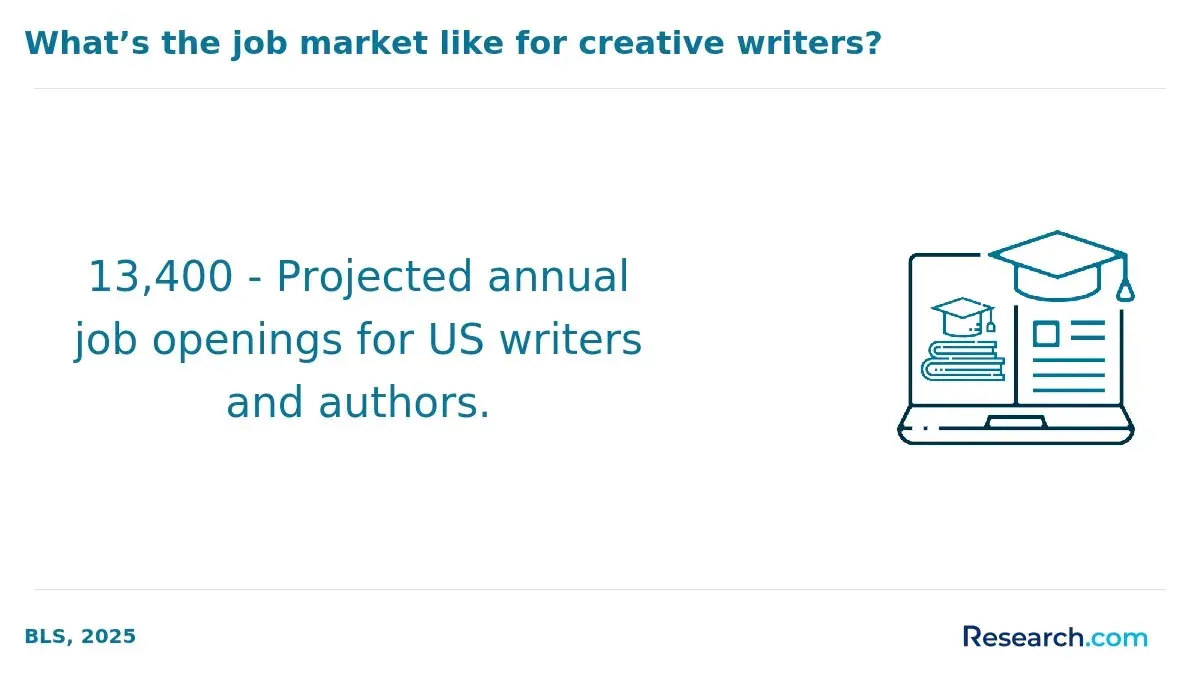
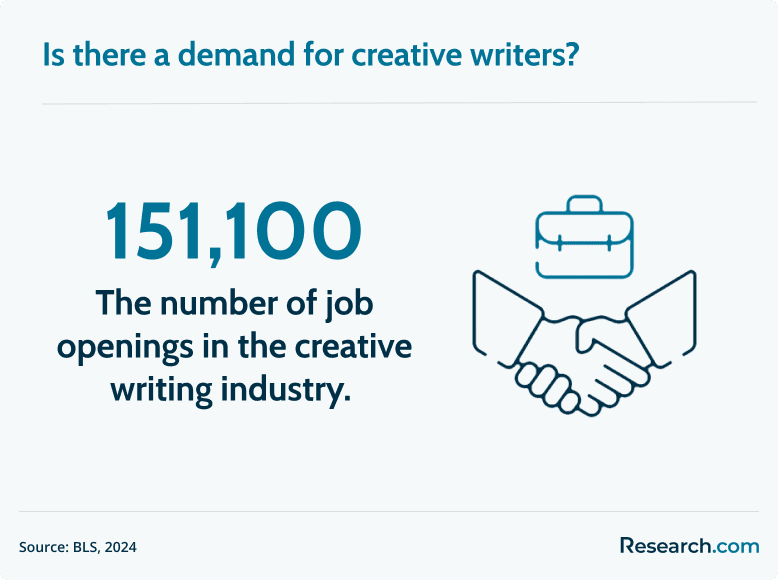
- Job Openings: Approximately 15,100 writing-related openings are projected each year over the next decade.
- Workforce Turnover: Many openings are expected to come from retirements and workers moving into other occupations.
- Industry Demand: Digital media, technology, healthcare, education, marketing, and nonprofit advocacy all need writers who can communicate clearly and adapt to audience expectations.
To improve your prospects, graduate with more than completed coursework. Build a portfolio with several polished samples, learn how to revise from feedback, understand the business side of writing, and practice using AI tools responsibly without letting them replace your voice or judgment.
Key Insights
- Fast online creative writing degrees are best for disciplined students who can handle compressed terms without neglecting reading, critique, and revision.
- Accreditation should be your first filter. A quick program is not a good investment if credits do not transfer or the credential lacks recognition.
- A strong program should offer workshops, faculty feedback, genre options, portfolio development, and some connection to publishing, internships, or career services.
- Creative writing can lead to many roles beyond authorship, including copywriting, editing, content strategy, technical writing, grant writing, screenwriting, and education.
- Salary and career outcomes are not guaranteed by the degree. Your portfolio, specialization, professional network, technical skills, and persistence strongly influence results.
- Before enrolling, compare total cost, transfer credit policies, course length, weekly workload, faculty credentials, online student support, and real-world experience opportunities.
- AI is changing writing work, but it has not eliminated the need for human judgment, originality, audience awareness, ethics, and strong editing skills.
References:
- Access Scholarships. (n.d.). Apprentice Ecologist Scholarship. Accessscholarships.com. Retrieved 16 June 2025.
- Bureau of Labor Statistics. (n.d.). Writers and authors. U.S. Department of Labor. Bls.gov. Retrieved 16 June 2025.
- Bureau of Labor Statistics. (2025). Occupational employment and wage statistics: Writers and authors. U.S. Department of Labor. Bls.gov. Retrieved 25 June 2025.
- Colorado Christian University. (n.d.). Creative writing program. Ccu.edu. Retrieved 16 June 2025.
- Data USA. (n.d.). Creative Writing: 23.1302. Datausa.io. Retrieved 16 June 2025.
- Film Society. (n.d.). Barbara Caras Memorial Scholarship for Film Studies. Filmsociety.org. Retrieved 16 June 2025.
- Full Sail University. (n.d.). Creative writing bachelor’s degree program. Fullsail.edu. Retrieved 16 June 2025.
- Harvard Extension School. (n.d.). Creative writing and literature degree requirements. Extension.harvard.edu. Retrieved 16 June 2025.
- Horror Scholarships. (n.d.). HWA Scholarship. Horrorscholarships.com. Retrieved 16 June 2025.
- Liberty University. (n.d.). Bachelor of Science in English and writing – Creative writing. Liberty.edu. Retrieved 16 June 2025.
- Newcombe Foundation. (n.d.). Charlotte W. Newcombe Dissertation Fellowships. Newcombefoundation.org. Retrieved 16 June 2025.
- Penn LPS Online. (n.d.). Creative writing course block. University of Pennsylvania. Lpsonline.sas.upenn.edu. Retrieved 16 June 2025.
- Southern New Hampshire University. (n.d.). Online bachelor's in creative writing. Snhu.edu. Retrieved 16 June 2025.
- Writers of the Future. (n.d.). Enter Writer Contest. Writersofthefuture.com. Retrieved 16 June 2025.
- ZipRecruiter. (n.d.). Creative writer salary. Ziprecruiter.com. Retrieved 16 June 2025.
- Zippia. (n.d.). Creative writer skills. Zippia.com. Retrieved 16 June 2025.
Other Things You Should Know About Online Creative Writing Degree Programs
The 2027 fastest online creative writing degree programs typically require completion of 120 credit hours. These programs may include core courses, electives, and capstone projects. Some may offer transfer credits to expedite progress, but specifics vary by institution.
Many accelerated online creative writing bachelor’s programs accept up to 90 transfer credits toward a 120-credit degree. Schools usually require official transcripts, a minimum 2.0 GPA, and proof that upper-division writing courses meet the program’s residency rules.


