2027 Best Online Creative Writing Degree Programs

Co-Founder and Chief Data Scientist
An online creative writing degree is for students who want structured training in storytelling, editing, literary analysis, and professional writing without relocating or attending campus full time. It can support careers in fiction, publishing, technical writing, public relations, marketing, journalism, screenwriting, and communications, but it is not a guaranteed path to a book deal or a high-paying writing job.
This guide explains what online creative writing programs include, how long they take, what they cost, which schools offer them, what admissions requirements to expect, and how to judge whether the degree is worth the investment. It also covers career options, salary expectations, accreditation, financial aid, and practical questions to ask before enrolling.
Quick answer: Is an online creative writing degree worth it?
An online creative writing degree can be worth it if you want formal writing practice, regular feedback, a portfolio, and transferable communication skills for writing-adjacent careers. It is especially useful for students who need flexibility and want to combine creative study with work, caregiving, or another major. However, students should compare tuition, accreditation, faculty experience, workshop quality, and career outcomes before committing.
- Online creative writing students study fiction, poetry, nonfiction, screenwriting, rhetoric, editing, literature, and professional communication.
- The degree can lead to writing-focused and communication-heavy roles in publishing, media, marketing, public relations, technical communication, and corporate content.
- Writers and authors earn a median annual wage of $73,150, though earnings vary widely by role, industry, experience, and employment type.
- There are about 135,400 writers and authors in the United States as of 2024, according to the US Bureau of Labor Statistics (BLS).
What can I expect from an online creative writing degree?
An online creative writing degree combines reading, writing, critique, and revision. Students usually take literature courses to understand how published work is built, then apply those techniques in workshops where classmates and instructors respond to drafts. The best programs do more than encourage creativity; they teach students how to revise, meet deadlines, read closely, accept criticism, and write for different audiences.
Coursework often includes literary studies, craft seminars, genre workshops, editing, rhetoric, digital writing, and professional writing. Some programs are housed in English departments, while others are offered as writing, rhetoric, or communication tracks. That distinction matters: a heavily literary program may suit students who want to write fiction or poetry, while a professional writing track may be better for students targeting technical writing, marketing, or workplace communication.
Where can I work with an online creative writing degree?
Creative writing graduates can work anywhere strong writing, audience awareness, and editing are valued. Some pursue traditional creative paths, such as novels, poetry, screenwriting, playwriting, or essays. Others use the degree in applied roles such as technical writer, editor, public relations specialist, speechwriter, content strategist, marketer, grant writer, communications coordinator, or journalist.
The most practical approach is to pair creative writing with a marketable skill. Students who add coursework in digital media, marketing analytics, publication, film, education, technical communication, or design may have more career options than those who focus only on creative manuscripts.
How much can I make with an online creative writing degree?
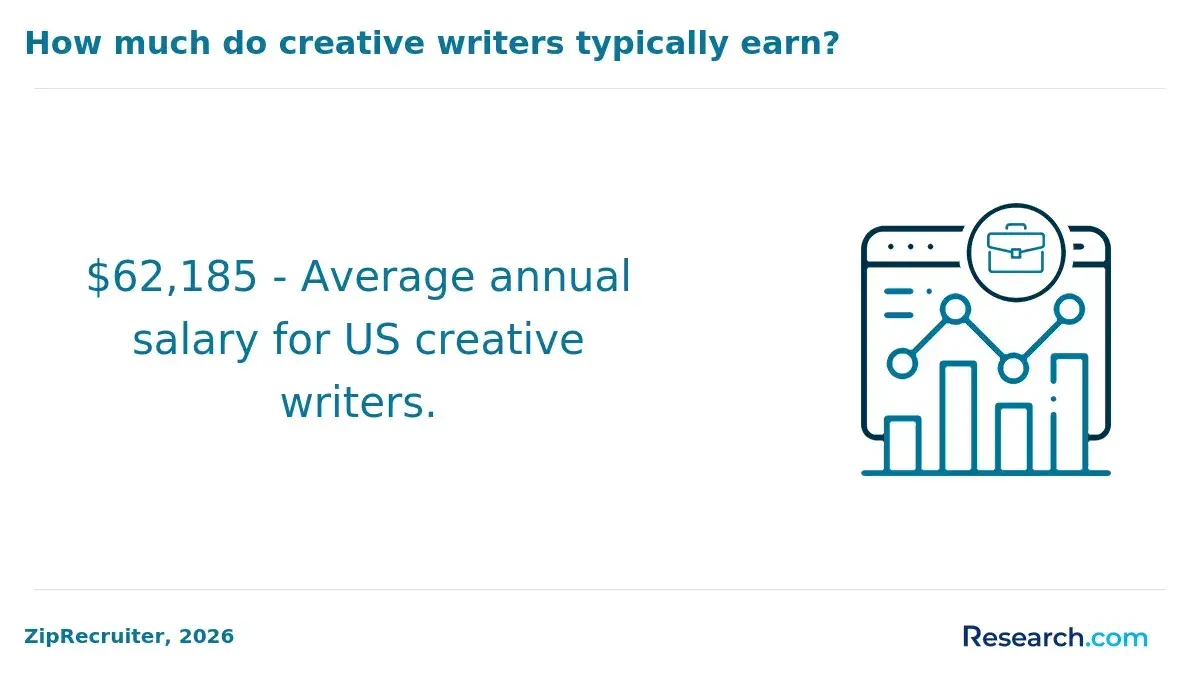
Graduates who become writers or authors earn a median annual wage of $73,150. The range is broad: the lowest 10% earn less than $39,610 per year, while the highest 10% earn about $161,260 per year, according to the U.S. Bureau of Labor Statistics. These figures should be treated as occupational benchmarks, not promises. Pay depends on the role, industry, location, portfolio quality, experience, and whether the writer is employed full time, freelancing, or combining multiple income streams.
- Online Creative Writing Degree Programs for 2027
- How long does it take to complete a creative writing degree?
- Online vs. campus creative writing programs
- Average cost of a creative writing degree
- Affordable online creative writing degree options
- Ways to lower the cost of an online creative writing degree
- Financial aid and writing scholarships
- Admissions requirements for creative writing programs
- Common courses in creative writing degrees
- Creative writing concentrations and specializations
- Skills developed in an online creative writing degree
- How to choose the right creative writing program
- Accreditation standards for online creative writing programs
- Creative writing career paths
- Job market outlook for creative writing graduates
- Creative writing in design and architecture
- How a degree helps you develop a writing voice
- Creative writing and online graphic design study
- Creative writing and interactive storytelling in game design
- Other fields to consider for higher earning potential
- Creative writing and accelerated marketing degrees
- Creative writing for digital marketing
- Creative writing in corporate communication
- Benefits of earning an online MFA in Creative Writing
Online Creative Writing Degree Programs for 2027
How Research.com evaluates schools
Research.com reviews online creative writing programs to help students compare flexible, accredited options. The ranking process considers institutional data, program availability, online learning access, and degree details that matter to prospective students.
The analysis draws from the IPEDS database, Peterson’s database, the Distance Learning Licensed Data Set from the College Scorecard database, and the National Center for Education Statistics. For more detail on how programs are assessed, see the Research.com methodology page.
| School | Program details | Estimated cost per credit | Credits and length | Accreditation |
| Southern New Hampshire University | Its online creative writing program includes advanced workshops, contests, and tracks in Fiction, Nonfiction, Poetry, and Screenwriting. | $330 | 120 credits; four years | New England Commission of Higher Education (NECHE) |
| Florida International University | The online Bachelor of Arts in English: Writing and Rhetoric Track focuses on writing for varied, multilingual audiences. Track/concentration: Literature. | $236 (in-state), $649 (out-of-state) | 120 credits; four years | Southern Association of Colleges and Schools Commission on Colleges (SACSCOC) |
| Central Washington University | The creative writing program emphasizes professional and creative writing, with practicums that connect writing skills to workplace needs. | $234 (in-state), $820 (out-of-state) | 180 (minimum quarter credits); three to four years | Northwest Commission on Colleges and Universities (NWCCU) |
| University of Houston-Victoria | The creative writing program blends literary arts study with writing skills applicable to public and private sector work. Track/concentration: Creative Writing. | $325 (resident), $746 (non-resident and international) | 120 credits; 16 weeks or more (8 weeks per course) | Southern Association of Colleges and Schools Commission on Colleges (SACSCOC) |
| Texas Tech University | The online English degree offers Creative Writing, Literature and Language, and English Teaching tracks. | $426 | 120 credits; four years | Southern Association of Colleges and Schools Commission on Colleges (SACSCOC) |
| Indiana University East | The online bachelor’s in English is designed for students interested in technical and professional writing. | $250 (in-state), $365 (out-of-state) | 120 credits; four years | Higher Learning Commission (HLC) |
| University of Central Florida | UCF’s online creative writing courses support students who want to become stronger communicators and readers of literature. | $180 (in-state), $716 (out-of-state) | 120 credits; four years | Southern Association of Colleges and Schools Commission on Colleges (SACSCOC) |
| Nicholls State University | The online English program includes Creative Writing, Literary Studies, Film Studies, Writing and Rhetoric, and Children’s and Young Adult Literature. | $302 | 120 credits; three to four years | Southern Association of Colleges and Schools Commission on Colleges (SACSCOC) |
| University of Colorado-Denver | The online BA English Writing, Rhetoric, and Technology emphasizes professional writing, research, theory, and technology. | $465 (in-state), $558 (out-of-state) | 120 credits; four years | Higher Learning Commission (HLC) |
| Regent University | The online English program builds writing fundamentals through U.S., British, and world literature. Tracks/concentrations include Biblical Studies, Communication, Government, History (European), History (U.S. History), and Self-Designed. | $395 (full-time), $450 (part-time) | 120+ credits; four years | Southern Association of Colleges and Schools Commission on Colleges (SACSCOC) |
Key facts before you apply
- A bachelor’s degree in creative writing is commonly completed online in four years.
- Online programs can support asynchronous workshops, peer critique, and flexible deadlines.
- Many listed online creative writing programs charge less than $500 per credit.
- Writing-related scholarships may provide awards up to $20,000.
- Students can often specialize in fiction, poetry, nonfiction, screenwriting, rhetoric, literature, film studies, or children’s and young adult literature.
- BLS data projects over 13,400 job openings for writers and authors each year from 2024 to 2034.
How long does it take to complete a creative writing degree program?
Completion time depends on the credential level, transfer credits, enrollment status, and whether the program uses traditional semesters, accelerated terms, or self-paced online formats. An associate degree typically takes two years, a bachelor’s degree usually takes four years, and a master’s degree in creative writing often adds another two years.
A four-year bachelor’s degree is a common option for students who want a broad foundation in literature, workshop practice, and professional communication. The chart below summarizes common education levels for creative writers as reported by Zippia in 2025.
| Degree path | Typical fit | What to consider |
| Associate degree | Students who want a lower-cost start or plan to transfer later | Confirm whether credits transfer into a bachelor’s program. |
| Bachelor’s degree | Students seeking a full undergraduate writing foundation and broader career options | Compare workshop access, portfolio expectations, electives, and internship options. |
| Master’s degree or MFA | Writers seeking advanced critique, manuscript development, teaching preparation, or a stronger professional network | Review residency requirements, faculty mentorship, and total cost carefully. |
How does an online creative writing program compare to an on-campus program?
An online bachelor’s degree in creative writing generally covers the same academic foundation as an on-campus English or writing program: literature, craft, writing workshops, general education, electives, and revision-based assignments. The biggest difference is delivery. Online students may complete readings, discussion posts, critiques, and drafts through a learning platform instead of meeting in a physical classroom.
Online study may be a better fit for students who need flexible scheduling, live far from campus, work full time, or prefer written critique. Campus study may be better for students who want frequent in-person events, face-to-face mentorship, theater or publishing clubs, and local writing communities. A 2024 study by the Online Learning Consortium reported that 73% of students desire to continue with online classes for peer collaboration.
| Factor | Online creative writing degree | On-campus creative writing degree |
| Schedule | Often more flexible, especially if courses are asynchronous | Usually follows fixed class meeting times |
| Workshop experience | Critiques may be written, recorded, or discussed virtually | Feedback often happens in live classroom sessions |
| Networking | Depends on virtual events, faculty access, and online communities | May include readings, clubs, campus publications, and local events |
| Best for | Working adults, remote students, caregivers, and self-directed learners | Students who want daily campus interaction and in-person creative communities |
What is the average cost of a creative writing degree program?
Several online creative writing options from the best reputable online colleges cost less than $500 per credit, and some are below $200 per credit. For example, the University of Central Florida lists $180 per credit for in-state students.
Cost is one reason students compare online programs closely. In a survey by Magda et al., 51% of students said affordable cost was their top reason for choosing an online program instead of an on-site program.
Do not judge affordability by tuition alone. Public versus private status, residency rules, full-time or part-time enrollment, technology fees, books, transfer credit policies, and graduation timeline all affect the real price of the degree.
| Cost factor | Why it matters | Question to ask |
| Per-credit tuition | This is the base price used to estimate total tuition. | Is the online rate the same for in-state and out-of-state students? |
| Required credits | A 120-credit program and a 180 quarter-credit program are structured differently. | How many credits must I complete after transfer evaluation? |
| Fees | Online, technology, library, graduation, and course fees can increase total cost. | What mandatory fees are charged each term? |
| Books and materials | Literature and writing courses may require multiple texts. | Does the program use open educational resources or low-cost digital materials? |
| Time to completion | Taking longer can increase total living and opportunity costs. | Can I attend part time without losing financial aid eligibility? |
What are the most affordable options for an online creative writing degree?
Budget-conscious students should look for accredited public universities, transfer-friendly programs, clear online tuition rates, and programs that publish fees upfront. Some of the cheapest online creative writing degree options still include workshops, literature courses, and genre study, but students should verify faculty access and student support before enrolling.
An affordable program is not automatically the best option. A lower price is valuable only if the school is accredited, credits are transferable, courses are available when needed, and the curriculum supports your goals. For example, a student who wants to become a technical writer may benefit more from a professional writing track than a low-cost program focused almost entirely on poetry.
How can I reduce the cost of an online creative writing degree?
Students can lower the cost of an online creative writing degree by planning early and comparing the full financial picture rather than only the advertised tuition rate.
- Apply for scholarships and grants: Look for institutional awards, writing contests, literary organization scholarships, state grants, and need-based aid.
- Submit the FAFSA: The Free Application for Federal Student Aid can determine eligibility for federal grants, work-study, and student loans.
- Use employer education benefits: If you are already employed, ask whether your organization offers tuition reimbursement or professional development funding.
- Compare affordable accredited programs: Public universities and transfer pathways may reduce costs. If you are comparing majors by price, resources such as how much is a computer science degree can help you understand cost differences across fields.
- Maximize transfer credits: Ask whether prior college credits, community college coursework, or exams can apply toward general education requirements.
- Reduce textbook expenses: Search for used, digital, library, or open-source course materials when allowed by instructors.
What are the financial aid options for students enrolling in a creative writing degree program?
Creative writing students may qualify for federal aid, institutional aid, state grants, private scholarships, and writing-specific awards. Some writing scholarships are based on a portfolio, original work, residency, heritage, academic level, or intended field of study. Award amounts can range from a few hundred dollars to more than $10,000.
CINTAS Foundation Fellowship in Creative Writing
- Package: $20,000
- Eligibility: Writers of Cuban citizenship or lineage may apply. Selected fellows have their work added to the CINTAS Fellows Collection after the grant period.
Des Moines Women’s Club Literature Scholarship
- Package: $2,000
- Eligibility: Graduating high school seniors planning to study Literature, Language Arts, Journalism, Writing, or Language Education may apply. Applicants must live or study in Polk, Boone, Dallas, Jasper, Madison, Marion, Story, or Warren County.
ACES Bill Walsh Scholarship
- Package: $3,500
- Eligibility: Students interested in news editing can apply for the scholarship and for financial support to attend the national ACES conference.
What are the prerequisites for enrolling in a creative writing degree program?
Most bachelor’s-level creative writing programs use standard undergraduate admissions requirements. Some programs may also ask for a writing sample or supplemental essay, especially if the degree includes competitive workshops or portfolio review.
- Transcript: Schools typically request an official high school transcript, college transcript, diploma, GED, or equivalent documentation.
- SAT or ACT scores: Many colleges remain test-optional, but some institutions may still request standardized test scores for admission or placement.
- Essay or writing sample: A separate writing prompt may help the admissions team evaluate readiness for writing-intensive coursework.
- Additional requirements: International applicants may need English-language proficiency scores, and students with missing high school credits may need extra coursework.
Applicants do not need to be published authors. They should, however, be ready to read extensively, revise repeatedly, accept critique, and write on deadline.
What courses are typically in a creative writing degree program?
Online creative writing degrees usually blend literature, theory, workshop practice, and professional writing. Course titles vary, but students can expect classes such as the following:
- English language and composition: These courses strengthen grammar, syntax, academic writing, and close reading.
- Literary theory: Students study frameworks such as feminism, structuralism, psychoanalytic criticism, and other methods for interpreting texts.
- Journalism: Coursework may introduce reporting, interviewing, fact-checking, news judgment, and writing for print or digital platforms.
- Screenwriting: Students learn screenplay structure, dialogue, visual storytelling, scene development, and script formatting.
- Writing workshops: Workshops require students to submit original work, critique peers, revise drafts, and sometimes attend guest lectures with published authors.
What types of specializations are available in online creative writing degree programs?
Specializations help students align the degree with a writing goal or industry. For example, the English program at Nicholls State University offers options in:
- Creative Writing
- Writing and Rhetoric
- Literary Studies
- Film Studies
- Children’s and Young Adult Literature
Students should choose a specialization based on the kind of writing they want to produce and the kind of work they may need after graduation. Fiction and poetry are useful for artistic development, while rhetoric, professional writing, and technical communication may connect more directly to salaried roles.
What are the top skills you can develop with an online creative writing degree?
A creative writing degree develops both artistic and workplace skills. The strongest graduates can generate original ideas, revise them clearly, and adapt their writing for different audiences, formats, and goals.
- Storytelling and narrative design: Students learn to build characters, scenes, conflict, pacing, voice, and structure.
- Writing and editing: Programs emphasize drafting, proofreading, line editing, developmental revision, and stylistic control.
- Critical reading and literary analysis: Students study how published texts work and apply those lessons to their own writing.
- Genre flexibility: Coursework may expose students to fiction, poetry, nonfiction, screenwriting, journalism, and professional writing.
- Self-discipline and time management: Online writing programs require consistent drafting, feedback, revision, and deadline management.
- Audience awareness: Writers learn to adjust tone, content, and structure for readers, clients, editors, or employers.
How to choose the best creative writing degree program
The best online creative writing program is the one that matches your goals, budget, learning style, and career plan. Do not rely on rankings alone. Compare the curriculum, faculty, workshop structure, accreditation, student support, and total cost.
- Confirm online availability: Make sure the full degree, not just selected courses, can be completed online.
- Check accreditation and reputation: A creative writing major usually does not require programmatic accreditation, but the institution should be recognized by an appropriate accrediting body.
- Review support services: In 2024, 73% of college students find school overwhelming, making advising, mental health services, tutoring, library access, and technology support important for online learners.
- Look at career relevance: If you want employment beyond literary publishing, prioritize programs with professional writing, editing, technical writing, marketing, or internship options.
- Evaluate faculty and feedback: Strong programs provide regular critique from instructors with relevant writing, publishing, or professional experience.
- Ask about certifications: Writers usually do not need certification, but journalism, editing, technical writing, or professional writing certificates may support specific career goals.
Questions to ask before enrolling
- Is the institution accredited by a recognized accrediting agency?
- How often are writing workshops offered online?
- Will I receive detailed feedback from faculty, or mainly peer comments?
- Can I build a publishable or employer-ready portfolio?
- Are internships, literary magazines, editing projects, or capstone manuscripts available to online students?
- What is the total estimated cost after fees, books, and transfer credit review?
- Does the program fit my intended path: literary writing, technical writing, marketing, education, publishing, or graduate study?
What accreditation standards should I look for in an online creative writing program?
Students should verify institutional accreditation before enrolling in any online creative writing program. Accreditation helps confirm that a school meets recognized standards for academic quality, faculty qualifications, student services, and administrative practices. It can also affect transfer credit, graduate school admission, and financial aid eligibility.
Most creative writing programs do not have a specialized accreditor. Instead, students should check whether the college or university is accredited by a recognized regional or national accrediting organization. Students interested in strategic communication may also consider complementary fields, such as a public relation degree, when building a broader communication skill set.
What career paths are available for graduates of creative writing degree programs?
A creative writing degree can support both independent creative work and communication careers. It may also suit students looking for a career for introverts, especially in writing, editing, research, or content development roles that allow focused independent work.
| Career path | How creative writing helps | What else may help |
| Technical writer | Translates complicated information into clear manuals, guides, documentation, and instructions. | Technical subject knowledge, software documentation tools, and editing experience. |
| Marketer | Creates persuasive messaging, campaign copy, brand stories, and audience-focused content. | Digital marketing, analytics, SEO, and campaign management. |
| Public relations specialist | Develops press materials, speeches, media messages, and reputation-focused communication. A bachelor’s degree in communications can also prepare students for this field. | Media relations, event planning, crisis communication, and networking. |
| Writer or author | Produces novels, essays, poems, scripts, articles, memoirs, and other original works. | Publication strategy, portfolio development, discipline, and professional contacts. |
| News writer | Uses research, interviewing, and clear writing to report current events. | Journalism ethics, fact-checking, multimedia skills, and newsroom experience. |
| Editor | Improves structure, accuracy, clarity, tone, and style in written content. | Grammar expertise, subject specialization, publishing knowledge, and project management. |
What is the job market for graduates with a degree in creative writing?
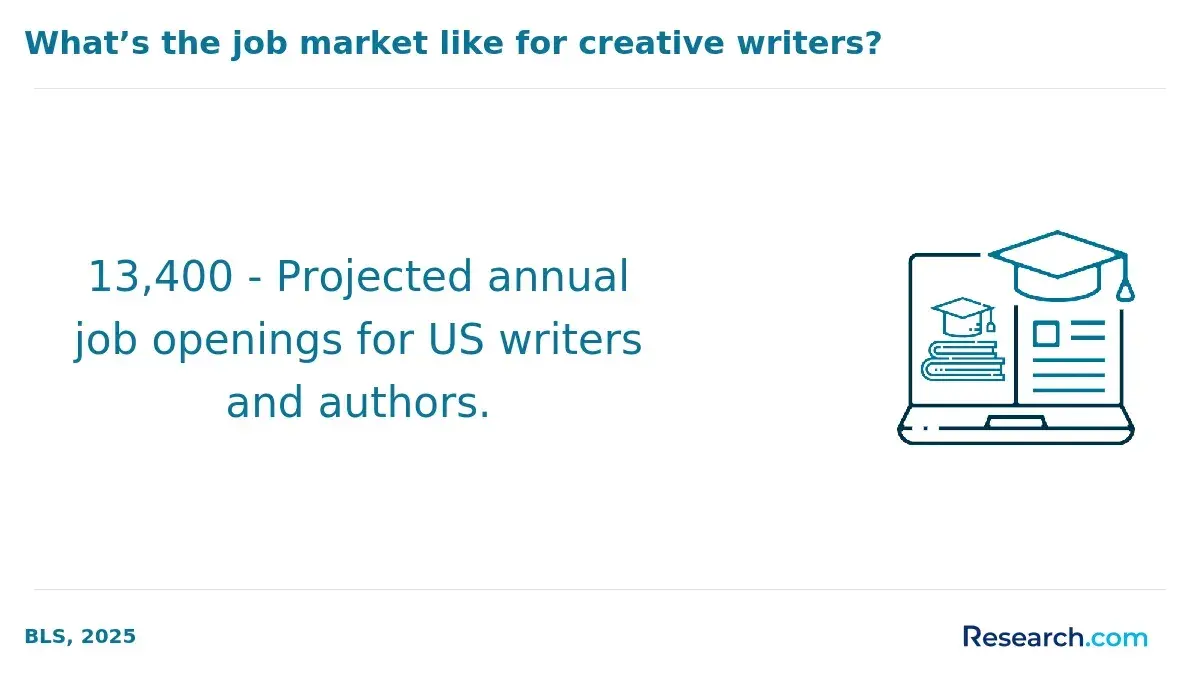
The job market is mixed. Some communication roles are growing, while traditional journalism has weaker projections. According to BLS reports, writers and authors are projected to have about 13,400 annual job openings from 2024 to 2034. Technical writers have a projected growth rate of 4%, while Marketing Managers and Public Relations Specialists show projected growth rates of 7% and 5%.
| Role | Projected Job Growth (2024-2034) | Average Annual Job Openings (2024-2034) |
| Technical Writers | 1% | 4,500 |
| Marketing Managers | 7% | 36,400 |
| Public Relations Specialists | 5% | 27,600 |
| Writers and Authors | 4% | 13,400 |
| News Analysts, Reporters, and Journalists | -4% | 4,100 |
| Editors | 1% | 9,800 |
Current trends affecting creative writing graduates
Creative writing students should prepare for a job market where writing alone may not be enough. Employers increasingly value writers who can work across formats, understand digital platforms, edit AI-assisted drafts, communicate with subject-matter experts, and write for measurable business or audience goals.
- AI-assisted writing is changing entry-level tasks: Writers who can plan, fact-check, revise, and add judgment may be better positioned than those who only generate basic copy.
- Portfolio evidence matters: Employers and editors often want samples, clips, scripts, documentation, or published work rather than only a transcript.
- Hybrid writing roles are common: Many jobs combine writing with SEO, social media, editing, research, design collaboration, or marketing strategy.
- Genre flexibility improves resilience: Students who can move between creative, technical, promotional, and informational writing may have more options.
Can creative writing enhance interdisciplinary innovation in design and architecture?
Creative writing can help designers and architecture students explain concepts, frame project narratives, and present ideas in language clients understand. Strong narrative skills are useful for proposals, design statements, exhibitions, and community-facing materials. Students exploring design-focused graduate study may also compare options such as the cheapest online architecture degree programs.
How can an online creative writing degree help develop your unique writing style?
Students develop a writing style through practice, reading, critique, and revision. Online creative writing programs create a structure for that process by requiring students to test different forms, respond to feedback, and revise work over time.
Workshops are especially important. A strong workshop does not simply praise or criticize a draft; it teaches students how readers experience structure, pacing, image, voice, and clarity. Courses in narrative structure, character development, dialogue, poetry, nonfiction, and screenwriting can help students identify what feels authentic while still learning craft discipline.
Students seeking lower-cost options can compare cheapest online creative writing degree programs, but they should not choose by price alone. Faculty feedback, workshop depth, and portfolio development are central to building a distinctive voice.
How can creative writing support success in an online graphic design degree?
Graphic design and creative writing overlap in visual storytelling, branding, campaign development, and user experience. Writers help clarify the message behind visuals, while designers shape how that message is seen. Students interested in both text and image may consider a best online graphic design degree to build complementary visual communication skills.
How can creative writing enhance interactive storytelling in game design?
Game design relies on narrative structure, character motivation, dialogue, setting, and player choice. Creative writing strengthens the story systems behind quests, cutscenes, branching narratives, worldbuilding, and emotionally engaging gameplay. Students comparing narrative-focused design paths can review the benefits of earning a game design degree.
What other fields can I consider if creative writing is not one of the majors that make the most money?
Students who prioritize earnings may want to compare creative writing with technology, engineering, healthcare, business, or other fields listed among majors that make the most money. This does not mean creative writing is the wrong choice. It means students should be realistic about income variability and may want to pair writing with a high-demand skill such as technical communication, marketing, UX writing, grant writing, or digital content strategy.
How can creative writing complement an accelerated marketing degree online?
Creative writing can make marketing messages more persuasive, memorable, and audience-centered. Students pursuing an accelerated marketing degree online can use storytelling skills to write campaign copy, brand narratives, email sequences, social content, case studies, and product messaging that connect strategy with emotion.
How can creative writing skills be applied to digital marketing success?
Digital marketing rewards writers who can hold attention quickly, explain value clearly, and adapt messages for search, email, video, landing pages, and social media. Creative writing strengthens voice, pacing, emotional appeal, and audience awareness. Students who want a more specialized marketing path may also consider a social media degree online.
Can creative writing skills elevate corporate communication strategies?
Corporate communication depends on clear, credible, and audience-specific messaging. Creative writing helps professionals turn complex information into stories employees, customers, investors, and stakeholders can understand. These skills are useful for executive messages, internal newsletters, brand storytelling, speeches, change communication, and crisis response. Students interested in this direction can explore a corporate communications career path.
What are the advantages of pursuing an MFA in Creative Writing online?
An online Master of Fine Arts (MFA) in Creative Writing is designed for writers who want advanced workshop practice, manuscript development, mentorship, and a stronger writing community. Compared with an undergraduate degree, an MFA typically goes deeper into genre specialization, craft analysis, revision, and professional preparation.
Online MFA programs may appeal to working adults because they can offer flexible coursework while still providing critique groups, virtual readings, faculty mentorship, and sometimes residencies. Students should compare residency requirements, faculty publications, genre strengths, funding, thesis expectations, and total cost before applying.
Some online MFA programs also include publishing guidance, manuscript submission support, agent discussions, literary events, and networking opportunities. These features can be valuable, but students should remember that an MFA does not guarantee publication or employment.
Common mistakes to avoid when choosing an online creative writing degree
- Choosing a program without checking accreditation: Accreditation can affect financial aid, transfer credits, and graduate school options.
- Looking only at tuition: Fees, books, transfer policies, and time to completion can change the real cost.
- Assuming all writing degrees lead to the same jobs: A poetry-heavy program and a technical writing track prepare students differently.
- Ignoring the quality of feedback: A creative writing degree is only as useful as the critique, revision, and mentorship it provides.
- Skipping portfolio planning: Employers, editors, and graduate programs often want writing samples.
- Expecting salary outcomes to be guaranteed: Writing income varies widely by role, industry, experience, and work arrangement.
- Relying only on rankings: Rankings can narrow the search, but curriculum fit, cost, support, and career alignment matter more.
Key Insights
- An online creative writing degree is best for students who want structured writing practice, critique, literary study, and flexible learning.
- The degree can support creative careers, but many graduates improve job prospects by adding skills in technical writing, editing, marketing, digital media, public relations, or communications.
- Program cost varies widely, but several listed options charge less than $500 per credit; always calculate total cost, not just tuition.
- Accreditation, workshop quality, faculty feedback, portfolio opportunities, and transfer credit policies should drive your program decision.
- Writers and authors earn a median annual wage of $73,150, but earnings are highly variable, with the lowest 10% below $39,610 and the top 10% about $161,260.
- BLS projections show about 13,400 annual openings for writers and authors from 2024 to 2034, while related roles such as marketing managers and public relations specialists may offer broader applied communication opportunities.
- An MFA can be useful for advanced craft development and manuscript work, but students should weigh cost carefully and avoid assuming it guarantees publication or a writing job.
References:
- Data USA. (n.d.). Creative Writing. Data USA. https://datausa.io/profile/cip/creative-writing-231302
- Elflein, J. (2024). Percentage of college students in the U.S. who agreed or disagreed that their health and well-being is a priority at their college/university as of fall 2024. Statista. https://www.statista.com/statistics/1125606/student-opinion-wellbeing-at-college-us
- Harmony Healthcare IT (2024). College and Mental Health Statistics: Half of Students Skip Class Due to Mental Health Struggles. Harmony Healthcare IT https://www.harmonyhit.com/college-student-mental-health-stats/
- Lopez, A. (n.d.). The Mega List of Scholarships You Should Apply For |. Colleges of Distinction. https://collegesofdistinction.com/advice/the-mega-list-of-scholarships-you-should-apply-for
- U.S. Bureau of Labor Statistics. (2025, August 28). Advertising, Promotions, and Marketing Managers : Occupational Outlook Handbook: : U.S. Bureau of Labor Statistics. https://www.bls.gov/ooh/management/advertising-promotions-and-marketing-managers.htm
- U.S. Bureau of Labor Statistics. (2025, August 28). Editors : Occupational Outlook Handbook: : U.S. Bureau of Labor Statistics. https://www.bls.gov/ooh/media-and-communication/editors.htm
- U.S. Bureau of Labor Statistics. (2025, August 28). News Analysts, Reporters, and Journalists : Occupational Outlook Handbook: : U.S. Bureau of Labor Statistics. https://www.bls.gov/ooh/media-and-communication/reporters-correspondents-and-broadcast-news-analysts.htm
- U.S. Bureau of Labor Statistics. (2025, August 28). Public Relations Specialists : Occupational Outlook Handbook: : U.S. Bureau of Labor Statistics. https://www.bls.gov/ooh/media-and-communication/public-relations-specialists.htm
- U.S. Bureau of Labor Statistics. (2025, August 28). Writers and Authors : Occupational Outlook Handbook: : U.S. Bureau of Labor Statistics. https://www.bls.gov/ooh/media-and-communication/writers-and-authors.htm
- Watson, A. (2024, April). Number of writers and authors in the U.S. Statista. https://www.statista.com/statistics/572476/number-writers-authors-usa
- Zippia. (2025, January 8). Best Colleges and Degrees For Creative Writers. Zippia. https://www.zippia.com/creative-writer-jobs/education
Other Things You Should Know About Online Creative Writing Degrees
Yes, many 2027 online creative writing programs require a senior thesis or capstone, usually worth 3 to 6 credit hours. Students often submit a manuscript, portfolio, or critical essay. Some programs also require faculty approval before the final project begins.
In 2027, a BA in Creative Writing focuses on developing original content across genres such as fiction, poetry, and screenwriting. It emphasizes narrative skills, workshops, and a creative portfolio, while a BA in English typically centers on literature history and analysis. This specialization enhances storytelling expertise crucial for aspiring writers in digital and traditional media.
Online creative writing programs in 2027 typically require a stable internet connection, a reliable computer with updated software, and access to word processing tools like Microsoft Word or Google Docs. Some programs may also recommend multimedia software for creating digital content.
The top online creative writing degree programs in 2027 are accredited by recognized bodies such as the Accreditation Council for Higher Education (ACHE) and regional accrediting agencies like the Middle States Commission on Higher Education, ensuring quality and credibility of the education provided.