2027 Most Affordable Online Marketing Degrees

Co-Founder and Chief Data Scientist
Choosing an affordable online marketing degree is not just about finding the lowest tuition. You are weighing cost, accreditation, transfer credits, online flexibility, career preparation, and whether the program will help you build practical skills employers can verify. That decision matters because marketing remains one of the most common business-related study areas; according to NCES data published in 2023, marketing is part of the 391,400 business degrees awarded at the bachelor's level, the most popular broad field of study.
This guide is for students who want a lower-cost path into marketing without sacrificing credibility. It explains what online marketing programs teach, how long they take, what they cost, which schools offer affordable options, what careers may follow, and how to compare programs before enrolling. It also covers financial aid, accreditation, online versus campus study, specializations, future marketing skills, and common mistakes that can make a “cheap” degree more expensive over time.
Quick answer: Is an affordable online marketing degree worth considering?
An affordable online marketing degree can be a practical choice if the program is accredited, fits your schedule, offers relevant coursework in digital marketing and analytics, and helps you build a portfolio or internship experience. It is especially useful for students seeking entry-level roles such as marketing coordinator, digital marketing specialist, social media manager, advertising coordinator, or market research analyst. The degree is less useful if you choose a program only because it is inexpensive, ignore accreditation, or graduate without applied projects, analytics skills, or professional experience.
What are the benefits of getting an affordable online marketing degree?
- Broad career options: Marketing graduates can work in agencies, corporate marketing departments, e-commerce companies, nonprofits, public relations firms, and media organizations. Common starting roles include marketing coordinator, social media manager, digital marketing specialist, and advertising coordinator.
- Flexible study format: Online delivery can make it easier to complete coursework while working, caring for family, or avoiding relocation and commuting costs.
- Skill-based career preparation: Strong programs teach market research, consumer behavior, branding, digital campaigns, communication, and analytics—skills that can be demonstrated through projects and portfolios.
- Salary potential varies by role: Market research analysts and marketing specialists make around $68,230 per year on average, while management and leadership roles may pay more with experience.
What can I expect from an affordable online marketing degree?
An online marketing degree usually combines business fundamentals with specialized marketing coursework. Students learn how organizations identify customers, study competitors, position products, communicate brand value, and measure campaign performance. Most programs also include general education classes and a business core covering areas such as accounting, economics, management, finance, and business communication.
Typical marketing coursework includes market research, advertising, digital marketing strategy, consumer behavior, brand management, sales, analytics, and integrated marketing communication. Better programs require applied assignments such as campaign plans, audience research, content calendars, advertising briefs, social media audits, or marketing analytics reports. These projects are important because employers often want evidence of what you can do, not only a transcript.
Annual tuition for online marketing degrees commonly ranges from around $10,000 to $20,000, depending on the school, residency status, fees, and program level. Many bachelor’s programs require about 120 to 130 credits, and completion time often ranges from two to four years depending on transfer credits, course load, and whether the program offers accelerated terms.
| Program factor | What to expect | Why it matters |
| Degree type | BBA, BSBA, or BS in marketing or business marketing | The title may differ, but the curriculum should include business foundations and marketing-specific courses. |
| Credits | Most programs require about 120 to 130 credits | Transfer credits can shorten the time and reduce total cost. |
| Common subjects | Consumer behavior, market research, digital marketing, advertising, branding, sales, analytics | These areas map closely to common entry-level marketing responsibilities. |
| Learning format | Asynchronous, synchronous, or mixed online delivery | The format affects scheduling flexibility, class interaction, and time management. |
| Career preparation | Projects, internships, certifications, career services, and portfolio support | Practical evidence can strengthen applications for marketing roles. |
Where can I work with an affordable online marketing degree?
A marketing degree can lead to opportunities in organizations that need to understand customers, promote products or services, manage brand reputation, and measure campaign results. Graduates may work for marketing agencies, advertising firms, corporate marketing teams, e-commerce businesses, nonprofit organizations, public relations companies, publishers, consulting firms, and technology-enabled businesses.
Marketing is also portable across industries. A graduate might help a retailer improve email campaigns, support a healthcare organization’s outreach strategy, analyze customer demand for a software company, or coordinate social media for a nonprofit. The specific job title depends on your coursework, internship experience, technical tools, writing ability, and portfolio.
The BLS identifies the following industries with the highest concentration of employment for market research analysts and market specialists:
- Advertising, Public Relations, and Related Services
- Management, Scientific, and Technical Consulting Services
- Lessors of Nonfinancial Intangible Assets
- Sound Recording Industries
- Newspaper, Periodical, Book, and Directory Publishers
How much can I make with an affordable online marketing degree?
Marketing pay depends heavily on role, location, industry, experience, technical skills, and whether the position focuses on coordination, analytics, strategy, or management. Entry-level marketing positions may pay $40,000 to $60,000 annually, while mid-career roles typically offer $60,000 to $100,000 annually. Senior-level executives can earn over $100,000, especially in big cities or high-demand industries. Specialization in analytics, paid media, marketing operations, product marketing, or leadership can improve earning potential, but salaries are never guaranteed by the degree alone.
Some of the highest-paying positions available to online marketing degree graduates include:
- Advertising, Promotions, and Marketing Managers - $138,730
- Data Scientists - $103,500
- Management Analysts - $95,290
- Operations Research Analysts - $85,720
- Market Research Analysts and Marketing Specialists - $68,230
- Most Affordable Online Marketing Degrees for 2027
- How long does it take to complete an online marketing degree?
- How does an online marketing degree compare to an on-campus program?
- What is the average cost of an online marketing degree?
- What financial aid options are available for online marketing students?
- What are the admission requirements for an online marketing program?
- What courses are usually included in an online marketing program?
- What marketing specializations can online students choose?
- Is an affordable online marketing degree a smart long-term investment?
- How can public relations strengthen your marketing skill set?
- How should you choose the best affordable online marketing program?
- What challenges might online marketing students face?
- How can creative writing improve marketing performance?
- Do employers value an affordable online marketing degree?
- How can creative design skills support a marketing degree?
- How do accreditation and institutional support affect degree value?
- What career paths are available after an online marketing degree?
- What is the job market like for online marketing graduates?
- What additional education can strengthen a marketing career?
- What is the return on investment for an affordable online marketing degree?
- What marketing skills will matter most in the future?
Most Affordable Online Marketing Degrees for 2027
How do we rank our schools?
Because tuition is only one part of program value, school rankings should be used as a starting point rather than the final decision. Research.com reviews information from sources such as the IPEDS database, Peterson's database, College Scorecard database, and the National Center for Education Statistics. These sources help compare affordability, institutional characteristics, and student-focused data. For details on the ranking process, review the Research.com methodology page.
| Rank | School | Online marketing degree | Cost per credit | Credits | Accreditation listed |
| 1 | Southeastern Oklahoma State University | Online BBA with a marketing focus | $306 | 124 | AACSB |
| 2 | California Coast University | Online BS in business marketing | $170 | 126 | DEAC |
| 3 | Fort Hays State University | Online BBA in marketing | $242.76 | 120 | HLC |
| 4 | Western Carolina University | Online BSBA in marketing | $188.96 for in-state students, $355.62 for out-of-state students | 120 | AACSB |
| 5 | Georgia Southwestern State University | Online BBA in marketing | $199 | 120 | AACSB |
| 6 | Utah Valley University | Online BS in Marketing | $215 for in-state students, $260 for out-of-state students | 120 | AACSB |
| 7 | Kennesaw State University | Online BBA in marketing | $240.40 | 120 | AACSB, SACSCOC |
| 8 | The University of Texas Permian Basin | Online BBA in marketing | $362.34 | 120 | AACSB |
| 9 | Minot State University | Online BS in marketing | $359.70 | 120 | IACBE, HLC |
| 10 | Columbia College | Online BS in marketing | $375 | 120 | ACBSP |
1. Southeastern Oklahoma State University
Southeastern Oklahoma State University offers an online BBA that emphasizes marketing within a broader business administration curriculum. Students study customer behavior, strategy development, and the business skills needed to communicate, analyze markets, and support organizational goals. This option may fit students who want a marketing-focused business degree with AACSB accreditation.
- Cost per Credit: $306
- Required Credits to Graduate: 124
- Accreditation: Association to Advance Collegiate Schools of Business (AACSB)
2. California Coast University
California Coast University provides an online BS in business marketing focused on consumer value, marketing theory, and business decision-making. The curriculum addresses domestic and international marketing environments while incorporating ethical reasoning, social responsibility, global awareness, legal considerations, economics, technology, and critical thinking.
- Cost per Credit: $170
- Required Credits to Graduate: 126
- Accreditation: Distance Education Accrediting Commission (DEAC)
3. Fort Hays State University
Fort Hays State University offers an online BBA in marketing built around business fundamentals and applied marketing practice. Students complete general education, business core, marketing core, and elective requirements. Coursework includes areas such as accounting, communication, management, finance, marketing principles, sales, retail, social media, and analytics.
- Cost per Credit: $242.76
- Required Credits to Graduate: 120
- Accreditation: Higher Learning Commission (HLC)
4. Western Carolina University
Western Carolina University offers an online BSBA in marketing that connects classroom learning with practical preparation for sales and marketing careers. Students examine value creation, selling scenarios, real marketing cases, and professional communication. The program also includes opportunities tied to internships, research, leadership development, and networking.
- Cost per Credit: $188.96 for in-state students, $355.62 for out-of-state students
- Required Credits to Graduate: 120
- Accreditation: AACSB
5. Georgia Southwestern State University
Georgia Southwestern State University offers an online BBA in marketing that focuses on marketing concepts, consumer behavior, research, analytics, planning, communication, and relationship-building. Students can engage through internships, student organizations, mentoring, and experiential learning. The curriculum also supports analytical thinking and includes opportunities connected to analytics and social media certifications.
- Cost per Credit: $199
- Required Credits to Graduate: 120
- Accreditation: AACSB
6. Utah Valley University
Utah Valley University offers an online BS in Marketing covering marketing management, digital marketing, and sales. Students study internet marketing, social media, web analytics, personal selling, sales management, and advertising. The program may suit students who want a practical marketing curriculum with exposure to digital tools and sales strategy.
- Cost per Credit: $215 for in-state students, $260 for out-of-state students
- Required Credits to Graduate: 120
- Accreditation: AACSB
7. Kennesaw State University
Kennesaw State University provides an online BBA in marketing with coursework in management, communication, economics, market research, consumer behavior, advertising, analytics, strategy, and finance. Students learn to study trends, prepare strategic presentations, and design targeted campaigns using digital marketing tools.
- Cost per Credit: $240.40
- Required Credits to Graduate: 120
- Accreditation: AACSB, Southern Association of Colleges and Schools Commission on Colleges (SACSCOC)
8. The University of Texas Permian Basin
The University of Texas Permian Basin offers an online BBA in marketing that covers traditional and digital promotion, demographic analysis, consumer behavior, communication, and strategic thinking. The program includes foundational business knowledge and marketing applications, with an optional undergraduate certificate in digital commerce for students who want additional specialization.
- Cost per Credit: $362.34
- Required Credits to Graduate: 120
- Accreditation: AACSB
9. Minot State University
Minot State University offers an online BS in marketing that blends business foundations with marketing-specific coursework. Students study accounting, communication, economics, statistics, marketing strategy, consumer behavior, logistics, managerial accounting, social media marketing, sales, advertising, and public relations. The program also emphasizes internship experience, which may be arranged through employers or student-developed opportunities.
- Cost per Credit: $359.70
- Required Credits to Graduate: 120
- Accreditation: International Accreditation Council for Business Education (IACBE), HLC
10. Columbia College
Columbia College offers an online BS in marketing covering digital marketing, consumer behavior, research, advertising, strategic management, pricing, product development, distribution, and promotion. The curriculum emphasizes communication, critical thinking, ethical marketing decisions, and problem-solving for corporate, government, and nonprofit settings.
- Cost per Credit: $375
- Required Credits to Graduate: 120
- Accreditation: Accreditation Council for Business Schools and Programs (ACBSP)
Key Findings
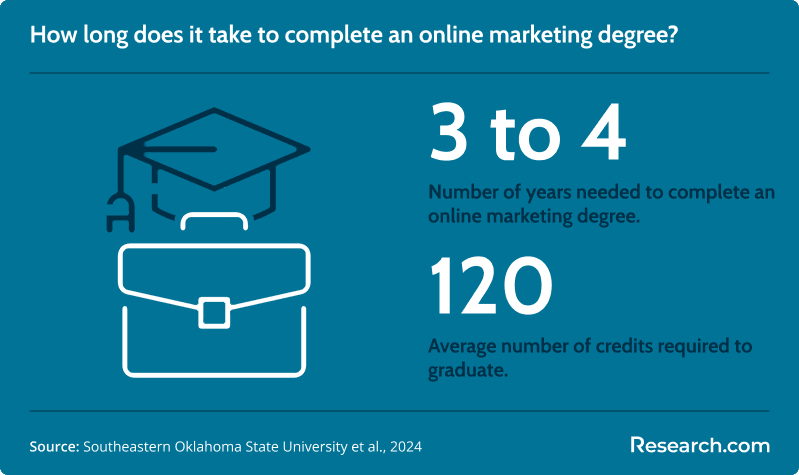
- Program duration typically ranges from three to four years, although transfer credits and accelerated terms can change the timeline.
- The average cost per credit falls between $300 to $700, while some affordable options are lower.
- Around 74% of marketing professionals hold bachelor's degrees.
- Average annual salaries for marketing professionals range from $60,000 to $100,000, depending on role, experience, industry, and location.
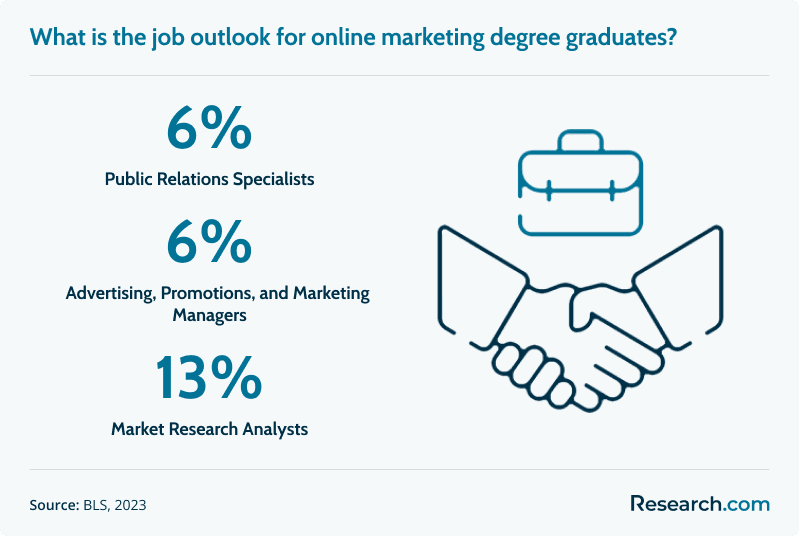
- The job outlook for marketing careers is projected to grow between 6% to 13%.
How long does it take to complete an affordable online marketing degree?
Most online bachelor’s degrees in marketing take about three to four years for full-time students. The exact timeline depends on the number of credits required, whether you enroll full time or part time, how many credits you transfer, and whether the school uses accelerated terms. Many programs require approximately 120 to 130 credits.
Students with prior college credit, military training, professional certifications, or an associate degree may finish faster if the school accepts those credits. Some accredited online programs also offer accelerated course formats, but faster pacing can be demanding for students who work full time.
| Student situation | Likely timeline | Best fit |
| First-time full-time student | Usually three to four years | Students who can take a standard full course load |
| Part-time student | Longer than four years in many cases | Working adults or students with family responsibilities |
| Transfer student | Can be shorter depending on accepted credits | Students with prior college coursework or an associate degree |
| Accelerated online student | Potentially faster, depending on the school | Students with strong time-management skills and fewer outside obligations |
How does an affordable online marketing degree compare to an on-campus program?
An online marketing degree can provide more scheduling flexibility and may reduce indirect costs, but it also requires more self-direction. An on-campus program may offer easier access to in-person networking, campus events, and face-to-face support. The better choice depends on your work schedule, learning style, location, budget, and need for structure.
| Factor | Online marketing degree | On-campus marketing degree |
| Schedule | Often more flexible, especially with asynchronous classes | Usually follows fixed class meeting times |
| Location | Can be completed from anywhere with reliable internet | Requires commuting or relocation |
| Costs beyond tuition | May reduce commuting and housing expenses | May include campus housing, transportation, parking, and local living costs |
| Networking | Depends on virtual events, discussion boards, group projects, alumni access, and career services | Often easier through campus organizations, events, and in-person faculty interaction |
| Learning style | Best for independent students who can manage deadlines | Best for students who want more face-to-face structure |
| Hands-on experience | Can include online projects, remote internships, simulations, and portfolio work | Can include local internships, campus-based projects, and employer events |
What is the average cost of an affordable online marketing degree?
The average cost per credit for online marketing programs ranges from $300 to $700, which is comparable to many affordable MBA programs at the graduate level. Some of the lowest-cost online marketing programs fall closer to $200 to $300 per credit. In-state tuition often ranges from $300 to $500 per credit, while out-of-state tuition can range from $500 to $700.
To understand the real price, compare total program cost rather than tuition alone. Fees, books, course materials, technology charges, transfer-credit policies, residency rules, and the number of remaining credits can significantly change what you pay.
| Cost item | Why it can change your total price |
| Tuition per credit | The most visible cost, but not the only one |
| Required credits | A lower per-credit rate may not be cheaper if the program requires more credits |
| Online or technology fees | Some programs charge additional fees for distance learning platforms or services |
| Books and digital materials | Marketing courses may require textbooks, simulations, software, or access codes |
| Transfer credit acceptance | Accepted transfer credits can reduce both time and cost |
| Residency status | In-state and out-of-state pricing can differ substantially at some public universities |
What are the financial aid options for students enrolling in an affordable online marketing program?
Online marketing students may qualify for the same major categories of financial aid as campus students if they attend an eligible institution and meet program requirements. Start by estimating total cost, then compare grants, scholarships, employer benefits, and loans. Borrow only after understanding repayment obligations.
- Federal financial aid: Students can submit the Free Application for Federal Student Aid (FAFSA) to be considered for federal aid. Options may include grants such as the Pell Grant and the Federal Supplemental Educational Opportunity Grant (FSEOG), as well as federal student loans such as Direct Subsidized Loans and Direct Unsubsidized Loans.
- State financial aid programs: Many states offer grants, scholarships, or tuition assistance for residents. Eligibility rules vary by state, enrollment status, financial need, and institution.
- Institutional scholarships and grants: Colleges and universities may award funding based on academic merit, financial need, transfer status, major, or other criteria.
- Private scholarships and grants: Students can search for scholarships from companies, foundations, nonprofits, and professional associations. Awards may consider academics, community service, demographics, career goals, or other qualifications.
- Employer tuition assistance: Some employers reimburse or partially cover tuition for job-related study. Ask human resources about eligibility, grade requirements, annual limits, and whether you must stay with the employer after receiving support.
The chart below illustrates the trend of total student loan debt in the past decade, according to data published in 2023 by the Education Data Initiative.
What are the prerequisites for enrolling in an affordable online marketing program?
If you are researching how to get a marketing degree, the first step is confirming admission requirements. Most bachelor’s programs are designed for applicants with a high school diploma or equivalent, while degree-completion programs may expect previous college credits. Requirements differ by institution, so always check the admissions page before applying.
- Educational background: Most programs require a high school diploma or equivalent. Some may list minimum GPA expectations.
- Transcripts: Applicants usually submit high school and college transcripts, including transfer coursework if applicable.
- Computer readiness: Because coursework is online, students should be comfortable using email, word processing tools, learning management systems, video platforms, and basic file management.
- English proficiency: Non-native English speakers may need to submit approved proof of English language ability.
- Prerequisite coursework: Some schools may expect prior coursework in math, communication, business, or general education before advanced marketing classes.
- Application materials: Programs may request essays, personal statements, recommendation letters, resumes, or other documents.
- Standardized tests: Some programs may ask for SAT or ACT scores, though many online marketing programs do not require them.
What courses are typically in an affordable online marketing program?
Most online marketing programs cover both strategy and execution. Students learn how to research audiences, design campaigns, communicate brand value, evaluate performance, and work across digital and traditional channels. Courses vary by school, but the subjects below are common.
- Principles of marketing: Introduces customer needs, segmentation, positioning, pricing, promotion, distribution, and marketing strategy.
- Digital marketing: Covers online channels such as search, social media, email, web content, and paid digital advertising.
- Market research: Teaches students how to collect, interpret, and apply data about customers, competitors, and markets.
- Consumer behavior: Examines why people buy, how decisions are influenced, and how marketers respond to customer motivations.
- Advertising and promotion: Focuses on campaign planning, media choices, messaging, and promotional strategy.
- Marketing analytics: Helps students use metrics to evaluate campaigns and make evidence-based decisions.
- Brand management: Explains how companies develop, protect, and communicate brand identity and value.
- Social media marketing: Covers content planning, platform strategy, engagement, audience analysis, and performance tracking.
- E-commerce marketing: Focuses on online selling, conversion strategy, customer retention, and digital customer journeys.
- Marketing communication: Builds written, visual, and strategic communication skills across channels.
What types of specializations are available in affordable online marketing programs?
Specializations help students match coursework with career goals. A student interested in data-heavy roles may choose analytics, while someone drawn to storytelling may prefer content marketing or brand management. Not every school offers formal concentrations, but many allow students to use electives to focus their studies.
| Specialization | What you learn | Best for students interested in |
| Digital marketing | Search, social media, email, online advertising, and campaign measurement | Digital marketing specialist, paid media assistant, SEO coordinator |
| Social media marketing | Platform strategy, content calendars, audience engagement, and social analytics | Social media manager, community coordinator, content strategist |
| Content marketing | Audience-focused writing, storytelling, content planning, and brand voice | Content marketer, copywriter, brand communications associate |
| Brand management | Brand identity, positioning, customer perception, and competitive differentiation | Brand assistant, product marketing associate, communications coordinator |
| E-commerce marketing | Online selling, conversion, retention, product pages, and customer journeys | E-commerce marketing coordinator, lifecycle marketing assistant |
| Market research and analytics | Data collection, survey design, market insights, and campaign analysis | Market research analyst, marketing analyst, insights associate |
| Advertising and promotion | Campaign planning, messaging, media strategy, and creative briefs | Advertising coordinator, media planning assistant, promotions specialist |
| International marketing | Global markets, cultural factors, international strategy, and cross-border communication | Global marketing assistant, international brand support roles |
| Mobile marketing | Mobile-first campaigns, app-based engagement, SMS, and mobile customer behavior | Mobile campaign coordinator, digital engagement associate |
| Integrated marketing communications | Consistent messaging across paid, owned, earned, and shared media | Marketing communications specialist, PR-adjacent marketing roles |
Is an affordable online marketing degree a smart long-term investment?
An affordable online marketing degree can be a sound long-term investment when the total cost is manageable and the program helps you build marketable skills. Look beyond tuition. Accreditation, curriculum relevance, internship access, employer connections, career services, transfer-credit policies, and portfolio development all influence value. A low-cost program with weak support may produce a poorer return than a moderately priced program with better career preparation.
Students interested in social platforms, creator strategy, campaign management, or audience engagement may also compare specialized options such as a social media marketing degree online. Specialized programs can be useful when they align with a clear career path, but a broader marketing degree may be better for students who want flexibility across roles.
How can a public relations component enhance your online marketing strategy?
Public relations strengthens marketing by teaching students how to manage reputation, communicate with stakeholders, respond during crises, and build credibility through earned media. This is useful because marketing campaigns do not operate in isolation; public perception, media coverage, customer trust, and brand voice all affect campaign performance.
Students who want deeper preparation in media relations, strategic outreach, and reputation management may consider coursework or a separate public relation degree. PR knowledge is especially valuable for careers in brand communications, nonprofit outreach, corporate communications, public affairs, influencer relations, and crisis communication.
How to choose the best affordable online marketing program?
The best affordable online marketing program is the one that meets your budget, is properly accredited, accepts useful transfer credits, teaches current marketing skills, and provides enough support to help you graduate and compete for jobs. Use the following process before enrolling.
- Confirm accreditation first: Check institutional accreditation and any listed business-school accreditation. Accreditation affects credibility, transferability, and financial aid eligibility.
- Calculate total cost: Multiply tuition by remaining credits, then add fees, books, technology costs, and any residency-related charges.
- Review transfer policies: Ask how many credits you can transfer, which credits apply to the major, and whether old credits expire.
- Study the curriculum: Look for courses in digital marketing, analytics, research, consumer behavior, branding, communication, and campaign strategy.
- Ask about applied work: Prioritize programs with internships, capstones, simulations, portfolio projects, or employer-connected assignments.
- Evaluate faculty and industry relevance: Review faculty backgrounds and whether courses reflect current tools and marketing practices.
- Check student support: Look for academic advising, tutoring, writing support, technology help, library access, accessibility services, and career coaching.
- Compare online format: Determine whether classes are asynchronous, live, self-paced, cohort-based, accelerated, or term-based.
- Review career services: Ask about resume support, internship help, employer events, alumni networking, portfolio guidance, and job-search coaching.
- Read outcomes carefully: Do not rely only on rankings or promotional claims. Compare graduation support, affordability, and career preparation in context. Some policy conversations focus on ways to reduce student debt, but your personal borrowing depends on program cost and aid.
| Question to ask before enrolling | Why it matters |
| Is the institution accredited? | Accreditation supports degree credibility and may affect aid and credit transfer. |
| How many of my credits will transfer into the degree? | Accepted credits can shorten your timeline and lower total cost. |
| Are there extra online, technology, or course fees? | Fees can make a low tuition rate less affordable than it appears. |
| Does the program include portfolio projects or internships? | Applied work helps demonstrate skills to employers. |
| What marketing tools or platforms will I use? | Tool familiarity can matter in digital marketing, analytics, and campaign roles. |
| Can online students access the same career services as campus students? | Career support can influence internships, networking, and job-search readiness. |
What challenges might you face with an affordable online marketing degree?
Online marketing degrees can be flexible, but that flexibility comes with trade-offs. Students must manage deadlines without frequent in-person reminders, troubleshoot technology issues, and create networking opportunities intentionally. Some programs also vary widely in internship access, career support, and curriculum quality.
- Time management: Online students need a weekly study schedule and a system for tracking assignments, discussions, exams, and projects.
- Limited in-person networking: Students may need to attend virtual events, join professional groups, connect with alumni, and seek internships proactively.
- Technology requirements: Reliable internet, updated software, and comfort with online learning platforms are essential.
- Program quality differences: Affordability should not replace due diligence. Verify accreditation, support services, curriculum depth, and employer relevance.
- Portfolio gaps: Graduating without campaign samples, analytics work, writing samples, or internships can make the job search harder.
Students comparing communication-heavy marketing roles may also review the job outlook for communications majors to understand related career paths in media, public relations, and organizational communication.
How can creative writing skills enhance your online marketing expertise?
Creative writing can make marketing stronger because campaigns depend on clear, persuasive, audience-aware messaging. Marketers use writing in ads, landing pages, email campaigns, social captions, video scripts, brand stories, product descriptions, and content strategy. Strong writing helps turn research and positioning into messages people understand and remember.
Students who want to develop deeper storytelling and content skills may consider complementary coursework or compare the most affordable online creative writing degree programs. This can be especially useful for students pursuing content marketing, copywriting, brand communication, social media, or nonprofit messaging.
Do employers value an affordable online marketing degree?
Employers generally care less about whether a degree was inexpensive and more about whether it is credible and whether the graduate can do the work. Accreditation, relevant coursework, internships, measurable projects, analytics skills, writing ability, and familiarity with digital platforms all influence how an online marketing degree is perceived.
A faster program can be attractive for students who already have credits or professional experience, but speed should not come at the expense of quality. Students focused on social media roles may compare options such as a fast track social media marketing online degree, while still checking accreditation, workload, support, and career outcomes.
How can creative design skills complement your online marketing degree?
Marketing campaigns often combine words, visuals, data, and user experience. Design skills help marketers communicate ideas more clearly through layouts, presentations, social graphics, landing pages, email templates, and campaign assets. Even if you do not become a designer, understanding color, typography, hierarchy, and visual consistency can improve collaboration with creative teams.
Students interested in creative campaign execution may supplement marketing coursework with design training or compare an online college for graphic design. This combination can be useful for brand marketing, social media, content production, advertising, and small-business marketing roles where one person may handle both strategy and visual execution.
How do accreditation and institutional support elevate your degree value?
Accreditation is one of the most important quality checks when comparing affordable online marketing programs. It signals that an institution or business program has been reviewed against established standards. Accreditation can also affect eligibility for financial aid, credit transfer, graduate school admission, and employer confidence.
Institutional support matters as much as the curriculum. Online students should have access to advising, library resources, tutoring, technology help, accessibility services, career counseling, and alumni networks. A low-cost program with strong support can be more valuable than a cheaper program that leaves students to navigate everything alone. For another example of how degree value can depend on field, credential expectations, and outcomes, review Is a masters in game design worth it?.
What career paths are available for graduates of affordable online marketing programs?
Graduates with an online marketing degree can pursue roles that involve customer research, campaign coordination, brand communication, digital strategy, advertising, public relations, and sales support. Career level depends on experience, technical tools, portfolio quality, industry, and location. Students comparing outcomes should also review information about marketing degree salary expectations.
- Marketing specialist: Plans, supports, and measures campaigns for products, services, or organizations.
- Digital marketer: Works with channels such as search, email, websites, social media, and paid digital campaigns. Students targeting this path can review digital marketing degree requirements.
- Market research analyst: Studies data, customers, competitors, and market conditions to support business decisions.
- Advertising coordinator: Helps organize campaigns, creative assets, media plans, and promotional schedules.
- Public relations specialist: Manages communication with media, audiences, and stakeholders to support reputation and visibility.
- Social media manager: Oversees content, engagement, brand voice, platform strategy, and social metrics.
- Sales representative: Uses product knowledge, customer insight, and communication skills to sell goods or services.
- Brand manager: Supports brand positioning, messaging, competitive differentiation, and customer perception.
- Marketing consultant: Advises organizations on campaigns, positioning, audience strategy, or growth opportunities.
- Product manager: Coordinates product development, positioning, market fit, and go-to-market planning.
The chart below lists the educational attainment of most marketing professionals in the US.
What is the job market for graduates with an affordable online marketing degree?
The job market for marketing graduates is broad but competitive. Employers often look for candidates who can combine communication, analytics, digital tools, creativity, and business judgment. Graduates may find opportunities in market research, digital marketing, public relations, advertising, sales support, brand management, and marketing operations.
Marketing and related roles are projected to grow between 6% and 13%, with particularly relevant opportunities in market research and public relations. Students who want advanced research, leadership, consulting, or academic roles may eventually consider graduate study, including an online business PhD. For most entry-level roles, however, practical experience, internships, certifications, and a strong portfolio can be just as important as additional degrees.
What additional education can strengthen a marketing career?
After completing a bachelor’s degree in marketing, additional education can help you specialize, move into management, or shift into a related field. The right next step depends on your career goal. Not every student needs graduate school immediately; targeted certifications, portfolio projects, and work experience may be more useful for entry-level advancement.
Graduate degrees
- Master’s in marketing or communications: Useful for students who want deeper training in strategy, analytics, brand communication, or leadership.
- MBA with a marketing concentration: Best for professionals who want broader business management preparation.
- Doctoral business study: More relevant for research, teaching, executive consulting, or advanced leadership goals.
Professional certifications
- Digital advertising certifications: Can support roles involving paid search, social ads, or campaign management.
- Analytics certifications: Useful for students pursuing marketing analyst, market research, or performance marketing roles.
- Marketing automation or CRM training: Helpful for marketing operations, email marketing, lifecycle marketing, and sales enablement roles.
Complementary skills
- Writing and content strategy: Supports copywriting, content marketing, brand communication, and social media work.
- Graphic design and visual communication: Helps marketers collaborate with creative teams and produce stronger campaign assets.
- Data literacy: Helps graduates interpret campaign results, customer trends, and market research.
What is the return on investment for an affordable online marketing degree?
Return on investment depends on how much you pay, how much debt you take on, how quickly you graduate, and whether the degree helps you qualify for better opportunities. A lower tuition rate improves ROI only if the program is credible and helps you build employable skills. A program that accepts transfer credits, offers scholarships, includes career support, and provides practical projects can improve value.
To estimate ROI, compare your total out-of-pocket cost with realistic salary ranges for the roles you want. Also consider opportunity cost: time spent studying, reduced work hours, and the pace at which you can move into higher-paying roles. Students who later want to specialize in communication leadership or strategic messaging may compare options such as a master of communications online program.
| ROI factor | What to check | Why it matters |
| Total program cost | Tuition, fees, books, technology, and remaining credits | Determines how much you must pay or borrow |
| Transfer credits | How many credits apply to the degree | Can reduce cost and shorten completion time |
| Financial aid | Grants, scholarships, employer aid, and loans | Gift aid lowers cost; loans must be repaid |
| Career preparation | Internships, portfolios, capstones, career services | Improves job-search readiness |
| Target role | Entry-level, analyst, specialist, manager, or leadership path | Different roles have different salary ranges and experience expectations |
Marketing skills for the future
Marketing is changing because organizations have more data, more channels, more automation tools, and more pressure to earn customer trust. A 2026-ready marketing education should not focus only on traditional advertising. Students should learn how to combine strategy, creativity, analytics, technology, and ethical judgment.
Essential skills for future marketers
- Digital marketing expertise: Students should understand SEO, paid search, social media marketing, email campaigns, landing pages, and digital advertising platforms.
- Data literacy: Marketers need to interpret campaign metrics, customer behavior, survey data, and market trends without treating dashboards as a substitute for judgment.
- Creative storytelling: Brands still need clear narratives, persuasive messaging, and audience-specific content across channels.
- Technical proficiency: Familiarity with marketing automation, CRM systems, analytics tools, and campaign platforms can improve employability.
- Adaptability: Platforms and tools change quickly. Continuous learning, certificates, or additional study such as a quickest cheapest masters degree can help professionals keep skills current when it fits their goals.
Emerging skills to watch
- AI and machine learning: AI is increasingly used for content support, segmentation, personalization, customer service automation, predictive analytics, and campaign optimization. Students should learn both how to use these tools and how to evaluate their output critically. Some Accelerated marketing degree programs are beginning to include AI-related marketing topics.
- Omnichannel marketing: Customers interact with brands across websites, social platforms, stores, email, mobile devices, and customer service channels. Marketers need to build consistent experiences across those touchpoints.
- Ethical marketing and consumer privacy: Data-driven marketing raises questions about consent, privacy, transparency, and responsible targeting. Students should understand the ethical and regulatory context of customer data use.
Common mistakes to avoid when choosing an affordable online marketing degree
| Mistake | Why it is risky | Better approach |
| Choosing the lowest tuition without checking accreditation | A very cheap program may create problems with aid, transfer credits, graduate school, or employer trust | Verify institutional accreditation before comparing prices |
| Looking only at cost per credit | Total cost also depends on fees, required credits, books, and transfer policies | Calculate full program cost based on your remaining credits |
| Ignoring online format | A self-paced or accelerated format may not fit your learning style or schedule | Ask whether classes are live, asynchronous, accelerated, or deadline-based |
| Graduating without a portfolio | Marketing employers often want work samples | Build campaign plans, analytics reports, writing samples, and social media audits during the program |
| Assuming the degree guarantees a salary | Pay depends on role, market, experience, location, and skills | Compare realistic job postings and salary sources for your target area |
| Relying only on rankings | Rankings cannot account for every personal factor | Use rankings as a shortlist, then compare accreditation, cost, curriculum, support, and outcomes |
Key Insights
- An affordable online marketing degree is most valuable when it combines low cost with accreditation, practical projects, career support, and current coursework in digital marketing, analytics, consumer behavior, and communication.
- Do not compare programs by tuition alone. Required credits, transfer policies, online fees, books, residency status, and financial aid can change the real price.
- Most online marketing bachelor’s programs require about 120 to 130 credits and often take three to four years, though transfer credits and accelerated formats can shorten the timeline.
- Marketing graduates can pursue roles in digital marketing, market research, advertising, public relations, social media, sales, brand management, and product marketing, but job outcomes depend on experience and demonstrable skills.
- Employers are more likely to value an online marketing degree when it comes from an accredited institution and is supported by internships, portfolio work, analytics experience, and strong communication skills.
- Future-ready marketers need a mix of creativity and data literacy. AI tools, omnichannel campaigns, privacy expectations, and marketing automation make continuous learning increasingly important.
References:
- Bureau of Labor Statistics (BLS). (2022). 13-1161 Market Research Analysts and Marketing Specialists. Occupational Employment and Wages, May 2022. BLS.
- Bureau of Labor Statistics (BLS). (2023a). Market Research Analysts. Occupational Outlook Handbook. BLS.
- Bureau of Labor Statistics (BLS). (2023b). Public Relations Specialist. Occupational Outlook Handbook. BLS.
- Bureau of Labor Statistics (BLS). (2023c). Advertising, Promotions, and Marketing Managers. Occupational Outlook Handbook. BLS.
- Hanson, M. (2024). Student Loan Debt Statistics. Education Data Initiative.
- National Center for Education Statistics (NCES). (2023). Undergraduate Degree Fields. Postsecondary Education. NCES.
- Zippia. (2023). Marketing Professional Demographics and Statistics in the US. Zippia.
Other Things You Should Know About Affordable Online Marketing Degrees
Yes. Many affordable online marketing degrees require a supervised internship or practicum for graduation, often worth 3 to 6 credit hours. Programs may ask students to complete 120 to 150 total credits, with the internship usually taken in the final year and coordinated through the school’s career office.
Most affordable online marketing degrees in 2027 typically require completion of around 120 credit hours. This includes coursework in digital marketing, consumer behavior, and strategic communication. Check specific program details to confirm exact credit hour requirements, as they may slightly vary by institution.
Eligibility requirements for affordable online marketing degrees in 2027 typically include a high school diploma or GED, a minimum GPA of around 2.5 to 3.0, and English language proficiency tests such as TOEFL or IELTS for international students. Some programs may also require SAT or ACT scores.