2027 Fastest Online Social Media Marketing Degree Programs

Co-Founder and Chief Data Scientist
Choosing an online social media marketing degree is not just a question of whether you enjoy social platforms. The real decision is whether a degree will help you build the strategy, analytics, content, branding, and leadership skills employers expect from digital marketing professionals. Social media marketing now sits inside a broader digital economy tied to advertising, e-commerce, customer experience, creator partnerships, data privacy, and artificial intelligence. That makes formal training useful for career changers, working marketers, communication professionals, entrepreneurs, and graduates who want to move beyond posting content into managing measurable campaigns.
This guide explains what online social media marketing programs cover, how online study compares with campus learning, what these degrees can cost, which careers they can support, and how to choose a program that fits your goals. It also includes a ranked program list, salary context, admissions expectations, financial aid options, common mistakes to avoid, and practical questions to ask before enrolling.
Quick Answer: Is an Online Social Media Marketing Degree Worth It?
An online social media marketing degree can be worthwhile if you want structured training in campaign strategy, analytics, consumer behavior, content planning, brand communication, and digital marketing tools. It is especially useful for professionals aiming for roles such as social media manager, digital marketing strategist, marketing analyst, content marketing specialist, or brand manager. The strongest programs combine marketing theory with hands-on projects, analytics platforms, capstones, internships, or industry certifications.
The degree is not the only path into the field. Some entry-level social media jobs can be reached through experience, portfolios, certificates, freelance work, or internships. However, a bachelor’s or master’s degree may help when applying for competitive agency roles, corporate marketing jobs, management positions, or analytics-heavy positions. For leadership roles, salaries can be substantial: advertising and promotions managers had a median salary of $126,960, while marketing managers had a median salary of $161,030 as of May 2024.
What are the main benefits of getting an online social media marketing degree?
- Broader career access: Graduates can pursue roles in social media management, digital strategy, content marketing, marketing analytics, brand management, and online community building.
- Potential for competitive pay: Social media marketing professionals often earn between $52,000 and $68,000, while experienced managers and senior marketing leaders can move into six-figure compensation ranges.
- Flexible skill building: Online programs allow working adults to study campaign planning, analytics, branding, SEO, paid media, and content strategy without relocating or leaving their jobs.
- Portfolio development: Many programs include campaigns, case studies, simulations, or capstone projects that can become proof of skill for employers.
- Stronger strategic foundation: A degree can help students understand why campaigns work, how audiences behave, and how to measure return on marketing investment.
What can I expect from an online social media marketing degree?
An online social media marketing degree teaches students how to plan, execute, measure, and improve digital campaigns across social platforms and related marketing channels. Most programs do not focus only on content posting. They typically cover audience research, brand positioning, analytics, digital advertising, SEO, consumer behavior, campaign management, and ethical issues such as privacy, copyright, disclosure, and platform policies.
At the graduate level, many programs are designed for working professionals who already have some background in marketing, communications, business, media, journalism, sales, public relations, or content production. Coursework may be asynchronous, meaning students can watch lectures and complete assignments on their own schedule. Some programs also include live sessions, group projects, client-based work, internships, or a final capstone.
Tuition varies by school and degree type. Some master’s programs cost around $15,000–$35,000 total, while other programs cost more depending on credit requirements, residency status, fees, and school type. Students should compare total program cost rather than looking only at the advertised per-credit tuition.
| Program feature | What it usually means for students | Why it matters |
| Asynchronous courses | Students complete lessons and assignments within weekly deadlines instead of attending class at a fixed time. | Best for working adults, parents, and students in different time zones. |
| Analytics coursework | Students learn to interpret campaign metrics, audience behavior, engagement, conversion data, and performance reports. | Employers increasingly expect marketers to connect creative work to measurable business outcomes. |
| Capstone project | Students complete a major campaign, strategy plan, research project, or applied marketing analysis. | A capstone can strengthen a portfolio and provide interview examples. |
| Internship or practicum | Students apply classroom learning to a real or simulated organization, client, brand, or campaign. | Practical experience is valuable for students without prior marketing work history. |
| Certification preparation | Some programs include exposure to tools such as Google Analytics, Hootsuite, or other marketing platforms. | Tool-based credentials can complement a degree and show job-ready technical skills. |
Where can I work with an online social media marketing degree?
Graduates can work anywhere organizations need digital visibility, audience engagement, lead generation, brand trust, or customer communication. Common employers include corporations, advertising agencies, public relations firms, nonprofits, government agencies, media companies, retailers, technology companies, universities, entertainment brands, healthcare organizations, and consulting firms. Some graduates also work independently as freelancers, content strategists, paid social consultants, or social media auditors.
The degree can support both creative and analytical career paths. A student who enjoys writing, video, and storytelling may pursue content or brand roles. A student who prefers data and experimentation may move toward marketing analytics, paid social, SEO/SEM, or performance marketing. Professionals with management experience may use the degree to prepare for leadership roles in digital strategy or integrated marketing communications.
| Work setting | Typical responsibilities | Best fit for |
| In-house marketing department | Manage brand channels, coordinate campaigns, support sales goals, and report performance to internal teams. | Students who want stability, deeper brand knowledge, and cross-functional collaboration. |
| Advertising or digital agency | Serve multiple clients, build campaign plans, create reports, test paid media, and manage fast-moving deliverables. | Students who like variety, client work, and a faster pace. |
| Nonprofit or government agency | Communicate public messages, raise awareness, manage community engagement, and support campaigns with limited budgets. | Students interested in mission-driven communication and public impact. |
| Freelance or consulting work | Offer content planning, audits, platform management, paid campaign support, or social strategy to clients. | Professionals with strong portfolios, business discipline, and client-management skills. |
| Media, entertainment, or creator economy roles | Build audiences, coordinate influencer campaigns, analyze engagement, and adapt quickly to platform trends. | Students who understand culture, storytelling, and audience behavior. |
As of 2024, marketing-related roles are projected to grow 8% through 2033, which indicates continued demand for professionals who can connect digital engagement with business results.
How much can I make with an online social media marketing degree?
Salary depends on job title, industry, location, portfolio quality, technical skill, management experience, and whether the role is entry-level, mid-level, or senior. Entry-level social media managers earn about $50,000, while mid-level professionals average $55,729. Senior-level professionals can earn upwards of $126,777 annually. Social media strategists and digital marketers reported average base salaries of $63,883 and $68,850, respectively, as of December 2024.
Higher-paying opportunities are often tied to analytics, paid media, brand leadership, large corporate employers, technology companies, or management responsibility. Top-paying companies such as Google, Meta, and Accenture may offer higher compensation and broader benefits, though those roles are typically competitive. Graduates may also use the degree as part of a longer path toward advertising, promotions, or marketing management roles, where median salaries were $126,960 and $161,030 in May 2024.
| Role or level | Salary figure stated | What can influence earnings |
| Entry-level social media manager | About $50,000 | Internships, portfolio samples, platform fluency, writing ability, and industry. |
| Mid-level social media professional | $55,729 average | Campaign ownership, analytics skills, paid social experience, and reporting ability. |
| Social media strategist | $63,883 average base salary | Strategic planning, cross-channel knowledge, client or stakeholder management, and data interpretation. |
| Digital marketer | $68,850 average base salary | SEO, paid media, email marketing, conversion optimization, and marketing automation skills. |
| Senior-level social media professional | Upwards of $126,777 annually | Leadership scope, budget responsibility, industry, company size, and proven business impact. |
| Advertising and promotions manager | $126,960 median salary as of May 2024 | Management responsibility, campaign budget, employer type, and experience. |
| Marketing manager | $161,030 median salary as of May 2024 | Leadership level, market strategy responsibility, industry, and measurable revenue impact. |
- Best Online Social Media Marketing Degree Programs for 2027
- How long does it take to complete an online social media marketing degree program?
- How does an online social media marketing degree program compare to an on-campus program?
- What is the average cost of an online social media marketing degree program?
- What are the financial aid options for online social media marketing students?
- What are the prerequisites for enrolling in an online social media marketing degree program?
- What courses are typically included in an online social media marketing degree program?
- What specializations are available in online social media marketing programs?
- How to choose the best online social media marketing degree program
- What career paths are available for graduates?
- Can online social media marketing graduates work internationally?
- What is the job market for online social media marketing graduates?
- Should I add an MBA to a social media marketing degree?
- How do industry partnerships and certifications improve career prospects?
Best Online Social Media Marketing Degree Programs for 2027
How do we rank the programs?
Research.com rankings are intended to help prospective students compare programs using consistent, education-focused criteria rather than marketing claims alone. For this social media marketing degree guide, program information is evaluated using trusted education data sources, including the IPEDS database, Peterson's database, the College Scorecard database, and the National Center for Education Statistics.
These sources help assess institutional quality, affordability, and student outcomes where available. Students should still verify tuition, curriculum, admissions requirements, and online delivery details directly with each school because program details can change. You can review Research.com's ranking approach on the methodology page.
1. Arizona State University
The fully online MS in Digital Audience Strategy at Arizona State University is a strong option for communication professionals, marketers, and media specialists who want to understand how digital audiences grow, respond, and engage. The program emphasizes audience research, digital analytics, content strategy, and data-informed decision-making. Its asynchronous format and flexible start dates can work well for students balancing graduate study with full-time employment.
- Program length: 30 credits
- Cost per credit: $565
- Total credits: 30
- Accreditation: Higher Learning Commission
2. Pennsylvania State University
Penn State offers an online MS in Marketing Analytics and Insights for professionals who want a data-centered marketing education. The 100% online curriculum focuses on consumer behavior, predictive modeling, data visualization, and analytical decision-making. This program may suit students who want to move beyond content execution into campaign measurement, customer insight, and performance optimization.
- Program length: 30 credits
- Cost per credit: $1,067
- Total credits: 30
- Accreditation: Middle States Commission on Higher Education
3. University of Florida
The online MA in Mass Communication, Digital Strategy at UF combines digital storytelling, brand development, SEO, content strategy, and marketing analytics. Designed for working professionals, the program includes applied digital strategy projects that mirror real campaign challenges. It can be a useful fit for students who want to connect communication expertise with measurable digital marketing outcomes.
- Program length: 36 credits
- Cost per credit: $449
- Total credits: 36
- Accreditation: Southern Association of Colleges and Schools Commission on Colleges
4. University of Maryland
The online MS in Management: Marketing Specialization from the University of Maryland is built around marketing strategy, management, branding, market research, and consumer analytics. Its flexible structure and rolling admissions may appeal to mid-career professionals who want to transition into marketing leadership or strengthen their business management foundation.
- Program length: 36 credits
- Cost per credit: $524 (in-state); $659 (out-of-state); $480 (military)
- Total credits: 36
- Accreditation: Middle States Commission on Higher Education
5. Rutgers University
The MS in Digital Marketing at Rutgers is designed for marketers who want deeper expertise in e-commerce, digital advertising, SEO/SEM, and customer journey analytics. The program is fully online and connected to an AACSB-accredited business school, making it a rigorous option for professionals who want a business-oriented digital marketing credential.
- Program length: 30 credits
- Cost per credit: Varies by term; estimated at $1,200+
- Total credits: 30
- Accreditation: AACSB International
6. Southern New Hampshire University
The fully online master’s in digital marketing from Southern New Hampshire University serves both career changers and experienced professionals. Students can study brand management, online engagement, and digital strategy, with optional concentrations such as new media and social media marketing. The program does not require the GRE or GMAT and accepts students from a range of academic backgrounds.
- Program length: 36 credits
- Cost per credit: $627
- Total credits: 36
- Accreditation: ACBSP
7. Fairleigh Dickinson University – Metropolitan Campus
Fairleigh Dickinson University offers a 100% online master’s in digital marketing with coursework in consumer behavior, web analytics, and social media strategy. Students may also complete professional certifications in tools such as Hootsuite and Google Analytics as part of the curriculum. This can be useful for professionals who want a degree that also strengthens platform-based technical skills.
- Program length: 30 credits
- Cost per credit: $925
- Total credits: 30
- Accreditation: AACSB
8. Northern Illinois University
The fully online, AACSB-accredited master’s in digital marketing at Northern Illinois University blends business fundamentals with digital marketing topics such as email campaigns, customer data analysis, and visualization. The program may appeal to working professionals who want a structured graduate pathway with analytical and managerial relevance. Applicants with lower undergraduate GPAs can submit GMAT scores for additional consideration.
- Program length: 30 credits
- Cost per credit: $897
- Total credits: 30
- Accreditation: AACSB
9. Drexel University
The online M.S. in Strategic and Digital Communication at Drexel University combines traditional communication principles with modern digital strategy. Students can study branding, content delivery, and social media engagement in a customizable format. Its asynchronous courses and flexible design make it suitable for working professionals who want to strengthen communication leadership skills.
- Program length: Varies (typically 45 quarter credits)
- Cost per credit: $820 (quarter credit)
- Total credits: Approx. 30 semester credits
- Accreditation: Middle States Commission on Higher Education
10. University of Illinois Urbana–Champaign
The fully online Master of Science in Strategic Brand Communication at the University of Illinois Urbana–Champaign is designed for professionals interested in integrated brand strategy. The curriculum emphasizes brand development, social media analytics, campaign management, and applied learning through a real-world capstone project.
- Program length: 32 credits
- Cost per credit: $650
- Total credits: 32
- Accreditation: Higher Learning Commission
How long does it take to complete an online social media marketing degree program?
Completion time depends on degree level, credit requirements, enrollment status, transfer credits, and whether the program uses an accelerated calendar. A short certificate may take only weeks or months, while a bachelor’s degree usually requires several years. Online master’s programs are often shorter, especially for students who enroll full time.
Typical completion timelines
| Credential type | Typical timeframe | Best for |
| Bachelor’s degree | 3 to 4 years with full-time study | Students seeking a broad undergraduate foundation in marketing, communication, business, or digital media. |
| Master’s degree | 1 to 2 years | Working professionals or graduates who want advanced training in digital strategy, analytics, or marketing leadership. |
| Accelerated online master’s option | As little as 10 to 12 months | Students who can handle a faster pace and heavier workload. |
| Certificate program | A few weeks to several months | Professionals who need targeted skills without committing to a full degree. |
Students who want faster training can also compare the shortest online social media programs. These options may be useful for professionals who need focused marketing skills quickly, although a shorter program may not provide the same depth as a full degree.
What can make a program shorter or longer?
- Full-time vs. part-time enrollment: Full-time students usually finish sooner, while part-time students gain more scheduling flexibility.
- Accelerated terms: Condensed courses can shorten the calendar but may increase weekly workload.
- Credit requirements: A 30-credit program is usually faster than a 36-credit program, assuming similar pacing.
- Capstone or internship requirements: Applied projects can add time but may improve career readiness.
- Prerequisite coursework: Students without a marketing or business background may need additional foundational courses.
How does an online social media marketing degree program compare to an on-campus program?
An online social media marketing degree can be just as academically meaningful as an on-campus program when it is offered by an accredited institution, uses qualified faculty, includes rigorous assignments, and provides strong student support. The bigger difference is the learning experience. Online programs prioritize flexibility and access, while campus programs provide more face-to-face interaction and in-person networking.
Online learning is especially practical for students who already work in marketing, communications, sales, media, or business and want to apply coursework directly to their current job. Best College’s 2023 survey reported that 96% of students said their online education had or will have a positive return on investment.
| Factor | Online program | On-campus program |
| Scheduling | Often asynchronous or designed for working adults. | Usually follows set class times and campus schedules. |
| Location | No relocation is required; students can study from almost anywhere. | Students must commute or live near campus. |
| Networking | Relies on virtual discussions, group projects, alumni networks, and online events. | Offers more in-person networking, clubs, events, and informal faculty access. |
| Cost considerations | May reduce commuting, relocation, and housing costs. | May include campus-based fees, transportation, or housing costs. |
| Learning style | Requires self-direction, time management, and comfort with technology. | Provides more built-in structure and face-to-face accountability. |
| Career relevance | Often mirrors digital workplace collaboration through online tools. | May provide stronger local employer connections in some markets. |
Advantages of online learning
- Students can balance school with work, caregiving, or other responsibilities.
- Course materials are often available on demand.
- Students avoid relocation and may reduce commuting or housing expenses.
- Digital coursework can expose learners to collaboration tools, analytics dashboards, and AI-supported marketing workflows.
- Online formats can be useful for students exploring digital-first roles such as content marketing specialist careers.
Some marketing professionals also expand their technical knowledge through adjacent credentials, such as accelerated ISC2 CGRC training bootcamps online, particularly if they work in industries where governance, risk, compliance, and customer data protection intersect with marketing operations.
Potential drawbacks of online learning
- Students may have fewer spontaneous networking moments than they would on campus.
- Some learners miss face-to-face discussion and campus community.
- Online study requires discipline, planning, and consistent participation.
- Technology issues can interrupt coursework or group collaboration.
- Students must be proactive about using career services, faculty office hours, and alumni networks.
What is the average cost of an online social media marketing degree program?
The cost of an online social media marketing degree depends on degree level, institution type, credit load, residency status, technology fees, books, and whether the program charges the same tuition to in-state and out-of-state online students. Online programs can reduce indirect costs because students usually do not need to relocate, commute, or pay for campus housing.
Estimated program cost ranges
| Program type | Cost figure stated | What students should verify |
| Online programs | Around $10,995 per year; some full programs cost between $18,342 and $30,000 | Whether fees, books, software, graduation fees, and residency differences are included. |
| In-person programs | Average $21,974 annually, with some top programs reaching $62,550 | Total attendance cost, including housing, commuting, campus fees, and living expenses. |
| Overall U.S. master’s degrees | About $36,760 per year | Whether the figure reflects tuition only or the full cost of attendance. |
| MBA programs with a social media focus | Average around $60,410 | Whether the MBA provides enough digital marketing depth for the student’s career goal. |
Before enrolling, compare the total price of the credential with your intended role. For example, students considering marketing roles can review career expectations in guides such as how to become a digital marketing specialist to decide whether a full degree, certificate, portfolio, or employer-supported training path makes the most sense.
What are the financial aid options for students enrolling in an online social media marketing degree program?
Online students may qualify for many of the same financial aid options as campus students if they attend an eligible accredited institution and meet enrollment requirements. Aid can come from federal programs, state programs, universities, employers, private organizations, or payment plans. Students in other specialized online graduate paths, such as the shortest online taxation management programs, often evaluate similar financing options when comparing flexible professional degrees.
Common financial aid options
- Federal aid: Graduate students may be eligible for Direct Unsubsidized Loans and Grad PLUS Loans after completing the FAFSA.
- Grants: Some schools and organizations offer need-based grants that may apply to online learners.
- Graduate assistantships: These are more common on campus, but some universities may offer remote assistantship opportunities.
- Employer tuition assistance: Employers may reimburse tuition for employees studying digital marketing, communication, analytics, or business.
- Scholarships: Students can search for university awards and external marketing scholarships from professional groups and private organizations.
- Payment plans: Monthly payment plans can reduce the need to pay an entire term upfront.
How to reduce the total cost
- Ask whether online students pay in-state, out-of-state, or separate online tuition.
- Confirm whether transfer credits or prior graduate credits can reduce the number of courses required.
- Compare total program cost, not just cost per credit.
- Look for embedded certifications so you do not pay separately for the same training later.
- Use employer reimbursement strategically, especially if your current role overlaps with marketing, communications, analytics, or sales.
What are the prerequisites for enrolling in an online social media marketing degree program?
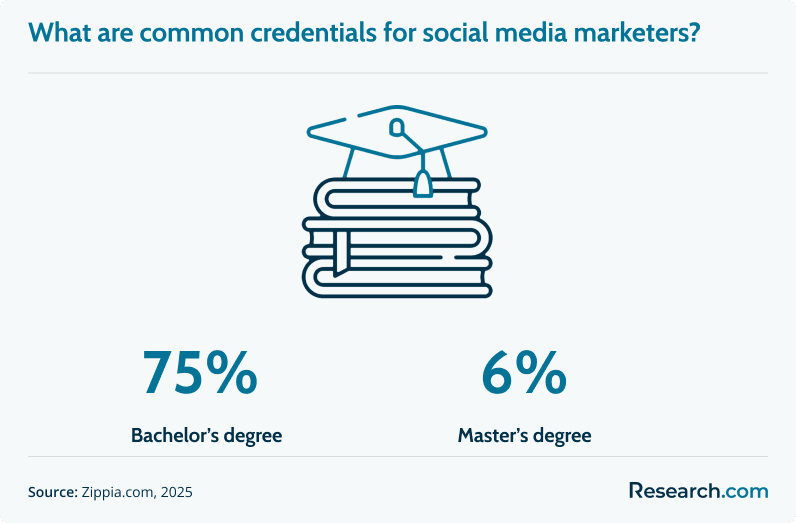
Admissions requirements vary, but online master’s programs in social media marketing, digital marketing, communication, or marketing analytics typically require a bachelor’s degree. Some programs prefer applicants with backgrounds in marketing, business, communications, journalism, media, public relations, or related fields, while others accept students from different academic areas if they can show strong writing, analytical ability, professional experience, or clear career goals.
Like other flexible professional degrees, including the shortest master's program in supply chain management, many online marketing programs are designed to accommodate working adults who want to move quickly into a specialized business field.
Common admissions requirements
- Completed online application form.
- Résumé showing professional, academic, leadership, or project experience.
- Statement of purpose or letter of intent explaining career goals and reasons for choosing the program.
- Official undergraduate transcripts, often with a minimum 3.0 GPA in major coursework.
- Optional letters of recommendation if GPA is below 3.0, typically 3 letters.
- Graduate transcripts, if the applicant has completed prior graduate-level coursework.
How to strengthen your application
- Include measurable marketing, communication, sales, content, or analytics achievements on your résumé.
- Build a small portfolio with writing samples, campaign examples, social audits, analytics reports, or content calendars.
- Explain why the program’s curriculum matches your career goal rather than submitting a generic statement.
- If your undergraduate GPA is weaker, highlight recent professional success, certifications, or relevant projects.
- Ask recommenders who can speak to your communication ability, strategic thinking, reliability, and readiness for graduate study.
What courses are typically in an online social media marketing degree program?
Online social media marketing degrees usually combine marketing foundations, communication strategy, analytics, content development, consumer research, and digital platform management. At the master’s level, students should expect more emphasis on strategy, measurement, leadership, and campaign evaluation than on basic posting or platform tutorials.
Common core courses
- Marketing Analytics: Students learn how to use data to evaluate campaign performance and guide marketing decisions.
- Consumer Behavior: Coursework explores how audiences make decisions, respond to messages, and interact with brands.
- Integrated Marketing Communications: Students learn how to coordinate brand messaging across social, email, search, paid media, public relations, and other channels.
- Social Media Strategy: This course focuses on planning, executing, and measuring campaigns across multiple platforms.
- Digital Media Law and Ethics: Students examine privacy, intellectual property, disclosure rules, platform policies, and ethical communication practices.
Specialized and elective courses
- Social Media Metrics and Analytics: Students practice measuring engagement, conversions, audience growth, and campaign return.
- Effective Social Media: Coursework evaluates which platforms and tactics serve different brand, audience, and business goals.
- Mobile and Emerging Technologies: Students study mobile-first content, apps, new platforms, and changing user behavior.
- Digital Media Management: This course covers content workflows, team coordination, budgeting, and campaign operations.
- Multimedia Storytelling: Students develop narratives using text, images, video, audio, and interactive formats.
Students comparing marketing degrees with broader business options should look closely at curriculum focus. For example, an accelerated entrepreneurship master's degree online may focus more on venture creation and innovation, while a social media marketing degree is usually more centered on audience strategy, brand communication, analytics, and digital engagement.
Similarly, students weighing business graduate options can compare programs such as MBA vs MS accounting to understand how specialized and generalist credentials lead to different career outcomes.
What types of specializations are available in an online social media marketing degree program?
Specializations help students focus their degree on a specific career direction. Some programs offer formal concentrations, while others allow students to choose electives that create an informal focus. The right specialization depends on whether you want to work in analytics, content, brand strategy, global marketing, advertising, or management.
Common specialization options
| Specialization | Main focus | Career fit |
| Digital Marketing | SEO, online advertising, content creation, digital engagement, and channel strategy. | Digital marketer, paid media specialist, marketing strategist, growth marketing associate. |
| Luxury Marketing | Brand positioning, prestige markets, high-end consumer behavior, fashion, cosmetics, and premium customer experience. | Luxury brand coordinator, brand strategist, social media specialist for premium brands. |
| International Marketing | Global audiences, cultural differences, regional campaigns, and cross-border marketing strategy. | Global marketing associate, international campaign coordinator, regional social media strategist. |
| Content Marketing | Editorial planning, audience-specific content, storytelling, blogs, video, and multi-channel publishing. | Content marketing specialist, social content strategist, editorial marketing manager. |
| Advertising or Brand Management | Campaign leadership, brand identity, messaging, creative strategy, and consumer perception. | Brand manager, account strategist, advertising coordinator, campaign manager. |
These focused options are also common in programs such as an accelerated online MBA in marketing, where students may combine broader business training with marketing-specific coursework. If you are deciding between leadership-oriented business degrees, comparing masters in organizational leadership vs MBA options can clarify whether you need marketing depth, general management training, or organizational leadership skills.
How to Choose the Best Online Social Media Marketing Degree Program
The best program is the one that fits your career goal, budget, schedule, learning style, and current experience level. A highly ranked program may not be the right choice if it lacks the specialization, flexibility, or career support you need. Start with your target job title, then work backward to identify the curriculum, portfolio opportunities, certifications, and network that will help you compete.
Key factors to compare
- Accreditation: Confirm that the institution is properly accredited. For business programs, specialized accreditation such as AACSB or ACBSP may also matter to some students and employers.
- Program focus: Business schools may emphasize management, analytics, and ROI, while communication schools may focus more on messaging, media research, and audience engagement.
- Online format: Check whether courses are asynchronous, synchronous, accelerated, part-time, or cohort-based.
- Faculty experience: Look for instructors with academic expertise and practical digital marketing, communications, analytics, agency, or brand experience.
- Career support: Ask about internships, portfolio reviews, mentorship, employer connections, alumni networks, and job search assistance for online students.
- Applied learning: Prioritize programs with capstones, campaign simulations, consulting projects, analytics assignments, or client-based work.
- Technology and tools: Find out whether the curriculum includes current analytics, content planning, social listening, advertising, SEO, or reporting tools.
- Total cost: Compare tuition, fees, books, software, travel requirements, and the number of credits required to graduate.
Career stage also matters. A recent graduate may need portfolio development and internships, while a mid-career professional may need leadership, strategy, or analytics depth. If you are considering business school more broadly, understanding what is the average age to get an MBA can help you think through timing, professional experience, and the value of graduate study at your stage.
Questions to ask before enrolling
- Is the school accredited, and does the program have any specialized business or communication accreditation?
- Does the curriculum focus on social media alone, or does it include broader digital marketing skills?
- Will I graduate with a portfolio, capstone, campaign plan, analytics report, or other work samples?
- Are courses asynchronous, live, or mixed?
- How often is the curriculum updated to reflect platform, analytics, advertising, and AI changes?
- What career services are available specifically to online students?
- Can I transfer credits or receive credit for prior graduate coursework?
- What is the total cost after fees, software, books, and required materials?
- Does the program support my target role: content, analytics, brand management, paid media, strategy, or leadership?
What career paths are available for graduates of an online social media marketing degree program?
Graduates can pursue roles that involve creating content, building online communities, managing paid or organic campaigns, analyzing data, improving search visibility, guiding brand perception, or leading digital teams. The best path depends on whether your strengths are creative, analytical, strategic, managerial, or technical.
Common career paths
| Career path | Typical responsibilities | Skills employers often expect |
| Social Media Manager | Plan content calendars, manage social channels, coordinate campaigns, monitor engagement, and report performance. | Platform knowledge, copywriting, scheduling tools, analytics, brand voice, and community management. |
| Digital Marketing Strategist | Design integrated campaigns across social, search, email, paid media, and web channels. | Strategic planning, analytics, channel selection, stakeholder communication, and campaign measurement. |
| Content Marketing Specialist | Create articles, videos, newsletters, social posts, and other content that supports audience growth and brand awareness. | Writing, SEO basics, editorial planning, storytelling, research, and audience analysis. |
| SEO/SEM Analyst | Improve search visibility, optimize paid search campaigns, analyze keywords, and report traffic or conversion results. | Keyword research, analytics, paid media platforms, testing, and technical marketing knowledge. |
| Community Manager | Build audience relationships, moderate discussions, respond to comments, and manage brand interactions. | Communication judgment, empathy, crisis response, platform fluency, and audience engagement. |
| Brand Manager | Shape brand perception, align messaging, support product positioning, and coordinate campaigns across channels. | Brand strategy, market research, storytelling, leadership, and cross-functional collaboration. |
Newer roles continue to emerge around analytics, UX, influencer marketing, short-form video, social commerce, and creator partnerships. The business impact of younger users is also shaping marketing strategy, as shown by research on the financial impact of young users on social platforms.
Students interested in the user experience side of digital marketing can also consider shortest online user experience programs. UX skills can complement social media training by helping marketers understand how users move from social platforms to websites, landing pages, apps, and conversion points.
Can online social media marketing graduates work internationally?
Yes. Social media marketing is naturally suited to remote, international, and cross-border work because campaigns, analytics, collaboration, and audience engagement often happen online. Graduates may work with global brands, distributed marketing teams, international agencies, or clients in different regions. However, global work requires more than platform knowledge. Professionals need cultural awareness, regional audience research, localization skills, time-zone management, and an understanding of different privacy, advertising, and disclosure expectations.
Students who want international leadership roles may benefit from pairing digital marketing expertise with broader business training. Programs such as the top rated online MBA programs can help professionals build management, finance, operations, and strategy skills that support larger global responsibilities.
What is the job market for graduates with an online social media marketing degree program?
The job market is shaped by the fact that social media is now central to brand discovery, customer communication, advertising, e-commerce, reputation management, and audience research. Organizations need professionals who can create strong content, interpret data, manage campaigns responsibly, and adapt to changing platforms. At the same time, the field is competitive because many candidates can gain basic social media experience without a degree. Graduates who combine formal education with a strong portfolio, analytics ability, and practical campaign examples are better positioned.
- Employment growth: According to the U.S. Bureau of Labor Statistics, jobs in advertising, promotions, and marketing management are expected to grow by 8% from 2022 to 2032—faster than average.
- Audience scale: Sprout Social reports that over 5.17 billion people now use social media worldwide, which creates ongoing demand for marketers who understand digital audiences.
- Average salary: Glassdoor lists the average base salary for U.S. social media marketers at $64,134, with higher pay possible in leadership, analytics, and specialized roles.
Some marketing professionals also build adjacent technical skills to manage the systems behind digital campaigns. For example, the fastest online CompTIA A+ training bootcamps may appeal to professionals who want foundational IT knowledge that complements marketing technology, analytics tools, and platform operations.
How AI and Platform Changes Are Affecting Social Media Marketing Degrees
AI tools are changing how marketers research audiences, generate content drafts, personalize campaigns, analyze results, and test messaging. This does not remove the need for human marketers. Instead, it raises the value of judgment, brand strategy, ethics, creative direction, data interpretation, and quality control. Students should look for programs that teach not only how to use tools, but also how to evaluate outputs, protect brand trust, and measure whether campaigns support real business goals.
Skills that are becoming more important
- Analytics interpretation: Knowing what data means is more valuable than simply collecting metrics.
- AI-assisted content workflows: Marketers need to use automation responsibly while maintaining originality, accuracy, and brand voice.
- Privacy-aware marketing: Campaigns must account for data protection, consent, and platform rules.
- Cross-channel strategy: Social media rarely works alone; it connects with search, email, websites, paid ads, events, and customer support.
- Reputation and crisis response: Brands need professionals who can respond quickly and thoughtfully when online conversations shift.
Should I Enhance My Social Media Marketing Degree with an MBA?
An MBA can be useful if your goal is to move from campaign execution into broader leadership, budgeting, operations, product strategy, consulting, or executive marketing roles. A social media marketing degree builds depth in digital audiences, content, analytics, and campaign strategy. An MBA adds broader business training in management, finance, organizational behavior, operations, and strategy.
The combination is not necessary for everyone. If you want to become a social media specialist, content marketer, or campaign coordinator, a focused marketing degree, certificate, portfolio, and experience may be enough. If you want to lead teams, manage budgets, oversee multiple marketing functions, or compete for senior roles, an MBA may provide additional value. Cost matters, so students often compare flexible and affordable options such as the cheapest MBA programs before deciding.
| Goal | Social media marketing degree may be enough | MBA may add value |
| Entry-level or mid-level social media role | Yes, especially with a portfolio and internship experience. | Usually not required. |
| Digital strategy or analytics role | Yes, if the curriculum includes analytics, paid media, SEO, and campaign measurement. | Helpful if the role includes budget ownership or leadership. |
| Marketing management | Helpful foundation, especially with experience. | Often useful for broader business, finance, and team leadership responsibilities. |
| Executive or consulting path | Provides digital expertise. | May strengthen strategic, operational, and client-facing credibility. |
How Do Industry Partnerships and Certifications Enhance Career Prospects?
Industry partnerships and certifications can make an online social media marketing degree more practical. A program that includes real client projects, internships, tool-based training, or certification preparation gives students more than academic knowledge. It helps them show employers what they can do.
Certifications can be especially helpful in fast-changing areas such as analytics, paid advertising, social listening, SEO, content scheduling, and marketing automation. They should not replace a degree when a degree is required for your target role, but they can strengthen a résumé and demonstrate current platform knowledge. Students who want to combine marketing with another industry can also explore related academic paths, such as the fastest sports management online bachelor's degree, if their goal is to work in sports branding, fan engagement, or digital audience development.
Common Mistakes to Avoid When Choosing an Online Social Media Marketing Degree
| Mistake | Why it can hurt you | Better approach |
| Choosing a program without checking accreditation | Accreditation affects credibility, financial aid eligibility, and transferability. | Verify institutional accreditation and, when relevant, business school accreditation. |
| Comparing only tuition per credit | Fees, books, software, and credit requirements can change the real price. | Calculate total program cost through graduation. |
| Assuming all online programs are self-paced | Some programs require live sessions, group meetings, or fixed deadlines. | Ask whether courses are asynchronous, synchronous, or hybrid. |
| Ignoring portfolio opportunities | Employers often want proof of campaign, analytics, writing, and strategy skills. | Prioritize programs with capstones, applied projects, internships, or client work. |
| Choosing a broad program when you need a specialization | A general marketing degree may not provide enough training in analytics, paid media, or social strategy. | Match electives and concentrations to your target job. |
| Assuming salary outcomes are guaranteed | Pay varies by role, location, industry, experience, and employer. | Use salary data as a planning tool, not a promise. |
| Relying only on rankings | A highly ranked program may not fit your budget, schedule, or career goal. | Use rankings as one input alongside curriculum, cost, support, and outcomes. |
Key Insights
- An online social media marketing degree is most valuable when it teaches strategy, analytics, content planning, brand communication, and applied campaign work—not just platform use.
- Master’s programs commonly take 1–2 years, while accelerated options may be completed in under 12 months and certificate programs may take only weeks or months.
- Online programs can reduce relocation, commuting, and housing costs, but students should compare total program cost rather than tuition per credit alone.
- Reported online program costs include around $10,995 per year, with some full programs between $18,342 and $30,000; in-person programs average $21,974 annually, with some top programs reaching $62,550.
- Career options include social media manager, digital marketing strategist, content marketing specialist, SEO/SEM analyst, community manager, and brand manager.
- Salary potential varies widely. Glassdoor lists the average base salary for U.S. social media marketers at $64,134, while advertising and promotions managers and marketing managers reported median salaries of $126,960 and $161,030 as of May 2024.
- The strongest applicants and graduates usually combine education with a portfolio, analytics experience, internships or applied projects, and current knowledge of AI-supported marketing tools.
- Before enrolling, verify accreditation, online format, total cost, curriculum fit, career services for online students, and whether the program helps you build job-ready work samples.
References:
- Coursera. (n.d.). Social media marketing salary: What to expect in 2024.
- Digital Marketing Institute. (n.d.). What’s the difference between online vs on-campus digital marketing master’s programs?
- Forbes. (2024, January 9). Social media marketing skills in demand, worth $1.5 trillion by 2030.
- Content Marketing Institute. (n.d.). How hard is it to find content or marketing jobs and how much should they pay?
- Sprout Social. (n.d.). Social media statistics.
- U.S. Bureau of Labor Statistics. (n.d.). Advertising, promotions, and marketing managers. Occupational Outlook Handbook.
- Zippia. (n.d.). Social media marketer jobs.
Other Things You Should Know About Online Social Media Marketing Degree Programs
Yes—an online social media marketing degree can be worth it for many students and professionals. It equips you with specialized skills in digital strategy, analytics, and content creation that are highly valued by employers. With rising demand for experts in online engagement and brand promotion, graduates often see a strong return on investment in the form of improved job opportunities and higher earning potential.
The speed of an online social media marketing degree program in 2027 is determined by factors such as course intensity, credit transfer policies, program structure, and enrollment flexibility. Programs offering accelerated courses and accepting prior learning credits can significantly reduce the time required to graduate.
Pursuing one of the fastest online social media marketing degree programs in 2027 allows you to quickly gain essential skills and credentials necessary for a rapidly evolving digital landscape. This accelerated learning path can provide quicker access to job opportunities in the competitive field of social media marketing.