2027 Fastest Online Master’s Degree in Entrepreneurship Programs

Co-Founder and Chief Data Scientist
An online master’s degree in entrepreneurship is for people who want graduate-level business training they can apply immediately—whether they are building a startup, preparing to scale a family business, moving into corporate innovation, or strengthening their ability to evaluate new markets. The main decision is not simply whether the degree is “good.” It is whether the program’s cost, pace, mentoring model, and applied coursework match the venture or career outcome you want.
Fast online entrepreneurship master’s programs are usually designed for bachelor’s degree holders who need flexibility, shorter academic terms, and project-based assignments instead of a traditional campus schedule. This guide explains what these programs teach, how long they take, what they cost, which schools offer accelerated options, and how to compare programs without relying only on rankings or tuition headlines.
Quick answer: Is an online master’s degree in entrepreneurship worth it?
An online master’s degree in entrepreneurship can be worthwhile if you need structured graduate business training, access to mentors, and a faster path to launching or leading a venture. It is most useful for students who already have a business idea, professional experience, or a clear career goal in startup leadership, consulting, corporate innovation, business development, or venture finance. It may be less useful if you only need basic startup knowledge that could be gained through short courses, incubators, or direct work experience.
What are the main benefits of earning an online master's degree in entrepreneurship?
- Graduates can use the degree in multiple settings, including startups, established companies, consulting firms, nonprofits, public-sector innovation programs, and family enterprises.
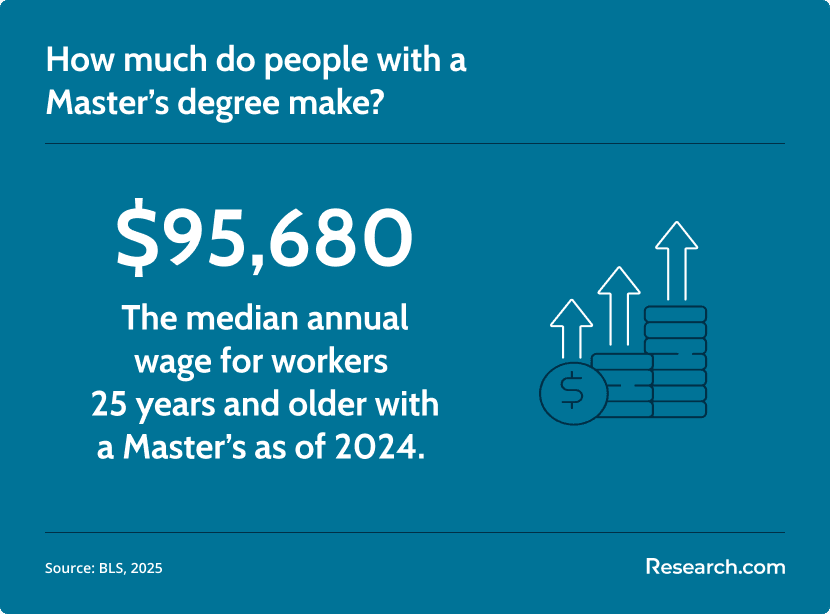
- Relevant roles such as management analyst, financial and investment analyst, general and operations manager, and chief executive report median earnings from $101,190 to $206,420, depending on the occupation, industry, and level of responsibility.
- Some online master's degree in entrepreneurship programs can be completed in 10–15 months, which may help students move into a new role or test a venture idea sooner than a longer graduate program would allow.
What can I expect from an online master's degree in entrepreneurship?
An online master’s degree in entrepreneurship combines core business training with applied venture development. Instead of focusing only on management theory, these programs usually ask students to test ideas, analyze customers, build financial models, practice pitching, and evaluate risk under realistic constraints.
Most programs are built for working adults. Courses may be asynchronous, live online, or a blend of both. The strongest programs do more than post recorded lectures; they create regular opportunities for feedback from faculty, peers, alumni, investors, founders, or industry mentors.
- Applied venture coursework: Students often work through customer discovery, business model testing, competitive analysis, pricing, and go-to-market planning in short academic modules.
- Capstone, launch lab, or venture studio: Many programs end with a pitch, business plan, consulting project, or incubator-style experience that requires students to defend decisions using evidence.
- Faculty and mentor feedback: Programs with instructors who have startup, investment, consulting, or executive experience can help students connect academic frameworks to current market realities.
- Elective focus areas: Students may be able to concentrate on fintech, social enterprise, family business, corporate innovation, sustainability, or technology ventures without adding extra semesters.
- Flexible online delivery: Many programs combine self-paced materials with optional or required live sessions, making the format more manageable for full-time professionals.
- Transfer or waiver opportunities: Some schools may accept prior graduate credits, business certifications, or documented professional experience to reduce the required course load.
- Digital business tools: Students may use analytics dashboards, prototyping platforms, collaboration software, customer relationship management tools, or financial modeling resources as part of coursework.
What skills should you graduate with?
| Skill area | How it is used in entrepreneurship | Why it matters |
| Opportunity evaluation | Testing whether a market problem is real and worth solving | Helps founders and innovation teams avoid building products without demand |
| Financial planning | Estimating revenue, costs, cash flow, valuation, and funding needs | Supports stronger decisions before hiring, fundraising, or scaling |
| Customer discovery | Interviewing users, interpreting feedback, and refining the value proposition | Improves product-market fit and reduces wasted development time |
| Strategic leadership | Coordinating teams, priorities, and resources in uncertain environments | Prepares graduates for startup, consulting, and corporate innovation roles |
| Pitch development | Presenting a venture, initiative, or investment case to decision-makers | Useful for fundraising, internal buy-in, partnerships, and grant proposals |
Where can I work with an online master's degree in entrepreneurship?
Entrepreneurship graduates are not limited to founding companies. The degree can support work anywhere organizations need people who can identify opportunities, test ideas, allocate resources, and lead change. That includes early-stage startups, large corporations, consulting firms, public agencies, nonprofits, and higher education innovation centers.
- Startups and early-stage companies: Graduates may support product development, operations, fundraising preparation, customer acquisition, or growth strategy in technology, consumer products, digital services, and other fast-changing markets.
- Corporate innovation teams: Established companies use entrepreneurial methods to test new products, enter adjacent markets, improve internal processes, or build new revenue lines.
- Nonprofits and mission-driven ventures: Entrepreneurial training can help leaders design sustainable programs, pursue funding, measure impact, and expand services.
- Public agencies and economic development offices: Graduates may work on small business support, grant programs, regional entrepreneurship ecosystems, or workforce development initiatives.
- Colleges, universities, and research organizations: Entrepreneurship centers, incubators, and commercialization offices often need professionals who can connect research, students, mentors, and investors.
- Creative and cultural industries: Arts, media, entertainment, design, and creator-focused ventures often require strong business model, branding, and audience development skills.
- International business and development: Graduates may apply venture strategy to cross-border expansion, export development, innovation policy, or emerging-market enterprise.
How much can I make with an online master's degree in entrepreneurship?
Income after an entrepreneurship master’s depends heavily on the path you choose. A founder may earn little salary at first while building equity. A consultant or corporate manager may see steadier compensation sooner. A senior executive may earn more, but those roles usually require substantial experience beyond the degree.
| Career path | Median salary stated | How the degree may apply |
| Chief Executives | $206,420 | Useful for founders, senior leaders, and executives responsible for strategy, growth, and organizational direction |
| General and Operations Managers | $102,950 | Relevant for professionals managing daily operations, teams, budgets, and process improvements |
| Management Analysts | $101,190 | Applies to consultants who evaluate business models, operations, market positioning, or growth strategy |
| Financial and Investment Analysts | $101,350 | Supports work in startup finance, venture analysis, investment research, and capital planning |
These salary figures should not be treated as guaranteed outcomes. Location, industry, prior experience, employer size, equity ownership, and the strength of your professional network can all change earnings significantly.
- Online Master's Degree in Entrepreneurship Programs for 2027
- How long does an online master's degree in entrepreneurship take?
- Online vs. campus entrepreneurship master's programs
- Average cost of an online master's degree in entrepreneurship
- Financial aid options for entrepreneurship master's students
- Admission requirements for online entrepreneurship master's programs
- Common courses in an online entrepreneurship master's degree
- Specializations in online entrepreneurship master's programs
- Networking and mentorship resources to look for
- How to choose the best online master's degree in entrepreneurship
- Common challenges in online entrepreneurship programs
- Career paths for entrepreneurship master's graduates
- Return on investment of an online master's degree in entrepreneurship
- Job market for entrepreneurship master's graduates
Online Master's Degree in Entrepreneurship Programs for 2027
How do we rank schools?
This list is intended for students who want an online entrepreneurship graduate program with a practical curriculum, flexible delivery, and a realistic path to completion. It emphasizes programs that can help students move from coursework to venture planning, consulting, corporate innovation, or business leadership without requiring relocation.
Selections are guided by Research.com’s ranking methodology, with attention to program structure, completion speed, institutional accreditation, and available program information. The goal is not to declare one school universally best for every student, but to help you compare options based on fit, cost, timeline, and outcomes.
Program information is reviewed using verifiable sources such as the National Center for Education Statistics, the U.S. Department of Education’s College Scorecard, Peterson’s Distance Learning database, and the Integrated Postsecondary Education Data System.
1. University of Arizona
The University of Arizona offers an online Master of Science in Entrepreneurship through the Eller College of Management. The program uses seven-week course blocks, venture studio work, and faculty-supported mentor teams to move students from market research to an investor-ready pitch while they continue working. Virtual design sprints, iterative feedback, and elective venture labs allow students to progress quickly or adjust pacing based on their schedules.
- Program Length: 12 months full-time
- Tracks/concentrations: General entrepreneurship with elective venture labs
- Cost per Credit: $1,000
- Required Credits to Graduate: 30
- Accreditation: Higher Learning Commission (HLC)
2. Babson College
Babson College delivers an Online MBA with a concentration in Entrepreneurship that emphasizes interactive, project-centered learning. Students complete consulting-style work with startup and corporate partners, participate in virtual intensives each trimester, and gain access to resources through the Arthur M. Blank Center. The format is designed for students who want an entrepreneurship-focused MBA rather than a standalone entrepreneurship degree.
- Program Length: 18 months full-time
- Tracks/concentrations: Entrepreneurship, with additional options in Finance, Business Analytics, and Global Business
- Cost per Credit: $1,990
- Required Credits to Graduate: 45
- Accreditation: New England Commission of Higher Education (NECHE); Association to Advance Collegiate Schools of Business (AACSB)
3. Liberty University
Liberty University offers a fully online MBA with an Entrepreneurship cognate. Courses run in eight-week formats, and qualified students may complete the program in roughly one year. The school’s transfer policy may allow up to half of the degree to be met through prior graduate credit, while the faith-integrated capstone gives students a structured way to test venture ideas with faculty input.
- Program Length: 12 months full-time
- Tracks/concentrations: Entrepreneurship cognate within the MBA
- Cost per Credit: $565 (online graduate business rate)
- Required Credits to Graduate: 36
- Accreditation: Southern Association of Colleges and Schools Commission on Colleges (SACSCOC); Accreditation Council for Business Schools and Programs (ACBSP)
4. East Carolina University
East Carolina University offers a fully online Master of Science in Entrepreneurship through its College of Business. The program combines cohort-based coursework with virtual new-venture labs, where students refine business models with guidance from faculty and regional mentors. Rolling entry points, a condensed calendar, and corporate-innovation electives may appeal to professionals who want to keep working while developing a launch plan.
- Program Length: 12 months full-time
- Tracks/concentrations: General entrepreneurship with elective pathways in new venture or corporate innovation
- Cost per Credit: $308 (distance-education in-state rate)
- Required Credits to Graduate: 30
- Accreditation: SACSCOC; AACSB
5. Western Carolina University
Western Carolina University offers a fully online Master of Entrepreneurship in Innovation Leadership and Entrepreneurship. The program is delivered through five compressed “mini-mesters” each year, giving focused students a route to complete core requirements in roughly one year. Faculty connected with the Center for Entrepreneurship guide students through market testing, pitch development, and feedback cycles.
- Program Length: 12 months full-time
- Tracks/concentrations: General entrepreneurship with electives in corporate innovation and new-venture creation
- Cost per Credit: $325 (distance-education graduate, in-state)
- Required Credits to Graduate: 30
- Accreditation: SACSCOC; AACSB
6. University of Florida
The University of Florida offers a fully online Master of Science in Entrepreneurship through the Warrington College of Business. Seven-week courses and the virtual Gator Venture Accelerator help students move from opportunity screening to an investor pitch in about one year. Live coaching, design-thinking studios, and optional global immersion electives create an applied path for professionals who want to launch or scale while remaining employed.
- Program Length: 12 months full-time
- Tracks/concentrations: General entrepreneurship (elective global immersion available)
- Cost per Credit: $530 (in-state online graduate rate)
- Required Credits to Graduate: 30
- Accreditation: SACSCOC; AACSB
7. University of Massachusetts Lowell
University of Massachusetts Lowell offers a fully online Master of Science in Entrepreneurship and Innovation through the Manning School of Business. Students take seven-week courses and participate in a virtual New Venture Incubator, where they test concepts with faculty and industry mentor support. Rolling admissions, a lock-step calendar, and practicum options help students keep their career momentum while developing a business model.
- Program Length: 12 months full-time
- Tracks/concentrations: General entrepreneurship with elective innovation projects
- Cost per Credit: $655 (online graduate business rate)
- Required Credits to Graduate: 30
- Accreditation: NECHE; AACSB
8. Southern New Hampshire University
Southern New Hampshire University offers an online MBA in Entrepreneurship using eight-week courses and six annual start dates. The structure can help working professionals move through venture-focused coursework without leaving full-time employment. A final capstone simulates elements of the startup process, requiring students to apply market research, strategy, and investor-oriented thinking.
- Program Length: As few as 15 months full-time
- Tracks/concentrations: Entrepreneurship concentration within the MBA
- Cost per Credit: $637 (online graduate rate)
- Required Credits to Graduate: 30
- Accreditation: NECHE; ACBSP
9. Louisiana State University–Shreveport
Louisiana State University Shreveport offers a fully online MBA with a concentration in Entrepreneurship and Family Enterprise. Delivered in seven-week terms with multiple start dates, the program focuses on applied strategy, family enterprise issues, and succession planning. Its accelerated format may suit professionals who want to move from coursework to execution quickly.
- Program Length: As few as 10 months full-time
- Tracks/concentrations: Entrepreneurship and Family Enterprise concentration within the MBA
- Cost per Credit: $374 (online graduate business rate)
- Required Credits to Graduate: 30
- Accreditation: SACSCOC; AACSB
10. Pepperdine University Graziadio
Pepperdine University’s Graziadio Business School offers a fully online MBA with an Entrepreneurship concentration. The trimester-based format includes live case discussions, applied consulting projects, and new venture strategy work through the E2B™ program. Students also gain access to alumni mentorship and pitch coaching through the Pepperdine Center for Entrepreneurship.
- Program Length: 15 months accelerated pathway
- Tracks/concentrations: Entrepreneurship plus six options including Finance, Business Analytics, and Global Business
- Cost per Credit: $2,115
- Required Credits to Graduate: 52
- Accreditation: WASC Senior College and University Commission (WSCUC); AACSB
How long does it take to complete an online master's degree in entrepreneurship?
An online master’s degree in entrepreneurship can take as little as 12 months, although the actual timeline depends on credit requirements, term length, transfer policies, and whether you study full time or part time. Many programs require 30–36 credits. Accelerated options may resemble the pacing used in the shortest online MBA programs in marketing, where shorter terms and year-round enrollment help students finish faster.
| Program format | Typical completion time stated | Best for |
| Standard full-time track | 18–24 months | Students who want a predictable pace with a traditional graduate workload |
| Accelerated cohort | 12–16 months | Motivated students who can handle six- or eight-week terms and year-round study |
| Competency-based format | Approximately 12 months for some students | Self-directed learners who can move quickly by proving mastery |
| Part-time schedule | 30–36 months | Working professionals, caregivers, and students balancing significant outside responsibilities |
| Credit waivers or transfer credit | May shorten the program by a full semester | Applicants with prior graduate coursework, certifications, or relevant professional experience |
Short residencies, virtual pitch weekends, or intensive project sessions may be required in some programs, but these usually do not add much to the total completion timeline. Before enrolling, ask whether accelerated pacing affects course availability, financial aid eligibility, internship access, or capstone scheduling.
The following chart shows the educational attainment of Americans aged 18 and above.
How does an online master's degree in entrepreneurship compare to on-campus programs?
Online and on-campus entrepreneurship master’s programs can follow the same academic standards when they are offered by accredited institutions. The difference is usually not the credential itself, but how students access instruction, mentorship, networking, facilities, and peer collaboration.
| Factor | Online master's in entrepreneurship | On-campus master's in entrepreneurship |
| Pacing | Often offers shorter terms, multiple start dates, and accelerated schedules | Often follows semester-based calendars with fewer pacing options |
| Networking | Relies on virtual teams, online mentor meetings, remote pitch events, and alumni platforms | Offers in-person events, campus incubators, local founder meetups, and face-to-face networking |
| Cost considerations | May reduce relocation, commuting, and some campus-related expenses | May involve housing, transportation, and location-based opportunity costs |
| Learning tools | Uses cloud-based collaboration, analytics, prototyping, and venture modeling platforms | May include physical makerspaces, labs, studios, and campus-based entrepreneurship centers |
| Best fit | Working adults, remote learners, and students who need flexible scheduling | Students who want an immersive campus experience and local entrepreneurial ecosystem |
Online study can be a strong choice if you are disciplined, comfortable with digital collaboration, and already have access to a professional environment where you can apply assignments. On-campus study may be better if you learn best through in-person discussion, need frequent face-to-face coaching, or want to build a local founder network. Students comparing accelerated business-related graduate options may also look at a fast-track emergency management masters degree online to understand how compressed online formats work in other professional fields.
If your venture idea depends on operations, fulfillment, procurement, or global trade, the fastest online graduate certificate programs in logistics and supply chain management may also be worth comparing as a targeted add-on or alternative.
What is the average cost of an online master's degree in entrepreneurship?
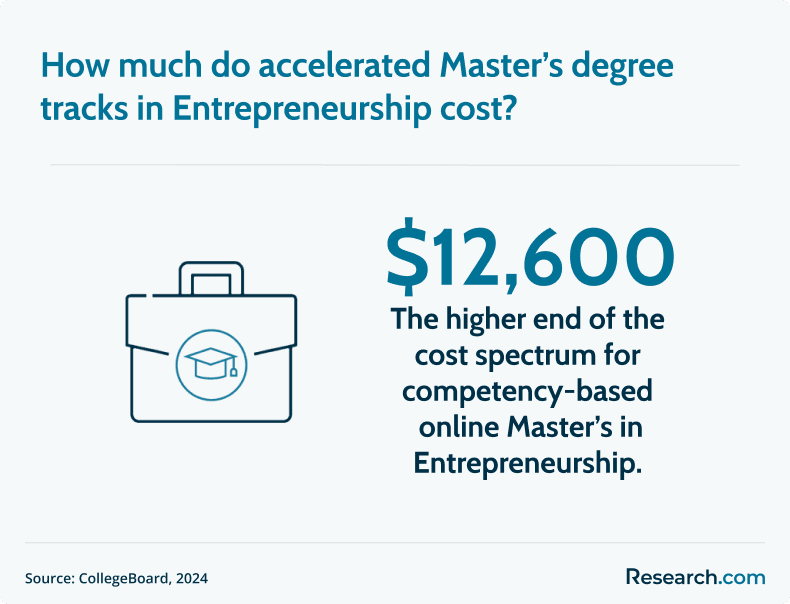
The average cost of an online master’s degree in entrepreneurship ranges from $13,500 to $36,000, depending on whether the institution is public or private, how many credits are required, and whether tuition is charged by credit or by term. Students considering broader graduate options may compare these costs with the best online dual master’s degree programs, especially if they want a combined credential.
| Program pricing model | Cost stated | What to watch |
| Public universities, in-state rate | $450 to $650 per credit; $13,500 to $19,500 for a 30-credit degree | Check whether you qualify for in-state pricing and whether online students pay extra fees |
| Flat online tuition | $650 to $800 per credit; $19,500 to $24,000 total | Helpful for out-of-state students, but confirm the full fee schedule |
| Private institutions | $900 to $1,200 per credit; up to $27,000 to $36,000 total | May offer strong networks or brand value, but compare scholarships and outcomes carefully |
| Competency-based or subscription models | $4,200 per six-month term; $8,400 to $12,600 overall for fast completers | Best value usually goes to students who can finish quickly and stay on pace |
| Additional expenses | $1,000 to $2,000 for materials, technology fees, and required software | Ask whether software, books, residencies, and graduation fees are included |
Do not compare programs by tuition alone. A lower-cost program that lacks mentorship, venture support, or relevant electives may deliver less value than a higher-cost program with strong applied learning and alumni access. At the same time, a premium tuition rate is not automatically justified unless the program’s outcomes and support services align with your goals.
What are the financial aid options for students enrolling in an online master's degree in entrepreneurship program?
Most students pay for an online entrepreneurship master’s degree through a mix of federal aid, employer support, scholarships, veterans benefits, personal savings, and payment plans. Because founders may face uneven income while launching a business, it is especially important to avoid borrowing more than your career plan can reasonably support.
- Federal loans: Graduate students may use Federal Direct Unsubsidized Loans and Graduate PLUS Loans to help cover eligible costs after other aid is applied.
- Employer tuition assistance: Some employers reimburse up to $5,250 per year, and that benefit remains tax-free under current IRS guidelines (IRS, 2025).
- Institutional scholarships: Business schools may award merit funding based on GPA, test scores, leadership experience, entrepreneurial background, or portfolio quality, sometimes reducing published rates by 10%–25%.
- Veterans benefits: Eligible service members and veterans may use Post-9/11 GI Bill funds, which can cover full tuition plus a housing stipend.
- State or regional entrepreneurship support: Some economic-development organizations offer forgivable loans or micro-grants to founders who commit to launching ventures locally.
A practical funding strategy is to compare your net price after grants, scholarships, and employer aid—not just the advertised tuition. Students who are drawn to fast, career-focused online study may use similar cost-control strategies when reviewing accelerated online real estate programs.
The chart below shows how many students received any form of federal aid in the 2023–24 academic year.
What are the prerequisites for enrolling in an online master's degree in entrepreneurship?
Admission requirements vary by institution, but most online entrepreneurship master’s programs look for evidence that applicants can handle graduate coursework and contribute meaningfully to applied business discussions. A bachelor’s degree is usually required, and professional experience can be helpful, especially in accelerated programs.
- Bachelor’s degree: Applicants generally need an undergraduate degree from an accredited institution. Many programs expect a minimum GPA of 3.0, though some review lower GPAs alongside work experience or other strengths.
- Official transcripts: Schools require transcripts from all prior colleges to verify degree completion, grades, and possible transfer credit.
- Resume or CV: Programs often prefer applicants with one to two years of professional, entrepreneurial, leadership, or project experience.
- Personal statement: Applicants usually explain their goals, venture interests, career plans, and reasons for choosing an online format.
- Letters of recommendation: Two academic or professional references may be required to speak to leadership potential, work ethic, and graduate readiness.
- Quantitative preparation: Some programs expect prior coursework or demonstrated ability in finance, accounting, statistics, or analytics. GMAT or GRE scores are often waived for applicants with business experience.
- English proficiency: International applicants may need TOEFL iBT scores of at least 79 or IELTS scores of 6.5.
If you are comparing career-oriented graduate business paths, it may also help to review related outcomes such as what jobs you can get with a business analytics degree. Students interested in public leadership or nonprofit innovation may also compare requirements for a fast-track public administration degree online.
What courses are typically in an online master's degree in entrepreneurship program?
Entrepreneurship master’s programs usually organize business fundamentals around the process of identifying, testing, financing, launching, and scaling new initiatives. Compared with more function-specific graduate options such as online MBA HR programs, entrepreneurship coursework tends to be more iterative and cross-functional.
- Opportunity Recognition: Students learn to identify market gaps, customer needs, competitive openings, and emerging trends.
- Entrepreneurial Finance: Coursework may cover valuation, cash-flow forecasting, funding sources, capital strategy, and early-stage investment decisions.
- Innovation Strategy: Students practice rapid prototyping, product-market fit testing, portfolio thinking, and innovation governance.
- Marketing for New Ventures: Courses may address digital acquisition, positioning, customer development, brand strategy, and growth experimentation.
- Legal and Intellectual Property: Students study entity formation, contracts, patents, trademarks, ownership issues, and legal risks that affect growing ventures.
- Data Analytics for Entrepreneurs: Coursework may use dashboards, low-code tools, and business metrics to test assumptions and improve operations.
- Leadership and Team Dynamics: Students examine hiring, team structure, decision-making, communication, and resilience in high-uncertainty environments.
- Capstone or Launch Lab: A final project often requires students to integrate finance, strategy, market validation, and pitching into a venture plan or consulting deliverable.
Students building ventures in finance, accounting, or tax-heavy industries may also consider whether fast-track master's in taxation management online programs would provide specialized knowledge that complements entrepreneurship coursework.
What types of specializations are available in an online master's degree in entrepreneurship?
Specializations help students align the degree with a specific market, venture type, or leadership goal. Many programs use 9–12 elective credits for a concentration, often ending in a project, pitch, or applied strategy assignment.
| Specialization | Focus | Best fit |
| Technology Venturing | Software products, agile development, prototyping, and venture capital concepts | Students interested in tech startups or digital products |
| Social Innovation | Mission-driven revenue, impact measurement, grants, and blended finance | Founders and leaders focused on social or community impact |
| Corporate Entrepreneurship | Internal ventures, lean pilots, governance, and innovation inside established companies | Professionals pursuing intrapreneurship or innovation roles |
| Family Business Leadership | Succession planning, governance, ownership structures, and growth across generations | Students preparing to lead or modernize a family enterprise |
| Fintech and Blockchain | Digital payments, decentralized finance, compliance, and financial technology markets | Students targeting finance-related ventures or startup finance roles |
| Global Entrepreneurship | Cross-border market entry, international funding, multicultural leadership, and export strategy | Students building ventures with international customers or suppliers |
| Sustainable Enterprise | Circular economy, Environmental, Social, and Governance (ESG) metrics, and green technology commercialization | Students focused on climate, sustainability, or responsible business models |
If you are considering data-driven venture roles, compare curriculum strength in analytics and market intelligence with adjacent career benchmarks such as business intelligence developer salary information.
What networking and mentorship resources bolster entrepreneurial success?
Networking is not a bonus feature in an entrepreneurship program; it is part of the value proposition. A strong online program should help students meet mentors, alumni, founders, investors, industry specialists, and peers who can challenge assumptions and open doors.
- Alumni founder networks: Look for graduates who are actively building companies, advising startups, investing, or leading innovation teams.
- Structured mentorship: Strong programs match students with mentors for recurring feedback, not just one-time guest lectures.
- Virtual incubators or accelerators: These resources can help students refine ideas, build prototypes, practice pitches, and test markets.
- Pitch events and demo days: Remote pitch opportunities can help students learn how investors, executives, and community partners evaluate venture ideas.
- Peer cohorts: A well-designed cohort gives students collaborators, early testers, accountability partners, and future professional contacts.
- Business school partnerships: Some entrepreneurship programs connect students with broader graduate business communities, including resources associated with top online MBA programs.
How to choose the best online master's degree in entrepreneurship?
The best online entrepreneurship master’s program is the one that fits your goals, budget, schedule, and preferred learning style. A program that is excellent for a future startup founder may not be ideal for someone targeting corporate strategy, and a prestigious program may not be worth the cost if it does not provide the specific mentoring or flexibility you need.
- Verify accreditation: Confirm institutional accreditation and, when relevant, business accreditation through the Association to Advance Collegiate Schools of Business. Accreditation can affect credit transfer, employer recognition, and financial aid eligibility.
- Match the curriculum to your goal: A founder may need venture finance and launch labs; a corporate innovator may need strategy, analytics, and change management; a family business successor may need governance and succession planning.
- Check pacing and course availability: Accelerated formats only work if required courses are offered frequently enough for you to stay on schedule.
- Review faculty experience: Prioritize programs where instructors understand startups, investment, consulting, product development, or business growth in practice.
- Calculate the full cost: Include tuition, fees, software, books, residencies, graduation costs, and any income you may lose by reducing work hours.
- Evaluate mentorship depth: Ask how mentors are assigned, how often students meet them, and whether mentors have relevant industry experience.
- Ask for outcome evidence: Review job placement information, alumni roles, startup support, employer partnerships, and available salary data, but remember that outcomes are not guaranteed.
Questions to ask before enrolling
| Question | Why it matters |
| Is the institution regionally accredited, and does the business school hold relevant specialized accreditation? | Accreditation affects credibility, transfer options, and access to federal financial aid. |
| Can I complete the degree in the advertised timeline if I work full time? | Accelerated schedules can be demanding, and not every student can sustain the workload. |
| Does the capstone support my actual venture or career target? | A practical final project can become a portfolio asset, pitch deck, or consulting sample. |
| Who provides mentorship, and how often will I receive feedback? | Entrepreneurship learning depends heavily on timely, informed critique. |
| What is the total net cost after scholarships, employer aid, and fees? | The lowest sticker price is not always the lowest real cost, and the highest price is not always the best value. |
| Are online students eligible for the same incubator, alumni, and career services as campus students? | Support access can strongly affect the practical value of the degree. |
For students who plan to continue into advanced leadership study, an entrepreneurship master’s can also provide a foundation for accelerated online doctor of business administration in management programs.
What challenges might students face in an online master's degree in entrepreneurship?
Online entrepreneurship programs can be efficient, but they require discipline. Students must manage fast course cycles, independent work, digital collaboration, and sometimes limited face-to-face interaction. The biggest challenge is often not the academic content itself, but staying accountable while juggling work, family, and venture development.
| Common mistake | Why it can hurt you | Better approach |
| Choosing a program only because it is fast | A shorter timeline may reduce reflection, mentoring time, or project quality if support is weak | Compare speed with curriculum depth, faculty access, and capstone quality |
| Ignoring accreditation | Unaccredited or poorly recognized programs may limit transfer credit, aid eligibility, and employer confidence | Verify institutional accreditation and relevant business accreditation before applying |
| Comparing only tuition | Fees, software, residencies, and lost work hours can change the true cost | Calculate total net cost and expected time to completion |
| Assuming online means easier | Accelerated online courses often require strong time management and weekly output | Review sample syllabi, weekly workload, and live session expectations |
| Overlooking networking access | A program without mentors, alumni engagement, or pitch opportunities may feel isolated | Ask how online students participate in incubators, advising, and events |
| Starting without a goal | Entrepreneurship coursework is more valuable when tied to a venture, industry, or role | Define whether you are pursuing startup launch, consulting, corporate innovation, or business succession |
Prospective students who want to understand how support services differ across accelerated online programs can also compare structures outside business, such as an accelerated online sports management bachelor's degree.
What career paths are available for graduates of an online master's degree in entrepreneurship?
An online master’s degree in entrepreneurship can lead to business ownership, but it can also support roles that involve growth strategy, product development, venture analysis, consulting, operations, and innovation management. The strongest career fit depends on your prior experience and how you use the program’s projects, network, and capstone.
- Founder or co-founder: Build and launch a new venture, often using coursework to test assumptions, shape strategy, and prepare funding materials.
- Product or strategy manager: Guide product roadmaps, market entry plans, innovation priorities, and cross-functional execution inside established organizations.
- Corporate venture associate: Evaluate partnerships, startup investments, new business lines, or emerging market opportunities for a larger company.
- Startup operations lead: Manage systems, hiring, customer operations, revenue processes, and execution in a growing company.
- Growth or innovation consultant: Advise clients on business model design, process modernization, market expansion, or new product launches.
- Business development director: Build partnerships, distribution channels, strategic alliances, and revenue opportunities for startups, nonprofits, or established firms.
- Policy or program manager: Support entrepreneurship grants, small business programs, incubators, economic development, or community revitalization initiatives.
- Entrepreneur-in-Residence: Work with accelerators, incubators, universities, or investment groups to evaluate ideas and mentor founders.
Some students combine entrepreneurship with analytics, especially when growth strategy depends on data-driven decision-making. If that is your target, it may help to review the difference between data science and business analytics. Students interested in sports ventures, athlete services, or sports-related business models may also compare the shortest sports management MBA online.
What is the return on investment of an online master's degree in entrepreneurship?
The return on investment of an online master’s degree in entrepreneurship depends on how directly the program supports your next move. ROI is clearer for students using the degree to qualify for consulting, management, innovation, or analyst roles. It is harder to measure for founders because early-stage ventures may produce little immediate salary but could create long-term value through ownership.
How to evaluate ROI before applying
- Estimate total program cost: Include tuition, fees, software, books, residencies, and financing costs.
- Compare net cost after aid: Subtract scholarships, employer assistance, veterans benefits, and other funding sources.
- Assess opportunity cost: Consider reduced work hours, delayed income, or time spent away from venture development.
- Map the degree to a specific outcome: Identify whether the program helps with a job transition, promotion, launch, funding strategy, or family business succession.
- Evaluate non-salary value: Mentors, alumni, pitch practice, incubator access, and credibility with partners may matter even when salary data is limited.
- Compare alternatives: For some students, affordable MBA programs online, graduate certificates, accelerators, or targeted short courses may provide a better cost-benefit fit.
- : "The degree is most likely to pay off when you enter with a clear problem to solve, use coursework to build evidence, and graduate with a stronger network, sharper financial plan, and usable venture or career portfolio."
What is the job market for graduates of an online master's degree in entrepreneurship?
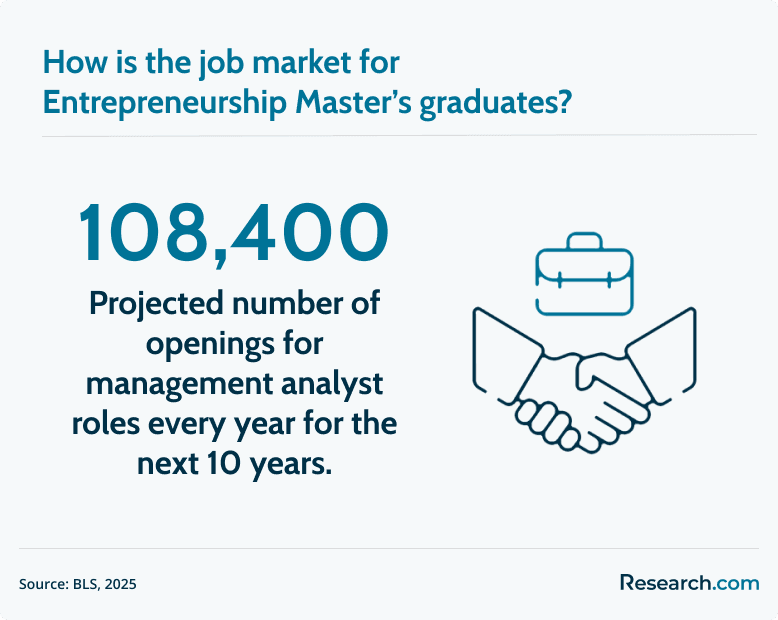
The job market for entrepreneurship graduates is strongest in roles that reward strategic analysis, operational improvement, and innovation leadership. According to the Bureau of Labor Statistics, management analyst positions are projected to grow by 10% from 2023 to 2033, with an estimated 108,400 openings each year.
This outlook reflects employer demand for professionals who can evaluate business models, identify inefficiencies, support growth decisions, and guide organizational change. Students weighing entrepreneurship against other graduate business routes may find it useful to compare MBA vs master’s in accounting pathways, since each credential prepares students for different types of business responsibility.
Current trends affecting entrepreneurship graduates
- AI and automation: Founders and innovation teams increasingly use digital tools for market research, customer service, content creation, analytics, and workflow automation. Graduates need to understand how to use these tools responsibly and strategically.
- Evidence-based venture building: Employers and investors expect stronger validation before committing resources. Customer discovery, analytics, and financial modeling are becoming more important.
- Credential plus portfolio hiring: A degree can help, but employers and partners also want proof of execution, such as capstone projects, pitch decks, consulting work, prototypes, or measurable business results.
- Hybrid career paths: Many graduates do not choose between employment and entrepreneurship immediately. They may work in consulting, product, operations, or innovation while building a venture on the side.
- Cost sensitivity: Rising education costs make ROI analysis more important. Students should compare program price, completion time, funding, and likely career benefit before enrolling.
References:
- AACSB International. (2024). Training tomorrow’s talent: Experiential learning in business education. https://www.aacsb.edu/insights/articles/2024/11/icymi-training-tomorrows-talent
- Bureau of Labor Statistics. (2025). Chief Executives. https://www.bls.gov/ooh/management/top-executives.htm
- Bureau of Labor Statistics. (2025). General and Operations Managers. https://www.bls.gov/ooh/management/top-executives.htm
- Bureau of Labor Statistics. (2025). Financial and Investment Analysts. https://www.bls.gov/ooh/business-and-financial/financial-analysts.htm
- Bureau of Labor Statistics. (2025). Management Analysts. https://www.bls.gov/ooh/business-and-financial/management-analysts.htm
- College Board. (2024). Trends in College Pricing and Student Aid 2024: Graduate tuition highlights. https://research.collegeboard.org/media/pdf/Trends-in-College-Pricing-and-Student-Aid-2024-ADA.pdf
- Fairlie, R. W. (2024). Indicators of entrepreneurial activity: 2023. University of California, Los Angeles. Retrieved January 2024, from https://bpb-us-e1.wpmucdn.com/sites.ucsc.edu/dist/1/884/files/2024/01/entrepreneurship-indicators-2023_v4-86a1385edc540715.pdf
- Graduate Management Admission Council. (2024). 2024 Application Trends Survey: Graduate Business Programs. https://www.gmac.com/market-intelligence-and-research/research-library/admissions-and-application-trends/2024-application-trends-survey-report
- Internal Revenue Service. (2024). Tax benefits for education: Employer-provided educational assistance. https://www.irs.gov/taxtopics/tc513
- U.S. Department of Education, Federal Student Aid. (2025). Types of aid for graduate or professional students. https://studentaid.gov/understand-aid/types
Key Insights
- An online master’s degree in entrepreneurship is best for students who want applied graduate business training tied to a specific venture, innovation role, consulting path, or leadership goal.
- Fast programs can take 10–15 months or as little as 12 months in many accelerated formats, but speed should not outweigh accreditation, mentoring quality, curriculum fit, and workload realism.
- Total cost can range from $13,500 to $36,000, with additional expenses of $1,000 to $2,000 possible; compare net cost after aid rather than sticker price alone.
- Career outcomes vary widely. Median salaries for related roles range from $101,190 to $206,420, but founder income may be lower early on and more dependent on equity or long-term business performance.
- The most valuable programs provide more than online courses. Look for venture studios, pitch coaching, alumni mentors, incubator access, and projects that produce usable work samples.
- Before enrolling, ask whether the program is accredited, whether online students receive the same support as campus students, and whether the capstone directly supports your career or venture plan.
Other Things You Should Know About Online Master's Degree in Entrepreneurship Programs
Look for regional accreditation from a U.S. accreditor recognized by the U.S. Department of Education. If the business school is separately accredited, AACSB is a strong sign of quality. Accreditation matters for federal aid, transfer credit, and employer recognition.
The fastest online Master's in Entrepreneurship programs in 2027 are designed to be completed in as little as 12 months. These accelerated programs allow students to balance their studies with professional commitments while gaining essential entrepreneurial skills swiftly.
The fastest online Master's Degree in Entrepreneurship programs in 2027 typically require around 30 to 36 credit hours. These programs are designed to be completed quickly, often within 12 to 18 months, by offering accelerated courses and flexible scheduling options.