
2027 Fastest Online Graduate Certificate Programs in Logistics and Supply Chain Management

Co-Founder and Chief Data Scientist
An online graduate certificate in logistics and supply chain management is best for professionals who already have a bachelor’s degree and want focused graduate-level training without committing to a full master’s program. It can help you move into supply chain analysis, logistics management, procurement, operations, distribution, or sector-specific roles in areas such as healthcare, manufacturing, retail, government, consulting, and third-party logistics.
The hard part is choosing the right program. Schools use different formats, credit structures, tuition models, and completion timelines, so the “fastest” option is not always the best fit. A short program may require intense weekly effort, while a longer program may offer better transfer value, employer recognition, or career support.
This guide explains what to expect from accelerated online graduate certificate programs in logistics and supply chain management, how to compare costs and requirements, which career paths may be available, and what questions to ask before enrolling. It is designed for working adults, career changers, military-affiliated learners, and professionals deciding whether a certificate, master’s degree, MBA, or industry certification is the better next step.
Quick Answer: Is an Online Graduate Certificate in Logistics and Supply Chain Management Worth It?
An online graduate certificate in logistics and supply chain management can be worth it if you need a faster, lower-commitment credential than a master’s degree and want graduate-level training in procurement, transportation, inventory management, supply chain analytics, global logistics, or operations strategy. It is most useful when the program is accredited, aligned with your target job, affordable after fees and employer aid, and either stackable toward a master’s degree or recognized by employers in your industry.
It may not be the best choice if you lack a bachelor’s degree, need a broad business credential, want licensure in another field, or are seeking a guaranteed salary increase. Career results depend on your experience, location, industry, job market, and how directly the certificate supports your role.
What are the benefits of getting an online graduate certificate in logistics and supply chain management?
- Focused career advancement: A graduate certificate can support movement into roles such as Logistics Manager, Supply Chain Analyst, Procurement Manager, Operations Manager, or Distribution Center Manager, especially for professionals who already have related experience.
- Graduate-level specialization without a full degree: Certificate programs usually concentrate on practical supply chain topics instead of requiring the broader course load of a master’s degree.
- Flexible online study: Online delivery can help working professionals continue employment while studying, though accelerated programs may still require significant weekly time.
- Potential salary upside: Existing salary data in this article show that supply chain and logistics compensation varies by role, state, employer, and level of responsibility, with management and senior analytical roles generally earning more than coordinator-level positions.
- Stackable academic value: Some programs allow certificate courses to count toward a future master’s degree, which can reduce duplicated coursework if you continue studying later.
What can I expect from an online graduate certificate program in logistics and supply chain management?
Most online graduate certificates in logistics and supply chain management are short, specialized programs built for people who want applied business and operations training. They usually assume you already understand basic business concepts and want to build deeper expertise in how goods, services, data, suppliers, warehouses, and transportation networks work together.
- Advanced supply chain coursework: Common topics include procurement, transportation, global logistics, inventory control, supply chain strategy, analytics, network design, operations, and risk management.
- Online delivery with different levels of structure: Some programs are asynchronous and let you complete weekly work on your own schedule, while others include live online sessions, fixed start dates, team projects, or scheduled deadlines.
- Applied assignments: Expect case studies, simulations, data analysis, forecasting exercises, sourcing problems, and projects based on real supply chain decisions.
- Compressed timelines: Many certificates are designed to be completed quickly, sometimes in under 12 months, but shorter calendars usually mean heavier weekly workloads.
- Professional networking: You may interact with faculty, classmates from different industries, alumni, and career services staff, depending on the program’s support model.
Online certificate, master’s degree, MBA, or industry certification?
The right credential depends on your goal. A graduate certificate is useful when you need targeted academic training. A full master’s degree may be better if you want deeper specialization, more credits, or stronger advancement potential. An MBA can make sense if you want broader leadership, finance, marketing, and strategy training. Industry certifications may be better when employers in your niche value specific professional exams or technical competencies.
| Option | Best For | Main Trade-Off |
| Online graduate certificate in logistics and supply chain management | Professionals who want focused graduate study in a shorter format | Less comprehensive than a full graduate degree |
| Master’s in supply chain management | Learners seeking advanced specialization and broader graduate credentials | Usually requires more time and tuition than a certificate |
| MBA with supply chain or operations focus | Professionals targeting broader management or executive roles | May include fewer supply-chain-specific courses than a specialized master’s |
| Industry certification | Workers who need a recognized professional credential tied to specific skills | May not carry graduate academic credit |
Where can I work with an online graduate certificate in logistics and supply chain management?
Supply chain skills apply wherever organizations buy, move, store, produce, distribute, or deliver goods and services. A graduate certificate can be especially useful if you already work in operations, purchasing, transportation, inventory, warehousing, analytics, project management, military logistics, or business administration.
- Manufacturing and production: Coordinate raw materials, production schedules, supplier relationships, inventory, and finished-goods distribution.
- Third-party logistics providers: Work for firms that handle warehousing, freight, transportation, fulfillment, or supply chain services for other companies, including providers such as DHL or C.H. Robinson.
- E-commerce and retail: Support distribution, order fulfillment, inventory availability, last-mile delivery, and reverse logistics for retailers such as Amazon or Target.
- Government and military: Manage procurement, transportation, contract logistics, inventory systems, and mission-critical supply operations in public agencies or defense settings.
- Healthcare and medical supply chains: Help manage products that require strict quality control, compliance, traceability, and timely delivery.
- Consulting: Advise organizations on cost reduction, supplier strategy, process improvement, technology adoption, and network optimization.
- Leadership pathways: With experience, supply chain professionals may move toward roles such as Director of Operations or VP of Supply Chain.
How much can I make with an online graduate certificate in logistics and supply chain management?
A certificate alone does not determine salary. Pay depends on your role, prior experience, employer, location, industry, technical skills, and management responsibility. However, graduate-level supply chain training may help strengthen your qualifications for analytical, management, or specialized roles.
- Analyst-level roles: Professionals using the credential to move into positions such as Supply Chain Analyst may see salary ranges between $65,000 and $85,000.
- Management-level roles: Experienced professionals in roles such as Logistics Manager or Supply Chain Manager may see salary ranges from $85,000 to $120,000.
- Senior and specialized roles: Senior leaders or highly specialized supply chain professionals may earn well over $130,000 annually.
- Fastest Online Graduate Certificate Programs in Logistics and Supply Chain Management for 2027
- What is the average cost of an online graduate certificate program in logistics and supply chain management?
- What are the financial aid options for online graduate certificate programs in logistics and supply chain management?
- What are the prerequisites for enrolling in an online graduate certificate program in logistics and supply chain management?
- What courses are typically in an online graduate certificate in logistics and supply chain management program?
- What types of specializations are available for logistics and supply chain management graduates?
- How do you choose the best online graduate certificate programs in logistics and supply chain management?
- What career paths are available for graduates of online graduate certificate programs in logistics and supply chain management?
- Is an online graduate certificate in logistics and supply chain management worth the investment?
- Is the program accredited and recognized by industry standards?
- Will an online graduate certificate in logistics and supply chain management enhance my long-term career value?
- What support services bolster online graduate certificate success?
- How much can I earn with an online graduate certificate in logistics and supply chain management?
- What is the job market like for graduates with an online graduate certificate in logistics and supply chain management?
- What are some current and future trends in logistics and supply chain management?
Fastest Online Graduate Certificate Programs in Logistics and Supply Chain Management for 2027
The programs below are useful starting points for comparing accelerated or flexible logistics and supply chain management certificates. When reviewing them, do not rely on speed alone. Compare credit requirements, delivery format, total price, transferability, accreditation, and whether the coursework matches your target role.
How do we rank schools?
Because graduate education requires a meaningful investment of time and money, our ranking process emphasizes transparent, decision-useful data. Research.com’s methodology uses recognized education data sources, including:
• the IPEDS database
• Peterson's database and its Distance Learning Licensed Data Set
• the College Scorecard database, and
• the National Center for Education Statistics.
Here are the featured programs:
| School | Program Length | Credits or Courses | Listed Tuition | Accreditation Listed |
| American Public University | 8 to 16 weeks | 18 credits | Cost per credit: $455 | $250* | $386.75 | $409.50* | Council for Higher Education Accreditation (CHEA®) |
| Arizona State University | 17 weeks | 3 courses | $1,500 total | Higher Learning Commission (HLC) |
| DeVry University | One academic year | Not explicitly stated | Not explicitly stated | Higher Learning Commission (HLC); Accreditation Council for Business Schools and Programs (ACBSP) |
| Georgia Southern University | 1 semester to 1 year | 3 courses | $367.00/credit | Southern Association of Colleges and Schools Commission on Colleges (SACSCOC) |
| Massachusetts Institute of Technology | Approximately 8 weeks | Required Credits to Graduate not explicitly stated | $10,000 | New England Commission of Higher Education (NECHE) |
| North Dakota State University | Typically one academic year for four courses | 4 courses / 9 credits | $4,356.90 estimated total cost | Higher Learning Commission (HLC) |
| Southern New Hampshire University | Typically one academic year for six courses | 6 courses /18 credits | $637/credit | New England Commission of Higher Education (NECHE); Accreditation Council for Business Schools and Programs (ACBSP) |
| Rutgers University | Typically 3 months | Non-credit - 4 courses | $1,950 (total) | Association to Advance Collegiate Schools of Business (AACSB) |
| University of Minnesota | 12–24 months | 13 credits | $1,797/credit | Association to Advance Collegiate Schools of Business (AACSB) |
| Wayne State College | Not explicitly stated; four classes (12 credit hours) | 12 credits | Not explicitly stated | International Accreditation Council for Business Education (IACBE) |
1. American Public University (APU)
The Online Graduate Certificate in Logistics Management at American Public University is a six-course graduate certificate for learners who want concentrated study in logistics management instead of a full graduate degree. The program is designed to strengthen students’ ability to evaluate logistics operations and understand how logistics supports commercial organizations, public agencies, and defense priorities.
The curriculum addresses the maritime industry’s role in economic activity and national security while also covering transportation policy, transportation economics, and intermodal strategy. This makes the program relevant for professionals interested in logistics systems that operate across industries and borders.
The certificate may be a practical option for working professionals who want graduate-level logistics coursework with a shorter academic commitment than a master’s program.
- Program Length: 8 to 16 weeks
- Tracks/Concentrations: Logistics Management
- Tuition Cost: Cost per credit: $455 | $250* | $386.75 | $409.50* (*with Preferred Military Rate, with Veteran Grant, *with APUS Opportunity Grant)
- Required Credits to Graduate: 18
- Accreditation: Council for Higher Education Accreditation (CHEA®).
2. Arizona State University (ASU)
Arizona State University's W. P. Carey Certificate in Foundations of Supply Chain Management is a fully online short-term certificate offered through ASU’s CareerCatalyst platform. The program includes three courses in a scheduled online format and is intended for working professionals who want an accessible introduction to supply chain strategy, operations, and analysis.
Coursework covers operations management, strategic procurement, and logistics, with attention to sustainability, innovation, ethical practices, technology use, and real-world decision-making. The credential may be shared on LinkedIn or a résumé and may also count toward master’s-level coursework at ASU.
- Program Length: 17 weeks
- Tracks/Concentrations: Foundations of Supply Chain Management
- Tuition Cost: $1,500 total
- Required Credits to Graduate: 3 courses
- Accreditation: Higher Learning Commission (HLC)
3. DeVry University
DeVry University’s Keller Graduate School of Management offers an Online Graduate Certificate in Global Supply Chain Management for professionals who want to study international supply chains, logistics, and operations research. The program focuses on global business complexity, including cross-border logistics and supply chain strategy.
Students can complete coursework online, and credits may be applied toward a master’s degree at Keller. The curriculum includes procurement, distribution, inventory management, and practical supply chain applications supported by faculty with relevant experience.
- Program Length: One academic year
- Tracks/Concentrations: Global Supply Chain Management
- Tuition Cost: Not explicitly stated
- Required Credits to Graduate: Not explicitly stated
- Accreditation: Higher Learning Commission (HLC); Accreditation Council for Business Schools and Programs (ACBSP)
4. Georgia Southern University
Georgia Southern University’s Operations and Supply Management Certificate (OSMC) is a fully online, 9-credit option for working professionals interested in logistics, operations, and leadership-focused supply chain coursework. Year-round course availability across Fall, Spring, and Summer mini-terms can make completion possible in as little as one semester.
Students choose three courses from five options: Fundamentals of Supply Chain Management, Operations Management Excellence, Lean Six Sigma and Process Improvement, Strategic Sourcing, and Emerging Topics in Operations and Supply Management. This structure lets students tailor the certificate toward process improvement, sourcing, transportation, or broader operations goals.
The asynchronous online format is designed for working adults, and courses are taught by tenured, research-active faculty.
- Program Length: 1 semester to 1 year
- Tracks/Concentrations: Logistics & Transportation, Operations & Supply Chain Management
- Tuition Cost: $367.00/credit
- Required Credits to Graduate: 3 courses
- Accreditation: Southern Association of Colleges and Schools Commission on Colleges (SACSCOC)
5. Massachusetts Institute of Technology (MIT)
Massachusetts Institute of Technology (MIT) offers a Graduate Certificate in Logistics and Supply Chain Management through the MIT SCALE Network. The program is designed for graduate students and professionals from developing countries who want advanced training in supply chain management.
The format blends online coursework with two intensive on-campus seminars at MIT. Participants study topics such as sustainable supply chains, humanitarian logistics, and omnichannel distribution. The GCLOG includes an online course, two three-week campus residencies, and a capstone project that applies supply chain concepts to real problems.
The capstone functions as the final academic milestone and gives participants a structured way to connect theory, research, and applied supply chain challenges.
- Program Length: Approximately 8 weeks
- Tracks/Concentrations: Excellence in Supply Chain
- Tuition Cost: $10,000
- Required Credits to Graduate:
- Accreditation: New England Commission of Higher Education (NECHE)
6. North Dakota State University
North Dakota State University offers a fully online Graduate Certificate in Supply Chain Management for professionals preparing for supply chain management roles or advancement. The curriculum combines management approaches with data analysis, forecasting, logistics, and data-informed decision-making.
Students study supply chain software, information technologies, statistical methods, and supply chain design. The program may be especially useful for professionals entering supply chain management from another field or looking to formalize practical experience with graduate study. The program is housed within DSU’s College of Business and Information Systems, and online learners have access to university support resources.
- Program Length: Typically one academic year for four courses
- Tracks/Concentrations: Supply Chain Management
- Tuition Cost: $4,356.90 estimated total cost
- Required Credits to Graduate: 4 courses / 9 credits
- Accreditation: Higher Learning Commission (HLC)
7. Southern New Hampshire University (SNHU)
Southern New Hampshire University (SNHU)’s Supply Chain Management Graduate Certificate Online is a six-course program for bachelor’s degree holders who want to deepen knowledge in inventory control, transportation planning, procurement, logistics, operations management, and supply chain strategy.
The program includes four core courses, including topics such as quantitative analysis and operations management. Students can select two electives or pursue an internship for practical experience. The fully online format is designed for working adults, and faculty bring industry experience into the coursework.
- Program Length: Typically one academic year for six courses
- Tracks/Concentrations: Operations and Supply Chain Management
- Tuition Cost: $637/credit
- Required Credits to Graduate: 6 courses /18 credits
- Accreditation: New England Commission of Higher Education (NECHE); Accreditation Council for Business Schools and Programs (ACBSP)
8. Rutgers University
Rutgers University offers an online rSBI Certificate in Supply Chain Management through the Rutgers Stackable Business Innovation (rSBI) Program. It is designed for working professionals who want to study logistics, procurement, operations, and supply chain analytics without immediately committing to a degree.
The certificate includes four graduate-level courses delivered online. Credits are stackable and may be applied toward the Rutgers Online Master’s in Supply Chain Management if students continue their studies. The program emphasizes applied learning, global supply chain developments, technology use, and access to Rutgers’ industry connections and career resources.
- Program Length: Typically 3 months
- Tracks/Concentrations: Supply Chain Management
- Tuition Cost: $1,950 (total)
- Required Credits to Graduate: Non-credit - 4 courses
- Accreditation: Association to Advance Collegiate Schools of Business (AACSB)
9. University of Minnesota
The University of Minnesota offers a Supply Chain Management for Medical & Health Sector Graduate Certificate for professionals who want specialized supply chain training in healthcare and medical device industries. The 13-credit graduate certificate can be completed in 12 to 24 months.
Students choose from coursework in project management, logistics, strategic sourcing, supply chain finance, and electives. The program uses a flexible in-person format for working professionals and allows certificate credits to be applied toward Carlson’s MBA or MS in Supply Chain Management programs. Its healthcare focus makes it most relevant for learners targeting medical supply chain roles rather than general logistics positions.
- Program Length: 12–24 months.
- Tracks/Concentrations: Medical & Health Sector Supply Chain Management
- Tuition Cost: $1,797/credit
- Required Credits to Graduate: 13
- Accreditation: Association to Advance Collegiate Schools of Business (AACSB)
10. Wayne State College
Wayne State College offers a fully online Certificate of Advanced Studies in Supply Chain Management launching in Fall 2025. The certificate is designed for working professionals and recent graduates who want practical and strategic training in supply chain optimization from sourcing through delivery.
The program includes four courses: Introduction to Predictive Analytics, Seminar in Supply Chain Management, Project Management, and Information Systems Technology and Management. These courses come from Wayne State’s IACBE-accredited online MBA in Supply Chain Management, creating a pathway for learners who may later transition into the full MBA by completing core business courses.
- Program Length: Not explicitly stated; four classes (12 credit hours)
- Tracks/Concentrations: Supply Chain Management
- Tuition Cost: Not explicitly stated
- Required Credits to Graduate: 12 credits
- Accreditation: International Accreditation Council for Business Education (IACBE)
What is the average cost of an online graduate certificate program in logistics and supply chain management?
The cost of an online graduate certificate in logistics and supply chain management depends on the school, credit load, residency rules, tuition model, and fees. Some programs charge a flat price, while others bill by credit hour. When comparing programs, calculate the full cost to complete the certificate, not just the advertised tuition rate.
- Public universities: Complete certificate tuition generally ranges from $8,000 to $18,000 for residents, with non-resident tuition often higher.
- Private universities: Private-school certificate programs often fall between $15,000 and $30,000 or more.
- Per-credit pricing: Many programs require 12 to 18 credit hours, with per-credit costs ranging from approximately $600 to over $1,500.
- Extra costs: Application fees, technology fees, digital textbooks, proctoring fees, and graduation fees can change the true price.
| Cost Factor | Why It Matters | Question to Ask |
| Tuition model | Flat-rate and per-credit pricing can produce very different totals | What is the total tuition required to finish the certificate? |
| Fees | Mandatory fees can make a low tuition rate less affordable | Are technology, proctoring, course material, or graduation fees required? |
| Residency status | Some public universities charge different rates for residents and non-residents | Do online students pay resident, non-resident, or separate online tuition? |
| Transferability | Stackable credits may lower future master’s degree costs | Can certificate credits apply to a graduate degree later? |
| Employer support | Tuition assistance can change the return on investment | Does my employer cover certificates, and are grades or service commitments required? |
Students comparing supply chain training with other career-focused online options may also look at affordable online auto mechanic programs when evaluating shorter, skills-oriented credentials and their total costs.
According to the U.S. Bureau of Labor Statistics, logisticians held approximately 237,100 jobs in 2023. Manufacturing employed the largest share at 23%, followed by professional, scientific, and technical services at 16% and the federal government at 15%. Management of companies and enterprises accounted for 9%, and wholesale trade also accounted for 9%.
These employment patterns show why supply chain education is relevant across both private and public sectors. The field is not limited to warehouses or freight; it supports manufacturing, technical services, government operations, corporate management, and wholesale distribution.
What are the financial aid options for online graduate certificate programs in logistics and supply chain management?
Financial aid for graduate certificates depends on the institution, accreditation status, program eligibility, and your enrollment level. Some certificate students qualify for federal aid, while others must rely on employer support, military benefits, scholarships, payment plans, or private loans.
- Employer tuition assistance: Many supply chain professionals begin by asking their employer whether the certificate qualifies for reimbursement or direct billing, especially if the coursework applies to their current role.
- Federal student loans: Students may be eligible for Direct Unsubsidized Loans if enrolled at least half-time in an eligible certificate program at an accredited institution.
- Veterans' benefits: Eligible veterans and service members may be able to use education benefits such as the Post-9/11 GI Bill for approved programs.
- Private loans: Banks and credit unions may offer private education loans, though interest rates, repayment rules, and borrower protections differ from federal loans.
- University scholarships and grants: Some business, engineering, or continuing education departments offer institutional support for graduate certificate students.
- Payment plans: Monthly payment options can reduce the need to borrow, but students should confirm fees and due dates.
Programs in adjacent logistics-related fields, such as affordable freight broker training online, often highlight employer support and flexible payments; those same funding questions are worth asking certificate programs in supply chain management. Contact the school’s financial aid office before enrolling and ask whether the specific certificate, not just the university, is aid-eligible.
What are the prerequisites for enrolling in an online graduate certificate program in logistics and supply chain management?
Admissions requirements vary, but most online graduate certificate programs expect applicants to show they are ready for graduate-level business, analytics, and operations coursework. If your goal is to move into careers in logistics, the strongest application usually connects your academic background, work history, and career goals to supply chain management.
- Bachelor's degree: A four-year undergraduate degree from a regionally accredited college or university is typically required. Applicants with nontraditional academic pathways, including those who completed a fast-track bachelor's in audio and music degree online, should confirm that their degree meets the school’s accreditation and admissions standards.
- Minimum GPA: Many programs expect an undergraduate GPA of 3.0 on a 4.0 scale, though conditional admission may be available at some schools.
- Work experience: Some programs prefer or require at least two years of relevant professional experience, particularly when courses rely on workplace examples and peer discussion.
- Application materials: Schools commonly request transcripts, a résumé, and a statement of purpose explaining your professional goals.
- Standardized tests: Many graduate certificate programs do not require GMAT or GRE scores.
Professionals who plan to combine supply chain skills with business creation, innovation, or ownership may later compare the fastest online master's degree in entrepreneurship programs as a next step after completing a certificate.
Before applying, ask an admissions advisor whether your academic record, work history, and intended pace match the program’s expectations. This is especially important for accelerated programs, where the workload may be concentrated into fewer weeks.
What courses are typically in an online graduate certificate in logistics and supply chain management program?
Graduate certificate coursework is usually compact and career-focused. The goal is to help students understand how to get into logistics or advance within supply chain roles by building skills in planning, sourcing, transportation, analytics, risk, and operations.
- Logistics and transportation management: Covers freight movement, carrier selection, route planning, transportation strategy, last-mile delivery, and cost control.
- Strategic sourcing and procurement: Teaches supplier evaluation, contract negotiation, purchasing strategy, sourcing risk, and alignment between procurement and business goals.
- Inventory management and control: Focuses on forecasting, stock levels, replenishment strategies, cost reduction, and availability management.
- Supply chain operations and analytics: Applies data analysis, quantitative tools, process measurement, and performance improvement to end-to-end supply chain systems.
- Global supply chain management: Examines international trade, tariffs, customs, compliance, cross-border logistics, supplier networks, and global risk.
- Project management and process improvement: Some programs include Lean Six Sigma, operations excellence, or project-based coursework for learners targeting leadership roles.
The strongest programs do more than explain concepts. They ask students to analyze scenarios, interpret data, evaluate trade-offs, and make recommendations similar to those used in actual supply chain roles. Professionals comparing accelerated credentials in other fields may also review the shortest healthcare management master's programs, especially if they are interested in healthcare operations or medical supply chains.
Market projections in this article point to a supply chain sector shaped by technology adoption. The U.S. supply chain management market is projected to expand from an estimated $9.84 billion in 2025 to $23.84 billion by 2033. The global value of artificial intelligence in the supply chain is forecasted to rise from $4.5 billion in 2023 to $157.6 billion by 2033. The Supply Chain as a Service (SCaaS) market is also expected to reach $7.9 billion in 2025.
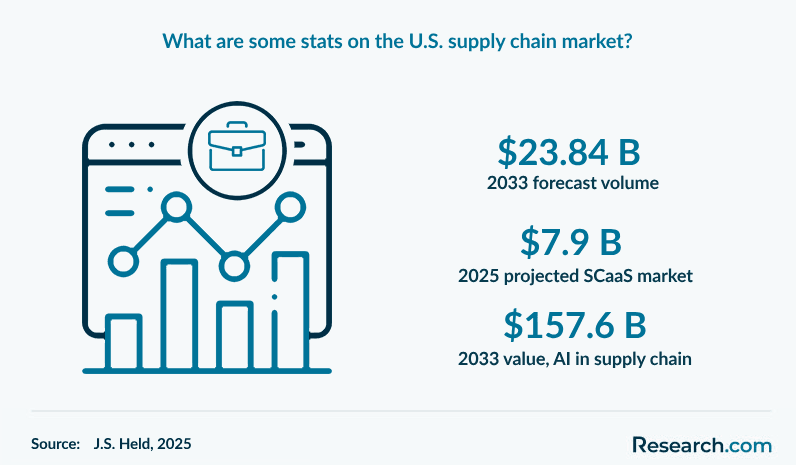
These figures explain why coursework in analytics, automation, software, and cybersecurity is becoming more important. Future supply chain leaders need to understand not only transportation and procurement, but also the digital systems that support planning, visibility, and risk management.
What types of specializations are available for logistics and supply chain management graduates?
A certificate itself is already a specialized credential, but many professionals narrow their focus even further. The best specialization is the one that matches the sector, function, or problem you want to solve.
- Supply chain analytics: Uses data, forecasting, predictive modeling, dashboards, and business intelligence tools to improve planning and decision-making.
- Global logistics: Focuses on international transportation, customs, import/export rules, sourcing networks, and global risk management.
- Healthcare supply chain management: Involves the sourcing, storage, and distribution of medical devices, pharmaceuticals, clinical supplies, and other regulated products. Learners can explore more background on healthcare supply chain management.
- Humanitarian and disaster relief logistics: Centers on rapid resource deployment during emergencies, crises, and relief operations. Professionals with emergency management or security interests may also compare the fastest online homeland security degree programs.
- Sustainable supply chain management: Looks at emissions reduction, ethical sourcing, waste reduction, circular economy models, and responsible logistics practices.
- Procurement and sourcing: Develops deeper expertise in supplier strategy, vendor management, negotiation, contract risk, and cost control.
Specialization can help you position yourself for a defined niche rather than competing as a generalist. It is especially valuable when your target industry has technical rules, regulatory requirements, or specialized software systems.
How do you choose the best online graduate certificate programs in logistics and supply chain management?
The best certificate is not simply the shortest or cheapest. It is the program that fits your schedule, budget, experience level, target role, and future education plans. If you are comparing careers in logistics and supply chain, begin with the job descriptions you want and work backward to the skills employers request.
- Confirm accreditation: Make sure the institution is appropriately accredited and that employers will recognize the credential.
- Compare the curriculum to your career target: Choose analytics-heavy programs for analyst roles, procurement courses for sourcing roles, and transportation or operations courses for logistics leadership.
- Check format and workload: Ask whether the program is asynchronous, synchronous, self-paced, cohort-based, or fixed-term.
- Look at faculty background: Strong programs combine academic expertise with current industry experience.
- Ask about transferability: If you may pursue a master’s degree later, confirm whether certificate credits are stackable.
- Evaluate career services: Determine whether certificate students receive résumé support, advising, interview preparation, networking access, and job-search resources.
- Calculate full cost: Include tuition, fees, books, software, travel, residency requirements, and lost time if the program is intensive.
| If Your Main Goal Is... | Prioritize Programs With... | Be Careful About... |
| Fast promotion in your current company | Courses tied to your current operations, procurement, or logistics responsibilities | Choosing a program your employer does not recognize or reimburse |
| Career change into supply chain | Foundational supply chain courses, applied projects, and career advising | Programs that assume extensive prior supply chain experience |
| Future master’s degree | Stackable graduate credits | Non-credit certificates that cannot be applied to a degree |
| Analytics-focused role | Forecasting, data analytics, supply chain software, and quantitative coursework | Programs focused mostly on general management |
| Global logistics role | International trade, customs, global sourcing, and transportation strategy | Programs limited to domestic operations |
Some students deciding whether a focused credential is right for them compare it with programs in other specialized career areas, such as the shortest fashion merchandising programs online. The broader lesson is the same: choose a program because its curriculum matches your professional goal, not because the title sounds marketable.
What career paths are available for graduates of online graduate certificate programs in logistics and supply chain management?
A graduate certificate can support several logistics and supply chain career paths, particularly for professionals who already have operations, business, analytics, military, manufacturing, retail, procurement, or transportation experience. Learners comparing certificate options with degree pathways may also review cheap online supply chain management degree programs.
- Logistics Manager: Oversees transportation, warehousing, distribution, inventory, and delivery performance.
- Supply Chain Analyst: Uses data to identify inefficiencies, forecast demand, track performance, and recommend operational improvements.
- Procurement or Sourcing Manager: Manages purchasing, supplier relationships, negotiations, contract strategy, and sourcing risk.
- Operations Manager: Coordinates business processes, production, quality, staffing, and operational efficiency, often with supply chain responsibilities.
- Distribution Center Manager: Leads warehouse operations, inventory control, order fulfillment, staffing, safety, and productivity.
- Transportation Manager: Plans transportation networks, carrier relationships, freight budgets, and routing decisions.
- Supply Chain Consultant: Helps organizations improve cost, speed, resilience, technology use, and process design.
The certificate is most powerful when paired with relevant experience and measurable accomplishments. Employers often want evidence that you can reduce costs, improve service levels, manage vendors, interpret data, or lead process improvements.
Is an online graduate certificate in logistics and supply chain management worth the investment?
An online graduate certificate may be a smart investment when it helps you gain a specific skill set faster and at a lower total commitment than a full degree. It can be especially useful if your employer values graduate education, if the credits apply toward a future degree, or if the coursework fills a clear gap in analytics, procurement, transportation, risk management, or operations leadership.
It is less likely to pay off if you choose the cheapest or fastest option without checking accreditation, course relevance, career support, transferability, or total cost. Some learners compare certificate options with a cheap MBA online to decide whether they need narrow supply chain training or broader business leadership preparation.
Who should consider this certificate?
- Working professionals in logistics, operations, procurement, warehousing, transportation, inventory, or manufacturing who want graduate-level specialization.
- Military-affiliated learners who want to translate logistics experience into a civilian business credential.
- Business professionals who want to move into supply chain analytics, sourcing, or operations management.
- Professionals who may later pursue a master’s degree and want stackable graduate coursework.
Who may want a different option?
- Applicants without a bachelor’s degree who do not meet graduate admission requirements.
- Learners who need a broad business credential rather than supply-chain-specific training.
- Professionals targeting roles where a full master’s degree is preferred.
- Students who need extensive internship, placement, or licensure support that a short certificate may not provide.
Is the program accredited and recognized by industry standards?
Accreditation should be one of your first checks. A certificate from an accredited institution is more likely to be recognized by employers and more likely to support transfer into future graduate study. Confirm institutional accreditation through official sources rather than relying only on marketing pages.
Also ask whether the business school or program has specialized accreditation, industry partnerships, advisory boards, or employer relationships. These features do not guarantee job outcomes, but they can signal stronger alignment with professional expectations. If you are comparing broader executive education options, you may also want to review the best value for money executive MBA online.
Will an online graduate certificate in logistics and supply chain management enhance my long-term career value?
A graduate certificate can improve long-term career value when it builds skills that remain useful across roles: analytics, sourcing strategy, risk management, transportation planning, supplier evaluation, technology use, and operations improvement. It can also help demonstrate a commitment to professional development in a field where digital tools, global disruption, and sustainability expectations continue to change employer needs.
However, career value is not automatic. To make the credential work for you, connect each course to a measurable workplace outcome: cost savings, faster fulfillment, better forecasting, supplier consolidation, inventory accuracy, or improved service levels. Professionals evaluating educational ROI across business disciplines sometimes compare outcomes with resources such as entrepreneurship salary data.
What support services bolster online graduate certificate success?
Support services matter more in accelerated online programs because students have less time to recover from confusion, scheduling conflicts, or technical issues. Before enrolling, ask whether certificate students receive the same level of support as degree-seeking graduate students.
- Academic advising: Helps you choose courses in the right order and understand workload expectations.
- Career coaching: Can support résumé updates, interview preparation, and job-search strategy for logistics and supply chain roles.
- Faculty access: Office hours and timely feedback are important when coursework is compressed.
- Technical support: Online students need reliable help with learning platforms, software, proctoring tools, and data-analysis assignments.
- Peer networking: Cohort interaction, discussion boards, group projects, and alumni access can help build professional connections.
- Applied learning resources: Simulations, case studies, analytics labs, and project templates can make the certificate more practical.
Learners comparing support systems across accelerated business programs may also look at accelerated finance online degrees to see how advising, career resources, and flexible pacing differ by field.
Common mistakes to avoid when choosing a supply chain graduate certificate
- Choosing based only on speed: A shorter program can be harder to manage if each course requires concentrated weekly work.
- Ignoring accreditation: Verify the institution and, when relevant, business-school accreditation before applying.
- Looking only at tuition: Fees, books, software, travel, proctoring, and lost time can affect the real cost.
- Assuming online means self-paced: Many online programs still use fixed deadlines, scheduled live sessions, or cohort pacing.
- Missing transfer-credit rules: If you want a future master’s degree, confirm whether the certificate credits actually apply.
- Overlooking non-credit status: Some certificates are valuable for skills but may not carry graduate credit.
- Assuming salary outcomes are guaranteed: Pay depends on experience, job function, location, industry, and employer demand.
- Not asking employers what they value: Talk to supervisors, recruiters, or hiring managers before paying for a credential.
Practical steps before you enroll
- Identify your target job: Choose three to five job postings and list the recurring skills, software, education requirements, and preferred credentials.
- Match courses to those skills: Favor programs with direct coverage of analytics, procurement, logistics, transportation, inventory, or global supply chain topics required for your goal.
- Verify accreditation: Check the institution’s accreditation and any business-school accreditation listed by the program.
- Calculate the complete cost: Include tuition, fees, materials, employer reimbursement, loans, and whether credits can reduce future degree costs.
- Ask about workload: Request estimated weekly hours per course, especially for programs completed in weeks rather than semesters.
- Confirm credit transferability: Ask whether credits apply to a master’s degree at the same school or elsewhere.
- Review support services: Make sure online certificate students receive advising, career services, technical support, and faculty access.
- Talk to your employer: Ask whether the certificate supports promotion, reimbursement, internal transfer, or professional development goals.
How much can I earn with an online graduate certificate in logistics and supply chain management?
An online graduate certificate can strengthen your qualifications, but it does not independently set your pay. Salaries are shaped by experience, geographic location, industry, employer size, job function, and level of responsibility.
Some professionals combine supply chain training with prior technical education, including niche programs such as the cheapest gunsmith online training, to pursue specialized manufacturing, inventory, or compliance-related logistics roles. Others continue from a certificate into a fast-track master's in supply chain management online when they want deeper preparation for strategic or leadership positions.
- Analyst-level roles: Professionals using the certificate for roles such as Supply Chain Analyst or Logistics Analyst can typically expect to earn between $70,000 and $90,000.
- Management positions: With several years of experience, graduates in roles such as Supply Chain Manager or Logistics Manager often see salaries ranging from $90,000 to $125,000.
- Senior leadership roles: Professionals who advance to director-level or executive positions may see annual compensation exceed $150,000.
- Specialized functions: Skills in supply chain technology, global procurement, analytics, and similar high-demand areas may command premium pay at different career levels.
2025 PayScale data shown below indicate significant variation by role. Management and senior analytical positions tend to have higher compensation than coordinator or frontline supervisory roles.
Completing the fastest bachelor's degree supply chain management online before or alongside graduate-level training may help some learners build the academic foundation needed for higher-level roles.
For example, a supply chain manager earns an average of $102,000, transportation and procurement managers earn around $96,720, and a senior supply chain analyst earns approximately $93,000. Lower salary tiers include roles such as logistics coordinator at an average of $59,620 and warehouse supervisor at about $52,310.
Location also matters. The article’s state-level salary data show a gap of up to $30,000 between the highest and lowest paying states. Average salaries are highest in California ($102,000), Texas ($98,000), and Illinois ($95,000), while lower averages appear in Kentucky ($72,000), Arkansas ($74,000), and Alabama ($75,000).
The main takeaway is that advancement into management, analytics, and specialized functions can have a meaningful impact on pay. Your earning potential will depend heavily on what role you pursue and where you work.
What is the job market like for graduates with an online graduate certificate in logistics and supply chain management?
The logistics and supply chain job market remains important because organizations depend on professionals who can manage procurement, transportation, inventory, planning, and supply chain risk. Recent disruptions have also made resilience, visibility, and data-driven decision-making more valuable to employers.
- Broad demand across industries: Manufacturing, e-commerce, healthcare, technology, government, and professional services all rely on supply chain talent.
- Strong growth projections: The U.S. Bureau of Labor Statistics projects that employment for logisticians will grow much faster than the average for all occupations.
- Skills gap in modern supply chains: Employers often seek candidates who understand analytics, sustainability, software, automation, and technology implementation.
- Further education options: BS, MS, and doctoral degrees may increase career options and earning potential. Learners can compare the cheapest online Master's in Supply Chain Management degree programs when evaluating longer-term education plans.
- Global opportunities: International sourcing, trade compliance, and global logistics experience can support roles with multinational employers.
- Career resilience: Because logistics supports essential business operations, supply chain roles can remain important even during periods of disruption.
Some professionals apply supply chain expertise in mission-driven environments and later explore an accelerated master's degree in nonprofit management to support humanitarian aid, disaster relief, or nonprofit operations.
According to 2025 data from the U.S. Bureau of Labor Statistics, median pay for logisticians in 2024 was $80,880 per year, or $38.89 per hour. The typical entry-level education for logisticians is a bachelor's degree, with no related work experience or on-the-job training generally required.
The BLS projects employment for logisticians to grow 19% between 2023 and 2033, which it classifies as much faster than average. That growth is expected to add an estimated 45,800 new jobs to the 237,100 positions that existed in 2023.
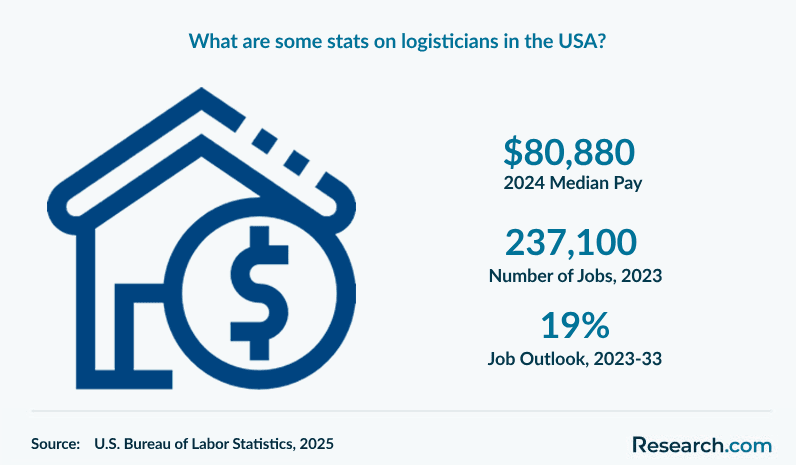
A graduate certificate can help you compete in this environment when it builds the specific capabilities employers need. It is especially useful if you can show how your coursework translates into better planning, lower costs, improved risk management, or stronger supply chain performance.
What are some current and future trends in logistics and supply chain management?
Supply chain management is changing quickly as companies invest in technology, resilience, sustainability, and cybersecurity. Professionals who understand these trends can make better education and career decisions.
- Artificial intelligence and digitalization: Companies are using AI and machine learning for demand forecasting, route optimization, inventory planning, automated warehousing, and faster decision-making.
- Sustainability and circular supply chains: Organizations are putting more attention on carbon reduction, waste reduction, ethical sourcing, reusable materials, and responsible logistics. An online project management degree may complement supply chain training for professionals leading sustainability projects.
- Resilience over pure efficiency: Businesses are balancing lean operations with backup suppliers, better visibility, scenario planning, and more flexible distribution networks.
- Hyper-automation: Robotic Process Automation (RPA) and physical robotics are being used for repetitive tasks in procurement, inventory tracking, warehouse work, and order fulfillment.
- End-to-end visibility: IoT sensors, cloud platforms, blockchain-related systems, and integrated software can help organizations monitor products and risks across the supply chain.
- Cybersecurity and supply chain vulnerability: Digitally connected supply chains create new risks, including ransomware, vendor software weaknesses, and attacks on logistics providers or supply chain software.
Professionals who want to combine supply chain leadership with workforce planning may compare the shortest online MBA programs human resource management, particularly if they manage staffing, training, or labor strategy in logistics operations.
The 2025 J.S. Held Global Risk Report highlights the growing risk tied to digital supply chains. Cybersecurity Ventures projects that the global annual cost of software supply chain attacks on businesses will more than double in six years, increasing from an estimated $60 billion in 2025 to $138 billion by 2031.
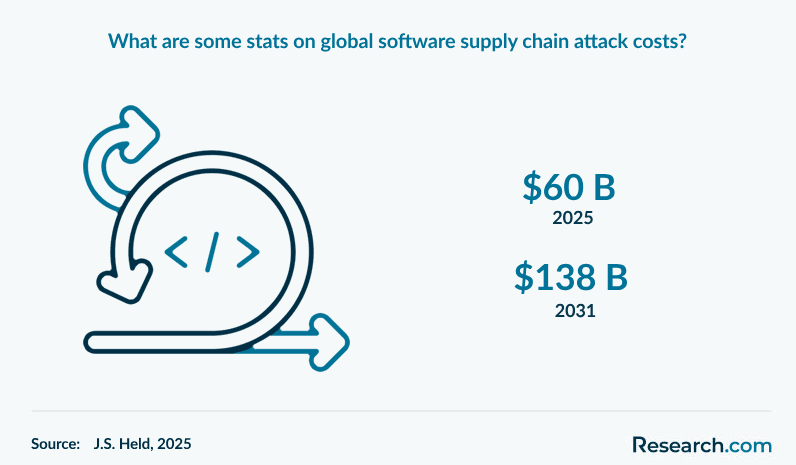
The future of logistics and supply chain management will favor professionals who can combine operations knowledge with data, technology, risk management, sustainability, and cross-functional leadership. Continuous learning is becoming a core requirement, not an optional advantage.
Related education paths to compare before deciding
If you are still deciding whether a logistics and supply chain certificate is the right credential, compare it with nearby academic and career pathways. A certificate is usually best when you already know you want supply chain specialization. A degree may be better when you need a broader credential, career reset, or deeper graduate study.
- Choose a certificate if you want targeted supply chain coursework in a shorter format.
- Choose a master’s degree if your target roles commonly prefer advanced graduate credentials.
- Choose an MBA if you want broader leadership training across finance, strategy, marketing, and management.
- Choose a trade or technical credential if your goal is hands-on work in a specific technical field rather than supply chain leadership.
Here's What Graduates Say About Their Online Graduate Certificate Programs in Logistics and Supply Chain Management
“I finished my logistics graduate certificate in six months while keeping my full-time job. The online format helped, but the most useful part was applying case studies directly to operational problems at work.” Leonard
“The accelerated supply chain program helped me shift from retail into a new career direction. The courses on global sourcing and risk management made the transition feel more realistic.” Elinor
“The curriculum felt practical because it covered current topics such as AI-supported inventory systems and sustainable shipping. I completed the program in under a year and soon moved into a higher-level role.” Jomar
Key Insights
- A graduate certificate is best for targeted upskilling: It works well for professionals who want focused supply chain training without the time commitment of a full master’s degree.
- Speed should not be your only selection factor: Compare workload, accreditation, total cost, credit transferability, and career support before choosing an accelerated program.
- The job outlook is strong: BLS data show logisticians had median pay of $80,880 in 2024 and projected employment growth of 19% between 2023 and 2033.
- Role and location strongly affect pay: PayScale data cited in this article show higher averages for management and senior analytical roles, with state-level salary differences of up to $30,000.
- Technology skills are increasingly important: AI, automation, analytics, end-to-end visibility, and cybersecurity are shaping modern supply chains.
- Manufacturing remains a major employer: BLS data show manufacturing accounted for 23% of logistician jobs in 2023, followed by professional, scientific, and technical services at 16% and the federal government at 15%.
- Market growth supports demand for modern skills: The U.S. supply chain management market is projected to grow from $9.84 billion in 2025 to $23.84 billion by 2033, while AI in supply chain is forecasted to grow from $4.5 billion in 2023 to $157.6 billion by 2033.
- Cybersecurity is now a supply chain issue: The global annual cost of software supply chain attacks is projected to rise from $60 billion in 2025 to $138 billion by 2031.
- Ask practical questions before enrolling: Confirm whether the certificate is credit-bearing, stackable, aid-eligible, employer-recognized, and aligned with the roles you actually want.
References:
- Glassdoor. (2025). Supply chain management salaries. Glassdoor.
- Indeed. (2025). Logistics & supply chain manager salaries. Indeed.
- J.S. Held. (2025). 2025 J.S. Held Global Risk Report: Global supply chain challenges. J.S. Held.
- PayScale. (2025). Certificate, Logistics & Supply Chain Management salary (United States). PayScale.
- PayScale. (2025). Logistics Manager salary (United States). PayScale.
- PayScale. (2025). Supply Chain Manager salary (United States). PayScale.
- PayScale. (2025). Supply chain management industry salary data (United States). PayScale.
- U.S. Bureau of Labor Statistics. (2025, April 18). Logisticians. In Occupational Outlook Handbook. U.S. Department of Labor. U.S. Bureau of Labor Statistics.
- ZipRecruiter. (2025). Logistics supply chain management salary. ZipRecruiter.
- ZipRecruiter. (2025). Supply chain logistics specialist salary. ZipRecruiter.
- ZipRecruiter. (2025). Supply chain management salary. ZipRecruiter.
Other Things You Should Know About Graduate Certificate Programs in Logistics and Supply Chain Management
Enrollment requirements for the fastest online graduate certificate programs in logistics and supply chain management typically include a bachelor’s degree and a strong interest in logistics. Some programs may ask for professional experience in the field, while others might include completion of specific prerequisite courses.
In 2027, schools like the University of North Carolina at Chapel Hill, Penn State World Campus, and the Massachusetts Institute of Technology offer some of the fastest online graduate certificate programs in logistics and supply chain management. These programs are typically designed to be completed in a few months to a year.


