
2027 Most Affordable Online Gunsmith Trade School Programs

Co-Founder and Chief Data Scientist
Choosing an online gunsmith trade school is not just about finding the lowest tuition. You need a program that teaches safe firearm handling, repair fundamentals, metalwork, legal compliance, and enough hands-on practice to help you move from hobby-level interest to employable skill. That decision matters because gunsmithing sits at the intersection of skilled trades, firearms law, customer service, machining, and small-business operations.
This guide is for students, hobbyists, veterans, career changers, and working adults who want gunsmith training without committing to a traditional campus schedule. You will learn what online gunsmith programs usually include, how much they cost, how long they take, which affordable programs stand out, what licensing issues to understand, and how to compare schools before enrolling.
Quick answer: Are online gunsmith trade school programs worth considering?
Online gunsmith trade school programs can be a practical option if you want flexible, lower-cost training in firearm repair, maintenance, customization, and shop operations. They are best for self-motivated students who can create a safe workspace, follow firearm laws carefully, and complete hands-on assignments at home. Most programs lead to a certificate, diploma, or career credential rather than a college degree.
The strongest programs combine clear safety instruction, technical lessons, repair practice, tool guidance, instructor support, and information about Federal Firearms License (FFL) requirements. The weakest programs rely mostly on reading materials and offer little feedback, limited hands-on work, or unclear career support.
What are the benefits of an online gunsmith trade school program?
- Online gunsmith programs can prepare graduates for work in gun shops, custom firearm businesses, manufacturing support, law enforcement-related firearm maintenance, or self-employment.
- Many programs use videos, manuals, at-home projects, tool assignments, and simulations so students can practice core processes before working independently on customer firearms.
- Entry-level gunsmiths often earn around $37,000, while experienced specialists may reach $55,000 or more depending on location, employer type, reputation, and niche skills.
What can I expect from an online gunsmith program?
An online gunsmith program usually teaches the fundamentals of firearm inspection, safe handling, maintenance, repair, customization, and basic shop practices. The goal is to build technical confidence for entry-level work, apprenticeships, hobbyist projects, or a future firearms-related business.
Common topics include firearm design, gun safety, ballistics, metalwork, machining, stock refinishing, federal firearms law, customer service, and shop management. Some schools also offer electives or advanced modules in welding, engraving, finishing, or custom fabrication. Because gunsmithing is a hands-on trade, many programs require students to buy tools, use school-provided kits, or complete practical assignments at a home workbench.
Most online gunsmith programs do not award academic degrees. Students typically earn a certificate, diploma, or school-issued credential. Many programs require between 20 and 35 credit hours, although some measure progress by clock hours, continuing education units, exams, or completed modules instead of traditional credits.
Program pricing varies widely. A credit hour often costs between $100 and $250, but some schools charge a single program price rather than per-credit tuition. In most cases, online gunsmithing is less expensive than a traditional college pathway, though students should still budget for tools, parts, shipping, background requirements, and possible licensing costs.
Where can I work with an online gunsmith program?
Graduates of online gunsmith training can pursue skilled, hands-on roles that involve firearm inspection, repair, parts fitting, customization, assembly, or quality control. Your exact options depend on your training depth, state laws, FFL requirements, experience level, and whether you work for an employer or operate independently.
Common work settings include local gun shops, sporting goods stores, private repair businesses, firearm manufacturers, machining shops, parts suppliers, custom firearm businesses, and companies that support defense or public safety markets. Some graduates use online training as a foundation before seeking apprenticeships or additional machining experience.
Common job titles include:
- Gunsmith
- Firearms assembler
- CNC machine operator specializing in firearm components
- Quality control inspector
- Custom firearms technician
The BLS reports that the largest employers for metal and plastic machine workers, whose work overlaps with several gunsmithing skills, include:
- Fabricated metal product manufacturing (25%)
- Plastics and rubber products manufacturing (16%)
- Transportation equipment manufacturing (13%)
- Primary metal manufacturing (12%)
- Machinery manufacturing (11%)
These industries value workers who can measure, shape, file, drill, fit, and finish parts with precision. Those abilities are central to gunsmith training. With a strong portfolio, documented practice, legal compliance, and continued skill development, some graduates move into restoration, custom builds, firearm design support, or independent shop ownership.
How much can I make with an online gunsmith program?
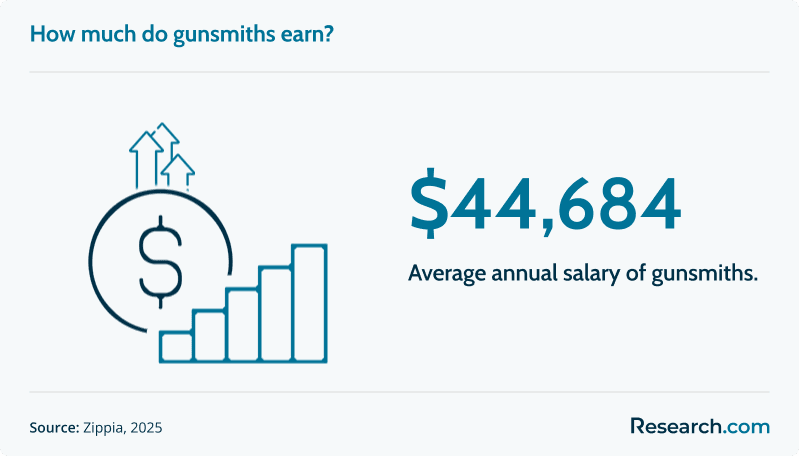
According to 2025 data from Zippia, the average annual salary for gunsmiths in the U.S. is $44,684, or roughly $21 per hour. Actual earnings depend heavily on location, experience, business model, customer base, and specialization.
New gunsmiths often begin between $30,000 and $38,000 per year, particularly in smaller shops or entry-level technician roles. Income may increase as you build a portfolio, become faster and more accurate, develop machining or finishing expertise, or serve higher-value custom firearm clients. Some experienced gunsmiths in high-demand locations or custom firearm businesses earn over $60,000 a year.
Major pay factors include:
- Local market demand and cost of living
- Whether you work for an employer, freelance, or own a shop
- The complexity of the work, from basic cleaning and repair to custom builds
- Additional skills such as welding, CNC machining, engraving, stock work, or business management
- Your legal ability to perform paid firearm services, including FFL compliance when required
A certificate alone does not guarantee a specific salary. Gunsmithing earnings usually grow through practice, reputation, specialization, speed, safety record, and customer trust.
- Most Affordable Online Gunsmith Trade School Programs for 2027
- Program Length: How Long Online Gunsmith Training Takes
- Online vs. Campus Gunsmith Training
- Average Cost of Online Gunsmith Trade School
- Financial Aid and Payment Options
- Admissions Requirements and Prerequisites
- Accreditation, FFL Rules, and Licensing Preparation
- Long-Term Value and Return on Investment
- Certifications and Credentials After Graduation
- Networking, Career Services, and Job Placement
- Typical Online Gunsmith Courses
- Common Gunsmithing Specializations
- How to Choose the Right Online Gunsmith School
- Career Paths After Online Gunsmith Training
- Job Market for Online Gunsmith Program Graduates
How do we rank schools?
Research.com rankings are built to help students compare programs using transparent, decision-focused information. For education data, our team reviews reputable sources such as the IPEDS database, Peterson’s, the College Scorecard, and the National Center for Education Statistics.
Because many gunsmithing programs are trade certificates, distance-learning courses, or non-degree credentials, not every provider appears in the same federal datasets used for traditional colleges. For this guide, affordability, program format, credential type, stated cost, accreditation status, hands-on training, and practical relevance were weighed together. You can review our full methodology for more detail about how Research.com evaluates schools and programs.
List of the Most Affordable Online Gunsmith Trade School Programs for 2027
The programs below are included because they offer online or distance-based gunsmith training at clearly stated price points. The right choice depends on whether you want a low-cost introduction, structured career diploma, advanced video-based training, a credit-bearing certificate, or a flexible self-paced course.
| School | Best Fit | Required Credits or Hours | Stated Cost | Accreditation Notes |
| MGS Trade School | Students who want self-paced practical projects at a moderate price | Equivalent 765 clock hours (Advanced) | Basic $1,759; Advanced $2,192 (one-time) | Middle States Commission on Secondary Schools |
| Penn Foster Career School | Budget-conscious students who want a structured career diploma | 38.4 CEUs | $1,139 total | Distance Education Accrediting Commission (DEAC); Middle States Association CSS |
| American Gunsmithing Institute (AGI) | Students who prefer extensive video instruction from working gunsmiths | ~175 instructional hours | $5,997 + shipping | A+ Better Business Bureau (BBB) rating (non-academic accreditation) |
| Sonoran Desert Institute (SDI) | Students seeking a credit-bearing gunsmithing certificate with a broader technical structure | 32 | $12,920 total | DEAC |
| Stratford Career Institute | Beginners who want a flexible, non-credit distance course | Not credit-based | $1,049 total | Not accredited |
MGS Trade School
MGS Trade School offers a self-paced gunsmithing curriculum designed for students working from home. The program uses printed and online lessons, seven practical projects, and training that covers safety, repair, and custom finishing. It may fit students who want a hands-on path for personal skill building, side work, or future business planning.
- Required Credits to Graduate: Equivalent 765 clock hours (Advanced)
- Cost: Basic $1,759; Advanced $2,192 (one-time)
- Accreditation: Middle States Commission on Secondary Schools
Penn Foster Career School
Penn Foster Career School provides a six-course gunsmith career diploma with 38.4 CEUs, 19 exams, and more than 50 instructional videos. The curriculum covers core skills such as disassembly, repair, and engraving in a self-paced format that many students complete in 3–6 months.
- Required Credits to Graduate: 38.4 CEUs
- Cost: $1,139 total
- Accreditation: Distance Education Accrediting Commission (DEAC); Middle States Association CSS
American Gunsmithing Institute (AGI)
American Gunsmithing Institute uses a self-paced video model taught by experienced gunsmiths. Its course includes 175 hours of instruction across firearm design, function, repair, and customization for rifles, pistols, and shotguns. This option may appeal to students who learn well through detailed demonstrations.
- Required Credits to Graduate: ~175 instructional hours
- Cost: $5,997 + shipping
- Accreditation: A+ Better Business Bureau (BBB) rating (non-academic accreditation)
Sonoran Desert Institute (SDI)
Sonoran Desert Institute offers a 32-credit Gunsmithing Certificate organized across two 16-week semesters. Students study firearm repair, machining, ballistics, finishing, and firearm building. SDI also offers AS degree pathways for students who want a broader technical and business education.
- Required Credits to Graduate: 32
- Cost: $12,920 total
- Accreditation: DEAC
Stratford Career Institute
Stratford Career Institute provides a flexible distance-learning gunsmith course for beginners and more advanced learners. Topics include pistols, rifles, revolvers, workspace setup, accuracy testing, and basics of starting a gunsmithing business. The course is not credit-based and may be better suited for personal enrichment or introductory training.
- Required Credits to Graduate: Not credit-based
- Cost: $1,049 total
- Accreditation: Not accredited
How long does it take to complete an online gunsmith trade school program?
Most online gunsmith trade school programs take 3 months to 2 years, depending on program depth, pacing, hands-on requirements, and how much time you can study each week. Short certificate or diploma programs often take 3 to 12 months and focus on safety, disassembly, cleaning, repair basics, and core firearm function.
More detailed programs may take 18 to 24 months when they include machining, business topics, custom work, advanced repair, or multiple hands-on projects. Some schools allow up to three years for completion, which can help students who work full-time, serve in the military, or need to build skills slowly.
| Program Type | Typical Timeline | Best For | Trade-Off |
| Short introductory course | 3 to 6 months | Hobbyists, beginners, and students testing interest | May not provide enough depth for immediate employment |
| Career diploma or certificate | 3 to 12 months | Students seeking entry-level repair knowledge | Hands-on practice depends heavily on the program design |
| Advanced certificate or technical program | 18 to 24 months | Students preparing for shop work, business ownership, or specialization | Usually costs more and requires stronger time management |
| Flexible self-paced route | Up to three years in some programs | Working adults and students balancing training with other responsibilities | Progress can stall without a study schedule |
If your long-term goal includes managing inventory, vendor relationships, or distribution for a firearm-related business, pairing trade training with business logistics education may be useful. For example, an accelerated online bachelor's degree in supply chain management can complement technical repair knowledge with inventory and operations skills.
How does an online gunsmith trade school program compare to an on-campus program?
Online gunsmith programs offer flexibility and lower travel costs, while campus programs usually provide more immediate access to equipment, supervised labs, and face-to-face coaching. Neither format is automatically better. The right choice depends on your schedule, budget, learning style, workspace, and need for direct supervision.
Students interested in adjacent public safety or investigative work may also compare gunsmithing with broader criminology careers, where firearm knowledge can support certain roles but does not replace criminal justice or forensic training.
| Factor | Online Gunsmith Program | On-Campus Gunsmith Program | Choose This If... |
| Schedule | Often self-paced or asynchronous | Usually follows fixed class and lab times | Online works better if you need flexibility |
| Hands-on practice | Completed at home using tools, kits, assignments, or personal equipment | Completed in supervised labs with shared equipment | Campus works better if you need close instructor supervision |
| Cost | Often lower, with no commuting or housing costs | May include lab, travel, and campus-related expenses | Online may fit tighter budgets |
| Instructor access | Email, forums, videos, phone, or virtual meetings | In-person feedback during labs | Campus is stronger for immediate correction |
| Networking | Online forums, alumni groups, and remote career support | Classmates, instructors, local employers, and shop visits | Campus may offer stronger local industry connections |
| Workspace needs | Student must create a safe and legal home workspace | School provides lab space and many tools | Online requires more self-discipline and setup planning |
What is the average cost of an online gunsmith trade school program?
The average cost of an online gunsmith trade school program ranges from approximately $1,100 to $13,000. The final price depends on whether the school offers a short non-credit course, a career diploma, a video-based professional program, or a credit-bearing certificate. Students should also consider tools, materials, shipping, exams, licensing expenses, and any required firearm components.
- Low-cost options ($1,100–$2,500): Penn Foster and MGS Trade School offer gunsmithing training in this range, with lessons, videos, printed materials, or hands-on projects depending on the program.
- Mid-range options ($5,000–$7,000): The American Gunsmithing Institute lists its professional-level course at around $5,997 and emphasizes extensive video training in firearm design, diagnosis, and repair.
- Higher-end programs ($12,000+): Sonoran Desert Institute’s 32-credit certificate costs about $12,920 and provides a more structured technical curriculum that may appeal to students aiming for industry work or business ownership.
| Cost Category | What You May Be Paying For | Questions to Ask Before Enrolling |
| Tuition | Lessons, videos, exams, instructor support, and credential completion | Is the total price fixed, or are there extra course fees? |
| Tools and supplies | Bench tools, safety equipment, cleaning supplies, parts, or kits | What tools are included, and what must I buy separately? |
| Shipping | Course materials, project kits, or physical media | Are shipping charges included in the published price? |
| Licensing and compliance | Possible FFL-related costs if you operate as a business | Does the program explain federal and state requirements clearly? |
| Career support | Resume help, employer connections, alumni access, or instructor guidance | Is career support included after graduation? |
Gunsmithing can also connect to investigative, evidence, or firearm analysis interests, though those fields usually require separate training. Students asking how to start a career in crime analysis should understand that gunsmithing knowledge may support firearm-related familiarity, but crime analysis typically emphasizes data, law enforcement systems, and analytical methods.
What are the financial aid options for students enrolling in an online gunsmith trade school program?
Financial aid for online gunsmith trade school depends on the school’s accreditation, program type, and your eligibility. Federal aid such as Pell Grants may not apply to every trade certificate, especially non-degree or non-accredited courses. However, students may still reduce out-of-pocket costs through military benefits, workforce funding, installment plans, employer support, and scholarships.
- Military and Veterans Benefits: Some schools, including Sonoran Desert Institute, accept GI Bill® and VA education benefits. Eligible students should confirm benefit coverage with both the VA and the school before enrolling.
- Workforce Development Programs: State workforce offices may provide Workforce Innovation and Opportunity Act (WIOA) support for approved trade training. Eligibility varies by state, provider, and student situation.
- Monthly Payment Plans: Schools such as MGS and Penn Foster often provide installment options that spread tuition across several payments. Ask whether the plan includes interest, fees, or penalties.
- Scholarships and Employer Reimbursement: Some industry organizations, including the American Custom Gunmakers Guild, may offer limited scholarship opportunities. Employers in security, law enforcement, sporting goods, or firearms retail may also consider reimbursement if the training supports your job.
Before relying on any aid source, ask the school for a written breakdown of total cost, refund rules, payment deadlines, materials charges, and whether your chosen program qualifies for the funding you plan to use.
The chart below lists the total number of firearms manufactured by type, as published by the ATF in 2024.
What are the prerequisites for enrolling in an online gunsmith trade school program?
Most online gunsmith trade school programs are open to beginners, but that does not mean there are no responsibilities. Students must be prepared to study technical material, follow safety rules, comply with firearm laws, and complete work in a suitable environment.
- High School Diploma or GED: Many programs, including options such as Sonoran Desert Institute and Penn Foster, ask for proof of high school completion. Non-degree programs may be more flexible. Students combining gunsmithing with advanced business or logistics study, such as the fastest graduate certificate in supply chain management and logistics online, must meet the separate admissions requirements for that academic program.
- Minimum Age Requirement: Students are commonly expected to be at least 18 years old because the training involves firearms, safety rules, and legal topics.
- English Reading and Writing Skills: Gunsmithing students must read manuals, safety procedures, technical diagrams, laws, and exam questions accurately.
- Tools and Safe Workspace: Online students need a clean, secure, and legally compliant area for hands-on assignments. Schools may provide kits, but students often need their own bench, tools, storage, and safety equipment.
- Legal Eligibility: You may need to confirm that you can legally handle firearms and receive related materials in your state. Some programs may not ship certain items to restricted locations.
Is the program accredited and does it prepare me for licensing?
Accreditation matters because it helps you understand whether a school has been reviewed by an outside quality assurance body. It can affect credit transfer, employer perception, financial aid eligibility, and student protections. However, accreditation is not the same as government licensing, and a gunsmith certificate does not automatically authorize you to run a paid firearm repair business.
If you plan to repair, customize, refinish, build, or sell firearms for compensation, you need to understand Federal Firearms License rules and state-level requirements. Some programs introduce FFL concepts, but students should verify requirements directly with the ATF and relevant state agencies before accepting paid work.
| Question | Why It Matters | What to Verify |
| Is the school accredited? | Accreditation can signal academic quality and affect aid or transfer options | Check the accreditor’s official directory, not only the school website |
| Is the credential academic or non-credit? | A diploma, certificate, CEU program, and non-credit course may carry different value | Ask what credential appears on your transcript or completion record |
| Does the curriculum explain FFL rules? | Paid firearm work may require federal licensing | Ask whether the program covers ATF requirements and state compliance |
| Will it prepare me for employment? | Employers may want proof of hands-on skill, not just course completion | Ask about projects, portfolios, assessments, and instructor feedback |
Some students use gunsmithing as one part of a broader educational plan. If you want a short academic credential in another field, reviewing what kind of degree can be completed in 6 months may help you compare timelines and credential types.
Is an online gunsmith education a solid long-term investment?
An online gunsmith education can be a worthwhile investment when the cost fits your career goal, the program includes meaningful practice, and you understand the legal and business requirements of the trade. It may not be a good investment if you expect a certificate alone to guarantee employment, high income, or immediate shop ownership.
The best return usually comes from combining training with practice, tool investment, customer service skills, machining knowledge, compliance awareness, and a realistic plan for entry-level work or apprenticeship. Students aiming to own a shop may also benefit from broader business education, including options such as a cheap accelerated bachelor's degree online, if management, accounting, marketing, or operations are part of their long-term plan.
Who should choose online gunsmith training?
- Students who need flexible scheduling and can study independently
- Hobbyists who want structured training before working on firearms
- Career changers exploring skilled trades without committing to a campus program
- Veterans or working adults who want a firearm-related technical credential
- Future shop owners who understand that business licensing and compliance are separate from school completion
Who should consider another path?
- Students who need constant in-person supervision to learn technical skills
- People without a safe, legal workspace for hands-on practice
- Students who want a traditional degree rather than a certificate or diploma
- Anyone unable to comply with firearm ownership, handling, or business laws
- Students expecting guaranteed salaries or job placement from a short course
What certifications should I pursue after completing an online gunsmith trade school program?
After completing a gunsmith trade school program, the most valuable next credential depends on your intended work. Some graduates focus on manufacturer-specific armorer courses, while others pursue machining, welding, engraving, safety instruction, or business credentials. The goal is to document a skill that employers or customers can recognize.
There is no single universal certification required for every gunsmith role. However, specialized training can help demonstrate competence in repair techniques, safety practices, firearm platforms, or advanced customization. Students comparing broader credential options can also review certifications for jobs that pay well to understand how short credentials vary by industry.
| Credential Area | Useful For | Decision Tip |
| Manufacturer armorer training | Working on specific firearm platforms | Choose this if employers or clients use those firearms frequently |
| CNC machining | Parts fitting, custom components, and manufacturing roles | Valuable if you want shop, factory, or custom fabrication work |
| Welding or metalworking | Advanced repair and fabrication | Useful for students who want deeper trade versatility |
| Engraving or finishing | Custom firearm aesthetics and restoration | Best for students targeting high-detail custom work |
| Business or retail operations | Shop ownership, pricing, inventory, and customer service | Important if your goal is self-employment |
Do online gunsmith programs offer robust networking and job placement support?
Some online gunsmith programs provide career support, but the level of help varies significantly. A strong program may offer instructor access, alumni communities, resume guidance, technical feedback, job-search resources, employer contacts, or advice on building a portfolio. A weaker program may provide only course materials and a completion document.
Before enrolling, ask the school how it supports students after graduation. Specifically, ask whether it tracks graduate outcomes, connects students with employers, reviews resumes, supports apprenticeships, or provides guidance for starting a compliant business. Students who want to broaden their credentials beyond gunsmithing may also compare flexible options such as one year degree programs, although those are a different academic pathway from trade training.
What courses are typically in an online gunsmith trade school program?
Online gunsmith programs usually combine firearm safety, mechanical theory, repair procedures, customization methods, legal awareness, and shop basics. Course names differ by school, but the core curriculum should help you understand both how firearms function and how to work on them responsibly.
- Firearm Safety and Handling: Students learn safe inspection, storage, handling, and workspace procedures. Programs often include federal and state law concepts because safety and compliance are central to the trade.
- Firearms Repair and Maintenance: These lessons teach disassembly, cleaning, troubleshooting, reassembly, and inspection for pistols, revolvers, rifles, and shotguns. Some programs cover over 70 different guns.
- Customization and Modification: Advanced modules may include sight adjustment, stock alteration, trigger work, bluing, jeweling, checkering, and finishing techniques.
- Metalwork and Machining Basics: Students may learn cutting, drilling, shaping, measuring, filing, and fitting. These skills support barrel work, part replacement, and precision repair.
- Ballistics and Firearm Function: Students study ammunition behavior, firearm mechanics, accuracy factors, recoil, and performance testing.
- Business and Shop Management: Some programs cover pricing, customer communication, records, inventory, marketing, and storefront basics. Students who want stronger management training may compare options such as the cheapest online bachelor’s in management.
What types of specializations are available in an online gunsmith trade school program?
Many online gunsmith programs offer electives or advanced modules that let students focus on a specific part of the firearm industry. Specialization matters because a general repair background may be enough for entry-level work, while higher-value services often require deeper skill in a narrow area.
- Custom Firearms Fabrication: This area focuses on performance improvements, personalized builds, engraving, stocks, trigger work, and finishing.
- Firearm Restoration and Collectible Repair: Students learn methods for preserving or repairing antique and historic firearms while protecting function, appearance, and value.
- Ballistics and Firearm Function Testing: This focus emphasizes accuracy, ammunition behavior, velocity, recoil, and performance diagnostics.
- Law Enforcement Firearms Support: Training may cover maintenance and modification of firearms used in public safety or military settings.
- Firearm Sales and Business Operations: Students study retail operations, customer service, FFL considerations, inventory, and compliance for gun shop environments.
Some specializations overlap with public safety or forensic interests. For example, firearm function knowledge can be relevant to certain law enforcement support roles, while forensic science involves separate laboratory methods and evidence procedures. Students comparing those directions should understand the difference between criminal justice and forensic science before choosing a program.
How to choose the best online gunsmith trade school program?
To choose the best online gunsmith trade school program, compare accreditation, legal compliance coverage, hands-on training, total cost, instructor access, student reviews, career support, and the match between the curriculum and your career goal. Do not choose only by tuition. A cheap program with limited practice may cost less upfront but provide weaker preparation.
- Verify accreditation carefully: Check whether the school is accredited by a recognized agency such as the Distance Education Accrediting Commission (DEAC) or the Middle States Commission on Secondary Schools. Use the accreditor’s directory instead of relying only on marketing claims.
- Review the curriculum line by line: Look for safety, repair, ballistics, customization, metalwork, compliance, and business content. Avoid programs that are vague about what you will actually learn.
- Confirm hands-on requirements: A quality online program should include projects, parts kits, tool guidance, or practical assignments. Gunsmithing cannot be learned through theory alone.
- Ask how instructors provide feedback: Email support is helpful, but stronger programs may include forums, video demonstrations, project review, Q&A sessions, or direct instructor contact.
- Calculate the true cost: Include tuition, tools, materials, shipping, payment plan fees, exam costs, licensing expenses, and any supplies not included by the school.
- Check graduate outcomes and reputation: Read student feedback, ask about job placement, and look for evidence that graduates have used the training in shops, manufacturing, restoration, or business settings.
- Match the credential to your goal: A hobbyist course may be enough for personal learning. A student seeking employment or business ownership should prioritize deeper instruction, practice, and compliance training.
Common mistakes to avoid when choosing an online gunsmith school
| Mistake | Why It Can Hurt You | Better Approach |
| Choosing based only on the lowest tuition | The program may exclude tools, feedback, hands-on work, or career support | Compare total cost and what is included |
| Ignoring accreditation | Credits, aid, and employer perception may be affected | Verify accreditation through the official accreditor directory |
| Assuming the certificate replaces an FFL | Paid firearm work may require federal licensing | Review ATF and state requirements before offering services |
| Overlooking state restrictions | Some materials or activities may be limited where you live | Ask the school whether your location affects enrollment or shipments |
| Skipping hands-on practice | Employers and customers need proof of skill, not only theory | Build a documented portfolio of completed projects |
| Expecting guaranteed income | Salary depends on skill, location, specialization, and business model | Use salary data as a planning tool, not a promise |
The chart below illustrates the trend in Type 1 (dealer) and Type 7 (manufacturer of firearms) licenses from 2019 to 2023, as published by the ATF.
What career paths are available for graduates of an online gunsmith trade school program?
Online gunsmith graduates can pursue repair, customization, manufacturing, restoration, instruction, retail, or business roles. Some paths require additional licensing, experience, or credentials. The ATF states that anyone who earns money from customizing, repairing, or refinishing firearms is required to hold a federal firearms license (FFL), so legal compliance must be part of your career plan.
- Professional Gunsmith: Gunsmiths inspect, repair, clean, modify, and maintain firearms for shops, sporting goods stores, private businesses, or manufacturers. Paid work generally requires appropriate licensing.
- Custom Firearms Builder or Designer: This path involves building or modifying firearms for performance, fit, appearance, or specialized use. It requires strong mechanical understanding, creativity, machining ability, and legal compliance.
- Restoration and Antique Firearms Specialist: Specialists repair and preserve older firearms for collectors, museums, and private clients. This work often combines metalworking, woodworking, research, and careful preservation techniques.
- Firearm Safety Instructor or Trade School Teacher: Experienced professionals may teach safety, maintenance, or introductory gunsmithing. Those interested in broader teaching roles can explore whether earning a teaching degree online fits their long-term goals.
- Firearm Parts and Accessories Business Owner: Some graduates sell or produce firearm parts, scopes, kits, accessories, or related services. FFL requirements may apply depending on the products and business activities.
| Career Path | Typical Work | Skills That Matter Most |
| Gun shop technician | Cleaning, repair, inspection, customer service | Safety, communication, troubleshooting |
| Manufacturing support | Assembly, inspection, parts work, quality control | Precision, measurement, machining basics |
| Custom gunsmith | Modifications, finishes, fitting, builds | Craftsmanship, creativity, advanced tools |
| Restoration specialist | Historic repair, preservation, collectible work | Research, patience, metal and wood skills |
| Shop owner | Repair services, sales, records, compliance, marketing | FFL knowledge, pricing, operations, customer trust |
What is the job market for graduates with an online gunsmith trade school program?
The job market for online gunsmith graduates is mixed. Some skills overlap with metal and plastic machine work, an occupational area where the BLS projects a 6% decline from 2023 to 2033. At the same time, the BLS still expects about 91,800 job openings per year across that sector, largely from retirements, career changes, and replacement needs.
Gunsmiths are not limited to one occupational category. Opportunities may appear in gun shops, manufacturing, custom firearm services, retail, restoration, quality control, parts work, and business ownership. Students can also broaden their technical options by studying adjacent repair fields, including programs such as the cheapest online automotive mechanic programs, if they want wider mechanical trade skills.
The broader firearms industry remains a significant employer. According to a 2025 report from the National Shooting Sports Foundation (NSSF), nearly 151,000 people are directly employed in the firearms, ammunition, and hunting equipment industry in the U.S. The report also states that the industry supports an estimated 232,000 jobs in related services such as shipping, raw materials, and marketing.
Graduates who understand logistics, inventory, and distribution may find additional business opportunities in supply and wholesale environments. For students considering that direction, the cheapest freight broker online training can provide a separate but potentially complementary skill set.
Common employment areas include:
- Gun shops and firearm repair businesses
- Firearm manufacturing and assembly operations
- Custom firearm and restoration services
- Parts, optics, and accessories businesses
- Firearms retail and wholesale operations
- Machining and quality control environments
Technology is also changing employer expectations. CNC machining, digital records, online retail, compliance software, and precision measuring tools are increasingly relevant in firearm-related businesses. Students who can combine traditional bench skills with machining, documentation, customer communication, and legal awareness will generally be more adaptable than those who learn only basic disassembly and cleaning.
Practical steps before you enroll
- Define your goal: Decide whether you want hobby training, entry-level employment, custom work, manufacturing support, or future shop ownership.
- Check legal eligibility: Review firearm handling rules in your state and understand when an FFL is required for paid work.
- Compare at least three programs: Look at cost, accreditation, curriculum, hands-on projects, instructor support, and completion timeline.
- Ask for a total cost sheet: Include tuition, tools, shipping, materials, payment plan fees, and any optional upgrades.
- Confirm hands-on training: Ask exactly what projects you will complete and how feedback is provided.
- Plan your workspace: Make sure you have safe storage, adequate lighting, a stable bench, proper tools, and compliance with local rules.
- Build a portfolio: Document safe practice, completed assignments, before-and-after work, and any instructor evaluations.
- Keep learning after graduation: Add machining, welding, engraving, armorer training, or business skills based on your career target.
Questions to ask an online gunsmith school
- Is the program accredited, and by which accrediting body?
- What credential will I receive when I finish?
- How many hands-on projects are required?
- Are tools, kits, parts, and shipping included in tuition?
- How do instructors evaluate practical work?
- Does the curriculum explain federal and state firearm laws?
- Does the program provide FFL guidance for students who want to operate a business?
- What career services are available after graduation?
- Can I speak with graduates or review graduate outcome information?
- What is the refund policy if the program is not a good fit?
Key Insights
- Online gunsmith trade school can be a strong fit for disciplined students who need flexibility and can complete safe hands-on work from home.
- The most affordable listed programs range from $1,049 total to $12,920 total, but students should also budget for tools, materials, shipping, and possible licensing costs.
- Most programs lead to a certificate, diploma, CEUs, or school-issued credential rather than a traditional college degree.
- Accreditation and FFL rules are separate issues. A school credential does not automatically authorize paid firearm repair, customization, refinishing, building, or sales.
- Salary outcomes vary. Zippia reports an average annual gunsmith salary of $44,684, but earnings depend on skill, specialization, location, and business model.
- Hands-on practice is essential. Avoid programs that do not clearly explain projects, tools, instructor feedback, and safety procedures.
- Students planning to open a shop should study business operations, compliance, pricing, inventory, customer service, and recordkeeping in addition to repair skills.
- The job outlook is nuanced: the BLS projects a 6% decline for metal and plastic machine workers from 2023 to 2033, yet still expects about 91,800 openings per year in that sector, while the broader firearms industry continues to support direct and related employment.
References:
- Alcohol, Tobacco, Firearms and Explosives (ATF). (2024). Firearms Commerce in the United States: Statistical Update 2024. ATF.
- Alcohol, Tobacco, Firearms and Explosives (ATF). (n.d.). Federal Firearms Licenses. Mission Areas. ATF.
- Bureau of Labor Statistics (BLS). (2025). Metal and Plastic Machine Workers. Occupational Outlook Handbook. BLS.
- California Community Colleges Centers of Excellence for Labor Market Research (COE). (2022). Gunsmithing in the North/Far North. Labor Market Analysis. COE.
- National Shooting Sports Foundation (NSSF). (2025). Firearm and Ammunition Industry: Economic Impact. NSSF.
- Zippia. (2025a). Gunsmith demographics and statistics in the US. Zippia.
- Zippia. (2025b). Gunsmith skills for your resume and career. Zippia.
Other Things You Should Know About Online Gunsmith Trade School Programs
In 2027, some of the most affordable online gunsmith trade school programs include those offered by Penn Foster, Modern Gun School, and Sonoran Desert Institute. These programs provide flexible online curriculums with competitive tuition rates, making it financially accessible to acquire essential gunsmithing skills.
To enroll in an online gunsmith trade school in 2027, you typically need a high school diploma or GED. Some schools may require basic math proficiency and computer skills. Additionally, access to tools may be necessary for practical assignments. Always check specific program requirements before applying.


