2027 Best Online Floor Installer Trade School Programs

Co-Founder and Chief Data Scientist
Data show that the employment for floor installers dropped 23% between 2013 and 2023, pushing construction firms to struggle finding skilled workers. This creates a major gap in the workforce, but it can be tough to know how to turn that industry demand into a secure and respectable career.
That’s where quality training makes all the difference. The right online floor installer programs provide a direct path into this high-demand field, offering a real craft with strong earning potential.
To help you find that path, our career planning experts with over 10 years of experience built this guide. This guide is not only a list of schools but also a comprehensive plan that helps you make a strategic choice for your future.
What are the benefits of enrolling in an online floor installer trade school program?
- You step into a career with exceptional job security, driven by a nationwide skilled labor shortage that creates more than 9,000 job openings each year.
- Graduates gain significant earning potential, around $60,000 and top specialists making more than $97,000 annually.
- With online floor installer programs, you get the flexibility to master the essential theories of the trade online, which allows you to fit your education around your current work and life schedule.
What can I expect from an online floor installer trade school program?
You can expect a curriculum that focuses on the theory and science behind professional flooring work. This means you’ll dive into subjects like material science, subfloor preparation, layout mathematics, and job site safety.
Good online floor installer programs teach professionals knowledge that prevents expensive mistakes and ensure a high-quality finish. Think of it as learning the science of surfaces, which is what truly separates a master craftsperson from an amateur.
To make sure you get practical skills, many top online programs use a hybrid learning model. You’ll cover the theoretical coursework online on your own schedule. Then, you’ll attend required, in-person workshops or labs to apply what you’ve learned and get essential hands-on training. This approach gives you both deep knowledge and real-world ability.
Where can I work after completing an online floor installer trade school program?
After you finish your program, you’ll find opportunities waiting in a few key areas. Most graduates start their careers working for specialty flooring contractors or larger general construction companies. These jobs are a great way to gain experience on different types of projects and build your professional network.
The industry data shows a clear picture. About 52% of all installers work for specialty contractors, making it the most common career path.
However, what truly sets this trade apart is the opportunity for independence. A significant 24% of floor installers are self-employed. This shows a very clear and achievable career progression: you can start by mastering your craft with an established company, and then launch your own business when you’re ready.
How much can I make with an online floor installer trade school program?
Let’s talk about earning potential, because it’s a critical factor. Nationally, the average annual income for a floor installer is $60,550.
Top specialists who work with high-demand materials can earn significantly more, with the top 10% bringing in over $97,180 a year.
Keep in mind that your actual earnings will depend on your location, specialty, and employer type. For instance, wages are often higher in states like Alaska and Minnesota, around $83,000 to $92,000. This data clearly shows that a career in floor installation offers a path to a strong, reliable income.
- List of the Best Online Floor Installer Trade School Programs for 2027 List of Programs
- How long does it take to complete an online floor installer trade school program? Completion Time
- How does an online floor installer trade school program compare to an on-campus program? How does an online floor installer trade school program compare to an on-campus program?
- What is the average cost of an online floor installer trade school program? Program Cost
- What are the financial aid options for students enrolling in an online floor installer trade school program? Financial Aid
- What are the prerequisites for enrolling in an online floor installer trade school program? What are the prerequisites for enrolling in an online floor installer trade school program?
- What courses are typically in an online floor installer trade school program? What courses are typically in an online floor installer trade school program?
- What types of specializations are available in an online floor installer trade school program? What types of specializations are available in an online floor installer trade school program?
- How to Choose the Best Online Floor Installer Trade School Program How to Choose the Best Online Floor Installer Trade School Program
- What career paths are available for graduates of an online floor installer trade school program? Career Paths
- What is the job market for graduates of an online floor installer trade school program? Job Outlook
- What additional certifications can boost my career earnings and opportunities? What additional certifications can boost my career earnings and opportunities?
- Are online floor installer trade school programs accredited and trusted by industry leaders? Are online floor installer trade school programs accredited and trusted by industry leaders?
- What challenges should I expect during an online floor installer trade school program? What challenges should I expect during an online floor installer trade school program?
Best Online Floor Installer Trade School Programs for 2027
Choosing a floor installer trade school is different from choosing a traditional college program. You are not just looking for lectures, a certificate, or a low tuition price. You need training that helps you handle flooring materials correctly, read job specifications, prepare subfloors, estimate work, use tools safely, and eventually complete installations that meet employer, manufacturer, and customer expectations.
This guide is for career changers, construction workers who want a more specialized skill, apprentices looking for structured training, and working installers who want credentials that can help them qualify for better projects. It explains how online and hybrid floor installer programs work, how long training takes, what programs cost, which specializations may lead to stronger opportunities, and how to avoid choosing a course that does not provide enough hands-on preparation.
You will also find a practical comparison of online, hybrid, and campus-based training; questions to ask before enrolling; financial aid options; career paths; and key labor market factors affecting the flooring trade.
Quick answer: What is the best online floor installer trade school program?
The best online floor installer trade school program depends on your goal. Beginners who want carpet installation training may prefer International Certified Flooring Installers (CFI), while workers seeking broader union or employer-supported training may find INSTALL more suitable. If you want flexible certification with online coursework and hands-on events, NAFCT is a strong option. Professionals moving into inspection may consider Certified Flooring Inspectors University, while LATICRETE University is useful for free continuing education and product-specific learning.
For most students, the strongest choice is a hybrid program: online theory for layout, materials, safety, estimating, and troubleshooting, plus supervised in-person practice for tool use, cutting, fitting, seaming, subfloor preparation, and installation quality.
How do we rank schools?
Because trade training can affect your earnings, job readiness, and employer credibility, our ranking approach prioritizes practical value rather than marketing claims. We consider program structure, industry recognition, cost transparency, hands-on learning opportunities, specialization options, student flexibility, and whether the credential is likely to be understood by employers or contractors.
For institutional and education-related context, Research.com draws from reliable data sources such as the IPEDS database, Peterson’s database, the College Scorecard database, and the National Center for Education Statistics. These sources are especially useful when evaluating schools and colleges that report formal education data. For industry-led trade credentials, we also examine program details, training model, credential focus, and employer relevance.
You can learn more about Research.com’s evaluation process on our methodology page.
| Program | Best fit | Format | Cost information | Main credential focus |
| International Certified Flooring Installers (CFI) | Beginners focused on residential carpet installation | Classroom and hands-on training through local retailer partnerships | $5,500 | Residential carpet installation |
| International Standards & Training Alliance (INSTALL) | Workers seeking broad, industry-updated training through employer or union pathways | Training model varies | Employer/union-funded | Multiple flooring systems, safety, productivity, and green building awareness |
| National Association of Floor Covering Technicians (NAFCT) | Students who want self-paced online learning combined with practical training events | Online coursework plus hands-on training events | $100 to $495 | Subfloor preparation, moisture mitigation, and installation specialties |
| Certified Flooring Inspectors (CFI) University | Experienced professionals moving into flooring inspection | Pre-class assignments and live Zoom classes | $1,995 | Carpet and hard surface inspection |
| LATICRETE University | Construction professionals seeking free continuing education | Self-paced online video learning | Free | Surface preparation and installation systems |
1. International Certified Flooring Installers (CFI)
International Certified Flooring Installers (CFI) offers a focused entry-level training path for students who want to build residential carpet installation skills. The program combines instruction with practical experience through local retailer partnerships, which can help new installers understand how classroom concepts translate to customer jobs, jobsite expectations, and installation quality.
- Program Length: 5 weeks
- Specialization: Residential Carpet Installation
- Total Tuition: $5,500
- Accreditation: World Floor Covering Association (WFCA)
2. International Standards & Training Alliance (INSTALL)
International Standards & Training Alliance (INSTALL) provides a broad training system shaped by industry input and updated to reflect new flooring products, tools, and installation practices. Its curriculum covers nine major areas, making it a good fit for workers who want exposure beyond one material type.
- Program Length: Varies
- Specializations: Standard Skills, Carpet, Resilient Flooring, Resinous Flooring, Hardwood Flooring, Concrete Polishing, Safety, Productivity, and Green Building Awareness
- Total Tuition: Employer/union-funded
- Accreditation: Reviewed by the U.S. Department of Labor
3. National Association of Floor Covering Technicians (NAFCT)
National Association of Floor Covering Technicians (NAFCT) is designed for learners who need flexibility but still want practical skill development. Its certification model combines self-paced online courses with hands-on training events, with a strong emphasis on substrate and subfloor preparation—one of the most important areas in preventing flooring failures.
- Program Length: 6 months
- Specializations: Subfloor Preparation, Moisture Mitigation, Resilient Installation, Hardwood Installation, Carpet Work, and Stone/Ceramic Work
- Program Cost: $100 to $495
- Accreditation: Not specified
4. Certified Flooring Inspectors (CFI) University
Certified Flooring Inspectors University (CFIU) serves a different audience than beginner installer programs. It is intended for professionals who want to move into flooring inspection, where the work involves evaluating installation problems, material issues, jobsite conditions, and field testing results. The program uses pre-class work and live Zoom instruction for carpet and hard surface flooring topics.
- Program Length: 1 to 3 weeks
- Specializations: Carpet Certification, Hard Surface Certification
- Total Tuition: $1,995
- Accreditation: World Floor Covering Association (WFCA)
5. LATICRETE University
LATICRETE University is a free online training platform for construction and flooring professionals who want short, self-paced lessons. It is not a full substitute for a hands-on installer trade school, but it can be useful for learning about surface preparation, installation systems, product applications, and continuing education documentation through printable certificates.
- Program Length: Self-paced
- Total Tuition: Free
- Accreditation: AIA Continuing Education System (CES), International Design Continuing Education Council (IDCEC)
How Long Does It Take to Complete an Online Floor Installer Trade School Program?
Most online or hybrid floor installer trade school programs are built to move faster than a traditional degree. Depending on the provider, specialization, and training format, completion may take a few weeks, several months, or up to a year. Short programs often focus on one skill area, while longer programs usually cover multiple materials, jobsite safety, estimating, preparation, and troubleshooting.
This timeline is one reason trade programs appeal to adults who want a faster route into paid work. Unlike a two-year associate degree, a floor installer certificate is usually designed around job-ready skills. That does not mean the work is easy. It means the curriculum is narrower, more technical, and more directly tied to jobsite performance.
Students comparing skilled-trade options may also look at flexible programs in other hands-on fields, such as online jewelry design and repair trade school programs, to understand how self-paced technical training can fit around work schedules.
| Training timeline | What it usually means | Best for |
| 1 to 5 weeks | Focused instruction in one area or an intensive certification format | Workers who already have related experience or need a narrow credential |
| Several months | More complete coverage of materials, subfloors, safety, and installation methods | Beginners and career changers who need stronger preparation |
| Up to a year | Broader training with multiple specializations, practical components, or employer pathways | Students who want a more comprehensive foundation |
A large trade with ongoing replacement needs
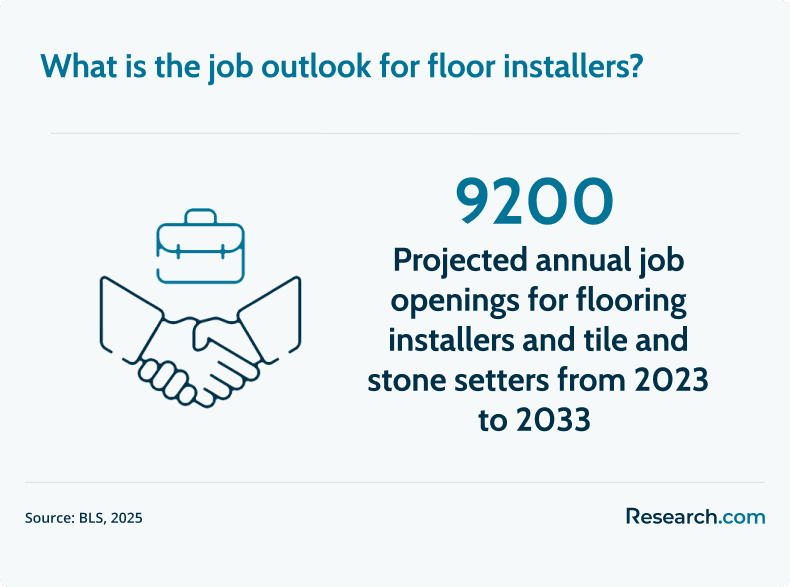
Floor installation is not a niche occupation. In 2023, flooring installers and tile and marble setters held about 115,400 jobs across the country. The nation also anticipates around 9,000 openings for general floor layers throughout the decade.
That scale matters when you are deciding whether training is worthwhile. Flooring is tied to residential construction, remodeling, commercial renovation, insurance repair, property management, and specialty contracting. A shorter training pathway can help you enter the labor market sooner, but your long-term success will depend on the quality of your hands-on practice and the reputation of your credential.
How Does an Online Floor Installer Trade School Program Compare to an On-Campus Program?
Online floor installer programs are best for learning theory, terminology, safety concepts, estimating, materials knowledge, blueprint basics, and troubleshooting. Campus-based programs are stronger when you need regular shop access, immediate instructor correction, and repeated tool practice. For many students, the best option is not fully online or fully in person, but hybrid.
A hybrid program lets you study lecture-based content online and then complete required labs, workshops, or field sessions in person. This format is especially useful in flooring because you cannot fully master cutting, stretching, setting, sanding, finishing, or subfloor preparation by watching videos alone.
This is similar to the way online home remodeling and repair programs can teach planning and theory remotely while still requiring practical experience for jobsite competence.
| Program format | Strengths | Limitations | Best choice when... |
| Fully online | Flexible, convenient, often lower-cost, useful for theory and continuing education | Limited direct tool practice and less immediate correction | You already work in the trade or need supplemental knowledge |
| Hybrid | Balances online flexibility with supervised practical training | May require travel for labs or workshops | You are a beginner or want employer-recognized skill development |
| On-campus | Structured schedule, regular shop access, more in-person feedback | Less flexible for working adults and may require commuting | You learn best with routine, direct supervision, and frequent lab time |
The hybrid model is often the safest choice for beginners
If you are new to the trade, be cautious about programs that promise complete job readiness through online videos alone. Flooring is a physical craft. You need to feel how materials respond, learn how tools behave, correct mistakes in real time, and understand how small errors in measurement or preparation can affect the finished floor.
A strong hybrid program should clearly explain which skills are taught online, which are practiced in person, how students are evaluated, and whether tools or materials are included in the cost.
What Is the Average Cost of an Online Floor Installer Trade School Program?
Many online and hybrid floor installer programs fall between $2,000 and $5,500, although some focused certifications and continuing education courses cost less. The program list above includes options ranging from Free to $5,500, which shows why students should compare not only tuition but also depth, format, recognition, and career relevance.
Cost should be evaluated against the credential’s usefulness. A cheap course may be worthwhile if it teaches a narrow skill you need immediately. But if you are a beginner, a low-cost program with no hands-on training, no industry recognition, and no employer connections may not be enough to help you compete for jobs.
Students sometimes compare the return on specialized online credentials across very different fields, such as an online MSN in forensic nursing. The same basic principle applies here: a program is valuable only if the skills, credential, and career pathway justify the time and money.
| Cost item | Why it matters | Question to ask before enrolling |
| Tuition | This is the advertised program price, but it may not include all required expenses. | Is the listed price the full cost or only the instructional fee? |
| Tools and materials | Flooring training may require tools, samples, safety equipment, or practice materials. | Are tools and materials included, rented, or purchased separately? |
| Travel for hands-on labs | Hybrid programs may require in-person attendance. | Where are labs held, and how many times must I attend? |
| Certification or exam fees | Some credentials may involve separate testing or documentation costs. | Are certification fees included in tuition? |
| Retake or extension fees | Self-paced programs may limit access time. | What happens if I need more time or do not pass the first attempt? |
What Financial Aid Options Are Available for Online Floor Installer Trade School Students?
Financial aid for floor installer training depends heavily on the provider. Some industry programs are employer-funded or union-funded, while others require students to pay tuition directly. Before enrolling, ask the school or training organization for a written explanation of payment options, refund rules, and any outside aid that may apply.
- Employer tuition reimbursement: If you already work for a contractor, retailer, flooring company, or construction firm, ask whether the employer will pay for training that improves your jobsite value. Employer support is common in many career fields, including healthcare pathways such as online MSN FNP programs, but policies vary by company.
- Union or employer-funded training: Some programs, including employer/union-funded pathways, may reduce or eliminate direct tuition costs for eligible workers.
- School payment plans: Some providers allow students to divide tuition into installments. Confirm whether fees or interest apply.
- Trade-specific scholarships: Industry associations and manufacturers, including the Floor Covering Education Foundation (FCEF) or the Maple Flooring Manufacturers Association (MFMA), may provide support for students entering the field.
- Federal student aid: Federal aid, such as the Pell Grant or student loans, may be available only if the program is offered through an eligible accredited institution.
- State vocational grants: Some states support workforce training in skilled trades. Check state workforce and education agencies for eligibility rules.
- Veteran education benefits: Veterans and eligible dependents may be able to use GI Bill benefits for approved training programs.
If affordability is your main concern, compare the structure of trade-school funding with other skilled-trade options, such as affordable online welding certification schools. You can also review how financial aid eligibility works at online colleges that accept financial aid, especially if you are deciding between an industry certificate and a college-based certificate.
What Are the Prerequisites for Enrolling in an Online Floor Installer Trade School Program?
Most online floor installer trade school programs have simple academic requirements. A high school diploma or GED is commonly enough, and many programs do not require college entrance exams. However, easy admission does not mean the career is easy.
The more important prerequisites are physical readiness, attention to detail, basic math comfort, communication skills, and a willingness to work carefully under jobsite conditions. Installers measure spaces, move materials, use sharp tools, follow safety rules, coordinate with other trades, and solve problems when subfloors or layouts are not ideal.
The real requirement: comfort with precise hands-on work
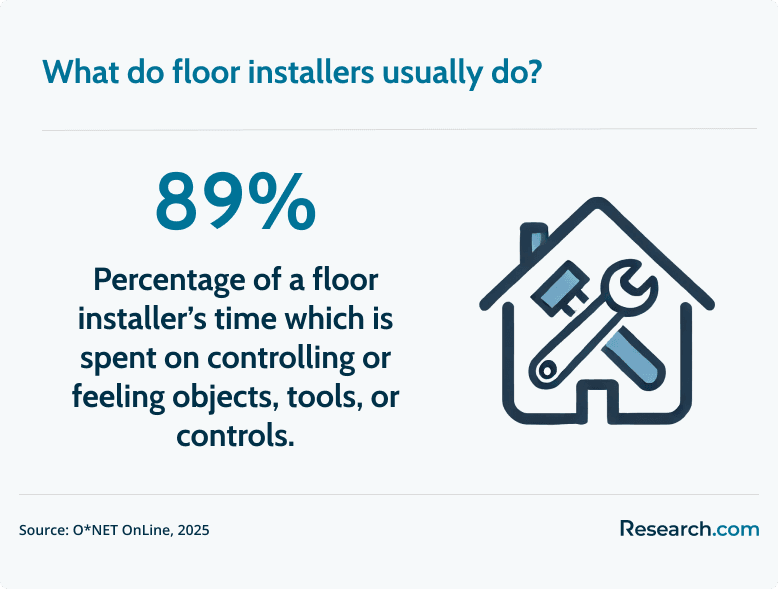
Floor installation requires steady, repetitive, skilled use of your hands. A detailed analysis of the profession shows that about 89% of a floor installer’s time is spent continually using their hands to handle materials and tools. If you dislike physical work, tight tolerances, kneeling, lifting, measuring, and correcting small details, this path may not be the right fit.
Before enrolling, ask yourself whether you enjoy practical problem-solving. Good installers do not simply place flooring. They prepare surfaces, anticipate expansion and moisture problems, protect finished areas, communicate with clients, and leave work that holds up after they leave the jobsite.
What Courses Are Typically Included in an Online Floor Installer Trade School Program?
A solid floor installer curriculum should cover more than product names and installation videos. The best programs teach the full workflow: assessing the space, preparing the substrate, selecting the right method, installing safely, checking quality, estimating materials, and communicating with customers or supervisors.
- Floor layout and installation: Students learn how to measure rooms, establish starting points, plan seams or patterns, reduce waste, and create a balanced finished appearance.
- Material handling: This topic covers safe receiving, storage, movement, acclimation, and protection of flooring materials before and during installation.
- Blueprint reading: Students practice interpreting drawings, dimensions, room layouts, and project specifications that guide installation work.
- Safety protocols: Training should cover personal protective equipment, tool safety, jobsite awareness, dust control, lifting practices, and hazard prevention.
- Job estimation: Estimating courses teach students how to calculate material quantities, account for waste, price labor, and prepare professional bids.
- Green flooring: Students may study sustainable products, low-impact materials, and installation considerations for eco-friendly flooring.
- Moisture and alkaline remediation: This area teaches students how to identify, test, and address subfloor moisture or alkalinity concerns before installation.
Flooring also connects to the larger construction process. Installers often work from plans created by designers, architects, builders, and project managers. Students who later want to broaden their technical understanding of buildings may explore options such as the fastest online architecture degree programs, although that is a separate academic path from installer training.
What Specializations Are Available in an Online Floor Installer Trade School Program?
Specialization can help you become more valuable because flooring products require different tools, preparation methods, tolerances, and troubleshooting skills. Market demand also varies by material type, renovation trends, and local construction activity. Reports on the common types of flooring in U.S. homes can help students understand how product preferences affect the trade.
The following specialization areas appear in the flooring field, along with the salary figures provided for each role:
| Specialization | Salary figure | What the work involves | Good fit for |
| Hardwood Floor Layers | $43,750 | Installing solid and engineered hardwood, including layouts that require careful measuring and craftsmanship | Students who enjoy detail work and wood materials |
| Resilient Floor Layers | $50,118 | Working with luxury vinyl tile, sheet vinyl, linoleum, cork, and similar flexible materials | Installers interested in durable products used in homes and commercial spaces |
| Floor Sanders and Finishers | $50,880 | Sanding wood floors and applying stains, sealers, and protective finishes | Workers who like restoration, refinishing, and appearance-focused projects |
| Carpet Installers | $55,860 | Measuring, cutting, stretching, seaming, and fitting carpet for residential or commercial jobs | Beginners seeking a focused installation pathway |
| Tile and Stone Setters | $57,590 | Cutting, arranging, and setting ceramic, porcelain, stone, and related materials | Installers who want precision work and custom project opportunities |
| General Floor Layers | $60,550 | Installing a range of flooring products across different job types | Students who want versatility and broader employment options |
| Floor Inspectors | $69,000 | Evaluating installation failures, material defects, site conditions, and documentation | Experienced installers who want an advanced diagnostic role |
If your long-term goal is to run a remodeling business rather than only install floors, you may eventually add broader skills through an affordable online home remodeling and repair diploma. That can make sense for installers who want to offer larger renovation packages instead of one trade service.
How to Choose the Best Online Floor Installer Trade School Program
The best program is the one that matches your experience level, schedule, budget, and career goal while giving you enough practical preparation to work safely and competently. Do not choose based only on a short completion time or low price. In a hands-on trade, weak training can show up quickly on the jobsite.
- Verify industry recognition: Look for credentials connected to respected trade organizations, manufacturers, unions, employers, or recognized continuing education systems.
- Check the hands-on requirement: Ask exactly how practical skills are taught, observed, corrected, and evaluated.
- Review the curriculum: Make sure the program includes subfloor preparation, moisture issues, safety, layout, estimating, and the flooring materials you want to install.
- Evaluate instructor background: Strong instructors should have direct field experience, not only academic or sales knowledge.
- Ask about employer connections: Job placement help, retailer partnerships, union pathways, or contractor networks can make the transition into work easier.
- Confirm total cost: Get a written breakdown of tuition, tools, supplies, travel, testing, and certificate fees.
- Look at professional skill development: Industry data shows 99% of floor installers have daily face-to-face discussions with supervisors, colleagues, or clients, so communication and jobsite professionalism matter.
| Common mistake | Why it can hurt you | Better approach |
| Choosing the cheapest course automatically | It may not include hands-on practice or a respected credential. | Compare cost against training depth, recognition, and job relevance. |
| Assuming online videos are enough | Flooring errors often come from tool use, prep work, layout, and field conditions. | Choose hybrid training if you are new to installation. |
| Ignoring subfloor and moisture training | Many flooring failures begin below the finished surface. | Prioritize programs that teach testing, preparation, and remediation. |
| Not asking about tools and materials | Extra expenses can raise your real cost. | Request a full list of required purchases before enrolling. |
| Relying only on rankings | A highly rated program may not match your location, schedule, or specialization. | Use rankings as a starting point, then verify fit with your goals. |
Questions to ask before you enroll
- Is this program fully online, hybrid, or in person?
- How many hours of hands-on practice are required?
- Who teaches the course, and what field experience do they have?
- Does the certificate qualify me for specific employers, unions, or manufacturer-related work?
- Are tools, materials, and exam fees included?
- What happens if I need extra time to complete the program?
- Does the provider offer job leads, apprenticeships, employer introductions, or resume support?
- Will the program prepare me for the type of flooring work available in my local area?
What Career Paths Are Available After an Online Floor Installer Trade School Program?
Graduates typically begin in entry-level installation roles or apprenticeships, where they learn jobsite pace, customer expectations, and real-world problem solving. From there, advancement depends on reliability, craftsmanship, material expertise, leadership ability, and business skills.
| Career stage | Typical focus | What helps you advance |
| Helper or apprentice | Assisting with materials, prep work, cleanup, measuring, and basic installation tasks | Punctuality, safety awareness, willingness to learn, and tool familiarity |
| Installer | Completing installation tasks with increasing independence | Material-specific skill, accuracy, and consistent job quality |
| Lead installer or foreman | Managing crews, coordinating schedules, checking quality, and solving site problems | Leadership, communication, estimating, and troubleshooting ability |
| Specialist | Focusing on tile, stone, hardwood, resilient flooring, sanding, finishing, or inspection | Advanced credentials, portfolio quality, and reputation |
| Business owner or contractor | Running projects, bidding jobs, hiring workers, and managing customers | Business planning, licensing awareness, insurance, marketing, and financial control |
Business ownership is a realistic long-term path
Many installers eventually move toward independent contracting or company ownership. While over half of installers work for specialty contractors, a significant 24% are self-employed. That does not mean everyone should immediately start a business. It means the trade can support entrepreneurship for workers who build strong technical skills, customer trust, and business discipline.
Installers who want to move beyond trade work into larger construction leadership roles sometimes consider additional education, such as the fastest online master’s in engineering management programs. That path is not necessary for most installers, but it may appeal to professionals who want to manage complex projects or teams at a higher level.
What Is the Job Market for Online Floor Installer Trade School Graduates?
The job market for trained floor installers is supported by construction, renovation, remodeling, and replacement work. The U.S. Bureau of Labor Statistics projects that employment in this field will grow 6.5% between 2023 and 2033, which is faster than the average for all occupations.
That growth does not guarantee a job for every graduate, and outcomes vary by location, skill level, employer demand, and specialization. However, formal training can help new workers signal that they understand safety, preparation, materials, and professional standards.
Why credentials can matter in a skilled-labor market
Employers need installers who can do more than finish a floor quickly. They need workers who understand surface preparation, moisture issues, layout, manufacturer guidelines, customer communication, and callbacks. The skilled labor issue is serious: 56% of construction firms are worried about the skill level of their workers.
With about 9,200 job openings projected each year, a recognized certificate can help you stand out, especially if it includes hands-on evaluation. The demand for flooring work is also connected to broader development, housing, renovation, and city growth patterns. Students interested in those larger forces may explore the fastest online urban planning programs, though that is a separate career direction.
What Do Graduates Say About Online Floor Installer Trade School?
- : "My relatives expected me to choose a four-year college, but I wanted a career where I could work with my hands and start earning sooner. The online lessons helped me move quickly through the basics, and the trade route made financial sense for me. Getting that first serious paycheck confirmed I had made the right decision. — Loren"
- : "I was unsure whether a physical trade could be taught partly online. The hybrid setup changed my mind. I could replay the lessons on layout and subfloor calculations at home, then use the tools during weekend workshops with an instructor watching my technique. That combination worked extremely well for how I learn. — Rick"
- : "I had been doing basic carpet and vinyl work for years without much wage growth. Specializing in tile and stone gave me a clearer niche. The advanced coursework was demanding, but now contractors bring me in for custom bathrooms and higher-detail projects. — Carlito"
What Additional Certifications Can Improve Career Earnings and Opportunities?
Additional certifications can help installers move into better-defined specialties, qualify for more complex jobs, or demonstrate expertise to employers and customers. Common areas for advanced development include material-specific installation, moisture testing, substrate preparation, safety, inspection, hardwood finishing, tile setting, resilient flooring, and manufacturer-approved systems.
The right certification depends on your current role. A beginner should first focus on installation fundamentals. An experienced installer may benefit more from inspection, advanced tile or stone, hardwood finishing, or moisture mitigation training. A future business owner may need estimating, customer management, safety, and project documentation skills in addition to installation credentials.
If you are comparing credentials across industries, Research.com’s guide to the best paying certifications can help you think about certification value, employer recognition, and career mobility.
Are Online Floor Installer Trade School Programs Accredited and Trusted by Industry Leaders?
Accreditation and industry recognition are not the same thing, and students should understand the difference. Traditional accreditation usually applies to colleges and schools that meet formal education standards. Industry recognition may come from trade associations, unions, manufacturers, employer partnerships, or continuing education systems.
For floor installer training, either form can be useful depending on your goal. If you want federal financial aid, you may need a program offered through an eligible accredited institution. If you want direct jobsite credibility, an industry-backed credential may matter more to contractors and employers.
Before enrolling, ask the provider to explain who recognizes the credential, whether it is tied to an exam or hands-on assessment, whether employers in your area value it, and whether it qualifies for financial support. Students considering college-based trade certificates can compare options with online colleges that accept financial aid.
What Challenges Should You Expect in an Online Floor Installer Trade School Program?
Online trade training can be convenient, but it also requires discipline. You must manage your study schedule, practice consistently, ask questions when concepts are unclear, and make sure you get enough hands-on experience. The biggest risk is finishing the online portion without being truly comfortable using tools, handling materials, or correcting installation problems.
- Limited immediate feedback: If an instructor cannot watch your technique, you may repeat mistakes without realizing it.
- Uneven hands-on access: Some programs provide strong labs, while others rely heavily on videos or demonstrations.
- Technology quality: Poor video instruction, confusing platforms, or weak support can slow learning.
- Hidden costs: Tools, travel, materials, and certification fees may not be included in advertised tuition.
- Local job fit: A program may teach skills that are useful nationally but not aligned with the most common flooring work in your area.
To reduce risk, choose a program that clearly documents its practical training requirements, instructor support, assessment methods, and total costs. If financing is a concern, review aid-eligible options and compare them with resources on online colleges that accept financial aid.
Key Insights
- The best floor installer training is usually hybrid. Online lessons are useful for theory, safety, materials, estimating, and troubleshooting, but beginners still need supervised hands-on practice.
- Program fit matters more than program hype. Choose based on your target role: carpet installation, resilient flooring, hardwood, tile and stone, subfloor preparation, or inspection.
- Costs vary widely. Listed options range from Free to $5,500, and many broader programs fall between $2,000 and $5,500. Always confirm tools, materials, lab travel, and exam fees.
- Flooring is a physical and detail-heavy trade. About 89% of a floor installer’s time is spent continually using hands to handle tools and materials, so comfort with precise manual work is essential.
- Credentials can help in a skill-sensitive labor market. Employment is projected to grow 6.5% between 2023 and 2033, and 56% of construction firms are worried about worker skill levels.
- Specialization can shape earnings and opportunities. Salary figures listed for flooring roles range from $43,750 for Hardwood Floor Layers to $69,000 for Floor Inspectors.
- Do not enroll without asking hard questions. Verify recognition, hands-on requirements, instructor experience, total cost, career support, and whether the credential is valued by employers where you plan to work.
References:
- Associated General Contractors (AGC) of America. (2025). The 2025 construction hiring and business outlook. Retrieved August 13, 2025, from https://www.agc.org/2025-construction-hiring-and-business-outlook
- CareerOneStop. (2025). Floor layers, except carpet, wood, and hard tiles. Retrieved August 13, 2025, from https://www.careeronestop.org/Toolkit/Careers/Occupations/occupation-profile.aspx?keyword=Floor%20Layers&location=US&onetcode=47-2042.00
- Harvard Joint Center for Housing Studies. (2025). Improving America's housing 2025. Retrieved August 13, 2025, from https://www.jchs.harvard.edu/improving-americas-housing-2025
- O*NET OnLine. (2025). Floor layers, except carpet, wood, and hard tiles. Retrieved August 13, 2025, from https://www.onetonline.org/link/summary/47-2042.00
- U.S. Bureau of Labor Statistics. (2024). May 2024 OEWS profiles. Retrieved August 13, 2025, from https://data.bls.gov/oesprofile
- U.S. Bureau of Labor Statistics. (2025). Flooring installers and tile and stone setters. Retrieved August 13, 2025, from https://www.bls.gov/ooh/construction-and-extraction/tile-and-marble-setters.htm
Other Things You Should Know About Online Floor Installer Trade School Programs
In 2027, online floor installer trade school programs usually require students to have basic tools such as measuring tapes, utility knives, trowels, and rubber mallets. While some programs may provide tool kits as part of their fees, others expect students to purchase these items independently for hands-on practice.
In 2027, online floor installer trade schools often offer certification options like the Certified Floorcovering Installer (CFI) and National Wood Flooring Association (NWFA) credentials. These certifications verify skills in various flooring materials and installation techniques, providing a competitive edge in the job market.
In 2027, online floor installer trade schools typically offer certifications such as the National Wood Flooring Association (NWFA) Certification and the Certified Floorcovering Installer (CFI) Certification. These certifications validate skills in various flooring materials and installation techniques, enhancing employability and ensuring high industry standards.