
2027 Cosmetology Degree Guide: Costs, Requirements & Job Opportunities

Co-Founder and Chief Data Scientist
If you want to work professionally with hair, skin, nails, or beauty services, the central question is not only “What degree do you need to be a cosmetologist?” It is also whether a cosmetology program fits your budget, your state licensing requirements, your preferred work environment, and your long-term career goals. For many students, the most common academic route is an Associate of Applied Science in cosmetology, often called an AAS in cosmetology.
A cosmetology degree is different from many popular online degrees because it cannot be completed through lectures alone. You need technical instruction, supervised practice, sanitation training, and enough hands-on hours to qualify for state licensure. This guide explains what an AAS in cosmetology includes, how much it may cost, what jobs it can lead to, how licensing works, whether online or hybrid options make sense, and how to decide if this path is worth it for you.
Cosmetology Degree Guide Table of Contents
- What is a Cosmetology degree?
- Cost of Cosmetology Degree
- Cosmetology Degree Jobs
- Types of Degrees in Cosmetology for 2027
- Cosmetology Degree Requirements
- What to Look for in a Cosmetology Degree
- Majors Related to Cosmetology Degree
- Cosmetology Degree vs. Certification
- Are Online Cosmetology Programs a Viable Option?
- Advanced Certifications in Cosmetology for Career Growth
- Expanding Horizons: Unconventional Career Opportunities with a Cosmetology Degree
- How Can an Online Bachelor's Degree Complement My AAS in Cosmetology?
- How Does the ROI of an AAS in Cosmetology Compare with Other Allied Health Programs?
- Can Additional Academic Credentials Boost My Cosmetology Career?
- What Emerging Trends Are Shaping the Cosmetology Industry?
- How Can Accelerated Online Bachelor's Degrees Complement My Cosmetology Education?
- What Continuing Education Opportunities Can Enhance My Professional Growth in Cosmetology?
Quick Answer: What Degree Do You Need to Be a Cosmetologist?
You do not always need a college degree to become a cosmetologist, but most states require you to complete a board-approved cosmetology program and earn a license before working professionally. An AAS in cosmetology is an associate degree that combines classroom study, salon lab practice, safety training, and business coursework. It can be a strong option if you want broader preparation than a short certificate and may eventually want to manage a salon, teach, specialize, or start a beauty business.
| Path | Best for | Main advantage | Important limitation |
| AAS in cosmetology | Students who want technical training plus business and general education coursework | Broader preparation for salon work, management, licensing, and future study | Usually takes longer than a short certificate |
| Cosmetology certificate | Students focused on entering the workforce quickly in a specific area | Shorter and often more narrowly focused | May provide less academic or business preparation |
| Specialized certification | Licensed professionals who want to add skills such as esthetics, makeup, nails, or salon management | Helps build a niche after initial training | Does not always replace state licensing requirements |
What is a Cosmetology degree?
A cosmetology degree is a career-focused program that teaches students how to provide beauty and personal care services safely and professionally. The most common degree option is the Associate of Applied Science in cosmetology. An AAS is not the same as a cosmetology license. The degree is an educational credential; the license is the state authorization that allows you to provide regulated cosmetology services to clients.
Students in cosmetology programs study hair cutting, styling, coloring, scalp care, skincare fundamentals, nail services, sanitation, client consultation, product use, and salon safety. Because cosmetology is a hands-on profession, programs include supervised practice in labs or student salons where learners apply techniques under instructor guidance.
Many AAS programs also include business-focused coursework. These classes may cover entrepreneurship, customer service, retail sales, personnel management, scheduling, and basic salon operations. That business training matters because many beauty professionals eventually rent a chair, manage a salon, freelance, or open their own business.
What can you do with a degree in cosmetology?
An AAS in cosmetology can prepare you for several beauty and personal care roles, depending on your training, state license, and any specializations you pursue. Common paths include hairstylist, barber, nail technician, skincare specialist, makeup artist, salon manager, or cosmetology instructor.
The degree can also support nontraditional roles. Some graduates move into bridal styling, product education, beauty retail, spa operations, editorial styling, wig care, or beauty entrepreneurship. If you want to teach, manage, or specialize, you may need experience, additional certifications, or a separate instructor license depending on your state.
Cost of Cosmetology Degree
AAS cosmetology programs are generally shorter and more career-specific than many other types of degrees, but the total price can still vary widely. Your final cost depends on the school, location, program length, required supplies, licensing exam fees, books, uniforms, kit requirements, and whether you qualify for financial aid.
How much does it cost to get an AAS cosmetology?
According to the Imagine America Foundation, attending an accredited cosmetology school can cost anywhere from $5,000 to $15,000 (Imagine America, 2024). That range is lower than the average costs of tuition and fees at public and private universities ($36,000 and $22,000, respectively).
Costs can be much different from one institution to another. In 2025, the Aveda Arts & Sciences Institute New York charged $19,000 for a cosmetology program (College Tuition Compare, n.d.). By comparison, Pasadena City College, California, listed an estimated cosmetology program cost of approximately $4,000 (Pasadena City College, n.d.).
Tuition is only one part of the budget. Students may also need to pay for textbooks, mannequins, styling tools, hair products, nail supplies, skincare materials, uniforms, exam preparation, and state licensing expenses. Specializations such as nail technology, hairstyling, or esthetics can add costs if they require separate courses, kits, or credentials.
| Cost factor | Why it matters | Question to ask before enrolling |
| Tuition | This is usually the largest published cost, but it may not include all required materials. | Is the quoted tuition the full program cost or only instructional charges? |
| Tools and supplies | Cosmetology students often need kits, mannequins, products, and equipment for practice. | Are tools included, rented, or purchased separately? |
| Licensing expenses | Graduation alone does not authorize professional practice in most states. | What exam, application, and renewal costs should I expect? |
| Program format | Hybrid or campus schedules may affect transportation, childcare, and work hours. | How often must I attend in person, and at what times? |
| Financial aid | Eligible students may reduce out-of-pocket costs through grants or scholarships. | Does the school participate in aid programs, and what is the refund policy? |
Is a cosmetology degree worth it?
An AAS in cosmetology can be worth it if you want structured training, state licensing preparation, hands-on practice, and business coursework in one program. It is especially useful for students who want more than a narrow certificate and are interested in salon management, self-employment, or future specialization.
It may not be the best choice if you only want to learn a single service quickly, cannot attend required in-person practice hours, or live in a state where a different training path better satisfies licensure rules. Before enrolling, compare total cost, completion time, job options in your area, licensing requirements, and the school’s graduate outcomes.
Students should also consider the realities of beauty work. Cosmetology can involve long hours standing, weekend or evening appointments, customer-service pressure, chemical exposure, variable income, and emotional labor. Emotional labor refers to managing your expressions and reactions around others to meet workplace expectations (The Pennsylvania State University, n.d.). For many professionals, client relationships are rewarding; for others, the interpersonal demands can become stressful.
Cosmetology Degree Jobs
A cosmetology degree can lead to several roles, but your exact options depend on your license, state rules, specialization, and local labor market. General cosmetology training may cover hair, skin, and nails, while some students choose a focused track such as esthetics, nails, massage therapy, hairstyling, or salon management.
Is cosmetology in high demand?
According to the latest data from the U.S. Bureau of Labor Statistics (BLS), the job outlook for hairdressers, hairstylists, and cosmetologists is expected to grow by 5% from 2024 to 2034.
Specialized beauty occupations may show stronger projected growth. The BLS expects employment for manicurists and pedicurists to grow 7% from 2024 to 2034 (Bureau of Labor Statistics, 2025). The BLS also projects 7% job growth for skincare specialists from 2024 to 2034.
What jobs can you get with an AAS cosmetology?
| Job option | Typical responsibilities | Good fit for students who... |
| Cosmetologist | Provides hair, skin, and beauty services; recommends products; consults with clients on appearance goals. | Want broad training and varied daily work with clients. |
| Hairstylist or barber | Cuts, colors, styles, treats, and maintains hair; may also provide shaving, facials, or grooming services. | Enjoy design, trends, precision work, and repeat client relationships. |
| Skincare specialist | Evaluates skin, performs treatments, and advises clients on skincare routines and products. | Prefer facial care, wellness settings, spas, or esthetics-focused services. |
| Manicurist, pedicurist, or nail technician | Cleans, shapes, files, polishes, and decorates nails; may provide hand and foot care services. | Like detailed work, nail art, short appointments, and specialty services. |
| Cosmetology instructor | Teaches theory and technique, demonstrates services, evaluates students, and prepares lessons. | Have experience and want to train future beauty professionals. |
Researchers have also explored the possibility that cosmetologists can contribute to health education and encourage positive health habits because they often build trusted relationships with clients. This does not make cosmetologists medical providers, but it does show how beauty professionals may support wellness conversations when properly trained and when they stay within their professional scope.
What kind of salary can I earn with an AAS cosmetology?
Income after cosmetology school depends on your role, state, city, clientele, experience, schedule, tips, commissions, booth rental costs, and whether you are employed or self-employed. According to the BLS, median hourly wages for cosmetologist degree graduates in May 2024 were $16.95 per hour (Bureau of Labor Statistics, 2024).
With an AAS in cosmetology, you can earn a median annual salary of $47,977 while working as a cosmetologist. Pay also varies by state. A cosmetologist in Washington, D.C., for example, may earn an estimated $53,122 annually (ZipRecruiter, 2025).
Do not treat any salary figure as a guarantee. Beauty careers can be highly local and reputation-based. New graduates often start by building a client base, improving speed and technique, and learning how to sell services ethically. Over time, specialization, strong client retention, retail skills, and business knowledge can affect earnings.
Types of Degrees in Cosmetology for 2027
Cosmetology is usually offered through beauty schools, technical colleges, community colleges, and vocational institutions. Unlike fields that commonly require bachelor’s or master’s degrees, cosmetology typically centers on career training, licensure preparation, and hands-on skill development.
AAS Degree in Cosmetology
Average time to complete: 2 to 2.5 years (coursework plus, required hours for licensure)
An AAS in cosmetology is often the most comprehensive academic credential for students entering the field. It usually combines theory, technical instruction, salon lab work, safety procedures, client service, and business-related coursework.
Students may study hair cutting, hair coloring, hair styling, scalp treatments, facials, manicures, pedicures, sanitation, infection control, product chemistry, client communication, and professional ethics. Programs commonly include supervised practice so students can build confidence before taking licensing exams and serving clients independently.
Business coursework can be valuable for students who want to manage a salon, rent a booth, supervise staff, sell products, or open a business. Topics may include small business finance, interpersonal communication, scheduling, retailing, and customer experience.
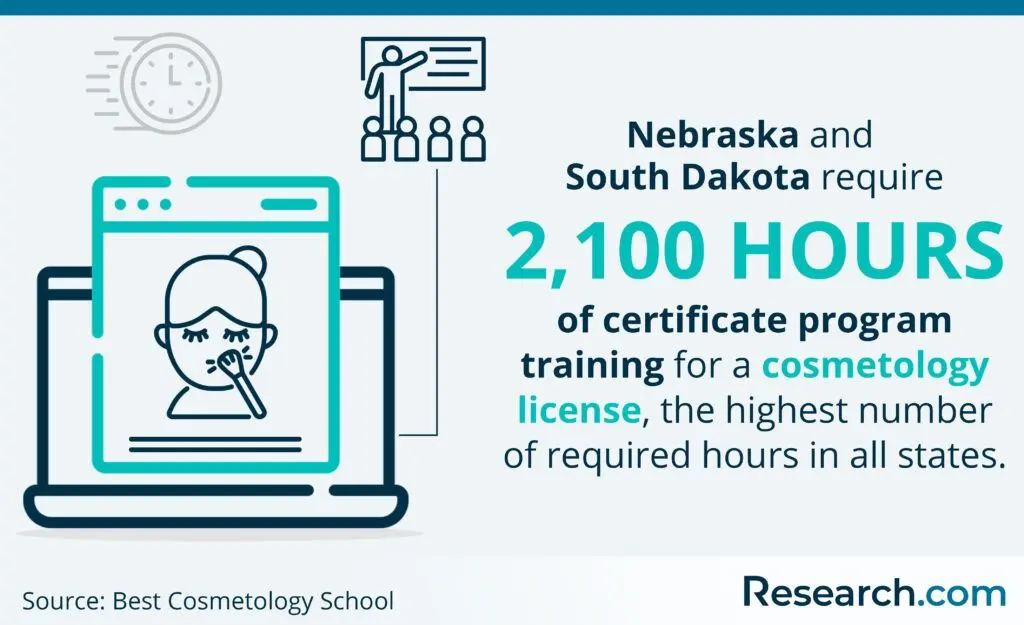
Most cosmetology programs also require a specific number of training hours. Depending on state regulations, required program training hours range from 1,000 to 2,100 hours.
Cosmetology Degree Requirements
Admission and licensing rules vary by school and state. Requirements may also differ depending on whether you enroll in a beauty school, technical college, or community college. If you are comparing trade school vs college, review not only tuition and schedule but also whether the program is approved for licensure in your state.
Admission Requirements
Proof of Graduation
Many states and schools require applicants to show proof of high school completion before entering cosmetology or beauty school. A high school diploma, GED transcript, or equivalent completion document is commonly accepted. Some associate degree programs may also expect applicants to already hold a cosmetology certificate or meet additional institutional requirements.
Transcripts or SAT/ACT score
Many cosmetology schools do not require a minimum high school GPA, SAT score, or ACT score. However, selective or more academically structured programs may ask for evidence of reading and writing readiness. Evergreen Beauty College, for example, notes that some programs require proof of competence in reading and writing (Evergreen Beauty College, n.d.).
Other Requirements
Age requirements are common. Some states allow applicants who are at least 16 years of age to begin cosmetology training, while other states require applicants to be at least 18 years of age. Always check your state board and the school’s admissions office before assuming you are eligible.
Skill Requirements
Cosmetology students benefit from manual dexterity, attention to detail, communication skills, patience, professionalism, and basic problem-solving. A foundation in math, finance, and management can also help when coursework covers retail sales, pricing, inventory, or salon operations.
What to Look for in a Cosmetology Degree
Choosing a cosmetology school is a licensing, financial, and career decision. A convenient location or attractive website is not enough. You need to know whether the program is approved, affordable, practical, and aligned with the services you want to provide.
Available Specializations
If you already know which part of the beauty industry interests you most, compare programs by specialization. Common focus areas include:
- Esthetics
- Hair design
- Makeup artistry
- Laser treatments
- Massage therapy
- Salon management
- Events styling
- Wig care
Specializations are most useful when they match your state’s scope of practice and the services clients actually seek in your area. For example, a student who wants spa work may prioritize esthetics, while someone interested in weddings or media work may focus on makeup artistry and event styling.
Accreditation
Accreditation and state approval are critical. Students typically must complete a board-approved cosmetology program to qualify for a cosmetology license (Cosmetology-License.com, n.d.). When evaluating schools, ask whether the program is approved by your state licensing board and whether the institution holds recognized accreditation.
The National Accrediting Commission for Career Arts and Sciences (NACCAS) is the largest accrediting agency for cosmetology institutions and schools. More than a thousand cosmetology and beauty schools are accredited by NACCAS.
Student-Teacher Ratio
Cosmetology requires observation, correction, and repeated practice. A lower or more manageable student-teacher ratio can make it easier to receive feedback on technique, sanitation habits, timing, and client communication. Ask how many students are assigned to each instructor in theory classes, lab sessions, and student salon settings.
Financial Aid Options
Cosmetology students may be eligible for grants, scholarships, or other financial aid depending on the school and program. The U.S. federal government offers aid to eligible students through the Pell Grant.
Professional organizations and beauty schools may also offer scholarships. The American Association of Cosmetology Schools has worked with sponsors to support qualified students, including through the Great Clips Great Scholarship Program (American Association of Cosmetology Schools, n.d.). If you need help preparing scholarship materials, Research.com offers guidance on how to write a cover letter for scholarship.
| Question to ask a cosmetology school | Why the answer matters |
| Is the program approved by the state board for licensure? | Without approval, you may not qualify for the license you need. |
| What is included in the published cost? | Tools, kits, books, fees, and exams can change the true price. |
| How many supervised practice hours are included? | Hands-on hours are essential for both licensing and confidence. |
| What are the completion, placement, and licensing exam outcomes? | Outcomes help you evaluate program quality and student support. |
| Can I transfer credits or continue into another degree? | This matters if you later pursue business, marketing, education, or management study. |
Majors Related to Cosmetology Degree
Students who want to move beyond client services may benefit from academic areas that support salon ownership, beauty retail, hospitality, branding, or business operations. Related fields include:
- Finance
- Hospitality and Tourism
- Marketing
- Entrepreneurial Studies
Cosmetology Degree vs. Certification
The right choice depends on your career target. An AAS in cosmetology is usually better for students who want broader training, a college credential, business coursework, and flexibility across beauty services. A certificate may be better for students who already know they want a focused skill, need a shorter path, or want to reduce upfront schooling time.
If your priority is a faster or simpler associate-level route, you can also compare cosmetology with the easiest associate degree to get. Just remember that “easy” should not be the main factor in a licensed profession. The program still needs to prepare you for safe practice, state exams, and real client work.
| Option | Choose this if... | Be careful if... |
| AAS in cosmetology | You want a structured credential with technical, practical, and business training. | You need the shortest possible path into one narrow specialty. |
| Cosmetology certificate | You want focused training and quicker workforce entry. | You may later want a broader academic credential or management preparation. |
| Post-licensure certification | You are already licensed and want to add advanced services or a niche. | You assume a certificate replaces legal licensing requirements. |
Are Online Cosmetology Programs a Viable Option?
Fully online cosmetology training is limited because students must practice physical techniques under supervision. However, some schools use hybrid formats. In these models, theory courses, safety lessons, business content, and demonstrations may be delivered online, while practical skills are completed in person.
Hybrid programs can help students who need scheduling flexibility, but they require careful verification. Before enrolling, confirm that the program satisfies state licensure standards, includes supervised hands-on practice, and provides enough live feedback to build technical skill. Students comparing affordable online options can review resources such as the cheapest online colleges that accept FAFSA, but cosmetology students should place licensure approval above convenience.
Advanced Certifications in Cosmetology for Career Growth
An AAS in cosmetology can prepare you for entry into the field, but many professionals add certifications after gaining foundational skills. Additional credentials can help you specialize, keep up with new techniques, build client trust, or move into management and education.
Types of Certifications to Consider
- Advanced Esthetics Certification: This option may suit professionals who want to focus on skincare and more complex facial treatments, such as microdermabrasion, chemical peels, and advanced facial therapies.
- Makeup Artistry Certification: This credential can support work in bridal beauty, photography, entertainment, fashion, and special events. Training may include airbrush application, special effects makeup, and makeup for camera lighting.
- Nail Technician Certification: Professionals interested in manicures, pedicures, nail art, and specialty nail services may benefit from focused nail training.
- Salon Management Certification: This path is useful for beauty professionals who want to supervise teams, manage inventory, improve scheduling, understand marketing, and lead a salon business.
- Hair Extensions Specialist Certification: Training in hair extensions can help stylists offer a specialized, higher-touch service that requires proper application, maintenance, and client education.
Benefits of Pursuing Certifications
- More focused services: Certifications can help you move from general practice into a defined niche.
- Stronger client confidence: Clients often look for professionals who can show current training in the service they want.
- Career flexibility: Specialized training may support salon employment, freelance work, spa roles, teaching, or business ownership.
- Professional credibility: A recognized credential can signal commitment to skill development and industry standards.
How to Get Certified
- Start with your goal: Choose a certification based on the services you want to offer, not simply on what is trending.
- Check recognition and hands-on practice: Look for programs that provide credible instruction and enough practice to build safe, consistent technique.
- Use online training carefully: Some online certifications may be useful for theory, business, or makeup concepts, but hands-on services often require live practice.
- Confirm licensing rules: Certification may improve your skills, but it does not automatically replace state licensing requirements.
Expanding Horizons: Unconventional Career Opportunities with a Cosmetology Degree
A cosmetology background can be useful outside a traditional salon chair. Professionals who combine technical skill with business judgment, creativity, communication, and continuing education can pursue more specialized or entrepreneurial roles.
- Beauty Product Development. Cosmetology graduates understand how clients use hair, skin, and nail products in real settings. That knowledge can support roles in product testing, education, retail strategy, or brand development. If you are comparing academic routes for business ambitions, Research.com’s guide on what degree should I get can help you think beyond technical training.
- Medical Aesthetics. Some beauty professionals pursue additional training for work in clinical or medspa environments. This path requires close attention to state scope-of-practice rules because treatments such as laser therapy, chemical peels, or Botox may involve medical oversight or separate credentials.
- Editorial and Fashion Industry Roles. Cosmetologists can work on photoshoots, runway shows, advertising campaigns, or media productions. These roles often require speed, creativity, strong portfolios, and comfort working with teams.
- Beauty Influencer or Educator. Social platforms have created opportunities for professionals who can teach techniques, review products, explain trends, or build a personal brand. Others prefer teaching in beauty schools, leading workshops, or training salon teams.
- Spa and Wellness Management. Graduates with business skills may move into spa operations, scheduling, customer experience, staff coordination, or service development.
- Sustainable Beauty Consultant. Some professionals focus on lower-waste practices, product sourcing, and environmentally conscious salon operations.
- Specialized Services. Niche work can include wig styling, theater and performance beauty, scalp services, or support services for clients experiencing hair loss.
How Can an Online Bachelor's Degree Complement My AAS in Cosmetology?
An online bachelor's degree can add broader business, marketing, leadership, or management training to the technical skills gained in an AAS program. This can be useful if your goal is not only to work with clients but also to manage a salon, build a brand, launch products, oversee staff, or move into beauty education and operations.
For cosmetology graduates who need flexibility and cost control, cheap online bachelor programs may be worth comparing. Look for programs that accept transfer credits, fit your schedule, and provide coursework that connects to your goals, such as digital marketing, entrepreneurship, communication, accounting, or hospitality management.
Is an AAS degree in cosmetology the right choice for you?
An AAS in cosmetology is a strong fit if you want a hands-on beauty career, value structured training, and want a credential that includes both technical and business preparation. It may also make sense if you want the option to specialize later in skincare, nails, hairstyling, massage therapy, salon management, or teaching.
You may want a different route if you need the shortest possible training option, only want one narrow skill, cannot attend required in-person practice, or are unsure whether you enjoy client-facing service work. Because licensing rules vary, your first step should be checking your state board’s approved training requirements.
Cost is another reason many students consider cosmetology. These programs are often less expensive than longer college degrees, and eligible students may be able to use financial aid, student scholarships and grants, or school-based assistance to reduce out-of-pocket expenses.
| An AAS in cosmetology may be right if... | Consider another option if... |
| You want broad training in hair, skin, nails, sanitation, and client service. | You only want one short, specialized skill and do not need a degree. |
| You may want to manage a salon or start a beauty business. | You are not interested in client-facing service work. |
| You can complete required in-person practice hours. | You need a fully online program with no hands-on attendance. |
| You want a credential that may support future academic study. | Your state or career goal requires a different license or training route. |
Common Mistakes to Avoid When Choosing a Cosmetology Program
- Choosing a school before checking licensure approval: A program that is not accepted by your state board can create serious delays and extra costs.
- Comparing tuition only: Always ask about kits, supplies, books, exam fees, uniforms, and other required expenses.
- Assuming online means fully online: Cosmetology requires hands-on practice. Hybrid courses may help, but supervised training is still essential.
- Ignoring schedule demands: Required hours can be difficult to complete if you work, commute, or have caregiving responsibilities.
- Relying only on rankings or reputation: A well-known school is not automatically the best fit. Compare outcomes, cost, instructor support, and licensing alignment.
- Assuming salary outcomes are guaranteed: Earnings depend on location, role, experience, clientele, tips, commissions, and business model.
Key Insights
- An AAS in cosmetology is an education credential, not a license: Most students still need to complete state-approved training and pass licensing requirements before practicing professionally.
- Hands-on training is nonnegotiable: Online or hybrid coursework can support theory learning, but cosmetology skills require supervised in-person practice.
- Costs vary widely: Accredited cosmetology school can cost anywhere from $5,000 to $15,000, but supplies, tools, and licensing fees can change the total price.
- Career options are broader than salon work: Graduates may pursue hairstyling, barbering, nails, skincare, instruction, salon management, product education, bridal work, or niche beauty services.
- Specialization can strengthen your path: Esthetics, makeup artistry, nail technology, salon management, and hair extensions can help licensed professionals focus their services.
- Program approval matters more than convenience: Before enrolling, confirm accreditation, state board approval, required hours, exam preparation, and student outcomes.
- The best ROI depends on your goals: Cosmetology can offer a faster, lower-cost entry into a hands-on career, but income varies and business skills often matter as much as technical ability.
How Does the ROI of an AAS in Cosmetology Compare with Other Allied Health Programs?
Evaluating return on investment for an AAS in cosmetology means weighing total cost, program length, licensing requirements, likely local earnings, and the opportunity to build independent income. Compared with many allied health fields, cosmetology can offer a quicker and less expensive route into a professional service career. It also offers entrepreneurial possibilities that may appeal to students who want flexibility or business ownership.
However, cosmetology income can be less predictable than wages in some clinical fields, especially early in a career. Allied health programs such as athletic trainer programs may involve different academic expectations, clinical requirements, and career structures. The better ROI depends on whether you value speed, cost, licensing requirements, job stability, client-facing work, or business potential most.
Can Additional Academic Credentials Boost My Cosmetology Career?
Additional academic credentials can help if your career goals extend beyond providing services. Business, marketing, education, leadership, finance, or hospitality coursework may support salon ownership, brand development, staff supervision, product sales, or training roles.
Some professionals explore advanced academic pathways, including options such as quick PhD programs, but this level of study is not required for most cosmetology careers. For most beauty professionals, the highest-value next step is usually a targeted credential that aligns with a specific business or specialization goal.
What Emerging Trends Are Shaping the Cosmetology Industry?
Cosmetology continues to change as clients expect more personalization, digital communication, flexible booking, visible safety practices, and environmentally conscious products. Beauty professionals increasingly need technical skill plus digital presence, client education, product knowledge, and business adaptability.
Schools are responding by adding more instruction in digital tools, marketing, consultation, and modern consumer expectations while still preserving hands-on practice. Students looking for faster education formats may compare options such as an accelerated associate's degree online, but cosmetology students should confirm that any accelerated or online pathway still meets hands-on and state licensing requirements.
How Can Accelerated Online Bachelor's Degrees Complement My Cosmetology Education?
An accelerated online bachelor's degree can help cosmetology graduates build skills that are harder to develop in a technical program alone. Areas such as business strategy, digital marketing, leadership, accounting, communication, and customer engagement can support salon management, product development, brand building, or entrepreneurship.
These programs are most useful when they accept relevant transfer credits, fit around work schedules, and connect directly to your career plan. Students exploring flexible academic routes can review accelerated online bachelor's degrees to understand how a faster bachelor’s pathway might complement cosmetology training.
What Continuing Education Opportunities Can Enhance My Professional Growth in Cosmetology?
Continuing education helps cosmetology professionals keep their skills current, add services, meet renewal requirements where applicable, and respond to changing client expectations. Useful options include advanced technique workshops, product education, sanitation updates, industry conferences, specialty certifications, and business training.
Academic study can also support long-term growth. An accredited bachelor degree online may help professionals who want stronger preparation in management, marketing, customer engagement, or entrepreneurship. The best continuing education choice is the one that improves your services, supports licensure compliance, and moves you closer to a specific career goal.
References:
- American Association of Cosmetology Schools. (2025). Grants & scholarships. American Association of Cosmetology Schools
- Bureau of Labor Statistics. (2025). Manicurists and pedicurists : Occupational outlook handbook: : U.S. Bureau of Labor Statistics. Bureau of Labor Statistics
- Bureau of Labor Statistics. (2025). Barbers, hairstylists, and cosmetologists : Occupational outlook handbook: U.S. Bureau of Labor Statistics. Bureau of Labor Statistics
- Cosmetology-License.com. (2025). Cosmetology license requirements | Cosmetologist, hairdresser and hair stylist licensing. Cosmetology-License.com
- Pasadena City College. (2025). Cosmetology. Pasadena City College
Other Things You Should Know About Cosmetology Degrees
In 2027, typical admission requirements for cosmetology programs include a high school diploma or GED. Some programs may require a minimum age of 16 to 18. Application processes often involve interviews and/or aptitude tests to assess suitability for the program. Ensure to check specific requirements with each institution to verify details.
The AAS in Cosmetology typically takes around two years to complete, including the required hours of hands-on training needed for licensure.
The cost of an AAS in Cosmetology ranges from $5,000 to $15,000, depending on the school and location. Additional costs for textbooks, supplies, and specialized training may apply.
Cosmetology students must follow state board sanitation rules: wash hands before and after services, disinfect tools between clients, use EPA-registered disinfectants, and keep workstations clean. Training salons also require blood spill procedures and proper storage of clean and soiled implements.
Cosmetology programs in 2027 offer specializations such as hairstyling, makeup artistry, nail technology, skincare, and cosmetology education. Each specialization provides targeted training to prepare students for distinct roles in the beauty industry, allowing them to cater to specific client needs and preferences.
To obtain a cosmetology license in 2027, graduates must pass a state board exam and complete a minimum of 1,500 training hours. Licensing requirements may vary by state, so checking with your state's licensing authority is essential for specific conditions.


