
2027 Most Affordable Online Jewelry Design and Repair Trade School Programs

Co-Founder and Chief Data Scientist
Choosing an affordable online jewelry design and repair program is not just a tuition decision. You are deciding whether a program can teach hands-on bench skills, provide enough feedback to improve your craftsmanship, and help you build a portfolio or service business without overspending on a credential employers may not recognize. This guide is for aspiring bench jewelers, jewelry designers, repair technicians, craft entrepreneurs, and career changers comparing online and hybrid trade school options in the United States.
You will learn what online jewelry design and repair programs usually include, how much they may cost, which schools offer lower-cost or flexible options, what careers are realistic after training, and how to judge whether a program is credible. The goal is to help you choose a program based on skills, cost, accreditation, tools, instructor support, and career fit rather than marketing claims alone.
Quick answer: Are online jewelry design and repair trade school programs worth considering?
Online jewelry design and repair programs can be a practical option if you need flexible training, want to build entry-level jewelry skills, or plan to start a small jewelry business. They are usually most useful for learning design fundamentals, repair procedures, tool use, basic gemology, CAD concepts, and business basics. However, students who need intensive bench supervision, access to professional studio equipment, or advanced stone setting practice may benefit from a hybrid or in-person program.
| Best fit | Why it may work | What to check before enrolling |
| Career changers | Self-paced programs can help you learn while working. | Confirm whether the program includes hands-on projects and instructor feedback. |
| Creative entrepreneurs | Courses may cover design, repair, marketing, and selling jewelry. | Check whether toolkits, materials, and business modules are included in tuition. |
| Future bench jewelers | Training can introduce repair, polishing, stone setting, and resizing skills. | Look for enough practical assignments, not only video lessons. |
| Students seeking formal credentials | Some schools offer accredited degrees or diplomas. | Verify accreditation and transfer policies before assuming credits will count elsewhere. |
What are the main benefits of earning an online jewelry design and repair qualification?
- Career preparation: A focused program can prepare students for roles such as Bench Jeweler, Custom Jewelry Designer, and Repair Technician, especially when the curriculum includes real projects and portfolio work.
- Income potential: Jewelry design and repair professionals in the United States may earn a median salary in the range of $45,000 to $60,000 annually, with higher earnings possible for experienced specialists, business owners, and jewelers with strong client networks.
- Scheduling flexibility: Online training lets students study around work, caregiving, or other commitments, although hands-on practice still requires dedicated workspace and consistent time.
- Lower startup risk: Certificate and diploma programs can be less expensive than degree programs, making them useful for students who want to test the field before committing to a longer academic path.
What should I expect from an online jewelry design and repair trade school program?
A good online jewelry design and repair program should teach both the creative and technical sides of the craft. Students typically learn through video demonstrations, written lessons, tool and supply lists, mailed kits, project submissions, and sometimes instructor critiques. The strongest programs make students practice, document, and revise their work rather than only watch demonstrations.
- Focused technical training: Common topics include metalworking, stone setting, casting, polishing, finishing, resizing, chain repair, and basic restoration.
- Structured learning materials: Programs may use video tutorials, downloadable manuals, assignments, tool guides, supplier lists, and online discussions.
- Hands-on assignments: Students should expect to complete projects at home using basic tools and materials; some programs require photos or mailed work for feedback.
- Shorter timeline than traditional apprenticeships: Many online programs are designed to teach foundational and intermediate skills faster than a multi-year apprenticeship, though mastery still takes substantial practice.
- Business preparation: Some programs include pricing, client communication, sourcing, marketing, and small-business operations for students who want to sell or repair jewelry independently.
Where can graduates work after completing an online jewelry design and repair program?
Graduates may work in retail, repair, production, design, appraisal support, or self-employment. The best path depends on the student’s skill level, portfolio, ability to use tools safely, and willingness to continue learning on the job.
- Retail jewelry stores: Many entry-level opportunities involve repairs, ring sizing, polishing, cleaning, and custom modification work.
- Independent jewelry brands: Designers and makers may assist with production, prototypes, small-batch fabrication, or custom orders.
- Freelance or self-employed work: Graduates can offer repair services, create their own jewelry line, sell online, or work with local clients, although income depends heavily on business execution.
- Auction houses and antique dealers: Restoration-oriented roles may involve evaluating, repairing, or preparing older pieces for resale.
- Home-based studios: Some jewelers operate from a small studio or home workshop, provided they can maintain safe ventilation, tool storage, and proper handling of materials.
- Further specialization: Online training can be a starting point for gemology, CAD/CAM, high-end stone setting, antique restoration, or watch repair.
How much can I make with an online jewelry design and repair qualification?
Income varies widely because jewelers work in different settings: retail shops, repair businesses, manufacturing, custom studios, and self-employment. A certificate or diploma can help you start, but earnings usually depend more on craftsmanship, speed, specialization, reputation, location, and business skills than on the credential alone.
- Entry-level pay: New Bench Jewelers typically earn between $38,000 and $48,000 annually.
- Mid-career earnings: Jewelers with stronger bench skills and several years of experience often move into the $50,000 to $65,000 range.
- Advanced specialists: Highly experienced jewelers with specialized skills can earn upwards of $75,000.
- Self-employed income: Independent jewelers may earn more or less than employees depending on pricing, demand, repeat clients, marketing, and overhead.
- Most Affordable Online Jewelry Design and Repair Trade School Programs for 2027
- What are jewelry designers and repairers and what do they do?
- What is the average cost of an online jewelry design and repair program?
- What are the financial aid options for online jewelry design and repair programs?
- What are the prerequisites for enrolling in an online jewelry design and repair program?
- What courses are typically in an online jewelry design and repair program?
- What types of specializations are available for jewelry design and repairs?
- How do you choose the best online jewelry design and repair program?
- What career paths are available for graduates of online jewelry design and repair programs?
- How can I verify the credibility of an online jewelry design and repair program?
- How can I pursue further academic advancement after completing an online jewelry design and repair program?
- Is investing in an online jewelry design and repair program financially viable?
- How do online programs compare to traditional in-person programs?
- How much can I earn with an online jewelry design and repair degree?
- What is the job market for graduates with an online jewelry design and repair degree?
Most Affordable Online Jewelry Design and Repair Trade School Programs for 2027
The programs below represent a limited selection of online and hybrid jewelry design, repair, gemology, and jewelry technology options. They should be treated as a starting point, not a complete market scan. Students comparing broader trade education options can also review Research.com’s guide to online vocational schools.
This list uses Research.com’s transparent methodology and draws from established education data sources, including the Integrated Postsecondary Education Data System database, Peterson's databases, the Distance Learning Licensed Data Set, the College Scorecard, and the National Center for Education Statistics. Because jewelry programs vary widely in format and credential type, students should verify current tuition, fees, materials, schedules, and accreditation directly with each school.
| Program | Format | Length | Cost listed | Credential or focus | Accreditation or recognition listed |
| Academy of Art University | Online | 48 months | $1,301 per unit | Jewelry & Metal Arts | Western Association of Schools and Colleges, Senior College and University Commission (WASC/WSCUC) |
| Gemological Institute of America | Hybrid | Varies by program; Graduate Jeweler Diploma approximately 9 months | Approximately $8,505.00 for Jewelry Design program | Jewelry Fabrication, Repair, Design, CAD Technology | Accrediting Commission of Career Schools and Colleges (ACCSC); Distance Education Accrediting Commission (DEAC) |
| IAP Career College | Online | Recommended 6 weeks, flexible between 4-12 weeks | $149 | Jewelry Designer Certificate Course | Not regionally accredited; recognized as a career college offering certificate programs |
| New York Institute of Art and Design | Online | Up to 18 months | Approximately $1,495; $799 promo | Jewelry Design Course | Registered with New York State Education Department (NYSED); Better Business Bureau (BBB) |
| Penn Foster Career School | Online | Approximately 10 months | Approximately $839 full payment, or $1,039 with monthly payment plan | Jewelry Design and Repair Career Diploma | Distance Education Accrediting Commission (DEAC) |
| Fashion Institute of Technology | Hybrid | 2 years | $2,645 per semester for Associate-level New York City/State residents; $7,935 per semester for Associate-level out-of-state residents | AAS in Jewelry Design | Middle States Commission on Higher Education (MSCHE) |
| International School of Gemology | Online | Varies by course | Varies by course | Gemology, Jewelry Design, Appraisal diplomas | Not regionally accredited; industry recognized |
| Texas Institute of Jewelry Technology at Paris Junior College | Hybrid | Varies; associate degree typically 2 years | $89 per credit hour in-district; $178 per credit hour out-of-district/out-of-state | Jewelry Technology, Gemology, Watchmaking, CAD | Southern Association of Colleges and Schools Commission on Colleges (SACSCOC) |
1. Academy of Art University
The Academy of Art University offers an online Jewelry & Metal Arts degree program for students who want a broader art-school education in jewelry design and metalsmithing. The program includes traditional studio concepts as well as contemporary methods, with coursework in sketching, color theory, soldering, stone setting, welding, casting, enameling, 3D printing, and laser cutting.
Students work through written lectures, instructional videos, and instructor feedback from professionals in the field. The degree is best suited for learners who want an extended curriculum, creative exploration, and a structured academic credential rather than a short career certificate.
- Program Length: 48 months (full-time, self-paced options available)
- Tracks/Concentrations: Jewelry & Metal Arts
- Tuition Cost: $1,301 per unit
- Required Credits to Graduate: 120 semester units
- Accreditation: Western Association of Schools and Colleges, Senior College and University Commission (WASC/WSCUC)
2. Gemological Institute of America (GIA)
The Gemological Institute of America provides hybrid jewelry education options, including the Jewelry Design & Technology Diploma. Its programs combine online study with hands-on training, which can be important for students who want exposure to professional tools, fabrication, quality control, stone setting, repair, and CAD design.
GIA is a strong option for students who want gemology-centered training and industry-focused credentials. The curriculum also incorporates business concepts such as sales and marketing, making it relevant to students aiming for design, appraisal, manufacturing, or retail roles.
- Program Length: Varies by program; Graduate Jeweler Diploma approximately 9 months (full-time)
- Tracks/Concentrations: Jewelry Fabrication, Repair, Design, CAD Technology
- Tuition Cost: Approximately $8,505.00 for Jewelry Design program (online diploma pricing varies)
- Required Credits to Graduate: Not specified
- Accreditation: Accrediting Commission of Career Schools and Colleges (ACCSC); Distance Education Accrediting Commission (DEAC)
3. IAP Career College
IAP Career College offers a fully online Jewelry Designer Certificate Course for beginners seeking an inexpensive introduction to the field. The course covers design principles, basic gemology, metalsmithing concepts, and business topics for students considering jewelry design or a small creative business.
This option is most appropriate for learners who want a low-cost overview rather than extensive bench training. Students who need advanced repair practice, studio access, or an accredited academic credential should compare it carefully with longer programs.
- Program Length: Recommended 6 weeks, flexible between 4-12 weeks
- Tracks/Concentrations: Jewelry Design
- Tuition Cost: $149 (flat fee)
- Required Credits to Graduate: Not applicable (certificate program)
- Accreditation: Not regionally accredited; recognized as a career college offering certificate programs
4. New York Institute of Art and Design (NYIAD)
The New York Institute of Art and Design (NYIAD offers a self-paced online Jewelry Design Course that emphasizes design techniques such as bead stringing, jump rings, wire transitions, and more advanced design concepts. The program also introduces marketing and selling jewelry, which can help students who plan to build a product line.
Students receive a toolkit, mentor feedback, and access to an online community. Because the program can be completed within 18 months, it may work well for beginners and intermediate learners who want flexibility and structured projects without committing to a degree.
- Program Length: Up to 18 months (self-paced)
- Tracks/Concentrations: Jewelry Design
- Tuition Cost: Approximately $1,495 (flat fee); $799 (promo)
- Required Credits to Graduate: Not applicable (certificate program)
- Accreditation: Registered with New York State Education Department (NYSED); Better Business Bureau (BBB)
5. Penn Foster Career School
Penn Foster Career School offers a fully online Jewelry Design and Repair Career Diploma designed for students who want practical exposure to jewelry creation and repair. Coursework includes stone setting, resizing, polishing, repair methods, and business fundamentals, and the program includes a toolkit with essential tools and materials.
The self-paced format makes it suitable for learners balancing work or family responsibilities. Students considering this program should review the amount of feedback provided on hands-on work and whether the included tools match the skills they want to practice after graduation.
- Program Length: Approximately 10 months (self-paced)
- Tracks/Concentrations: Jewelry Design and Repair
- Tuition Cost: Approximately $839 (full payment), or $1,039 with monthly payment plan
- Required Credits to Graduate: Not specified
- Accreditation: Distance Education Accrediting Commission (DEAC)
6. Fashion Institute of Technology (FIT)
The Fashion Institute of Technology (FIT) offers a hybrid Associate in Applied Science (AAS) in Jewelry Design. The program combines studio-based instruction with online coursework and covers fabrication, CAD design, gemology, and business practices.
FIT may be a better fit for students who want an associate degree, access to specialized studios, and training connected to design, manufacturing, and retail. It is less ideal for students looking for a short, fully online certificate.
- Program Length: 2 years (full-time)
- Tracks/Concentrations: Jewelry Design, CAD, Gemology
- Tuition Cost: Associate-level New York City/State residents: $2,645 per semester; Associate-level out-of-state residents: $7,935 per semester
- Required Credits to Graduate: 61 credits
- Accreditation: Middle States Commission on Higher Education (MSCHE)
7. International School of Gemology
The International School of Gemology offers online courses in gemology, jewelry design, and appraisal-related topics. Its programs are designed for students who want flexible study in gemstone identification, grading, design fundamentals, and appraisal knowledge without relocating to a campus.
This path may be useful for students interested in gemology, appraisal support, or jewelry retail. Students seeking academic credit or regional accreditation should verify transferability and recognition before enrolling.
- Program Length: Varies by course (self-paced)
- Tracks/Concentrations: Gemology, Jewelry Design, Appraisal diplomas
- Tuition Cost: Varies by course
- Required Credits to Graduate: Not applicable (certificate programs)
- Accreditation: Not regionally accredited; industry recognized
8. Texas Institute of Jewelry Technology at Paris Junior College
The Texas Institute of Jewelry Technology offers hybrid training in jewelry technology, including fabrication, repair, gemology, watchmaking, and computer-aided design. The hybrid structure is useful for students who want theory content supported by in-person laboratory work.
Students interested in repair, manufacturing, horology, or technical bench work may find this option more hands-on than a fully online program. Because the associate degree typically requires 60 credits, applicants should compare time, travel, and total cost against shorter certificate routes.
- Program Length: Varies; associate degree typically 2 years
- Tracks/Concentrations: Jewelry Technology, Gemology, Watchmaking (Horology), Computer-Aided Design
- Tuition Cost: $89 per credit hour (in-district), $178 per credit hour (out-of-district/out-of-state)
- Required Credits to Graduate: 60 credits (associate degree)
- Accreditation: Southern Association of Colleges and Schools Commission on Colleges (SACSCOC)
What are jewelry designers and repairers and what do they do?
Jewelry designers and repairers create, modify, maintain, and restore jewelry. The field blends artistic judgment with precise hand skills, tool safety, materials knowledge, and customer service. Some professionals focus on new designs, while others specialize in repairs, stone setting, gem identification, or production work. Students comparing short certificates in this field may also want to explore broader online vocational certificate programs to understand how trade credentials differ from academic degrees.
| Role | Primary work | Skills that matter most |
| Jewelry Designer | Develops new jewelry concepts by sketching, modeling, or using CAD software before production. | Creativity, visual design, materials knowledge, client communication. |
| Bench Jeweler | Fabricates, assembles, polishes, sets stones, finishes pieces, and completes repairs at a workbench. | Hand dexterity, soldering, finishing, repair technique, precision. |
| Jewelry Repairer | Fixes broken chains, resizes rings, replaces clasps, repairs prongs, and resets stones. | Problem-solving, construction knowledge, tool control, customer trust. |
| Gemologist | Identifies and grades gemstones for design, sales, appraisal, or quality control purposes. | Gem identification, grading, documentation, ethical sourcing awareness. |
| Stone Setter | Places gemstones securely into settings such as prong, bezel, pavé, or channel settings. | Extreme precision, magnification work, patience, metal control. |
The global gems and jewellery market, as shown in the graphic below, was valued at $431.57 million in 2024 and is projected to reach $608.38 million by 2030, growing at a CAGR of 5.95%. Growth is tied to rising disposable incomes and a growing middle class in developing nations like China and India, which has increased demand for luxury goods.
At the same time, the industry is changing in response to consumer expectations. Many buyers now care more about ethically sourced materials, personalization, and bespoke jewelry, especially among younger generations. For students, this means technical ability should be paired with design originality, sourcing awareness, and client-centered service.

What is the average cost of an online jewelry design and repair program?
Online jewelry design and repair program costs vary because credentials range from inexpensive short courses to university-level degrees. The cheapest option is not always the best value, especially if it lacks tools, instructor feedback, or hands-on assignments. Students should calculate total cost, not just advertised tuition.
| Program type | Typical cost stated | Best for | Potential limitation |
| Career diploma or certificate | Approximately $800 to $2,000 | Students seeking foundational skills at a manageable price. | May not provide academic credit or deep studio supervision. |
| Individual online course | $100 to $600 each | Learners who need a specific skill such as stone setting or CAD. | May not be comprehensive enough for entry-level employment alone. |
| University-level program | $4,000 to over $35,000 annually | Students who want a degree, broader art training, or transfer-ready coursework. | Higher cost and longer time commitment. |
| Tool and material kit | Additional $300 to $1,000 | Students who need equipment to practice at home. | Quality and completeness can vary by school. |
When comparing programs, ask whether tuition includes tools, metals, stones, safety equipment, shipping, software access, and critique time. If you plan to combine jewelry work with product photography or online sales, related creative training such as the fastest online digital photography degree may be useful, but it should not replace hands-on bench training.
What are the financial aid options for online jewelry design and repair programs?
Financial aid depends on the school, credential type, and accreditation status. Degree programs at accredited institutions may have different aid options than non-degree certificates. Before enrolling, ask the school what aid is available, whether payment plans add fees, and whether scholarships can be applied to online students.
- Scholarships: Industry organizations, including the Women's Jewelry Association (WJA) and Jewelers of America (JA), offer scholarships for students pursuing jewelry design, metalsmithing, or gemology.
- Payment plans: Many online schools and vocational providers allow monthly payments, which can reduce the need for a large upfront payment.
- Private loans: Banks and credit unions may offer financing, but students should compare interest rates and avoid borrowing more than the likely career return supports.
- Crowdfunding: Some creative students raise training funds by showing a portfolio, business plan, or custom collection concept.
- Employer support: Students already working for jewelry retailers or manufacturers may be able to ask about tuition assistance or reimbursement for job-related training.
What are the prerequisites for enrolling in an online jewelry design and repair program?
Most entry-level jewelry design and repair programs are accessible to beginners. Admissions requirements are usually simpler than those for a four-year degree, but students still need the maturity and discipline to complete detailed hands-on work safely at home.
- High school diploma or equivalent: Many diploma and certificate programs require a high school diploma or GED.
- Minimum age: Applicants are often expected to be at least 18 years old.
- Strong interest in the craft: Jewelry work requires patience, repetition, and attention to small details, so motivation matters.
- Computer and internet access: Online students need reliable technology to watch lessons, upload assignments, and communicate with instructors.
- Portfolio for advanced programs: Degree-level or competitive programs may ask for samples of creative work. Students who need design foundations before applying may explore related visual training, including the fastest graphic design programs online.
What courses are typically in an online jewelry design and repair program?
Coursework should move from safety and basic tool use into fabrication, repair, stone setting, design, and business skills. Since jewelry is a hands-on trade, the most valuable courses include practice assignments and feedback, not only reading or video lectures.
| Course area | What students usually learn | Why it matters |
| Introduction to Jewelry Making | Tools, materials, workshop safety, sawing, filing, soldering, and basic construction. | Builds the foundation for safe and accurate bench work. |
| Metalsmithing | Metal properties, shaping, forming, texturing, and joining methods. | Helps students understand how metals behave during fabrication and repair. |
| Stone Setting | Bezel, prong, pavé, and other setting methods. | Stone security and appearance are essential in both repair and custom design. |
| Jewelry Repair Techniques | Ring sizing, chain repair, clasp replacement, prong retipping, polishing, and restoration. | Repair work is one of the most practical entry points into the industry. |
| Casting and Mold Making | Lost-wax casting, rubber molds, and reproduction of designs. | Supports production work and custom jewelry manufacturing. |
| Computer-Aided Design (CAD) | Digital modeling tools such as Rhino or Matrix for 3D jewelry design. | CAD skills help jewelers collaborate with manufacturers and use digital workflows. |
| Gemology Basics | Gem identification, grading, and the 4Cs: cut, color, clarity, and carat weight. | Supports ethical sales, quality control, appraisal support, and client communication. |
Students planning to sell their own jewelry may also benefit from business education. For example, an accelerated online bachelor degree in entrepreneurship can complement craft training for students who want stronger preparation in pricing, operations, branding, and growth strategy.
What types of specializations are available for jewelry design and repairs?
Specialization can help jewelers stand out in a competitive market. After learning the basics, students can build expertise in a niche that matches their strengths, equipment access, and target customers.
- Custom design: Jewelers work directly with clients to design one-of-a-kind pieces, translate ideas into drawings or CAD models, and manage expectations around cost and materials.
- Antique restoration: Specialists repair heirloom and historical pieces while preserving original construction, style, and value.
- Stone setting: Some professionals focus heavily on securing gems with advanced techniques such as micro-pavé and channel setting.
- Engraving: Engravers add lettering, symbols, patterns, and decorative detail to metal by hand or machine.
- CAD/CAM technology: Digital specialists create precise models and support 3D printing, wax models, and casting workflows.
- Goldsmithing or platinumsmithing: These specialists develop advanced expertise in specific precious metals and high-end fabrication methods.
Students serving international clients, teaching workshops, or working in multilingual markets may consider communication-focused credentials such as the cheapest ESL certification programs online, but this is supplementary and not a substitute for jewelry training.
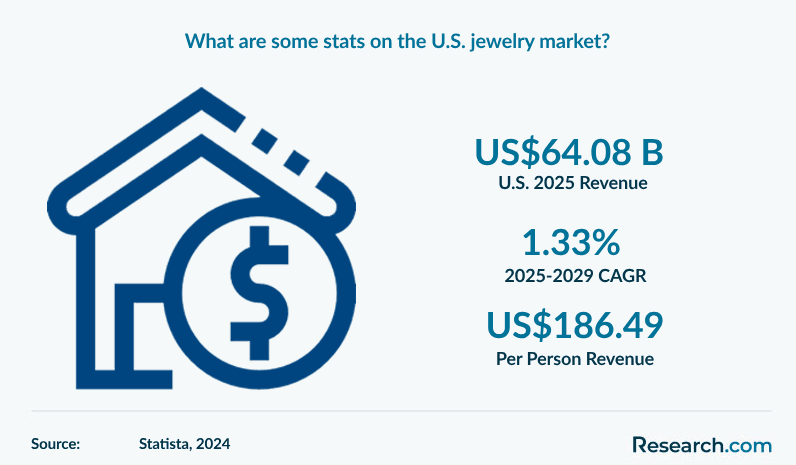
In 2025, the United States jewelry market is projected to generate US$64.08 billion in revenue, with an expected annual growth rate of 1.33% through 2029. This equals approximately US$186.49 per person this year. The U.S. market remains below China, which is forecasted to lead globally with US$120 billion in revenue.
The non-luxury segment is expected to account for an estimated 85% of all U.S. sales in 2025, while demand for ethically sourced diamonds and sustainable materials continues to shape consumer behavior. For students, this suggests that affordability, responsible sourcing, customization, and trust-building may matter as much as luxury positioning.
How do you choose the best online jewelry design and repair program?
The best program is the one that matches your goal: employment, self-employment, portfolio development, academic credit, or specialization. A low-cost course may be enough for hobby-to-business exploration, while a hybrid diploma or degree may be better for students who need more bench supervision and recognized credentials.
| Selection factor | What to look for | Warning sign |
| Curriculum depth | Coverage of fabrication, repair, stone setting, finishing, design, CAD, and business basics. | The program mainly offers inspiration or theory with little practice. |
| Instructor support | Clear feedback on student work, accessible instructors, and industry experience. | No critique process or unclear instructor qualifications. |
| Tools and materials | Transparent kit list, quality tools, safety guidance, and realistic supply costs. | Students must buy many required items after enrolling with little notice. |
| Accreditation or recognition | Accreditation for degree or diploma programs, or strong industry recognition for specialized training. | Claims of recognition without verifiable details. |
| Career support | Portfolio guidance, business resources, job search support, or alumni examples. | Vague promises about guaranteed employment or high earnings. |
| Total cost | Tuition, payment plan cost, kits, shipping, software, and replacement materials. | Only tuition is disclosed, while required extras are unclear. |
Students should research instructor backgrounds and compare program claims with professional standards from organizations such as Jewelers of America. If formal accreditation and flexible pacing are important, review related options among accredited self-paced online colleges before committing.
Questions to ask before enrolling
- How many hands-on projects will I complete?
- Will an instructor review my actual work or only grade quizzes?
- Are tools, metals, stones, and shipping included in the listed tuition?
- Does the credential have academic credit, industry recognition, or both?
- Can I speak with an advisor about job outcomes without being pressured to enroll?
- Does the program teach safe home studio practices?
- What software, if any, is required for CAD work?
- Can graduates show portfolio pieces suitable for employers or clients?
What career paths are available for graduates of online jewelry design and repair programs?
Graduates may pursue employment, freelance work, or entrepreneurship. A formal degree is not always required to begin in this field; many entry-level opportunities value demonstrable skill, portfolio work, and practical training. Students who want a broader academic credential can compare jewelry training with accredited online degree programs, but certificates and diplomas may be enough for many entry-level craft roles.
| Career path | Typical work | Best preparation |
| Bench Jeweler | Repairs, sizing, polishing, stone setting, assembly, and finishing. | Hands-on repair training, tool practice, and portfolio documentation. |
| Custom Jewelry Designer | Creates commissioned pieces for individual clients or jewelry houses. | Design portfolio, CAD or sketching ability, client communication. |
| Jewelry Repair Technician | Handles repair-focused work such as chain repair, clasp replacement, ring sizing, and prong work. | Repair-specific coursework and supervised practice when possible. |
| CAD/CAM Specialist | Builds digital 3D models for casting, manufacturing, and custom design. | CAD software training, understanding of fabrication, and design accuracy. |
| Small Business Owner | Sells designs, offers repairs, manages pricing, sourcing, marketing, and customer service. | Jewelry skills plus business planning and bookkeeping knowledge. |
| Jewelry Appraiser Assistant | Supports appraisal-related work with materials knowledge and documentation. | Jewelry construction knowledge plus additional gemology training. |
In 2023, there were approximately 46,200 jobs for jewelers and precious stone and metal workers in the United States. Self-employed workers made up the largest group at 48%, followed by jewelry, luggage, and leather goods stores at 24%. Jewelry and silverware manufacturing accounted for 14% of jobs, while merchant wholesalers and repair shops represented 5% and 3%, respectively.
This employment pattern shows that jewelry work is heavily shaped by independent artisans, small businesses, and direct client relationships. Students considering this field should prepare not only to make and repair jewelry but also to price work, build trust, communicate clearly, and manage repeat customers.
How can I verify the credibility of an online jewelry design and repair program?
Start by confirming whether the school is accredited, industry-recognized, or simply offering an informal certificate. Accreditation matters most if you want academic credit, transfer options, access to certain financial aid pathways, or a credential that another school may recognize. Industry recognition may matter more for specialized gemology, appraisal, or bench training, but it should still be verifiable.
- Search the accreditor’s official website instead of relying only on the school’s marketing page.
- Ask whether credits transfer to other institutions and request the policy in writing.
- Review sample lessons, assignment types, and tool requirements before paying.
- Look for instructor biographies showing real jewelry design, repair, gemology, retail, or manufacturing experience.
- Ask for examples of graduate portfolios, not only testimonials.
- Be cautious of programs that promise guaranteed income, instant mastery, or unusually fast career outcomes.
If you are comparing accelerated credentials, review whether the pace is realistic for hands-on learning. For example, options such as a degree in 6 months online may be useful in some fields, but jewelry repair and metalsmithing require repeated practice that cannot be rushed without sacrificing skill development.
How can I pursue further academic advancement after completing an online jewelry design and repair program?
After finishing a trade certificate or diploma, students may continue into an associate degree, bachelor’s degree, business program, design program, gemology credential, or entrepreneurship training. The key question is whether your first program offers transferable credit. Many short career certificates do not automatically transfer into degree programs, so students should ask about articulation agreements before enrolling.
A student who wants to move from bench work into management, product development, teaching, or brand ownership may consider a fast bachelor's degree online. Those interested in graduate-level study in business, design, education, or leadership can also compare one year graduate programs, but only after confirming prerequisites and whether the additional credential supports a specific career goal.
Is investing in an online jewelry design and repair program financially viable?
An online jewelry program can be financially reasonable when the cost is aligned with your goal, the program includes enough hands-on training, and you have a plan for employment or income generation after completion. It is less viable if you choose an expensive program without understanding required tools, expected practice time, job market conditions, or how you will build clients.
| Cost or return factor | Why it matters | How to evaluate it |
| Tuition | Determines your upfront education cost. | Compare total tuition against similar certificate, diploma, and degree options. |
| Tools and materials | Jewelry training requires physical supplies, not only online lessons. | Ask for a complete required kit list before enrolling. |
| Practice time | Skill improves through repetition. | Estimate weekly hours needed for projects, not just lesson viewing. |
| Career goal | A hobbyist, employee, and business owner need different preparation. | Choose the credential that matches your target path. |
| Additional credentials | Gemology, CAD, appraisal, or business training may increase options. | Consider targeted add-ons rather than stacking unrelated certificates. |
Students comparing jewelry credentials with other career-focused options can review courses for high paying jobs, but no program should be judged only by advertised salary potential. In this field, portfolio quality, technical reliability, client service, and business execution strongly influence outcomes.
How do online programs compare to traditional in-person programs?
Online programs are best for flexibility and lower access barriers. In-person and hybrid programs are stronger for students who need studio equipment, live correction, and close supervision. Jewelry repair is tactile, so the format should support the level of hand-skill development you need.
| Format | Advantages | Limitations | Best for |
| Fully online | Flexible schedule, lower travel cost, self-paced learning, possible toolkits. | Less direct supervision, limited access to studio equipment, self-discipline required. | Beginners, career changers, hobby-to-business learners, students with schedule constraints. |
| Hybrid | Combines online theory with in-person labs and practical instruction. | May require travel, set schedules, and higher total cost. | Students who want flexibility but still need hands-on studio experience. |
| Traditional in-person | Live demonstrations, immediate feedback, professional studio access, peer learning. | Less flexible, location-dependent, often more expensive. | Students seeking intensive bench training, degree study, or advanced fabrication skills. |
Technology is narrowing some gaps between formats. Many programs now use CAD, digital design workflows, video critique, 3D modeling, and online portfolio review. Still, tools such as torches, polishing equipment, casting systems, and microscopes may be difficult to replicate at home. Students interested in digital workflows should understand the distinction between CAD/CAM and related tools before choosing a program.
How much can I earn with an online jewelry design and repair degree?
Most people in this field earn based on job role, location, skill, specialization, and business model rather than the phrase “online degree” itself. Many roles can begin with a certificate, diploma, apprenticeship-style experience, or employer training instead of a full academic degree. Students comparing schools can also review regionally accredited online schools if they want a credential with broader academic recognition.
- Entry-Level Bench Jeweler: New graduates can typically expect an annual salary ranging from $38,000 to $48,000.
- Mid-Career Bench Jeweler: With stronger skills and experience, earnings often increase to between $50,000 and $65,000 per year.
- Jewelry Designer: Designer pay varies by employer, brand, portfolio, and client base, with an average range of $45,000 to $70,000.
- Highly Skilled Specialists: Jewelers with advanced custom design, stone setting, or antique restoration skills can command salaries upwards of $75,000.
- Business Owners: Self-employed earnings vary widely and depend on sales, pricing, overhead, marketing, and customer retention.
The national median salary for jewelers and precious stone and metal workers is $49,890 annually. State-level earnings differ significantly. New York reports the highest median salary at $63,570 per year, followed by Connecticut at $62,430. Washington reports $60,250, Massachusetts reports $59,960, and Virginia reports $58,950.
Other higher-paying states include Rhode Island at $57,210, California at $55,950, Texas at $55,590, Vermont at $54,790, and Florida at $53,770. These figures show why location can affect financial outcomes, especially for jewelers working in retail markets, luxury regions, or areas with strong custom jewelry demand.
What is the job market for graduates with an online jewelry design and repair degree?
The job market is competitive and somewhat specialized. Demand continues for repair, custom work, restoration, and skilled bench services, but the overall employment outlook is not a high-growth story. Students should enter the field with realistic expectations and a plan to keep improving their craft.
- Overall employment: The U.S. Bureau of Labor Statistics projects a slight decline in overall employment for jewelers and precious stone and metal workers, although replacement needs still create openings.
- Repair services: Jewelry repair remains a practical service area because customers continue to resize, restore, and maintain meaningful pieces.
- Customization: Personalized jewelry and bespoke pieces create opportunities for designers who can translate client ideas into durable work.
- Retail and manufacturing: Jewelry stores and manufacturers continue to employ bench jewelers with broad technical skills.
- E-commerce: Online selling allows independent designers to reach more buyers, but it also requires branding, product photography, inventory control, and financial tracking. Students planning to operate independently may benefit from accredited bookkeeping courses for basic business accounting.
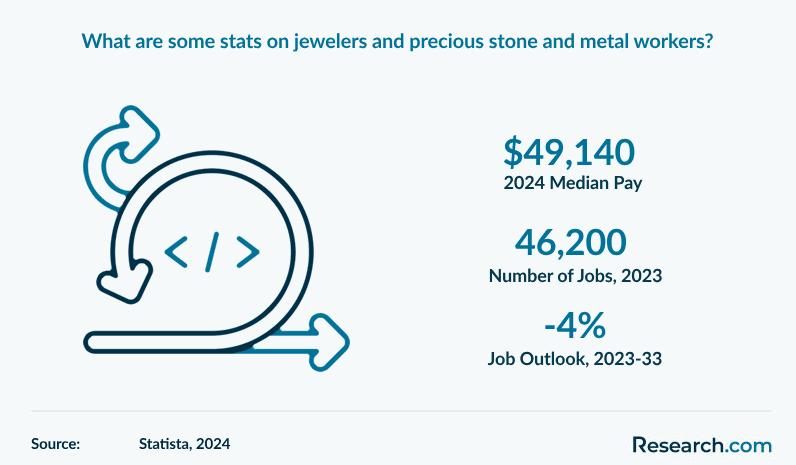
According to the Bureau of Labor Statistics, the median pay for jewelers and precious stone and metal workers in 2024 was $49,140 per year, or $23.63 per hour. Entry typically requires a high school diploma or equivalent, followed by long-term on-the-job training. The number of jobs is projected to decline by 4% between 2023 and 2033, which equals a loss of approximately 1,700 positions from the 46,200 jobs recorded in 2023.
Despite that projected decline, opportunities can still exist for graduates with strong portfolios, repair capability, CAD/CAM familiarity, business discipline, and a clear niche. Students should treat online training as the beginning of skill development, not the end.
Common mistakes to avoid when choosing an online jewelry design and repair program
- Choosing only by tuition: A cheaper program can cost more in the long run if it excludes tools, materials, feedback, or enough practice.
- Ignoring accreditation: If you need transfer credit, financial aid eligibility, or an academic credential, verify accreditation before enrolling.
- Assuming online means easy: Jewelry skills require repeated hands-on practice, careful safety habits, and patience.
- Overlooking workspace needs: Some techniques require ventilation, lighting, tool storage, and safe handling of heat or chemicals.
- Believing salary is guaranteed: Published salary ranges are not promises; earnings depend on skill, role, geography, and business results.
- Skipping portfolio development: Employers and clients often want to see finished work, repairs, before-and-after examples, or CAD models.
- Relying only on rankings: Rankings can help narrow choices, but you still need to compare curriculum, cost, support, and fit.
- Choosing a program without career goals: A design-focused course may not prepare you for repair work, and a repair-focused diploma may not provide enough branding or design training for entrepreneurship.
Key Insights
- Online jewelry training can be useful, but only if it is hands-on: The strongest programs require projects, tool practice, and instructor feedback, not just passive video lessons.
- Affordable does not always mean best value: Compare tuition together with toolkits, materials, software, shipping, critique time, and career support.
- Program format should match your goal: Fully online programs work well for flexibility and foundations; hybrid or in-person programs are stronger for advanced bench supervision and studio equipment.
- Credentials vary widely: Some programs are short certificates, some are career diplomas, and others are accredited associate or bachelor’s degree pathways. Verify what the credential actually represents.
- The market rewards skill and specialization: Repair, custom design, CAD/CAM, stone setting, antique restoration, and gemology can help graduates build stronger career options.
- Self-employment is common: In 2023, self-employed workers represented 48% of U.S. jeweler and precious stone and metal worker jobs, so business skills matter.
- Job growth is limited: BLS projects a 4% decline from 2023 to 2033, making portfolio quality, adaptability, and business discipline important for new entrants.
- Salary depends on role and location: National median pay is reported around $49,140 to $49,890 annually, while states such as New York, Connecticut, and Washington report higher medians.
References:
- Bureau of Labor Statistics. (2025, April 18). Jewelers and precious stone and metal workers. Occupational Outlook Handbook. Bureau of Labor Statistics.
- CareerOneStop. (2025). Wages for jewelers and precious stone and metal workers in Pennsylvania [Data set]. U.S. Department of Labor. CareerOneStop.
- Statista. (2025). Jewelry market in the United States – outlook 2025 [Data set]. Statista.
- Yahoo Finance. (2025, March 12). Gems and jewellery market analysis report 2025: Global trends, size, share & forecast [News article]. Yahoo Finance.
Other Things You Should Know About Jewelry Design and Repair Trade School Programs
In 2027, most affordable online programs offer certificates in jewelry design and repair, often recognized by professional artisans. Some programs also provide specialized training in areas like gemology or metalworking, enhancing qualification credibility for entering the industry.
When selecting an online jewelry design and repair trade school program in 2027, consider factors like accreditation, tuition costs, program length, curriculum comprehensiveness, and the availability of hands-on training opportunities. These elements ensure you get a valuable education that balances cost and practical experience.


