2027 Most Affordable Online Doctorate in Educational Leadership Programs

Co-Founder and Chief Data Scientist
Affordable Online Doctorates in Educational Leadership for 2027
An online doctorate in educational leadership is usually pursued by experienced educators, school administrators, curriculum leaders, and higher education professionals who want to move into senior decision-making roles. The challenge is that doctoral study takes years, requires serious research work, and can become expensive if you choose a program without comparing tuition, credits, accreditation, and completion requirements.
This guide is built to help you evaluate the most affordable online doctorate programs in educational leadership for 2027. You will learn what these programs include, how long they take, what they cost, how online formats compare with campus-based study, which admissions requirements to expect, and how to decide whether the investment fits your career goals.
Quick Answer: Is an Online Doctorate in Educational Leadership Worth Considering?
An online doctorate in educational leadership can be worth considering if you already work in education and want to qualify for higher-level roles in K-12 administration, higher education, policy, curriculum leadership, or organizational change. These programs typically take three to five years, and education administrators commonly earn annual wages ranging from $99,000 to $104,000, according to the US Bureau of Labor Statistics (BLS). The best choice is usually an accredited program with a clear specialization, transparent tuition, strong dissertation support, and a format that fits your work schedule.
Key benefits of earning the degree online
- Leadership mobility: A doctorate can support advancement into roles such as superintendent, dean, curriculum director, policy analyst, or senior education administrator.
- Flexible study format: Online delivery can make doctoral work more realistic for working professionals who cannot relocate or attend weekly campus classes.
- Research-based decision-making: Students learn how to use evidence, data, policy analysis, and organizational theory to solve complex education problems.
- Potential salary growth: Education administrator salaries often fall in the $99,000 to $104,000 range, though actual earnings depend on role, location, employer, experience, and credentials.
What can I expect from an online doctorate in educational leadership?
An online doctorate in educational leadership is an advanced graduate program focused on preparing education professionals to lead schools, districts, colleges, universities, agencies, and education-focused organizations. Most programs combine leadership theory, applied research, policy, organizational management, finance, equity, and a major research project such as a dissertation or dissertation-in-practice.
Students should expect a demanding academic experience. Although the online format adds flexibility, doctoral study still requires weekly reading, writing, data analysis, faculty interaction, peer collaboration, and long-term research planning.
- Leadership development: Coursework typically examines how education leaders manage people, improve systems, allocate resources, and guide institutional change.
- Applied research training: Students learn qualitative, quantitative, and mixed-methods approaches used to investigate problems in schools and higher education.
- Online flexibility: Many programs are designed for full-time educators and administrators, often using asynchronous coursework, virtual meetings, and online research support.
- Long-term commitment: Most students should plan for three to five years of study, with some part-time formats extending longer.
Ed.D. vs. Ph.D. in educational leadership: what is the difference?
| Degree Type | Best For | Typical Focus | Common Outcome |
| Ed.D. in Educational Leadership | Working educators who want senior leadership or administrative roles | Applied problem-solving, organizational improvement, policy implementation, and leadership practice | Principal, superintendent, dean, director, senior administrator, or education consultant |
| Ph.D. in Educational Leadership | Professionals interested in research, scholarship, policy analysis, or faculty roles | Original research, theory development, research design, and academic publication | Researcher, faculty member, policy analyst, or senior academic leader |
Where can I work with an online doctorate in educational leadership?
Graduates often work in K-12 school systems, colleges and universities, education agencies, nonprofit organizations, policy institutes, curriculum companies, and training-focused organizations. Common pathways include superintendent, principal, dean of students, department chair, curriculum director, higher education administrator, policy analyst, and education researcher.
How much can I make with an online doctorate in educational leadership?
Graduates may qualify for education administrator roles in kindergarten, elementary, secondary, and postsecondary settings. According to the US Bureau of Labor Statistics, education administrators earn annual wages ranging from $99,000 to $104,000. Salary is not guaranteed by the degree alone, and outcomes vary based on several factors:
- Role and responsibility level: District-level and executive positions such as superintendent, dean, or senior administrator often pay more than specialist or coordinator roles.
- Geographic location: Pay often reflects local budgets, cost of living, and regional demand for administrators.
- Experience: Prior teaching, administrative, budgeting, supervision, and policy experience can influence hiring and compensation.
- Licensure or certification: Some K-12 leadership roles require state-specific administrator credentials in addition to the doctorate.
- 2027 List of the Most Affordable Online Doctorates in Educational Leadership Programs
- How long does it take to complete an online doctorate in educational leadership?
- How does an online doctorate in educational leadership compare to an on-campus program?
- What is the average cost of an online doctorate in educational leadership?
- What are the financial aid options for students enrolling in an online doctorate in educational leadership?
- What are the prerequisites for enrolling in an online doctorate in educational leadership?
- What courses are typically in an online doctorate in educational leadership?
- What types of specializations are available in online doctorates in educational leadership?
- How to choose the best online doctorate in educational leadership?
- Is the Investment in an Online Doctorate in Educational Leadership Worth It?
- What challenges might you encounter during your online doctorate in educational leadership?
- What career paths are available for graduates of online doctorates in educational leadership?
- What is the job market for graduates of online doctorates in educational leadership?
- What are the emerging trends in online educational leadership?
- How can interdisciplinary insights enrich an online doctorate in educational leadership?
- How do faculty qualifications impact the online doctorate experience?
- How an Online Doctorate in Educational Leadership Transforms Educational Systems
- The Role of Equity and Diversity in Educational Leadership
- Are fast-track programs in online educational leadership a viable option?
- How can I maximize success in my online doctorate program?
- What digital tools and support systems enhance the online doctoral experience?
- Why is accreditation important when choosing an online doctorate in educational leadership?
2027 List of the Most Affordable Online Doctorates in Educational Leadership
How do we rank schools?
To identify affordable online doctoral options in educational leadership, we used a ranking methodology that reviews publicly available institutional and program information. The data sources considered include:
- Peterson’s data set;
- College Scorecard database;
- National Center for Education Statistics; and
- IPEDS database.
Programs were reviewed using factors such as tuition, academic reputation, enrollment information, accreditation, and program characteristics. Students should use this list as a starting point and verify current tuition, fees, transfer credit rules, dissertation requirements, and licensure alignment directly with each university before applying.
| School | Program Length | Credits | Cost per Credit | Accreditation |
| Valdosta State University | Five years | 55 | $304.82 | CAEP |
| University of Wyoming | Five years | 55 | $308.80 (in-state); $468.8 (out-of-state) | CAEP |
| University of Texas at Arlington | Five years | 66 | $273.33 | SACSCOC |
| Lamar University | Five years | 60 | $324 | SACSCOC |
| University of Arkansas | Three years | 42 | $484.81 | HLC |
| Northwest Nazarene University | 26 months | 36 | $625 | CAEP |
| University of the Cumberlands | Three years | 60 | $415 | Educational Professional Standards Board |
| Northern Illinois University | Three years | 42 | $556.74 | HLC |
| National University | 39 months | 60 | $442 | WASC Senior College and University Commission |
| Texas Tech University | Five years | 63 | $444.37 (in-state); $852.37 (out-of-state) | SACSCOC |
1. Valdosta State University
Valdosta State University offers an online doctorate in educational leadership designed for doctoral candidates who want to become ethical, effective, and inclusive leaders in schools and other organizations.
- Program Length: Five years
- Tracks/concentrations: Executive Leadership, Teacher Leadership, Curriculum Leadership, Technology Leadership, Higher Education Leadership
- Cost per Credit: $304.82
- Required Credits to Graduate: 55
- Accreditation: Council for the Accreditation of Educator Preparation (CAEP)
2. University of Wyoming
The fully online doctorate in educational leadership from the University of Wyoming is structured for professionals preparing for senior K-12 leadership roles, including assistant superintendent and superintendent positions.
- Program Length: Five years
- Tracks/concentrations: Organizational Leadership, Educational Leadership
- Cost per Credit: $308.80 (in-state); $468.8 (out-of-state)
- Required Credits to Graduate: 55
- Accreditation: CAEP
3. University of Texas at Arlington
The doctoral program at the University of Texas at Arlington brings together students and scholars from K-12 and postsecondary education to study leadership and policy across educational systems.
- Program Length: Five years
- Tracks/concentrations: Institutional Assessment, Policy Analysis, Institutional Leadership, Higher Education Administration
- Cost per Credit: $273.33
- Required Credits to Graduate: 66
- Accreditation: Southern Association of Colleges and Schools Commission on Colleges (SACSCOC)
4. Lamar University
The Doctor of Education in Educational Leadership at Lamar University prepares students to lead instruction and organizational improvement in public schools, private schools, state agencies, and entrepreneurial education ventures.
- Program Length: Five years
- Tracks/concentrations: Global Educational Leadership, Educational Technology Innovation
- Cost per Credit: $324
- Required Credits to Graduate: 60
- Accreditation: SACSCOC
5. University of Arkansas
The online Doctorate in Educational Leadership at the University of Arkansas develops scholar-practitioners for leadership in schools, districts, higher education, and policy-focused settings.
- Program Length: Three years
- Tracks/concentrations: Educational Policy and Change
- Cost per Credit: $484.81
- Required Credits to Graduate: 42
- Accreditation: Higher Learning Commission (HLC)
6. Northwest Nazarene University
The doctorate in educational leadership from Northwest Nazarene University gives students an opportunity to pursue advanced education research and leadership study in a focused doctoral format.
- Program Length: 26 months
- Tracks/concentrations: Effective Leadership for Change Management
- Cost per Credit: $625
- Required Credits to Graduate: 36
- Accreditation: CAEP
7. University of the Cumberlands
The University of the Cumberlands offers an accelerated online Doctorate in Educational Leadership that can be completed in three years or less and includes asynchronous remote coursework, an executive format, and individualized instruction.
- Program Length: Three years
- Tracks/concentrations: Strategic Administration and Curriculum
- Cost per Credit: $415
- Required Credits to Graduate: 60
- Accreditation: Educational Professional Standards Board
8. Northern Illinois University
The Doctorate in Educational Leadership and Policy Studies at Northern Illinois University prepares action-oriented scholar-practitioners to lead change and address problems of practice using research, theory, and professional experience.
- Program Length: Three years
- Tracks/concentrations: Ethical Approaches to Problems of Practice, Systematic Inquiry into Problems of Practice
- Cost per Credit: $556.74
- Required Credits to Graduate: 42
- Accreditation: HLC
9. National University
The National University doctoral program explores leadership theory, evidence-based decision-making, education policy, and the relationship between policy and school performance.
- Program Length: 39 months
- Tracks/concentrations: Educational Policy, Leadership, and Research
- Cost per Credit: $442
- Required Credits to Graduate: 60
- Accreditation: WASC Senior College and University Commission
10. Texas Tech University
The educational leadership policy doctorate at Texas Tech University prepares graduates to analyze, design, implement, and evaluate education policies using data-informed approaches with an emphasis on equity for students and families.
- Program Length: Five years
- Tracks/concentrations: Importance of Policy in Educational Systems
- Cost per Credit: $444.37 (in-state); $852.37 (out-of-state)
- Required Credits to Graduate: 63
- Accreditation: SACSCOC
What Graduates Say About Online Doctoral Study in Educational Leadership
-
: "
“Balancing a job, family responsibilities, and doctoral coursework felt overwhelming at the beginning. The online format made it possible to build study time around my schedule, join discussions during breaks, and work with classmates from different parts of the country. The degree was demanding, but the flexibility helped me stay committed.” - Sarah
"
-
: "
“The strongest part of my online program was learning with educators who brought different experiences to every discussion. Even without meeting in person, our cohort became a valuable professional network. As a principal, I still use ideas that came from those conversations.” - David
"
-
: "
“My doctorate helped me reconnect with the research side of education and apply new leadership strategies in my district. The workload was heavy, but faculty feedback and mentoring made the process manageable. It changed how I approach school improvement.” - Angela
"
Key Findings About Online Doctorates in Educational Leadership
- Online doctorate programs in educational leadership commonly take three to seven years, with many full-time options structured for three to four years.
- Affordable programs may cost from $18,040.00 to $22,975.00 on average, depending on school type, residency rules, program length, and credit requirements.
- Online formats can be especially practical for working educators, but they require strong time management and independent study habits.
- Graduates may pursue roles such as principal, superintendent, curriculum director, higher education administrator, policy analyst, and education program director.
- Median salaries for education administrators range from $102,610 to $103,460 annually.
How long does it take to complete an online doctorate in educational leadership?
Most students should expect to spend at least three years earning an online doctorate in educational leadership. The actual timeline depends on whether you study full time or part time, how quickly you complete research milestones, whether transfer credits are accepted, and how the dissertation or capstone is structured.
- Full-time enrollment: Many full-time students finish in three to four years, often by taking heavier course loads each term.
- Part-time enrollment: Working professionals who take fewer courses may need four to seven years or longer.
- Transfer credits: Some universities allow approved graduate credits to shorten the program, but policies vary widely.
- Dissertation structure: Programs that integrate research throughout the curriculum may feel different from programs that place most dissertation work near the end.
| Enrollment Format | Typical Completion Time | Best Fit |
| Full-time | 3-4 years | Students who can commit substantial weekly time to coursework and research |
| Part-time | 4-7 years | Working educators and administrators balancing doctoral study with full-time employment |
How does an online doctorate in educational leadership compare to an on-campus program?
Online and on-campus doctorates can lead to similar academic outcomes, but the learning experience is different. The better option depends on your schedule, learning style, need for in-person networking, and access to campus-based resources.
| Factor | Online Doctorate | On-Campus Doctorate |
| Flexibility | Usually better for working professionals because coursework may be asynchronous or scheduled outside standard work hours | Requires regular in-person attendance and may be harder to manage with full-time employment |
| Learning style | Works best for self-directed students who can manage deadlines independently | Works well for students who prefer scheduled classes and face-to-face discussion |
| Networking | Networking happens through online cohorts, virtual meetings, group projects, and professional associations | Offers easier access to campus events, in-person faculty meetings, and local professional contacts |
| Cost considerations | May reduce commuting, housing, and relocation costs, though tuition varies by institution | May include additional transportation, relocation, or campus-related expenses |
| Support needs | Requires strong virtual advising, library access, technology support, and dissertation mentoring | May provide more immediate access to campus offices, research centers, and faculty |
Who should choose an online program?
- Educators who plan to keep working while enrolled
- Students who live far from doctoral-granting universities
- Professionals who are comfortable with online research tools and virtual collaboration
- Applicants who need flexible pacing or asynchronous coursework
Who may prefer an on-campus program?
- Students who want frequent in-person faculty interaction
- Professionals seeking campus-based research assistantships or teaching opportunities
- Learners who benefit from scheduled classroom structure
- Applicants who want to build a local academic network around one institution
What is the average cost of an online doctorate in educational leadership?
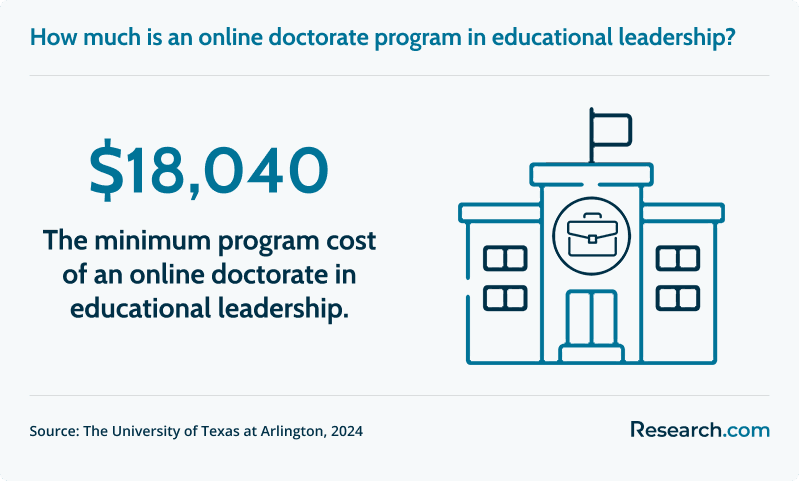
The most affordable online doctorate programs can range from as low as $18,040.00 to upwards of $22,975.00. For educational leadership doctorates, the final cost depends on tuition, number of required credits, fees, residency status, transfer credit policies, dissertation continuation fees, and whether the school charges online students separate technology or distance learning fees.
- Public vs. private institution: Public universities often have lower tuition, especially for in-state students.
- Residency status: Some programs charge different rates for in-state and out-of-state students.
- Credit requirements: A lower per-credit rate is not always cheaper if the program requires many more credits.
- Fees and dissertation costs: Students should ask about technology fees, graduation fees, research course fees, and charges for extended dissertation enrollment.
| Cost Factor | Why It Matters | Question to Ask |
| Tuition per credit | It is the most visible cost, but not the only one | What is the current per-credit tuition for online doctoral students? |
| Total credits | More credits can increase total program cost even if the per-credit rate is low | How many credits are required after transfer evaluation? |
| Residency rules | Out-of-state rates can change affordability | Do online students pay in-state, out-of-state, or a separate online rate? |
| Fees | Technology, library, dissertation, and graduation fees can add up | What mandatory fees are not included in advertised tuition? |
| Time to completion | Longer enrollment may increase total cost | Are there dissertation continuation fees if I need extra time? |
What are the financial aid options for students enrolling in an online doctorate in educational leadership?
Doctoral students may have fewer grant options than undergraduates, so it is important to plan carefully before borrowing. Online students should confirm that their program is eligible for federal aid and ask each university about scholarships, assistantships, tuition discounts, and employer partnerships.
- Federal student aid: Some students may use federal loan options such as Direct Unsubsidized Loans. Federal grants such as the TEACH Grant are generally associated with eligible teaching preparation pathways, so students should confirm eligibility rather than assume it applies to their doctoral program.
- Institutional aid: Universities may offer doctoral scholarships, grants, tuition discounts, or limited assistantship opportunities for online students.
- Employer tuition assistance: School districts, colleges, universities, and education organizations may reimburse part of the cost for employees pursuing job-related graduate study.
- External scholarships: Professional associations, foundations, and education leadership organizations may provide awards for doctoral students.
- Payment plans: Some universities allow students to spread tuition payments across a term, which can reduce reliance on loans.
Ways to reduce the total cost
- Ask whether previous graduate credits can transfer.
- Compare total program cost, not just tuition per credit.
- Choose a dissertation topic connected to your workplace to reduce research access barriers.
- Apply for institutional scholarships before each deadline.
- Request written confirmation of all fees and continuation charges.
What are the prerequisites for enrolling in an online doctorate in educational leadership?
Admissions standards vary by university, but most online doctoral programs in educational leadership expect applicants to have graduate-level preparation, professional experience in education, and a clear reason for pursuing doctoral study.
- Master's degree: Applicants usually need a master's degree in educational leadership, education, administration, curriculum, or a related field from an accredited institution.
- Minimum GPA: Many programs expect a graduate GPA around 3.0 or higher.
- Education experience: Some programs prefer or require teaching, leadership, administrative, or higher education experience.
- Standardized tests: GRE requirements vary, and some online programs no longer require them.
- Résumé or CV: Applicants typically submit a record of academic preparation, employment, leadership roles, publications, and professional service.
- Recommendation letters: Programs often request letters from supervisors, faculty members, or colleagues who can evaluate leadership potential and graduate-level readiness.
- Statement of purpose or writing sample: Applicants may need to explain their goals, research interests, leadership experience, and fit with the program.
Admissions questions to ask before applying
- Does the program require a teaching license or administrative license?
- Are applicants expected to have K-12 leadership experience?
- Does the program support higher education leadership as well as K-12 leadership?
- Are GRE scores required, optional, or waived?
- Can I speak with an advisor about whether my background is competitive?
What courses are typically in an online doctorate in educational leadership?
Curricula differ by school and degree type, but most online doctorates in educational leadership include coursework in leadership theory, research methods, policy, finance, organizational change, equity, and dissertation development.
Leadership and education systems
- Educational leadership theory: Examines leadership models used to guide schools, districts, colleges, and organizations.
- School law and education policy: Reviews legal and policy issues that affect administrators and institutional decision-making.
- School finance and budgeting: Develops understanding of resource allocation, fiscal planning, and financial accountability.
- Curriculum and instruction: Studies curriculum design, instructional improvement, assessment, and learning outcomes.
Research and data analysis
- Research methods in education: Introduces the design of studies that address real education problems.
- Quantitative and qualitative methods: Builds skills in collecting, analyzing, and interpreting numerical and narrative data.
- Educational statistics: Helps students evaluate evidence and use statistical tools for education research.
Organizational leadership and change
- School culture and climate: Focuses on improving learning environments and organizational health.
- Human resources in education: Covers hiring, evaluation, staff development, supervision, and professional growth.
- Change leadership: Examines how leaders plan, implement, and evaluate institutional improvement initiatives.
Dissertation or capstone research
The culminating requirement is commonly a dissertation or dissertation-in-practice. Students identify a problem, review existing scholarship, design a study, collect or analyze evidence, and present findings under faculty supervision.
What types of specializations are available in online doctorates in educational leadership?
Some online doctorates in education offer a broad leadership curriculum, while others allow students to focus on a defined specialty. The right specialization should match the setting where you want to lead and the problems you want to solve.
| Specialization | Focus Area | Best For |
| Curriculum and Instruction | Curriculum design, instructional strategy, assessment, and student learning improvement | Curriculum directors, instructional coaches, and academic program leaders |
| Technology Leadership in Education | Digital learning, instructional technology, technology planning, and online learning strategy | Education technology directors and leaders managing digital transformation |
| Early Childhood Education Leadership | Young learners, early learning programs, child development, and early education administration | Preschool, kindergarten, and early childhood program leaders |
| Special Education Leadership | Special education law, inclusion, differentiated instruction, and disability support systems | Administrators leading special education services or inclusive learning initiatives |
| Higher Education Leadership | College administration, student affairs, academic programs, and institutional leadership | Deans, department chairs, student affairs leaders, and higher education administrators |
| Urban Education Leadership | Equity, diversity, community context, resource gaps, and urban school improvement | Leaders serving urban schools, districts, and community-based education organizations |
| School Business Leadership | Finance, budgeting, operations, facilities, and resource planning | Administrators responsible for school operations and fiscal management |
How to choose the best online doctorate in educational leadership?
The best online doctorate in educational leadership is not always the cheapest or highest-ranked program. It is the accredited program that aligns with your career goal, fits your schedule, provides strong research supervision, and has a total cost you can manage responsibly.
Step 1: Define your target role
- Choose K-12 administration, higher education leadership, curriculum leadership, education policy, or organizational leadership as your primary direction.
- Confirm whether your desired role requires state licensure, certification, or prior administrative experience.
- Decide whether you need an applied Ed.D. or a research-focused Ph.D.
Step 2: Verify accreditation and institutional credibility
- Confirm institutional accreditation and review program-level accreditation where applicable.
- For educator preparation programs, check whether the program is recognized by a reputable agency such as CAEP.
- Ask whether the online degree appears differently from the campus degree on transcripts.
Step 3: Compare curriculum and faculty fit
- Review required courses, specialization options, and research methods training.
- Look for faculty whose expertise matches your dissertation interests.
- Ask how dissertation chairs are assigned and how often students meet with advisors.
Step 4: Calculate real cost and time
- Compare total credits, tuition rates, fees, and expected completion time.
- Ask about transfer credits, tuition guarantees, and dissertation continuation fees.
- Review financial aid, scholarships, employer reimbursement, and payment options.
Step 5: Evaluate support for online doctoral students
- Look for online library access, writing support, research software, career services, and academic advising.
- Ask how the program builds cohort interaction and professional networking.
- Find out whether virtual residencies, synchronous sessions, or campus visits are required.
Common mistakes to avoid
| Mistake | Why It Can Hurt You | Better Approach |
| Choosing only by lowest tuition | A low rate may be offset by more credits, fees, or weak dissertation support | Compare total program cost and completion support |
| Ignoring accreditation | Unrecognized programs can create problems for employment, transfer, aid, or licensure | Verify institutional and programmatic accreditation before applying |
| Assuming online means self-paced | Many online programs still have weekly deadlines and required meetings | Ask for a sample course schedule and residency requirements |
| Overlooking licensure requirements | A doctorate may not automatically qualify you for principal or superintendent certification | Check state requirements before enrolling |
| Starting without a research direction | Unclear research goals can slow dissertation progress | Identify possible problems of practice before applying |
Is the Investment in an Online Doctorate in Educational Leadership Worth It?
The investment can be worthwhile for professionals who need a doctorate for senior leadership, higher education administration, policy work, district-level advancement, or research-informed organizational change. It may be less useful if your target role does not require doctoral preparation or if the expected salary increase does not justify the debt and time commitment.
Before enrolling, compare tuition against your likely career path, employer reimbursement options, and the credential requirements for the roles you want. If your interests extend beyond schools and colleges into broader leadership settings, reviewing a PhD in organizational leadership online may help you compare education-specific and organization-wide leadership pathways.
When the degree is more likely to make sense
- You already have education experience and want to move into senior administration.
- Your district, university, or organization values doctoral credentials for promotion.
- You have a research interest tied to a real problem in your workplace or field.
- You can complete the degree without taking on unmanageable debt.
When another path may be better
- You are still deciding whether education leadership is the right field.
- You need a state administrator license more urgently than a doctorate.
- You want a faster credential for a specific job requirement.
- Your employer does not reward doctoral study with advancement, salary growth, or expanded responsibility.
What challenges might you encounter during your online doctorate in educational leadership?
Online doctoral study is flexible, but it is not easy. Students often struggle with isolation, workload management, research design, technology issues, and the long duration of dissertation work. These challenges can be managed, but they should be planned for before enrollment.
- Time pressure: Many doctoral students balance full-time work, family responsibilities, and leadership roles while studying.
- Limited in-person connection: Online programs require students to be intentional about networking with faculty and peers.
- Dissertation momentum: Research projects can stall without clear milestones, advisor access, and consistent writing habits.
- Technology dependence: Reliable internet, access to research databases, and comfort with online platforms are essential.
- Career uncertainty: Students should clarify whether the degree supports their desired roles, especially if they are also exploring what jobs can I do with a teaching degree.
What career paths are available for graduates of online doctorates in educational leadership?
An online doctorate in educational leadership can support careers in K-12 education, higher education, nonprofit leadership, policy, consulting, and education research. The degree is most useful when paired with relevant professional experience, leadership accomplishments, and any required credentials.
K-12 school and district leadership
- Principal: Leads school operations, instructional improvement, staff management, family engagement, and student support.
- Assistant Principal: Supports the principal and may oversee discipline, curriculum, scheduling, assessment, or teacher development.
- Curriculum Director: Guides curriculum planning, instructional resources, assessment practices, and district-wide learning goals.
- Superintendent: Leads a school district, sets strategic direction, manages district leadership teams, and works with boards and communities.
Higher education roles
- Dean of Students: Oversees student affairs, campus support services, student engagement, and related programs.
- Department Chair: Leads an academic department, manages faculty responsibilities, and supports curriculum and program planning.
- Director of Educational Programs: Designs, evaluates, and manages academic or professional education programs.
Education organizations and policy settings
- Program Director: Manages education initiatives in nonprofit, public, or private organizations.
- Curriculum Specialist: Creates, evaluates, and improves instructional materials and learning frameworks.
- Educational Policy Analyst: Studies education policy, evaluates outcomes, and recommends changes based on evidence.
Some professionals also compare education leadership doctorates with affordable online doctorate programs in organizational leadership, especially if they want to lead outside the formal education system.
The chart below shows the median annual salaries of education administrators.
Educational leadership is not the right fit for every student. If you are still comparing fields before committing to a doctoral path, you may also review these lower-cost or career-specific options:
- affordable online associate degrees in accounting
- affordable online clinical psychology graduate programs
- affordable online marriage and family therapy programs
- affordable online LPN programs
For additional comparison, you can revisit online accounting associate options, clinical psychology graduate programs, and marriage and family therapy programs if your goals are shifting away from education administration.
What is the job market for graduates of online doctorates in educational leadership?
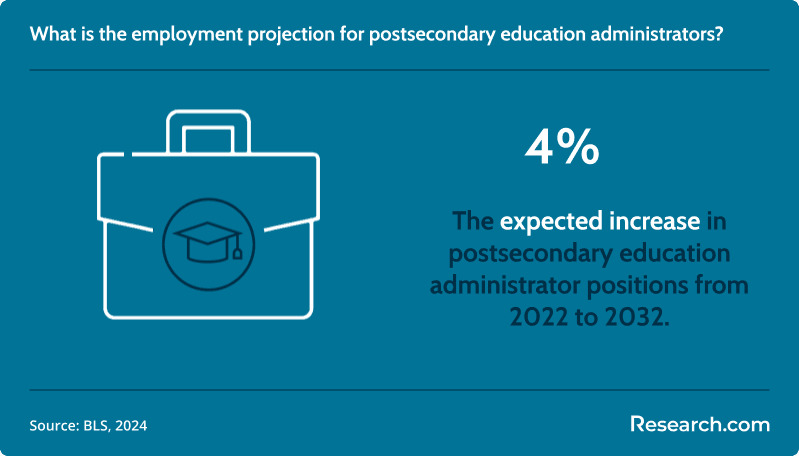
Employment for postsecondary education administrators is projected to grow by 4% from 2022 to 2032. On average, about 15,300 openings for postsecondary education administrators are projected each year during the decade.
Demand for postsecondary administrators is closely tied to college and university enrollment. When more students pursue higher education, institutions need professionals to manage admissions, registration, student services, housing, academic programs, compliance, and campus operations.
Not all leadership roles expand at the same pace. Positions such as provost and academic dean are limited because institutions typically have a fixed number of these senior roles. Applicants for top jobs should expect competition and should build a record of leadership, budgeting, supervision, policy knowledge, and measurable institutional improvement.
What are the emerging trends in online educational leadership?
Online educational leadership programs are being shaped by new expectations in digital learning, data use, equity, institutional accountability, and flexible adult education. Doctoral students increasingly need to understand how technology affects instruction, operations, student support, and policy decisions.
- Technology-enabled leadership: Leaders are expected to evaluate learning management systems, digital access, online student engagement, and instructional technology decisions.
- Data-informed improvement: Schools and colleges rely on data to evaluate student outcomes, budgets, retention, equity gaps, and program effectiveness.
- Flexible doctoral formats: Some programs are designed for experienced professionals seeking accelerated or streamlined study, similar to options discussed in accelerated teaching degree online programs.
- Equity-centered decision-making: Education leaders are expected to address barriers affecting access, belonging, achievement, and completion.
How can interdisciplinary insights enrich an online doctorate in educational leadership?
Educational leadership problems rarely fit neatly into one discipline. A district technology rollout, for example, may involve budgeting, teacher training, data privacy, curriculum design, family communication, and equity analysis. Doctoral students who draw from multiple fields can often design stronger research questions and more practical interventions.
Information management, library science, public policy, psychology, business, and organizational leadership can all add useful perspectives. Students interested in how information systems and learning resources support education may find related context in What jobs can you get with library science degree?.
How do faculty qualifications impact the online doctorate experience?
Faculty quality matters because doctoral study depends heavily on mentoring, research guidance, feedback, and methodological expertise. Before enrolling, review faculty profiles to see whether professors have advanced degrees, current research activity, leadership experience, and expertise in your area of interest.
Strong faculty support is especially important for online students because dissertation progress can slow without regular communication. Ask how often students meet with advisors, how dissertation committees are formed, and what support exists for research design and writing. If you are exploring broader academic options and communication-focused graduate study, you may also compare programs such as creative writing degrees online.
How an Online Doctorate in Educational Leadership Transforms Educational Systems
An online doctorate in educational leadership can prepare experienced professionals to improve schools, districts, colleges, and education organizations through evidence-based planning and ethical leadership. The degree is not just about earning a title; it is about learning how to diagnose institutional problems, design interventions, measure results, and lead people through change.
Strengthening school and district leadership
Doctoral graduates may use their training to improve curriculum systems, teacher development, student support structures, budgeting, and organizational culture. In K-12 settings, leaders can apply research to challenges such as achievement gaps, staff retention, school climate, instructional consistency, and community engagement.
Influencing education policy
Graduates may also work in policy roles where they analyze laws, funding structures, accountability systems, and institutional regulations. Research skills can help leaders evaluate whether policies are producing the intended outcomes and whether changes are needed.
Improving educational practice
Doctoral programs often connect theory to practice. Students examine real problems in educational settings and learn how to apply evidence-based strategies to curriculum, student services, leadership development, technology integration, and organizational change.
Advancing equity and access
Education leaders with doctoral preparation can help identify disparities in resources, outcomes, staffing, discipline, technology access, and student support. Their research and leadership training can support better decisions for underserved students and communities.
If you are comparing dedicated leadership pathways, a doctorate in educational leadership online can help you evaluate programs designed specifically for education systems and senior administrative work.
The Role of Equity and Diversity in Educational Leadership
Equity and diversity are central to modern education leadership because schools and colleges serve students with different backgrounds, resources, languages, abilities, and support needs. Effective leaders must understand how policies, budgets, staffing, curriculum, discipline, and institutional culture can either widen or reduce opportunity gaps.
Building inclusive learning environments
Leaders are responsible for creating environments where students and staff feel respected, supported, and able to participate fully. This may involve culturally responsive teaching, accessible services, inclusive hiring practices, targeted academic support, and stronger family or community engagement.
Reviewing policy through an equity lens
Doctoral study can help leaders analyze whether policies are fair in practice, not just in wording. This includes reviewing school funding, discipline practices, placement decisions, access to advanced coursework, student services, and staffing patterns.
Connecting research and advocacy
Graduates may conduct research, evaluate programs, publish findings, or work with organizations that advocate for systemic improvement. Professionals interested in broader social systems and advocacy may also compare related doctoral options such as online DSW programs.
Are fast-track programs in online educational leadership a viable option?
Fast-track online doctorate programs can be viable for experienced professionals who already have a strong academic foundation, clear research interests, and enough weekly time to handle compressed coursework. They are not the best fit for everyone. Shorter timelines can increase pressure, reduce recovery time between terms, and make dissertation planning more intense.
Students considering accelerated doctoral formats should ask whether the shorter schedule affects dissertation support, faculty access, cohort interaction, and work-life balance. To compare fast completion models, review options such as doctor of education online programs.
How can I maximize success in my online doctorate program?
Success in an online doctorate depends on consistency. Students who make steady progress each week usually have an easier path than those who wait for large blocks of free time. Build a plan before your first term and adjust it as coursework and research demands increase.
- Create a weekly doctoral schedule: Reserve specific blocks for reading, writing, discussion posts, research, and advisor communication.
- Choose a practical research topic: Select a problem that matters to your field and can realistically be studied with available data and access.
- Use faculty early: Ask for feedback before major assignments and research decisions become difficult to revise.
- Build a peer network: Stay active in cohort discussions, writing groups, and professional associations.
- Track dissertation milestones: Break the project into proposal, literature review, methods, data collection, analysis, writing, and defense tasks.
- Use academic tools: Take advantage of online libraries, writing centers, research databases, citation managers, and advising.
Students who want to strengthen research and information management skills may also find value in exploring an affordable library science degree online as a complementary academic direction.
What digital tools and support systems enhance the online doctoral experience?
Online doctoral students need more than recorded lectures. Strong programs provide digital systems that support research, writing, collaboration, advising, and academic planning.
- Learning management system: Centralizes assignments, discussion boards, grades, readings, and announcements.
- Video conferencing: Supports live classes, dissertation meetings, group projects, and advising sessions.
- Online library access: Gives students access to journals, books, databases, and research guides.
- Writing and research support: Helps students improve academic writing, citation practices, research design, and dissertation drafts.
- Collaboration tools: Supports group work, shared documents, peer review, and virtual research teams.
Students comparing online learning formats in other fields may also review how digital delivery works in a fast online degree creative writing pathway.
Why is accreditation important when choosing an online doctorate in educational leadership?
Accreditation is one of the most important checks when choosing an online doctorate in educational leadership. It indicates that an institution or program has been reviewed against recognized academic standards. Accreditation can affect employer recognition, transfer credit, financial aid eligibility, and, in some cases, licensure or certification pathways.
Students should confirm both institutional accreditation and any relevant programmatic accreditation. For educator preparation, organizations such as the Council for the Accreditation of Educator Preparation (CAEP) may be relevant. Regional accrediting bodies such as SACSCOC, HLC, and the WASC Senior College and University Commission also appear among the programs listed in this guide.
Before applying, ask the university whether the online doctorate meets requirements for your target role and state. Do not assume that a doctorate automatically leads to principal, superintendent, or administrator certification. For broader school research, the top accredited online universities can help you understand why recognized accreditation matters in online education.
Key Insights
- An online doctorate in educational leadership is best for experienced education professionals pursuing senior leadership, policy, research, or administrative roles.
- Affordable programs are not always the lowest-cost programs; total credits, fees, transfer policies, and dissertation timelines determine the real price.
- Most students should expect three to five years of study, while part-time students may need four to seven years or longer.
- Accreditation is essential. Verify institutional accreditation, programmatic recognition, and state licensure alignment before enrolling.
- Online study offers flexibility, but doctoral success still requires disciplined scheduling, active faculty communication, and steady research progress.
- The degree can support roles such as principal, superintendent, dean, curriculum director, policy analyst, and higher education administrator, but salary and advancement depend on experience, location, credentials, and employer needs.
- Students should choose a program based on career fit, faculty expertise, specialization, support services, and total cost—not rankings alone.
References:
- BLS. (2024). Occupational Employment and Wage Statistics: Education Administrators, Kindergarten through Secondary.
- BLS. (2024). Postsecondary education administrators.
Other Things You Should Know About Online Doctorates in Educational Leadership Programs
Most online doctorates in educational leadership require about 54 to 60 semester credits beyond a master’s degree. Dissertation or capstone work is usually included in that total, and many programs require completion within 3 to 5 years, plus a final oral defense or comprehensive assessment.
Admission requirements typically include a master's degree in education or a related field, a minimum GPA of 3.0, letters of recommendation, a statement of purpose, and sometimes relevant professional experience. Check specific program websites for detailed criteria in 2027.