2027 Best Online Doctorate in Educational Leadership: Guide to Online Programs

Co-Founder and Chief Data Scientist
An online doctorate in educational leadership is a major professional and financial decision. It can help experienced educators move into senior roles in K-12 administration, higher education leadership, policy, curriculum, student services, or organizational leadership, but it also requires years of study, disciplined research, and careful cost planning. This guide is designed for working educators, school administrators, instructional leaders, and higher education professionals who want to compare online doctoral options without relying only on rankings or marketing language.
You will learn what these programs usually include, how online and campus formats compare, what the listed programs cost, which careers may fit your goals, and how to evaluate accreditation, support services, specialization options, and return on investment before applying.
Quick answer: Is an online doctorate in educational leadership worth it?
An online doctorate in educational leadership can be worth it for professionals who already have education experience and want to qualify for senior leadership, policy, research, or administrative roles. It is less likely to be a strong fit if you are still exploring entry-level teaching careers, cannot commit to a dissertation or applied research project, or would need to borrow heavily without a clear career plan. The best choice is an accredited program that matches your target role, offers strong faculty and advising support, and has a tuition structure you can manage.
What are the benefits of earning a doctorate in educational leadership?
- It can support advancement into roles such as postsecondary education administrator, principal, district leader, academic dean, curriculum leader, or policy-focused education professional.
- Education administrators in kindergarten through secondary settings earn a mean annual wage of $106,690, while principals earn about $101,320 annually, showing why many experienced educators consider graduate leadership study.
- Online doctoral study can allow working professionals to continue in their current roles while completing advanced coursework, research, and leadership development.
- Because 76% of academic leaders view online degrees as equal to on-campus degrees, an accredited online doctorate from a recognized institution can carry professional value, especially when the institution also has a physical campus.
What should you expect from the best online doctorate in educational leadership?
The best online doctorate in educational leadership is built for experienced professionals who want to lead educational systems, not simply study education theory. Programs typically combine leadership coursework, policy analysis, organizational change, applied research, equity-focused practice, and a dissertation or capstone-style research project. Some programs focus heavily on K-12 administration, while others emphasize higher education, policy, organizational leadership, or interdisciplinary leadership.
Students should expect demanding reading, writing, research, group discussion, and applied projects tied to real education problems. Many online programs are designed for working professionals, but “online” does not mean easy. A strong program should provide structured milestones, faculty mentorship, library access, technical support, and clear expectations for the dissertation or applied research process.
| What to evaluate | Why it matters | Questions to ask before applying |
| Program focus | Educational leadership programs vary widely across K-12, higher education, policy, curriculum, and organizational leadership. | Does the curriculum match the role I want after graduation? |
| Accreditation | Accreditation affects credibility, financial aid eligibility, and in some cases licensure or employer recognition. | Is the institution accredited, and does the program hold relevant professional accreditation? |
| Research model | Doctoral students need to know whether the program emphasizes applied practice, original research, or policy analysis. | Is the final project a dissertation, capstone, improvement study, or another research requirement? |
| Online format | Asynchronous courses offer flexibility, while synchronous sessions may improve faculty and peer interaction. | Are live sessions required, and are there any campus visits or residencies? |
| Total cost | Per-credit tuition is only one part of doctoral cost; fees, books, travel, and time to completion also matter. | What is the full estimated cost from admission through graduation? |
Where can you work with an online doctorate in educational leadership?
Graduates commonly work in schools, school districts, colleges, universities, professional schools, education nonprofits, government agencies, and educational support services. Possible positions include principal, superintendent, district administrator, postsecondary education administrator, instructional coordinator, academic dean, chief academic officer, curriculum director, policy analyst, or organizational learning leader.
The employment picture depends on the role and location. Most people with an education degree work in educational instruction and library occupations, which account for 54% of employment in the field. Texas, California, and New York have the highest employment levels for education administrators at the kindergarten through secondary level, and New York is listed among the top-paying states. For postsecondary education administrators, Texas, Illinois, and Florida have high employment levels, while Vermont and the District of Columbia have the highest concentration of jobs.
How much can you make with an online doctorate in educational leadership?
Earnings vary by role, institution type, state, years of experience, and whether the position is in K-12, higher education, government, or another education-related organization. A doctorate can strengthen a candidate’s qualifications for leadership roles, but it does not guarantee a specific salary.
Education administrators in kindergarten through secondary settings earn a mean annual wage of $106,690. Postsecondary education administrators have an annual mean wage of $115,180, and postsecondary education administrators in New York earn an annual mean wage of $168,370. Other top-paying areas noted for postsecondary education administrators include Delaware, New Jersey, and the District of Columbia.
| Role or category | Reported wage figure | Best fit for |
| Education administrators, kindergarten through secondary | Mean annual wage of $106,690 | Experienced K-12 leaders pursuing school or district administration |
| Principals | About $101,320 annually | Educators seeking building-level leadership roles |
| Postsecondary education administrators | Annual mean wage of $115,180 | Professionals interested in college administration, student services, academic affairs, or institutional leadership |
| Postsecondary education administrators in New York | Annual mean wage of $168,370 | Candidates targeting higher-paying markets with strong competition and higher costs of living |
| Instructional coordinators | Mean annual wage of $73,080 | Professionals focused on curriculum, instruction, assessment, and teaching standards |
- 2027 best online doctorate in educational leadership programs
- How long does an online doctorate in educational leadership take?
- Online vs. on-campus doctorate in educational leadership
- Average cost of online doctorate in educational leadership programs
- Financial aid options for doctoral students
- Admission requirements for online educational leadership doctorates
- Common courses in educational leadership doctoral programs
- Educational leadership doctorate specializations
- How to choose the best online doctorate in educational leadership
- Career paths after an online doctorate in educational leadership
- Job market for educational leadership doctorate graduates
- Support systems that help online doctoral students succeed
- Digital tools and innovation in online doctoral programs
- Challenges of earning an online doctorate in educational leadership
- How library science can support educational leadership
- How certifications can complement an educational leadership doctorate
- How interdisciplinary collaboration improves doctoral research
- How broader academic skills can strengthen leadership practice
- EdD vs. PhD in Educational Leadership
- Affordable online doctorate options in educational leadership
- Policy advocacy training in educational leadership doctorates
- Emerging trends in educational leadership
- Employer perception of online educational leadership doctorates
- Final checklist for choosing the right program
2027 Best Online Doctorate in Educational Leadership Programs
The programs below provide online doctoral pathways for experienced educators and leaders who want to strengthen their qualifications for senior roles. When comparing options, look beyond tuition and completion time. Review accreditation, dissertation expectations, faculty expertise, program focus, and whether the curriculum supports your intended career path. If you are still deciding between a master’s and doctoral pathway, you may want to compare online graduate study in higher education before committing to a doctorate.
How do we rank schools?
Research.com rankings are developed through structured review and data analysis. To understand the full ranking process, see our methodology section. Sources used for this ranking include:
- the IPEDS database;
- Peterson’s database;
- the Distance Learning Licensed Data Set, College Scorecard database; and
- the National Center for Education Statistics.
1. Appalachian State University
The online Educational Leadership Ed.D. at Appalachian State University is designed for educators who want to lead improvement in K-12 schools and related educational settings. The program emphasizes leadership practice, educational innovation, research-informed decision-making, and change management. Its online format is intended for working professionals who need to continue meeting job and family responsibilities while completing doctoral study.
Program Length: three years
Tracks/Concentrations: Interdisciplinary Studies, Higher Education
Tuition: $319 per credit hour (NC residents)
Required Credits to Graduate: 60
Accreditation: Council for the Accreditation of Educator Preparation (CAEP)
2. Arkansas State University
The online Ed.D. in Educational Leadership at Arkansas State University serves current and future education leaders who want advanced preparation for leadership across K-12 and higher education environments. Coursework addresses leadership, policy, and strategic decision-making, with an online structure designed for professionals who need flexibility while developing skills for institutional improvement.
Program Length: three years
Tracks/Concentrations: N/A
Tuition: $456 per credit hour
Required Credits to Graduate: 60
Accreditation: Council for the Accreditation of Educator Preparation (CAEP)
3. Texas Tech University
Texas Tech University offers a fully online Doctor of Philosophy in Educational Leadership Policy for students interested in policy research, equity-focused leadership, and systemic educational improvement. The program is structured for learners who want to connect theory with policy practice and pursue leadership or research-oriented roles in education organizations, government agencies, or policy-focused institutions.
Program Length: three years
Tracks/Concentrations: Educational Leadership and Policy
Tuition: $313.00 per credit
Required Credits to Graduate: 63
Accreditation: Council for the Accreditation of Educator Preparation (CAEP)
4. Florida State University
The online Ed.D. in Educational Leadership and Policy at Florida State University is built for mid-career education professionals who want to study organizational systems, policy, practice improvement, and equity. The program is FSU's inaugural online doctoral program and is intended for applicants who already hold a master’s degree and relevant professional experience.
Program Length: Three to five years
Tracks/Concentrations: Educational Leadership/Administration
Tuition: $444.26 per credit
Required Credits to Graduate: 69
Accreditation: Southern Association of Colleges and Schools Commission on Colleges
5. Abilene Christian University
The online Doctor of Education in Organizational Leadership at Abilene Christian University is a faith-informed leadership doctorate for professionals in education, nonprofit, corporate, government, and related sectors. The program focuses on workplace culture, leadership identity, research, and organizational change, with online coursework and industry-specific concentrations for students who want leadership preparation beyond a traditional school-administration pathway.
Program Length: Three to five years
Tuition: $767 per credit
Required Credits to Graduate: 60
Accreditation: Southern Association of Colleges and Schools Commission on Colleges
What Students Commonly Value in Online Educational Leadership Doctorates
Students who choose online doctoral programs often value flexibility, access to faculty without relocating, and the ability to connect coursework to current work problems. The strongest programs help students turn professional experience into research questions, leadership projects, and evidence-based improvement plans.
- Flexibility: Online delivery can make doctoral study more realistic for full-time educators, administrators, and working parents.
- Practical application: Applied assignments and research projects can help students address issues in their own schools, districts, colleges, or organizations.
- Professional network: Cohorts and virtual communities can connect students with peers across regions, institution types, and leadership roles.
- Faculty guidance: Consistent dissertation or capstone advising is one of the most important supports for doctoral completion.
Key Findings for Prospective Doctoral Students
- 19% of people in education have an advanced degree, which shows that graduate education is common in the field, but a doctorate should still be pursued with a clear career purpose.
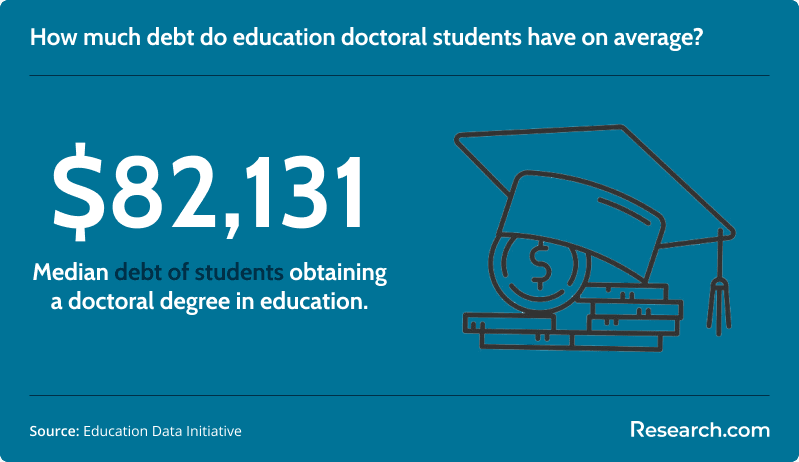
- Obtaining a Doctoral degree in Education comes with a median debt of $82,131, making cost comparison, employer assistance, and financial aid planning essential.
- 76% of academic leaders view online degrees as equal to on-campus degrees. For colleges with physical campuses, that perception rises to 89%.
- The U.S. Department of Education’s “Raise the Bar Policy Brief” emphasizes educator diversity and shortages in special education and STEM.
- Educational instruction and library occupations are projected to add approximately 857,600 new job openings each year from 2022 to 2032.
- Education administrators in kindergarten through secondary settings earn a mean annual wage of $106,690, while postsecondary education administrators earn $115,180 annually.
- Instructional coordinators represent another possible pathway, with employment expected to increase and a mean annual wage of $73,080.
How long does it take to complete the best online doctorate in educational leadership programs?
Most online doctorates in educational leadership take three to five years. Programs at Appalachian State University, Arkansas State University, and Texas Tech University are structured around a three-year timeline. Florida State University and Abilene Christian University list timelines that can extend from Three to five years.
The actual time to completion depends on course load, transfer policies, dissertation progress, research approvals, work schedule, and whether the program uses a cohort model. Students comparing online doctoral degree options should ask how long students typically take to finish, not only the fastest advertised timeline.
| Program pace | Best for | Trade-off |
| Three-year structure | Students with strong time management and a clear research interest | Faster completion may mean heavier workload each term |
| Three to five years | Working professionals who need more scheduling flexibility | Longer enrollment can increase total cost and delay career benefits |
| Part-time progression | Students balancing demanding leadership roles or family obligations | Maintaining momentum through the dissertation phase can be harder |
How does an online doctorate in educational leadership compare to an on-campus program?
Online programs are usually stronger for working professionals who need schedule flexibility, while on-campus programs may appeal to students who want regular in-person interaction, campus-based networking, or access to local research communities. For many education leaders, the practical value of an online program comes from applying coursework immediately in their current workplace.
Acceptance of online education has grown. According to Drexel University’s discussion of online and traditional degrees, 76% of academic leaders consider online degrees equivalent to on-campus degrees, with favorability increasing to 89% for institutions that also have a physical campus. Still, program reputation, accreditation, field placements, dissertation support, and employer expectations matter more than format alone.
If you want to compare doctoral education options more broadly, review Research.com’s guide to an online doctorate degree for teachers.
| Factor | Online doctorate | On-campus doctorate |
| Schedule | Often better for full-time educators and administrators | Usually requires more fixed class or campus time |
| Networking | Can include virtual cohorts, discussion boards, and online residencies | Offers more face-to-face contact with faculty and peers |
| Location | Allows students to study without relocating | May limit choices to nearby institutions unless relocation is possible |
| Learning style | Requires self-direction, writing discipline, and comfort with technology | May suit students who prefer in-person discussion and campus routines |
| Employer perception | Strongest when accredited and offered by a recognized institution | May be preferred in settings that value traditional doctoral pathways |
What is the average cost of the best online doctorate in educational leadership programs?
Costs vary significantly by institution, residency status, number of credits, fees, and time to completion. In the listed programs, tuition ranges from $313.00 per credit at Texas Tech University to $767 per credit at Abilene Christian University. Appalachian State University lists $319 per credit hour for NC residents, Arkansas State University lists $456 per credit hour, and Florida State University lists $444.26 per credit.
For context, College Tuition Compare reports 2024 average graduate tuition & fees for education degree types of $11,450 for in-state students and $20,595 for out-of-state students. The average salary post-completion of education programs is $53,519 at the master's level or higher. Because doctoral tuition can be substantial, students should calculate total program cost and expected career benefit before enrolling.
| School | Listed tuition | Credits required | What to verify |
| Appalachian State University | $319 per credit hour (NC residents) | 60 | Whether your residency status changes tuition |
| Arkansas State University | $456 per credit hour | 60 | Fees, books, and dissertation-related costs |
| Texas Tech University | $313.00 per credit | 63 | Whether tuition differs by student category |
| Florida State University | $444.26 per credit | 69 | Costs across a Three to five years completion window |
| Abilene Christian University | $767 per credit | 60 | Total tuition and available institutional aid |
What financial aid options are available for online doctoral students?
Financial aid can be central to the decision because the median debt of $82,131 for a doctoral degree in Education is a major obligation. Before applying, complete cost comparisons, ask about aid for online doctoral students, and confirm whether employer benefits can be used for the program.
- Federal grants: Need-based aid that does not require repayment when eligibility rules are met through the FAFSA.
- Scholarships: Institutional, private, professional association, or philanthropic awards based on merit, need, service, leadership, or research interest.
- Federal student loans: Graduate students may use options such as Direct Unsubsidized Loans and Direct PLUS Loans.
- Work-study programs: Federally funded work opportunities can help offset costs, although only 18% earn income through work-study.
- Employer tuition reimbursement: School districts, colleges, universities, and education organizations may support graduate education tied to an employee’s role.
What are the prerequisites for enrolling in the best online doctorate in educational leadership programs?
Admission requirements differ by school, but online doctorates in educational leadership usually expect applicants to show graduate-level academic readiness, relevant professional experience, and a clear purpose for doctoral study.
- Master’s degree: Most programs require a master’s degree from an accredited institution, often in education or a related field.
- Professional experience: Applicants are typically expected to have several years of work experience in education, leadership, administration, or a related organizational setting.
- Academic record: Programs commonly review transcripts and may expect a minimum GPA near 3.0 or higher on a 4.0 scale.
- Recommendation letters: Schools often request references who can speak to leadership potential, professional performance, and readiness for doctoral research.
- Statement of purpose: Applicants usually explain their career goals, research interests, and reasons for pursuing a doctorate degree in leadership and management.
- Writing sample or research proposal: Some programs assess writing ability and research preparation through an academic paper, professional writing sample, or preliminary research concept.
What courses are typically part of the best online doctorate in educational leadership programs?
Educational leadership doctoral curricula usually combine leadership theory, policy, research methods, organizational improvement, ethics, and equity. Programs often use a learning management system to deliver readings, discussions, assignments, advising communication, and collaborative projects.
- Leadership in educational organizations: Examines leadership models, decision-making, culture, and organizational behavior in schools and education systems.
- Policy analysis in education: Teaches students to evaluate, interpret, and develop policy at local, state, and national levels.
- Organizational change and improvement: Focuses on leading institutional change, managing resistance, and using evidence to improve outcomes.
- Research methods in education: Builds skills in research design, data collection, analysis, and scholarly writing for dissertation or capstone work.
- Ethics and legal issues in education: Covers the legal and ethical responsibilities of education leaders.
- Diversity and equity in education: Prepares leaders to address access, inclusion, representation, and student support across educational environments.
What types of specializations are available in online doctorate in educational leadership programs?
Specializations help align doctoral study with a student’s leadership goals. A general doctorate in educational leadership may prepare students for broad leadership roles, while a focused concentration can provide stronger preparation for a specific setting or function.
| Specialization | Focus | Best suited for |
| Curriculum and Instruction | Curriculum design, assessment, instructional improvement, and education technology | Instructional leaders, curriculum directors, and teacher leaders |
| Higher Education Leadership | College governance, student affairs, academic administration, and institutional policy | Professionals seeking leadership roles in colleges and universities |
| K-12 School Leadership | School administration, district leadership, principal preparation, and improvement planning | Aspiring principals, superintendents, and district administrators |
| Special Education Leadership | Program leadership, advocacy, compliance, and services for students with disabilities | Leaders in special education departments, districts, or agencies |
| Educational Policy and Reform | Policy analysis, systems change, advocacy, and education reform | Professionals interested in policy, government, nonprofits, or systems leadership |
| Instructional Technology | Digital learning, educational software, technology integration, and online instruction | Leaders responsible for learning innovation or digital education strategy |
How to Choose the Best Online Doctorate in Educational Leadership Program
Choosing a doctoral program should begin with your target role, not the school’s marketing language. Postsecondary education administrator roles are projected to grow by 4% from 2022 to 2032, and the education field employs over 5 million individuals, but career outcomes still depend on your experience, location, network, and the program’s fit.
- Define your goal first. Decide whether you want K-12 leadership, higher education administration, policy work, curriculum leadership, organizational leadership, or research-oriented roles.
- Check accreditation carefully. Confirm institutional accreditation and any relevant programmatic accreditation before applying.
- Compare total cost, not only tuition. Include fees, books, technology costs, travel, residencies, and the cost of extending beyond the planned timeline.
- Review dissertation support. Ask how students are matched with advisors, how research milestones are structured, and what happens if a student falls behind.
- Study the curriculum. Make sure the course sequence includes the leadership, policy, research, and specialization content you need.
- Ask about flexibility. Determine whether courses are asynchronous, synchronous, cohort-based, part-time, or accelerated.
- Evaluate faculty expertise. Faculty research and professional experience should align with your interests.
- Look at student support. Online doctoral students need writing support, library services, technology help, advising, and peer connection.
If you are not yet ready for doctoral study, online master’s programs in education may offer a more appropriate next step.
What career paths are available for graduates of the best online doctorate in educational leadership programs?
A doctorate in educational leadership can support career movement into senior administrative, academic, curriculum, policy, and executive roles. These positions often require leadership experience in addition to credentials. Some graduates may also use the degree to strengthen consulting, nonprofit, research, or organizational development work.
- Chief Academic Officers: CAOs oversee academic strategy, curriculum, faculty standards, and program quality. Exact salary information for CAOs is not available, but top executives, including CAOs, typically earn a median annual wage of $98,980, with top earners making over $208,000.
- School Superintendents: Superintendents manage school district operations, budgets, curriculum standards, and performance priorities. Based on BLS data, the median annual wage for top executives, including superintendents, is $98,980. The highest earners can make over $208,000.
- Postsecondary Education Administrators: These leaders manage academic programs, student services, faculty affairs, admissions, or institutional operations. The median annual wage for these roles was approximately $99,940.
- Principals: Elementary, middle, and high school principals manage school operations, staff, students, planning, and improvement initiatives. Principals earned a median annual wage of about $101,320.
- Instructional Coordinators: These professionals develop curriculum, evaluate teaching materials, support instructional standards, and help improve learning outcomes. They earn a median annual wage of $66,490.
Students who want applied practice should look for programs that use field-based work, leadership cases, action research, or models such as the flipped classroom model to connect theory with real educational challenges.
What is the job market for graduates with an online doctorate in educational leadership?
The job market is strongest for graduates who pair the doctorate with relevant experience, leadership accomplishments, and a clear specialization. Educational leadership roles are influenced by school funding, institutional budgets, enrollment patterns, regional demand, and policy priorities. A doctorate can improve competitiveness, but employers usually look for demonstrated results in addition to academic credentials.
The Economic Policy Institute has highlighted how the pandemic exacerbated a long-standing national teacher shortage, especially in areas such as special education, STEM, CTE, and bilingual education. The U.S. Department of Education’s policy agenda around recruiting, preparing, retaining, and supporting a diverse educator workforce also points to continued need for capable education leaders. For broader context on delivery models and student demand, review the latest statistics about online education.
What support systems enhance success in an online doctorate program in educational leadership?
Online doctoral students need more than course access. Strong support systems can make the difference between steady progress and stalled dissertation work. Look for clear advising structures, accessible faculty, online library databases, research help, writing support, technology assistance, peer communities, and career services for leadership roles.
Programs similar in structure to a doctorate in organizational leadership can be useful comparisons because they also serve working professionals who need leadership training, applied research support, and flexible delivery.
How are digital tools and innovative practices integrated in online doctorate programs in educational leadership?
Online educational leadership doctorates use digital platforms for coursework, collaboration, research supervision, discussion, and sometimes simulations or applied projects. Students may also study educational technology, data-informed leadership, digital resource management, and online learning strategy.
Because many education leaders now oversee hybrid, online, or technology-supported instruction, comfort with digital tools is increasingly important. Students earlier in their education pathway can also explore bachelors in education online to understand how digital learning begins at the undergraduate level.
Challenges of Pursuing an Online Doctorate in Educational Leadership
An online doctorate can be flexible, but it still requires sustained discipline over several years. Before enrolling, consider whether the common challenges below are manageable for your schedule, support system, and career goals.
- Time pressure: Doctoral coursework, research, and writing can be difficult to balance with full-time educational leadership work.
- Limited in-person interaction: Online students may need to be intentional about building faculty relationships and professional networks.
- Technology requirements: Reliable internet, comfort with digital collaboration tools, and access to research platforms are essential.
- Employer skepticism in some settings: Although online degrees are widely accepted, credibility depends heavily on accreditation, institution reputation, and program quality.
- Dissertation persistence: Many students find the research phase more difficult than coursework because it requires independent planning and long-term motivation.
How can interdisciplinary insights from library science enhance educational leadership?
Library science can strengthen educational leadership by improving how leaders manage information systems, evaluate research, curate digital resources, and support institutional knowledge. This connection is especially relevant for administrators who oversee academic libraries, learning resources, digital archives, or research support services. Professionals interested in this intersection can explore the cheapest library science degree online as a complementary pathway.
How can additional certifications enhance your online doctorate in educational leadership?
Certifications can add targeted expertise to a doctorate, especially when a role requires licensure, teaching credentials, school administration authorization, technology training, or specialized instructional knowledge. Requirements vary by state, employer, and role, so students should never assume a doctorate alone meets certification or licensure requirements.
If you need to add or renew classroom credentials, Research.com’s guide to the fastest way to become a certified teacher can help you compare accelerated certification options.
How does interdisciplinary collaboration enhance research outcomes in online educational leadership programs?
Educational problems rarely fit within one discipline. Doctoral research can be stronger when students draw from policy, psychology, sociology, data analysis, organizational behavior, library science, instructional design, and communication. For example, a leader studying information access, academic resources, or research support may benefit from understanding the library science career outlook and its connection to institutional learning systems.
How can broader academic skills strengthen an online doctorate in educational leadership?
Educational leaders need to communicate clearly with boards, faculty, students, families, policymakers, and community partners. Skills in storytelling, argument structure, and audience awareness can improve strategic communication, grant writing, policy briefs, and change-management messaging. Some professionals build these skills through related study, including online creative writing degrees, when communication is central to their leadership work.
What distinguishes an EdD from a PhD in Educational Leadership?
An EdD generally focuses on applying research to solve problems in schools, colleges, districts, and organizations. It is often the better fit for practitioners who want senior administrative or applied leadership roles. A PhD usually emphasizes original research, theory development, and scholarly contribution, making it more appropriate for students who want research, faculty, or policy-scholar pathways.
| Degree type | Primary emphasis | Common fit |
| EdD in Educational Leadership | Applied leadership, organizational improvement, policy implementation, and practice-based research | Principals, superintendents, higher education administrators, district leaders, and organizational leaders |
| PhD in Educational Leadership | Original research, theory, policy analysis, and scholarly publication | Researchers, faculty candidates, policy scholars, and research-focused leaders |
Professionals who want to improve communication and narrative skill alongside leadership preparation may also consider related resources such as the fastest degree in creative writing online, though this should be viewed as a complementary skill-building option rather than a substitute for leadership preparation.
What are the most affordable options for an online doctorate in educational leadership?
The most affordable option is not always the lowest advertised tuition. A program with lower per-credit tuition may still cost more if it requires more credits, charges substantial fees, or takes longer to complete. Compare full program cost, transfer credit policies, financial aid, employer reimbursement, and the risk of extending dissertation enrollment.
Research.com’s guide to the cheapest online EdD programs can help students identify lower-cost doctoral pathways. A cost-effective program can improve return on investment, but it should still meet accreditation, academic quality, and career-fit standards.
How do educational leadership doctorates train graduates for policy advocacy?
Educational leadership doctorates often prepare students for policy advocacy through coursework in policy analysis, law, ethics, equity, research methods, organizational leadership, and systems change. Students learn to interpret education policy, evaluate its effects, communicate evidence, and advocate for reforms tied to access, outcomes, funding, or institutional improvement.
A focused doctorate in educational leadership online can be especially useful for working professionals who want to study policy while remaining active in schools, districts, colleges, or education organizations. Some programs may also include internships, field projects, residencies, or policy-focused applied research.
What are the emerging trends in educational leadership?
Educational leadership is changing as schools and colleges respond to technology, workforce shortages, equity goals, student well-being, and accountability pressures. Doctoral students should choose programs that address current leadership conditions rather than relying only on traditional administration models.
- Technology integration: Leaders increasingly manage digital learning platforms, data systems, remote learning tools, and personalized learning strategies.
- Equity and inclusion: Educational leaders are expected to address disparities in access, outcomes, representation, and support.
- Data-driven decision-making: Leaders use data to evaluate curriculum, student services, performance trends, and institutional strategy.
- Social-emotional learning: Schools are placing more attention on student well-being, school climate, and support for teachers and learners.
- Sustainable leadership: Some institutions are adopting environmental practices and adding sustainability topics to curriculum and operations.
- Adaptive leadership: The pandemic emphasized the need for leaders who can manage uncertainty, communicate clearly, and adjust quickly.
If you want to build a foundation before doctoral study, consider reviewing online master's in education programs.
How do employers perceive an online doctorate in educational leadership?
Employers are more likely to respect an online doctorate when it comes from an accredited institution, includes rigorous research expectations, and aligns with the candidate’s leadership record. The credential matters, but hiring decisions also depend on demonstrated outcomes, references, professional experience, communication skill, and fit for the institution’s needs.
Some professionals seek accelerated pathways such as an Ed.D online to balance career advancement with work responsibilities. Speed should not be the only priority. A fast program still needs strong advising, academic credibility, and a research process that prepares graduates for real leadership challenges.
Final Checklist for Choosing the Right Online Doctorate in Educational Leadership Program
Use this checklist before applying or accepting admission. It can help you avoid common mistakes such as choosing based only on rankings, ignoring accreditation, underestimating total cost, or assuming every online program meets licensure expectations.
| Decision point | What to confirm | Common mistake to avoid |
| Accreditation | Institutional accreditation and any relevant professional accreditation | Assuming all online universities have equal recognition |
| Licensure or certification | Whether the program meets requirements in your state or target role | Assuming a doctorate automatically qualifies you for principal or superintendent licensure |
| Total cost | Tuition, fees, books, technology, travel, and dissertation continuation costs | Comparing only per-credit tuition |
| Research support | Advisor availability, dissertation milestones, writing resources, and research tools | Choosing a program without understanding the dissertation process |
| Career alignment | Curriculum, specialization, faculty expertise, and alumni pathways | Selecting a general leadership program when you need a specialized pathway |
| Flexibility | Course format, synchronous requirements, cohort structure, and residency expectations | Assuming online means fully self-paced |
| Institution quality | Reputation, student support, outcomes, and recognition | Relying only on advertising claims or rankings |
Accreditation should be one of your first filters. Research.com’s guide to the most accredited online university options can help you understand why institutional recognition matters. After that, compare curriculum, faculty, support services, cost, and career fit before making a final decision.
Key Insights
- An online doctorate in educational leadership is best for experienced educators and administrators who already know the leadership, policy, research, or institutional role they want to pursue.
- Program format matters, but accreditation, dissertation support, faculty expertise, and career alignment matter more than whether the degree is online or on campus.
- Costs can be substantial. With a median debt of $82,131 for a doctoral degree in Education, students should compare total cost, aid, employer reimbursement, and likely career benefit before enrolling.
- Online study offers flexibility, but doctoral work still requires disciplined writing, research persistence, and strong time management.
- EdD programs usually fit applied leadership goals, while PhD programs are generally better for research-intensive or academic careers.
- Do not assume a doctorate automatically satisfies licensure or certification requirements. Always check state, district, institutional, or employer rules before applying.
References:
- CollegeTuitionCompare. (2024). Education Program 2024 Tuition. College Tuition Compare.
- Education Administrators, Kindergarten through Secondary. (2023, April 25). Bls.gov.
- Education Administrators, Postsecondary. (2023, April 25). Bls.gov.
- Education pays, 2022; Career Outlook: U.S. Bureau of Labor Statistics. (2023, May 5). Bls.gov.
- Educational Instruction and Library Occupations: Occupational Outlook Handbook: U.S. Bureau of Labor Statistics. (2023, September 6). Bls.gov.
- Elementary, Middle, and High School Principals: Occupational Outlook Handbook: : U.S. Bureau of Labor Statistics. (2023, September 6). Bls.gov.
- Field of degree: Education: Occupational Outlook Handbook: U.S. Bureau of Labor Statistics. (2023, September 6). Bls.gov.
- Hanson, M. (2022, February 15). Financial Aid Statistics [2023]: Average aid per student. Education Data Initiative.
- Hanson, M. (2023j, September 25). College Graduation Statistics [2023]: Total graduates per year. Education Data Initiative.
- Instructional Coordinators: Occupational Outlook Handbook: U.S. Bureau of Labor Statistics. (2023, September 6). Bls.gov.
- Instructional Coordinators. (2023, April 25). Bls.gov.
- Postsecondary Education Administrators: Occupational Outlook Handbook: U.S. Bureau of Labor Statistics. (2023, September 6). Bls.gov.
- Raise the Bar Policy Brief: | U.S. Department of Education. (2023). Ed.gov.
- The pandemic has exacerbated a long-standing national shortage of teachers. (2022). Economic Policy Institute.
- Top Executives: Occupational Outlook Handbook: U.S. Bureau of Labor Statistics. (2023, September 6). Bls.gov.
Other Things You Should Know About the Best Online Doctorate in Educational Leadership Programs
Prospective students should prioritize programs accredited by recognized bodies like the Council for the Accreditation of Educator Preparation (CAEP) or regional accrediting agencies. Accreditation ensures the program meets quality standards, enhancing credibility and ensuring eligibility for financial aid. This can impact career advancement and recognition in the field.
Many online EdD programs do not require the GRE, but some still ask for test scores, especially for applicants with a lower GPA. When required, schools usually list acceptable exams, minimum score rules, and waiver conditions in the admissions section for 2027.