2027 What Can You Do With a Master’s in Elementary Education?

Co-Founder and Chief Data Scientist
A master’s in elementary education can help teachers deepen their classroom practice, qualify for specialized roles, move into leadership, or meet state and district requirements for advancement. The degree is most useful when it connects directly to a clear goal: becoming a stronger elementary teacher, earning an endorsement, moving into literacy or curriculum work, preparing for administration, or changing careers into teaching.
This guide explains what you can do with a master’s in elementary education, how long programs take, what salaries and job outlook data suggest, which specializations may fit your plans, and how to compare online programs without relying only on tuition or rankings. It is designed for licensed teachers, aspiring educators, and career changers who want a practical way to evaluate whether the degree is worth the time and cost.
Quick answer: What should you know before earning a master’s in elementary education?
- A master’s in elementary education can strengthen teaching skills, support advancement into specialist or leadership positions, and may improve salary placement in some districts.
- Programs are available online, on campus, and in hybrid formats, which allows working teachers to compare options based on schedule, licensure needs, fieldwork requirements, and cost.
- The average annual salary for those with a master’s degree in elementary education is $57,000.
- What jobs can I get with a master’s in elementary education?
- Is a master’s in elementary education worth it for career advancement?
- How much can I earn with a master’s degree in elementary education?
- How does a master’s in elementary education increase my earning potential?
- What specializations can I choose for a master’s in elementary education program?
- How long does it take to complete a master’s in elementary education?
- What certifications can I pursue after completing a master’s in elementary education?
- What factors should be considered when choosing an online master’s in elementary education program?
- Is pursuing an EdD a smart next step beyond a master’s in elementary education?
- What are the advantages of an online master’s in elementary education?
- How can I assess the academic quality and long-term ROI of my program?
- How can integrating creative writing enrich elementary education?
- What are the admission requirements for a master’s in elementary education?
- How does a master’s in elementary education compare to other advanced degrees?
- How fast can I accelerate my journey in elementary education?
- How can a strong background in English enhance elementary education outcomes?
- Can interdisciplinary studies boost my impact in elementary education?
- Can speech-language pathology strategies enhance elementary education?
- What financial aid options are available for elementary education graduate students?
- What is the job outlook for elementary education teachers?
- What emerging trends are shaping the future of elementary education?
- Key insights for choosing a master’s in elementary education
What jobs can I get with a master’s in elementary education?
A master’s in elementary education most often supports careers in K–6 teaching, literacy support, curriculum development, instructional coaching, special education, STEM instruction, and school leadership. The best option depends on whether you want to stay in the classroom, specialize in a student population or subject area, or move toward administrative responsibilities.
| Career path | Typical focus | When this path makes sense |
| Elementary school teacher | Planning lessons, managing the classroom, assessing student progress, and teaching core subjects. | Choose this route if you want to improve classroom effectiveness or qualify for higher salary lanes in districts that reward graduate education. |
| Reading or literacy specialist | Supporting reading fluency, comprehension, writing development, and intervention programs. | This fits teachers who want to work with struggling readers, coach colleagues, or lead schoolwide literacy efforts. |
| Instructional coordinator | Developing curriculum, reviewing student data, recommending materials, and training teachers. | Consider this path if you enjoy systems-level improvement more than daily classroom instruction. |
| Special education teacher | Adapting instruction, supporting accessibility, and helping implement individualized education programs (IEPs). | This option is best for educators who want to support students with disabilities, learning differences, or behavioral needs. |
| Principal or assistant principal | Managing school operations, supervising staff, working with families, and leading academic improvement. | This route usually requires leadership preparation and may require additional state administrative certification. |
| STEM education specialist | Improving elementary science, technology, engineering, and math instruction. | This specialization is useful for teachers who want to lead project-based learning, technology integration, or STEM curriculum initiatives. |
Elementary school teacher
For classroom teachers, the degree can provide deeper training in child development, assessment, differentiated instruction, classroom management, and subject-area pedagogy. If you are comparing entry routes into teaching, a guide on what is the easiest teaching degree to get can help you understand how elementary education compares with other licensure pathways.
Reading or literacy specialist
Literacy specialists work with students who need extra support in reading, writing, vocabulary, and comprehension. They may deliver small-group interventions, help teachers select evidence-based strategies, and review data to determine whether students are making progress. Teachers looking for graduate options that fit a demanding schedule may also compare the easiest master’s program for teachers with more specialized literacy-focused degrees.
Instructional coordinator
Instructional coordinators connect classroom practice with curriculum goals. Their work may include reviewing assessment results, selecting instructional materials, designing professional development, and helping teachers apply new standards or teaching methods. Educators interested in curriculum technology may also explore whether the easiest computer science degree is relevant to instructional technology, digital learning, or education data roles.
Special education teacher
Elementary educators who focus on special education learn to adjust lessons, create inclusive environments, collaborate with families and specialists, and use assistive tools when appropriate. If your goal is a broader education pathway rather than a specialized licensure route, reviewing the easiest education degree may help you compare general and specialized program demands.
School principal or assistant principal
A master’s degree can be one step toward school administration, but it is not always sufficient by itself. Many states and districts require a separate principal, school administrator, or educational leadership credential. If leadership is your goal, check whether the program includes supervised administrative fieldwork and aligns with your state’s requirements.
STEM education specialist
Elementary STEM specialists help teachers make science, technology, engineering, and math more hands-on and developmentally appropriate for young learners. This path may involve lesson design, technology integration, teacher coaching, and curriculum planning rather than a traditional single-classroom assignment.
Is a master’s in elementary education worth it for career advancement?
A master’s in elementary education can be worth it when the program clearly supports a professional outcome: a higher salary lane, a required endorsement, a specialist role, stronger instructional practice, or a path toward leadership. It is less likely to pay off if you choose an expensive program without checking district salary schedules, state licensure rules, transfer policies, or total borrowing costs.
The degree may be especially valuable for licensed teachers who want to move into literacy, special education, instructional coaching, curriculum work, or administration. Some districts recognize graduate degrees through salary steps or stipends, while others place more emphasis on experience, credentials, or hard-to-staff assignments. Teachers who want a faster path can compare traditional timelines with one-year master’s programs, but accelerated options require careful review of workload and field experience expectations.
| The degree may be worth it if... | You should be cautious if... |
| Your district salary schedule rewards a completed master’s degree. | You are relying on salary gains without confirming your local pay policy. |
| You need advanced preparation for reading, ESL, special education, STEM, or curriculum roles. | The program does not lead to the endorsement or certification you actually need. |
| You want to remain in education long enough to benefit from the credential. | You are unsure whether you want to stay in teaching or school-based work. |
| The school is properly accredited and offers strong advising for licensure. | The program is inexpensive but lacks clear student support, field placement guidance, or licensure alignment. |
How much can I earn with a master’s degree in elementary education?
Salary outcomes vary by state, district, school type, years of experience, union contract, and role. A master’s degree may improve earning potential, but it does not guarantee a specific salary. The available salary figures show that classroom teaching, special education, curriculum work, and school leadership can have different pay ranges.
For example, a kindergarten and elementary school teacher earns an average of $63,670, while an elementary, middle, and high school principal earns a higher average salary of $103,460. A special education teacher earns an average of $65,910, and instructional coordinators earn an average salary of $74,620 per year.
| Role | Average annual salary stated | What to consider |
| Kindergarten and elementary school teacher | $63,670 | Pay often depends heavily on district salary schedules and years of service. |
| Special education teacher | $65,910 | Additional certification may be required, and demand can differ by region. |
| Instructional coordinator | $74,620 | These roles may require curriculum experience, data skills, or coaching background. |
| Elementary, middle, and high school principal | $103,460 | Administrative licensure and leadership experience are commonly required. |
How does a master’s in elementary education increase my earning potential?
A master’s degree can affect earnings in several ways. In some public school systems, it moves teachers into a higher salary lane. In other settings, it helps educators qualify for roles such as lead teacher, curriculum specialist, instructional coach, reading specialist, or administrator. Outside traditional public schools, it may strengthen a candidate’s profile for private school leadership, tutoring, consulting, instructional design, or training roles.
Some districts provide annual pay increases of $2,000 to $10,000 or more for teachers with advanced degrees, but this varies by contract and location. Before enrolling, ask your district human resources office how graduate credits are counted, whether the degree must be in an approved field, and whether online coursework is treated the same as campus-based coursework.
-
: "
Practical check: Do not estimate ROI using national averages alone. Compare the total program cost against your actual district salary schedule, expected time in the profession, and any tuition reimbursement available through your employer.
"
What specializations can I choose for a master’s in elementary education program?
Specializations matter because they shape your coursework, field experiences, certification options, and future job opportunities. Choose a concentration based on the students you want to serve and the role you want after graduation, not only on what sounds interesting.
| Specialization | What it emphasizes | Best fit for |
| Special education | Inclusive teaching, accommodations, behavior supports, assessment, and individualized instruction. | Teachers who want to support students with disabilities or learning differences. It can complement study in areas such as a masters degree in child development. |
| STEM education | Elementary science, technology, engineering, math, inquiry learning, and problem-solving. | Educators who want to strengthen STEM instruction or lead schoolwide STEM initiatives. |
| Educational leadership | School management, supervision, school improvement, policy, and decision-making. | Teachers preparing for administrative or district-level responsibilities. |
| Literacy and reading specialist | Reading development, writing instruction, intervention, comprehension, and literacy assessment. | Teachers who want to become reading interventionists, literacy coaches, or school literacy leads. |
| Early childhood education | Developmentally appropriate instruction for younger children, typically pre-K to grade 3. | Educators focused on early learning, early literacy, and foundational classroom skills. |
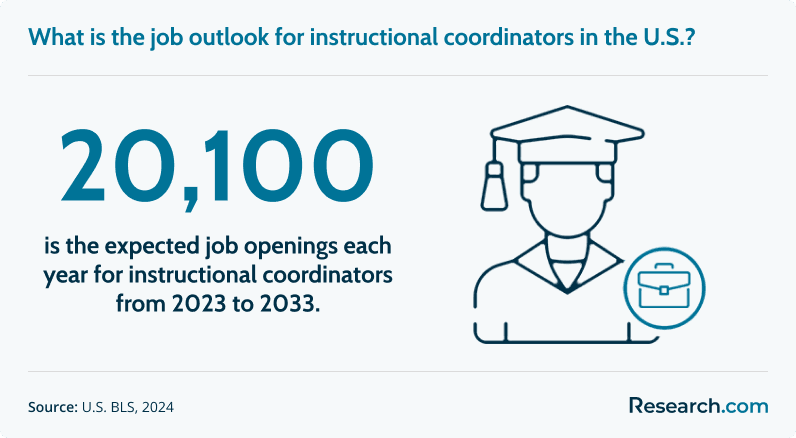
| Curriculum and instruction | Lesson design, assessment, instructional improvement, teacher coaching, and standards alignment. | Teachers interested in instructional coaching or curriculum roles. The employment of instructional coordinators is expected to grow by two percent over the next decade, with about 20,100 job openings each year, on average until 2033. |
| ESL/bilingual education | Language acquisition, culturally responsive teaching, multilingual learners, and bilingual instruction. | Teachers serving English language learners or multilingual classrooms. A related English degree can also strengthen language arts preparation. |
How long does it take to complete a master’s in elementary education?
Most students finish a master’s in elementary education in 1 to 2 years if enrolled full time. Part-time students commonly take 2 to 4 years, especially if they are teaching while enrolled. Programs that combine a master’s degree with an initial teaching credential may take longer because they must include state-required coursework and supervised field experiences.
| Program format | Typical completion time stated | Important trade-off |
| Full-time program | 1 to 2 years | Faster completion, but less flexibility for full-time teachers. |
| Part-time program | 2 to 4 years | Better for working professionals, but delays the credential and any salary benefit. |
| Accelerated program | 12 to 18 months | Shorter timeline, but heavier workload. Compare options for accelerated degree programs for working adults carefully. |
| Online program | 1 to 4 years | Flexible pacing, but students must confirm fieldwork, licensure, and state authorization rules. |
| Combined credential program | 2 to 3 years | Useful for career changers, but requirements depend on state rules and prior coursework. |
What certifications can I pursue after completing a master’s in elementary education?
Certification options depend on state policy, your prior license, and your graduate program’s design. A master’s degree alone does not automatically grant every endorsement. Always verify with your state education agency before enrolling.
- National Board Certification: Offered by the National Board for Professional Teaching Standards (NBPTS), this voluntary credential recognizes accomplished teaching practice.
- Reading specialist certification: Supports work as a reading interventionist, literacy coach, or school literacy leader.
- ESL certification: Prepares teachers to support English language learners through language development and culturally responsive instruction.
- Special education certification: Qualifies teachers, where approved by the state, to serve students with learning, emotional, physical, or developmental needs.
- Curriculum and instruction certification: Helps educators move into curriculum design, instructional coaching, or teacher support roles.
- Educational leadership certification: Often required for principal, assistant principal, or other school administration positions.
- STEM certification: Strengthens preparation for elementary STEM teaching, coaching, or curriculum leadership.
- Early childhood education certification: Focuses on teaching younger children, typically pre-K to grade 3.
Salary also differs by work setting. As of 2023, the median annual wage for kindergarten and elementary school teachers in the top industries is $63,670. Teachers working in local elementary and secondary schools earn an average of $63,680, while those working in private schools earn about $50,840. Professionals working in child daycare services earn an average of $40,120.
What factors should be considered when choosing an online master’s in elementary education program?
When comparing online programs, start with accreditation, licensure alignment, field experience support, faculty expertise, cost, and flexibility. A convenient program is not a good investment if it fails to meet your state’s credential requirements or your district’s salary-lane rules.
| Factor | What to ask before enrolling |
| Accreditation | Is the institution accredited, and does the program meet professional standards expected by your state or employer? |
| Licensure alignment | Does the program lead to initial licensure, an added endorsement, or professional development only? |
| Fieldwork | Can you complete practicum, student teaching, or administrative hours in your local area? |
| Faculty and curriculum | Do instructors have relevant school experience, and does coursework reflect current elementary education practice? |
| Cost | What is the full price after tuition, fees, books, technology charges, and travel for required residencies? |
| Student support | Are advising, placement help, licensure guidance, library access, and technical support available to online students? |
If affordability is a major factor, compare total cost rather than tuition alone. Resources on the cheapest online teaching degree can help you identify lower-cost options, but you should still verify accreditation and state approval.
Is pursuing an EdD a smart next step beyond a master’s in elementary education?
An EdD may be a logical next step if your goal is district leadership, policy work, superintendent-level preparation, college teaching, or large-scale school improvement. It is usually not necessary for teachers who want to remain in classroom instruction, literacy intervention, or most school-based specialist roles.
Doctoral programs typically focus on applied research, organizational leadership, education systems, and problem-solving at the school or district level. Before committing, compare program length, dissertation or capstone requirements, residency expectations, tuition, and how the credential connects to the jobs you want. Educators considering a faster doctoral route can review EdD programs online to understand how accelerated formats differ from standard doctoral pathways.
What are the advantages of an online master’s in elementary education?
An online master’s in elementary education can be a strong fit for working teachers because it allows them to continue teaching while completing graduate coursework. It may also make more programs available to students who cannot relocate. However, online study works best for students who can manage deadlines independently and confirm all in-person requirements in advance.
- Scheduling flexibility: Many online courses are asynchronous, which helps teachers complete assignments around school and family responsibilities.
- Lower indirect costs: Online students may reduce commuting, relocation, housing, and campus-related expenses.
- Wider school choice: Students can compare programs outside their local area, including an online masters in early childhood education if their interest is younger learners.
- Specialization options: Online programs may offer tracks in literacy, special education, curriculum, STEM, ESL, or leadership.
- Career continuity: Teachers can keep earning income while completing the degree and applying new strategies in their classrooms.
- Broader peer network: Online cohorts often include educators from different districts, states, and school types.
| Online format is a good fit if... | Campus or hybrid may be better if... |
| You need to keep teaching full time while studying. | You prefer face-to-face discussion and structured weekly meetings. |
| You live far from a university with the specialization you need. | You need extensive local field placement support from campus partners. |
| You are comfortable with learning platforms, video meetings, and independent pacing. | You struggle to stay organized without in-person accountability. |
How can I assess the academic quality and long-term ROI of my program?
To judge academic quality, look beyond marketing claims. Review accreditation, faculty qualifications, course descriptions, required assessments, practicum expectations, and whether the program teaches evidence-based methods for reading, math, classroom management, and assessment. Ask whether graduates have advanced into the roles you want and whether local districts recognize the degree for salary or hiring purposes.
To estimate ROI, compare total program cost with realistic career benefits. Include tuition, fees, books, certification exams, travel, lost income if you reduce work hours, and loan interest. Then compare those costs with your expected salary increase, stipend eligibility, promotion opportunities, or access to specialist roles. If you are weighing education against another communication-focused pathway, reviewing options such as an online writing degree can help clarify whether your goal is classroom teaching, writing instruction, or a broader language-focused career.
How can integrating creative writing enrich elementary education?
Creative writing can strengthen elementary literacy because it gives students meaningful practice with vocabulary, sentence structure, storytelling, voice, and revision. It also helps children connect reading and writing rather than treating them as separate skills.
For teachers, the key is to connect creative writing to learning standards. Short stories, journals, poetry, dialogue, and personal narratives can support comprehension, language development, social-emotional learning, and critical thinking. Educators who want deeper preparation in writing pedagogy may find useful ideas in programs focused on majoring in creative writing online, especially when adapting writing activities for young learners.
What are the admission requirements for a master’s in elementary education?
Admission requirements vary by school and by whether the program is designed for licensed teachers or career changers seeking initial certification. In general, applicants are asked to show academic preparation, professional readiness, and a clear reason for pursuing graduate study.
| Common requirement | What it usually shows |
| Bachelor’s degree from an accredited institution | You meet the baseline academic requirement for graduate study. |
| Teaching license or certification | Often required for advanced programs designed for current teachers. |
| Classroom experience | Shows that you can connect graduate coursework to school practice. |
| References | Helps the admissions committee assess your teaching ability, professionalism, and readiness. |
| Statement of purpose | Explains your career goals, specialization interests, and reasons for choosing the program. |
| Test scores or interview | Some programs use these as part of a broader admissions review. |
If cost is part of your admissions decision, compare program prices and outcomes together. A resource on the cheapest master of education online can be a useful starting point, but affordability should not replace accreditation and licensure checks.
How does a master’s in elementary education compare to other advanced degrees?
A master’s in elementary education is usually the most direct graduate option for teachers who want stronger K–6 instructional skills or elementary-focused credentials. Other advanced degrees may be better if your goal is administration, counseling, library services, instructional technology, higher education, or research.
| Degree option | Main focus | Best for |
| Master’s in elementary education | K–6 teaching, elementary pedagogy, curriculum, assessment, and classroom practice. | Teachers who want to improve instruction or pursue elementary-focused specialist roles. |
| Master of Education | Broad education practice, leadership, curriculum, or specialization depending on the program. | Educators who want flexibility across teaching and non-classroom education roles. |
| Educational leadership degree | School administration, supervision, policy, and organizational leadership. | Teachers preparing for principal or district leadership roles. |
| Library science degree | Information literacy, library systems, research support, and school or public library services. | Educators considering school library or media specialist roles. Comparing the master's in library science cost can help with financial planning across alternatives. |
How fast can I accelerate my journey in elementary education?
Accelerated programs can reduce time to completion, but speed should not come at the expense of licensure alignment, fieldwork quality, or manageable workload. A compressed program may be appropriate for students who already have a teaching license, strong academic preparation, and enough weekly time for intensive coursework.
Career changers should be especially careful. If a program includes initial teacher preparation, state-required clinical practice may limit how quickly you can finish. To compare realistic timelines, review guidance on how fast can you get a teaching degree and ask programs whether accelerated pacing affects practicum placement, certification exams, or eligibility for student teaching.
How can a strong background in English enhance elementary education outcomes?
Elementary teachers spend a major part of the school day building literacy. A strong English background can improve instruction in phonics, vocabulary, grammar, reading comprehension, writing, speaking, and listening. It can also help teachers design more precise feedback for young writers and select texts that support diverse learners.
Teachers who want additional language arts preparation may consider English-focused coursework or compare lower-cost options such as a low cost online bachelors degree in English. The right choice depends on whether you need a full degree, a graduate endorsement, or targeted professional development in literacy instruction.
Can interdisciplinary studies boost my impact in elementary education?
Interdisciplinary study can help educators understand the social, policy, cultural, and community factors that shape schools. This is especially useful for teachers moving into leadership, advocacy, family engagement, curriculum reform, or district-level work.
For example, political science can help educators understand education policy, public funding, civic learning, and government decision-making. Teachers interested in that broader policy perspective may explore affordable online political science degree programs as a complement to education-focused training.
Can speech-language pathology strategies enhance elementary education?
Speech-language pathology strategies can help elementary teachers better support oral language, vocabulary, articulation awareness, listening comprehension, and classroom communication. Teachers do not replace licensed speech-language pathologists, but they can collaborate more effectively when they understand common language-development needs.
This knowledge is especially useful in early literacy, multilingual classrooms, intervention teams, and inclusive settings. Educators considering a deeper credential in communication disorders can compare the cheapest SLP master's programs to understand whether speech-language pathology is a better long-term fit than elementary education alone.
What financial aid options are available for elementary education graduate students?
Graduate education can be expensive, so funding should be part of the program-selection process from the beginning. Ask each school for a full cost estimate and a written explanation of aid eligibility before you enroll.
- Scholarships: Universities, foundations, and professional organizations may offer awards for graduate education students, including those focused on STEM, special education, or high-need areas.
- Grants: Some students may qualify for institutional, state, or program-specific grants that do not require repayment.
- Fellowships: Merit-based funding may include tuition support, stipends, or support for students committed to teaching, research, or education reform.
- Federal student loans: Direct Unsubsidized Loans and Grad PLUS Loans are common federal borrowing options for graduate students and may include access to flexible repayment plans.
- Loan forgiveness programs: Teacher Loan Forgiveness and Public Service Loan Forgiveness may help eligible educators who work in qualifying schools or public service roles.
- Employer tuition assistance: Some districts reimburse part of graduate tuition for teachers pursuing approved degrees or endorsements.
- Teaching or research assistantships: Like some cheap masters in school counseling programs, certain education graduate programs may offer assistantship opportunities with stipends or tuition support.
- Military and veteran benefits: Eligible veterans, active-duty service members, and military-connected students may use benefits such as the GI Bill or Troops to Teachers.
Common financial mistakes to avoid
- Comparing only tuition instead of total program cost.
- Borrowing before checking whether your district offers tuition reimbursement.
- Assuming every online program qualifies for your state license or endorsement.
- Ignoring fees, certification exam costs, residency travel, and student teaching requirements.
- Choosing a program based on speed without calculating workload and lost income.
What is the job outlook for elementary education teachers?
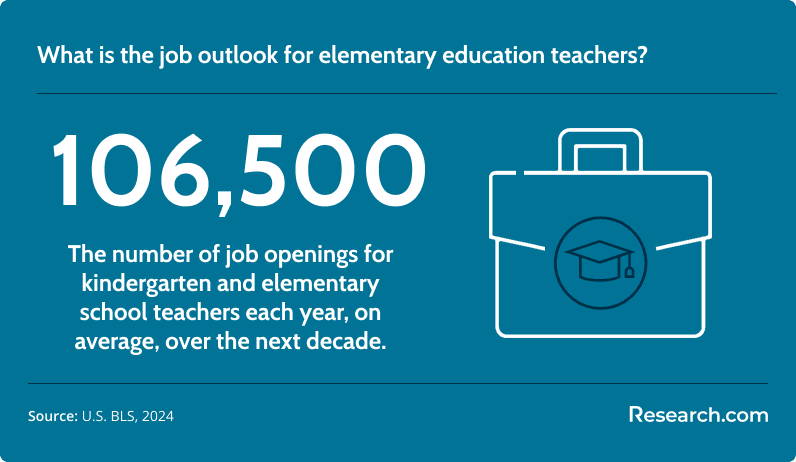
The job outlook for elementary education teachers is generally stable, though opportunities differ by region, school type, grade level, and specialization. Based on our research, there will be an average of 106,500 job openings for kindergarten and elementary school teachers each year, from 2023 to 2033.
Teachers with certifications in high-demand areas such as special education, ESL, and STEM education may have stronger prospects than candidates with only general credentials. Rural and low-income districts may also offer more openings or incentives, while highly desirable districts can be more competitive. A master’s degree can strengthen your profile, but location, licensure area, classroom experience, and district hiring needs remain important.
What emerging trends are shaping the future of elementary education?
Elementary education is being shaped by digital learning tools, data-informed instruction, personalized learning platforms, inclusive classroom practices, early literacy interventions, and stronger expectations around teacher collaboration. These trends do not replace core teaching skills; they make it more important for educators to understand assessment, differentiation, classroom technology, and evidence-based instruction.
Artificial intelligence and adaptive learning tools are also changing how teachers plan lessons, review student progress, and personalize practice. Educators should learn how to use these tools responsibly while protecting student privacy, avoiding overreliance on automated outputs, and maintaining professional judgment. Teachers who want to move beyond classroom practice into system-level leadership may eventually compare doctoral options such as the cheapest online doctorate in educational leadership.
Questions to ask before choosing a master’s in elementary education
- Does the program serve licensed teachers, career changers, or both?
- Will it meet the licensure, endorsement, or salary-lane requirements in my state or district?
- What fieldwork, practicum, student teaching, or residency requirements are included?
- How much will the full degree cost after fees, books, technology costs, and travel?
- Can I complete the workload while teaching full time?
- What support does the program provide for online students, certification exams, and placement requirements?
- Do graduates move into the roles I want, such as literacy specialist, instructional coach, special education teacher, or administrator?
Key Insights
- A master’s in elementary education is most valuable when it connects to a specific goal, such as salary advancement, certification, literacy work, special education, curriculum leadership, or administration.
- Most full-time programs take 1 to 2 years, while part-time students often need 2 to 4 years; accelerated formats can take 12 to 18 months but require a heavier workload.
- Salary outcomes vary. Stated figures include $63,670 for kindergarten and elementary school teachers, $65,910 for special education teachers, $74,620 for instructional coordinators, and $103,460 for elementary, middle, and high school principals.
- Before enrolling, verify accreditation, state licensure alignment, district salary policies, field placement requirements, and total cost.
- Specializations such as literacy, ESL, special education, STEM, curriculum and instruction, and educational leadership can improve job fit and may strengthen career mobility.
- Online programs can be convenient for working teachers, but they require careful review of practicum rules, state authorization, advising quality, and technology support.
- The job market includes an average of 106,500 job openings for kindergarten and elementary school teachers each year, from 2023 to 2033, but local demand varies widely.
Resources:
- Payscale. (2024). Master of Education (MEd), Elementary Education Degree. https://www.payscale.com/research/US/Degree=Master_of_Education_(MEd)%2C_Elementary_Education/Salary
- U.S. Bureau of Labor Statistics. (2024). Occupational Outlook Handbook: Instructional Coordinators. https://www.bls.gov/ooh/education-training-and-library/instructional-coordinators.htm#tab-1
Other Things You Should Know About Getting a Master’s in Elementary Education
Yes. In every U.S. state, elementary classroom teachers must hold a state-issued teaching license or certificate from the state education department. Most pathways require a bachelor’s degree, an approved educator-preparation program, supervised student teaching, and passing scores on the Praxis or a state exam.
In 2027, a master's in elementary education can lead to careers such as educational consultant, curriculum developer, or education policy advisor. These roles benefit from the pedagogical and developmental expertise gained during the degree, offering diverse pathways beyond traditional classroom teaching.