2027 Easiest Master's Degree for Teachers

Co-Founder and Chief Data Scientist
For many teachers, the “easiest” master’s degree is not the program with the least work. It is the program that fits your schedule, recognizes your professional experience, supports your certification goals, and does not create unnecessary cost or licensure problems later. Working educators often need an online or flexible program that can be completed while teaching full-time, but they also need to confirm accreditation, state requirements, practicum expectations, and salary payoff before enrolling.
This guide explains how online master’s degrees for teachers work, which program features usually make them more manageable, how costs and timelines compare, and how to choose a degree that supports your next career step. It is designed for licensed teachers, career changers, instructional professionals, and educators considering roles in curriculum, leadership, special education, higher education, or school administration.
Quick Answer: What Is the Easiest Master’s Degree for Teachers?
The easiest master’s degree for teachers is usually an accredited online education program with flexible start dates, asynchronous coursework, no unnecessary licensure barriers, clear graduation requirements, and a specialization aligned with your current teaching experience. Programs in curriculum and instruction, educational technology, higher education administration, and general education leadership may feel more manageable for working teachers than programs requiring extensive clinical hours or state-specific licensure steps.
- An online master’s degree for teachers can support employment in schools, government agencies, nonprofits, higher education, training departments, and private-sector education roles.
- Online study may reduce expenses tied to commuting, campus fees, housing, and time away from work, especially for educators who continue teaching full-time.
- Teachers with a master’s degree can pursue roles with median annual earnings of at least $67,000 to more than $80,000 for higher-level positions, depending on location, role, district pay rules, experience, and specialization.
What can I expect from a master's degree for teachers?
A master’s degree for teachers is designed to deepen professional knowledge beyond undergraduate teacher preparation. Most programs move from basic teaching foundations into advanced topics such as curriculum design, learning assessment, educational research, instructional improvement, leadership, inclusive practice, and student support systems.
The experience depends heavily on the degree type and specialization. A curriculum and instruction program may focus on lesson design, assessment, and teacher leadership. A special education program may include disability law, individualized instruction, and intervention strategies. An educational leadership program may prepare experienced educators for administrative or supervisory responsibilities, although licensure requirements vary by state.
| Program feature | What it usually means for teachers | Why it affects difficulty |
| Online coursework | Courses are completed remotely through a learning platform | More flexible for full-time teachers, but requires strong time management |
| Asynchronous classes | Students do not have to log in at fixed class times | Often easier to fit around classroom teaching schedules |
| Practicum or fieldwork | Students complete supervised professional activities | Can add scheduling complexity, especially for licensure programs |
| Capstone project | Students apply learning to a classroom, school, or organizational problem | Often more practical than a thesis, but still requires planning and research |
| Licensure alignment | The program may prepare students for state certification or endorsement | Important for career mobility, but requirements can vary by state |
Where can I work with an online master's degree for teachers?
An online master’s degree for teachers can lead to opportunities inside and outside traditional classrooms. Many graduates remain in K-12 teaching and use the degree to qualify for salary lane movement, specialized instructional roles, or leadership responsibilities. Others move into curriculum design, teacher coaching, higher education administration, nonprofit education, government education programs, or corporate learning and development.
Your options depend on three practical factors: your specialization, your state certification status, and your work experience. For example, a teacher with a master’s in special education may pursue specialized classroom roles, while a teacher with a master’s in higher education administration may be better positioned for college student services, enrollment, academic advising, or program coordination.
How much can I make with an online master's degree for teachers?
A master’s degree may improve earning potential, but the payoff is not automatic. District salary schedules, state funding, union contracts, subject area, seniority, and job title all influence compensation. On average, teachers with a master's degree earn $67,000 annually, compared to $52,500 for those with a bachelor's degree. This represents a 10-15% salary boost.
Salary outcomes also vary by geography. Teachers in higher-paying districts like New York City may earn significantly more than teachers in lower-paying areas like some districts in Texas. Specialized areas such as STEM and special education may also offer stronger opportunities in some markets. The clearest way to estimate your return is to compare your current salary schedule with your district’s master’s-degree lane or advanced-degree stipend policy before applying.
- 2027 list of manageable master’s degree programs for teachers
- How long does it take to complete a master's degree for teachers program?
- How does an online master's degree for teachers compare to an on-campus program?
- What is the average cost of a master's degree for teachers program?
- What are the financial aid options for students enrolling in a master's degree for teachers program?
- What are the prerequisites for enrolling in a master's degree for teachers program?
- What courses are typically in a master's degree for teachers program?
- What types of specializations are available in master's degree for teachers programs?
- How do employers evaluate an online master’s degree in teaching?
- Which teaching specializations are most in demand?
- What is the return on investment of earning a master's degree for teachers?
- What are the state-specific teacher certification requirements?
- How does one choose the best master's degree for teachers program?
- How can you verify the credibility of an online master’s degree for teachers?
- What are the best practices for succeeding in an online master's degree for teachers?
- What career paths are available for graduates of master's degrees for teachers programs?
- Is an additional accelerated degree advantageous for career growth?
- How do robust student support services enhance online learning outcomes?
- What is the job market for graduates with a master's degree for teachers?
- Should I advance to a doctoral degree after my master's?
- Can short doctoral programs online complement a master's degree for teachers?
- What other trends and decisions should teachers consider?
2027 List of the Easiest Master's Degree Programs for Teachers
How do we rank schools?
Research.com evaluates schools with a transparent, data-informed process that considers program availability, affordability, institutional information, and career relevance. Sources used in the ranking process include the IPEDS database, Peterson's database with distance learning data, the College Scorecard database, and the National Center for Education Statistics.
For this topic, “easiest” should be interpreted as manageable for working educators, not academically weak. A strong program should still be accredited, rigorous, transparent about requirements, and relevant to your career goals.
| School | Program focus | Best fit | Important caution |
| Southern New Hampshire University | Higher education administration | Teachers interested in college administration or student services | May not be the right choice for K-12 teaching licensure advancement |
| National University | Curriculum and teaching | Educators who want structured, sequential courses | Confirm how transfer credits and location affect total cost |
| Purdue Global | Health education | Educators interested in health promotion and community education | Check whether the curriculum fits your intended school or public health role |
| Grand Canyon University | Curriculum and instruction | Working professionals seeking non-licensure instructional leadership training | Non-licensure degrees may not satisfy certification requirements |
| Liberty University | Education, leadership, curriculum, and special education options | Students seeking multiple online education pathways | Compare full-time, part-time, and military tuition rates carefully |
1. Southern New Hampshire University
The Master of Science in Higher Education Administration at Southern New Hampshire University (SNHU) is built for students who want to move into administrative work in colleges, universities, and related education settings. The curriculum addresses strategic leadership, student success, data-informed resource decisions, budgeting, enrollment, higher education law, and institutional operations. Courses include Contemporary Issues in Higher Education, Enrollment Management and Marketing, Budget and Financial Management, and Higher Education Law and Regulation. Because the degree is fully online and offers multiple start dates, it may be easier for working educators who need scheduling flexibility. Graduates may pursue roles such as enrollment manager, student affairs officer, and academic dean.
- Program Length: Typically completed in 15 months.
- Tracks/Concentrations: General Higher Education Administration.
- Tuition Cost: Approximately $627 per credit hour.
- Required Credits to Graduate: 36 credits.
- Accreditation: New England Commission of Higher Education (NECHE)
2. National University
The Master of Education (MEd) in Curriculum and Teaching at National University serves educators who want to strengthen curriculum planning, instructional design, and teaching practice across K-12, higher education, and training environments. Students study curriculum design, implementation, evaluation, and evidence-based instructional delivery. The four-week course format allows students to take courses one at a time, which can make the workload easier to organize for educators balancing school, work, and family responsibilities.
- Program Length: 16 months (estimated completion)
- Tracks/Concentrations: Curriculum and Teaching
- Tuition Cost: Approximately $18,000 (varies by student location and transfer credits)
- Required Credits to Graduate: 30-36 credits
- Accreditation: WASC Senior College and University Commission (WSCUC)
3. Purdue Global
The MS in Health Education at Purdue Global prepares students to plan, deliver, and evaluate health education initiatives. The curriculum is aligned with the eight core areas outlined by the National Commission for Health Education Credentialing (NCHEC) and includes health education planning, advocacy, leadership, program evaluation, communication, and multicultural literacy. Students complete a capstone project that connects academic study to health education practice, including work related to underserved communities. The program may also help students prepare for the Certified Health Education Specialist (CHES) exam.
- Program Length: Approximately 18 months full-time
- Tracks/Concentrations: General Health Education
- Tuition Cost: Varies by location and military status, with discounts for veterans and active-duty servicemembers
- Required Credits to Graduate: 48 quarter credits
- Accreditation: Higher Learning Commission (HLC)
4. Grand Canyon University
The Master of Arts in Curriculum and Instruction at Grand Canyon University is an online, non-licensure program for education professionals who want stronger skills in curriculum design, instructional improvement, and teacher leadership. Coursework emphasizes differentiated instruction, curriculum mapping, culturally responsive teaching, and evidence-based practice. Students complete a capstone that includes developing and delivering a professional development plan. The six-week online course structure may appeal to working teachers who prefer shorter course blocks and predictable pacing.
- Program Length: Varies, with each online course typically six weeks long
- Tracks/Concentrations: No specific concentrations; curriculum focuses on advanced instruction and curriculum design
- Tuition Cost: $605 per credit (same for all students, as no out-of-state tuition)
- Required Credits to Graduate: 32
- Accreditation: Higher Learning Commission
5. Liberty University
Liberty University offers several online graduate education degrees for educators and administrators. Options include Educational Leadership, Curriculum and Instruction, and Special Education. The Master of Education (M.Ed.) in Curriculum and Instruction covers instructional methods, curriculum planning, education policy, supervision, and educational technology, with specialization options such as Leadership or Reading Specialist. Programs are also designed around Christian perspectives in education, which may be a deciding factor for students seeking a faith-based academic environment.
- Program Length: Typically 1-2 years for most M.Ed. programs, depending on full-time or part-time enrollment.
- Tracks/Concentrations: Options include Curriculum and Instruction, Educational Leadership, and Special Education.
- Tuition Cost: $415 per credit for full-time students; $615 per credit for part-time students; military rate at $275 per credit.
- Required Credits to Graduate: Varies by program, generally around 36 credits.
- Accreditation: Southern Association of Colleges and Schools Commission on Colleges (SACSCOC); Council for the Accreditation of Educator Preparation (CAEP).
How long does it take to complete a master's degree for teachers program?
Most master’s degrees for teachers take 1 to 2 years for full-time students and 2 to 3 years for part-time students. The actual timeline depends on the credit requirement, course length, whether the program runs year-round, and whether fieldwork, internships, or licensure components are required.
- Typical Duration: 1–2 years for full-time students; 2–3 years part-time.
- Accelerated Options: Some programs offer a condensed, 1-year option.
- Internships/Practicums: Fieldwork can extend the timeline, especially in special education, counseling, or administrator preparation.
- Online Flexibility: Many online programs give working educators more control over pacing and start dates.
Teachers who need the most flexible path may want to compare easiest online master’s degree options, especially programs with streamlined course sequencing and multiple annual start dates. However, faster does not always mean better. If a program leads to certification or endorsement, make sure the timeline includes every required practicum, exam, and state approval step.
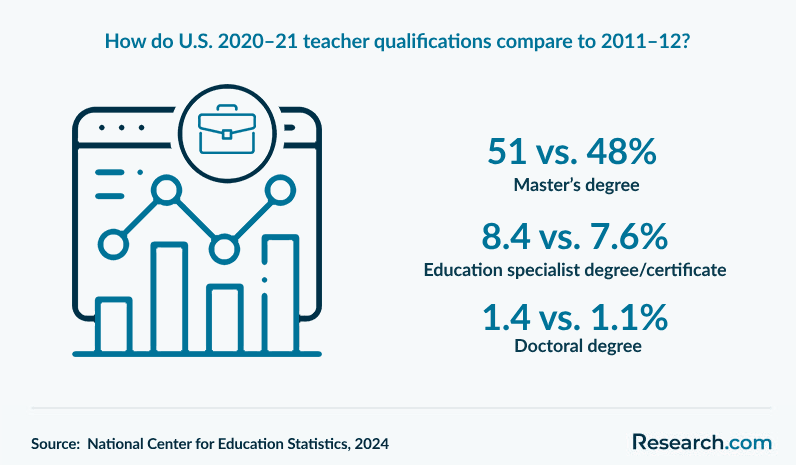
Public school teachers in 2020-21 were more highly educated than in 2011-12. A higher percentage of teachers in 2020-21 held a Master's degree (51% vs. 48%), an Education Specialist degree/certificate (8.4% vs. 7.6%), or a Doctoral degree (1.4% vs. 1.1%) as their highest degree, as shown in the graphic below. This pattern shows that advanced credentials have become more common among public school teachers.
How does an online master's degree for teachers compare to an on-campus program?
Online and campus-based master’s programs can cover similar academic content, but the student experience is different. The better option depends on your schedule, learning style, local school partnerships, need for in-person networking, and whether your program includes certification or clinical requirements.
| Factor | Online master’s degree | On-campus master’s degree |
| Schedule | Often offers asynchronous or evening-friendly coursework | May require set class times and travel to campus |
| Best for | Working teachers, rural students, military students, and students with family responsibilities | Students who prefer face-to-face discussion and campus resources |
| Interaction | Uses discussion boards, video meetings, email, and virtual collaboration | Provides in-person classes, campus events, and direct peer interaction |
| Curriculum | Often similar to the campus version when offered by the same school | May provide more immediate access to campus-based labs, clinics, or school partnerships |
| Cost considerations | May reduce commuting, housing, and relocation costs | May include campus fees, parking, housing, or commuting costs |
| Licensure risk | Must be checked carefully across state lines | May be easier to align with local state requirements if the school serves your region |
Educators considering major career changes should compare the workload and professional payoff of other graduate routes as well. For example, flexible easiest law program options may interest professionals who want to move toward policy, advocacy, compliance, or education law, although legal careers involve very different training and licensing requirements.
What is the average cost of a master's degree for teachers program?
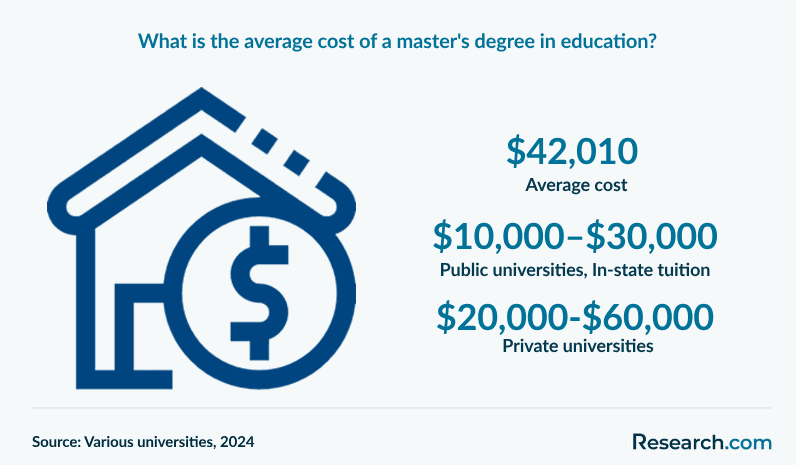
The average cost of a master's degree in education is around $42,010, but the total can vary widely by school type, residency status, online pricing, credit requirement, and fees. Teachers should calculate total program cost, not just tuition per credit.
- Public Universities: In-state tuition ranges from $10,000–$30,000; out-of-state typically $20,000–$50,000.
- Private Universities: Often $20,000–$60,000, with higher rates on average.
- Online Programs: Some schools offer in-state rates for online students, which can reduce the overall cost.
- Additional Expenses: Budget for technology fees, textbooks, certification exams, background checks, and travel for practicums when required.
| Cost question | Why it matters |
| Is tuition charged per credit, per course, or per term? | The pricing model affects how much part-time or accelerated study will cost. |
| Are online students charged out-of-state tuition? | Some programs are affordable only if online students receive reduced or in-state pricing. |
| Are certification fees included? | Licensure exams, applications, and background checks can add out-of-pocket costs. |
| Can graduate credits transfer in? | Transfer credit may reduce both time and tuition, but policies vary by school. |
| Will your district increase your salary after graduation? | The ROI depends on whether your employer recognizes the degree for pay advancement. |
If you are comparing education with other professional degrees, make sure you compare total cost and admissions expectations, not just flexibility. Students weighing business options may ask, what is the easiest MBA program to get into? Similarly, teachers considering technology roles may explore an easy computer science degree, especially if they want to transition into instructional technology, data, or software-related education work.
What are the financial aid options for students enrolling in a master's degree for teachers program?
Graduate students in teacher education may use a mix of federal aid, state incentives, school-based scholarships, employer benefits, and service-based programs. The best funding strategy starts with the Free Application for Federal Student Aid (FAFSA), followed by a conversation with the school’s financial aid office and your employer or district HR office.
Federal Aid
- Federal Student Loans: Graduate students may qualify for federal loans with repayment options that can be more flexible than many private loans.
- TEACH Grant: This federal grant provides funding for students who commit to teaching in high-need schools for a required period.
- Federal Work-Study: Eligible students may access part-time work opportunities through their institution or community-based placements.
State Grants and Scholarships
- State-Specific Grants: Many states fund teacher scholarships or grants, often linked to service commitments in public schools or shortage areas.
- Employer Tuition Reimbursement: Districts, schools, and education employers may reimburse part of the cost for approved graduate study.
Institutional Aid
- Scholarships: Colleges may award aid based on academic merit, financial need, teaching experience, subject area, or leadership potential.
- Graduate Assistantships: Some programs offer tuition support or stipends in exchange for teaching, research, or administrative work.
Before borrowing, ask whether your degree qualifies for salary advancement, whether your employer requires a specific accreditation type, and whether service-based grants become loans if you do not meet the teaching commitment.
What are the prerequisites for enrolling in a master's degree for teachers program?
Admissions requirements vary, but most master’s programs for teachers expect applicants to show academic readiness, professional purpose, and, in some cases, prior teaching credentials. Licensure-oriented programs tend to have stricter requirements than non-licensure programs.
- Bachelor's Degree: Applicants usually need a bachelor’s degree from an accredited institution.
- Education Background: Many programs prefer or require prior study in education or a related field.
- Minimum GPA: A GPA around 3.0 or higher is commonly expected, though policies differ.
- Teaching Certification: Some advanced education programs require a valid teaching certificate, particularly those tied to professional licensure or advanced educator roles.
- Letters of Recommendation: Recommendations from supervisors, principals, professors, or professional colleagues can strengthen an application.
- Statement of Purpose: Applicants are often asked to explain their goals, teaching background, and reasons for graduate study.
- Standardized Test Scores: Some programs still request GRE or GMAT scores, but this requirement is becoming less common.
Do not assume that lower-cost programs have easier or identical admissions rules. Even cheap education degrees online can require transcripts, references, certification documents, and state-specific prerequisites.
What courses are typically in a master's degree for teachers program?
Coursework usually combines education theory, applied teaching practice, research, assessment, and specialization-specific training. The exact mix depends on whether the degree is an M.Ed., MAT, MA, MS, or leadership-focused program.
Core Courses
- Educational Research Methods: Introduces research design, data interpretation, and evidence-based inquiry in education.
- Curriculum and Instruction: Examines how curricula are designed, implemented, assessed, and improved.
- Educational Leadership: Covers school leadership, organizational decision-making, education policy, and administrative practice.
- Child Development and Learning: Explores how students grow, learn, and respond to instruction across developmental stages.
Major Courses/Electives
- Special Education: Focuses on instructional planning, disability categories, assessment, intervention, and legal responsibilities.
- Early Childhood Education: Covers learning and development from birth to age 8.
- Secondary Education: Develops teaching strategies and curriculum knowledge for middle and high school settings.
- Educational Technology: Studies digital tools, instructional design, online learning, and technology integration.
- School Counseling: Covers counseling methods, ethics, student development, and support systems.
- Bilingual/ESL Education: Prepares educators to support English Language Learners through language instruction and culturally responsive practice.
Educators who plan to move into senior leadership may later compare doctoral-level options. For example, cheapest online doctorate in organizational leadership programs may appeal to professionals interested in executive, supervisory, or organizational change roles.
What types of specializations are available in master's degree for teachers programs?
Specialization choice is one of the most important decisions in a teacher’s master’s program. The easiest option is usually the one that builds on your current experience and moves you toward a clear career outcome. A teacher who enjoys classroom practice may prefer curriculum and instruction, while someone aiming for administration may need educational leadership or principal preparation.
| Specialization | Best for | Decision note |
| Curriculum and Instruction | Teachers who want to improve lesson design, assessment, and instructional leadership | Often a flexible option for experienced classroom teachers |
| Educational Leadership | Educators pursuing principal, assistant principal, or district leadership roles | Confirm state administrator licensure requirements |
| Special Education | Teachers who want to serve students with disabilities | May require fieldwork, endorsement steps, or state-specific coursework |
| Early Childhood Education | Educators focused on children from birth to age 8 | Compare affordable online colleges for early childhood education if cost is a priority |
| Bilingual/ESL Education | Teachers working with English Language Learners | Demand and endorsement rules vary by state and district |
| Educational Technology | Educators interested in digital learning, online instruction, and instructional design | Can support roles beyond traditional classroom teaching |
| School Counseling | Professionals who want to provide student counseling and guidance | Usually includes strict licensure and supervised practice requirements |
| Reading and Literacy | Teachers focused on reading intervention, literacy coaching, and writing instruction | Useful for schools prioritizing literacy improvement |
| Science Education | Teachers specializing in science instruction and STEM learning | Can align with shortage-area hiring in some regions |
| Mathematics Education | Teachers focused on math instruction, problem-solving, and content mastery | May strengthen competitiveness in math teaching roles |
| Art Education | Educators teaching visual arts and creative practice | Check local certification and hiring patterns |
| Physical Education | Teachers focused on physical fitness, sports, wellness, and health education | May overlap with health education depending on state rules |
| Higher Education | Teachers moving toward college administration, advising, or student affairs | Not usually designed for K-12 classroom licensure |
Teachers considering long-term academic or administrative advancement may later pursue a doctorate degree in education. If that is part of your plan, choose a master’s program with strong research preparation, credible accreditation, and faculty support.
The graph below presents the percentage of public school teachers holding a master's degree in various states. New York leads with 83.1% of teachers possessing a master's degree, followed closely by Massachusetts (71.8%) and Connecticut (68.1%). Oklahoma (27.6%) and North Dakota (35.4%) have much lower percentages of teachers with master's degrees. These differences show why local labor markets and state education policies matter when evaluating the value of an advanced credential.
How do employers evaluate an online master’s degree in teaching?
Most employers care less about whether a degree was completed online and more about whether it came from an accredited institution, aligns with the role, and produced relevant skills. School districts, colleges, and education organizations may review accreditation, state approval, transcripted coursework, field experiences, portfolio evidence, references, and whether the degree qualifies for salary advancement or certification.
For licensure-focused roles, the program must meet the requirements of the state where you intend to work. For non-licensure roles, employers may look more closely at practical experience, leadership projects, technology skills, curriculum samples, and measurable classroom or program outcomes. Students comparing online preparation routes can also review best online teacher certification programs to understand how certification pathways differ from graduate degree pathways.
Which teaching specializations are most in demand?
Demand depends on state, district, grade level, and subject area. In many regions, educators with preparation in STEM, special education, bilingual/ESL education, and technology integration may see stronger opportunities than those in less specialized areas. However, no specialization guarantees employment or a salary increase.
The smartest approach is to compare your preferred specialization with local job postings, district shortage lists, certification rules, and long-term career goals. For a broader view of staffing patterns, see Research.com’s guide to what teachers are most in demand right now?.
What is the return on investment of earning a master's degree for teachers?
The ROI of a master’s degree for teachers depends on cost, time to completion, salary increase, loan repayment, certification benefits, and career mobility. A low-cost program with strong employer recognition may produce better ROI than a prestigious but expensive program that does not change your pay or job options.
| ROI factor | What to check before enrolling |
| Salary lane movement | Ask your district whether the degree increases pay and by how much. |
| Certification or endorsement | Confirm whether the program meets your state’s requirements. |
| Total debt | Estimate tuition, fees, books, exams, and interest, not only advertised tuition. |
| Time away from work | Choose a format that does not require unpaid leave unless the payoff is clear. |
| Career flexibility | Consider whether the specialization supports classroom, leadership, and nonclassroom options. |
Cost-conscious educators may want to compare master's in teaching online options, especially if their employer recognizes accredited online graduate degrees for advancement.
What are the state-specific teacher certification requirements?
Teacher certification requirements are set at the state level, so a program that works in one state may not satisfy requirements in another. This is especially important for online students who enroll in an out-of-state school. Requirements may include approved coursework, student teaching or practicum hours, background checks, content exams, pedagogy exams, administrator exams, or specific endorsements.
Before applying, contact the program and your state licensing agency. Ask for written confirmation that the degree aligns with your intended credential. You can start with this overview of teacher education requirements, then verify details with the state where you plan to teach.
How does one choose the best master's degree for teachers program?
The best master’s program is the one that fits your career goal, state requirements, budget, schedule, and learning needs. Rankings can help you build an initial shortlist, but they should not replace your own verification process.
1. Start with the career outcome
- Specialization: Choose a concentration tied to the role you actually want, such as curriculum leadership, special education, literacy, ESL, or administration.
- Coursework: Review the full degree plan and confirm that assignments, projects, and fieldwork match your professional goals.
2. Confirm accreditation and approval
- Institutional Accreditation: Make sure the college or university is accredited by a recognized accrediting body.
- Program Accreditation: If the degree is tied to teacher preparation, licensure, or administrator certification, check program-level approval as well.
3. Evaluate faculty and academic support
- Qualified Faculty: Look for instructors with relevant teaching, research, school leadership, or policy experience.
- Research Opportunities: If you may pursue doctoral study, consider whether the program includes research mentoring or applied inquiry projects.
4. Match format to your life
- Online or On-Campus: Choose online if flexibility is essential; choose campus if you need face-to-face interaction or local field placements.
- Part-time or Full-time: Be realistic about lesson planning, grading, family obligations, and school-year workload.
5. Compare real cost
- Tuition and Fees: Calculate the full cost through graduation, including fees and required materials.
- Financial Aid: Compare scholarships, grants, district reimbursement, assistantships, and federal loans.
6. Look at professional networks
- Alumni Network: A strong alumni base may help with referrals, leadership opportunities, and professional visibility.
- Industry Connections: Programs connected to schools, districts, nonprofits, or higher education employers can offer practical advantages.
7. Review outcomes carefully
- Employer Recognition: Ask whether local districts and education employers recognize the degree for hiring or pay advancement.
- Job Placement Rates: Treat placement data carefully and ask how it is collected, which graduates are counted, and what types of jobs are included.
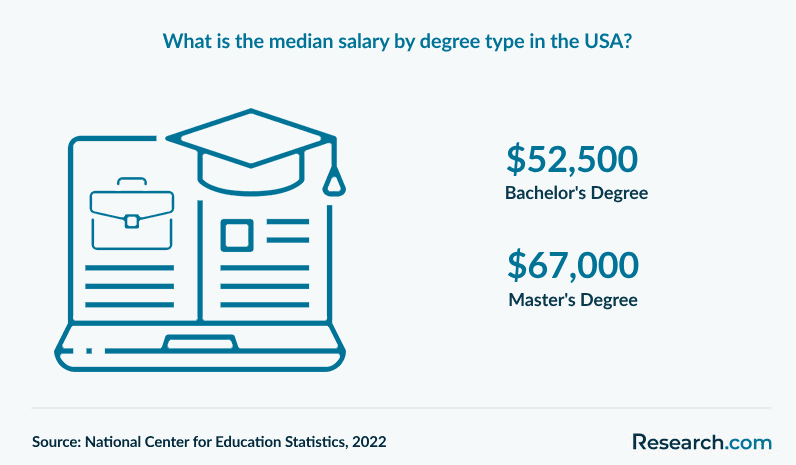
The median salary for individuals with a Bachelor's degree in the United States is $52,500, while those with a Master's degree earn a median salary of $67,000, as shown below. This comparison can be useful, but your personal ROI depends on your location, employer policies, debt level, and career path.
How can you verify the credibility of an online master’s degree for teachers?
To verify an online master’s degree, confirm the school’s institutional accreditation, review any program-level accreditation or state approval, and check whether the program is accepted for certification or salary advancement in your state or district. Do not rely only on marketing language such as “fully accredited” without checking the accreditor and approval status yourself.
- Search the institution’s accreditation status through recognized accreditation resources and the school’s official accreditation page.
- Ask the program whether it is licensure, endorsement, or non-licensure.
- Request a written explanation of how the program supports your intended state credential.
- Review faculty credentials, curriculum maps, fieldwork requirements, and student support services.
- Ask for graduation, retention, and employment information, but evaluate how those outcomes are defined.
If you plan to continue beyond the master’s level, compare the credibility of doctoral options as well. Research.com’s guide to cheapest EdD programs can help you understand cost and format differences among education doctorates.
What are the best practices for succeeding in an online master's degree for teachers?
Online graduate study is manageable for many teachers, but it requires structure. The most successful students protect study time, communicate early with faculty, use school breaks strategically, and connect assignments to real classroom or leadership problems.
- Create a weekly schedule that includes reading, discussion posts, assignments, and group work.
- Use your classroom, school, or district context as a learning laboratory when assignments allow it.
- Contact instructors before deadlines become emergencies.
- Build a small peer network for accountability and feedback.
- Save major projects for your professional portfolio.
- Use academic advising, library help, tutoring, career services, and technical support before you fall behind.
If your long-term goal is a higher-earning or nonclassroom role, compare education degrees with other flexible credentials. Research.com’s guide to the highest paying online degrees can help you compare broader online degree options.
What career paths are available for graduates of master's degrees for teachers programs?
A master’s degree can support advancement in classroom teaching, instructional leadership, school administration, student support, training, research, and education policy. The best path depends on your specialization, certification, and years of experience.
Teaching Roles
- Classroom Teacher: Continue teaching while qualifying for advanced responsibilities, salary movement, or specialized grade-level and subject-area work.
- Curriculum Developer: Design curriculum, instructional materials, assessments, and learning resources.
- Instructional Coach: Support teachers through observation, feedback, professional development, and instructional planning.
- Special Education Teacher: Provide individualized instruction and supports for students with disabilities. Teachers comparing this pathway may review cheapest Masters in Special Education programs.
- Bilingual/ESL Teacher: Support English language learners in classrooms, pull-out programs, or specialized language programs.
Administrative Roles
- School Principal: Lead school operations, staff, instruction, climate, and compliance.
- Assistant Principal: Support student discipline, teacher evaluation, scheduling, operations, and instructional improvement.
- District Administrator: Work across schools on curriculum, student achievement, operations, programs, or policy implementation.
- Curriculum Director: Guide curriculum standards, instructional resources, assessment planning, and educator training.
Other Roles
- Educational Consultant: Advise schools, districts, nonprofits, or companies on education programs and improvement strategies.
- Corporate Trainer: Develop and deliver employee learning programs for businesses and organizations.
- Higher Education Faculty: Teach or support academic programs at colleges and universities, depending on credentials and field expectations.
- Educational Researcher: Study teaching, learning, policy, assessment, or program outcomes.
- School Counselor: Provide academic, social, emotional, and career support to students, typically with additional licensure requirements.
- Educational Policy Analyst: Analyze education laws, policies, data, and reform proposals.
Is an additional accelerated degree advantageous for career growth?
An additional accelerated degree can be useful when it fills a specific skill gap, but it is not always necessary after a master’s degree. Teachers should consider a second credential only when it clearly supports a new role, endorsement, technical skill set, leadership track, or career transition.
For example, a teacher moving into instructional technology may need targeted training in digital tools or design. A teacher moving toward business operations, health education, or public service may need coursework outside education. Some professionals compare shorter credentials such as the quickest associates degree online, but educators should weigh whether a certificate, endorsement, graduate course sequence, or doctoral program would be more relevant.
How do robust student support services enhance online learning outcomes?
Strong student support can make the difference between finishing an online master’s degree and stopping out. Teachers often study during evenings, weekends, school breaks, and grading periods, so timely advising and technical help matter.
- Academic advising: Helps students choose courses in the right order and avoid delays.
- Technical support: Reduces lost time when online platforms, exams, or video tools fail.
- Library and writing support: Helps with research papers, citations, literature reviews, and capstone projects.
- Career services: Supports resume updates, interview preparation, portfolio development, and role transitions.
- Faculty access: Makes it easier to clarify expectations before assignments become high-stakes problems.
Students who need maximum flexibility may also compare broader easy online degree programs, but support quality should matter as much as convenience.
What is the job market for graduates with a master's degree for teachers?
The job market for graduates with a master’s degree for teachers is generally stable, but it differs by grade level, subject area, district budget, state policy, and local staffing needs. A master’s degree may improve competitiveness for certain roles, but it does not remove the need for certification, experience, and strong references.
Job Outlook
- Overall Growth: According to the Bureau of Labor Statistics (BLS), the employment growth for teachers is projected to be around 3% to 4% from 2022 to 2032. This points to a steady market rather than rapid expansion.
- Elementary and Middle School Teachers: The BLS anticipates a 3% growth in jobs for elementary and middle school teachers. Students interested in this pathway can compare elementary education online degree options.
- High School Teachers: The job outlook for high school teachers shows a slightly better growth rate of 4%, especially in shortage areas such as math, science, and special education.
Factors Influencing Job Opportunities
- Subject Area: Teachers in high-demand areas such as STEM may find stronger prospects than teachers in fields with more applicants.
- Geographical Location: Demand differs by state, region, and district; some rural and underserved areas may have more persistent staffing needs.
- Flexibility: Educators willing to relocate, add endorsements, or teach shortage subjects may have more options.
- Advanced Roles: A master’s degree can support movement into instructional coaching, curriculum leadership, special education, administration, consulting, and higher education roles.
Salary Expectations
Earning a master’s degree can raise compensation in some roles and districts, but the increase depends on employer policy. Teachers with a master's degree typically earn about 7.6% more than their counterparts with only a bachelor's degree. Educational administrators with a master's can earn around $75,000, compared to about $52,000 for those without advanced degrees.
The estimated average teacher salary for the 2023-2024 school year in the United States is $71,699. Salaries differ sharply by state: teachers in California can expect to earn an average of $100,789, while those in Arkansas may earn around $55,193. Other states with relatively high average teacher salaries include Alaska ($78,140), Connecticut ($86,511), and the District of Columbia ($86,663), as shown in the graph below.
When evaluating the job market, focus on your specific subject, region, credential, and desired role. A master’s degree is most valuable when it connects directly to a recognized need, a salary schedule, or a clear advancement path.
Should I advance to a doctoral degree after my master's?
A doctoral degree can make sense if you want to lead institutions, conduct research, teach in higher education, influence policy, or move into executive-level education roles. It may not be necessary if your goal is classroom advancement, a salary lane increase, or a specialized teaching endorsement.
Before applying, compare doctoral program accreditation, dissertation or capstone requirements, faculty expertise, completion support, and how the credential aligns with your career vision. Teachers who want a shorter doctoral route can explore the shortest EdD program online, while still checking quality and state or employer recognition.
Can short doctoral programs online complement a master's degree for teachers?
Short online doctoral programs can complement a master’s degree when they provide advanced leadership, applied research, policy, or organizational strategy skills. They are often designed for working professionals who need flexible study while remaining employed.
However, shorter does not automatically mean easier or better. Compare completion requirements, dissertation format, faculty access, accreditation, and whether the degree will help you reach a specific career outcome. Research.com’s guide to short doctoral programs online can help educators compare accelerated doctoral pathways.
What are the emerging trends in master's degree programs for teachers?
Master’s programs for teachers are increasingly shaped by online learning, technology integration, data-informed instruction, student mental health needs, inclusive education, and demand for flexible professional credentials. Programs may include more coursework in digital tools, online pedagogy, adaptive learning, evidence-based intervention, and leadership for diverse classrooms.
Teachers should also consider how artificial intelligence and education technology are changing lesson planning, assessment design, academic integrity, tutoring, accessibility, and administrative work. The strongest programs do not treat technology as a standalone course only; they help educators evaluate tools ethically, protect student data, and use evidence to improve learning.
If you are comparing graduate options across fields, Research.com’s guide to what is the best masters degree to get may help you evaluate long-term value beyond education alone.
Common mistakes to avoid when choosing a master's degree for teachers
| Mistake | Why it can hurt you | Better approach |
| Choosing only because a program looks easy | A weak or poorly aligned program may not improve your career options. | Choose a manageable program that is accredited, relevant, and respected by employers. |
| Ignoring state certification rules | An out-of-state online degree may not meet your licensure requirements. | Verify state approval before enrolling. |
| Looking only at tuition per credit | Fees, books, exams, travel, and extra credits can change the final cost. | Calculate total cost through graduation. |
| Assuming online means self-paced | Many online programs still have weekly deadlines and group assignments. | Review course format, login expectations, and assignment schedules. |
| Relying only on rankings | A highly ranked program may not fit your state, budget, or career goal. | Use rankings as a starting point, then verify fit. |
| Assuming salary increases are guaranteed | Some employers do not pay more for every master’s degree. | Check your salary schedule or HR policy in writing. |
Questions to ask before enrolling
- Is this program licensure, endorsement, or non-licensure?
- Will it meet requirements in the state where I plan to work?
- Is the institution accredited by a recognized accrediting body?
- Does my district or employer recognize this degree for salary advancement?
- How many credits are required, and how long do students typically take to finish?
- Are courses asynchronous, synchronous, or blended?
- Are there practicums, internships, clinical hours, or on-site requirements?
- What is the total cost, including fees, books, exams, and technology requirements?
- Can I transfer graduate credits into the program?
- What advising, library, writing, technical, and career services are available online?
Here's what graduates have to say about their master's degree for teachers
The online format made graduate school realistic while I was still teaching. I could apply assignments directly to my classroom, and the flexible schedule helped me keep up with work and family responsibilities. Carla
I expected the workload to be overwhelming, but the structure was clear and the professors understood the demands on working teachers. The program helped me strengthen my instruction without stepping away from my job. Stanley
The degree gave me new strategies for inclusive teaching and student engagement. It was flexible enough for my schedule, but still challenging in ways that improved my confidence as an educator. Eunice
Key Insights
- The easiest master’s degree for teachers is usually the one that is flexible, accredited, relevant to your current experience, and aligned with your state and employer requirements.
- Online programs can be a strong fit for working teachers, but students must verify licensure alignment, fieldwork expectations, and employer recognition before enrolling.
- Cost varies widely. The average cost of a master's degree in education is around $42,010, while public universities, private universities, and online programs may differ significantly in total price.
- Teachers with a master's degree typically earn about 7.6% more than their counterparts with only a bachelor's degree. Educational administrators with a master's can earn around $75,000, compared to about $52,000 for those without advanced degrees.
- The estimated average teacher salary for the 2023-2024 school year in the United States is $71,699, but state differences are substantial: California is listed at $100,789, Arkansas at $55,193, Alaska at $78,140, Connecticut at $86,511, and the District of Columbia at $86,663.
- According to the Bureau of Labor Statistics (BLS), employment growth for teachers is projected to be around 3% to 4% from 2022 to 2032, which suggests stability rather than rapid expansion.
- Advanced degrees are common in some states. New York leads with 83.1% of teachers possessing a master's degree, followed by Massachusetts (71.8%) and Connecticut (68.1%), while Oklahoma (27.6%) and North Dakota (35.4%) report much lower percentages.
- Do not choose a program based only on speed or convenience. The best decision comes from checking accreditation, certification rules, total cost, support services, and realistic career payoff.
References:
- Augusta University. (n.d.). Online education blog. Augusta University.
- Bureau of Labor Statistics. (2024). Educational instruction and library occupations. Bureau of Labor Statistics.
- Education Degree. (n.d.). Teacher salary with a master’s degree. Education Degree.com.
- Education Week. (2023). How much do teachers get paid? See new state-by-state data. Education Week.org.
- Economic Policy Institute. (2023). Teacher pay in 2023—but not enough to shrink pay gap with other college graduates. Economic Policy Institute.
- National Center for Education Statistics. (2021). Characteristics of 2020–21 Public and Private K–12 School Teachers in the United States: Results from the National Teacher and Principal Survey. National Center for Education Statistics.
- National Center for Education Statistics. (2021). Percentage distribution of public school teachers, by highest degree earned and state: 2017–18. National Center for Education Statistics.
- National Center for Education Statistics. (2022). Digest of education statistics 2021. National Center for Education Statistics.
- National Center for Education Statistics. (2023). Characteristics of public school teachers. Condition of Education. U.S. Department of Education, Institute of Education Sciences. National Center for Education Statistics.
- National Education Association. (2024). Average teacher pay passes $70K. National Education Association.
- National Education Association. (2024). Educator pay data 2024. National Education Association.
- National Education Association. (n.d.). Starting Teacher Pay 2023. National Education Association.
- Student Loan Planner. (2024). Teacher job outlook: It's more complicated than you think. Student Loan Planner.
Other Things You Should Know About Online Master's Degrees for Teachers
The minimum GPA requirement for the easiest master's degree for teachers in 2027 is typically around 2.5. Some programs may offer conditional admission for lower GPAs if other criteria, such as relevant work experience, are met. Always check specific program requirements.
Most streamlined master’s degrees for teachers require 30 to 36 semester credits. Some universities also accept transfer credit for prior graduate work, but the program must still meet the graduate school’s minimum credit requirement and any state licensure rules.