
2027 Best Online Elementary Education Programs

Co-Founder and Chief Data Scientist
Choosing an online elementary education degree is really a licensure, cost, and career-fit decision—not just a question of convenience. The right program can prepare you to teach young learners in reading, writing, math, science, and social studies while completing supervised fieldwork required for state certification. The wrong program can leave you with credits that do not transfer, coursework that does not meet your state’s teacher licensure rules, or costs that are higher than expected.
This guide is for future elementary teachers, teaching assistants, career changers, and working adults comparing online elementary education programs. You will learn what these programs include, how online and campus formats differ, what they cost, which careers they can support, how licensure works, and what questions to ask before enrolling.
Quick Answer: Is an Online Elementary Education Degree Worth It?
An online elementary education degree can be worth it if the program is accredited, includes approved student teaching or practicum requirements, and aligns with the licensure rules in the state where you plan to teach. It is especially practical for students who need flexible coursework, want to reduce commuting or housing costs, or already work in a school setting. However, online does not mean fully remote: teacher preparation programs typically require in-person field experiences in approved classrooms.
What are the main benefits of earning an online elementary education degree?
- An online elementary education degree can prepare graduates for roles such as elementary school teacher, special education teacher, instructional coordinator, or elementary school principal, depending on licensure, experience, and highest degree earned.
- Elementary school teachers in the United States had a median annual wage of $62,340.
- Online programs may reduce costs tied to commuting, housing, and campus-based living expenses, while allowing students to complete coursework from any location that meets the program’s technology requirements.
What can I expect from an Online Elementary Education Program?
An online elementary education program combines education theory, subject-area teaching methods, classroom management, child development, assessment, and supervised practice in real schools. Most bachelor’s programs are designed for students who want to become licensed elementary teachers, although licensure requirements depend on the state and the program’s approval status.
Coursework is usually delivered through a learning management system where students watch lectures, submit assignments, join discussions, complete group projects, and receive instructor feedback. Programs may use videos, teaching simulations, case studies, digital lesson-planning tools, and virtual classroom activities to help students connect theory with teaching practice.
The most important thing to understand is that online elementary education is not entirely online when it leads to teacher licensure. Students usually need field observations, practicum hours, and student teaching placements in elementary classrooms. Before enrolling, confirm whether the school helps arrange placements near you and whether those placements meet your state’s certification rules.
Online elementary education degree at a glance
| Feature | What to expect | Why it matters |
| Typical degree level | Bachelor’s degree in elementary education or a related education major | A bachelor’s degree is commonly required for initial teacher licensure. |
| Program format | Online coursework with in-person fieldwork or student teaching | Teacher preparation requires practical classroom experience. |
| Common subjects | Child development, literacy instruction, math methods, classroom management, assessment, special education, and multicultural education | Elementary teachers must teach multiple subjects and support diverse learners. |
| Licensure connection | Varies by state and program approval | A degree alone may not qualify you to teach if it does not meet state certification standards. |
| Best fit | Students who need flexible coursework but can complete local classroom placements | Online learning works best when flexibility is paired with supervised teaching practice. |
Where can I work with an Online Elementary Education Degree?
Graduates most often work in elementary schools, but the degree can also support careers in curriculum support, special education, child services, education administration, and related learning environments.
- About 1.4 million elementary school teachers were employed in the US, and 84% worked in local public schools.
- Private elementary and secondary schools employed 13% of elementary school teachers.
- Around 230,200 special education teachers worked in kindergarten and elementary schools.
- Among special education teachers, 85% worked in local elementary and secondary schools, while 8% worked in private schools.
- Graduates may also find roles in higher education, educational support services, religious organizations, childcare, and social work-related settings.
How much can I make with an Online Elementary Education Degree?
Elementary school teachers in the US had a median annual wage of $62,340, which is above the $49,500 median annual wage for all occupations nationwide. Actual pay depends on location, school type, union contracts, years of experience, graduate credits, and district salary schedules.
Additional education can expand career options. A master’s degree may help teachers qualify for positions such as instructional coordinator or school principal, depending on state and district requirements. Instructional coordinators in the US had a median annual wage of $74,720, while elementary, middle, and high school principals had a median annual wage of $104,070.
- List of Online Elementary Education Programs for 2027
- How long does it take to complete Online Elementary Education Programs?
- How do Online Elementary Education Programs compare to an on-campus program?
- What is the average cost of Online Elementary Education Programs?
- What are the financial aid options for students enrolling in Online Elementary Education Programs?
- What are the prerequisites for enrolling in Online Elementary Education Programs?
- What courses are typically in Online Elementary Education Programs?
- What types of specializations are available in Online Elementary Education Programs?
- How to choose the best Online Elementary Education Programs?
- What are the accreditation considerations for choosing an Online Elementary Education Program?
- What advanced degrees can enhance an elementary education career?
- What career paths are available for graduates of Online Elementary Education Programs?
- How do online elementary education programs bridge online learning with classroom realities?
- Do employers recognize online elementary education degrees?
- What challenges do online elementary education graduates encounter in their early careers?
- What is the job market for graduates of Online Elementary Education Programs?
- How do online elementary education programs address diversity and inclusion?
- How do online elementary education programs prepare you for teacher licensure and certification?
- How Do Online Elementary Education Programs Ensure Quality Outcomes and Graduate Success?
- What technology skills are essential for graduates of online elementary education programs?
- What Opportunities Exist for Further Education and Specialization After Completing an Online Elementary Education Program?
- How do online elementary education programs support professional networking and mentoring?
- Can Accelerated Programs Fast-Track Your Elementary Education Career?
- What is the role of technology and innovation in online elementary education?
List of Online Elementary Education Programs for 2027
How do we rank schools?
To identify online elementary education programs that deserve closer review, we focused on accredited US institutions and examined available program information, tuition details, and institutional data. The ranking process follows Research.com’s research methodology and uses data from the IPEDS database, Peterson's database, the College Scorecard database, and the National Center for Education Statistics.
1. Brenau University
Brenau University in Georgia offers Bachelor of Science (BS) programs in elementary education through online and campus-based formats. The curriculum includes developmental psychology, multicultural education, teaching learners with special needs, classroom management, and applied instruction. Applicants are not required to pay an application fee or submit ACT or SAT scores.
- Program Length: 4 years
- Tracks/Concentrations: None
- Cost per Credit: $754
- Required Credits to Graduate: 120 credits
- Accreditation: Southern Association of Colleges and Schools Commission on Colleges (SACSCOC) Georgia Professional Standards Commission for Teacher Education Programs (GaPSC)
2. Liberty University
Liberty University, based in Virginia, offers an online BS in elementary education grounded in the university’s Christian mission. Students complete coursework in areas such as instructional design, teaching reading to diverse learners, and behavioral and individual differences. The program includes six specialization options, including middle grades English, middle grades mathematics, and special education.
- Program Length: 4 years
- Areas of Specialization: GeneralMiddle Grades EnglishMiddle Grades MathematicsMiddle Grades ScienceMiddle Grades Social ScienceSpecial Education
- Cost per Credit: $390
- Required Credits to Graduate: 120 credits
- Accreditation: SACSCOCCouncil for the Accreditation of Educator Preparation (CAEP)
3. University of Alaska Southeast
The University of Alaska Southeast offers an online Bachelor of Arts (BA) in elementary education. Students study multicultural education, mathematics for elementary teachers, child development, literacy in the K-8 curriculum, and classroom management. The program also includes a 9-month internship in the final academic year and 1,200 hours of experience in public school classrooms.
- Program Length: 4 years
- Tracks/Concentrations: None
- Cost per Credit: Between $234 and $282
- Required Credits to Graduate: 120 credits
- Accreditation: Northwest Commission on Colleges and Universities (NWCCU)CAEP
4. Ottawa University-Online
Ottawa University-Online offers a BA in elementary education for students preparing to teach young children and manage elementary classrooms. Coursework includes educational psychology, elementary mathematics methods, and elementary student teaching. The university is accredited by the Higher Learning Commission (HLC), and the elementary education program is accredited by CAEP.
- Program Length: 4 years
- Tracks/Concentrations: None
- Cost per Credit: $499
- Required Credits to Graduate: 120 credits
- Accreditation: HLC; CAEP
5. Bay Path University
Bay Path University offers an online elementary education pathway designed to help students qualify for licensure through the Massachusetts Department of Elementary and Secondary Education. The curriculum covers topics such as special education, reading, early literacy, and curriculum development. Students may complete field experiences or practicum placements in elementary school settings under experienced educator supervision.
- Program Length: 3.5 years
- Tracks/Concentrations: None
- Cost per Credit: $410
- Required Credits to Graduate: 120 credits
- Accreditation: New England Commission of Higher Education (NECHE)
Key Findings
- Bachelor’s-level online elementary education programs commonly take four years to finish, although some programs use accelerated schedules.
- Core coursework usually includes education foundations, child development and psychology, literacy instruction, classroom management, and methods for teaching elementary subjects.
- Elementary school teachers in the US had a median annual wage of $62,340.
- About 1.4 million elementary school teachers were employed across the country.
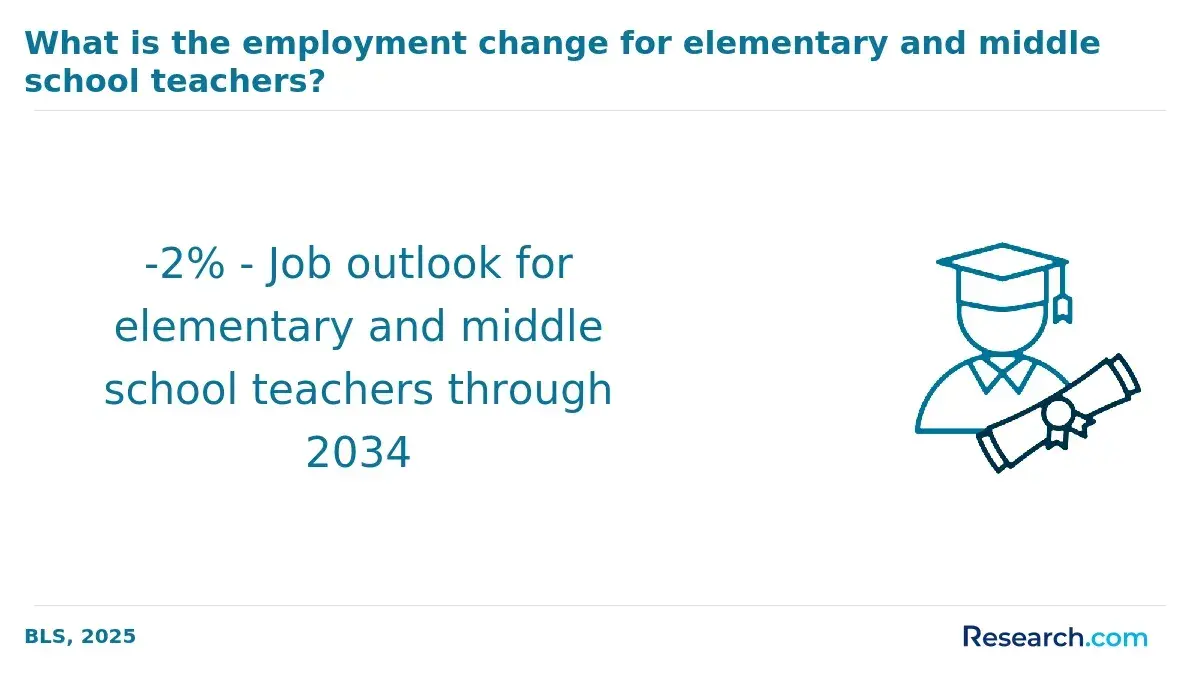
- Employment for elementary school teachers in the US is expected to decline by 2% through 2034.
How long does it take to complete Online Elementary Education Programs?
If you are asking, “How many years of college to be a teacher?” the standard answer is about four years for a bachelor’s degree. Most online elementary education programs follow the same credit expectations as campus programs, with students completing general education, major coursework, field experiences, and student teaching before graduation.
| Stage | Typical focus | Decision point for students |
| Freshman year | General education courses, introductory education classes, psychology, and child development | Confirm that teaching is the right career path before upper-division requirements begin. |
| Sophomore year | Educational psychology, classroom management, and early teaching methods | Check GPA, testing, and program admission requirements for the teacher preparation sequence. |
| Junior year | Methods for teaching elementary math, reading, language arts, science, and social studies | Plan for field placements and confirm that local school partnerships are available. |
| Senior year | Advanced coursework, student teaching or practicum, capstone work, and licensure preparation | Prepare certification documents and state exam requirements before graduation. |
Students considering a broader teaching degree should compare whether the program leads to elementary licensure, special education licensure, early childhood licensure, or a non-licensure education degree.
How do Online Elementary Education Programs compare to an on-campus program?
Both campus-based and online education degrees can prepare students for teaching, but the experience differs. Campus programs usually offer more face-to-face interaction and a fixed weekly schedule, while online programs emphasize flexibility, digital collaboration, and independent time management.
On-campus programs may be a better fit for students who want frequent in-person access to faculty, peer teaching practice, and a structured classroom rhythm. Online programs may work better for students who are employed, have family obligations, live far from campus, or need to complete coursework around school-based jobs.
The key comparison is not whether online or campus is “better.” The better choice is the one that is accredited, approved for licensure in your state, affordable for your budget, and strong in classroom placement support. Many online teaching degree programs include local fieldwork, so ask how placements are arranged before assuming you must find them on your own.
| Factor | Online elementary education program | On-campus elementary education program |
| Schedule | More flexible, often with asynchronous coursework | More fixed, with scheduled classes and campus meetings |
| Classroom practice | Usually completed locally through approved field placements | Often coordinated through nearby partner schools |
| Peer interaction | Discussion boards, video meetings, group projects, and virtual simulations | In-person classes, teaching labs, and campus-based collaboration |
| Best for | Working adults, rural students, career changers, and students needing schedule flexibility | Students who want campus life, in-person support, and a highly structured routine |
| Main risk | Weak placement support or licensure mismatch if not carefully verified | Higher commuting or housing costs and less scheduling flexibility |
What is the average cost of Online Elementary Education Programs?
Based on current tuition information from reviewed academic institutions, bachelor’s-level online elementary education programs may cost between $234 and $754 per credit in the US. Your final cost can change based on school type, residency status, enrollment load, transfer credits, required fees, books, technology, background checks, testing fees, and student teaching-related expenses.
Some public institutions charge different rates for in-state and out-of-state students, while others use a flat online tuition rate. Online students may save money on housing, transportation, and meal costs, but they should still budget for reliable internet, a suitable computer, webcam or video tools, software, and travel to required field placements.
Cost factors to compare before enrolling
- Tuition per credit. Multiply the per-credit price by the number of credits you still need, not just by the full program length.
- Transfer credit policy. A school with a higher per-credit rate may cost less overall if it accepts more prior credits.
- Licensure and testing fees. Teacher certification exams, background checks, fingerprinting, and state application fees can add to the total cost.
- Field placement logistics. Transportation, unpaid student teaching time, and schedule changes can affect your budget.
- Technology requirements. Online coursework may require updated hardware, stable internet, webcams, and specific software.
What are the financial aid options for students enrolling in Online Elementary Education Programs?
Students in eligible online elementary education programs may qualify for several types of financial aid. Always confirm that the institution and program meet federal aid eligibility rules before applying.
- Federal Pell Grants. These need-based grants support undergraduate students with exceptional financial need. Eligibility depends on factors such as financial need, cost of attendance, and enrollment status.
- Scholarships. Scholarships may be based on academic performance, service, career goals, financial need, or educator-specific criteria. Examples include the Jack Kinnaman Scholarship Fund, the Teachers of Tomorrow Scholarship, and the Robert Noyce Teacher Scholarship Program.
- Federal Direct Loans. Undergraduate and graduate students may use these loans to help cover education costs. Subsidized loans are need-based, while unsubsidized loans are not limited to students with financial need.
How to reduce the cost of an online elementary education degree
- Submit the FAFSA early and confirm whether your program is eligible for federal aid.
- Ask each school for an official transfer credit evaluation before committing.
- Compare total program cost instead of focusing only on tuition per credit.
- Look for teacher scholarships, state grants, district partnerships, and service-based awards.
- Ask whether student teaching is unpaid and plan financially for that term.
What are the prerequisites for enrolling in Online Elementary Education Programs?
In the fall of 2025, a total of 439,730 undergraduate students enrolled in education fields, representing a 0.2% change from the previous year. Admission requirements vary by institution, but applicants should be ready to provide academic records and meet program-specific standards.
- High School Diploma or High School Equivalency (HSE). Applicants generally need to show proof of high school completion or an HSE credential.
- Transcript of Records. Schools typically require official transcripts from high school and any colleges previously attended.
- Prerequisite Coursework. Some programs expect applicants to complete introductory coursework in areas such as mathematics, English, psychology, or education before entering upper-division teacher preparation courses.
- GPA. Many programs set minimum GPA requirements, often between 2.0 and 3.0 on a 4.0 scale, although each institution determines its own standard.
- Letters of Recommendation. Some schools ask for recommendations from teachers, employers, supervisors, or others who can speak to the applicant’s readiness for teaching.
What courses are typically in Online Elementary Education Programs?
Online elementary education programs are designed to help future teachers understand how children learn, how to teach core subjects, and how to manage classrooms. Course titles differ by school, but common requirements include the following:
- Introduction to Elementary Education. Students examine the purpose of elementary schooling, the history of education, learning theories, teacher responsibilities, and the structure of today’s schools.
- Child Development and Psychology. This course studies children’s physical, cognitive, social, and emotional growth from infancy through adolescence and connects those stages to classroom instruction.
- Instructional Strategies for Elementary Education. Students learn how to plan lessons, adapt instruction, support different learning needs, manage behavior, and assess student progress.
- Literacy Development and Instruction. This course focuses on reading, writing, speaking, listening, vocabulary, comprehension, and evidence-based literacy teaching methods.
- Mathematics Education for Elementary Teachers. Future teachers learn how to explain elementary math concepts, build problem-solving skills, support mathematical reasoning, and align instruction with curriculum standards.
What types of specializations are available in Online Elementary Education Programs?
Specializations help students align their degree with specific learner needs, grade levels, or subject interests. Not every online elementary education program offers concentrations, so verify options before applying.
| Specialization | What it focuses on | Best for students who want to... |
| Special Education | Individualized instruction, disability support, accommodations, and inclusive teaching strategies | Teach or support students with diverse learning needs. |
| STEM | Science, technology, engineering, and mathematics instruction for elementary learners | Strengthen hands-on, inquiry-based learning in math and science. |
| Literacy and Language Arts | Reading comprehension, writing development, language acquisition, and communication skills | Focus on early reading, writing, and literacy intervention. |
| Early Childhood Education | Developmentally appropriate teaching for young children, often kindergarten through third grade | Work with younger elementary learners or transition toward early childhood settings. |
| English as a Second Language (ESL) | Language acquisition, cultural responsiveness, and support for English language learners | Teach in multilingual classrooms or serve students learning English. |
How to choose the best Online Elementary Education Programs?
The best online elementary education program is the one that fits your state licensure goals, budget, schedule, and learning needs. Rankings can help you create a shortlist, but they should not replace your own verification process.
- Accreditation. Confirm that the institution is regionally accredited and check whether the teacher preparation program is accredited or approved by a recognized body such as CAEP when relevant.
- State licensure alignment. Ask whether the program meets certification requirements in the state where you plan to teach.
- Curriculum. Review whether coursework covers pedagogy, child development, elementary subject methods, assessment, special education, and diversity.
- Field placements. Choose a program with clear support for observation hours, practicum, and student teaching placements.
- Student support. Look for advising, licensure guidance, tutoring, career services, technology help, and mentor access.
- Total cost. Compare tuition, fees, transfer credits, testing costs, and student teaching expenses.
Questions to ask admissions advisors before enrolling
- Is this program approved for elementary teacher licensure in my state?
- Who arranges student teaching placements, and can they be completed near my home?
- What certification exams, background checks, or field hours are required?
- How many transfer credits will the program accept?
- Are there synchronous class meetings, and when are they scheduled?
- What happens if I move to another state before graduation?
- What percentage of students complete student teaching and graduate from the program?
What are the accreditation considerations for choosing an Online Elementary Education Program?
Accreditation is one of the most important checks for any online elementary education degree. Institutional accreditation shows that the college or university meets recognized academic standards. Programmatic accreditation or state approval can also matter because teacher preparation programs must often satisfy specific educator preparation requirements.
For aspiring teachers, accreditation from organizations such as the Council for the Accreditation of Educator Preparation (CAEP) or the National Council for Accreditation of Teacher Education (NCATE) can signal that a program has been reviewed against educator preparation standards. However, licensure is state-specific, so students should not rely on accreditation alone. Always confirm with the state education agency where you plan to teach.
Accreditation can also affect financial aid eligibility and employer recognition. Students comparing affordability and quality may want to review accredited options for an online education degree while still checking whether the program leads to the exact certification they need.
Common mistakes when choosing an online elementary education program
- Assuming every education degree leads to licensure. Some programs are non-licensure and are not designed for classroom teacher certification.
- Checking national accreditation but not state approval. A program can be reputable and still fail to meet your state’s teacher certification requirements.
- Comparing tuition only. Fees, testing costs, lost wages during student teaching, and transfer credit rules can change the real cost.
- Ignoring field placement support. Student teaching is often the most complicated part of an online teacher preparation program.
- Relying only on rankings. A highly ranked program may not be the best fit for your state, schedule, or budget.
What advanced degrees can enhance an elementary education career?
A bachelor’s degree can prepare graduates for initial teaching roles, but advanced degrees may support movement into leadership, curriculum, special education, research, or administration. A master’s degree in education administration or curriculum and instruction can be useful for educators pursuing instructional coordinator, teacher leader, or principal pathways.
Educators interested in higher-level leadership, policy, or applied research may also consider doctoral study. Cost-conscious students can compare options such as the cheapest online EdD programs to understand how doctoral programs differ by cost, format, and career focus.
What career paths are available for graduates of Online Elementary Education Programs?
Most graduates pursue classroom teaching, but elementary education training can also support instructional, administrative, and student support roles. Some positions require additional certification, graduate education, or experience.
| Career path | Typical role | Salary information provided | Additional preparation to consider |
| Elementary School Teacher | Teaches core subjects to kindergarten through fifth-grade students, plans lessons, assesses learning, and builds a supportive classroom environment | Median annual wage of $62,340; about 1.4 million employed across the US | State teacher licensure |
| Instructional Coordinator | Develops curriculum, supports teachers, analyzes instructional materials, and helps align teaching with standards | Median annual wage of $74,720 | Teaching experience and often graduate education |
| Elementary School Principal | Leads school operations, supervises staff, manages resources, supports instruction, and shapes school culture | Elementary, middle, and high school principals had a median annual wage of $104,070 | A master's degree online in educational administration or a doctorate in education administration may be useful |
| Special Education Teacher | Provides specialized instruction and support for students with diverse learning needs | Median annual wage of $63,000 | A masters in special education can deepen preparation |
| Educational Consultant | Advises schools, districts, or organizations on curriculum, instruction, policies, and learning strategies | Average annual salary of $94,974 | Experience, specialized expertise, or graduate study such as a masters in secondary education online |
How do online elementary education programs bridge online learning with classroom realities?
Strong online elementary education programs connect virtual coursework with hands-on classroom preparation. They may use supervised field experiences, micro-teaching assignments, recorded teaching demonstrations, live simulations, and partnerships with local schools. These experiences help students practice lesson delivery, respond to student behavior, differentiate instruction, and receive feedback from mentor teachers.
Students should ask how much classroom experience is required, when it begins, who supervises it, and whether placements are available in their region. Educators who later want to move into applied research or leadership can also explore affordable EdD programs that build on classroom experience.
Do employers recognize online elementary education degrees?
Employers are generally more interested in accreditation, licensure eligibility, student teaching quality, references, classroom readiness, and certification status than in whether coursework was completed online. A properly accredited online program with supervised fieldwork can be a credible path into teaching.
Online graduates may also bring strengths that schools value, including digital communication, learning management system experience, and comfort with education technology. Continued professional development can further improve career mobility, particularly for educators exploring jobs with a masters in education.
What challenges do online elementary education graduates encounter in their early careers?
New teachers from any pathway can struggle with classroom management, lesson pacing, parent communication, differentiation, and workload. Online graduates may face an added adjustment if their program offered limited face-to-face teaching practice before student teaching.
The best way to reduce this risk is to choose a program with early field experiences, strong mentor feedback, live teaching practice, and clear licensure support. After graduation, induction programs, district mentoring, professional learning communities, and advanced credentials can help teachers strengthen classroom confidence. Some educators also use graduate study to pursue jobs with a masters in education beyond the classroom.
What is the job market for graduates of Online Elementary Education Programs?
Students often ask, “Are teachers in demand?” The answer depends on location, certification area, and school type. Employment for elementary school teachers is projected to decrease by 2% through 2034, but the occupation is still expected to provide 91,000 annual openings.
Entry-level education-related roles that may require a high school diploma or an associate degree certification in education, such as childcare workers and teacher assistants, are expected to have no change or declining employment levels. Teacher assistants are projected to have an employment change of -1.5% with 170,400 annual openings, while childcare workers have a projected employment outlook of -2.9% with 160,200 openings.
Job prospects may be stronger in certain regions, especially places experiencing population changes or facing teacher shortages. Candidates with preparation in special education, bilingual education, literacy, or high-need locations may have more options than candidates with only general preparation.
How do online elementary education programs address diversity and inclusion?
Elementary teachers work with students from different linguistic, cultural, economic, academic, and family backgrounds. Online elementary education programs may address this through coursework in culturally responsive teaching, differentiated instruction, special education, anti-bias education, classroom equity, and support for English language learners.
Students should look for programs that do more than mention diversity in a course description. Strong preparation includes case studies, field experiences in varied school settings, reflection assignments, and practical strategies for building inclusive classrooms. Educators interested in school libraries, literacy resources, and information access may also explore related pathways such as jobs with library science degree.
How do online elementary education programs prepare you for teacher licensure and certification?
Licensure preparation should be one of the first things you verify. A strong online elementary education program aligns coursework, field placements, student teaching, and assessment preparation with state certification standards. Programs may also guide students through background checks, exam registration, portfolio requirements, and state application steps.
Because licensure rules vary by state, ask the program directly whether it prepares graduates for certification where you intend to teach. If you plan to work across school resource or library environments, reviewing options such as the cheapest online MLIS programs may help you understand related education pathways.
How Do Online Elementary Education Programs Ensure Quality Outcomes and Graduate Success?
Quality online elementary education programs measure whether students are progressing academically and becoming classroom-ready. They may track retention, course completion, field experience performance, student teaching evaluations, licensure exam preparation, and graduate employment indicators.
Students should ask programs for clear outcome information rather than relying on marketing claims. Useful questions include: How are student teachers evaluated? What support exists for struggling candidates? How often is the curriculum reviewed? What partnerships exist with school districts? Educators who want deeper expertise in learning and student development may also consider a masters in child development.
What technology skills are essential for graduates of online elementary education programs?
Elementary teachers increasingly use digital tools for instruction, communication, assessment, differentiation, and classroom organization. Online students often gain these skills naturally through their coursework, but they should also practice applying them with children in real teaching settings.
- Learning Management System (LMS) Proficiency. Teachers should know how to use tools such as Canvas, Google Classroom, and Blackboard to post assignments, organize materials, communicate with families, and monitor student progress.
- Digital Assessment Tools. Platforms such as Kahoot, Quizlet, and Edmodo can help teachers create quizzes, checks for understanding, and interactive review activities.
- Virtual Communication Platforms. Tools such as Zoom, Microsoft Teams, and Google Meet are useful for remote instruction, parent meetings, tutoring, and collaboration.
- Educational Content Creation. Teachers benefit from using Canva, Prezi, Google Slides, and similar tools to build visual, accessible, and engaging learning materials.
- Data Management and Analysis. Basic skill with Microsoft Excel and Google Sheets can help teachers track student performance and identify learning patterns.
- Cybersecurity Awareness. Teachers must protect student information, use secure access practices, and understand school data privacy rules.
- Assistive Technology for Special Needs. Tools such as text-to-speech programs, audiobooks, and screen magnifiers can help teachers support students with varied learning needs.
What Opportunities Exist for Further Education and Specialization After Completing an Online Elementary Education Program?
An online elementary education degree can be the starting point for several advanced pathways. Teachers may pursue graduate study in curriculum and instruction, educational leadership, reading and literacy, special education, child development, education technology, or administration.
Educators interested in policy, research, higher education, or senior administrative roles may consider doctoral study, including an online PhD higher education. The right next step depends on whether you want to stay in the classroom, become a specialist, move into leadership, or work in education research or policy.
How do online elementary education programs support professional networking and mentoring?
Online students should not assume they will be isolated. Many programs provide virtual advising, cohort discussions, online mentoring, career services, faculty office hours, and school district connections. These supports can help students understand licensure requirements, prepare for interviews, and learn from experienced teachers.
Professional networking is especially important for student teaching placements and first teaching jobs. Ask whether the program has district partnerships, alumni groups, mentor teacher networks, or job placement assistance. Educators who later want to teach adults, train teachers, or work in professional development may also consider an online master's in adult education.
Can Accelerated Programs Fast-Track Your Elementary Education Career?
Accelerated online elementary education programs can shorten the path to graduation by using condensed terms, year-round scheduling, heavier course loads, or transfer-friendly structures. They may appeal to career changers, paraprofessionals, or students with prior college credit.
Speed should not come at the expense of licensure preparation. Before choosing an accelerated format, confirm that fieldwork, student teaching, and certification requirements are fully included. Students comparing time-to-completion options can review accelerated teaching degree programs to understand how faster pathways may work.
What is the role of technology and innovation in online elementary education?
Technology is changing how future teachers learn and how elementary classrooms operate. In 2027, online elementary education programs may use artificial intelligence (AI), virtual simulations, video feedback, adaptive learning tools, gamified activities, and digital collaboration platforms to help candidates practice instructional decision-making.
AI-powered tools can support practice with assessment, lesson planning, and differentiated instruction, but they do not replace teacher judgment. Future educators must learn how to use technology ethically, protect student data, verify content accuracy, and choose tools that support learning goals rather than distract from them.
Virtual reality, simulations, and gamified learning can help students visualize historical events, science processes, classroom scenarios, and problem-solving activities. These tools are most useful when they are connected to strong pedagogy, clear learning objectives, and age-appropriate instruction.
Students interested in teaching younger learners may also compare programs such as an affordable early childhood education degree online to see whether early childhood or elementary education better matches their preferred age group and career goals.
Key Insights
- An online elementary education degree can be a practical route into teaching, but only if it is accredited, state-aligned, and includes approved fieldwork and student teaching.
- Online coursework offers flexibility, but licensure-focused programs still require in-person classroom experience.
- Program cost should be evaluated by total degree price, transfer credits, fees, licensure expenses, and student teaching logistics—not tuition alone.
- Elementary school teachers had a median annual wage of $62,340, while advanced roles such as instructional coordinator and principal generally require additional experience or graduate education.
- Employment for elementary school teachers is projected to decline by 2% through 2034, but 91,000 annual openings are still expected, with opportunities varying by region and specialization.
- Before enrolling, ask whether the program meets certification requirements in your state, who arranges field placements, and what support exists for licensure exams and first-job preparation.
References
- Learning Policy Institute. (2025, July). An Overview of Teacher Shortages: 2025 Fact Sheet. https://learningpolicyinstitute.org/media/4764/download?inline&file=Teacher_Shortages_Overview_2025_FACTSHEET.pdf
- National Student Clearinghouse Research Center. (2026, January 15). Final Fall Enrollment Trends. https://nscresearchcenter.org/final-fall-enrollment-trends
- U.S. Bureau of Labor Statistics. (2025, August 28). Occupational projections, 2024–2034, and worker characteristics. Retrieved February 2026, from https://www.bls.gov/emp/tables/occupational-projections-and-characteristics.htm
- ZipRecruiter. (2026). Educational Consultant Salary. Retrieved March 2026, from https://www.ziprecruiter.com/Salaries/Educational-Consultant-Salary
Other Things You Should Know about Online Elementary Education Programs
Most online elementary education programs require at least 100 hours of supervised fieldwork before student teaching, and a full-time student-teaching placement usually lasts 12 to 16 weeks. Programs aligned to state licensure also require placement in a K–6 classroom approved by the university.
Financial aid for 2027's top online elementary education programs includes federal grants, scholarships, and student loans. Eligible students should fill out the FAFSA for detailed assistance options. Some programs may offer institution-specific scholarships, so check directly with each university's financial aid office.
In 2027, some of the best online elementary education programs that offer notable student teaching opportunities include the University of Florida, Arizona State University, and University of Cincinnati. These programs emphasize hands-on experience, providing diverse placements and extensive mentorship to prepare students for successful teaching careers.
The best 2027 online elementary education programs integrate tools like interactive whiteboards, digital storytelling apps, and learning management systems to enhance teaching and learning experiences. These technologies foster engagement and a more personalized education for students.


