
2027 Is an MFT Degree Worth It?

Co-Founder and Chief Data Scientist
A master’s in marriage and family therapy is not just another counseling degree. It is a licensure-focused graduate path for people who want to help clients understand mental health concerns through relationships, family systems, communication patterns, conflict, trauma, and life transitions. The degree can lead to meaningful clinical work, but it also requires years of graduate study, supervised practice, licensing exams, emotional stamina, and a clear financial plan.
This guide is for prospective students asking whether an MFT degree is worth the time, cost, and licensing process. You will learn how the degree works, how it compares with psychology and social work, what licensing usually requires, what jobs graduates pursue, how salaries vary, how to compare programs, and what mistakes to avoid before enrolling.
Quick answer: Is an MFT degree worth it?
An MFT degree can be worth it if your goal is to become a licensed therapist who works with couples, families, and individuals through a relational and systems-based lens. The path usually requires a bachelor’s degree, a master’s degree, supervised clinical experience, a licensing exam, and state approval. The median salary for marriage and family therapists is around $58,510 per year, and the U.S. Bureau of Labor Statistics projects 16% employment growth for MFTs from 2023 to 2033. However, the degree is less ideal if you want a shorter training path, dislike emotionally intensive work, or need immediate high earnings after graduation.
Key things to know before choosing an MFT degree
- Marriage and family therapists diagnose and treat cognitive, behavioral, emotional, and relational disorders involving individuals, couples, families, and other close relationships.
- Licensure generally requires a master’s degree, supervised clinical hours, a licensing exam, and compliance with state-specific rules.
- Salary outcomes vary by state, setting, specialization, caseload, and experience; the median salary is around $58,510 per year.
- How to earn a marriage and family therapy degree
- MFT vs. psychology vs. social work: which path fits your goals?
- How long it takes to become a licensed MFT
- Common courses in a marriage and family therapy program
- How to choose the right MFT graduate program
- Jobs you can pursue with a master’s in marriage and family therapy
- Scholarships and financial aid for MFT students
- How much MFT graduates earn
- Job outlook and career growth for MFT graduates
- Challenges of working as a marriage and family therapist
- Professional development options for MFTs
- Faith-based approaches in MFT practice
- Doctoral study after an MFT degree
- Research and evidence-based practice for MFTs
- How to evaluate MFT degree ROI
- Cultural competence in MFT practice
- Using psychology study to strengthen MFT practice
- Condensed online degree formats and career flexibility
- Common mistakes to avoid before enrolling
How do you obtain a marriage and family therapy degree?
The MFT path is built around one main goal: preparing you for state licensure as a marriage and family therapist. Exact requirements differ by state, but most students move through the same broad sequence of education, supervised experience, examination, and licensure application.
- Complete a bachelor’s degree. MFT master’s programs typically require an undergraduate degree, though the major does not always have to be psychology or counseling. Still, coursework in psychology, human development, sociology, social work, or counseling can make graduate study easier. Students comparing helping professions may also review how to become a substance abuse counselor, since addiction counseling and MFT training can overlap in family systems, relapse support, and client communication.
- Enroll in a master’s program in marriage and family therapy. Choose a program designed for licensure preparation, preferably one aligned with recognized accreditation standards such as COAMFTE or CACREP. Many programs take 2–3 years to complete and include family systems theory, ethics, assessment, diagnosis, counseling techniques, and practicum experience. If cost is a major factor, comparing the cheapest CACREP-accredited programs online can help you understand how counseling-related programs differ in affordability and licensure preparation.
- Complete supervised clinical training during the degree. Many programs include at least 500 hours of supervised therapy work before graduation. This is where students begin applying theory with real clients under faculty or site supervision.
- Pass the required licensing exam. After graduation, candidates generally take the National MFT Exam or a state-specific exam. The exam confirms that candidates understand clinical, ethical, diagnostic, and professional standards.
- Accumulate postgraduate supervised hours. Most states require 2,000–4,000 hours of supervised clinical work after graduation before full independent licensure. This period typically takes 2–4 years.
- Apply for state licensure. Once you meet your state’s education, supervision, and exam requirements, you can apply for LMFT status. Always check the licensing board in the state where you plan to practice, especially if you attend an online or out-of-state program.
- Consider focused training after licensure. Many therapists pursue additional training in trauma, addiction, child and adolescent therapy, couples therapy, sex therapy, or culturally responsive care. Those who want doctoral-level clinical training may later compare online PsyD programs accredited by recognized bodies. If you are deciding between school-based and family-focused counseling careers, it can also help to review the requirements to be a school counselor.
| Stage | Typical requirement | Why it matters |
| Bachelor’s degree | Usually four years | Provides the academic foundation required for graduate admission |
| MFT master’s degree | Usually 2–3 years full time | Provides required clinical coursework and practicum preparation |
| Graduate clinical training | At least 500 supervised hours in many programs | Builds direct therapy skills before graduation |
| Postgraduate supervision | 2,000–4,000 hours in most states | Required before full independent licensure |
| Licensing exam and application | National MFT Exam or state-specific test | Confirms readiness to practice under state rules |
How is an MFT degree different from a psychology or social work degree?
MFT, psychology, and social work degrees can all lead to mental health careers, but they are not interchangeable. The best choice depends on the type of clients you want to serve, the problems you want to treat, the license you want, and the settings where you hope to work.
| Path | Main focus | Common practice lens | Typical credential or outcome | Good fit if you want to... |
| Marriage and family therapy | Relationships, couples, family systems, and relational patterns | Systemic therapy that looks at how people affect one another within families and close relationships | LMFT | Provide therapy to couples, families, and individuals while focusing on relational context |
| Psychology | Individual mental health, assessment, diagnosis, behavior, cognition, and research | Individual therapy, psychological assessment, testing, and evidence-based intervention | Clinical psychologist through PhD/PsyD training or other psychology-related roles | Conduct assessment, research, or advanced clinical work requiring doctoral-level preparation |
| Social work | Individuals, families, communities, advocacy, case management, and social systems | Person-in-environment perspective combining therapy, services coordination, and systems advocacy | LCSW or related social work credentials | Combine therapy with advocacy, community resources, healthcare navigation, or public service |
An MFT degree is usually the strongest match if you want your clinical identity to center on relationships and family systems. Psychology may be a better match if you are drawn to psychological testing, doctoral study, or research. Social work may fit better if you want to combine therapy with case management, policy, healthcare systems, or community-based service.
Some readers comparing helping professions also explore adjacent graduate fields. For example, where can you get a master’s in real estate online is not a therapy pathway, but students interested in housing stability, community development, or property-related services for vulnerable populations may encounter related interdisciplinary work outside clinical practice.
How long does it take to become a licensed MFT?
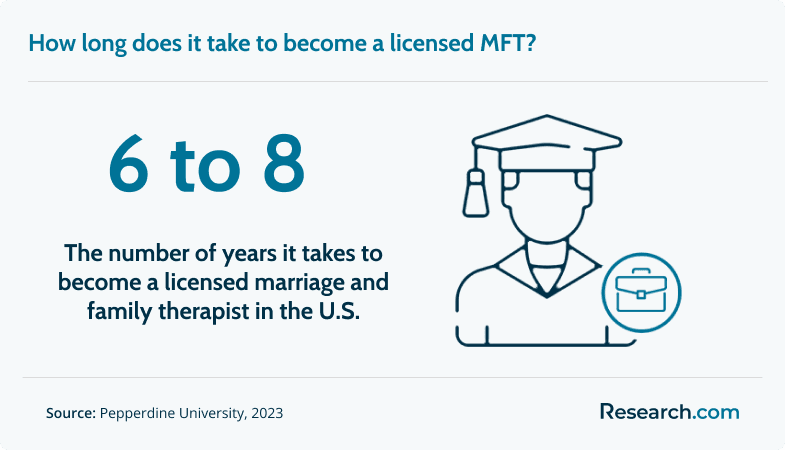
From the start of undergraduate study to full MFT licensure, the process can take about six to eight years. The timeline depends on whether you study full time or part time, how quickly you complete clinical hours, and the licensing rules in your state.
A bachelor’s degree usually takes four years. A master’s in marriage and family therapy typically takes two to three years of full-time study. Some accelerated programs may be completed in as little as 18 to 24 months, while part-time students may need four to five years. During the master’s program, students commonly complete at least 500 hours of supervised clinical training.
After graduation, candidates usually need another 2 to 4 years to complete 2,000 to 4,000 hours of postgraduate supervised clinical work. During this stage, graduates may be able to work under a provisional or associate license, but full independent practice generally requires completing supervised hours, passing the National MFT Exam or a state-specific licensing exam, and receiving approval from the state board.
| Timeline question | Typical answer |
| How long is the bachelor’s degree? | Usually four years |
| How long is the MFT master’s degree? | Typically two to three years full time |
| Can the master’s be faster? | Some accelerated options may take 18 to 24 months |
| How long can part-time study take? | Often four to five years |
| How long is postgraduate supervision? | Usually 2 to 4 years, depending on state rules and work pace |
| Total path to licensure | About six to eight years from the start of undergraduate study |
If your long-term interest is healthcare-based mental health support rather than therapy licensure, you may also compare clinical care routes such as women’s health nurse practitioner online programs. These are different professional pathways, but they can overlap in patient education, behavioral health awareness, and whole-person care.
What types of courses do you take in a Marriage and Family Therapy program?
MFT coursework combines theory, diagnosis, ethics, supervised practice, and clinical skill development. The curriculum is designed to teach students how to understand symptoms not only within the individual client, but also within relationships, families, culture, and environment.
- Theories of marriage and family therapy: Students study major therapy models such as systems theory, cognitive-behavioral therapy, and narrative therapy. The goal is to learn how different models explain relational distress and guide treatment planning.
- Human development and lifespan psychology: This coursework examines social, emotional, and psychological development across childhood, adolescence, adulthood, and later life. Students learn how trauma, attachment, transitions, and family patterns can shape mental health.
- Clinical assessment and diagnosis: Students learn how to assess symptoms, use the DSM-5, and understand diagnoses in relational context. This is especially important when treating couples or families where one person’s symptoms affect the entire system.
- Ethics and professional issues in MFT: Courses cover confidentiality, mandated reporting, informed consent, boundaries, professional conduct, cultural responsiveness, and legal responsibilities.
- Practicum and supervised clinical training: Students complete 500+ hours of supervised therapy experience in settings such as clinics, hospitals, community agencies, or private practice training sites.
| Course area | Skills you should gain | Why employers and licensing boards care |
| Family systems theory | Understanding patterns across couples and families | MFT practice is built around relational assessment and intervention |
| Diagnosis and assessment | Identifying mental health concerns and treatment needs | Therapists must document, diagnose, and plan care responsibly |
| Ethics and law | Handling confidentiality, safety, and mandated reporting | Clinical work carries legal and professional obligations |
| Practicum | Providing therapy under supervision | Hands-on training is essential for licensure readiness |
| Cultural competence | Working respectfully across identities and lived experiences | Effective therapy requires awareness of culture, power, bias, and context |
How do I choose the right MFT graduate program?
The best MFT program is not automatically the most famous, cheapest, or fastest option. The right program is the one that prepares you for licensure in your target state, gives you strong clinical supervision, fits your schedule, and does not leave you with debt that your expected earnings cannot reasonably support.
- Start with accreditation and licensure alignment. Look for programs accredited by COAMFTE, the Commission on Accreditation for Marriage and Family Therapy Education, or CACREP, when applicable to your goals. Accreditation can affect licensure eligibility, transferability, employer trust, and doctoral admissions.
- Check whether the program meets your state’s requirements. This is especially important for online programs. A program may be legitimate but still not meet every requirement in the state where you plan to practice.
- Review clinical placement support. Ask whether the school finds practicum sites for students, helps with placements, or leaves students to secure sites independently. Clinical placement quality can strongly affect your readiness and stress level.
- Compare faculty expertise. Faculty experience in couples therapy, trauma, addiction, child and adolescent therapy, grief, sexuality, or multicultural practice can shape your training.
- Evaluate schedule flexibility. Online, hybrid, evening, part-time, and self-paced coursework can help working adults, but therapy training still requires supervised clinical practice. Students who need maximum scheduling flexibility may also compare accredited self-paced online colleges to understand how flexible formats work across higher education.
- Calculate the full cost, not just tuition. Include fees, books, supervision costs, commuting, technology, exam fees, and the possibility of reduced work hours during practicum.
Questions to ask before enrolling
| Question | Why it matters |
| Does this program meet licensure requirements in the state where I plan to practice? | Licensure rules are state-specific, and out-of-state or online programs may require extra review. |
| Is the program COAMFTE-accredited, CACREP-accredited, or otherwise recognized by my licensing board? | Accreditation can reduce uncertainty when applying for licensure. |
| Who arranges practicum and internship placements? | Placement support can affect whether you graduate on time. |
| How many supervised hours are included before graduation? | Many programs require at least 500 hours, but structures vary. |
| What are recent graduate outcomes? | Ask about exam pass rates, licensure progress, employment settings, and alumni support. |
| Can I continue working while enrolled? | Even flexible programs may require daytime clinical hours. |
What jobs can you get with a master's in marriage and family therapy?
A master’s in MFT most directly prepares graduates for work as marriage and family therapists, but the degree can also support related counseling, supervisory, school-based, addiction, and rehabilitation roles depending on state rules, employer requirements, and additional credentials.
| Role | What you may do | Average salary stated |
| Marriage and Family Therapist | Provide therapy for individuals, couples, and families dealing with relationship conflict, trauma, addiction, communication problems, and mental health concerns. | $58,510 |
| Clinical Supervisor or Program Director | Oversee therapists, supervise clinical services, manage programs, and support quality control in agencies or treatment settings. | $110,680 |
| School Counselor | Support students with emotional, family, academic, bullying, and stress-related concerns, depending on credential requirements. | $61,710 |
| Substance Abuse Counselor | Help clients and families address addiction, recovery, relapse prevention, and treatment planning. Students interested in this specialization can review how to become a substance abuse counselor. | $53,710 |
| Rehabilitation Counselor | Support people adjusting to disability, injury, trauma, or major life changes through counseling and reintegration planning. | $61,710 |
These roles differ in licensing expectations. Some positions require an LMFT, some require another counseling credential, and some may require education-specific credentials. Before choosing a specialization, confirm the credential required by employers in your state.
What scholarships and financial aid options exist for MFT students?
Because MFT training usually requires graduate study and clinical hours, financing should be part of your decision from the beginning. Students may combine federal aid, institutional scholarships, professional association funding, private grants, and employer benefits.
- Federal Student Aid through FAFSA: Completing the Free Application for Federal Student Aid can make students eligible for federal loans, grants, and work-study opportunities.
- State and school-based scholarships: Some states and universities offer awards for students entering mental health, counseling, or service-focused professions. Eligibility may be based on need, merit, career goals, or commitment to underserved communities.
- Professional association funding: Groups such as the American Association for Marriage and Family Therapy (AAMFT) may offer scholarships, fellowships, or student resources for future MFTs.
- Private scholarships and grants: Foundations, local organizations, and community groups may fund graduate students based on academic record, background, service plans, or professional interest.
- Employer tuition assistance: If you already work in healthcare, education, social services, or a nonprofit organization, ask whether your employer helps pay for graduate coursework.
Ways to reduce the cost of an MFT degree
- Choose a program that meets licensure requirements the first time, so you do not pay for extra coursework later.
- Compare total program cost, including fees and supervision-related expenses.
- Ask whether graduate assistantships, tuition discounts, or paid clinical placements are available.
- Consider part-time study if it allows you to keep income and benefits while enrolled.
- Apply early for scholarships, because many awards have deadlines before admission decisions are finalized.
How much do MFT graduates make on average?
The median annual salary for MFTs is generally around $58,510, but earnings can differ substantially by state, work setting, experience, client population, and specialization. Private practice, specialty treatment areas, high-demand regions, and leadership roles may produce different income patterns than community mental health, schools, or nonprofit agencies.
Location can make a major difference. MFTs in Washington, which has the highest demand for therapists, often earn around $96,277 per year on average. In New York, the figure is around $92,999 annually. Other higher-than-average states listed for MFT salaries include Massachusetts at $92,837, Alaska at $91,546, and Vermont at $90,382.
| State | Average salary stated |
| Washington | $96,277 |
| New York | $92,999 |
| Massachusetts | $92,837 |
| Alaska | $91,546 |
| Vermont | $90,382 |
Salary should not be evaluated in isolation. A higher-paying state may also have higher housing, insurance, and practice costs. If you plan to enter private practice, account for unpaid administrative time, marketing, billing, office space, telehealth tools, and gaps between sessions.
Is an MFT degree worth it for job prospects and career growth?
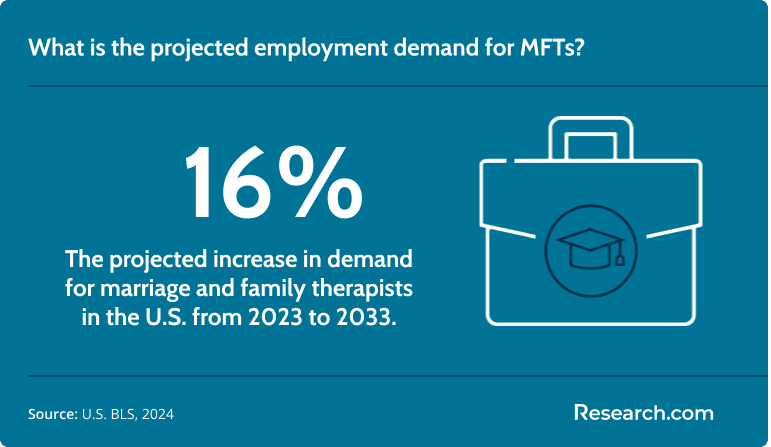
For students committed to clinical therapy, the labor market outlook is one of the stronger arguments for the degree. The U.S. Bureau of Labor Statistics projects 16% employment growth for marriage and family therapists from 2023 to 2033, which is much faster than the average for all occupations. Demand is tied to continued need for mental health services, relationship counseling, family therapy, addiction support, and integrated behavioral care.
The degree can also support career growth because MFTs can build expertise in specific populations or treatment areas. Common areas include couples therapy, trauma, addiction counseling, child and adolescent therapy, grief, perinatal mental health, military families, and high-conflict family systems. Some students also add healthcare-related training, and resources on medical certificate programs can help them understand short credential options outside the MFT license itself.
When an MFT degree is likely worth it
- You want to become a licensed therapist, not simply study relationships academically.
- You are comfortable with a multi-year licensure process after graduate school.
- You want to work with couples, families, and relational systems.
- You can choose a program that meets state licensure requirements and fits your budget.
- You are prepared for emotionally demanding work and ongoing supervision or consultation.
When another path may be better
- You want a faster route into the workforce with less graduate education.
- You prefer psychological testing, research, or doctoral-level assessment work.
- You want case management, policy, or social services to be central to your role.
- You need high earnings immediately after graduation and cannot manage the supervised licensure period financially.
- You are not interested in working with relationship dynamics, conflict, and family systems.
What are the biggest challenges of being a marriage and family therapist?
MFT work can be deeply meaningful, but it is not easy. Therapists often work with clients during painful, high-conflict, or traumatic periods. Before committing to the degree, consider whether the challenges match your temperament and support system.
- Emotional fatigue and burnout: Listening to trauma, conflict, grief, betrayal, addiction, and family distress can be draining over time. Therapists need boundaries, supervision, consultation, and self-care habits. Students interested in how cognition and mental processes affect therapy work may also explore cognitive psychology careers.
- Client resistance: Some clients attend therapy reluctantly, especially in couples or family sessions. Progress may be slow when partners or family members disagree about goals.
- Complex family dynamics: MFTs often manage multiple perspectives in the same session. Remaining balanced, ethical, and clinically useful can be difficult when conflict is intense.
- Confidentiality and ethical judgment: Therapists must protect privacy while responding appropriately to safety issues, abuse concerns, threats of harm, and mandated reporting requirements.
- Work-life balance: Evening appointments, large caseloads, private practice administration, documentation, and crisis situations can stretch the workweek beyond scheduled sessions.
How can I enhance my professional development as an MFT?
Professional growth in MFT usually happens through continuing education, supervision, advanced certifications, peer consultation, and specialization. Strong therapists keep learning after licensure because clinical practice changes as new research, laws, technology, and client needs emerge.
- Pursue continuing education in evidence-based models relevant to your client population.
- Join professional organizations for ethics updates, networking, and training opportunities.
- Seek mentorship from experienced LMFTs, especially if you plan to open a private practice.
- Track outcomes and reflect on which interventions are helping clients improve.
- Use career resources such as how to become a family therapist to map the steps from education through licensure and advancement.
Can integrating faith-based perspectives enhance my MFT practice?
Faith-based perspectives can strengthen therapy when they are used ethically, respectfully, and only when aligned with the client’s values and consent. For clients who see spirituality as central to healing, a therapist who understands religious language, family beliefs, and spiritual coping may be better equipped to build trust.
Training in this area should not replace clinical competence. Instead, it should complement evidence-based practice, ethical boundaries, cultural humility, and respect for client autonomy. Students interested in this niche can review options such as a Christian counseling grad degree to understand how some programs integrate counseling skills with spiritual frameworks.
Should I consider an online MFT program?
An online MFT program can be a strong option if it is accredited or otherwise accepted by your state licensing board, provides meaningful clinical placement support, and offers the supervision structure needed for licensure preparation. The format can help working adults, caregivers, and students outside major metro areas access graduate training, but online coursework does not remove the need for in-person or approved supervised clinical experience.
| Online MFT programs may work well if... | Be cautious if... |
| You need flexible coursework around work or family obligations. | The school cannot clearly explain whether it meets your state’s licensure requirements. |
| The program helps students secure local clinical placements. | You must find practicum sites entirely on your own with little support. |
| Faculty are accessible for supervision, advising, and professional guidance. | The program relies mostly on asynchronous coursework with limited clinical interaction. |
| Total cost is manageable compared with expected earnings. | The advertised tuition excludes major fees, travel, supervision, or technology costs. |
Prospective students comparing flexible formats can review online masters degree programs in family therapy to evaluate affordability, curriculum structure, and licensure preparation questions.
How can pursuing a doctoral degree complement my MFT practice?
A doctoral degree can make sense for MFTs who want advanced clinical training, research preparation, teaching opportunities, leadership roles, or deeper expertise in assessment and intervention. It is not required for standard LMFT practice, so the decision should be based on career goals rather than prestige alone.
Doctoral coursework may strengthen skills in research methods, advanced psychopathology, neuropsychology, program evaluation, supervision, and leadership. For clinicians considering doctoral-level clinical psychology, reviewing online PsyD programs accredited by APA can help clarify how PsyD training differs from MFT licensure preparation.
Can engaging in research further advance my therapeutic practice?
Research can improve MFT practice by helping therapists evaluate whether their interventions are working, understand emerging treatment models, and apply evidence more carefully. Not every therapist needs to become a researcher, but every therapist benefits from being able to read research critically and translate it into practice.
MFTs interested in teaching, publishing, program evaluation, or specialized clinical research may consider further academic study. Options such as online PhD in psychology programs can provide a research-oriented path for professionals who want to contribute to scholarship or leadership in mental health.
How can I evaluate the return on investment of an MFT degree?
ROI for an MFT degree should include more than tuition. You also need to consider program length, lost income during practicum, supervision costs, exam fees, geographic salary differences, loan repayment, and how long it may take to reach full licensure.
| ROI factor | What to compare |
| Total education cost | Tuition, fees, books, technology, travel, and clinical placement expenses |
| Time to licensure | Program length plus 2 to 4 years of postgraduate supervised experience |
| Expected earnings | Median salary around $58,510 and state-specific salary differences |
| Licensure portability | Whether your education will be accepted if you move states |
| Career flexibility | Private practice, agencies, schools, addiction treatment, supervision, or program leadership |
| Debt comfort | Whether projected income can support monthly loan payments and living expenses |
If you are comparing related counseling paths, reviewing a cost-focused option such as a masters degree counseling online can help you understand how MFT, counseling, and broader mental health programs differ in price and outcomes.
How can I build cultural competence in my MFT practice?
Cultural competence in MFT means more than being respectful. It requires ongoing work to understand how identity, culture, religion, language, race, socioeconomic status, immigration history, gender, sexuality, disability, and power dynamics affect family relationships and therapy itself.
- Choose courses and workshops that address cultural humility, bias awareness, and structural inequality.
- Use supervision to examine your assumptions and blind spots in real cases.
- Learn how family roles, communication norms, and help-seeking behaviors vary across cultures.
- Adapt treatment plans without stereotyping clients or ignoring individual differences.
- Seek programs that integrate diversity and inclusion throughout the curriculum, such as options listed among the most affordable online counseling degrees.
Can pursuing an accelerated psychology degree enhance my MFT practice?
Additional psychology study can help MFTs better understand cognition, behavior, development, trauma, assessment, and evidence-based intervention. However, an accelerated psychology degree should be evaluated carefully. It may broaden knowledge, but it does not automatically replace MFT licensure requirements or guarantee career advancement.
Programs such as the fastest psychology degree may be useful for professionals who want a quicker way to add psychology coursework, prepare for graduate study, or strengthen their theoretical base. Before enrolling, confirm how the credential supports your specific licensing or career goal.
Can condensed online degree formats provide a competitive edge in my MFT career?
Condensed online programs can help working professionals add knowledge quickly, but speed should not be the only criterion. In clinical fields, program quality, supervision, accreditation, licensure relevance, and faculty support matter more than finishing fast.
For MFT professionals who want additional psychology training in a shorter format, one year masters programs in psychology may offer a focused way to expand theoretical and research knowledge. The key is to verify whether the program complements your MFT goals rather than duplicating coursework you have already completed.
Common mistakes to avoid before enrolling in an MFT program
- Choosing a program without checking state licensure rules: Do not assume every accredited or online program qualifies you for licensure in every state.
- Looking only at tuition: Fees, supervision, books, technology, commuting, exam costs, and reduced work hours can change the real price.
- Assuming online means fully remote: MFT programs still require supervised clinical experience, which may need to be completed locally or in person.
- Ignoring practicum placement support: Weak placement support can delay graduation or licensure progress.
- Overestimating early-career earnings: Full earning potential may take time because postgraduate supervision and associate-level licensure often come first.
- Choosing the degree for general interest only: If you do not want clinical practice, a different graduate program may be a better fit.
- Failing to plan for burnout prevention: Emotional resilience, supervision, boundaries, and manageable caseloads are essential in long-term therapy work.
Current trends affecting MFT students and therapists
- Telehealth is now part of routine practice. Many therapists use video sessions, online scheduling, digital consent forms, and electronic documentation. Students should learn the legal and ethical rules for teletherapy in their state.
- AI is changing administrative work. AI-supported tools may assist with scheduling, note organization, and practice operations, but therapists remain responsible for confidentiality, accuracy, informed consent, and ethical use.
- Employers increasingly value specialization. Training in trauma, addiction, couples therapy, child and adolescent care, grief, or culturally responsive practice can help graduates stand out.
- Licensure portability remains important. Students who may move should compare state requirements before enrolling, not after graduation.
- Cost scrutiny is rising. With graduate education requiring significant investment, students are paying closer attention to ROI, program outcomes, clinical placement quality, and debt management.
Here’s what graduates have to say about their MFT degrees
"My MFT program pushed me academically and personally. Learning how family systems shape behavior changed the way I understand clients, and the clinical training helped me become more confident working with complicated relationship patterns." – Juliet
"The practicum experience was the most valuable part of my training. Working with clients under supervision helped me connect classroom theory to real sessions and made the transition into professional practice feel much more manageable." – Viktor
"Graduate school in MFT changed how I approach empathy, patience, and communication. The work is demanding, but helping families repair trust and move forward has been deeply meaningful." – Mira
Resources
- Pepperdine University. (2023). How Long Does It Take to Become an LMFT? https://gsep.pepperdine.edu/blog/posts/how-long-does-it-take-to-become-an-lmft.htm
- U.S. Bureau of Labor Statistics. (2024). Marriage and Family Therapists. https://www.bls.gov/ooh/community-and-social-service/marriage-and-family-therapists.htm
- ZipRecuiter. (2025). What Is the Average Graduate MFT Salary by State. https://www.ziprecruiter.com/Salaries/What-Is-the-Average-Graduate-MFT-Salary-by-State
Key Insights
- An MFT degree is most valuable for students who specifically want to become licensed therapists working with couples, families, and relational systems.
- The path to full licensure is lengthy: students typically complete a bachelor’s degree, a 2–3 year master’s program, at least 500 supervised clinical hours during training, 2,000–4,000 postgraduate supervised hours, and a licensing exam.
- The median salary for MFTs is around $58,510, but location can significantly affect earnings, with stated averages of $96,277 in Washington and $92,999 in New York.
- Job outlook is strong, with 16% projected employment growth for marriage and family therapists from 2023 to 2033.
- Program choice matters. Before enrolling, confirm accreditation, state licensure alignment, clinical placement support, total cost, and graduate outcomes.
- Online MFT programs can be worthwhile, but only if they meet licensing requirements and provide a realistic plan for supervised clinical training.
- The degree may not be worth it if you need a short path to high earnings, prefer research or testing over therapy, or are not prepared for emotionally demanding clinical work.
Other things you should know about getting an MFT degree
Most states require 2,000 to 4,000 post-degree supervised clinical hours before full MFT licensure. Those hours must be completed under an approved supervisor and documented for the state licensing board. Exact rules vary by jurisdiction, so candidates must check the board in the state where they plan to practice.
In 2027, financial aid options for MFT programs include federal loans, grants, scholarships, and work-study programs. Specific aid availability varies by institution, so it is essential to check with the financial aid office of the school you plan to attend.


