2027 How to Become a Nurse Midwife in Georgia – Midwife Schooling Requirements

Co-Founder and Chief Data Scientist
Becoming a certified nurse-midwife in Georgia is a graduate-level nursing pathway for registered nurses who want to provide pregnancy, birth, postpartum, newborn, family planning, and well-woman care. The decision matters because CNMs work in settings where access, continuity of care, clinical judgment, and collaboration with physicians and other providers directly affect maternal and infant health.
This guide is for BSN-prepared nurses, current RNs comparing advanced practice options, and graduate nurses considering nurse midwifery in Georgia. It explains the education route, admissions expectations, clinical training, certification, licensure, costs, financial aid, accredited programs, renewal requirements, and career-fit questions to ask before enrolling.
Quick answer: how to become a nurse midwife in Georgia
- Start by earning a Bachelor of Science in Nursing (BSN), passing the NCLEX-RN, and holding an active registered nursing license in Georgia or another eligible compact state.
- Complete a graduate nurse-midwifery program accredited by the Accreditation Commission for Midwifery Education (ACME). Most candidates complete an MSN, while some choose a DNP or post-master’s certificate depending on their prior degree.
- After graduation, pass the American Midwifery Certification Board (AMCB) national certification exam and apply for Georgia advanced practice authority before practicing as a CNM.
- Minimum degree needed for nurse midwifery practice in Georgia
- Admissions requirements for Georgia nurse-midwifery programs
- Typical nurse-midwifery coursework
- Clinical training and practicum requirements
- Timeline from BSN to CNM certification
- Estimated cost of nurse-midwifery school in Georgia
- Financial aid options for nurse-midwifery students
- Healthcare trends affecting CNMs in Georgia
- Employment outlook for Georgia nurse midwives
- Accredited nurse-midwifery schools to consider
- Advanced degrees for CNM career growth
- Accreditation for nurse-midwifery programs
- Georgia renewal and continuing education requirements
What is the minimum degree requirement to become a nurse midwife in Georgia?
The minimum graduate education commonly required for nurse-midwifery practice in Georgia is a Master of Science in Nursing (MSN) with a nurse-midwifery specialization. This degree prepares registered nurses to provide advanced care across reproductive health, pregnancy, birth, postpartum recovery, newborn assessment, and routine women’s health services.
An MSN nurse-midwifery curriculum is not limited to classroom theory. Students also complete supervised clinical rotations where they learn to assess patients, manage normal pregnancy and birth, recognize complications, coordinate referrals, and provide evidence-based counseling. That combination of advanced coursework and direct patient care is what prepares graduates for national certification and state authorization.
Some nurses choose a doctoral path instead of stopping at the MSN. A DNP may make sense for CNMs who want stronger preparation in clinical leadership, quality improvement, healthcare systems, or program development. However, for most candidates asking about the minimum requirement, the MSN nurse-midwifery route is the core entry point.
Before committing to this pathway, compare CNM practice with other advanced nursing roles. Reviewing high-paying nursing career options can help you understand how nurse midwifery fits alongside nurse practitioner, nurse anesthetist, and other advanced practice routes.
| Education path | Best fit | What it can lead to |
| BSN to MSN Nurse Midwifery | RNs who want the standard graduate route into CNM practice | Eligibility for AMCB certification after completing an ACME-accredited program |
| Post-master’s certificate | Advanced practice nurses who already hold a graduate nursing degree but need nurse-midwifery preparation | Focused midwifery coursework and clinical training for certification eligibility |
| DNP with nurse-midwifery preparation | Nurses seeking advanced practice plus leadership, systems improvement, or executive preparation | CNM practice, quality improvement leadership, and advanced clinical roles |
What are the admission requirements for nurse midwife programs in Georgia?
Admission to nurse-midwifery programs in Georgia is competitive because schools must evaluate whether applicants are ready for graduate-level clinical decision-making. Most programs look for a strong nursing foundation, current RN licensure, professional maturity, and evidence that the applicant understands the demands of maternal and reproductive healthcare.
| Requirement | What applicants should prepare | Why it matters |
| Prior nursing degree | Most programs require a BSN from an accredited institution. Post-master’s certificate applicants usually need an MSN, DNP, or PhD in Nursing. | Graduate midwifery coursework builds on registered nursing knowledge and clinical practice. |
| Minimum GPA | A cumulative GPA of at least 3.0 on prior college coursework is generally expected. | Schools use GPA as one signal of readiness for advanced science, pharmacology, and clinical coursework. |
| RN license | Applicants typically need a current, unrestricted RN license from Georgia or a compact state. | Active RN licensure is the professional foundation for advanced practice nursing preparation. |
| Nursing experience | At least one year of nursing experience is often preferred. Georgia College & State University requires one year of labor and delivery nursing experience. | Experience in obstetrics, women’s health, or acute care can help applicants transition into midwifery clinical training. |
| Official transcripts | Send transcripts from every college or university previously attended. | Programs must verify completed prerequisites, degree conferral, GPA, and academic history. |
| Recommendations | Most applicants submit three letters from faculty, supervisors, or clinical leaders. | Strong references can confirm professionalism, patient-care judgment, and graduate-school potential. |
| Personal or goal statement | Explain why you want to become a CNM and how your goals align with the program. | This helps admissions committees assess career focus and commitment to nurse midwifery. |
| Resume or CV | Include nursing roles, certifications, clinical settings, leadership experience, and service work. | A clear resume shows whether your background supports advanced clinical training. |
| GRE scores | Some programs may request GRE scores, although this requirement is becoming less common. | Applicants should check each school’s current admissions page instead of assuming the GRE is waived. |
| International applicant materials | Students with non-U.S. degrees may need English proficiency documentation and official transcript evaluations. | Schools must verify academic equivalency and language readiness for clinical education. |
| Georgia-specific planning | Georgia College & State University uses early, regular, and late admission windows. | Missing a deadline can delay enrollment by a full cycle. |
The strongest applicants do more than meet minimum requirements. They show evidence of safe nursing practice, comfort with patient education, interest in reproductive health, and awareness of the responsibilities CNMs carry during pregnancy and birth.
To help you think beyond admissions and evaluate long-term career potential, review the chart below on top-paying industries for nurse midwives.
What courses are included in nurse midwife programs in Georgia?
Nurse-midwifery programs in Georgia combine advanced nursing science, reproductive health, perinatal care, newborn assessment, research, policy, and clinical practice. The goal is to prepare graduates to deliver safe care, identify risk, collaborate with physicians and healthcare teams, and support patients across the lifespan.
- Advanced Health Assessment: Students learn comprehensive physical, psychosocial, and culturally responsive assessment techniques for women, pregnant patients, and newborns.
- Advanced Pharmacology: This course covers medication selection, safety, contraindications, and prescribing principles relevant to women’s health, pregnancy, postpartum care, and newborn care.
- Advanced Pathophysiology: Students study disease processes and physiologic changes that affect reproductive health, pregnancy, childbirth, and neonatal outcomes.
- Women’s Reproductive Healthcare: Coursework includes contraception, fertility concerns, gynecologic conditions, preventive care, and lifespan reproductive health management.
- Intrapartum and Postpartum Care: Students learn how to support labor, birth, pain management, postpartum recovery, complication recognition, and family-centered care.
- Newborn Care: Training focuses on newborn assessment, normal transition after birth, early warning signs, and collaboration with pediatric providers when needed.
- Evidence-Based Practice and Research: Students evaluate clinical literature and learn how to apply evidence to improve care quality and patient outcomes.
- Healthcare Leadership and Policy: This area prepares CNMs to understand regulation, ethics, advocacy, access to care, and interdisciplinary team leadership.
- Clinical Practicum or Internship: Supervised clinical placements allow students to apply classroom learning in hospitals, birth centers, OB/GYN practices, and community health settings.
These courses are designed to align with national midwifery competencies and Georgia licensure expectations. If you are still comparing midwifery with related roles, Research.com’s guide to becoming a midwife explains broader career pathways, responsibilities, and salary considerations.
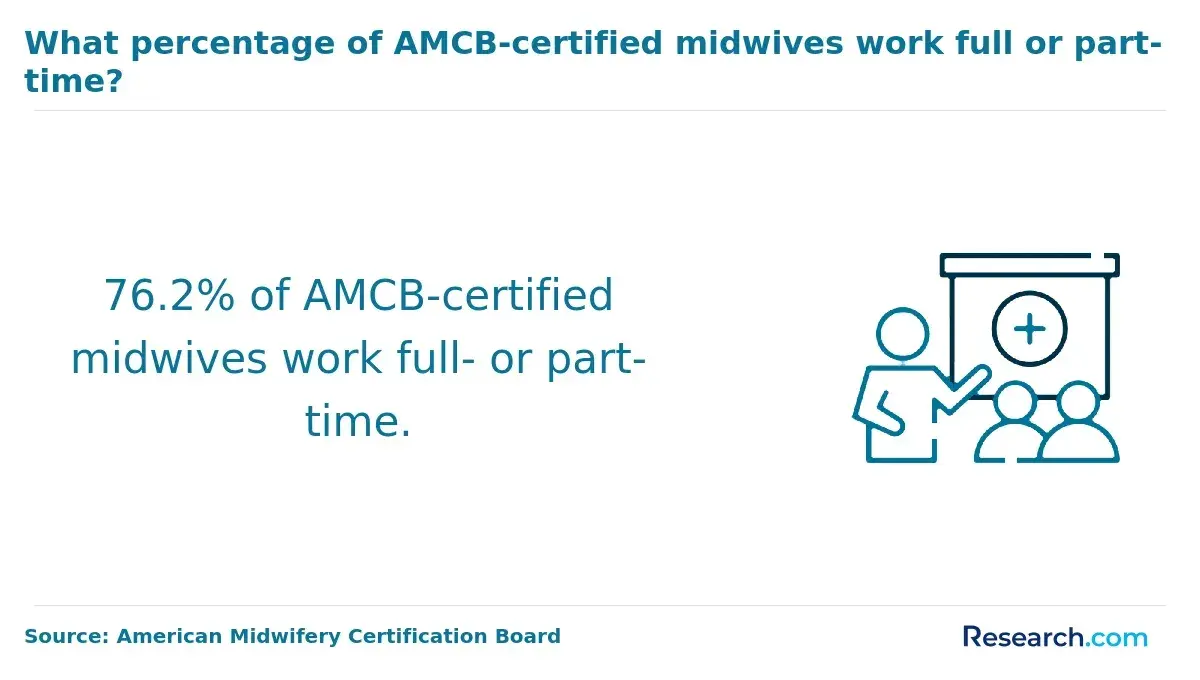
The image below provides additional context on how many AMCB-certified nurse midwives work full-time compared with part-time.
What are the clinical training requirements for nurse midwife programs in Georgia?
Nurse-midwifery students in Georgia complete at least 500 clinical hours, and some programs require more, with certain programs reaching up to 720 hours. These hours are completed under supervision in real care environments such as hospitals, birth centers, OB/GYN clinics, and community health centers.
Clinical placement is one of the most important parts of choosing a program. A hospital rotation may expose students to higher-risk labor and delivery cases, while a birth center may emphasize physiologic birth and lower-intervention care. OB/GYN clinics strengthen prenatal, postpartum, contraceptive, and gynecologic care skills. Community health centers can provide experience with rural, underserved, or resource-limited populations.
During clinical training, students practice prenatal assessment, labor support, birth management, postpartum care, newborn evaluation, counseling, documentation, collaboration, and escalation of care when complications arise. Preceptors may include board-certified nurse midwives, obstetricians, or other qualified clinicians who provide direct oversight and feedback.
Students should ask programs how clinical sites are assigned, whether placements are guaranteed, how far they may need to travel, and what happens if a clinical site becomes unavailable. A flexible online format can be helpful, but it does not reduce the need for in-person clinical training.
| Clinical setting | What students commonly learn | Question to ask before enrolling |
| Hospital labor and delivery unit | Labor management, birth attendance, risk recognition, interprofessional collaboration | Will I rotate through units that provide enough birth experiences for certification preparation? |
| Birth center | Low-intervention birth, patient education, physiologic labor support | How many students are placed there, and how are hands-on opportunities distributed? |
| OB/GYN clinic | Prenatal visits, postpartum care, gynecologic assessment, contraception counseling | Will the placement include both pregnancy care and broader women’s health care? |
| Community health center | Care for underserved patients, chronic condition screening, continuity of care | Does the program help students prepare for rural or medically underserved practice? |
How long does it take to become a certified nurse midwife in Georgia?
The full path from beginning a BSN to becoming a certified nurse-midwife in Georgia usually takes about 6 to 8 years. The timeline depends on prior education, whether you study full time or part time, how quickly you gain RN experience, and whether you choose an MSN, DNP, or post-master’s certificate.
| Step | Typical time or requirement | Decision point |
| Earn a BSN | Typically four years of full-time study | Choose an accredited nursing program that prepares you for RN licensure. |
| Pass the NCLEX-RN and obtain RN licensure | Completed after nursing school | Plan for testing, licensure paperwork, and state requirements. |
| Gain nursing experience | Georgia does not require a specific minimum before graduate admission, but many programs prefer at least one year of professional nursing practice. | Labor and delivery experience can improve readiness, and Georgia College & State University requires one year of labor and delivery nursing experience. |
| Complete an ACME-accredited graduate program | Usually 2 to 3 years of full-time study and about 50 to 60 credits | Decide whether an MSN, DNP, or certificate route fits your goals. |
| Finish program requirements | MSN coursework in Georgia must be completed within seven years, though many students finish in 2 to 3 years. | Part-time study may help working nurses but can extend the timeline. |
| Pass the AMCB exam | Required after graduation for national certification | Ask programs about certification exam preparation and pass-rate support. |
| Apply for Georgia APRN authority | Applications are typically processed within 20 business days if complete. | Incomplete files or high application volume can slow licensure. |
| Maintain Georgia practice requirements | APRN/CNM licenses must be renewed every two years. | Track renewal deadlines, continuing education, and collaborative practice requirements. |
Georgia also requires a collaborative agreement with a physician for certain prescriptive authorities. Because regulations can change, applicants should verify current requirements with the Georgia Board of Nursing before making career or enrollment decisions.
How much does it cost to attend nurse midwife school in Georgia?
The cost of nurse-midwifery school in Georgia depends on the institution, residency status, degree level, credit load, fees, clinical expenses, and whether you attend a public or private university. Tuition is only one part of the total cost, so applicants should calculate the full price before comparing programs.
| Cost category | Figures to consider | How to evaluate it |
| Public university tuition | Public nurse-midwifery tuition in Georgia can range from $373 to $1,220 per credit hour. | Multiply the per-credit rate by total program credits, then add mandatory fees. |
| Georgia College post-master’s certificate example | Georgia College charges around $373 per credit hour for its post-master’s certificate, or roughly $10,071 for a 27-credit program. | This may be more affordable for nurses who already have a graduate nursing degree. |
| Public graduate program annual cost | Comprehensive graduate programs at public universities typically cost about $17,789 annually for in-state students and $30,782 for out-of-state students. | Residency status can significantly affect public university affordability. |
| Private university tuition example | Private universities such as Emory University list higher total tuition, with programs costing approximately $67,710 for the full course regardless of residency. | Compare clinical partnerships, program format, aid packages, and career goals rather than tuition alone. |
| Books and materials | Textbooks and course materials can cost between $1,000 and $2,000 annually. | Ask whether digital resources, exam-prep tools, or lab materials are included in fees. |
| Clinical supplies | Uniforms, a stethoscope, and other clinical supplies often range from $300 to $600 over the program. | Budget for these early because they may be required before clinical rotations begin. |
| Certification and licensure | The AMCB exam fee is $500, and Georgia Board of Nursing application fees are $75 to $100. | Include these costs in your final semester budget. |
| University fees | Technology, health, activity, and other institutional fees may range from a few hundred to over a thousand dollars per year. | Request a complete cost-of-attendance estimate, not just tuition. |
Online or hybrid programs may reduce commuting costs, but they do not eliminate clinical travel, time away from work, or licensure-related expenses. If you are comparing CNM preparation with a women’s health nurse practitioner path, this guide on how long it takes to become a women’s health nurse practitioner can help you evaluate timing and opportunity costs.
What financial aid options are available for nurse midwife students in Georgia?
Nurse-midwifery students in Georgia often combine several funding sources: federal loans, institutional aid, nursing scholarships, work-study, employer support, and loan repayment programs. The practical first step is completing the FAFSA, then asking each school for a program-specific aid estimate.
- Federal Direct Unsubsidized Loans: Graduate students can borrow up to $20,500 annually with a fixed interest rate of 6.28%. Students should verify current federal loan limits and rates before borrowing.
- Graduate PLUS Loans: These loans can help cover remaining costs after other aid, subject to credit approval, and are listed with a 7.28% interest rate. Borrow only after comparing scholarships, employer assistance, and lower-cost program options.
- Federal Pell Grants: Pell Grants are generally not available for graduate nursing programs, though limited exceptions may apply when the program is tied to a first undergraduate degree.
- Federal Work-Study: Work-study can provide part-time income, sometimes in healthcare-related roles, with awards ranging from $4,000 to $8,000 annually.
- Georgia grants and scholarships: State-based aid may support nurses who plan to serve rural or underserved communities, depending on program rules and funding availability.
- Nursing and midwifery scholarships: Options such as NEF and Wood-Bond Legacy Scholarships may support students who demonstrate academic promise, service commitment, or interest in women’s healthcare.
- Loan repayment programs: Federal and state repayment opportunities may reduce debt for graduates who work in high-need communities after becoming licensed.
- Institutional aid: Georgia schools may offer scholarships, assistantships, or tuition support, sometimes with service or academic requirements.
- External scholarships: Professional organizations and private foundations may support nursing students from underrepresented groups, students with disabilities, or students committed to specific practice areas.
A smart funding strategy starts with the net cost, not the sticker price. Ask each school how much aid is scholarship-based, how much must be repaid, whether aid continues after the first year, and whether part-time students qualify.
| Financial aid mistake | Better approach |
| Borrowing the full amount offered without calculating repayment | Estimate monthly payments and compare them with realistic early-career earnings. |
| Looking only at tuition | Add fees, books, clinical travel, certification, licensure, and lost work hours. |
| Missing scholarship deadlines | Create a calendar for FAFSA, school aid, state aid, and outside scholarships. |
| Assuming loan forgiveness is automatic | Read service requirements, eligible sites, employment length, and documentation rules. |
To better understand who is entering the profession, review the chart below showing the age range of CNMs.
What impact do emerging healthcare trends have on nurse midwifery practice in Georgia?
Several healthcare trends are shaping nurse-midwifery practice in Georgia. Telehealth has expanded how prenatal follow-ups, postpartum support, contraception counseling, and patient education may be delivered when appropriate. Electronic health records and data tools also make documentation, care coordination, and quality tracking central parts of modern CNM work.
Another important shift is team-based care. CNMs often coordinate with obstetricians, family physicians, pediatric providers, nurses, social workers, and other advanced practice clinicians. Students who want a broader view of advanced practice nursing in the state can compare CNM training with nurse practitioner programs in Georgia.
These trends do not replace bedside clinical skill. They add expectations. Future CNMs should be comfortable with patient communication, technology, cultural humility, documentation, referral decisions, and interprofessional collaboration.
What does the employment outlook for nurse midwives in Georgia look like?
The employment outlook for nurse midwives in Georgia is tied to maternal health needs, access to reproductive healthcare, growth in team-based care, and demand for clinicians who can serve both urban and rural communities. Hospitals, birth centers, OB/GYN practices, community clinics, and academic settings may all employ CNMs, although opportunities vary by region and facility model.
Prospective CNMs should avoid assuming that certification automatically guarantees a preferred job location or salary. Instead, research where CNMs are practicing, whether local employers hire new graduates, how collaborative agreements are structured, and whether the role includes births, clinic care, call schedules, teaching, leadership, or a combination of duties.
If you are still building your nursing foundation, Research.com’s guide to the requirements to become a nurse in Georgia can help you understand the RN licensure steps that come before advanced practice preparation.
What are the top accredited nurse midwife schools in Georgia?
The most important filter when choosing a nurse-midwifery school is ACME accreditation. Without graduating from an ACME-accredited program, candidates may not be eligible for AMCB certification or Georgia CNM practice authority. Program reputation matters, but accreditation, clinical placement quality, certification preparation, cost, and fit matter more.
- Georgia College & State University – MSN Nurse Midwifery Concentration: This is the first fully ACME-accredited nurse-midwifery program at a public university in Georgia. Clinical experiences are completed in-state, and the program reports a 100% retention rate of graduates practicing locally.
- Georgia College & State University – Nurse Midwifery Post-Master’s Certificate: This option is designed for MSN-prepared nurses who need focused nurse-midwifery education. It offers mostly online coursework with limited campus visits and clinical placements arranged in Georgia.
- Emory University – MSN Nurse Midwifery Specialty: Emory’s program combines advanced practice preparation with clinical partnerships in Atlanta-area settings and emphasizes clinical excellence, leadership, and advocacy.
- Emory University – Dual Nurse Midwifery and Family Nurse Practitioner Track: This dual pathway prepares students for both nurse-midwifery and family nurse practitioner certification routes, expanding potential roles in primary care and reproductive health settings.
- Online ACME-Accredited Nurse Midwifery Programs Accessible in Georgia: Some nationally accredited online programs may allow Georgia students to complete didactic coursework remotely while arranging approved clinical placements in the state.
| Program factor | Why it matters | Question to ask |
| ACME accreditation | It supports certification eligibility and licensure preparation. | Is the program currently ACME-accredited, preaccredited, or under review? |
| Clinical placement support | CNM training depends on direct patient-care experiences. | Does the school find placements, or must students secure their own? |
| Format | Online, hybrid, and campus formats affect work-life balance and travel. | How often must students come to campus, and where are clinical sites located? |
| Certification preparation | Graduates must pass the AMCB exam. | What exam-preparation support is built into the program? |
| Total cost | Tuition alone does not show the full financial commitment. | What is the complete cost of attendance including fees and clinical expenses? |
For nurses thinking beyond entry-level CNM practice, this guide on what you can do with a doctorate in nursing explains how doctoral education can support leadership, education, and systems-level roles.
Which advanced degrees support career advancement for CNMs in Georgia?
CNMs in Georgia can expand their careers through additional graduate education, doctoral study, specialty preparation, teaching, leadership, or research. The right degree depends on whether you want to stay primarily in clinical care or move toward administration, academia, policy, or scholarship.
| Degree or credential | Best for | Potential career direction |
| MSN Nurse Midwifery | RNs entering CNM practice | Clinical CNM roles, precepting, and advanced reproductive health care |
| Doctor of Nursing Practice | CNMs interested in practice leadership and systems improvement | Program leadership, quality improvement, executive roles, and advanced clinical practice |
| PhD in Nursing | CNMs focused on research, policy, or academia | Faculty positions, research careers, evidence-based practice leadership, and policy influence |
| Post-Master’s Certificate in Nurse Midwifery | Graduate-prepared nurses who need nurse-midwifery specialization | Eligibility pathway for CNM certification preparation |
| Dual specialization programs | Nurses who want broader advanced practice preparation | Roles that combine nurse midwifery with family or women’s health practice |
If affordability and admissions flexibility are major concerns, comparing related pathways such as the easiest RN to MSN online programs to get into may help you understand alternative advanced nursing routes. Just confirm that any program you choose matches your intended license or certification outcome.
What organizations accredit nurse midwife programs in Georgia?
The Accreditation Commission for Midwifery Education (ACME) is the nationally recognized accreditor for nurse-midwifery education programs. For Georgia students, ACME accreditation is critical because it connects directly to AMCB certification eligibility and state practice preparation.
ACME evaluates whether programs have appropriate curricula, qualified faculty, adequate clinical resources, and student outcomes that support safe beginning practice. Programs may hold preaccreditation, initial accreditation, or continued accreditation, and continued accreditation can last up to ten years.
Students should verify accreditation before applying, not after admission. Accreditation status can change, and a school’s general nursing accreditation does not automatically mean its nurse-midwifery track is ACME-accredited.
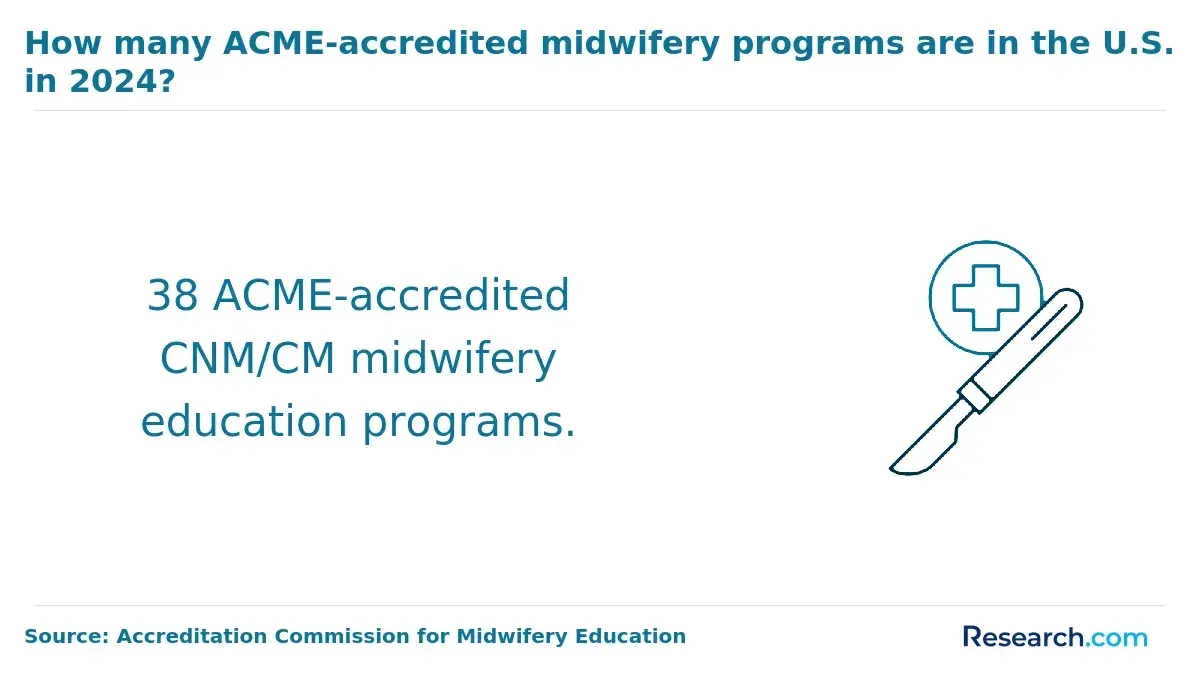
As of 2024, Georgia College & State University is identified as the only public program in Georgia with full accreditation. Students comparing nurse-midwifery tuition in Georgia should weigh cost against accreditation status, clinical placement support, and certification eligibility.
| Accreditation check | Why it matters |
| Confirm ACME status on the program and accreditor websites | Program brochures may be outdated, so verify from official sources. |
| Ask whether accreditation covers the specific track you plan to enter | Different specialties, certificates, or dual tracks may have different approval details. |
| Confirm eligibility for the AMCB exam | National certification is required before Georgia CNM practice authority. |
| Ask about clinical placement requirements in Georgia | Online programs still require approved hands-on training. |
What are the license renewal and continuing education requirements for nurse midwives in Georgia?
Nurse midwives in Georgia must maintain RN licensure, advanced practice authority, national certification, and any state-required practice documentation. APRN/CNM licenses must be renewed every two years, and CNMs should track renewal deadlines well in advance to avoid interruptions in practice.
Continuing education should support current clinical practice, women’s health, reproductive care, newborn care, pharmacology when applicable, ethics, patient safety, and evolving healthcare technology. Documentation matters. Keep certificates, transcripts, renewal confirmations, and professional records organized in case the Georgia Board of Nursing requests proof.
Because state rules can change, CNMs should verify renewal and continuing education requirements directly with the Georgia Board of Nursing and the AMCB before each renewal cycle. For readers comparing other Georgia healthcare credentials, this overview of CNA requirements in Georgia can provide broader context on how state-level healthcare credentialing works, although CNA rules are not the same as CNM requirements.
How should you decide whether nurse midwifery is the right career path?
Nurse midwifery can be deeply meaningful, but it is not the right fit for every nurse. CNMs need clinical confidence, emotional steadiness, comfort with unpredictable schedules, strong communication skills, and a willingness to collaborate when patient risk changes quickly.
- Choose this path if you want advanced responsibility in pregnancy, birth, reproductive health, postpartum care, and newborn assessment.
- Be cautious if you want a predictable schedule with limited call, limited emotional intensity, or no high-stakes clinical decision-making.
- Compare alternatives if you are equally interested in primary care, women’s health, neonatal care, family practice, education, or nursing leadership.
- Talk to working CNMs before applying so you understand call expectations, patient volume, documentation demands, liability concerns, and employer practice models.
Common mistakes to avoid when choosing a nurse-midwifery program in Georgia
| Mistake | Why it can hurt you | Better decision |
| Choosing a program without verifying ACME accreditation | You may risk certification and licensure eligibility. | Confirm current ACME status before submitting an application deposit. |
| Assuming online means fully remote | Clinical hours must still be completed in person. | Ask where clinical sites are located and who arranges them. |
| Comparing only tuition | Fees, clinical travel, books, supplies, and exam costs can change the true price. | Use the full cost of attendance for comparisons. |
| Ignoring admissions timing | Missed deadlines can delay graduate study. | Track early, regular, and late application windows. |
| Assuming salary or job placement is guaranteed | Employment outcomes depend on location, employer needs, experience, and practice authority. | Ask programs about employer partnerships, alumni locations, and new-graduate support. |
| Not checking licensure rules before enrolling from out of state | Some programs may not meet every state’s requirements. | Confirm Georgia eligibility and any requirements in states where you may practice later. |
Related Articles for Nearby States
- 2027 How to Become a Nurse Midwife in South Carolina - Midwife Schooling Requirements
- 2027 How to Become a Nurse Midwife in Florida – Midwife Schooling Requirements
- 2027 How to Become a Nurse Midwife in Alabama – Midwife Schooling Requirements
- 2027 How to Become a Nurse Midwife in Tennessee – Midwife Schooling Requirements
- 2027 How to Become a Nurse Midwife in North Carolina - Midwife Schooling Requirements
- 2027 How to Become a Nurse Midwife in Mississippi - Midwife Schooling Requirements
- 2027 How to Become a Nurse Midwife in Kentucky – Midwife Schooling Requirements
- 2027 How to Become a Nurse Midwife in Virginia – Midwife Schooling Requirements
- 2027 How to Become a Nurse Midwife in Louisiana – Midwife Schooling Requirements
- 2027 How to Become a Nurse Midwife in West Virginia - Midwife Schooling Requirements
References:
- All Nursing Schools. (n.d.). Nursing scholarships and financial aid resources. https://www.allnursingschools.com/financial-aid/nursing-scholarships
- Emory University, Nell Hodgson Woodruff School of Nursing. (n.d.). Tuition, financial aid, and scholarship information. https://www.nursing.emory.edu/pages/tuition-financial-aid-and-scholarships
- Georgia College & State University. (n.d.). Nurse midwifery program information. https://www.gcsu.edu/health/nursing/nurse-midwifery
- Georgia Southern University. (n.d.). School of Nursing scholarship resources. https://www.georgiasouthern.edu/colleges/health-professions/departments/nursing/scholarships
- Georgia Midwives. (n.d.). Scholarship opportunities from Midwives of Georgia. https://www.georgiamidwife.org/new-page
- Indeed. (2025). Midwife salary information in Georgia. https://www.indeed.com/career/midwife/salaries/GS
- Indeed. (2025). Registered nurse salary information in Georgia. https://www.indeed.com/career/RN/salaries/GA
- Midwife Schooling. (2025). Certified nurse-midwife pathway in Georgia. https://www.midwifeschooling.com/georgia
- NurseJournal.org. (n.d.). Financial aid and scholarship guide for nurses. https://nursejournal.org/resources/financial-aid/nursing-scholarship-grants
- NursingCECentral. (n.d.). Graduate nursing scholarships for Georgia RNs. https://nursingcecentral.com/15-graduate-nursing-scholarships-for-georgia-rns
- Nursing License Map. (n.d.). Nursing scholarships, grants, and financial aid overview. https://nursinglicensemap.com/resources/nursing-financial-aid
- RNtoMSN.com. (n.d.). MSN programs and nursing degree options in Georgia. https://www.rntomsn.com/states/georgia
- Zippia. (2025). Certified nurse-midwife demographics and career data. https://www.zippia.com/certified-nurse-midwife-jobs/demographics
Key Insights
- The standard route to becoming a nurse midwife in Georgia is BSN, RN licensure, ACME-accredited graduate nurse-midwifery education, AMCB certification, and Georgia advanced practice authorization.
- An MSN in nurse midwifery is the core minimum graduate pathway, while a DNP, PhD, post-master’s certificate, or dual specialization may support leadership, research, teaching, or broader clinical roles.
- Clinical training is a major decision factor. Georgia students should expect at least 500 clinical hours, with some programs requiring up to 720 hours, and should ask how placements are secured.
- Total cost varies widely. Public tuition may range from $373 to $1,220 per credit hour, while private program tuition can be higher, such as approximately $67,710 for the full course at Emory University.
- Accreditation is nonnegotiable. Verify ACME status before enrolling because it affects AMCB certification eligibility and Georgia CNM practice preparation.
- The full pathway commonly takes about 6 to 8 years from starting a BSN through certification and state authorization, depending on prior education and enrollment pace.
- The best program is not always the cheapest or highest-profile option. Choose based on accreditation, clinical placement support, certification preparation, total cost, format, and fit with your career goals.
Other Things You Need to Know About How to Become a Nurse Midwife in Georgia
Georgia requires Certified Nurse-Midwife applicants to hold current national certification from the American Midwifery Certification Board. The AMCB certification is earned by passing the national CNM exam after completing an ACME-accredited graduate nurse-midwifery program, which Georgia uses as the key licensing qualification.
To practice as a nurse midwife in Georgia, you need to obtain certification from the American Midwifery Certification Board (AMCB). This involves passing the AMCB national certification exam, which ensures you meet established standards for clinical competency and professional practice in midwifery.