
2027 Easiest RN-to-MSN Online Programs to Get Into

Co-Founder and Chief Data Scientist
Choosing an online RN-to-MSN program is not just about finding the shortest admissions checklist. For working registered nurses, the real decision is whether a program can accept your current credentials, fit around your schedule, support required clinical placements, meet accreditation and licensure expectations, and lead to the advanced nursing role you actually want.
This guide explains how RN-to-MSN online programs work, which programs are designed with more accessible entry pathways, what they cost, how long they take, and how to compare them without relying only on rankings or marketing claims. It is written for licensed RNs who want to move into advanced practice, nursing education, leadership, informatics, or related MSN-level roles while continuing to work.
Quick answer: What is the easiest RN-to-MSN online program to get into?
The easiest RN-to-MSN online program for you is usually one that accepts your current nursing background, does not require unnecessary extra steps, offers bridge coursework if you do not hold a BSN, provides flexible online delivery, and is accredited by a recognized nursing accreditor such as CCNE or ACEN. Admission standards still matter: most programs require an active RN license, prior nursing education, a minimum GPA, and sometimes clinical experience.
Do not choose a program only because it appears easy to enter. For nursing, “easy to get into” should still mean accredited, licensure-aligned, clinically credible, and transparent about tuition, transfer credits, graduation requirements, and practicum expectations.
Why nurses choose online RN-to-MSN programs
- More career options: An RN-to-MSN pathway can prepare registered nurses for advanced roles such as nurse practitioner, nurse educator, nurse administrator, clinical nurse leader, or informatics-focused nursing professional.
- Work-friendly scheduling: Online coursework can make graduate study more realistic for nurses balancing shifts, family responsibilities, and clinical requirements. Some programs also reduce commuting and relocation costs compared with campus-based study.
- Higher earning potential in advanced roles: Compensation depends on specialty, location, credentials, and experience, but advanced nursing roles can pay substantially more than many bedside RN positions. For example, nurse practitioners earn a median annual salary of $120,680.
What can I expect from an online RN-to-MSN program?
An online RN-to-MSN program is a bridge from registered nursing practice into graduate-level nursing preparation. Depending on the school, it may allow ADN-prepared nurses, diploma-prepared nurses, or RNs with a non-nursing bachelor’s degree to move toward an MSN without completing a separate traditional BSN first.
- Bridge and graduate coursework: Programs commonly combine upper-division nursing content with MSN-level classes in advanced assessment, pharmacology, pathophysiology, research, quality improvement, health policy, leadership, and evidence-based practice.
- Specialty preparation: Students usually select a concentration such as family nurse practitioner, psychiatric-mental health nurse practitioner, nurse educator, nursing administration, informatics, or another advanced practice or leadership track.
- Clinical and practicum requirements: Even online programs require supervised clinical or practicum experiences. The amount, setting, and placement process vary by specialization and state requirements.
- Stronger decision-making expectations: MSN programs are designed to move nurses beyond task-based care into advanced clinical reasoning, systems thinking, patient care management, teaching, research translation, or organizational leadership.
Where can I work with an MSN degree?
MSN-prepared nurses work across clinical, academic, administrative, public health, and policy settings. The right workplace depends heavily on your concentration and whether your role requires advanced practice licensure or national certification.
- Healthcare delivery settings: Hospitals, outpatient clinics, community health centers, long-term care organizations, private practices, and specialty care offices employ MSN-prepared nurses.
- Education and training settings: Nurse educators may work in colleges, universities, hospital education departments, simulation labs, and continuing education programs.
- Leadership and systems roles: Nurse executives, administrators, care coordinators, and informatics specialists may work for health systems, insurers, government agencies, public health organizations, or healthcare technology teams.
- Advanced practice roles: Depending on your MSN track, certification, and state licensure, possible roles may include nurse practitioner, clinical nurse specialist, nurse anesthetist, or nurse midwife.
How much can I make with an MSN degree?
MSN salaries vary widely by role, state, employer, experience, certification, and scope of practice. The highest-paid MSN-related roles are often advanced practice positions that require additional certification and licensure after graduation.
- Nurse anesthetists: earn a median annual salary of $212,650.
- Nurse midwives: earn $129,650.
- Nurse educators: earn around $75,000, with the top 10% making over $100,000.
- Overall value: An MSN can improve earning potential compared with a BSN, but the return depends on specialty choice, total program cost, debt, state practice rules, and local hiring demand.
- Accessible RN-to-MSN Online Programs for 2027
- How long does an RN-to-MSN program take?
- Online vs. on-campus RN-to-MSN programs
- RN-to-MSN program cost
- Financial aid options
- Admission prerequisites
- Common RN-to-MSN courses
- Available MSN specializations
- Why accreditation matters
- RN-to-MSN return on investment
- Certification and licensure after graduation
- Accelerated FNP pathways
- Challenges in online RN-to-MSN study
- Technology in clinical training
- Long-term earnings and ROI
- Preparation for healthcare innovation
- Emerging RN-to-MSN trends
- Transfer credits
- Student support services
- Accelerated vs. traditional pathways
- How to choose a program
- Career paths after an RN-to-MSN
- Job market for RN-to-MSN graduates
- Common mistakes to avoid
Easiest RN-to-MSN Online Programs to Get Into for 2027
How do we rank schools?
Because an RN-to-MSN program is a major academic, financial, and career decision, Research.com reviews programs using transparent education data sources and school-reported information where available. Our process considers factors that matter to working nurses, including program accessibility, online or hybrid flexibility, accreditation, tuition, curriculum structure, and available tracks.
Sources used in our review process include the IPEDS database, Peterson's database and its Distance Learning Licensed Data Set, the College Scorecard database, and the National Center for Education Statistics.
The programs below are examples of RN-to-MSN pathways with flexible formats, bridge options, or admissions structures that may be more accessible for licensed RNs. Always verify current admissions rules, state authorization, clinical placement policies, tuition, and licensure alignment directly with the school before applying.
| School | Program length | Tracks or concentrations | Tuition | Credits | Accreditation |
| Southern New Hampshire University | 2–3 years depending on track and pace | Nursing Education, Nurse Executive Leadership, Patient Safety & Quality, and Family Nurse Practitioner (FNP) | $627 per credit | 60–63 credits depending on specialization | Commission on Collegiate Nursing Education (CCNE) |
| Baker University | 2–3 years | Nursing Education, Nursing Administration | Approximately $655 per credit hour | 60 credits | Commission on Collegiate Nursing Education (CCNE) |
| Spalding University | Approximately 3 years, depending on full-time or part-time enrollment | Family Nurse Practitioner (FNP) | $680 per credit hour | 49-52 credits | Commission on Collegiate Nursing Education (CCNE) |
| Herzing University | 20-24 months | Family Nurse Practitioner (FNP), Nursing Education, Nursing Leadership and Administration | $735 per credit | 52 credits | Commission on Collegiate Nursing Education (CCNE) |
| Texas A&M University-Corpus Christi | 2-3 years | Family Nurse Practitioner, Leadership in Nursing Systems, Nurse Educator | Approximately $11,700 in-state; $30,200 out-of-state | 37-49 credits | Commission on Collegiate Nursing Education (CCNE) |
| Nebraska Methodist College | 21 to 33 months | Care Coordinator, Nurse Educator, Nurse Executive, Nursing Informatics | $320 per credit hour in-state; $588 per credit hour out-of-state | 57 credits | Commission on Collegiate Nursing Education (CCNE) |
| Wilkes University | Approximately 36 months | Family Nurse Practitioner, Adult-Gerontology Primary Care Nurse Practitioner, Psychiatric/Mental Health Nurse Practitioner | $728 per credit hour | 45 to 55 credits | Commission on Collegiate Nursing Education (CCNE) |
| Edgewood College | Approximately 2 to 3 years | Family Nurse Practitioner (FNP), Clinical Nurse Specialist (CNS) in Adult-Gerontology, Nurse Educator | $1,030 per credit hour | 45 credits | Commission on Collegiate Nursing Education (CCNE) |
| Indiana Wesleyan University | 2 to 3 years | Nursing Administration, Nursing Education | Approximately $599 per credit hour | 48 to 60 credits | Commission on Collegiate Nursing Education (CCNE) |
| MCPHS University | 24 to 36 months | Family Nurse Practitioner (FNP), Nurse Educator | $990 per credit hour | 62 credits for the FNP track | Commission on Collegiate Nursing Education (CCNE) |
1. Southern New Hampshire University
Southern New Hampshire University (SNHU) offers an accelerated online RN-to-MSN option for registered nurses who want to combine BSN-level and MSN-level progress in a more streamlined format. The program is built for working nurses, with 24/7 online access and 8-week courses. MSN options include Nursing Education, Nurse Executive Leadership, Patient Safety & Quality, and Family Nurse Practitioner (FNP). Students considering the FNP track should review on-campus and immersive requirements carefully, since some advanced clinical tracks include in-person components.
- Program Length: 2–3 years depending on track and pace
- Tracks/Concentrations: Nursing Education, Nurse Executive Leadership, Patient Safety & Quality, and Family Nurse Practitioner (FNP)
- Tuition Cost: $627 per credit (standard rate, no differentiation between in-state and out-of-state tuition)
- Required Credits to Graduate: 60–63 credits depending on specialization
- Accreditation: Commission on Collegiate Nursing Education (CCNE)
2. Baker University
Baker University provides an RN-to-MSN pathway for licensed nurses who want to move into education or administration. The program uses a hybrid format that blends online coursework with campus-based sessions, so it may suit nurses who want flexibility but still value cohort interaction and periodic in-person learning. Coursework emphasizes nursing theory, evidence-based practice, leadership, and the skills needed to influence healthcare delivery in academic or management roles.
- Program Length: 2–3 years
- Tracks/Concentrations: Nursing Education, Nursing Administration
- Tuition Cost: Approximately $655 per credit hour (same for in-state and out-of-state)
- Required Credits to Graduate: 60 credits
- Accreditation: Commission on Collegiate Nursing Education (CCNE)
3. Spalding University
Spalding University offers an RN-to-MSN Bridge Program for RNs who hold an Associate Degree in Nursing (ADN) and a non-nursing bachelor's degree. The pathway is focused on Family Nurse Practitioner (FNP) preparation. Students complete two baccalaureate-level bridge courses before moving into the MSN curriculum, which includes health care policy, advanced health assessment, pathophysiology, pharmacology, and clinical practicum experiences. The program requires over 700 clinical hours across three practicum courses, making clinical planning especially important.
- Program Length: Approximately 3 years, depending on full-time or part-time enrollment
- Tracks/Concentrations: Family Nurse Practitioner (FNP)
- Tuition Cost: $680 per credit hour (tuition rates may vary)
- Required Credits to Graduate: 49-52 credits (varies based on gap analysis)
- Accreditation: Commission on Collegiate Nursing Education (CCNE)
4. Herzing University
Herzing University offers an online RN-to-MSN route for registered nurses who want to move into graduate study without completing a separate BSN first. Students can choose Family Nurse Practitioner (FNP), Nursing Education, or Nursing Leadership and Administration. Clinical experiences are required for applicable tracks, and the school’s Clinical Placement Pledge is designed to help students identify placements. The curriculum emphasizes leadership, evidence-based practice, and advanced nursing competencies.
- Program Length: 20-24 months
- Tracks/Concentrations: Family Nurse Practitioner (FNP), Nursing Education, Nursing Leadership and Administration
- Tuition Cost: $735 per credit (both in-state and out-of-state)
- Required Credits to Graduate: 52 credits
- Accreditation: Commission on Collegiate Nursing Education (CCNE)
5. Texas A&M University-Corpus Christi
Texas A&M University-Corpus Christi offers an online RN-to-MSN program with part-time study options for working nurses. Available tracks include Family Nurse Practitioner, Leadership in Nursing Systems, and Nurse Educator. The curriculum includes nursing research, health policy, role development, evidence-based practice, and track-specific courses. The FNP track focuses on primary care across the lifespan, while the leadership and educator tracks emphasize systems management, informatics, finance, policy, curriculum, and teaching strategies.
- Program Length: 2-3 years (part-time)
- Tracks/Concentrations: Family Nurse Practitioner, Leadership in Nursing Systems, Nurse Educator
- Tuition Cost: Approximately $11,700 (in-state), $30,200 (out-of-state)
- Required Credits to Graduate: 37-49 credits (depending on the track)
- Accreditation: Commission on Collegiate Nursing Education (CCNE)
6. Nebraska Methodist College
The RN-to-MSN online program at Nebraska Methodist College (NMC) allows registered nurses to pursue an MSN without first earning a BSN. The program is delivered in a 100% online format and includes bridge coursework for RNs who do not already have a bachelor’s degree. Students can choose Care Coordinator, Nurse Educator, Nurse Executive, or Nursing Informatics. Courses are generally 5 to 10 weeks long, include breaks between terms, and no GRE is required for admission.
- Program Length: 21 to 33 months
- Tracks/Concentrations: Care Coordinator, Nurse Educator, Nurse Executive, Nursing Informatics
- Tuition Cost: $320 per credit hour (in-state); $588 per credit hour (out-of-state)
- Required Credits to Graduate: 57 credits (includes bridge courses)
- Accreditation: Commission on Collegiate Nursing Education (CCNE)
7. Wilkes University
Wilkes University offers a fully online RN-to-MSN pathway for licensed registered nurses who want to enter advanced clinical practice. Students complete bridge and core MSN requirements before moving into one of several nurse practitioner tracks. The program includes mentoring and flexible scheduling, but applicants should confirm GPA, license, and experience requirements before applying.
- Program Length: Approximately 36 months
- Tracks/Concentrations: Family Nurse Practitioner, Adult-Gerontology Primary Care Nurse Practitioner, Psychiatric/Mental Health Nurse Practitioner
- Tuition Cost: $728 per credit hour (in-state and out-of-state)
- Required Credits to Graduate: 45 to 55 credits, depending on the track
- Accreditation: Commission on Collegiate Nursing Education (CCNE)
8. Edgewood College
Edgewood College offers an RN-to-MSN bridge pathway for registered nurses who want to move into graduate nursing study without earning a separate BSN. The program combines online learning with required practicum experiences. Concentrations include Family Nurse Practitioner (FNP), Clinical Nurse Specialist (CNS) in Adult-Gerontology, and Nurse Educator. Core study areas include advanced pharmacology, pathophysiology, physical assessment, and evidence-based practice.
- Program Length: Approximately 2 to 3 years, depending on track and course load
- Tracks/Concentrations: Family Nurse Practitioner (FNP), Clinical Nurse Specialist (CNS) in Adult-Gerontology, Nurse Educator
- Tuition Cost: $1,030 per credit hour
- Required Credits to Graduate: 45 credits
- Accreditation: Commission on Collegiate Nursing Education (CCNE)
9. Indiana Wesleyan University
Indiana Wesleyan University (IWU) offers an online RN-to-MSN program with a faith-based academic environment. It is designed for working RNs who want to earn an MSN without completing a separate BSN. The main tracks are Nursing Administration and Nursing Education. Coursework is online, though students should check for any campus-based intensives or clinical expectations. The program emphasizes leadership, evidence-based practice, mentoring, and preparation for advanced roles in healthcare organizations or nursing education.
- Program Length: 2 to 3 years
- Tracks/Concentrations: Nursing Administration, Nursing Education
- Tuition Cost: Approximately $599 per credit hour
- Required Credits to Graduate: 48 to 60 credits, depending on the track
- Accreditation: Commission on Collegiate Nursing Education (CCNE)
10. MCPHS University
MCPHS University offers an online RN-to-MSN pathway for registered nurses who want a faster route into graduate nursing study. Students may pursue Family Nurse Practitioner (FNP) or Nurse Educator preparation. The bridge option is intended for RNs without a BSN who need a structured transition into graduate coursework. The program includes advising, clinical placement support, evidence-based practice, leadership development, and advanced clinical skill preparation.
- Program Length: 24 to 36 months, depending on specialization
- Tracks/Concentrations: Family Nurse Practitioner (FNP), Nurse Educator
- Tuition Cost: $990 per credit hour
- Required Credits to Graduate: 62 credits for the FNP track
- Accreditation: Commission on Collegiate Nursing Education (CCNE)
How long does it take to complete an RN-to-MSN degree program?
Most RN-to-MSN programs take about 2 to 4 years, depending on your prior education, enrollment status, specialty, clinical requirements, transfer credits, and whether the program is accelerated or part-time.
- Accelerated programs: Full-time students may finish in as little as 2 years.
- Traditional part-time pathways: Working nurses commonly need 3-4 years.
- Bridge pathways: RNs entering without a BSN may need an additional year or more for undergraduate bridge requirements.
- Online formats: Online delivery can make scheduling easier, but it does not remove clinical, practicum, or licensure-related requirements.
| Student situation | Typical timeline | Best fit | Watch for |
| ADN-prepared RN entering a bridge program | May add an additional year or more | Nurses who want to bypass a separate BSN | Bridge course requirements and transfer-credit limits |
| Full-time accelerated student | As little as 2 years | Nurses with strong time availability and clinical flexibility | Heavy workload and compressed clinical scheduling |
| Part-time working nurse | Typically 3-4 years | Nurses balancing employment, family, and school | Longer time to salary gains and possible tuition changes |
| Advanced practice track student | Varies by clinical-hour requirement | Nurses pursuing NP, CNS, midwifery, or anesthesia roles | Clinical placement availability and state authorization |
Nurses looking for a broader comparison of accessible graduate options can also review the easiest MSN online programs. Those interested in child-focused advanced practice may want to compare requirements for the easiest pediatric nurse practitioner online programs.
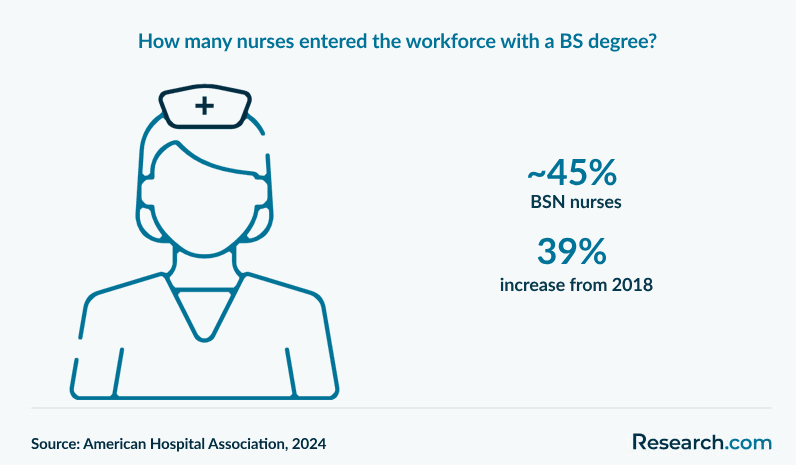
Around 45% of nurses entered the workforce with a bachelor's degree in nursing (BSN) as of 2021–22, up from 39% in 2018 (American Hospital Association, 2024). This shift reflects the continued emphasis on higher nursing education and the role advanced preparation can play in clinical development and career mobility.
How does an online RN-to-MSN degree compare to an on-campus program?
Online and on-campus RN-to-MSN programs can both lead to the same degree, but they differ in scheduling, interaction, commuting, clinical coordination, and how much structure students receive day to day.
| Factor | Online RN-to-MSN | On-campus RN-to-MSN |
| Schedule | Often better for nurses working rotating or full-time shifts | More fixed class meeting times |
| Location | Can reduce geographic barriers, if the program is authorized in your state | Requires access to campus or a nearby instructional site |
| Faculty and peer interaction | Usually uses discussion boards, video meetings, learning platforms, and virtual office hours | Offers more face-to-face interaction and informal campus access |
| Clinical requirements | Still required; may need local preceptors or school-arranged sites | May rely more on established regional clinical partnerships |
| Cost considerations | May reduce commuting and housing costs | May include travel, parking, housing, or schedule-related costs |
| Best for | Self-directed working nurses who need flexibility | Students who prefer in-person learning and a fixed weekly rhythm |
When comparing formats, ask whether the school helps secure clinical placements, whether your state allows enrollment in the online program, and whether the program prepares you for licensure in the state where you plan to work. Students comparing different healthcare graduate routes may also ask what the easiest speech-language pathology programs to get into require.
What is the average cost of an RN-to-MSN degree program?
RN-to-MSN costs vary by school type, credit requirements, residency status, clinical fees, and program length. Published tuition rarely tells the full story, so compare total program cost rather than cost per credit alone.
- Public institutions: Costs range from $20,000 to $60,000 for the entire program.
- Private institutions: Costs typically range from $50,000 to $100,000 or more.
- Online programs: Costs often fall between $25,000 and $80,000.
- Additional expenses: Budget for books, technology fees, background checks, immunization records, clinical supplies, travel to practicum sites, certification exam costs, and possible campus intensives.
| Cost item | Why it matters | Question to ask |
| Tuition per credit | Programs with fewer credits may cost less even if the per-credit rate is higher | What is the total tuition for my exact track? |
| Fees | Online, technology, clinical, simulation, and graduation fees can add up | What mandatory fees are not included in tuition? |
| Clinical travel | Some students must travel for practicum, intensives, or approved clinical sites | Will I need to travel, and how often? |
| Time away from work | Clinical rotations or intensive courses may reduce work hours | Can I complete clinicals around my work schedule? |
| Certification and licensure costs | Advanced practice roles often require post-graduation exams and applications | Which exam and state fees should I plan for? |
Graduate degree comparisons outside nursing can also help students think about ROI. For example, professionals weighing public-sector and management careers may ask what is the difference between MPA and MBA before choosing a graduate path.
What are the financial aid options for students enrolling in an RN-to-MSN degree program?
Financial aid can reduce out-of-pocket cost, but eligibility depends on the school, program status, enrollment level, citizenship or residency criteria, and whether the program is properly accredited.
- Federal financial aid: Eligible students may use federal grants, loans, or work-study where available.
- Scholarships: Nursing schools, professional associations, hospitals, state agencies, and private foundations may offer awards for graduate nursing students.
- Employer tuition assistance: Hospitals and healthcare systems may help pay for graduate education, often with grade, employment, or service requirements.
- State-specific aid: Some states offer grants, loan repayment, or forgiveness programs for nurses who work in high-need areas.
- Military benefits: Active-duty service members, veterans, and eligible dependents may be able to use military education benefits.
Apply early, compare award letters carefully, and ask whether scholarships are renewable. Also confirm whether dropping below a certain credit load could affect your aid.
What are the prerequisites for enrolling in an RN-to-MSN degree program?
Admissions requirements differ by school and specialty, but RN-to-MSN programs generally expect applicants to show they are academically prepared, clinically licensed, and ready for graduate-level nursing work.
- Active RN license: Programs generally require a valid, unencumbered registered nursing license.
- Prior nursing education: Applicants may need an ADN, nursing diploma, BSN, or specific prerequisite coursework, depending on the bridge structure.
- Minimum GPA: Many programs expect a GPA in the 2.75-3.0 range on a 4.0 scale.
- Clinical experience: Some programs require 1-2 years of nursing practice, especially for advanced practice tracks.
- Standardized tests: GRE scores may be required by some programs, though many schools waive this requirement.
In 2023, BSN enrollment reached 255,455 students, a 0.3% increase from the previous year (American Association of Colleges of Nursing [AACN], 2023). RN-to-BSN enrollment declined by 1.0%, with only 703 students enrolling. Master’s nursing programs also declined by 0.9%, with 130,348 students enrolled. DNP enrollment increased by 2.0%, reaching 41,831 students. The same data show that 65,766 qualified nursing applicants were turned away, highlighting the gap between demand for nursing education and available program capacity.
MSN-prepared nurses considering a terminal practice degree can compare online dnp programs as a next step after graduate preparation.
What courses are typically in an RN-to-MSN degree program?
RN-to-MSN curricula usually include bridge coursework, graduate nursing core courses, specialty courses, and supervised clinical or practicum experiences. Exact courses depend on whether the program leads to advanced practice, education, administration, informatics, or another MSN focus.
Common BSN-level bridge courses
- Pathophysiology: How disease processes affect body systems.
- Pharmacology: Medication actions, uses, risks, and patient safety considerations.
- Nursing Research: Research foundations and the use of evidence in nursing practice.
- Community Health Nursing: Population health, prevention, and health promotion in community settings.
- Leadership and Management in Nursing: Introductory leadership, delegation, quality, and care coordination concepts.
- Health Assessment: Systematic patient assessment across age groups.
- Ethics and Legal Issues in Nursing: Professional accountability, patient rights, legal responsibilities, and ethical decision-making.
Some nurses decide to complete a bridge degree before graduate study. Options such as affordable RN to BSN online programs or RN to BSN online no clinicals pathways may be relevant for students who want a separate bachelor’s credential first.
Common MSN-level courses
- Advanced Pathophysiology: Graduate-level analysis of disease mechanisms and complex patient presentations.
- Advanced Pharmacology: Medication management for advanced clinical decision-making.
- Advanced Nursing Research: Research design, evidence appraisal, and application to practice.
- Advanced Health Assessment: Comprehensive assessment for complex patients and specialty populations.
- Advanced Nursing Practice: Specialty-specific preparation in areas such as family practice, pediatrics, or psychiatric-mental health.
- Healthcare Policy and Advocacy: How policy, regulation, and advocacy shape nursing practice and patient care.
- Nursing Informatics: Use of clinical data, information systems, and technology to improve care.
- Quality Improvement in Healthcare: Methods for improving safety, efficiency, and outcomes.
- Ethics in Advanced Practice Nursing: Ethical issues in advanced roles, leadership, prescribing, and patient care.
Nurses planning beyond the MSN may also review the shortest MSN to DNP program options to understand later doctoral pathways.
In 2023, the nursing workforce included 3,175,390 Registered Nurses (RNs), 630,250 Licensed Practical Nurses (LPNs), 280,140 Nurse Practitioners (NPs), 47,810 Nurse Anesthetists (CRNAs), and 6,960 Nurse Midwives (Health Resources and Services Administration [HRSA], 2023). These figures show how large the RN workforce is compared with more specialized advanced nursing roles.
What types of specializations are available in RN-to-MSN degree programs?
Your specialization is one of the most important RN-to-MSN decisions because it determines your coursework, clinical hours, certification path, licensure requirements, and likely career options.
| Specialization | Best for nurses who want to | Important consideration |
| Family Nurse Practitioner (FNP) | Provide primary care to patients across the lifespan | Requires clinical placements and post-graduation certification; compare cheapest online FNP programs if cost is a priority |
| Nurse Educator | Teach nursing students or train staff in clinical settings | May involve curriculum design, assessment, and academic teaching expectations |
| Nurse Leadership/Administration | Manage teams, budgets, workflows, and healthcare operations | Best for nurses interested in systems improvement rather than direct advanced practice |
| Psychiatric-Mental Health Nurse Practitioner (PMHNP) | Provide mental health assessment, therapy-related care, and medication management where permitted | Licensure and scope of practice vary by state |
| Pediatric or Adult-Gerontology Nurse Practitioner | Specialize in children, adults, or older adult populations | Clinical sites must align with the patient population |
| Nursing Informatics | Use data, technology, and health information systems to improve care | Useful for nurses interested in EHRs, analytics, workflow design, and quality |
| Public Health Nursing | Work on prevention, community health, and population-level programs | May lead to roles in government, nonprofits, or community agencies |
| Clinical Nurse Specialist (CNS) | Serve as an expert clinician, educator, consultant, or practice-change leader | State recognition and certification expectations should be verified |
| Nurse Anesthetist (CRNA) | Administer anesthesia and monitor patients during procedures | Requires highly specialized preparation and strict credentialing |
| Nurse Midwife | Provide women’s health, prenatal, labor, delivery, and postpartum care | Certification and state practice rules are critical |
| Health Policy Nurse | Influence regulations, legislation, and healthcare systems | Often fits nurses interested in advocacy, agencies, or policy organizations |
| Nurse Researcher | Conduct research that improves nursing practice and patient outcomes | Some research careers may require doctoral study |
| Occupational Health Nurse | Support workplace safety, wellness, and injury prevention | Often intersects with compliance, employee health, and organizational policy |
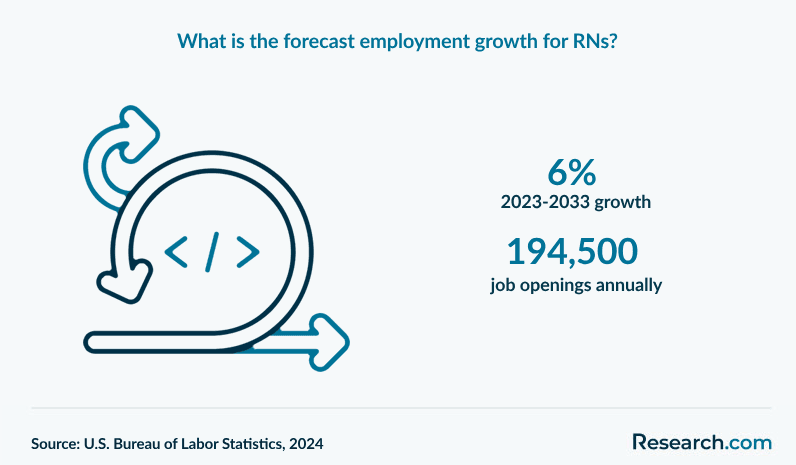
The employment growth forecast for registered nurses is projected to be 6% from 2023 to 2033, resulting in approximately 194,500 job openings annually (U.S. Bureau of Labor Statistics, 2024). This steady growth supports ongoing need for qualified nurses in a variety of settings, though demand differs by region and specialty.
Is accreditation essential for your RN-to-MSN program?
Yes. Accreditation is one of the first things to verify before applying to an RN-to-MSN program. A properly accredited nursing program has been reviewed against academic and clinical standards, and accreditation can affect financial aid eligibility, transfer credit, employer recognition, certification eligibility, and licensure pathways.
For RN-to-MSN programs, look for recognized nursing accreditors such as the Commission on Collegiate Nursing Education (CCNE) or the Accreditation Commission for Education in Nursing (ACEN). You can also compare broader program options through RN to MSN online rankings and guides, but always verify accreditation directly with the accreditor and the school.
Is an RN-to-MSN Degree a Strong Return on Investment?
An RN-to-MSN can be a strong investment when the program cost is manageable, the specialty aligns with market demand, and the credential leads to a role that justifies the time and debt. It may be a weaker investment if you choose an expensive program without confirming licensure eligibility, clinical placement support, or realistic salary outcomes in your state.
| ROI factor | Why it matters | How to evaluate it |
| Total cost | Debt can reduce the benefit of higher earnings | Compare tuition, fees, travel, lost work hours, and certification costs |
| Specialization | Different MSN tracks have different salary and hiring patterns | Research your target role in your state or region |
| Clinical placement support | Delayed placements can extend time to graduation | Ask whether the school assigns sites or expects students to find preceptors |
| Licensure alignment | A program must meet requirements where you plan to practice | Check state board and certification requirements before enrolling |
| Program outcomes | Completion, certification, and employment outcomes show practical value | Request graduation rates, certification pass rates, and graduate employment data |
Students comparing bridge options may also find it useful to review the easiest direct entry MSN programs to get into, especially if they are comparing different routes into graduate nursing education.
What certifications and licensures are required after completing an RN-to-MSN degree?
Graduating with an MSN does not automatically authorize advanced practice. Requirements depend on your role, specialty, and state. Nurse practitioner, nurse midwife, nurse anesthetist, and clinical nurse specialist roles commonly require national certification, state recognition or licensure, supervised clinical preparation, and ongoing continuing education.
Before choosing a program, identify your target role and state, then confirm the exact certification board, clinical-hour expectations, exam requirements, and state board rules. Bridge pathways such as RN to NP programs may help streamline academic progression, but they still must satisfy state and certification requirements.
Are Accelerated Family Nurse Practitioner Programs the Fastest Path to Advanced Practice?
Accelerated FNP pathways can shorten the time between RN practice and advanced practice preparation, but they are not automatically the best choice for every nurse. These programs compress coursework and clinical experiences, which can be valuable for highly organized students with strong support systems and flexible work schedules.
Before enrolling, compare the depth of the curriculum, clinical placement process, simulation resources, faculty access, certification preparation, and state licensure alignment. If speed is your main priority, review accelerated family nurse practitioner programs, but balance pace with clinical readiness.
What challenges should I expect during my online RN-to-MSN program?
Online RN-to-MSN study can be flexible, but it is not easy. Graduate nursing programs require sustained reading, writing, research, clinical judgment, discussion participation, and practicum coordination.
- Time pressure: Working nurses often underestimate how much weekly study time graduate courses require.
- Clinical placement logistics: Finding approved preceptors can be difficult if the school does not provide strong placement assistance.
- Technology demands: Online learning platforms, telehealth simulations, testing systems, and virtual meetings require reliable internet and comfort with digital tools.
- Role transition: Moving from RN practice to provider, educator, leader, or systems role requires a different level of accountability.
- State restrictions: Some online programs cannot enroll students in every state or may not meet licensure expectations everywhere.
Students without a traditional nursing background face a different set of demands and may want to compare direct entry MSN programs online.
How do online RN-to-MSN programs integrate advanced technology into clinical training?
Online RN-to-MSN programs increasingly use simulation, virtual case studies, telehealth modules, digital documentation exercises, and learning management systems to support clinical reasoning. These tools cannot replace all hands-on clinical hours, but they can help students practice assessment, prioritization, documentation, and decision-making before working with patients in approved practicum settings.
Technology is especially important in accelerated formats, where students need structured feedback and realistic clinical scenarios. Programs such as a 12 month FNP program may use intensive online and simulation tools, but applicants should verify clinical-hour requirements and licensure alignment.
What are the long-term earnings and ROI prospects for RN-to-MSN graduates?
Long-term ROI depends on what you do with the MSN. A nurse who becomes an advanced practice provider may see a different financial outcome than a nurse who moves into education, administration, informatics, or policy. Location, employer type, specialty certification, work setting, and years of experience all influence earnings.
To estimate ROI, compare your current RN compensation with likely pay in your target role, then subtract total program cost, interest, certification fees, and time away from work. Specialty-specific salary resources, such as the psych DNP salary report, can help you understand how compensation varies by role and geography.
How are RN-to-MSN programs preparing you for future healthcare innovations?
Modern RN-to-MSN programs increasingly prepare nurses for technology-enabled care, interdisciplinary collaboration, quality improvement, data-informed decisions, and telehealth-supported patient management. These skills matter as healthcare organizations continue to adopt digital records, remote care models, analytics tools, and simulation-based training.
Some nurses build toward graduate study through faster bachelor’s pathways such as the fastest RN to BSN programs. Whether you choose RN-to-BSN first or RN-to-MSN directly, look for curricula that include informatics, evidence-based practice, health policy, and quality improvement.
What emerging trends are shaping online RN-to-MSN programs?
Several trends are influencing online RN-to-MSN education: greater use of virtual simulation, more telehealth content, stronger emphasis on mental health, closer attention to state authorization, and increased scrutiny of clinical placement support. Employers also continue to value nurses who can combine clinical expertise with leadership, digital literacy, and quality improvement skills.
Interest in mental health care is also drawing nurses toward psychiatric-mental health pathways, including affordable psychiatric NP programs. Applicants should confirm that any PMHNP program meets certification and state practice expectations.
Can I Transfer Previous Credits to Accelerate My RN-to-MSN Degree?
Many RN-to-MSN programs allow some transfer credit, but policies vary. Schools may review prior nursing coursework, general education credits, bachelor’s-level credits, graduate credits, and professional certifications. Transfer credit can reduce cost and time, but only if credits meet the school’s recency, grade, accreditation, and course-equivalency rules.
If you previously completed coursework through the easiest RN to BSN program online or a similar pathway, ask for a formal transcript review before enrolling. Do not rely on informal estimates from admissions conversations alone.
What student support services are critical for RN-to-MSN success?
Student support can make the difference between progressing smoothly and losing time to avoidable delays. This is especially true for online students who may not have daily campus access.
- Clinical placement support: Ask whether the school finds placements, assists with preceptors, or leaves students primarily responsible.
- Academic advising: Advisors should explain sequencing, transfer credits, specialty requirements, and graduation timelines.
- Faculty access: Look for clear office hours, timely feedback, and support for difficult clinical or research assignments.
- Technical support: Online students need reliable help with learning platforms, exams, simulation tools, and digital libraries.
- Career services: Strong programs help with certification planning, resumes, interview preparation, and role transition.
Students comparing alternative nursing routes may also review an ABSN program online, especially if they are advising someone entering nursing from a non-nursing background.
How do accelerated RN-to-MSN programs differ from traditional pathways?
Accelerated RN-to-MSN programs compress the journey to graduate nursing preparation, while traditional pathways spread coursework and clinical experiences over a longer period. Accelerated options can reduce time to graduation, but they also increase weekly workload and may be harder to manage with full-time employment.
| Pathway | Advantages | Trade-offs | Best for |
| Accelerated RN-to-MSN | Shorter timeline and faster movement toward MSN-level roles | Intensive workload, less scheduling margin, and possible clinical pressure | Highly organized nurses with flexible work and strong support |
| Traditional RN-to-MSN | More time to absorb graduate material and manage clinical placements | Longer time before completion and possible delayed earnings benefit | Working nurses who need a sustainable pace |
| RN-to-BSN then MSN | Provides a separate BSN milestone before graduate study | May take longer than a direct bridge pathway | Nurses who want a staged credential path |
Some accelerated structures resemble other fast-entry nursing pathways, such as the easiest ABSN program to get into, but graduate nursing standards, clinical requirements, and licensure expectations are different.
How do you choose the best RN-to-MSN degree program?
The best RN-to-MSN program is the one that fits your credential background, target role, state licensure needs, budget, learning style, and clinical placement reality. Use the checklist below before applying.
- Confirm accreditation: Verify CCNE or ACEN accreditation through the accreditor, not only the school website.
- Match the specialization to your career goal: Do not choose a general MSN if your goal requires NP, CNS, midwifery, or anesthesia preparation.
- Check state authorization: Make sure the program can enroll students in your state and meets requirements where you plan to practice.
- Understand clinical placement responsibilities: Ask whether the school secures clinical sites or only provides guidance.
- Compare total cost: Include tuition, fees, books, travel, lost work time, certification exams, and licensure applications.
- Ask for outcomes: Request graduation rates, certification pass rates, employment outcomes, and time-to-completion data.
- Review course sequencing: Some courses may only be offered in certain terms, which can delay graduation if missed.
- Evaluate support services: Advising, tutoring, library access, faculty responsiveness, and technical support matter in online study.
Common mistakes to avoid when choosing an RN-to-MSN program
| Mistake | Why it can hurt you | Better approach |
| Choosing the easiest admission process without checking accreditation | You may lose access to aid, certification eligibility, or employer recognition | Verify CCNE or ACEN accreditation before applying |
| Looking only at tuition per credit | A program with more credits or hidden fees may cost more overall | Compare full program cost for your exact track |
| Assuming online means no campus or clinical requirements | Many programs still require practicums, intensives, simulations, or travel | Request a complete list of in-person expectations |
| Ignoring state licensure rules | Your program may not meet requirements where you plan to practice | Check with the state board before enrolling |
| Relying only on rankings | A highly ranked program may not fit your schedule, budget, or state | Use rankings as one input, not the final decision |
| Waiting to think about clinical placements | Placement delays can postpone graduation | Ask about placement support before submitting your application |
What career paths are available for graduates of RN-to-MSN degree programs?
RN-to-MSN graduates can pursue a wide range of roles, but eligibility depends on specialization, certification, licensure, experience, and employer requirements.
- Nurse Practitioner: Provide primary or specialty care, diagnose and manage conditions, and prescribe medications where permitted by state law.
- Nurse Educator: Teach nursing students, train clinical staff, design curriculum, and support competency development.
- Nurse Leader/Administrator: Manage departments, teams, budgets, quality initiatives, and operational improvements.
- Clinical Nurse Specialist: Provide expert care for a specific population or specialty while supporting evidence-based practice and staff education.
- Public Health Nurse: Develop prevention programs, educate communities, and address population health needs.
- Nursing Informaticist: Improve healthcare delivery through technology, data systems, EHR workflows, and outcomes analysis. Nurses interested in broader analytics careers may compare related programs such as the cheapest data science masters online options.
- Nurse Researcher: Conduct studies that improve nursing practice, patient outcomes, and healthcare systems.
- Nurse Anesthetist: Provide anesthesia-related care before, during, and after surgical, diagnostic, therapeutic, or obstetrical procedures.
- Nurse Midwife: Provide reproductive, prenatal, labor, birth, postpartum, and newborn-related care.
- Nurse Consultant: Advise healthcare organizations, legal teams, or clinical programs on nursing practice and systems improvement.
- Healthcare Policy Advocate: Work with agencies, nonprofits, associations, or government groups to influence healthcare policy.
- Nurse Entrepreneur: Build healthcare-related businesses such as consulting practices, clinics, education services, or home care organizations.
What is the job market for graduates with an RN-to-MSN degree?
The job market for RN-to-MSN graduates depends on the credential earned after the degree. Advanced practice nurses, educators, leaders, and informatics professionals may see different opportunities based on local workforce shortages, employer needs, state scope-of-practice rules, and healthcare system priorities.
- Demand remains broad: Healthcare employers continue to need experienced nurses in clinical, leadership, teaching, and systems roles.
- Advanced roles can be competitive: Specialized positions may require certification, state recognition, clinical experience, and strong professional references.
- Location matters: Rural and underserved areas may have different demand patterns than large urban markets.
- Credentials influence mobility: National certification and state licensure can determine whether graduates qualify for advanced practice positions.
- Technology skills are increasingly valuable: Informatics, telehealth, quality improvement, and data-informed care are becoming more important across healthcare settings.
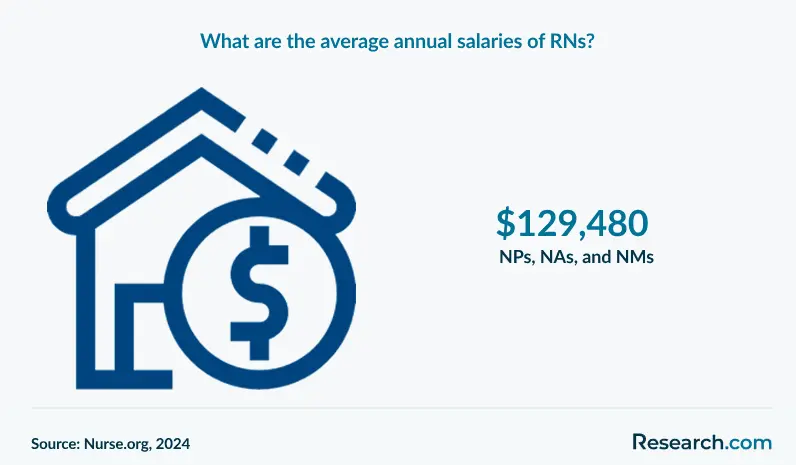
The average annual salaries for advanced practice registered nurses (APRNs), including nurse practitioners (NPs), nurse anesthetists (NAs), and nurse midwives (NMs), is $129,480 (Nurse.org, 2024). This illustrates the earning potential for RNs who complete advanced education and obtain the credentials required for APRN practice.
Graduate perspectives on RN-to-MSN online study
Completing an RN-to-MSN program helped me move into leadership at my hospital. Online learning made it possible to continue working while studying, and the nursing education focus helped me turn a long-time interest into a practical career direction. Jessie
The RN-to-MSN pathway changed my professional goals. With a family practice specialization, I gained the academic preparation and clinical experience I needed to work toward nurse practitioner practice and serve patients in a more direct advanced role. Skyler
The coursework was demanding, but it strengthened my critical thinking and leadership skills. Moving from RN to MSN gave me more confidence in managing teams and contributing to quality improvement in patient care. Enid
Key Insights
- The easiest RN-to-MSN program to enter is not always the best choice. Prioritize accreditation, licensure alignment, clinical placement support, and specialty fit before speed or admissions convenience.
- RN-to-MSN programs commonly take 2 to 4 years. Accelerated programs may finish in as little as 2 years, while part-time and bridge pathways often take longer.
- Program costs vary substantially: public schools range from $20,000 to $60,000, private schools can cost $50,000 to $100,000 or more, and online programs often fall between $25,000 and $80,000.
- Specialization drives career outcomes. FNP, PMHNP, CNS, nurse educator, administration, informatics, midwifery, and anesthesia pathways have different clinical requirements, certification rules, and salary potential.
- Accreditation is essential. Look for recognized nursing accreditation such as CCNE or ACEN and verify state authorization before enrolling in an online program.
- Nursing education remains capacity-constrained. In 2023, 65,766 qualified nursing applicants were turned away, even as BSN enrollment reached 255,455 students and DNP enrollment grew by 2.0%.
- The 2023 nursing workforce included 3,175,390 RNs, 630,250 LPNs, 280,140 NPs, 47,810 nurse anesthetists, and 6,960 nurse midwives.
- Registered nurse employment is projected to grow by 6% from 2023 to 2033, with approximately 194,500 job openings annually.
- Advanced roles can offer strong earning potential. Nurse anesthetists earn a median annual salary of $212,650, nurse midwives earn $129,650, and APRNs including NPs, NAs, and NMs have an average annual salary of $129,480.
- Before applying, ask each school about total cost, transfer credits, clinical placement responsibility, certification pass rates, graduation outcomes, state licensure fit, and support for working nurses.
References:
- Accreditation Commission for Education in Nursing. (n.d.). Accreditation Commission for Education in Nursing (ACEN). Accreditation Commission for Education in Nursing.
- American Association of Colleges of Nursing. (2023). Enrollment and graduations in baccalaureate and graduate programs in nursing: 2023 data report. American Association of Colleges of Nursing.
- All Nursing Schools. (n.d.). How much do MSN nurses make? All Nursing Schools.
- American Association of Colleges of Nursing. (n.d.). American Association of Colleges of Nursing (AACN). American Association of Colleges of Nursing (AACN).
- American Nurses Association. (n.d.). American Nurses Association (ANA). American Nurses Association (ANA).
- Commission on Collegiate Nursing Education. (n.d.). Commission on Collegiate Nursing Education (CCNE). CCNE.
- Health Resources and Services Administration. (2023). National sample survey of registered nurses: 2023 results. Health Resources and Services Administration.
- Journal of Nursing Education. (n.d.). Journal of Nursing Education. Journal of Nursing Education.
- NurseJournal.org. (n.d.). Average salary for MSN degree holders. NurseJournal.org.
- Online Journal of Issues in Nursing. (n.d.). Online Journal of Issues in Nursing. Online Journal of Issues in Nursing.
- State Boards of Nursing. (n.d.). State nursing boards for licensure and program approval requirements. State Boards of Nursing.
- U.S. Bureau of Labor Statistics. (2024). Registered nurses. Occupational Outlook Handbook. U.S. Bureau of Labor Statistics.
- Xavier University. (n.d.). Understanding MSN in education salaries and popular career paths. Xavier University.
Other Things You Should Know About RN-to-MSN Degree Programs
Common requirements for easy-to-enter RN-to-MSN online programs in 2027 include a valid RN license, a minimum GPA (often around 2.75-3.0), and professional references. Some programs may not require GRE scores, making them more accessible for applicants.
Yes. Many RN-to-MSN bridge programs accept registered nurses with an associate degree in nursing and an active RN license, then award BSN-level bridge credit before MSN coursework begins. Some schools also require a minimum 2.5 to 3.0 GPA and 1 to 2 years of RN experience.


