2027 What is a Behavior Analyst? Salary and Career Paths

Co-Founder and Chief Data Scientist
Becoming a behavior analyst is a serious career decision because it usually requires graduate education, supervised fieldwork, certification, and—in many locations—state licensure. The payoff can be meaningful: behavior analysts use evidence-based behavioral science to help people build communication, learning, social, daily living, and safety skills in schools, clinics, homes, hospitals, government programs, and workplace settings.
This guide explains what behavior analysts do, how ABA, RBT, BCaBA, and BCBA roles differ, what the main BCBA pathways require, how licensing works, where salaries are strongest, and how to decide whether this path fits your goals. It is written for students comparing psychology, education, counseling, special education, and applied behavior analysis programs, as well as working professionals considering a move into behavior analysis.
Quick answer: Is becoming a behavior analyst worth it?
Becoming a behavior analyst can be worth it if you want a structured, data-driven helping profession and are prepared for graduate study, supervised practice, certification exams, ethical responsibilities, and ongoing professional development. As of March 2025, behavioral analysts had a median annual wage of $73,616 (Zippia, 2025), while ZipRecruiter reported average annual BCBA pay of $89,075 in 2025. Career prospects are also supported by rising employer demand, including a 58% increase for BCBA and BCBA-D certified professionals and a 131% increase for assistant behavior analysts from 2023 to 2024, according to US Employment Demand for Behavior Analysts.
The path is not ideal for everyone. It can involve emotionally demanding cases, detailed data collection, extensive documentation, family and team coordination, and strict compliance with certification and state practice rules. The best candidates are patient, analytical, ethical, comfortable with measurable treatment goals, and willing to keep learning as research and regulations evolve.
What are the benefits of becoming a behavior analyst?
- Strong earning potential at advanced certification levels. Becoming a Board-Certified Behavior Analyst (BCBA) can lead to average annual salary ranges between $74,000 and $90,500, according to ZipRecruiter, 2025.
- Direct impact on quality of life. Behavior analysts help clients with behavioral, developmental, learning, communication, or adaptive skill challenges make practical progress that can affect school participation, home routines, employment readiness, and independence.
- Growing employer demand. Professionals with behavior analyst credentials are increasingly sought after, with a 58% rise for BCBA and BCBA-D certified professionals and a 131% increase for assistant behavior analysts from 2023 to 2024, according to US Employment Demand for Behavior Analysts, 2025.
- What does a behavior analyst do?
- ABA vs. BCBA: What is the difference?
- What are the BCBA certification pathways for 2026?
- What else is required to become a BCBA?
- Do behavior analysts need state licensure?
- What skills do behavior analysts need?
- How much do behavior analysts earn?
- Which industries pay behavior analysts the most?
- What jobs can BCBAs pursue?
- How can I find affordable education for behavior analysis?
- How can additional licensure expand a behavior analyst’s career?
- How do behavior analyst careers compare with other mental health professions?
- Should behavior analysts pursue an advanced degree?
- What challenges do behavior analysts face?
- Can counseling techniques strengthen behavior analysis practice?
- Can online psychology degrees support behavior analysis careers?
- How can behavior analysts continue professional development?
- What specializations are available in behavior analysis?
- What is the job outlook for behavior analysts?
What does a behavior analyst do?
A behavior analyst is a professional who studies behavior, identifies why behavior occurs, and designs evidence-based interventions to increase helpful behaviors and reduce harmful or disruptive ones. The field is rooted in behavioral science and most commonly uses Applied Behavior Analysis, or ABA, to create measurable treatment plans.
In practice, behavior analysts may conduct assessments, observe clients in real-world environments, collect and interpret behavior data, train caregivers or staff, supervise direct-service providers, and revise plans when progress stalls. Their work is often associated with autism spectrum disorder (ASD) and developmental disabilities, but behavior analysis is also used in education, healthcare, mental health services, rehabilitation, social services, criminal justice, and organizational behavior management.
| Common setting | What behavior analysts may do | Who they often work with |
| Schools | Create behavior support plans, advise teachers, support IEP implementation, and train classroom teams. | Students with autism, ADHD, learning needs, or behavioral challenges. |
| Clinics and autism treatment centers | Assess behavior, design ABA plans, supervise RBTs, and monitor client progress. | Children, adolescents, and adults receiving behavioral health services. |
| Homes and family services | Teach communication, daily living, safety, and social skills while coaching caregivers. | Clients and families needing support in daily routines. |
| Healthcare and rehabilitation | Support behavioral rehabilitation, treatment adherence, and behavior plans for complex cases. | Patients with neurological, developmental, or behavioral needs. |
| Organizations | Apply behavior principles to improve training, safety, performance, and workplace systems. | Employees, leaders, and human resource teams. |
ABA vs. BCBA: What is the difference?
Applied Behavior Analysis is the discipline or method; BCBA is a professional certification. This distinction matters because many people use “ABA therapist,” “behavior analyst,” and “BCBA” interchangeably, even though the responsibilities, education requirements, and supervision authority are different.
ABA refers to the science-based approach used to understand and change behavior. Within ABA services, several credential levels may appear, including Registered Behavior Technicians, Board-Certified Assistant Behavior Analysts, and Board-Certified Behavior Analysts.
| Credential or term | What it means | Typical scope | Level of independence |
| Applied Behavior Analysis (ABA) | The evidence-based field that uses behavioral principles to improve socially significant behavior. | Assessment, intervention, skill building, behavior reduction, and data-based decision-making. | Not a credential by itself. |
| Registered Behavior Technician (RBT) | A paraprofessional role providing direct services under supervision. | Implements behavior plans and collects data. | Does not independently assess clients or design treatment plans. |
| Board-Certified Assistant Behavior Analyst (BCaBA) | A certified assistant-level professional who works under BCBA supervision. | May help with assessments, intervention design, and supervision of RBTs. | Requires ongoing supervision by a BCBA. |
| Board-Certified Behavior Analyst (BCBA) | An advanced certified professional who meets education, fieldwork, and exam requirements. | Conducts assessments, designs plans, supervises RBTs and BCaBAs, and manages treatment programs. | Can practice with greater independence, subject to state licensing laws. |
BCBAs working in schools or educational leadership may also compare related advanced credentials. For example, learning what an EdS degree is can help candidates understand a post-master’s option often used by education professionals seeking advanced practice or administrative roles.
What are the BCBA certification pathways for 2026?
The Behavior Analyst Certification Board recognizes multiple ways to qualify for BCBA certification. The right route depends on your current degree, coursework history, faculty experience, and supervised fieldwork plan.
For many candidates, the most direct route is completing a graduate program in behavior analysis that is designed around certification requirements. Students asking what you can do with a master's in behavior analysis should know that pursuing BCBA certification is one of the most common next steps.
| BCBA pathway | Who it fits best | What to verify before choosing it |
| ABAI-Accredited University Degree | Candidates pursuing a master’s or doctorate from a program accredited by Behavior Analysis International (ABAI) or the Association of Professional Behavior Analysts (APBA). | Confirm that the degree and supervised fieldwork plan align with BACB requirements. |
| Behavior-Analytic Coursework | Students who already hold a graduate degree, such as an online master's in psychology or education, but still need behavior-analytic coursework. | Check whether required content areas include behavior assessment, intervention design, ethics, and other BACB-required topics. |
| Faculty Teaching and Research | Graduate-degree holders with at least three years of full-time faculty experience in behavior analysis, including teaching and research. | Prepare documentation such as department chair verification and course syllabi. |
| Postdoctoral Experience | Candidates with advanced doctoral-level experience aligned with BACB standards. | Confirm that the postdoctoral work satisfies the educational requirement and fits BACB documentation rules. |
Your undergraduate major does not have to be behavior analysis. However, prior study in psychology, education, social work, or special education can make the transition easier because those areas introduce human development, learning, ethics, research, and service delivery concepts that appear often in behavior analysis.
What else is required to become a BCBA?
A graduate degree alone is not enough to become a BCBA. Candidates must also complete supervised fieldwork, apply to the Behavior Analyst Certification Board, pass the certification exam, and maintain certification through continuing education. Students comparing applied behavior analysis programs should look beyond course titles and ask exactly how each program supports these requirements.
| Requirement | What it involves | Why it matters |
| Supervised fieldwork | Candidates complete either 2,000 hours of supervised fieldwork with periodic supervision from a BCBA or 1,500 hours of concentrated supervised fieldwork with increased supervision. | This is where candidates learn to assess behavior, develop intervention plans, collect data, and apply ABA strategies under qualified oversight. |
| Application and documentation | Candidates submit a BACB application, pay required fees, and provide official transcripts. Faculty pathway applicants may need a department chair letter and syllabi. | Incomplete or mismatched documentation can delay eligibility. |
| BCBA exam | Eligible candidates take a multiple-choice exam covering behavior-change procedures, client-centered responsibilities, assessment, supervision, and ethics. | Passing the exam is required for certification. |
| Continuing education | Certified BCBAs complete ongoing professional development to maintain certification. | The field changes, and practitioners must remain current with ethical standards and evidence-based practice. |
The steps to become a BCBA require planning, but certification growth shows sustained interest in the profession. BCBA certifications increased from 44,025 in 2020 to 74,125 in 2025, a 68% increase. BCaBA and RBT credentials have also grown; as of 2025, their numbers are 5,479 and 196,579 respectively (BACB, 2025).
Do behavior analysts need state licensure?
BCBA certification does not automatically authorize independent practice everywhere. In many U.S. states, behavior analysts must also hold a state license before they can legally provide behavior analysis services. This is one of the most important details to check before enrolling in a program or accepting a job across state lines.
State rules vary. In the United States, many jurisdictions have licensing laws for behavior analysts, meaning BCBAs must obtain a state license in addition to certification. Examples include Alabama, Arizona, Connecticut, Massachusetts, and Washington.
Licensure may require proof of BCBA certification, additional coursework or training, a state-specific exam, continuing education, a background check, or extra field experience. In states without behavior analyst licensure laws, BCBA certification may be enough for some roles, but employers, insurers, schools, and agencies may still impose their own requirements.
Before you choose a school or job, verify the rules through your state licensing board and the BACB. This is especially important if you plan to complete an online program in one state and practice in another.
What skills do behavior analysts need?
Effective behavior analysts combine scientific precision with strong interpersonal judgment. They must know how to measure behavior, test hypotheses, design interventions, and explain plans clearly to clients, families, teachers, technicians, and other professionals.
| Skill area | What it looks like in practice | Why it matters |
| ABA principles | Using reinforcement, prompting, shaping, chaining, and related strategies appropriately. | These methods form the foundation for behavior-change plans. |
| Behavioral assessment | Conducting functional behavior assessments and preference assessments. | Good interventions depend on understanding why a behavior is happening. |
| Data collection and analysis | Using ABC charts, frequency recording, scatter plots, and progress data to guide decisions. | Behavior analysis is evidence-based; plans should change when the data show they should. |
| Program development | Creating individualized goals and procedures based on assessment results. | Students comparing BCBA online programs should look for training that connects assessment data to treatment design. |
| Ethical decision-making | Following BACB professional and ethical expectations while protecting client dignity and rights. | Behavior analysts often work with vulnerable clients and must avoid harmful or unsupported practices. |
| Crisis response | Using de-escalation, positive behavior supports, and safety procedures for high-risk behavior. | Some cases involve aggression, self-injury, or severe disruption. |
| Supervision and training | Coaching RBTs, educators, caregivers, and support staff on correct implementation. | Treatment quality depends heavily on consistent implementation across people and settings. |
| Communication | Explaining complex behavioral concepts in practical language. | BCBA degree programs should help students communicate with families, schools, and interdisciplinary teams. |
| Patience and resilience | Staying steady when progress is slow or when plans need repeated adjustment. | Behavior change can take time, especially in complex cases. |
| Critical thinking and adaptability | Revising strategies when the client, setting, data, or family needs change. | No single intervention works for every person or situation. |
How much do behavior analysts earn?
Behavior analysis salaries differ by credential level, role, location, employer type, experience, and scope of responsibility. Entry-level direct-service roles generally pay less than advanced roles that involve assessment, treatment design, supervision, and program leadership.
According to ZipRecruiter salary data cited for 2025, average annual pay varies across RBT, BCaBA, and BCBA roles as follows.
| Credential | Average salary information | Typical responsibility level |
| Registered Behavior Technician (RBT) | Average salary of around $56,657 per year. | Entry-level direct service under BCBA or BCaBA supervision; implements plans and collects data. |
| Board-Certified Assistant Behavior Analyst (BCaBA) | Average annual pay of $70,884, with hourly wages ranging from $19.95 to $59.62. | Assistant-level certified role that may support assessments, intervention design, and RBT supervision under BCBA oversight. |
| Board-Certified Behavior Analyst (BCBA) | Average annual pay of $89,075, with typical wages ranging between $74,000 and $90,500. Top earners can make up to $132,500 annually. | Advanced role involving assessment, treatment planning, supervision, clinical decision-making, and program oversight. |
BCBAs generally earn more because they hold advanced credentials and may be responsible for independent assessment, treatment design, staff supervision, parent or caregiver training, and clinical documentation. However, salary outcomes are not guaranteed. Geographic location, payer systems, employer budgets, years of experience, caseload complexity, and leadership responsibilities can all affect pay.
Location is especially important. As of 2025, California was identified as the best state to work as a BCBA, with Berkeley, Redwood City, and Mojave listed among the best cities.
Which industries pay behavior analysts the most?
Zippia identifies the highest-paying industries for Board-Certified Behavior Analysts as government, professional services, healthcare, and education. These sectors differ not only in compensation, but also in client population, work environment, documentation expectations, and career trajectory.
| Industry | Salary cited by Zippia | What behavior analysts may do | Best fit for |
| Government | $75,181 | Develop programs, support public health initiatives, contribute to social services, criminal justice, military support, or mental health systems. | Professionals interested in policy, systems-level work, and public service populations. |
| Professional services | $73,873 | Work in consulting, corporate training, human resources, or organizational behavior management. | Behavior analysts who want to apply behavioral science to workplaces and performance systems. |
| Healthcare | $72,859 | Collaborate in hospitals, clinics, rehabilitation centers, and mental health facilities on behavioral intervention plans. | Professionals comfortable working with interdisciplinary clinical teams. |
| Education | $66,678 | Support students, teachers, families, IEP teams, and special education programs. | Behavior analysts who want school-based or child-focused work. |
Healthcare, education, and professional services also represent major employment areas. Recent statistics cited in the original analysis show that most behavior analysts in the U.S. are in healthcare (29%), education (21%), and professional services (20%). Healthcare behavior analysts often work alongside professionals with training in psychology, including foundational topics similar to courses needed for a psychology degree, such as research methods, human behavior, and ethical practice.
What jobs can BCBAs pursue?
BCBA certification can lead to direct-service, supervisory, administrative, consulting, academic, and research roles. The best fit depends on whether you prefer one-on-one client work, school collaboration, family training, healthcare teams, organizational systems, or leadership.
| Role | Primary responsibilities | Work setting |
| Clinical BCBA | Assess clients, design ABA therapy plans, supervise RBTs, and evaluate progress. | Behavioral health clinics, autism treatment centers, hospitals. |
| School-Based BCBA | Create classroom behavior plans, train educators, support IEP implementation, and collaborate with families and administrators. | Public schools, private schools, special education programs. |
| In-Home BCBA | Provide family-centered intervention, teach daily living and communication skills, and coach caregivers. | Client homes and family service agencies. |
| Healthcare and Rehabilitation BCBA | Support behavioral rehabilitation for patients recovering from brain injuries, strokes, or neurological conditions. | Hospitals, rehabilitation centers, medical systems. |
| Organizational Behavior Management BCBA | Improve workplace performance, employee training, safety systems, and leadership practices. | Businesses, consulting firms, human resources departments. |
| Government and Social Services BCBA | Create interventions for populations such as juvenile offenders, mental health patients, and military personnel. | Government agencies, public health systems, social service organizations. |
| University Faculty or Researcher | Teach future behavior analysts, mentor BCBA candidates, conduct studies, and publish research. | Colleges, universities, research centers. |
| Clinical Director | Oversee ABA service quality, manage treatment teams, and supervise clinical operations. | ABA therapy centers and behavioral health organizations. |
| Director of Behavioral Services | Lead large behavioral health programs, establish policies, coordinate BCBA teams, and monitor service delivery. | Hospitals, school districts, government agencies. |
| ABA Program Director | Manage ABA certification or degree programs, supervise faculty, and align curricula with BACB standards. | Universities and training centers. |
School-based BCBAs should also understand how developmental stages affect intervention design. An early childhood education and elementary education programs comparison can help clarify how supports may differ for younger children versus elementary-age students.
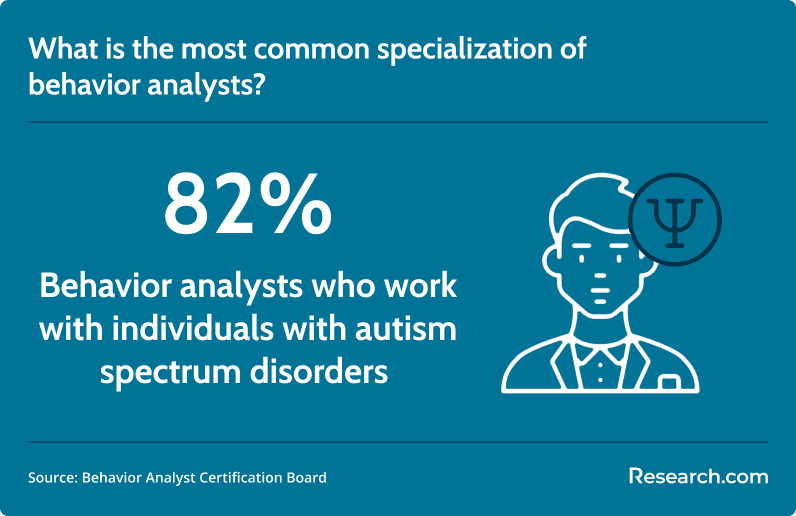
Although behavior analysts can serve many populations, a significant share of professionals work with people with autism spectrum disorders.
How can I find affordable education for behavior analysis?
The most affordable path is not always the program with the lowest advertised tuition. Behavior analysis candidates should compare total cost, accreditation or coursework alignment, supervised fieldwork support, online flexibility, transfer credit policies, exam preparation, faculty experience, and whether the program satisfies requirements in the state where they plan to practice.
Students should also compare related helping-profession programs if they are still deciding between behavior analysis, counseling, psychology, or therapy. For example, reviewing the cheapest online counseling degree options can help applicants understand cost structures and career differences before committing to a behavior analysis route.
| Cost factor | Why it matters | Question to ask |
| Tuition and fees | Fees, technology charges, supervision costs, and exam costs can change the real price. | What is the full program cost, not just tuition per credit? |
| Accreditation or coursework alignment | Certification eligibility depends on meeting required education standards. | Does this program align with BACB requirements for my intended pathway? |
| Supervised fieldwork support | Fieldwork hours are required and can be difficult to arrange alone. | Does the school help students find qualified supervisors? |
| Online format | Online study can reduce relocation and commuting costs, but licensure rules still matter. | Will this online program meet requirements in the state where I plan to work? |
| Transfer credit | Accepted credits may shorten time to completion and lower costs. | How many graduate credits can I transfer, and which ones count? |
How can additional licensure expand a behavior analyst’s career?
Some behavior analysts pursue additional credentials in counseling, therapy, psychology, or education to broaden their scope and work in integrated care settings. This can be valuable for professionals who want to address behavioral needs alongside emotional, family, or mental health concerns. However, additional licensure usually requires separate education, supervised clinical hours, exams, and state approval.
Behavior analysts considering a counseling or therapy credential can review the steps to become a licensed therapist to understand how that process differs from BCBA certification.
How do behavior analyst careers compare with other mental health professions?
Behavior analysts focus on observable behavior, environmental variables, skill acquisition, behavior reduction, and data-based intervention. Many other mental health professionals place greater emphasis on emotional processing, diagnosis, psychotherapy, family systems, or broader psychological assessment. The fields can overlap, but they are not interchangeable.
| Profession | Main focus | Typical training emphasis | When it may be the better fit |
| Behavior analyst | Behavior change, skill acquisition, environmental supports, and measurable outcomes. | ABA principles, assessment, intervention design, supervision, ethics, and data analysis. | You want structured, observable, data-driven intervention work. |
| Licensed counselor or LPC | Mental health counseling, emotional well-being, coping, and client-centered care. | Counseling theory, diagnosis, psychotherapy skills, ethics, and supervised clinical practice. | You want to provide talk therapy or broader mental health counseling. Reviewing LPC degrees can help clarify this route. |
| Psychology professional | Human behavior, cognition, research, assessment, and mental processes. | Research methods, psychological theory, statistics, assessment, and clinical or applied specialization. | You are interested in research, assessment, or broader psychological practice. |
| Marriage and family therapy professional | Relationship dynamics, family systems, and interpersonal functioning. | Family systems theory, couples therapy, diagnosis, ethics, and supervised therapy practice. | You want to focus on couples, families, and relational treatment. |
Should behavior analysts pursue an advanced degree?
An advanced degree can make sense if it directly supports your career goal: leadership, university teaching, research, school administration, interdisciplinary clinical work, or specialized practice. It may not be worth the cost if it does not improve certification eligibility, licensure options, salary potential, or role access in your target market.
Some behavior analysts consider complementary graduate study outside ABA to deepen their work with specific populations or settings. For instance, a masters of Christian counseling may interest professionals working in faith-informed counseling environments, though it should be evaluated carefully against licensure and career goals.
What challenges do behavior analysts face?
Behavior analysis can be rewarding, but it is not low-pressure work. Practitioners may manage severe behavior, complex family needs, high documentation loads, ethical questions, staff turnover, payer requirements, and emotionally demanding caseloads. They must also stay current with research, maintain certification, follow state regulations, and adapt interventions when client progress is uneven.
Professionals who want a broader family-systems perspective sometimes explore related mental health training, including the cheapest online MFT programs. This can be useful for comparison, but it is a distinct professional path with its own requirements.
Can counseling techniques strengthen behavior analysis practice?
Counseling skills can complement behavior analysis when used within the practitioner’s legal and ethical scope. Empathetic listening, rapport building, motivational conversations, and caregiver-sensitive communication can improve collaboration and treatment adherence. However, behavior analysts should not present themselves as licensed counselors unless they have the appropriate credential.
Those considering a counseling track can review the quickest path to begin working as a counselor to compare training requirements and career expectations.
Can online psychology degrees support behavior analysis careers?
Advanced psychology study can strengthen a behavior analyst’s understanding of research design, development, cognition, ethics, and mental health concepts. This may be useful for professionals working in interdisciplinary teams or planning to move into research, teaching, or program development.
Students should still verify whether a psychology degree satisfies BCBA coursework or licensure requirements. A program such as the fastest online psychology degree may offer flexibility, but speed alone should not outweigh accreditation, curriculum fit, faculty quality, and certification alignment.
How can behavior analysts continue professional development?
Behavior analysts need ongoing professional development to maintain certification, improve clinical judgment, and adapt to changing research and service models. Useful options include continuing education courses, professional conferences, ethics training, supervision training, specialty workshops, peer consultation, and advanced graduate study.
Some professionals use interdisciplinary graduate programs to broaden their understanding of complex populations. For example, an affordable master's in forensic psychology online may be relevant for behavior analysts interested in justice-involved populations, risk behavior, or forensic service settings.
Common mistakes to avoid when choosing a behavior analysis path
| Mistake | Why it can hurt you | Better approach |
| Choosing a program based only on tuition | A low-cost program may not provide the coursework, supervision support, or state alignment you need. | Compare total cost, certification alignment, fieldwork support, and outcomes. |
| Assuming online programs meet every state’s rules | Licensure requirements vary by state, and online completion does not guarantee eligibility everywhere. | Check the state licensing board before enrolling. |
| Ignoring supervised fieldwork logistics | Fieldwork requires 2,000 hours or 1,500 concentrated supervised hours, depending on the option. | Ask how the program helps students secure qualified supervision. |
| Confusing ABA experience with BCBA authority | RBTs and BCaBAs do not have the same independent scope as BCBAs. | Understand each credential level before planning your career timeline. |
| Relying only on salary averages | Pay depends on location, industry, experience, caseload, supervision duties, and employer type. | Research salaries in your city and preferred work setting. |
| Overlooking burnout risk | High-needs caseloads, crisis behavior, travel, and documentation can be demanding. | Ask employers about caseload size, supervision support, safety protocols, and work-life expectations. |
What specializations are available in behavior analysis?
Behavior analysis is not limited to autism services, even though autism-related work is a major employment area. BCBAs and related professionals can apply behavioral science across clinical, educational, organizational, aging, feeding, forensic, and animal behavior contexts.
- Clinical Behavior Analysis. This area applies behavioral methods to mental health concerns such as depression and anxiety and may involve approaches such as Acceptance and Commitment Therapy (ACT) and Behavioral Activation.
- Organizational Behavior Management (OBM). OBM applies behavioral principles to workplace performance, safety, training, leadership, and productivity.
- Behavioral Gerontology. This specialization focuses on older adults, including behavior supports for cognitive decline, aging-related challenges, and quality-of-life improvement.
- Pediatric Feeding Therapy. This area uses behavioral strategies to address feeding difficulties in children and support healthier eating routines.
- Forensic Behavior Analysis. Forensic applications may involve offender rehabilitation, behavior modification, and recidivism reduction within criminal justice settings.
- Applied Animal Behavior. Behavioral principles can also be used ethically to address animal behavior issues and support animal welfare.
Professionals comparing remote or home-based service models may also find an online therapist career guide useful when weighing telehealth therapy roles against in-home behavioral services.
What is the job outlook for behavior analysts?
Demand indicators for behavior analysts remain strong. According to US Employment Demand for Behavior Analysts, demand for BCBA and BCBA-D certified professionals increased by 58% from 2023 to 2024. Demand for assistant behavior analysts also rose sharply, with a 131% surge in BCaBA certifications from 2023 to 2024.
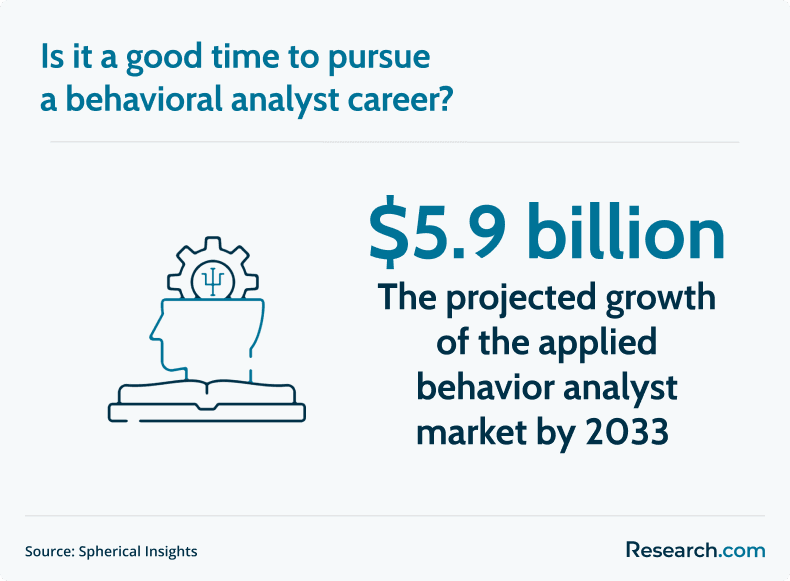
Market projections also point to continued need for ABA services. According to Spherical Insights, the ABA market was valued at $3.8 billion in 2023 and is projected to grow at a Compound Annual Growth Rate (CAGR) of 4.5%. By 2033, the market size is expected to reach $5.9 billion.
Even with positive demand signals, students should avoid assuming automatic job placement or guaranteed salary outcomes. The strongest opportunities typically depend on certification status, licensure eligibility, supervised experience, geographic location, specialization, and willingness to work in high-need settings such as autism services, schools, healthcare, and behavioral health clinics.
Key Insights
- Behavior analysis is a data-driven helping profession focused on measurable behavior change, skill development, and evidence-based intervention.
- ABA is the field or method; BCBA is an advanced certification. RBTs, BCaBAs, and BCBAs have different education levels, supervision requirements, and scopes of responsibility.
- BCBA certification generally requires graduate-level preparation, supervised fieldwork, a BACB application, passing the BCBA exam, and continuing education.
- Supervised fieldwork is a major planning factor: candidates complete either 2,000 supervised fieldwork hours or 1,500 concentrated supervised fieldwork hours.
- Licensure is separate from certification in many locations. BCBAs should verify state rules before enrolling in a program or relocating for work.
- Salary potential rises with credential level. ZipRecruiter reported average annual pay of around $56,657 for RBTs, $70,884 for BCaBAs, and $89,075 for BCBAs in 2025.
- BCBA certifications grew from 44,025 in 2020 to 74,125 in 2025, a 68% increase, while 2025 BACB data listed 5,479 BCaBAs and 196,579 RBTs.
- Government, professional services, healthcare, and education are the highest-paying industries cited for BCBAs, while healthcare, education, and professional services are also major employment settings.
- California stands out in the cited salary analysis, with 9 of the top 10 highest-paying cities for BCBAs located there.
- Most behavior analysts, including RBTs, BCaBAs, and BCBAs, work with people with autism spectrum disorders, but specializations also exist in OBM, gerontology, feeding therapy, forensic behavior analysis, clinical behavior analysis, and applied animal behavior.
References:
- Behavior Analyst Certification Board. (2025). US employment demand for behavior analysts: 2010–2024. Retrieved from https://www.bacb.com/wp-content/us_employmentdemand_ba/
- Behavior Analyst Certification Board. (n.d.). BACB certificant data. Retrieved from https://www.bacb.com/BACB-certificant-data
- Behavior Analyst Certification Board. (2020). BACB compliance code. Retrieved from https://www.bacb.com/wp-content/uploads/2020/05/BACB-Compliance-Code-english_190318.pdf
- Behavior Analyst Certification Board. (2022). BCBA handbook. Retrieved from https://www.bacb.com/wp-content/uploads/2022/01/BCBAHandbook_241226-a.pdf
- ZipRecruiter. (n.d.). Board-certified behavioral analyst salary. Retrieved from https://www.ziprecruiter.com/Salaries/Board-Certified-Behavioral-Analyst-Salary
- ZipRecruiter. (n.d.). BCaBA salary. Retrieved from https://www.ziprecruiter.com/Salaries/Bcaba-Salary
- ZipRecruiter. (n.d.). RBT salary. Retrieved from https://www.ziprecruiter.com/Salaries/Rbt-Salary
- Zippia. (n.d.). Behavior analyst demographics. Retrieved from https://www.zippia.com/behavior-analyst-jobs/demographics/
- Zippia. (n.d.). Highest paying industries for behavior analysts. Retrieved from https://www.zippia.com/salaries/behavior-analyst/
- ZipRecruiter. (n.d.). Salaries for behavior analysts. Retrieved from https://www.ziprecruiter.com/Salaries/Behavior-Analyst-Salary
Other Things To Know About Becoming a Behavior Analyst
BCBA candidates need either 2,000 supervised fieldwork hours or 1,500 concentrated supervised fieldwork hours. The hours must be completed under an approved supervisor and documented before sitting for the BACB certification exam.
To become a certified behavior analyst in 2027, you must complete a master's degree in behavior analysis, accumulate 1,500 hours of supervised fieldwork, and pass the BCBA exam. Certification is overseen by the Behavior Analyst Certification Board (BACB).