2027 What is an LPC? Degrees, Careers & Salary

Co-Founder and Chief Data Scientist
Choosing the Licensed Professional Counselor (LPC) path is a major education, licensure, and career decision. You are not only selecting a graduate degree; you are committing to supervised clinical training, state licensing rules, continuing education, and a profession that requires strong emotional stamina. An LPC is a master’s-level mental health professional who helps clients address emotional, behavioral, relational, and psychological concerns through counseling and evidence-based treatment.
This guide explains what LPCs do, how the licensure process works, what degree you need, how long the path can take, where LPCs work, and what salary and job outlook data suggest. It is designed for prospective counseling students, career changers, psychology majors, and working professionals comparing counseling with psychology, social work, marriage and family therapy, or doctoral-level clinical careers.
Quick answer: Is becoming an LPC worth considering?
Becoming an LPC can be a strong fit if you want a clinical mental health career focused on therapy, client support, and long-term behavioral change. The standard pathway requires a master’s degree, supervised clinical experience, a licensing exam, and state approval. Master’s degrees related to LPC licensure may take up to 3 years to complete, while the full path to licensure may take up to 8 years depending on your education pace, state requirements, and supervised-hour timeline.
Key things to know about becoming a Licensed Professional Counselor
- LPC licensure generally requires a master’s degree, supervised clinical hours, and a passing score on a required licensing exam; exact rules vary by state.
- Relevant master’s programs may take up to 3 years to finish.
- The full LPC pathway may take up to 8 years from undergraduate study through licensure.
- LPCs can work in private practice, hospitals, schools, outpatient clinics, community agencies, rehabilitation programs, and faith-based or specialized counseling settings.
- Licensed Professional Counselors in the U.S. earn an average annual salary of around $73,261.
- What does an LPC do?
- How much can an LPC earn in 2027?
- How is an LPC different from a psychologist or social worker?
- What education is required for LPC licensure in 2027?
- How long does it take to become an LPC?
- What skills help LPCs succeed?
- What jobs can LPCs pursue?
- Which continuing education options can strengthen an LPC career?
- What ethical and legal issues should LPCs prepare for?
- Which industries may offer higher LPC pay?
- What challenges do LPCs commonly face?
- How should I choose an LPC degree program?What career challenges should I consider before enrolling?
- How can I pay for LPC education and training?
- Can forensic psychology specialization help an LPC career?
- Are combined master’s and PsyD programs useful for advancement?
- What is the job outlook for LPCs?
- Can online MFT degrees add value to LPC practice?How does demand affect counseling career planning?
- Can a doctoral degree expand LPC career options?
- Should I choose an accelerated education path?When does doctoral study make sense?How should job outlook affect my decision?What should I do before applying?
What does an LPC do in the field of mental health?
A Licensed Professional Counselor provides counseling services to people experiencing mental health, emotional, behavioral, or life-adjustment concerns. Depending on state scope-of-practice rules and workplace policies, LPCs may assess client needs, develop treatment plans, deliver individual or group counseling, respond to crises, document clinical progress, and coordinate care with other professionals.
LPCs often use evidence-based approaches such as cognitive-behavioral therapy (CBT), person-centered therapy, trauma-informed care, and other counseling models. Their work is usually client-centered: they help people understand patterns, build coping strategies, improve relationships, and make healthier decisions.
Common LPC responsibilities
- Assessing client needs: LPCs gather information through interviews, intake forms, clinical conversations, and standardized tools when appropriate.
- Providing counseling and therapy: They help clients address anxiety, depression, stress, trauma, grief, relationship conflict, addiction-related concerns, and other behavioral health issues.
- Creating treatment plans: LPCs set goals with clients, select counseling interventions, and adjust treatment as progress or needs change.
- Responding to crises: They may help clients experiencing suicidal thoughts, acute distress, safety risks, or severe emotional disruption.
- Coordinating care: LPCs may collaborate with psychiatrists, physicians, social workers, school personnel, case managers, or family members when appropriate and legally permitted.
- Maintaining records: Documentation is a core part of the role because records support continuity of care, ethical practice, legal compliance, and billing requirements.
| Work area | What LPCs typically do | Why it matters |
| Assessment | Identify presenting concerns, history, risks, strengths, and treatment goals. | Good assessment helps avoid a one-size-fits-all treatment plan. |
| Counseling | Use therapeutic techniques to support behavior change, emotional regulation, and coping skills. | This is the core service most clients seek from an LPC. |
| Crisis support | Evaluate safety concerns and connect clients with emergency or higher-level care when needed. | Timely intervention can protect clients during high-risk situations. |
| Documentation | Record session notes, treatment updates, and relevant clinical observations. | Accurate records support ethical, legal, and professional accountability. |
How much can I earn as an LPC for 2027?
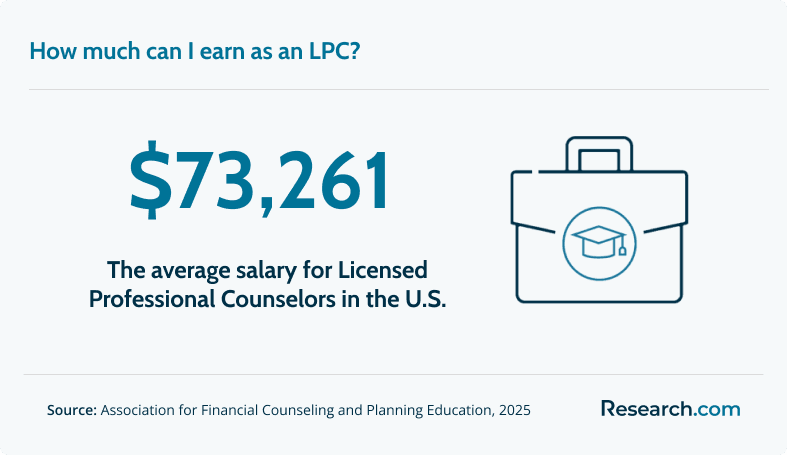
LPC earnings depend on location, license level, employer type, years of experience, client population, specialization, and whether the counselor works in private practice or as an employee. The article’s salary data notes that Licensed Professional Counselors in the U.S. earn an average annual salary of around $73,261. This figure should be treated as a general benchmark rather than a guaranteed income.
Salary can also vary by role. Counselors in private practice may have more control over fees and schedule, but they also take on business expenses, insurance billing, marketing, taxes, and administrative work. Counselors employed by hospitals, schools, clinics, or community agencies may have more predictable income and benefits, but less control over caseload and scheduling.
Factors that can influence LPC pay
- State and metro area: Pay is often shaped by local demand, cost of living, insurance reimbursement rates, and employer budgets.
- Work setting: Hospitals, outpatient programs, schools, private practices, and community agencies may offer different compensation structures.
- Specialization: Experience in trauma, substance use, couples counseling, child and adolescent counseling, crisis work, or forensic settings can affect opportunities.
- License status: Fully licensed counselors generally have more independence than pre-licensed clinicians completing supervised hours.
- Business model: Private practice income depends heavily on client volume, referral sources, insurance participation, fees, and overhead costs.
How does an LPC differ from a psychologist or social worker?
LPCs, psychologists, and Licensed Clinical Social Workers can all provide mental health services, but they are trained for different professional roles. The right path depends on whether you want a master’s-level counseling career, a doctoral-level clinical and assessment career, or a clinical role that combines therapy with social services and systems-based advocacy.
| Profession | Typical education level | Main professional focus | Best fit for students who want to... |
| Licensed Professional Counselor | Master’s degree | Counseling, therapy, treatment planning, and mental health support. | Provide counseling services and work directly with clients using therapeutic methods. |
| Psychologist | Doctoral degree such as a Ph.D. or Psy.D. | Clinical services, psychological testing, assessment, research, supervision, or academia depending on training and licensure. | Pursue advanced assessment, research, teaching, or doctoral-level clinical practice. |
| Licensed Clinical Social Worker | Master’s degree | Therapy plus case management, advocacy, and connection to community or social resources. | Blend clinical work with social systems, resource navigation, and client advocacy. |
- LPC vs. psychologist: LPCs commonly focus on counseling and treatment. Psychologists usually complete doctoral training and may be more involved in psychological testing, research, consultation, and complex diagnostic assessment, depending on state rules and professional setting.
- LPC vs. social worker: LPCs typically emphasize counseling and mental health treatment. Licensed Clinical Social Workers also provide therapy, but their training often includes case management, social advocacy, and help with practical needs such as housing, healthcare access, child welfare, and community resources. When comparing a social worker vs. therapist, the main distinction is often the balance between clinical counseling and broader systems-based support.
What are the educational requirements to become an LPC for 2027?
The LPC path is regulated at the state level, so requirements can differ. In general, aspiring LPCs complete undergraduate study, earn a counseling-related master’s degree, finish supervised clinical experience, pass a licensing exam, and satisfy any additional state board requirements.
- Earn a bachelor’s degree: Many future LPCs major in psychology, counseling, social work, human services, or another behavioral science field. A specific undergraduate major is not always required, but relevant coursework can make graduate school preparation easier.
- Complete a master’s degree in counseling or a related field: The master’s degree is the central academic requirement for LPC licensure. Programs often include counseling theory, ethics, assessment, human development, group counseling, multicultural counseling, and supervised practicum or internship experiences.
- Finish supervised clinical experience: After the master’s degree, candidates usually complete supervised postgraduate clinical hours. The article’s cited range is often between 2,000–4,000 hours, depending on the state.
- Pass the required licensing exam: Many states use the National Counselor Examination or the National Clinical Mental Health Counseling Examination (NCMHCE) as part of the licensing process.
- Meet state-specific rules: Additional requirements may include background checks, jurisprudence exams, ethics coursework, specific course titles, or documentation forms required by the licensing board.
| Requirement | What to verify before enrolling | Why it matters |
| Bachelor’s degree | Whether your undergraduate coursework prepares you for counseling graduate admissions. | Some programs may require prerequisite coursework or prefer behavioral science preparation. |
| Master’s program | Whether the curriculum aligns with your state’s LPC educational requirements. | A degree that does not meet state standards can delay or block licensure. |
| Clinical training | Whether the program includes practicum and internship experiences accepted by your state board. | Clinical placement quality affects skill development and licensure readiness. |
| Licensing exam | Which exam your state requires and when you can sit for it. | Exam rules and timing differ by state and license category. |
| Postgraduate supervision | How many supervised hours are required and who can supervise you. | Supervision rules can affect your timeline and employment options after graduation. |
How long does it take to become an LPC?
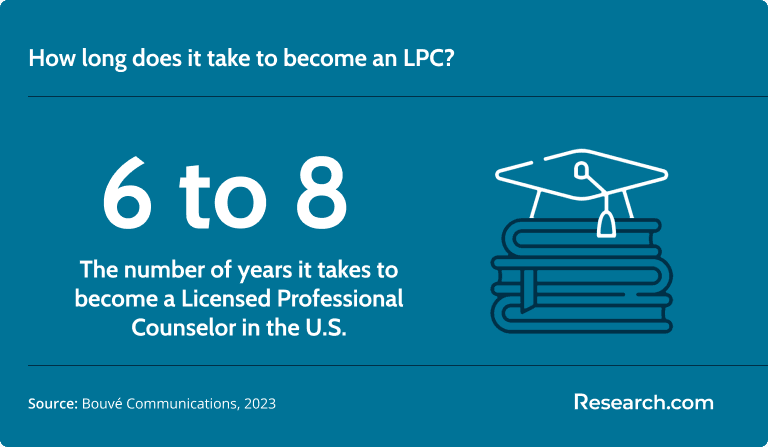
The LPC pathway often takes 6 to 8 years. A full-time bachelor’s degree typically takes 4 years, followed by a counseling-related master’s program that typically takes 2 to 3 years. After graduation, candidates usually complete 2,000–4,000 hours of supervised clinical experience, which often spans about 1 to 2 years. The final step is passing the required licensing exam and receiving approval from the state licensing board.
Students looking for the quickest way to become a therapist should be careful not to sacrifice licensure eligibility for speed. A faster program is only useful if it meets state academic, practicum, internship, and supervision requirements.
| Stage | Typical time noted in this guide | Decision point |
| Bachelor’s degree | 4 years of full-time study | Choose coursework that supports graduate counseling admissions. |
| Master’s degree | 2 to 3 years | Confirm the program supports LPC licensure in your state. |
| Supervised clinical experience | About 1 to 2 years | Plan for 2,000–4,000 hours, depending on your state. |
| Licensing exam and state approval | Varies by state and candidate readiness | Check exam timing, application deadlines, and documentation requirements early. |
What skills do I need to become a successful licensed professional counselor?
Strong LPCs combine clinical training with disciplined communication, ethical judgment, and emotional steadiness. Technical knowledge matters, but counseling effectiveness also depends on how well you listen, build trust, respond under pressure, and adapt treatment to each client’s needs.
- Empathy and active listening: Clients need to feel understood without being judged. LPCs must listen closely, reflect accurately, and respond with care.
- Clear communication: Counselors explain treatment goals, discuss sensitive concerns, write clinical notes, and coordinate with other professionals.
- Clinical reasoning: LPCs assess complex situations and select approaches that fit the client’s symptoms, culture, goals, risks, and readiness for change.
- Emotional resilience: Counseling can involve trauma, grief, crisis, addiction, and severe distress. Sustainable practice requires boundaries, supervision, consultation, and self-care.
- Cultural responsiveness: Effective counseling requires respect for a client’s identity, family context, community, beliefs, language, and lived experience.
- Ethical reliability: LPCs must protect confidentiality, document carefully, avoid conflicts of interest, and practice within their competence.
- Organization: Caseload management, records, treatment planning, referrals, billing, and continuing education all require dependable systems.
What types of jobs can an LPC get?
LPCs can work in a range of clinical and community settings. Some roles focus on individual therapy, while others involve crisis services, addiction treatment, school-based support, family systems, or specialized populations.
- Private practice therapist: LPCs may provide individual, couples, family, or group counseling. Some specialize in grief, trauma, anxiety, depression, or life transitions. Students interested in how to become a grief counselor may find private practice or hospice-related counseling especially relevant.
- Clinical mental health counselor: These counselors may work in hospitals, outpatient clinics, rehabilitation centers, or community mental health organizations.
- Marriage and family therapy-focused counselor: LPCs with family-systems training may work with couples and families, although MFT licensure is a separate credential in many states.
- Substance abuse counselor: LPCs may support clients with substance use concerns, relapse prevention, coping strategies, and co-occurring mental health conditions.
- School-based counselor or mental health provider: LPCs may work with students dealing with anxiety, bullying, family stress, academic pressure, or social-emotional challenges. Readers exploring how to become a child psychologist should compare this route with doctoral psychology training because the credentials and scopes of practice differ.
- Social service or community agency clinician: LPCs may collaborate with case managers, social workers, and community programs to support clients with complex needs.
Related counseling and mental health roles have different salary patterns. Licensed Clinical Social Workers are noted as earning a similar range, with salaries averaging around $58,380 annually. Marriage and family therapists earn around $58,510, while substance abuse counselors and mental health counselors earn around $53,710 or more in private practice or high-demand areas. School counselors, a role some LPCs pursue depending on credential rules, often earn around $61,710 depending on location and district.
What continuing education paths can elevate my LPC career?
Continuing education is not just a licensure maintenance task. It can help LPCs deepen clinical skill, move into specialized practice, qualify for new roles, and respond to changing client needs. Useful options include trauma training, addiction counseling education, child and adolescent counseling, couples and family systems training, crisis intervention, telehealth ethics, supervision training, and advanced assessment coursework.
Some LPCs also add behavior-focused training to better support clients with developmental, behavioral, or educational needs. For example, exploring the best online ABA certificate programs can help counselors understand applied behavior analysis training options, although certification and practice rules should be checked carefully before enrolling.
| Continuing education option | When it can make sense | What to check first |
| Trauma-informed care | You work with clients affected by abuse, violence, loss, crisis, or long-term stress. | Instructor credentials, clinical depth, and relevance to your client population. |
| Addiction counseling | You want to serve clients with substance use or co-occurring mental health concerns. | State credentialing rules and employer expectations. |
| Child and adolescent counseling | You plan to work in schools, youth agencies, private practice, or family-centered settings. | Supervision access and legal requirements for working with minors. |
| Supervision training | You want to supervise interns or pre-licensed counselors later in your career. | State requirements for approved supervisors. |
| Telehealth ethics and practice | You provide online counseling or plan to serve clients across locations. | State jurisdiction rules, privacy requirements, and platform compliance. |
What legal and ethical challenges must LPCs navigate?
LPCs work with sensitive information, vulnerable clients, and high-stakes decisions. Ethical practice requires more than good intentions. Counselors must understand confidentiality, informed consent, mandated reporting, documentation, boundaries, competence, cultural humility, and risk management.
Common legal and ethical issues include deciding when confidentiality must be broken for safety reasons, documenting clinical decisions clearly, avoiding dual relationships, managing client records securely, and practicing only within areas of competence. Students preparing for the field can review broader expectations for schooling to become a counselor while also checking state board rules before beginning clinical work.
- Confidentiality: Clients must understand what is private and what exceptions apply.
- Informed consent: LPCs should explain services, risks, fees, records, telehealth policies, and client rights.
- Mandatory reporting: Counselors must know when the law requires reporting abuse, neglect, or serious safety concerns.
- Scope of competence: LPCs should seek training, supervision, or referral when client needs exceed their expertise.
- Boundary management: Dual relationships, social media contact, gifts, and community overlap require careful ethical judgment.
What are some high-paying industries for LPCs?
Higher-paying LPC opportunities are often found in healthcare and specialized behavioral health environments. Hospitals at the state, local, and private levels have a median annual wage of $59,090. Offices of health practitioners report median wages around $55,410, particularly when counselors work with private health practitioners or specialized therapists. Outpatient mental health and substance abuse centers and individual and family services also provide salary opportunities, with median wages at $51,130 and $51,010 respectively.
Demand for mental health and substance abuse treatment continues to influence openings in these sectors. Counselors interested in how to become a Christian counselor may also consider faith-based counseling settings, where mental health support may be integrated with spiritual guidance depending on the organization, client preferences, and counselor training.
What are the biggest challenges LPCs face in their careers?
LPC work can be meaningful, but it is not easy. Counselors must manage clinical responsibility, emotional exposure, documentation, administrative demands, and continuing education while maintaining ethical boundaries and personal well-being.
- Heavy caseloads: Community agencies, clinics, and public-service settings may require counselors to support many clients with complex needs.
- Burnout and compassion fatigue: Repeated exposure to trauma, grief, crisis, and severe distress can affect counselors if they lack support and recovery time.
- Documentation pressure: Treatment notes, risk assessments, care coordination, and billing records can take substantial time beyond sessions.
- Insurance and reimbursement issues: Private practice LPCs may need to manage claims, authorizations, denials, payment delays, and payer rules.
- Changing standards: Ethical rules, telehealth expectations, evidence-based practices, and state regulations can shift over time.
- Boundary strain: Counselors often care deeply about clients, but they must preserve professional limits to avoid harm and burnout.
Common mistakes aspiring LPCs should avoid
| Mistake | Why it can hurt your career | Better approach |
| Choosing a program without checking licensure alignment | You may complete a degree that does not satisfy your state board’s requirements. | Compare the curriculum with your state LPC rules before enrolling. |
| Focusing only on tuition | Low tuition may not offset weak clinical placement support or poor advising. | Evaluate total cost, supervision support, graduation outcomes, and licensure preparation. |
| Assuming every online program works for every state | State licensure rules may differ, especially for practicum, internship, and coursework. | Ask the program to confirm state-by-state licensure preparation in writing. |
| Ignoring supervised-hour logistics | Finding approved supervision after graduation can affect your timeline. | Research employers, supervisors, and associate-license requirements before finishing the degree. |
| Expecting salary outcomes to be guaranteed | Pay varies by employer, region, license level, specialty, and client volume. | Use salary data as a planning tool, not a promise. |
How can I identify the ideal LPC educational program for my career?
The best LPC program is the one that prepares you for licensure in the state where you plan to practice while also fitting your budget, schedule, clinical interests, and support needs. Accreditation, curriculum alignment, practicum quality, faculty expertise, and field placement support should carry more weight than brand recognition alone.
If you want to expand into behavioral or developmental practice areas, review whether the curriculum includes related coursework or electives. Candidates interested in applied behavior analysis can compare ABA schools as part of a broader career-planning process, while still confirming that their counseling degree meets LPC licensure requirements.
Questions to ask before choosing an LPC program
- Does this program meet LPC educational requirements in the state where I plan to become licensed?
- How many practicum and internship hours are included, and where do students complete them?
- Does the school help students find clinical placements, or are students responsible for securing their own sites?
- What licensing exams do graduates typically prepare for?
- Are faculty members experienced in clinical mental health counseling?
- Can online students access advising, supervision guidance, library resources, and career support?
- What is the total cost, including fees, books, travel, residency requirements, background checks, and liability insurance?
- How does the program support students who want to specialize in trauma, addiction, child counseling, family systems, or another area?
| Program feature | Strong sign | Warning sign |
| Licensure preparation | The program clearly maps coursework to state LPC requirements. | The school gives vague answers about whether graduates qualify for licensure. |
| Clinical placement | Students receive structured support finding approved practicum and internship sites. | Students must find placements with little guidance. |
| Faculty | Faculty have counseling experience, supervision experience, or relevant clinical expertise. | Few instructors have direct counseling practice backgrounds. |
| Student support | Advising, exam preparation, career services, and field-placement support are accessible. | Support is limited, especially for online or part-time students. |
| Cost transparency | The school explains tuition, fees, clinical costs, and financial aid options clearly. | Important expenses are difficult to find or only discussed late in the process. |
How can I finance my LPC education and training?
Paying for LPC education requires planning beyond tuition. Students may need to budget for application fees, books, technology, background checks, liability insurance, commuting to practicum sites, exam fees, and unpaid or lower-paid clinical training time. Federal aid, scholarships, assistantships, employer tuition support, institutional grants, and payment plans may help reduce upfront costs.
Students comparing specialized online options may also review affordable child and adolescent psychology masters programs online, especially if they are interested in youth-focused mental health careers. However, affordability should always be evaluated alongside licensure alignment and clinical training quality.
Ways to reduce the cost of LPC preparation
- Complete lower-cost prerequisite coursework before graduate enrollment if the program allows it.
- Ask whether transfer credits are accepted and how many can apply toward the degree.
- Compare total program cost instead of only per-credit tuition.
- Look for scholarships tied to counseling, behavioral health, underserved communities, or public service.
- Ask employers about tuition reimbursement if you already work in education, healthcare, social services, or human services.
- Plan for the supervised clinical period, when income and work schedules may be less flexible.
How can a specialization in forensic psychology boost my LPC career?
Forensic psychology training can be useful for LPCs who want to work with clients affected by legal systems, victimization, correctional settings, court-related stress, or rehabilitation needs. This specialization may support work in correctional facilities, victim advocacy programs, diversion programs, reentry services, or clinical settings that serve justice-involved clients.
Students considering this direction can review the cheapest forensic psychology masters online options as a starting point, but they should verify whether the program supports counseling licensure, forensic specialization, or both. A forensic psychology degree and an LPC-eligible counseling degree are not automatically interchangeable.
Should I consider combined masters PsyD programs for career advancement?
Combined master’s and PsyD pathways may appeal to students who want advanced clinical training, doctoral-level credentials, research exposure, supervision opportunities, leadership roles, or academic work. These programs can be intensive, and they are not necessary for every LPC career. Many counselors build successful master’s-level careers without doctoral study.
Before choosing masters PsyD programs, compare the time commitment, cost, licensure outcomes, clinical training model, dissertation or doctoral project expectations, and whether you actually need a doctorate for your goals. A combined route may make sense if you are committed to doctoral-level practice or leadership, but it may be more education than required for standard LPC work.
What is the job outlook for LPCs?
The outlook for LPC-related work is favorable. The projected growth rate is 19% from 2023 to 2033, which is much faster than the average for all occupations. This demand is connected to rising need for mental health services in schools, healthcare organizations, outpatient treatment, and addiction-related care.
Even with strong projected growth, job outcomes are not automatic. New counselors should consider state licensing timelines, local employer demand, supervised-hour availability, specialization, and willingness to work in high-need settings. Students who choose strong clinical placements and build marketable skills during graduate school may be better positioned after graduation.
Current trends affecting LPC careers
- Greater demand for behavioral health services: Schools, clinics, hospitals, and addiction treatment centers continue to need trained counselors.
- Telehealth expectations: Many clients now expect online counseling options, making telehealth ethics, privacy, and state practice rules important.
- Integrated care models: LPCs may increasingly collaborate with primary care, psychiatry, social work, and community services.
- Specialization pressure: Employers and clients may look for counselors with focused training in trauma, addiction, youth mental health, couples work, or crisis care.
- Administrative complexity: Documentation, insurance reimbursement, and compliance demands remain major parts of counseling work.
Can pursuing online MFT degrees enhance my LPC practice?
Marriage and family therapy training can help LPCs understand relationship patterns, family systems, communication cycles, and couple dynamics. This can be especially useful for counselors who work with families, adolescents, couples, co-parenting issues, grief, addiction recovery, or conflict patterns that extend beyond the individual client.
Programs such as online MFT degrees may provide structured family-systems training, but students should remember that MFT licensure and LPC licensure are separate in many states. If your goal is to become licensed as an LPC, confirm that any additional MFT education supports your intended counseling scope rather than replacing required LPC coursework.
How can pursuing a doctoral degree enhance my LPC career?
A doctoral degree can expand an LPC’s options in clinical leadership, supervision, teaching, research, advanced consultation, program development, and policy-related work. It may also support deeper specialization. However, doctoral study usually requires a significant investment of time, money, and academic energy, so it should be tied to a clear career purpose.
Professionals considering doctoral training can explore the best online PsyD programs to understand available pathways. Before applying, compare licensure implications, residency or internship requirements, clinical training expectations, and whether a PsyD is necessary for the role you want.
Should I consider an accelerated education path for LPC licensure?
An accelerated pathway can be useful for disciplined students who can manage a demanding course load and want to complete academic requirements faster. It may be especially appealing to career changers or students who already know they want counseling licensure. Still, speed should not be the only priority.
Accelerated programs must still provide adequate clinical training, meet state educational requirements, and prepare students for supervised practice. Before choosing a faster route, review accreditation, state licensure alignment, practicum and internship support, faculty access, and workload expectations. Students comparing options can review a fast track psychology degree guide, while remembering that psychology and counseling programs may lead to different credentials.
What should I do before applying to an LPC program?
Before applying, identify the state where you plan to practice, review that state’s LPC board requirements, and compare them against each program’s curriculum. Then evaluate cost, clinical placement support, online or campus format, faculty expertise, and specialization options. If possible, speak with admissions staff, current students, alumni, and licensed counselors in your state.
- Choose your target state for licensure.
- Download or review that state’s LPC educational and supervision requirements.
- Ask each program whether it meets those requirements.
- Compare total costs, not just tuition.
- Review practicum and internship placement support.
- Ask about licensing exam preparation and graduate outcomes.
- Plan financially for the supervised clinical period after graduation.
- Choose the program that best balances licensure eligibility, affordability, clinical quality, and your long-term counseling goals.
Key Insights
- LPCs are master’s-level mental health professionals who provide counseling, treatment planning, crisis support, and client-centered care across many settings.
- The LPC path usually includes a bachelor’s degree, a counseling-related master’s degree, 2,000–4,000 supervised clinical hours, a licensing exam, and state board approval.
- The full timeline is commonly around 6 to 8 years, with master’s programs typically taking 2 to 3 years after undergraduate study.
- Licensed Professional Counselors in the U.S. earn an average annual salary of around $73,261, but income depends on location, license level, employer, specialty, and private practice factors.
- Related roles differ: psychologists usually need doctoral training, while social workers often combine therapy with advocacy and case management.
- The projected growth rate for LPC-related counseling work is 19% from 2023 to 2033, but students should still evaluate local demand and supervised-hour opportunities.
- The best LPC program is not simply the cheapest or fastest one. It is the one that meets your state’s licensure rules, provides strong clinical training, fits your budget, and supports your intended counseling population.
- Before enrolling, verify accreditation, curriculum alignment, practicum support, supervision requirements, exam preparation, total cost, and whether online study is accepted for licensure in your state.
Resources:
- Association for Financial Counseling and Planning Education. (2025). Licensed Professional Counselor (LPC) Salary. https://careercenter.afcpe.org/salary/licensed-professional-counselor-lpc
- Bouvé Communications. (2023). How Long Does it Take to Become A Licensed Mental Health Counselor? https://bouve.northeastern.edu/news/how-long-does-it-take-to-become-a-licensed-mental-health-counselor
- U.S. Bureau of Labor Statistics. (2024). Occupational Outlook Handbook: Substance Abuse, Behavioral Disorder, and Mental Health Counselors. https://www.bls.gov/ooh/community-and-social-service/substance-abuse-behavioral-disorder-and-mental-health-counselors.htm#tab-8
Other things you should know about being an LPC
To become a Licensed Professional Counselor (LPC) in 2027, you typically need a master's degree in counseling or a related field. This education should include coursework in human development, counseling techniques, and ethics, along with a practicum and internship to gain supervised clinical experience.
Most LPC master’s programs require 60 credit hours, including counseling theory, ethics, human development, assessment, diagnosis, multicultural counseling, and supervised practicum or internship. Programs must also meet state board standards and often align with CACREP accreditation requirements for licensure preparation.