
2027 NCMHCE vs. NCE: Counselor Licensure and Certification

Co-Founder and Chief Data Scientist
Every year, thousands of counseling graduates face a pivotal question: which exam should they take—the NCE or the NCMHCE? These two NBCC-administered exams serve as the national benchmarks for counselor licensure, yet their purpose, format, and recognition vary across states.
This article breaks down who should take each exam, how they differ, and what the latest data says about costs, pass rates, and eligibility. By the end, readers will know exactly which exam aligns with their counseling career path.
Key Things You Should Know About NCMHCE and NCE
- The NCE tests general counseling knowledge through 200 multiple-choice questions across eight CACREP domains, while the NCMHCE measures clinical decision-making through 11 case simulations involving assessment, diagnosis, and treatment planning—making it more application-based and clinically intensive.
- Both exams are developed and owned by the National Board for Certified Counselors (NBCC) and are used nationwide for counselor licensure and national certification. However, specific state licensing boards determine which exam—or combination—is required for independent practice.
- The pass rates differ significantly: recent program reports show around 91–92% for NCE first-time takers versus 67–77% for NCMHCE. The difference reflects the exams’ purpose—the NCE focuses on theory and ethics mastery, while the NCMHCE tests real-world clinical reasoning under timed scenarios.
- What is NCMHCE vs. NCE? Overview
- Who should take the NCMHCE and who should take the NCE? Who Should It
- What are the exam formats and content areas for NCMHCE and NCE? Exam Format & Content
- What are the eligibility requirements for each exam? Eligibility Requirements
- How do state licensing boards treat the NCMHCE vs. NCE? State Licensing Rules
- How hard are these exams and what are common challenges? Exam Difficulty & Challenges
- What is the registration, scheduling, cost, and retake policy for each exam? Registration, Cost & Retakes
- How can candidates best prepare and study for the NCMHCE vs. NCE? Study & Preparation Tips
- Can affordable counseling education programs enhance exam readiness? Can affordable counseling education programs enhance exam readiness?
- What do the score reporting, pass/fail criteria, and result timeframes look like? What do the score reporting, pass/fail criteria, and result timeframes look like?
- After passing, how do these exams lead to licensure, certification, and career paths? After passing, how do these exams lead to licensure, certification, and career paths?
NCMHCE vs. NCE: Which Counseling Licensure Exam Do You Need?
Choosing between the National Clinical Mental Health Counseling Examination (NCMHCE) and the National Counselor Examination (NCE) is not just a test-prep decision. It affects your licensure timeline, the state where you can practice, the type of counseling work you are preparing for, and the credentials you may pursue after graduate school.
Both exams are administered by the National Board for Certified Counselors (NBCC), but they measure different kinds of readiness. The NCE tests broad counseling knowledge through 200 multiple-choice questions tied to core areas such as ethics, assessment, counseling theory, and group work. The NCMHCE focuses on applied clinical judgment through 11 case simulations and 100 scored items, requiring candidates to make decisions about assessment, diagnosis, and treatment planning.
This guide explains how the two exams differ, who should take each one, how state boards treat them, what the formats and costs look like, how difficult they are, and how to prepare. It is designed for counseling graduate students, recent graduates, licensure candidates, and professionals comparing career options with a counseling degree.
Quick answer: NCMHCE vs. NCE
The NCE is usually the better fit when your state accepts it for licensure or when you are pursuing the National Certified Counselor (NCC) credential. The NCMHCE is typically the right exam when your goal is clinical mental health counseling licensure, independent clinical practice, or the Certified Clinical Mental Health Counselor (CCMHC) credential. Your state licensing board has the final authority, so always confirm the required exam before registering.
| Decision point | NCE | NCMHCE |
| Main purpose | Measures broad professional counseling knowledge | Measures applied clinical decision-making |
| Exam style | 200 multiple-choice questions | 11 case simulations with 100 scored items |
| Best fit | General counseling licensure, NCC pathway, broad counseling preparation | Clinical mental health licensure, diagnosis-focused practice, CCMHC pathway |
| State use | Required by some states and accepted by many others | Required by some states, especially where clinical readiness is emphasized |
| Skill emphasis | Theories, ethics, assessment, professional practice, and core counseling domains | Assessment, diagnosis, treatment planning, clinical reasoning, and client care decisions |
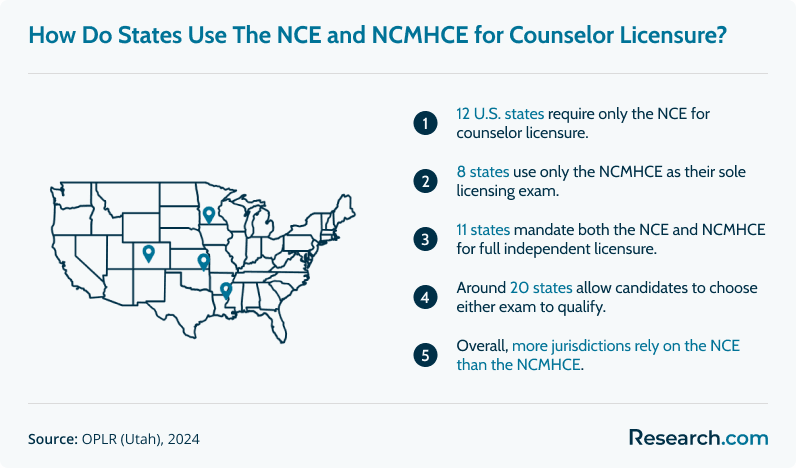
According to Utah’s 2024 Occupation-Level Report, 12 states require only the NCE, 8 require only the NCMHCE, and about 20 allow either. Because requirements vary, do not rely on national summaries alone. Check the current rules of the state where you plan to apply for licensure.
Who should take the NCMHCE and who should take the NCE?
The right exam depends on three things: your state’s licensing rule, the credential you want, and the setting where you expect to practice. The NCMHCE is generally aimed at candidates preparing for clinical mental health licensure. The NCE is more commonly associated with general counseling certification, broad licensure pathways, and states that do not require a clinical simulation exam.
If you plan to work in settings where diagnosis, treatment planning, clinical documentation, and ongoing client care are central responsibilities, the NCMHCE may align more closely with your future work. If your state uses the NCE or gives you a choice, the NCE may be the more direct route when you need to demonstrate foundational counseling competence across the profession.
| Take this exam | When it usually makes sense | Questions to ask before choosing |
| NCMHCE | You are pursuing an LCMHC or equivalent clinical mental health counseling license, want to work in diagnostic or treatment-focused roles, or plan to pursue the CCMHC credential. | Does my state require the NCMHCE for independent practice? Does my program include enough case-based clinical training? Am I prepared to apply DSM-5 reasoning under time pressure? |
| NCE | You are seeking the NCC credential, applying in a state that requires or accepts the NCE, or need a broad exam covering counseling foundations. | Will the NCE satisfy my state board? Do I need clinical licensure later? Would taking the NCMHCE now make future mobility easier? |
You should usually prepare for the NCMHCE if you:
- Plan to become a Licensed Clinical Mental Health Counselor (LCMHC) or a comparable state-licensed clinical counselor.
- Expect to work in private practice, hospitals, community mental health agencies, integrated care, or other clinical environments.
- Want to qualify for the Certified Clinical Mental Health Counselor (CCMHC) credential.
- Are comfortable being tested through client scenarios rather than standalone multiple-choice questions.
You should usually prepare for the NCE if you:
- Need the National Certified Counselor (NCC) credential.
- Are applying for licensure in a state where the NCE is the required or optional exam.
- Want a test that emphasizes counseling theory, ethics, assessment, human development, and professional practice across broad domains.
- Are still deciding among counseling settings and want a credential path with wider generalist coverage.
Do not choose based only on perceived difficulty. Licensure portability, employer expectations, supervised experience rules, and credential goals matter more. Compensation also depends on state, setting, experience, and clinical scope, so review realistic counselor salary information rather than assuming one exam automatically produces higher earnings.
Your exam choice should also reflect where you want to practice. Counselors working in hospitals, community clinics, private practices, schools, nonprofit agencies, and telehealth settings may face different credential expectations. If you are still comparing work environments, start by reviewing where mental health counselors work.
What are the exam formats and content areas for NCMHCE and NCE?
The NCE and NCMHCE differ most clearly in how they test you. The NCE asks whether you know the core concepts of professional counseling. The NCMHCE asks whether you can use clinical information to make appropriate decisions for a client.
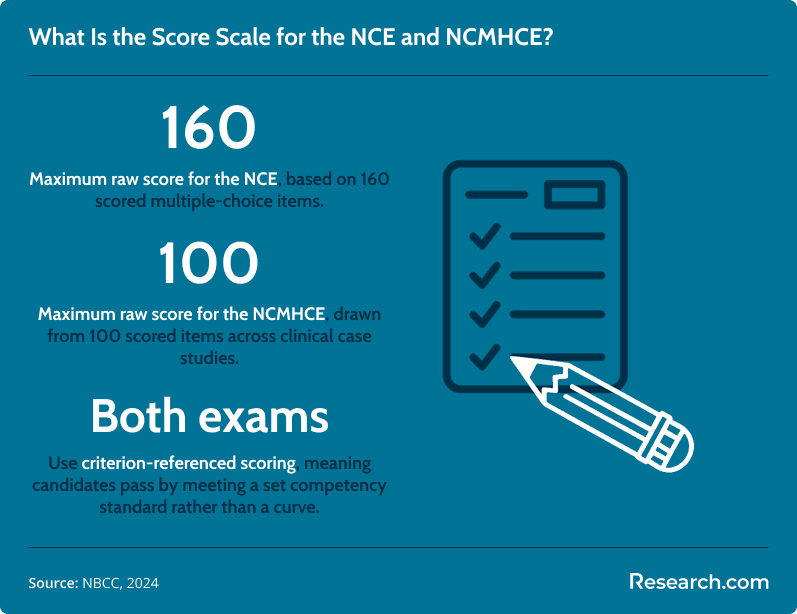
The NCE includes 200 multiple-choice questions. According to the NBCC NCE candidate handbook, 160 questions are scored and 40 are unscored pretest items. Candidates have 3 hours and 45 minutes to complete the exam. The content reflects CACREP-aligned areas such as professional ethics, assessment, group counseling, counseling theory, human growth and development, and helping relationships.
The NCMHCE uses clinical case simulations. According to the NBCC NCMHCE candidate handbook, the exam contains 11 client case studies with 100 scored items. Candidates have 4 hours and 15 minutes, including optional breaks. Instead of recalling isolated facts, examinees must interpret client information, identify clinically relevant details, choose appropriate next steps, and avoid actions that could be ineffective or unethical.
| Feature | NCE | NCMHCE |
| Question structure | Multiple-choice questions | Case-based simulations |
| Total items or cases | 200 multiple-choice questions | 11 client case studies |
| Scored items | 160 scored questions and 40 unscored pretest items | 100 scored items |
| Time limit | 3 hours and 45 minutes | 4 hours and 15 minutes, including optional breaks |
| Primary skill tested | Foundational counseling knowledge | Clinical reasoning and treatment planning |
| Typical challenge | Remembering and applying broad content across many domains | Making defensible clinical choices from complex client information |
Both exams are criterion-referenced, which means the passing decision is based on whether you meet a defined competency standard rather than how you rank against other test-takers. This distinction matters. A candidate may be strong in counseling theory but less prepared for diagnostic case analysis, just as a clinician may understand treatment approaches yet still need to distinguish frameworks such as the difference between ABA therapy and CBT in practice.
The chart below summarizes the NBCC’s NCMHCE clinical focus areas and how they relate to the applied judgment expected on the exam.
¹ The “Areas of Clinical Focus” domain represents diagnoses and presenting problems prevalent in clinical work. It is assessed across exam forms, not at the item level.
What are the eligibility requirements for each exam?
Eligibility is not based only on wanting to sit for the exam. You must be approved by the NBCC, your state licensing board, or the appropriate credentialing pathway before you can schedule. Requirements vary by state, but both exams generally assume graduate-level counseling preparation.
For the NCE, candidates typically need to hold or be close to completing a master’s degree in counseling or an equivalent program from an accredited institution. Coursework should cover the eight CACREP core content domains, including ethics, assessment, counseling theories, and group work. Candidates must receive authorization before scheduling the exam.
The NCMHCE relies on the same graduate-level foundation but places more emphasis on clinical mental health readiness. State boards often verify that the candidate’s program meets required counseling standards and includes the coursework needed to support case-based clinical decision-making. Some states permit graduate students in their final year to begin the application process, but this is not universal.
| Requirement area | NCE | NCMHCE |
| Education | Graduate degree in counseling or equivalent preparation | Graduate counseling preparation with clinical mental health relevance |
| Coursework | Core counseling content across required domains | Core counseling content plus preparation for assessment, diagnosis, and treatment planning |
| Authorization | Approval from NBCC or the state licensing board before testing | Approval through NBCC’s Credentialing Gateway or a state board process |
| Best preparation signal | Strong grounding in counseling theory, ethics, assessment, and professional identity | Strong grounding in clinical reasoning, case conceptualization, diagnosis, and intervention planning |
Typical requirements for each exam include:
- NCE: Graduate counseling degree, required core coursework across eight domains, authorization from NBCC or the state board, and registration through NBCC/CCE.
- NCMHCE: Graduate counseling preparation, approval to test from NBCC or the relevant licensing authority, and readiness to apply clinical concepts in case-based scenarios.
If you are strengthening your academic background before licensure, compare program content carefully. Some online graduate certificate programs in counseling may help with targeted coursework, but a certificate alone may not satisfy licensure education requirements unless your state board accepts it as part of a qualifying pathway.
How do state licensing boards treat the NCMHCE vs. NCE?
State boards—not the NBCC alone—decide whether the NCE, the NCMHCE, both exams, or either exam will satisfy licensure requirements. That is why two candidates with the same master’s degree may need different exams if they apply in different states.
The NCE is often used to confirm broad counseling competence. The NCMHCE is often used when a board wants stronger evidence of clinical readiness for diagnosis and treatment planning. Some states require one specific exam, some require both for full independent licensure, and others allow candidates to choose based on licensure category or scope of practice.
According to the Utah Office of Professional Licensure Review’s 2024 Occupation-Level Report, twelve states require only the NCE, eight states require only the NCMHCE, and eleven states require both to achieve full independent licensure. About twenty states allow candidates to choose either exam to qualify, depending on their intended scope of practice.
This variation is common in counseling because states regulate scope, titles, supervision, and independent practice differently. Even within the broader counseling field, professional categories can differ in training focus and authority, similar to how the difference between biblical counseling and Christian counseling depends on framework, credentialing, and practice context.
How to verify your state’s requirement
- Go to your state counseling or behavioral health licensing board website.
- Find the application instructions for your exact license title, not a general counseling page.
- Confirm whether the board requires the NCE, the NCMHCE, both, or either.
- Check whether the exam must be completed before supervised hours, after supervised hours, or at a specific application stage.
- Save the board’s written requirement before paying an exam fee.
The infographic below shows how states differ in their use of the NCE and NCMHCE for counseling licensure.
How hard are the NCMHCE and NCE?
Both exams require serious preparation, but they are difficult in different ways. The NCE is broad. You need to remember and apply a large body of counseling knowledge across multiple domains. The NCMHCE is more situational. You must make clinical decisions from client scenarios where the best answer may depend on subtle details.
Many candidates experience the NCMHCE as harder because it tests applied judgment rather than recognition of definitions. You may know diagnostic criteria and still struggle if you select too many unnecessary actions, miss an ethical risk, or misread the client’s presenting concern. On the NCE, the challenge is often breadth, pacing, and retention.
The difference in reported pass rates illustrates the added challenge of the case-simulation format. According to the Board of Behavioral Sciences (CA DCA, 2023), NCMHCE pass rates for California LPCC candidates averaged 60–63% overall and 66–67% for first-time takers, compared to national NCE averages of 91–92% for first-time examinees.
| Common challenge | More likely on the NCE | More likely on the NCMHCE | Better preparation approach |
| Content volume | High | Moderate to high | Use a domain-by-domain calendar and revisit weak areas weekly. |
| Clinical ambiguity | Lower | High | Practice case vignettes and explain why each choice is clinically justified. |
| Time pressure | Moderate | High | Take timed practice sets instead of untimed review only. |
| Diagnostic reasoning | Limited compared with the NCMHCE | Central | Review DSM-5 criteria and practice differential diagnosis from client narratives. |
| Ethical decision-making | Important | Important in context | Study ethical codes through applied scenarios, not just memorized rules. |
If you are still deciding where counseling fits into your long-term plan, review the different types of counseling careers. The more clinical your intended role is, the more important it becomes to prepare for case-based reasoning even if your state allows either exam.
The chart below uses California Board of Behavioral Sciences data to show how NCMHCE pass-rate patterns differ by exam cycle and candidate group.
What are the registration, scheduling, cost, and retake rules?
The NCE and NCMHCE use similar registration systems. Candidates generally need approval from the NBCC or their state licensing board before they can schedule through Pearson VUE. After authorization, candidates have up to six months to choose a test date. Exams are computer-based and are usually offered during designated testing windows, typically the first two full weeks of each month.
| Item | NCE | NCMHCE |
| Registration route | Apply through NBCC or the state board, then register online through Pearson VUE. | Submit approval through NBCC’s Credentialing Gateway or your state board, then schedule after authorization. |
| Scheduling window | Schedule within the six-month eligibility window. | Testing is offered monthly, with seats available on a first-come, first-served basis. |
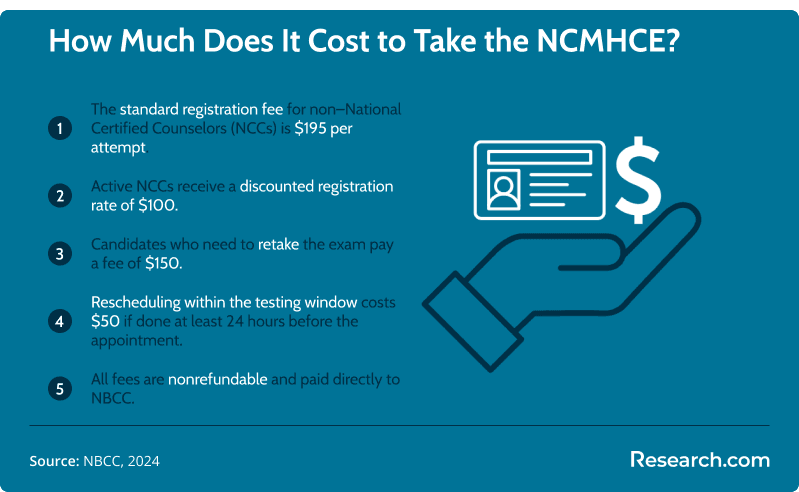
| Standard cost | $195 per attempt | $195 standard fee |
| Discounted fee | $100 for active National Certified Counselors (NCCs) | $100 for active NCCs |
| Retake cost | Retake rules apply after the waiting period | $150 retake (reregistration) fee |
| Retake waiting period | Minimum three-month wait before retesting; no cap on attempts | Candidates may retake after three months |
| Rescheduling | Follow Pearson VUE and NBCC scheduling rules | Rescheduling before 24 hours incurs a $50 fee |
Before you pay, confirm these details:
- Whether your state requires board approval before NBCC registration.
- Whether your eligibility window will cover your intended testing month.
- Whether your application name exactly matches your identification documents.
- Whether your state accepts the exam for the license title you are pursuing.
- Whether retaking the exam could delay your supervised practice or licensure application timeline.
Credential logistics can be confusing because two credentials may both be legitimate but serve different purposes. That is similar to choosing between PTCB or NHA certification: the best option depends on recognition, requirements, and where you plan to work.
The infographic below summarizes the NBCC’s NCMHCE fee schedule and highlights standard and retake-related costs for 2024.
How should you study for the NCMHCE vs. NCE?
Preparation should match the exam format. Studying for the NCE means building broad command of counseling domains and practicing multiple-choice application. Studying for the NCMHCE means training yourself to think through cases like a clinician: What information matters? What risks are present? What diagnosis is most likely? What intervention is appropriate now?
Start with official NBCC materials. The NBCC exam preparation resources include study guides aligned with each exam. The NCE guide includes 180 multiple-choice items, while the NCMHCE guide includes sample case studies. These resources help candidates understand the structure and language of the exams before using third-party materials.
| Study area | Best approach for the NCE | Best approach for the NCMHCE |
| Content review | Cover CACREP core areas such as human development, ethics, assessment, group work, and counseling theory. | Review assessment, diagnosis, treatment planning, ethics, and crisis-related decision-making through clinical cases. |
| Practice format | Use multiple-choice question banks, flashcards, and full-length practice tests. | Use case simulations, timed vignettes, and post-case reviews of why each action was or was not appropriate. |
| Time management | Practice answering questions steadily across a long testing block. | Practice reading cases efficiently and avoiding over-selection or under-selection of clinical actions. |
| Weak-area tracking | Track missed questions by domain and revisit high-error topics. | Track mistakes by reasoning type: diagnosis, risk, ethics, treatment plan, or information gathering. |
| Final review | Take timed full-length exams to build stamina. | Take timed case exams and review clinical logic, not just the answer key. |
For the NCE, prioritize:
- A study calendar that covers all core counseling domains rather than only your favorite topics.
- Repeated practice with theory, ethics, assessment, diagnosis basics, career counseling, group work, and human development.
- Timed practice exams to build endurance for a long multiple-choice test.
- Flashcards or retrieval practice for definitions, theorists, ethical principles, and assessment terms.
For the NCMHCE, prioritize:
- Case vignette practice focused on client assessment, diagnosis, treatment planning, and follow-up decisions.
- DSM-5 review, especially criteria that commonly overlap across diagnoses.
- Timed clinical simulations so you can practice decision-making under pressure.
- Reflection after each case: What information was essential? What was distracting? What would be premature or unethical?
Common study mistakes to avoid
| Mistake | Why it hurts candidates | Better approach |
| Using only class notes from graduate school | Course notes may not match the exam structure or weighting. | Use NBCC outlines and official-style practice items as your roadmap. |
| Studying the NCMHCE like a multiple-choice test | Case simulations require clinical prioritization, not simple recall. | Practice case reasoning and learn why certain options are clinically inappropriate. |
| Ignoring ethics until the final week | Ethical issues appear across content areas and can affect clinical decisions. | Review ethics early and apply ethical standards to scenarios. |
| Taking practice tests without reviewing errors | Scores alone do not explain why you missed items. | Keep an error log and identify repeated patterns. |
| Scheduling too soon after authorization | Testing before you are ready can lead to retake delays and added fees. | Choose a date that allows enough time for structured review and timed practice. |
Can affordable counseling education programs improve exam readiness?
A lower-cost counseling program can support exam readiness if it offers the right academic foundation, faculty support, clinical preparation, and alignment with licensure expectations. Affordability matters, but it should not be the only factor. A program that saves money upfront may create problems later if it does not meet state education requirements or lacks adequate clinical training.
When comparing options, look beyond tuition. Review accreditation, field placement support, course sequence, faculty credentials, exam-prep resources, and whether the curriculum covers the domains tested on the NCE or the clinical competencies needed for the NCMHCE. Students trying to manage costs can compare the most affordable online counseling degree options, but they should still verify state licensure fit before enrolling.
Online programs can be useful for working adults, career changers, and students who need scheduling flexibility. However, online delivery does not remove licensure requirements. If you are considering distance education, compare accredited online counseling degree programs and ask each school how its curriculum, practicum, and internship experiences prepare students for the NCE, the NCMHCE, or both.
How are scores reported, and when do results arrive?
The NCE and NCMHCE both use NBCC scoring procedures designed to evaluate competence consistently across exam forms. Because the exams are criterion-referenced, your result is based on whether you meet the passing standard for the specific form you took, not on whether you outperformed other candidates.
| Scoring item | NCE | NCMHCE |
| Exam structure used for scoring | 200 questions total, with 160 scored and 40 unscored pretest items | 11 case simulations totaling 100 scored items |
| Score type reported | Pass/fail result only; numerical scores are not disclosed | Pass/fail result only; numerical scores are not disclosed |
| Passing model | Criterion-referenced scoring with equating across test forms | Criterion-referenced scoring with equating across test forms |
| General raw-score expectation | The minimum passing raw score generally equals about 60–65% accuracy | The minimum passing raw score generally equals about 60–65% accuracy |
| Result timing | NBCC releases results within 30 days of the exam window’s close | NBCC releases results within 30 days of the exam window’s close |
Unofficial results may appear immediately after testing, but official results are released only after verification. NBCC sends official reports to state licensing boards after processing, and candidates are notified by email when results are available.
The infographic below summarizes how NBCC score reporting reflects competency-based testing rather than percentile ranking.
What happens after you pass the NCE or NCMHCE?
Passing the exam is an important milestone, but it is usually not the final step to independent practice. Most state licensure pathways also require a qualifying master’s degree, supervised clinical experience, application approval, background checks or documentation, and compliance with professional ethics rules.
- The NCE can support the National Certified Counselor (NCC) credential and is often used for entry-level licensure or general counseling licensure pathways.
- The NCMHCE is required for the Certified Clinical Mental Health Counselor (CCMHC) credential and is used by many states to evaluate clinical readiness for diagnostic and therapeutic work.
According to NBCC (2025), there are over 60,000 active NCCs nationwide. Many counselors use the NCC as part of a broader professional development path and may later pursue clinical specialization, supervision roles, private practice, or additional credentials. If you are still mapping the full education route, review how to earn a master’s degree in counseling and how coursework and field experience connect to licensure.
After passing the required exam, counselors may work in private practice, hospitals, schools, community agencies, nonprofit organizations, and telehealth settings, depending on state scope-of-practice rules and license level. Maintaining certification requires completing 100 continuing education hours every five years, which helps counselors keep skills current and meet ongoing professional standards.
Current trends affecting counseling exam candidates
- Licensure portability remains a planning issue. Because states use different exam rules, candidates who may relocate should check more than one state before choosing an exam.
- Telehealth has increased attention to scope and jurisdiction. Counselors providing remote services must understand where the client is located and which state rules apply.
- Employers continue to value clinical readiness. Case conceptualization, risk assessment, documentation, and evidence-informed treatment planning are important even when an employer does not specify one exam over the other.
- AI tools may change administrative workflows but not licensure accountability. Counselors remain responsible for ethical judgment, confidentiality, diagnosis, and client care decisions.
Questions to ask before registering for either exam
- Which exam does my state require for my exact license title?
- If my state allows either exam, which one better supports my future practice setting?
- Will I pursue the NCC, the CCMHC, or both?
- Does my graduate program prepare me more strongly for broad knowledge testing or clinical simulations?
- Could I move to a state that requires the other exam?
- Do I have enough time before my eligibility window expires?
- What retake delay or added cost would affect my licensure timeline?
What Graduates Say About Preparing for the NCE and NCMHCE
- Mariel: "Preparing for the NCE online felt more manageable once I built a weekly schedule. The hardest part was staying consistent while working and taking care of family responsibilities, but passing confirmed that the structure and review time were worth it."
- Jayson: "The NCMHCE forced me to move beyond memorizing terms. Case simulations helped me practice how to think through client information, risk, diagnosis, and treatment decisions. Passing made me feel more prepared for real clinical work."
- Leonie: "I studied for the NCE while working part-time in a mental health clinic. Recorded lessons, practice tests, and a steady review plan helped me stay focused. Passing on the first attempt reminded me that preparation works best when it is organized."
References:
- American Counseling Association. Counseling licensure examination requirements.
- Board of Behavioral Sciences (California Department of Consumer Affairs). January 2023 examinations report.
- College of Education & Human Development (Georgia State University). NCC certification information.
- National Board for Certified Counselors (NBCC). NCE candidate handbook for state licensure.
- National Board for Certified Counselors (NBCC). NCMHCE candidate handbook for state licensure.
- National Board for Certified Counselors (NBCC). NBCC exam preparation resources.
- National Board for Certified Counselors (NBCC). NBCC licensure exam registration.
- National Board for Certified Counselors (NBCC). NBCC examinations overview.
- National Board for Certified Counselors (NBCC). NCMHCE content outline.
- National Board for Certified Counselors (NBCC). NCE content outline.
- National Board for Certified Counselors (NBCC). NCE exam overview.
- National Board for Certified Counselors (NBCC). NCMHCE registration form.
- National Board for Certified Counselors (NBCC). NBCC retake guidance for candidates who did not pass.
- National Board for Certified Counselors (NBCC). NBCC score report information.
- National Board for Certified Counselors (NBCC). NBCC state licensure resources.
- Palo Alto University. National Counselor Certification pathway.
- Pearson VUE. NBCC certification testing through Pearson VUE.
- Southern New Hampshire University. MA Clinical Mental Health Counseling 2024 program outcomes report.
- Texas Behavioral Health Executive Council. Texas counseling licensure examinations.
- Utah Office of Professional Licensure Review. CMHC occupation-level report, January 2024.
Key Insights
- The NCE and NCMHCE are not interchangeable everywhere. State boards decide which exam satisfies licensure, so verify your state’s rule before registering.
- The NCE is broader; the NCMHCE is more clinical. The NCE tests foundational counseling knowledge through 200 multiple-choice questions, while the NCMHCE tests clinical judgment through 11 case simulations and 100 scored items.
- Your career goal should guide your exam strategy. Choose the NCMHCE if you are preparing for clinical mental health practice or the CCMHC credential. Choose the NCE if your state accepts it and your goal is general counseling licensure or the NCC credential.
- Difficulty depends on format. The NCE challenges candidates with breadth; the NCMHCE challenges candidates with realistic case reasoning, diagnostic judgment, and treatment-planning decisions.
- Do not choose a program or exam based only on cost or convenience. Check accreditation, state licensure alignment, supervised experience requirements, exam preparation support, and portability before committing.
- Preparation should match the test. Use domain-based review and multiple-choice practice for the NCE; use timed clinical simulations and case conceptualization practice for the NCMHCE.
Other Things You Should Know About NCMHCE and NCE Licensure and Examination
State boards set the requirement. Many states accept the NCE for counselor licensure, while others require the NCMHCE, especially for clinical licensure. Some states accept either exam but require a passing score set by NBCC and any additional supervised-hour rules from the licensing board.
The cost for the NCMHCE exam is typically higher than the NCE, with an average fee of around $275 for NCMHCE compared to $195 for the NCE. Candidates should verify with their state boards as fees can vary based on additional processing charges.


