2027 Master’s in Counseling: Everything You Need to Know Before Enrolling

Co-Founder and Chief Data Scientist
A master’s in counseling is often the required graduate credential for people who want to become licensed mental health counselors, school counselors, marriage and family therapists, addiction counselors, or related helping professionals. The decision is not simple: programs differ by licensure track, accreditation, fieldwork hours, delivery format, cost, and state requirements. This guide explains what a master’s in counseling includes, how to compare programs, what career paths it can support, and what questions to ask before enrolling so you can choose a path that fits your goals, budget, and licensing plans.
Quick answer: Is a master’s in counseling worth it?
A master’s in counseling can be worth it if your goal is to enter a licensed counseling role, work directly with clients, or specialize in school counseling, mental health counseling, marriage and family therapy, rehabilitation counseling, or addiction counseling. The degree is most valuable when the program aligns with your state’s licensure requirements, includes supervised clinical experience, and has appropriate accreditation. It may be a poor fit if you want a non-clinical helping role that does not require licensure or if the program does not qualify you for the credential you plan to pursue.
What are the benefits of getting a master’s in counseling?
- In 2021, master’s degrees accounted for 88% of the degrees awarded in mental health counseling, showing how common graduate-level preparation is in this field.
- Employment for substance abuse, behavioral disorder, and mental health counselors is projected to increase by 18% from 2022 to 2032, a rate described as much faster than the average for all occupations.
- About 67,730 students in the United States were enrolled in master’s in counseling programs in 2021.
What can I expect from a master’s in counseling?
A master’s in counseling combines counseling theory, human development, ethics, assessment, multicultural practice, and supervised client-facing experience. Most licensure-oriented programs also include practicum and internship requirements, because counseling is not only an academic discipline; it is a regulated professional practice built around supervised skill development.
The exact structure depends on the degree title, specialization, and state licensing pathway. Two common degree formats are:
- Master of Arts in Counseling (MA). An MA usually places more emphasis on counseling theory, social science, human behavior, development, culture, ethics, and communication. Students may complete a thesis, capstone, or research project. This route may appeal to applicants with backgrounds in education, social work, liberal arts, or human services.
- Master of Science in Counseling (MS). An MS often has a stronger research, assessment, and evidence-based practice orientation. Coursework may include statistics, research design, psychopharmacology, biological bases of behavior, or clinical assessment. Students with psychology, biology, neuroscience, or research-heavy undergraduate preparation may find this format familiar.
| Decision point | MA in Counseling | MS in Counseling |
| Typical emphasis | Theory, counseling practice, culture, ethics, and human development | Research, assessment, evidence-based practice, and behavioral science |
| Common student fit | Students drawn to applied counseling, education, social work, or community practice | Students interested in clinical assessment, research-informed practice, or science-based coursework |
| Licensure impact | Depends on curriculum, credits, fieldwork, and state requirements | Depends on curriculum, credits, fieldwork, and state requirements |
| Best way to compare | Review licensure alignment, accreditation, practicum structure, and internship support | Review licensure alignment, accreditation, practicum structure, and internship support |
Where can I work with a master’s in counseling?
Graduates may work in many settings, but the right workplace depends on specialization, license eligibility, and supervised experience. Clinical mental health counseling graduates may work in community mental health agencies, hospitals, outpatient clinics, residential treatment programs, nonprofit organizations, private practices, or integrated care settings. School counseling graduates usually pursue roles in elementary, middle, high school, or college environments, where they support academic planning, student development, career readiness, and crisis response.
Other counseling specializations lead to more targeted settings. Rehabilitation counselors often support people with disabilities as they pursue employment and independence. Forensic counselors may work with clients connected to courts, correctional settings, victim services, or legal proceedings. Geriatric counselors may focus on older adults dealing with grief, health changes, retirement, isolation, caregiving stress, or major life transitions.
How much can I make with a master’s in counseling degree?
Counseling salaries vary by role, state, license level, employer, years of experience, specialization, and whether the counselor works in an agency, school, hospital, or private practice. Marriage and family therapists have a median annual wage of $56,570, substance abuse counselors earn a median salary of $58,210, and school and career counselors and advisors have an average yearly income of $60,140.
Some reported salary figures are higher in specialized or differently measured categories. Clinical mental health counselors can anticipate an average annual pay of $72,203, while forensic counselors have a national average salary of $87,877 per year. These figures should be treated as reference points, not guarantees, because compensation depends heavily on licensure, location, caseload, reimbursement structures, and employer type.
| Role | Reported compensation figure | Important context |
| Marriage and family therapist | $56,570 median annual wage | Often requires a qualifying graduate degree, supervised experience, and state licensure |
| Substance abuse counselor | $58,210 median salary | Requirements vary by state, role, and treatment setting |
| School and career counselor or advisor | $60,140 average yearly income | School roles may require state education credentials in addition to graduate training |
| Clinical mental health counselor | $72,203 average annual pay | Usually tied to licensure eligibility and clinical supervision requirements |
| Forensic counselor | $87,877 national average salary | Specialized work may require additional training in legal, correctional, or court-related contexts |
- 2027 Best Master’s in Counseling Programs
- How long does it take to complete a master’s in counseling program?
- How does an online master’s in counseling compare to an on-campus program?
- What is the average cost of a master’s in counseling program?
- What are the financial aid options for students enrolling in a master’s in counseling program?
- What are the prerequisites for enrolling in a master’s in counseling program?
- What courses are typically in a master’s in counseling program?
- What types of specializations are available in master’s in counseling programs?
- How to choose the best master’s in counseling program?
- What career paths are available for graduates of master’s in counseling programs?
- What is the typical growth and compensation for grief counselors?
- What is the job market for graduates with a master’s in counseling?
- How can I expedite the licensure process in counseling?
- Can accelerated MFT programs fast-track my counseling career?
- What challenges might you face during your master’s in counseling program?
- What are the ethical considerations in counseling practice?
- How to find the most affordable master's in counseling programs?
- How can you get certified in Christian counseling after earning your master’s?
- How does genetic counseling differ from other counseling specializations?
- How can you optimize your career advancement after completing your master’s in counseling?
- How can you reach a six-figure salary as a therapist?
- What are the key differences between LCSW and LPC pathways?
2027 Best Master’s in Counseling Programs
How do we rank schools?
Research.com evaluates counseling programs using a data-informed process designed to help prospective students compare academic quality, cost, and delivery options. The ranking draws from sources such as the IPEDS database, Peterson’s database, including the Distance Learning Licensed Data Set, the College Scorecard database, and the National Center for Education Statistics.
Rankings should be used as a starting point, not as the only basis for enrollment. Before applying, students should verify accreditation, licensure alignment, clinical placement support, total cost, and state-specific requirements. For more detail on the ranking process, review the Research.com methodology.
1. Arizona State University — Counseling (School Counseling), MC
Arizona State University offers a Master of Counseling with a specialization in School Counseling. The program is structured for students seeking professional preparation connected to mental health counseling and school counseling credentials. Graduates may qualify for the School Counselor, PreK-12 Certificate from the Arizona Department of Education. The 60-credit-hour program is approved by the Arizona Board of Behavioral Health Examiners (AZBBHE), which allows graduates to apply for a mental health counseling license through the board. The estimated cost of attendance for nonresidents is $41,588.
2. University of Colorado, Denver — Clinical Mental Health, MA
The University of Colorado, Denver provides a Master of Arts in Counseling, Clinical Mental Health program for students who want to deliver counseling services in a range of mental health settings. The campus-based program requires 63 credits and is designed for completion in three to four years. It emphasizes license portability and prepares graduates for professional counselor licensure in Colorado and other states, with state licensure board information made available to students. The curriculum includes a practicum in the campus-based student-counseling clinic. The program is accredited by the Council for Accreditation of Counseling and Related Educational Programs (CACREP).
3. University of San Francisco — Marriage and Family Therapy, MA
The University of San Francisco’s Marriage and Family Therapy, MA program is built for students preparing for therapy careers with couples, families, and individuals. The cohort-based program requires 60 credits, starts in the fall, and is designed for completion in two to three years. Its curriculum aligns with the California Board of Behavioral Sciences (BBS) educational requirements for marriage and family therapists and professional clinical counselors. The university also works with the Kaiser Permanente Mental Health Scholars Academy to support training for clinicians committed to equity in mental health care.
4. Grand Canyon University — Master’s in Addiction Counseling
Grand Canyon University offers a Master’s in Addiction Counseling degree with online coursework and required practical experiences. Students complete pre-practicum and practicum/internship components, including in-person supervised fieldwork with counseling-related and direct-contact practicum hours. The program requires 36 credits and costs $575 per credit. It is accredited by the National Addiction Studies Accreditation Commission (NASAC), which supports preparation for drug counselor job requirements.
5. The George Washington University — Master’s in Rehabilitation Counseling
The George Washington University offers a Master’s in Rehabilitation Counseling that requires 60 credits and is available both online and on campus. The program blends advanced coursework with supervised clinical experience for students who plan to serve diverse populations. Graduates may become eligible for the Certification as a Rehabilitation Counselor (CRC), Certification as a National Certified Counselor (NCC), and professional counselor licensure. Tuition is $1,870 per credit hour for the on-campus option and $950 per credit hour for the online option.
6. Northwestern University — Master’s in Counseling Child and Adolescent Specialization
Northwestern University’s Master’s in Counseling with a Child and Adolescent Specialization is CACREP-accredited and focuses on counseling skills for work with younger clients. Courses include Child and Adolescent Counseling and Psychotherapy, Assessment in Counseling (Child/Adolescent), Evaluation and Treatment of Trauma (Child/Adolescent), and Play Therapy Methods. Students complete a 200-hour practicum with 50 hours of face-to-face client contact under licensed counselor supervision, followed by a 600-hour internship. This counseling specialization differs from a child and adolescent psychology career path, so applicants should compare training goals carefully.
7. John Jay College of Criminal Justice — MA in Forensic Mental Health Counseling
John Jay College of Criminal Justice offers an MA in Forensic Mental Health Counseling program recognized as a “license eligible” program that meets New York State’s educational requirements for licensure as a mental health counselor. The 60-credit curriculum includes a 600-hour supervised fieldwork internship. Approved by New York State, the program develops skills in interviewing, assessment, and counseling using established theories of human development, personality, psychopathology, and counseling research. Students may choose an externship, thesis, or victim specialization depending on their professional interests.
8. Colorado State University — MA in Counseling and Career Development
Colorado State University’s on-campus MA in Counseling and Career Development program requires 60 credits. The curriculum includes courses such as Career and Employment Concepts, Counseling Assessment and Appraisal, and Theories of Counseling and Development. The CACREP-accredited program prepares graduates to pursue professional counseling licensure in Colorado and provides a foundation for counseling and career development work.
9. Liberty University — Human Services Counseling Master’s in Trauma
Liberty University’s Human Services Counseling Master’s in Trauma is a 30-credit-hour online program designed for completion in 12 months. It is not designed to meet clinical counseling licensure requirements, so students seeking licensure should review other options. The program is accredited by the Southern Association of Colleges and Schools Commission on Colleges (SACSCOC) and prepares graduates for non-licensed counseling-related roles in settings such as churches or ministries, community centers, international relief work, private mental health facilities, and rehabilitation centers.
10. Texas Southern University — Master of Education in Counseling
Texas Southern University offers an M.Ed. in Counseling with online and on-campus formats. Students may specialize in Clinical Mental Health Counseling, Rehabilitation Counseling, or School Counseling. This graduate education degree pathway requires 60 credit hours and a 600-hour counseling internship in an appropriate clinical setting. The structure supports preparation for counseling roles across clinical mental health, rehabilitation, and school-based environments.
What graduates say about earning a master’s in counseling
“My counseling program gave me a stronger grasp of theory, but the supervised practice was what changed how I worked with people. Studying online helped me keep my job while learning, and the class discussions exposed me to viewpoints I would not have encountered on my own.” Alex
“Choosing an online master’s in counseling made graduate school possible with my schedule. The flexibility mattered, but so did the faculty feedback, group projects, and virtual meetings that helped me feel connected to the cohort.” Morgan
“The program connected classroom material to real counseling situations through case analysis, practice sessions, and supervised fieldwork. That practical structure helped me move from understanding concepts to applying them with more confidence.” Theresa
Key findings
- A Master of Arts in Counseling generally emphasizes humanities, social sciences, and counseling theory, while a Master of Science often leans more toward natural sciences, research, and evidence-based practice.
- In 2021, master’s degrees made up 88% of the degrees conferred in mental health counseling.
- Substance abuse, behavioral disorder, and mental health counselor employment is projected to grow by 18% from 2022 to 2032.
- Approximately 67,730 students were enrolled in master’s in counseling programs in the United States in 2021.
- Graduates can pursue counseling-related work in hospitals, schools, community agencies, private practices, rehabilitation settings, and other environments, depending on specialization and licensure.
How long does it take to complete a master’s in counseling program?
Most counseling master’s programs take about two years of full-time study, but the actual timeline depends on credits, internship sequencing, enrollment intensity, and whether the student transfers prior graduate coursework.
- Full-time study. Many full-time plans are built around four academic semesters or roughly two years, with about 18-24 months of coursework.
- Part-time study. Part-time students commonly need three or more years because they take fewer courses each term. Evening, hybrid, or online formats may help working adults continue enrollment.
- Accelerated study. Some accelerated master’s in counseling programs are structured for completion in 18 months.
Several practical issues can extend or shorten the timeline:
- Required credits. Many licensure-focused programs require 60 credits, although exact requirements differ by institution and track.
- Clinical placement hours. Practicum and internship experiences may run alongside coursework or require dedicated terms, depending on the program design.
- Transfer credit policies. Prior graduate coursework may reduce the number of courses you must complete if the school accepts the credits.
- Life and work responsibilities. Employment, caregiving, health, and financial interruptions can all affect pace.
| Enrollment format | Typical timeline | Best for | Main caution |
| Full-time | Four academic semesters or about two years | Students who can prioritize graduate study and fieldwork | Harder to balance with full-time employment |
| Part-time | Three or more years | Working adults and students with major outside obligations | Longer time before graduation and licensure steps |
| Accelerated | 18 months in some programs | Students who can manage a compressed schedule | May be intense, especially with clinical requirements |
How does an online master’s in counseling compare to an on-campus program?
Online and on-campus counseling programs can both prepare students for counseling careers, but format affects schedule, interaction, field placement logistics, and total cost. The key question is not whether online or campus is automatically better; it is whether the specific program is accredited, licensure-aligned, and able to support your clinical training where you live.
| Factor | Online master’s in counseling | On-campus master’s in counseling |
| Flexibility | Often allows students to complete coursework from anywhere and may include asynchronous learning | Requires in-person attendance on a set schedule |
| Course delivery | Uses videos, learning platforms, discussion boards, online exercises, and sometimes live sessions | Uses classroom lectures, in-person discussion, labs, role-play, and campus activities |
| Clinical experience | Usually completed locally through approved sites, sometimes with placement support | May use campus clinics or established local placement networks |
| Networking | Requires intentional participation in virtual discussions, events, or local meetups | Offers frequent face-to-face interaction with faculty, peers, and local professionals |
| Cost considerations | May reduce commuting or relocation expenses, though tuition and fees vary | May involve housing, transportation, parking, or relocation costs |
| Student fit | Works best for disciplined students who can manage time independently | Works best for students who prefer structure, in-person feedback, and campus support |
What is the average cost of a master’s in counseling program?
The cost of a master’s degree varies widely. The average is $65,134, while individual program expenses commonly fall between $54,000 and $73,000. Cost is influenced by the institution, major, program length, residency status, and whether the program is online or campus-based.
Master’s in counseling programs generally fall within this broader graduate cost range. Students should compare total cost, not only advertised tuition. Fees, books, technology requirements, travel to campus residencies, background checks, liability insurance, clinical supervision expenses, and lost work hours can all affect affordability.
What are the financial aid options for students enrolling in a master’s in counseling program?
Counseling graduate students may use a mix of federal aid, institutional support, scholarships, employer benefits, and service-based repayment programs. Before borrowing, complete the FAFSA, ask each school for a full aid estimate, and compare the debt you may take on with likely earnings in your intended role and location.
Federal student loans
- Graduate PLUS loans. These loans may help graduate students cover remaining educational costs after other aid is applied. They can involve high interest rates and should be reviewed carefully before borrowing.
- Federal Pell Grant. Pell Grants are generally associated with undergraduate study, although some graduate programs may provide limited Pell Grant aid.
State and institutional aid
- State grants and scholarships. Some states provide aid based on residency, academic merit, financial need, or field of study. Students should contact their state higher education agency for details.
- University scholarships and grants. Counseling departments and graduate schools may offer merit-based or need-based awards. Ask the financial aid office and program coordinator about separate applications and deadlines.
Professional and foundation scholarships
- American Counseling Association (ACA) Foundation. The ACA Foundation offers scholarship opportunities for students in counseling and related fields.
- CACREP. CACREP lists scholarships and grants from a range of organizations.
- Mental health and social work organizations. Field-specific associations may support students focused on addiction treatment, family therapy, child counseling, or other specialties.
- Private foundations. Foundations may award funding based on merit, need, community service, specialization, or demographic criteria.
Other options
- Employer tuition assistance. Some workplaces help employees pay for graduate education that aligns with organizational needs.
- Work-study programs. Some universities provide limited graduate work-study opportunities that allow students to earn income while enrolled.
- Loan repayment programs. After graduation, counselors working in underserved communities or public service roles may qualify for repayment assistance or forgiveness programs.
What are the prerequisites for enrolling in a master’s in counseling program?
Admission standards differ by school, but most counseling master’s programs look for academic readiness, interpersonal maturity, ethical awareness, and evidence that the applicant understands the demands of counseling work.
- Bachelor’s degree. Most programs require a bachelor’s degree. Psychology, social work, education, or human services backgrounds may be preferred, although applicants from other fields may qualify with relevant coursework or experience.
- Minimum GPA. Many programs require a minimum GPA between 2.75 and 3.0, while some set higher standards.
- Standardized tests. GRE or MAT scores are less common than they once were, so applicants should review each program’s current requirements.
- Personal statement. This essay should explain your reasons for pursuing counseling, your career goals, and the experiences that shaped your interest in the field.
- Résumé or CV. Programs typically want a record of education, work experience, volunteer service, leadership, and related helping roles.
- Interviews. Some schools use interviews to evaluate communication skills, professionalism, self-awareness, and fit with the program.
- Prerequisite coursework. Certain programs may require previous study in psychology, statistics, social sciences, or related areas.
- Relevant experience. Work or volunteer experience in counseling-adjacent settings can strengthen an application.
- Letters of recommendation. Strong references from professors, employers, supervisors, or mentors can help an admissions committee assess readiness. Research suggests that letters of recommendation can be very impactful. The chart below illustrates the value of mentors’ and teachers’ recommendation letters in communicating an applicant’s abilities and potential for success.
What are the common courses in a master’s in counseling program?
Course titles vary by institution and specialization, but most counseling master’s programs cover core areas required for ethical and effective practice. Students should confirm that required courses match the licensure rules in the state where they plan to work.
- Counseling Theories. Students study major therapeutic models, including psychodynamic, cognitive-behavioral, humanistic, and other approaches, and learn how these frameworks guide clinical decision-making.
- Counseling Skills and Techniques. This practice-focused course develops core skills such as active listening, rapport building, questioning, reflection, goal setting, and intervention planning. Similar content is often found in counseling psychology master’s-level coursework.
- Multicultural Counseling. Students examine culture, identity, power, bias, and social context so they can serve clients from diverse backgrounds more responsibly.
- Ethical and Legal Issues in Counseling. This course covers confidentiality, informed consent, documentation, mandated reporting, boundaries, professional conduct, and legal responsibilities.
- Human Development and Psychopathology. Students learn about development across the lifespan, common mental health conditions, diagnosis, and mental health treatment among adults and younger populations.
The chart below shows U.S. adults receiving mental health treatment by age group.
What types of specializations are available in master’s in counseling programs?
Specializations help students align their training with a population, setting, or clinical issue. The right choice should be based on the clients you want to serve, the license you need, and the job market in your region.
- Child and Adolescent Counseling. Focuses on emotional, behavioral, social, and developmental concerns affecting children and teenagers.
- Forensic Counseling. Prepares students for counseling, assessment, and mental health work involving people connected to legal systems. This is distinct from a forensic psychology degree pathway.
- College and Career Counseling. Supports students and adults with college planning, career exploration, decision-making, and transitions.
- Substance Abuse Counseling. Concentrates on addiction, recovery planning, relapse prevention, and support for people with substance use challenges.
- Rehabilitation Counseling. Helps individuals with disabilities pursue independence, employment, education, and quality-of-life goals.
| Specialization | Best fit if you want to work with | Common settings |
| Child and adolescent counseling | Children, teens, families, and school-age populations | Schools, clinics, community agencies, private practices |
| Forensic counseling | Clients involved with courts, corrections, victim services, or legal processes | Justice-related agencies, treatment programs, court-connected services |
| College and career counseling | Students and adults making academic or career decisions | Schools, colleges, workforce programs, career centers |
| Substance abuse counseling | People affected by addiction or substance use disorders | Residential programs, outpatient treatment, community agencies |
| Rehabilitation counseling | People with disabilities pursuing employment and independence | Vocational rehabilitation agencies, nonprofits, healthcare settings |
How to choose the best master’s in counseling program?
The best counseling program is the one that prepares you for your intended license, population, and work setting at a cost you can reasonably manage. A highly ranked program is not the right choice if it does not meet your state’s requirements or cannot support your practicum and internship needs.
Academics
- Program focus. Match the program’s track to your target career, such as clinical mental health counseling, school counseling, marriage and family therapy, addiction counseling, or rehabilitation counseling.
- Curriculum. Review whether the coursework covers counseling theory, skills, ethics, multicultural practice, assessment, diagnosis, research, group counseling, and field experience.
- Faculty background. Look for faculty with clinical, research, or supervisory experience connected to your area of interest.
Practicum and internship
- Supervision quality. Ask who supervises students, what credentials supervisors hold, and how often supervision occurs.
- Placement support. Find out whether the school secures placements, approves student-found sites, or expects students to locate their own internships.
- Connection to coursework. Strong programs help students integrate classroom learning with supervised counseling practice rather than treating fieldwork as an afterthought.
Program environment
- Class size and culture. Decide whether you prefer a smaller cohort, a larger program, a highly structured schedule, or more flexible learning options.
- Financial aid and scholarships. Compare grants, assistantships, scholarships, and total out-of-pocket cost, not just tuition.
- Location and delivery format. Consider whether online, hybrid, or campus-based study works best for your schedule, field placement access, and networking goals.
Additional factors
- Licensure requirements. Confirm in writing that the program meets or is designed to meet the educational requirements for the state where you plan to become licensed.
- Alumni network. Ask where graduates work, how many pursue licensure, and whether the program offers career support after graduation.
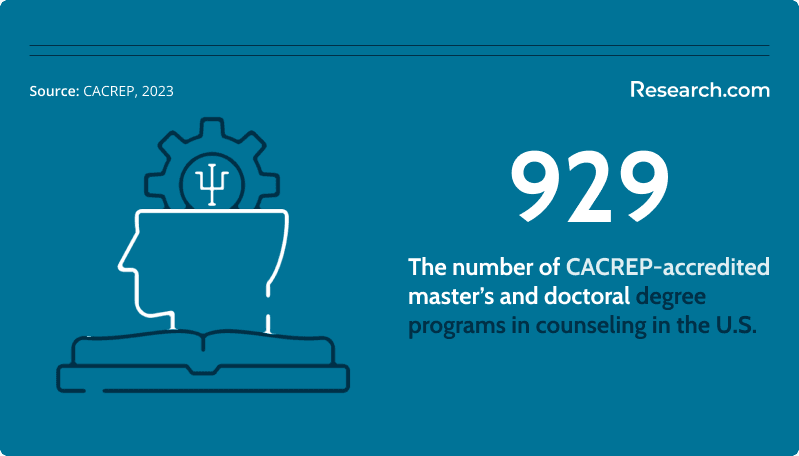
- Accreditation. Verify whether the program is accredited by a recognized body such as CACREP. The image below shows the number of CACREP-accredited counseling programs in the United States as of 2023.
Questions to ask before applying to a master’s in counseling program
- Does the program meet the educational requirements for the license I want in the state where I plan to practice?
- Is the program CACREP-accredited or otherwise recognized by the relevant licensing board?
- How many practicum and internship hours are required, and who helps arrange placements?
- Are online students eligible for the same placement support as campus students?
- What is the total cost, including fees, books, travel, residencies, and clinical requirements?
- What percentage of graduates pursue licensure, school credentials, or specialty certifications?
- Does the program publish clear information about transfer credits, course sequencing, and time to completion?
- Will the degree support my desired role, or would social work, psychology, MFT, or another pathway fit better?
Common mistakes to avoid when choosing a counseling master’s program
| Mistake | Why it matters | Better approach |
| Choosing based only on tuition | A low tuition rate may not include fees, travel, supervision costs, or extra terms | Compare the full cost of attendance and expected borrowing |
| Ignoring licensure rules | A degree that works in one state may not meet another state’s requirements | Check the licensing board before enrolling |
| Assuming every online program provides local placements | Some programs expect students to find their own practicum and internship sites | Ask how placements are approved and supported in your area |
| Relying only on rankings | Rankings cannot tell you whether a program fits your license, schedule, or specialization | Use rankings as one input alongside accreditation, outcomes, and fit |
| Overlooking accreditation | Accreditation can affect licensure, employer recognition, and transfer options | Verify institutional and programmatic accreditation directly |
| Assuming salary outcomes are guaranteed | Earnings vary by location, license status, setting, and experience | Research local job postings and supervision pathways |
What career paths are available for graduates of master’s in counseling programs?
A master’s in counseling can lead to several counseling and human services roles. Some require state licensure or certification, while others are non-licensed positions that use counseling-related skills.
- Licensed Professional Counselor (LPC). LPCs provide individual or group counseling for concerns such as anxiety, depression, trauma, addiction, life transitions, and relationship difficulties.
- Marriage and Family Therapist (MFT). MFTs work with couples, families, and individuals on communication, conflict, relationship patterns, and family systems.
- Mental Health Counselor. Mental health counselors support clients in hospitals, community agencies, outpatient clinics, private practices, and other care settings.
- Substance Abuse Counselor. These counselors help people address addiction, build recovery plans, manage triggers, and maintain treatment progress.
- School Counselor. School counselors assist students with academic development, emotional concerns, social challenges, college planning, career readiness, and crisis intervention.
- Private Practice Counselor. Licensed counselors may build independent practices, often after completing supervised experience and meeting state rules.
- Research or Teaching Roles. Some graduates pursue academic, training, research, or program evaluation work, especially if they continue into doctoral study.
What is the typical growth and compensation for grief counselors?
Grief counseling focuses on helping individuals and families process bereavement and other significant losses. Counselors in this area benefit from specialized training in grief theory, trauma-informed practice, and compassionate communication. Pay can differ based on location, experience, employment setting, licensure, and demand for grief-related services. For a more focused discussion of compensation in this specialty, review the guide to grief counselor salary. Telehealth, continuing education, and niche expertise may also influence opportunities in grief counseling.
What is the job market for graduates with a master’s in counseling?
The job market for counseling graduates is supported by continued demand for mental health, addiction, school, and career support services. Employment for substance abuse, behavioral disorder, and mental health counselors is projected to grow by 18% from 2022 to 2032, which is faster than the average for all occupations. This projection is expected to create about 42,000 annual job openings, including openings from workers moving into other occupations or leaving the labor force, such as through retirement.
Educational, guidance, and career counselors and advisors also have positive employment prospects. Employment in this category is projected to grow by 5% from 2022 to 2032, with about 26,600 annual job openings for school and career counselors and advisors. Graduates should still evaluate local demand because hiring conditions vary by state, district, employer, license level, and specialization.
How can I expedite the licensure process in counseling?
The fastest way to move toward counseling licensure is to choose a program that already aligns with your state’s requirements, complete fieldwork on schedule, document supervised hours carefully, and prepare early for required exams. Licensure is state-specific, so students should not assume that a program approved in one state automatically satisfies another state’s board. For a practical timeline, review these steps to become licensed therapist. Mentorship, organized supervision records, and continuing professional development can also reduce avoidable delays.
Can accelerated MFT programs fast-track my counseling career?
Accelerated options, including accelerated MFT programs, may shorten the academic portion of preparation by compressing coursework and integrating clinical experiences. They can be useful for focused students who can handle a demanding schedule and who already know they want a marriage and family therapy pathway. However, a shorter program does not eliminate state licensure requirements, post-degree supervision, or exam obligations. Before enrolling, confirm that the accelerated format still meets the educational and clinical requirements for your intended license.
What challenges might you face during your master’s in counseling program?
Graduate counseling students often manage intensive reading, skills practice, clinical documentation, supervision, ethical decision-making, and emotionally demanding fieldwork at the same time. Students who work full time or support families may find scheduling particularly difficult. Online learners may also need to be proactive about building relationships with faculty, supervisors, and peers.
Cost is another common barrier. Tuition, fees, books, technology, travel, and unpaid or low-paid fieldwork can put pressure on students. If affordability is a major factor, compare accredited options such as affordable masters in counseling online, but verify licensure alignment before choosing the lowest-cost program.
What are the ethical considerations in counseling practice?
Ethical counseling practice protects clients and defines professional responsibility. Counselors must maintain confidentiality except when disclosure is legally or ethically required, such as when there is risk of harm or mandatory reporting applies. They must also obtain informed consent by explaining the counseling process, risks, limits of confidentiality, fees, client rights, and alternatives in clear language.
Cultural competence is also central. Ethical counselors recognize how culture, identity, power, discrimination, religion, language, disability, gender, and social context affect the counseling relationship. They also manage boundaries carefully by avoiding conflicts of interest, inappropriate dual relationships, and conduct that could impair objectivity or harm clients.
Students interested in faith-integrated practice should pay special attention to ethical boundaries between spiritual support and clinical care. Programs such as those featured in the guide to the best master’s in Christian counseling degree programs may help students explore how spiritual frameworks intersect with counseling ethics, client autonomy, and professional standards.
How to find the most affordable master's in counseling programs?
Affordability should be evaluated alongside accreditation, licensure preparation, clinical placement support, and completion timeline. A cheaper program may cost more in the long run if it delays licensure, requires extra coursework, or provides weak field placement support.
- Start with accredited programs. Confirm institutional accreditation and, when relevant, programmatic accreditation. Accreditation can affect licensure eligibility, employer recognition, financial aid, and transfer options.
- Compare online options carefully. Online counseling programs may reduce commuting or relocation costs, but students should ask about residency requirements, clinical placement procedures, and technology fees.
- Look beyond sticker price. Public universities, in-state tuition rates, and online programs may offer lower costs, but the total price depends on fees, required credits, and time to completion.
- Apply for aid early. Scholarships, grants, assistantships, employer tuition assistance, work-study, and federal aid may reduce what you pay out of pocket. Submit the FAFSA and ask programs about department-specific awards.
- Calculate total cost. Include tuition, books, software, background checks, liability insurance, travel, residencies, and clinical supervision-related expenses.
- Compare specialty-specific low-cost options. If your goal is marriage and family therapy, review affordable pathways such as the cheapest MFT programs.
How can you get certified in Christian counseling after earning your master’s?
Christian counseling certification may appeal to graduates who want to combine counseling knowledge with faith-based support. This path is most appropriate for professionals who understand the ethical distinction between spiritual guidance, pastoral care, and licensed mental health counseling.
Certification often involves additional coursework in Christian counseling methods, theology, ethics, and faith-integrated helping practices. Some credentialing routes may also require supervised experience in faith-based settings. Organizations such as the National Christian Counselors Association and similar bodies may offer certification pathways, but requirements and recognition vary.
If you are considering this specialty, review the steps and credential options for Christian counseling certification. Also check whether the credential is intended for ministry, pastoral care, coaching, or licensed clinical practice, because those categories are not interchangeable.
How does genetic counseling differ from other counseling specializations?
Genetic counseling is different from most mental health counseling specializations because it combines counseling skills with genetics, risk assessment, medical information, and healthcare decision support. Genetic counselors help individuals and families understand inherited conditions, testing options, prevention decisions, and treatment implications. Traditional counseling tracks primarily focus on emotional, behavioral, relational, educational, or addiction-related concerns, while genetic counseling requires scientific preparation in genetics and clinical applications. Students interested in this healthcare-focused path can compare the best genetic counseling programs.
How can you optimize your career advancement after completing your master’s in counseling?
Career growth after graduation depends on more than holding a degree. New counselors should complete licensure steps, seek strong supervision, join professional associations, attend conferences, pursue specialty training, and build a professional network. Targeted certifications can help counselors move into areas such as addiction, trauma, family therapy, grief, rehabilitation, or school counseling.
Graduates can also expand their options by developing expertise in underserved practice areas. For example, students interested in addiction treatment may compare programs such as the cheapest online substance abuse counseling programs to strengthen preparation for substance use counseling roles.
How can you reach a six-figure salary as a therapist?
Higher earnings in therapy often depend on licensure level, specialization, location, private practice strategy, payer mix, referral networks, advanced training, and business skills. Counselors who want to increase income may consider niche clinical expertise, group practice leadership, consulting, supervision, workshops, or carefully managed private practice. Income is not guaranteed, and counselors should evaluate local demand, ethical marketing rules, and reimbursement realities. For a deeper strategy guide, see how to make more money as a therapist.
What are the key differences between LCSW and LPC pathways?
The LCSW and LPC routes both involve graduate education, supervised clinical experience, and state licensure, but they are not the same pathway. LCSW preparation is rooted in social work and often includes clinical care along with systems, advocacy, case management, and community-based services. LPC preparation is centered more directly on counseling theory, therapeutic techniques, assessment, and clinical counseling practice. Requirements vary by state, so students deciding between the two should compare local rules and career goals. For a detailed side-by-side explanation, review the LCSW vs. LPC comparison.
References:
- CACREP. (2022). CACREP vital statistics 2021. Council for Accreditation of Counseling and Related Educational Programs. Retrieved December 19, 2023.
- CACREP. (2023, September 26). Excellence in counselor education since 1981. Council for Accreditation of Counseling and Related Educational Programs. Retrieved December 19, 2023.
- Data U.S.A. (n.d.). Mental health counseling. Data U.S.A. Retrieved December 18, 2023.
- Salary.com. (2023, November 27). Substance abuse counselor salary. Salary.com. Retrieved December 19, 2023.
- U.S. BLS [a]. (2023, September 6). Occupational outlook handbook: Substance abuse, behavioral disorder, and mental health counselors. U.S. Bureau of Labor Statistics. Retrieved December 18, 2023.
- U.S. BLS [b]. (2023, September 6). How to become a substance abuse, behavioral disorder, or mental health counselor. U.S. Bureau of Labor Statistics. Retrieved December 18, 2023.
- U.S. BLS [c]. (2023, 6). Occupational outlook handbook: School and career counselors and advisors. U.S. Bureau of Labor Statistics. Retrieved December 19, 2023.
- U.S. BLS [d]. (2023, April 25). Occupational employment and wages, May 2022: Marriage and family therapists. U.S. Bureau of Labor Statistics. Retrieved December 19, 2023.
- ZipRecruiter [a]. (2023, December 11). Masters clinical mental health counseling salary. ZipRecruiter.com. Retrieved December 19, 2023.
- ZipRecruiter [b]. (2023, December 11). Forensic counselor salary. ZipRecruiter.com. Retrieved December 19, 2023.
Key Insights
- A master’s in counseling is most useful when it is tied to a specific licensure goal, not chosen as a general helping-profession credential.
- Licensure alignment matters more than program name. Always verify state requirements before enrolling, especially for online or out-of-state programs.
- Most students should compare accreditation, practicum support, internship placement, total cost, and graduate outcomes before focusing on rankings.
- Online programs can be a strong option for working adults, but only if they provide clear field placement guidance and meet the requirements in the student’s state.
- Specialization affects your career path. School counseling, clinical mental health counseling, MFT, addiction counseling, rehabilitation counseling, forensic counseling, and genetic counseling can lead to very different requirements and work settings.
- Salary outcomes vary. Reported figures provide a useful benchmark, but licensure, geography, employer type, experience, and private practice strategy strongly influence actual earnings.
- The strongest applicants plan early: they document prerequisites, secure recommendations, research licensing boards, compare total costs, and ask schools direct questions about fieldwork and graduate preparation.
Other things you need to know about master’s in counseling
In 2027, a Master's in Counseling typically requires coursework in human development, counseling theories, ethics, assessment techniques, and supervised clinical practice. Programs often mandate internships or practicums to provide hands-on experience. Specific requirements can vary by program, so it's crucial to review individual schools' curricula for precise information.
Application deadlines for a Master's in Counseling program in 2027 vary by institution but typically fall between December 2026 and March 2027 for fall enrollment. It's important to check specific schools for precise dates and any early admission options.
Most counseling master’s programs require 600 internship or practicum hours, with at least 240 hours of direct client contact in many CACREP-accredited programs. Students usually complete these hours in an approved school, agency, or clinic under supervision before graduation and licensure eligibility.
In 2027, some states may introduce new licensure requirements for graduates. Check with the National Board for Certified Counselors and state licensing boards for updated exams, completed clinical hours, and continuing education plans relevant to your program.