
2027 Best Online Master’s in Mental Health Counseling Degree Programs

Co-Founder and Chief Data Scientist
Choosing an online master’s in mental health counseling is not just a degree decision. It is a licensure, cost, clinical training, and career-planning decision. In August 2024, over 122 million Americans, more than a third of the U.S. population, resided in areas designated as Mental Health Professional Shortage Areas (HPSAs), which makes the need for well-prepared counselors especially urgent.
This guide is designed for prospective graduate students comparing online mental health counseling programs for 2027. You will learn how these programs work, what they cost, how long they take, what accreditation means, how licensure varies by state, which careers may be available, and how to avoid choosing a program that does not match your professional goals.
Quick Answer: Is an Online Master’s in Mental Health Counseling Worth It?
An online master’s in mental health counseling can be worth it if the program is properly accredited, meets your state’s licensure requirements, includes supervised clinical training, and fits your budget. The degree can prepare graduates for roles such as licensed professional counselor, clinical mental health counselor, substance abuse counselor, and other counseling-related positions. According to the U.S. Bureau of Labor Statistics, mental health counselors earn a median annual salary of approximately $53,710, though income varies by setting, location, specialization, licensure status, and experience.
What are the main benefits of earning this degree online?
- Licensure preparation: A qualifying master’s program is commonly required for professional counselor licensure, although exact rules differ by state.
- Career flexibility: Graduates may work in community agencies, hospitals, rehabilitation centers, schools, private practice, nonprofit organizations, government programs, and telehealth settings.
- Access without relocation: Online delivery allows students to complete didactic coursework remotely while arranging required practicum and internship experiences in approved local settings.
- Specialization options: Many programs let students build expertise in areas such as addiction counseling, trauma counseling, child and adolescent counseling, or marriage and family therapy.
- Work-life balance: Online study can be a practical option for students who are working, raising families, or living far from a campus-based counseling program.
What can I expect from an online master’s in mental health counseling degree?
An online master’s in mental health counseling is a graduate program that prepares students to provide therapeutic support, conduct assessments, apply counseling theories, follow ethical standards, and work with clients from diverse cultural and social backgrounds. Most programs combine online coursework with in-person supervised clinical experiences.
Students typically study counseling techniques, human development, psychopathology, assessment, research, group counseling, ethics, crisis response, multicultural counseling, and professional identity. Programs may also include electives or formal tracks in substance abuse counseling, trauma therapy, marriage and family therapy, school counseling, or child and adolescent counseling.
The online format usually affects how classroom learning is delivered, not whether clinical practice is required. Students should expect practicum and internship placements, live skills demonstrations, supervision, documentation, and sometimes short campus residencies. Accreditation from organizations such as CACREP can be important because many licensing boards and employers use accreditation as a signal that the curriculum meets recognized counseling standards.
Where can I work with an online master’s in mental health counseling degree?
Graduates may pursue counseling and behavioral health roles in settings where individuals, families, groups, or communities need emotional, psychological, or behavioral support. Common workplaces include community mental health centers, hospitals, outpatient clinics, residential treatment centers, rehabilitation programs, schools, universities, nonprofit organizations, correctional facilities, government agencies, and private practices.
Telehealth has also expanded where counselors can deliver services, although practice across state lines is governed by licensure rules. Before enrolling, students should confirm whether the program supports licensure in the state where they plan to practice and whether field placements can be completed near their location.
How much can I make with an online master’s in mental health counseling degree?
Salary outcomes depend on licensure, state, employer type, years of experience, clinical specialization, and whether the counselor works for an organization or operates a private practice. According to the U.S. Bureau of Labor Statistics (BLS), the median annual salary for mental health counselors is approximately $53,710. Those working in government agencies or hospitals tend to earn higher wages, with salaries reaching $70,000 or more.
Private practice counselors and those specializing in areas like substance abuse or marriage and family therapy may earn between $60,000 and $80,000, depending on their client base and geographic region. Counselors in major metropolitan areas or those with additional certifications often command higher salaries. Experienced professionals in supervisory or director roles can earn $90,000 or more annually.
- Best Online Master’s in Mental Health Counseling Degree Programs for 2027
- How long does an online master’s in mental health counseling take?
- Online vs. on-campus mental health counseling programs
- Average cost of an online master’s in mental health counseling
- Financial aid options for counseling graduate students
- Admissions requirements and prerequisites
- Common courses in a mental health counseling master’s program
- Available concentrations and specializations
- How to choose the right online counseling program
- Career paths after graduation
- Job market outlook for counseling graduates
- Technology and student support in online counseling programs
- Moving from general counseling into marriage and family therapy
- Certifications that may strengthen counseling careers
- Return on investment for an online counseling master’s degree
- How employers view online counseling graduates
- Whether a doctoral degree can advance a counseling career
- How state licensure affects program choice
- Mental health counseling vs. behavioral health programs
- Mental health counseling, social work, and psychology compared
- Balancing affordability and quality
List of Best Online Master’s in Mental Health Counseling Degree Programs for 2027
How do we rank schools?
Selecting an online master’s in mental health counseling program requires more than comparing tuition. Students also need to evaluate accreditation, clinical placement support, licensure alignment, flexibility, and student outcomes. Research.com reviews online counseling programs to help prospective students compare options using structured, data-informed criteria.
Our ranking process follows a transparent methodology and uses information from sources such as the Integrated Postsecondary Education Data System (IPEDS), Peterson's databases including their Distance Learning Licensed Data Set, and the College Scorecard database from the National Center for Education Statistics. Students should still verify current tuition, accreditation, residency requirements, and state licensure compatibility directly with each institution before applying.
1. Adams State University – Master of Arts in Clinical Mental Health Counseling
Adams State University offers an online Master of Arts in Clinical Mental Health Counseling that prepares students for professional counseling licensure. The curriculum emphasizes counseling theory, ethical decision-making, cultural responsiveness, and clinical practice skills. The primarily online structure may appeal to students who need to manage graduate study alongside employment or family responsibilities.
- Program Length: 2-3 years
- Tracks/Concentrations: Clinical Mental Health Counseling, School Counseling
- Cost per Credit: $400 - $500
- Required Credits to Graduate: 60
- Accreditation: Council for Accreditation of Counseling and Related Educational Programs
2. Antioch University – Master of Arts in Clinical Mental Health Counseling
Antioch University provides a 60-credit online Master of Arts in Clinical Mental Health Counseling accredited by CACREP. The program is structured for completion in three years full-time or four to five years part-time and includes online coursework, two one-week residencies, practicum, and internship experiences. Students can select electives in areas such as trauma, substance abuse/addiction, and military counseling, with an emphasis on multicultural competence and social justice.
- Program Length: 3 years
- Tracks/Concentrations: Clinical Mental Health Counseling
- Cost per Credit: $600 - $800
- Required Credits to Graduate: 60
- Accreditation: Council for Accreditation of Counseling and Related Educational Programs
3. Bellevue University – Master of Science in Clinical Mental Health Counseling
Bellevue University offers a CACREP-accredited online Master of Science in Clinical Mental Health Counseling. The program covers counseling theories, ethics, clinical skills, and licensure-focused preparation through an online format intended for students who need scheduling flexibility.
- Program Length: 2 years
- Tracks/Concentrations: Clinical Mental Health Counseling
- Cost per Credit: $400 - $600
- Required Credits to Graduate: 60
- Accreditation: Council for Accreditation of Counseling and Related Educational Programs
4. Bradley University – Master of Arts in Clinical Mental Health Counseling
Bradley University offers an online Master of Arts in Clinical Mental Health Counseling with 60 credit hours and CACREP accreditation. The program includes core coursework, practicum, and internships totaling 750 hours of supervised clinical experience. It is designed to prepare students for the National Counselor Examination and later licensure, while allowing students to complete clinical placements locally when approved.
- Program Length: Typically 2-3 years.
- Tracks/Concentrations: Clinical Mental Health Counseling
- Cost per Credit: $600 - $800
- Required Credits to Graduate: 60
- Accreditation: Council for Accreditation of Counseling and Related Educational Programs
5. The Chicago School of Professional Psychology – Master of Arts in Clinical Mental Health Counseling
The Chicago School of Professional Psychology offers a 60-credit-hour online Master of Arts in Clinical Mental Health Counseling accredited by CACREP. The curriculum develops core counseling competencies in ethics, research, assessment, and intervention strategies, with preparation for licensure and practice across varied clinical settings.
- Program Length: 2-3 years
- Tracks/Concentrations: Addiction Counseling, Child and Adolescent Counseling
- Trauma and Crisis Counseling
- Cost per Credit: $800
- Required Credits to Graduate: 60
- Accreditation: Council for Accreditation of Counseling and Related Educational Programs
6. Cornerstone University – Master of Arts in Clinical Mental Health Counseling
Cornerstone University offers a 60-credit-hour online Master of Arts in Clinical Mental Health Counseling intended to align with state licensing expectations. Students study foundational counseling theory and skill development and may pursue optional concentrations in marriage and family therapy, addictions counseling, and trauma counseling. The program requires two separate three-day, in-person professional development orientations on campus.
- Program Length: 2-3 years
- Tracks/Concentrations: Clinical Mental Health Counseling
- Cost per Credit: $565
- Required Credits to Graduate: 60
- Accreditation: Council for Accreditation of Counseling and Related Educational Programs
7. Edinboro University – Master of Arts in Counseling
Edinboro University offers an online Master of Arts in Counseling for students preparing for professional counseling roles. The curriculum combines theoretical study with applied preparation for counseling practice. Prospective students should contact the institution for the most current details on delivery format, concentrations, fieldwork expectations, and licensure alignment.
- Program Length: 2-3 years
- Tracks/Concentrations: Clinical Mental Health Counseling
- Cost per Credit: $526
- Required Credits to Graduate: 60
- Accreditation: Council for Accreditation of Counseling and Related Educational Programs
8. Grace College – Master of Arts in Clinical Mental Health Counseling
Grace College offers a CACREP-accredited online Master of Arts in Clinical Mental Health Counseling that integrates psychological theory with a biblical worldview. Students complete most coursework online and attend an annual seven-day residency on campus in Winona Lake, Indiana. The program has been offered since 1995.
- Program Length: 2-3 years
- Tracks/Concentrations: Clinical Mental Health Counseling
- Cost per Credit: $470
- Required Credits to Graduate: 60
- Accreditation: Council for Accreditation of Counseling and Related Educational Programs
9. Hodges University – Master of Science in Clinical Mental Health Counseling
Hodges University offers an online Master of Science in Clinical Mental Health Counseling focused on building practical counseling abilities and theoretical knowledge for work with diverse populations. Students should confirm current program delivery details, fieldwork procedures, and licensure preparation directly with the university.
- Program Length: Offers accelerated options
- Tracks/Concentrations: Clinical Mental Health Counseling
- Cost per Credit: $830
- Required Credits to Graduate: 60 semester hours.
- Accreditation: Council for Accreditation of Counseling and Related Educational Programs
10. Indiana Wesleyan University – Master of Arts in Counseling (Community Care)
Indiana Wesleyan University offers an online Master of Arts in Counseling with a Community Care focus. The 36-credit-hour, non-licensure program is designed for students preparing for human-services work in community settings and includes psychological theory, interpersonal skill development, multicultural counseling, human growth and development, group counseling, and faith-based principles. The program is delivered entirely online and can be completed in approximately 24 months. Students seeking licensure should verify whether this pathway meets their state’s requirements before enrolling.
- Program Length: 2-3 years
- Tracks/Concentrations: Clinical Mental Health Counseling
- Cost per Credit: $551
- Required Credits to Graduate: 60
- Accreditation: Council for Accreditation of Counseling and Related Educational Programs
How long does it take to complete an online master’s in mental health counseling degree program?
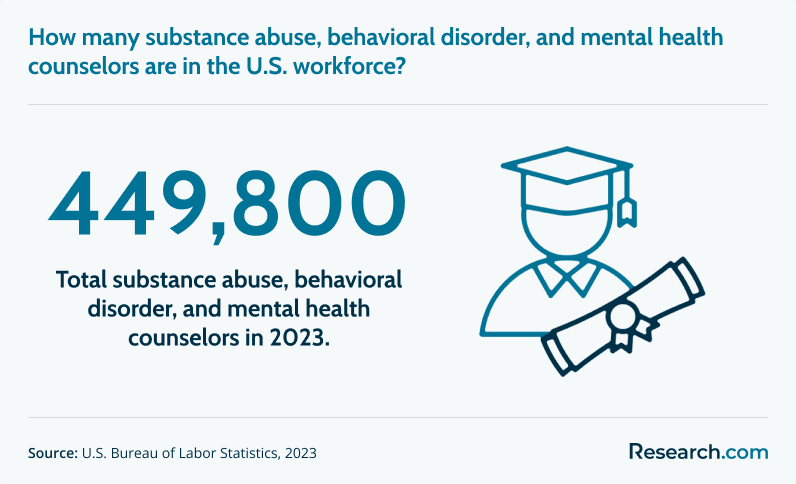
In 2023, there were 449,800 substance abuse, behavioral disorder, and mental health counselors in the U.S. workforce.
Most online master’s in mental health counseling programs take about two to three years. The timeline can be shorter or longer depending on enrollment pace, course sequence, clinical placement timing, and residency requirements.
| Factor | How it affects completion time |
| Full-time enrollment | Often supports completion in about two to three years, depending on the program plan. |
| Part-time enrollment | Can extend the timeline but may be more realistic for students working full time. |
| Accelerated options | Some programs may be completed in as little as 18 months, although accelerated study can be demanding. |
| Practicum and internship | Clinical requirements may affect graduation timing if placement approval, supervision, or hour completion is delayed. |
| Residencies | Short in-person requirements can add travel planning and scheduling considerations. |
Because licensure-track counseling programs require supervised clinical training, students should not judge the timeline by coursework alone. Ask each program how it helps students find practicum and internship sites, what happens if a placement falls through, and whether clinical hours satisfy the rules in your intended state of practice.
How does an online master’s in mental health counseling degree compare to an on-campus program?
Online and campus-based mental health counseling programs often cover similar licensure-focused content: counseling theories, ethics, assessment, diagnosis, multicultural counseling, group counseling, crisis intervention, practicum, and internship. The largest difference is how students experience the academic portion of the program.
Online programs may use asynchronous modules, live video classes, discussion boards, virtual simulations, and remote faculty supervision. Campus programs offer in-person class meetings, face-to-face peer interaction, and easier access to physical campus resources. Both formats can be valid if the program is accredited and aligned with licensure requirements.
| Program format | Best for | Trade-offs to consider |
| Online | Students who need flexibility, live far from campus, or plan to keep working while enrolled. | Requires strong self-management, reliable technology, and careful clinical placement planning. |
| On-campus | Students who prefer structured class schedules, in-person networking, and direct campus access. | May require commuting, relocation, or a less flexible weekly schedule. |
| Hybrid | Students who want online coursework with some in-person skill development or residencies. | Travel costs and required campus dates should be reviewed before enrollment. |
What is the average cost of an online master’s in mental health counseling degree program?
The total price of an online mental health counseling master’s degree depends on credit requirements, tuition rates, institutional type, residency costs, clinical expenses, and fees. Students should calculate the full program cost rather than comparing tuition per credit alone.
| Institution type | Typical tuition range stated for this guide | Possible total cost stated for this guide |
| Public Universities | $300 to $600 per credit hour | $36,000 to $72,000 |
| Private Universities | Often exceeding $1,000 per credit hour | Can easily exceed $120,000 |
Costs beyond tuition
- Technology fees: Online platforms, digital tools, and remote learning systems may carry separate charges.
- Course materials: Textbooks, assessment tools, software, and other supplies can increase the total cost.
- Application and registration fees: These may be required before or during enrollment.
- Residency expenses: Travel, lodging, meals, and missed work time can matter if the program requires campus visits.
- Clinical supervision fees: Some practicum or internship arrangements may create additional costs.
- Licensure exam fees: Students should budget for required exams after completing the academic pathway.
What are the financial aid options for students enrolling in an online master’s in mental health counseling degree program?
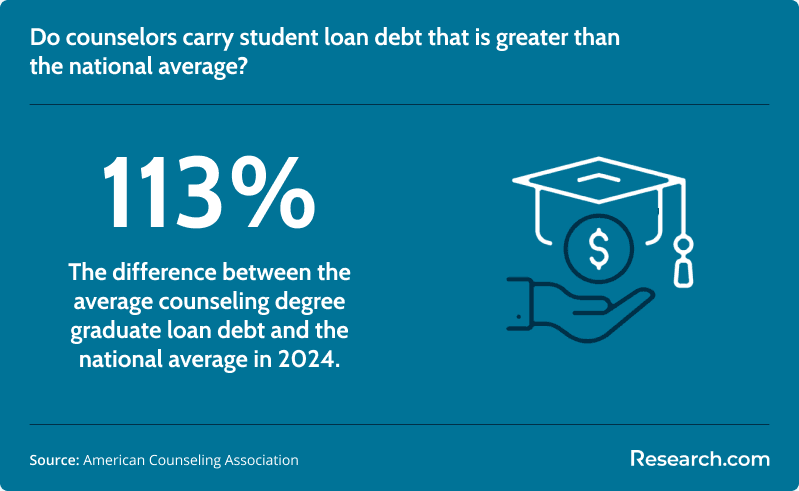
In 2024, the American Counseling Association reported that the average student loan debt for counselors is 113% higher than the national average. That makes financial planning especially important before committing to a program.
Federal Student Aid
- FAFSA: Completing the FAFSA is the starting point for federal student aid. Graduate students commonly rely on federal loans, which may offer repayment protections that private loans do not.
Scholarships and Grants
- Institutional scholarships: Counseling departments and graduate schools may offer merit-based, need-based, or program-specific awards.
- Professional associations: Counseling organizations, including the American Counseling Association, may provide scholarships, grants, or student funding opportunities.
- External scholarships: Graduate students can also search broader scholarship databases and community-based funding sources.
Graduate Assistantships
Some universities offer assistantships that reduce costs in exchange for work such as research support, teaching assistance, administrative help, or program operations. Availability may be limited for fully online students, so ask before applying.
Military Benefits
Service members and veterans may be able to use GI Bill benefits or the Yellow Ribbon Program to help pay for graduate study.
Private Loans
Private loans may fill funding gaps, but they often have less flexible repayment terms than federal options. Compare interest rates, deferment rules, cosigner requirements, and repayment protections before borrowing.
What are the prerequisites for enrolling in an online master’s in mental health counseling degree program?
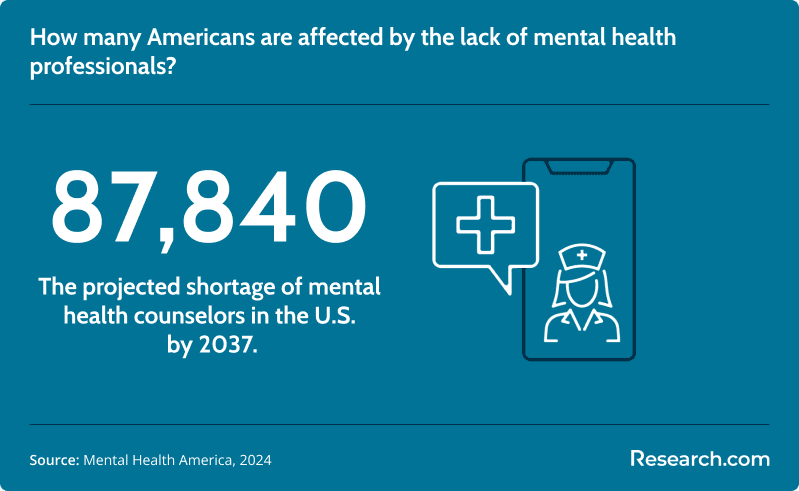
By 2037, the projected shortage of mental health counselors in the U.S. is at 87,840. Students interested in the field should still remember that admission to a licensure-oriented program can be selective and requires careful preparation.
Requirements differ by school, but many affordable online master's in counseling programs ask for the following:
- Bachelor's Degree: Applicants usually need a bachelor’s degree from a regionally accredited institution. Psychology, sociology, human services, or related coursework may help, but many programs consider applicants from other academic backgrounds.
- Minimum GPA: Many schools expect a minimum undergraduate GPA, often around 3.0 on a 4.0 scale, although some programs review applicants holistically.
- Application Materials: Even the cheapest online masters in counseling typically require official transcripts, a personal statement, letters of recommendation, a resume, and a completed application.
- Graduate Record Examinations (GRE): Some programs still request or recommend GRE scores, but many online counseling programs have reduced or removed this requirement.
- Prerequisite Courses: Schools may prefer prior coursework in subjects such as General Psychology, Abnormal Psychology, Developmental Psychology, or Sociology.
- Interview or admissions screening: Some counseling programs use interviews to assess communication skills, ethical awareness, readiness for clinical training, and fit with the profession.
What courses are typically in an online master’s in mental health counseling degree program?
Online counseling master’s programs vary, but licensure-track curricula generally include a common foundation in theory, assessment, ethics, human development, cultural competence, and supervised practice.
Students searching for the fastest way to get counseling degree should be cautious: a faster program still must include the coursework and clinical training required for licensure.
Foundational Counseling Theories and Skills
- Counseling Theories: Students examine major approaches such as psychodynamic, cognitive-behavioral, humanistic, and systems-based counseling.
- Counseling Skills/Techniques: Courses build core skills such as active listening, interviewing, empathy, case conceptualization, and crisis intervention.
- Multicultural Counseling: Students learn how culture, identity, power, and lived experience shape the counseling relationship.
- Ethics and Professional Issues in Counseling: This coursework covers legal responsibilities, ethical codes, professional boundaries, documentation, confidentiality, and mandated reporting.
Assessment and Diagnosis
- Assessment in Counseling: Students learn how to use assessment tools, intake procedures, and treatment planning methods.
- Psychopathology/Diagnosis: Coursework addresses mental disorders, diagnostic criteria, differential diagnosis, and clinical decision-making.
Human Development and Behavior
- Human Growth and Development: Students study physical, cognitive, emotional, and social development across the lifespan.
- Social and Cultural Foundations of Behavior: This area explores how social systems, culture, family, and environment influence mental health and behavior.
Clinical Practice Requirements
- Practicum: Early supervised experience helps students begin applying counseling skills with clients or simulated clients.
- Internship: More advanced supervised clinical work builds readiness for post-graduate practice and licensure steps.
- Supervision seminars: Students discuss cases, ethics, professional identity, and clinical growth with faculty and peers.
What types of specializations are available in online master’s in mental health counseling degree programs?
Specializations help students align their education with the populations, conditions, or practice settings they hope to serve. In 2024, approximately 6.2 million out of 27.1 million adults age 18 and older with any mental illness did not receive mental health treatment, reinforcing the importance of counselors who can address varied needs.
| Specialization | Best fit for students interested in |
| Clinical Mental Health Counseling | Diagnosis, treatment planning, psychotherapy, and work with individuals, couples, families, and groups. |
| Addiction Counseling | Substance use, relapse prevention, treatment planning, and support for individuals and families affected by addiction. Students comparing early pathways may also review an affordable online substance abuse counseling degree. |
| Child and Adolescent Counseling | Developmental needs, school collaboration, family systems, play-based methods, and youth mental health. |
| Marriage, Couple, and Family Counseling | Relationship patterns, communication, family dynamics, and systems theory. |
| School Counseling | Academic, social, emotional, and career support for students in educational settings. |
| Trauma and Crisis Counseling | Crisis response, trauma-informed care, safety planning, and recovery-focused counseling. |
How do you choose the best online master’s in mental health counseling degree program?
The best program is not always the cheapest, fastest, or highest ranked. The right choice is the program that meets licensure requirements where you plan to practice, fits your learning needs, provides credible clinical training support, and makes financial sense.
Decision checklist before applying
- Confirm accreditation: Review both institutional accreditation and program-level accreditation. Many students prioritize CACREP accredited online masters counseling programs because accreditation may affect licensure eligibility.
- Check state licensure alignment: Ask whether the curriculum, practicum, internship, and exam preparation match the requirements of your intended licensing board.
- Evaluate field placement support: Find out whether the school identifies sites, approves sites, assigns placement coordinators, or expects students to secure placements independently.
- Compare delivery formats: Review whether courses are asynchronous, synchronous, hybrid, cohort-based, self-paced, part-time, or full-time.
- Review residency requirements: Short campus visits can be valuable for skills practice but may increase cost and scheduling complexity.
- Assess faculty qualifications: Look for licensed faculty, clinical experience, research interests, and evidence of strong online teaching support.
- Understand total cost: Include tuition, fees, books, technology, travel, clinical costs, and licensure expenses.
- Ask about student support: Strong programs provide advising, library access, career services, licensure guidance, technical support, and practicum assistance.
Common mistakes to avoid
| Mistake | Why it matters | Better approach |
| Choosing a program without checking licensure rules | A program may not meet the requirements in the state where you plan to practice. | Contact the state licensing board and request written clarification from the school. |
| Looking only at tuition per credit | Fees, residencies, supervision, and exam costs can change the real price. | Build a full cost estimate before comparing programs. |
| Assuming online means fully remote | Clinical hours and residencies may require in-person attendance. | Ask which requirements must be completed face-to-face. |
| Relying only on rankings | A highly ranked program may not fit your state, schedule, budget, or specialization goals. | Use rankings as a starting point, not the final decision. |
| Ignoring placement support | Delayed practicum or internship placement can delay graduation. | Ask how many students receive placement help and what happens if a site is unavailable. |
What career paths are available for graduates of online master’s in mental health counseling degree programs?
Graduates may pursue several careers in counseling, although many clinical roles require state licensure, supervised post-graduate hours, and passing required exams.
Licensed Professional Counselor (LPC)
The LPC pathway is one of the most common goals for students in mental health counseling master’s programs. LPCs may provide counseling to individuals, couples, families, and groups in settings such as:
- Private practice
- Community mental health centers
- Hospitals
- Schools
- Non-profit organizations
- Government agencies
Specialized Counseling Roles
- Addiction Counselor: Supports clients dealing with substance use and recovery-related challenges.
- Marriage and Family Therapist (MFT): Helps couples and families address communication patterns, relational conflict, and family dynamics.
- Child and Adolescent Counselor: Works with children, teens, families, and sometimes schools to support youth mental health.
- School Counselor: Provides academic, social, emotional, and career guidance in educational environments.
- Geriatric Counselor: Focuses on mental health concerns affecting older adults.
- Trauma Counselor: Helps clients process and recover from traumatic experiences.
- Career Counselor: Assists clients with career exploration, decision-making, and employment transitions.
Related Roles
- Mental Health Counselor: A broad role that may include assessment, treatment planning, and counseling services.
- Rehabilitation Counselor: Helps individuals with disabilities pursue independence and personal goals.
- Wellness Coach: Supports clients pursuing health and wellness objectives, although this is not the same as licensed counseling.
- Community Health Worker: Provides outreach, education, and resource navigation related to health and mental health.
- Case Manager: Coordinates services and care plans for clients with mental health or social service needs.
Leadership and Administrative Roles
With experience, counselors may move into supervisory, clinical director, program manager, training, advocacy, or agency leadership roles. These positions often require strong documentation, compliance, supervision, and program-development skills in addition to clinical competence.
What is the job market for graduates with an online master’s in mental health counseling degree?
The employment outlook for counseling graduates is generally favorable, supported by rising public awareness of mental health needs, expanded telehealth access, and demand in community-based care. The field is expected to grow at 19% through 2033.
Graduates may find opportunities in private practice, community mental health centers, hospitals, schools, government agencies, and nonprofit organizations. Specialized areas such as addiction counseling, marriage and family therapy, trauma counseling, and child and adolescent counseling may also offer focused career paths.
Location still matters. Rural areas, underserved communities, large metropolitan regions, and state-funded systems may have different hiring patterns, pay levels, supervision availability, and licensure expectations. Graduates should build a professional network, complete strong clinical placements, prepare for licensure exams, and document supervised hours carefully.
Could pursuing a doctoral degree enhance my career in mental health counseling?
A doctorate is not required for many licensed counseling roles, but it may be useful for counselors who want to move into advanced clinical leadership, teaching, research, supervision, consulting, or specialized practice. Students considering research-focused or psychology-related doctoral study can compare options such as online psychology PhD programs to understand how doctoral preparation differs from a counseling master’s pathway.
How do state licensure requirements affect online mental health counseling programs?
State licensure rules should be one of the first factors students review. Requirements may differ in graduate credits, required coursework, practicum and internship hours, post-graduate supervised hours, exams, background checks, jurisprudence requirements, and accepted accreditation. Some states may also recognize specialized training such as a drug and alcohol counselor degree for addiction-related credentials.
Before enrolling, contact the licensing board in the state where you plan to practice. Ask whether the program satisfies educational requirements, whether online coursework is accepted, whether local clinical placements are allowed, and whether additional courses or supervised hours may be needed after graduation.
How does online mental health counseling differ from related behavioral health programs?
Mental health counseling programs focus on therapeutic relationships, assessment, diagnosis, counseling theory, ethical practice, and client-centered interventions. By contrast, programs such as an online masters in behavior analysis focus more on behavior assessment, intervention design, applied research, and behavior-change methods. Both fields support behavioral and emotional well-being, but they usually lead to different credentials, job functions, and licensure pathways.
How do mental health counseling, social work, and psychology differ?
Mental health counseling usually centers on psychotherapy, counseling skills, diagnosis, treatment planning, and client support. Social work often combines clinical care with case management, advocacy, resource coordination, and systems-level support. Psychology places stronger emphasis on research, assessment, psychological testing, and evidence-based evaluation. Students comparing these paths can review this guide to psychology vs MSW for a broader comparison.
| Field | Primary focus | Common career direction |
| Mental Health Counseling | Therapy, diagnosis, treatment planning, and counseling interventions. | Licensed counselor, clinical counselor, private practice counselor, agency counselor. |
| Social Work | Clinical support, advocacy, case management, and community resources. | Clinical social worker, case manager, social services administrator. |
| Psychology | Assessment, research, testing, diagnosis, and psychological science. | Psychologist, researcher, evaluator, academic, clinical specialist. |
How can I balance affordability and quality in an online master’s in mental health counseling program?
Affordability matters, but a low-cost program is not a good value if it does not support licensure, clinical placement, or student success. Compare tuition, fees, residency costs, financial aid, accreditation, faculty qualifications, licensure alignment, placement support, and graduation requirements together.
Students comparing price across related graduate pathways may use resources such as the cheapest online psychology masters listing as a benchmark, while remembering that counseling licensure programs have specific clinical and accreditation requirements. If your interests include workplace mental health and organizational systems, a related option such as the cheapest organizational psychology masters Canada online may be worth comparing, though it is not a substitute for a licensure-track counseling degree.
How can integrating organizational psychology enhance mental health counseling practice?
Organizational psychology can help counselors understand workplace stress, burnout, leadership dynamics, employee well-being, and system-level factors that affect mental health. This can be useful for counselors interested in employee assistance programs, workplace wellness, corporate consulting, or leadership development. However, students should distinguish between organizational psychology training and counseling licensure preparation because they serve different professional purposes.
How do technology and student support services enhance the online learning experience?
Strong online counseling programs use learning platforms that support video instruction, discussion, skills practice, assignment feedback, library access, and communication with faculty. The technology should make clinical learning easier, not create barriers.
Student support is equally important. Look for advising, career services, licensure guidance, technical help, tutoring, writing support, and clinical placement assistance. Students who want broader human-services training may also compare related options such as online MSW programs, while keeping in mind that social work and counseling follow different licensure routes.
How can I transition from general counseling to a specialization like marriage and family therapy?
To move from general counseling into marriage and family therapy, choose electives, internships, supervision, and post-graduate training that focus on systems theory, family dynamics, couples counseling, relationship patterns, and ethical issues in family work. Because MFT licensure requirements differ from counseling licensure, verify whether your degree and supervised hours qualify in your state. For a step-by-step overview, review this guide on how to become a family therapist.
What additional certifications can boost my career prospects in mental health counseling?
Additional credentials may help counselors demonstrate focused expertise after completing graduate education and licensure requirements. Common areas include substance abuse counseling, trauma counseling, family therapy, crisis counseling, and specialized work with children or older adults. Students interested in formal family therapy training can compare programs such as an MFT degree online to see how MFT preparation differs from a general counseling track.
What is the return on investment for an online master’s in mental health counseling degree?
ROI depends on total program cost, debt, time to licensure, local demand, salary potential, supervision availability, and the type of setting where you plan to work. A lower-cost program with strong licensure alignment may offer better value than a more expensive program with weak placement support. Conversely, a higher-cost program may be reasonable if it provides strong accreditation, clinical support, and a clear path to the credential you need.
When estimating ROI, compare tuition and fees with expected career outcomes, but avoid assuming a guaranteed salary. For a deeper look at compensation across counseling roles, review how much does a counselor make a year.
How do employers view online master’s in mental health counseling graduates?
Employers generally focus on whether graduates completed an accredited, licensure-appropriate program; gained supervised clinical experience; passed required exams; and can practice ethically and competently. The word “online” is usually less important than accreditation, licensure eligibility, clinical readiness, references, and demonstrated counseling skills.
Graduates who want to pursue more advanced clinical training later may compare options such as PsyD programs online accredited, but a doctoral degree is not necessary for every counseling career goal.
Questions to ask before enrolling
- Is the program accredited, and by whom?
- Does the program meet educational requirements for licensure in my state?
- How many practicum and internship hours are required?
- Will the school help me find clinical placements near where I live?
- Are any campus residencies required?
- What is the full cost, including fees, books, technology, travel, and licensure expenses?
- Are courses synchronous, asynchronous, or a mix of both?
- What happens if I move to another state during or after the program?
- What student support services are available to online learners?
- Does the program offer the specialization I want?
References
- American Counseling Association (2024). Growing a Rewarding Career.
- Bureau of Labor Statistics. (n.d.). Substance abuse, behavioral disorder, and mental health counselors. Occupational Outlook Handbook.
- 2024 CCBHC Impact Report. (2024). Counseling Impact.
- Mental Health America. (2024). MHA releases 2024 State of Mental Health in America report.
- State of the behavioral health workforce (2024). Counseling Workforce Report.
Key Insights
- An online master’s in mental health counseling can be a strong pathway into professional counseling, but only if the program aligns with your state’s licensure rules.
- Accreditation, clinical placement support, supervised hours, and exam preparation should carry more weight than convenience alone.
- Most programs take about two to three years, but part-time study, residencies, and practicum or internship delays can extend the timeline.
- Cost varies widely: public universities may charge $300 to $600 per credit hour, while private universities may exceed $1,000 per credit hour.
- The BLS reports a median annual salary of approximately $53,710 for mental health counselors, but earnings depend heavily on location, setting, licensure, specialization, and experience.
- Do not assume every online counseling program leads to licensure. Verify requirements with the licensing board in the state where you intend to practice.
- The best program is the one that balances accreditation, affordability, licensure fit, clinical support, faculty quality, and your long-term counseling goals.
Other Things You Should Know About Online Master’s in Mental Health Counseling Degree
Online Master's in Mental Health Counseling programs in 2027 typically require a practicum involving 600 hours of supervised clinical experience, adhering to CACREP standards. These hours are necessary for preparing students for licensure and providing hands-on experience in real-world counseling settings.
Most programs require a supervised internship of about 600 hours, often completed in a community mental health, school, or private practice setting. Programs usually also require a separate practicum before the internship, and both experiences must meet state licensing board standards for supervised clinical training.


