2027 Fastest Online Master's in School Counseling Programs

Co-Founder and Chief Data Scientist
Choosing a fast online Master’s in School Counseling is not just a question of speed. The real decision is whether a program can help you graduate sooner while still meeting licensure, fieldwork, accreditation, and employer expectations. That matters because schools are asking counselors to support academic planning, college and career readiness, crisis response, family communication, and student mental health at the same time.
The need is visible in current school data. YouScience reported in 2025 that 90% of counselors identify personalized guidance as one of their biggest challenges. At the same time, many schools report shortages in mental health staffing and access to licensed professionals. For aspiring counselors, teachers, career advisors, and career changers, an accelerated online degree can be a practical route into the field if it is chosen carefully.
This guide explains what to expect from the fastest online school counseling master’s programs, how licensure works, what these degrees cost, which schools offer accelerated options, and how to compare programs without overlooking the details that affect your ability to work as a licensed school counselor.
Quick answer: Is a fast online Master’s in School Counseling worth it?
A fast online Master’s in School Counseling can be worth it if the program is properly accredited, includes required practicum and internship hours, and aligns with your state’s school counselor licensure rules. The best accelerated programs do not remove core clinical training; they shorten the schedule through year-round courses, shorter terms, heavier course loads, or streamlined sequencing.
According to the U.S. Bureau of Labor Statistics (2023), employment for school and career counselors is projected to grow by 4% from 2023 to 2033, with approximately 29,100 job openings expected during that period. The median annual salary for school counselors is $65,140 as of the BLS 2024 report. Salary and job access still depend on state certification, district budgets, experience, and local demand.
What are the main benefits of choosing an accelerated online school counseling master’s degree?
- You may enter the field sooner. Accelerated formats can reduce the time between enrollment and eligibility for licensure-related steps, especially when courses are offered year-round.
- You can keep working while studying. Online delivery can make graduate school more manageable for teachers, paraprofessionals, advisors, and working adults who cannot relocate or attend daytime campus classes.
- You still complete supervised fieldwork. Legitimate fast-track school counseling programs include practicum and internship experiences because these are tied to licensure preparation.
- You can build skills for a stable education career. School counselors support academic achievement, social-emotional development, college readiness, career planning, and crisis response.
- You may reduce total opportunity cost. Finishing sooner can reduce the time spent out of the full-time workforce, although tuition and fees should still be compared carefully.
What can I expect from an accelerated online Master's in School Counseling?
An accelerated online Master’s in School Counseling is typically a condensed graduate program that prepares students for school counseling roles through online coursework, supervised field experiences, and licensure-focused training. Many fast programs are designed for completion in 12–18 months, although some reputable options take 2 years or longer because of credit, internship, and state certification requirements.
Coursework usually covers counseling theory, child and adolescent development, school counseling foundations, ethical practice, multicultural counseling, crisis intervention, assessment, group counseling, and college and career readiness. Online delivery may be asynchronous, synchronous, or a mix of both. Even in a fully online program, practicum and internship hours are generally completed in local K–12 school settings.
| Program feature | What it usually means | Why it matters |
| Accelerated timeline | Shorter terms, year-round enrollment, or a heavier course sequence | Can shorten completion time, but may increase weekly workload |
| Online coursework | Classes delivered through a learning platform, live sessions, recorded modules, or both | Improves flexibility for working adults and students outside commuting distance |
| Practicum and internship | Supervised counseling experience in school settings | Required for graduation and commonly tied to licensure eligibility |
| Licensure alignment | Curriculum designed around state certification or endorsement standards | Determines whether the degree can help you qualify to work as a school counselor |
| Accreditation | Institutional and, in some cases, programmatic review by recognized accreditors | Important for licensure, financial aid, transferability, and employer confidence |
Where can I work with an accelerated online Master's in School Counseling?
Graduates of online school counseling master’s programs most commonly work in education settings where students need academic, emotional, behavioral, and career-related support. The degree is especially relevant for K–12 counseling roles, but it can also support positions in advising, youth services, and career development depending on state rules and employer requirements.
- Public K–12 Schools
- Private and Charter Schools
- Vocational and Technical Schools
- Community Colleges
- Online Virtual Schools
Some graduates also work in career centers, alternative education programs, nonprofit youth organizations, or district-level student support offices. With additional credentials, supervised clinical experience, or separate licensure, some professionals may move toward mental health counseling or private practice where state licensing boards permit it.
How much can I make with an accelerated online Master's in School Counseling?
Earnings for school counseling graduates vary by district salary schedule, state funding, years of experience, licensure level, union contracts, and additional responsibilities. A fast-track degree does not guarantee a higher salary, but it can help qualified graduates reach the credentialing stage sooner if the program meets state requirements.
Salary.com (2025) reports the following school counselor salary figures by experience level:
- Entry to Intermediate Level: $59,542 - $60,274
- Senior Level: $61,756
- Specialist: $62,052
- Expert Level: $62,250
Compensation may also be affected by state licensure, school level, extra-duty assignments, specialized training, and whether the role is in a public district, private school, college, or community organization.
- Fastest Online Master's in School Counseling Programs for 2027
- Fastest pathway to becoming a licensed school counselor
- Average cost of an online Master's in School Counseling
- Education background and teaching license requirements
- Applying with a bachelor’s degree in another field
- Practicum and internship requirements in fast programs
- Common school counseling specializations
- Student support services in online counseling programs
- Supplemental certifications for school counselors
- How to check accreditation and program quality
- Employer views of fast-track online counseling degrees
- State licensure and online degree eligibility
- Ways to finish an online school counseling master’s faster
- Career paths after an online school counseling master’s
- Job market for online school counseling graduates
- References and sources
Fastest Online Master's in School Counseling Programs for 2027
The programs below are designed for students who want a shorter or more flexible route to graduate training in school counseling. Use this list as a starting point, not a final decision. Before applying, confirm that the program’s curriculum, fieldwork, accreditation, and state approval match the state where you plan to seek school counselor licensure.
If you are comparing accelerated learning models across fields, Research.com also covers other fast online options, including accelerated artificial intelligence certification courses online. For school counseling, however, speed must be evaluated differently because supervised practice and licensure alignment are central to the degree’s value.
How do we rank schools?
Research.com rankings are intended to help students compare programs using transparent, decision-relevant criteria. This list was developed by Research.com’s education researchers using a data-informed methodology that considers factors such as affordability, program length, accreditation, and graduation outcomes.
Program information is reviewed using sources such as the IPEDS database, Peterson’s database, College Scorecard, and the National Center for Education Statistics. Students should verify current tuition, state authorization, and licensure outcomes directly with each university before enrolling.
| School | Program length | Credits | Cost per credit | Accreditation listed |
| University of Denver | 2 years | 72 | $1,383 | CACREP |
| University of West Alabama | 1 year | 48 | $429 | CAEP |
| Campbellsville University | 18 months | 48 | $319 | CAEP |
| Sacred Heart University | 30 months | 60 | $665 | NECHE |
| Winthrop University | 2 years | 60 | $629 | CACREP |
| USC Rossier School of Education | 20 months | 49 | $2,137 | WASC |
| University of Nebraska at Kearney | 2 years | 48 | $345 (in-state), $617 (out-of-state) | NCATE |
| Truman State University | 2 years | 60 | $400 | CACREP |
| Citadel Military College of South Carolina | 2 years | 60 | $595 | CACREP |
| National University | 2 years | 54 | $442 | WSCUC |
1. University of Denver
The University of Denver offers a Master of Arts in School Counseling for students preparing to support K–12 learners across diverse school communities. The program combines online academic work with in-person field experiences and emphasizes culturally responsive counseling. Students typically complete the program in 2 years.
- Program Length: 2 years
- Tracks/Concentrations: General School Counseling
- Cost per Credit: $1,383
- Required Credits to Graduate: 72
- Accreditation: Council for Accreditation of Counseling and Related Educational Programs (CACREP)
2. University of West Alabama
The University of West Alabama offers an online M.Ed. in School Counseling built for educators who want a quicker transition into counseling roles. The program can be completed in as little as 1 year and includes training in mental health support, student development, and career guidance.
- Program Length: 1 year
- Tracks/Concentrations: General School Counseling
- Cost per Credit: $429
- Required Credits to Graduate: 48
- Accreditation: Continuing Agency Education Program (CAEP)
3. Campbellsville University
Campbellsville University offers an online MA in Education in School Guidance Counseling (P-12) for students preparing to work with elementary and secondary learners. The program can be completed in about 18 months and includes two practicum placements. Its curriculum is designed for working adults and includes Christian-centered training.
- Program Length: 18 months
- Tracks/Concentrations: P–12 School Counseling
- Cost per Credit: $319
- Required Credits to Graduate: 48
- Accreditation: CAEP
4. Sacred Heart University
Sacred Heart University offers an MA in School Counseling that focuses on student advocacy, ethics, leadership, and mental health support. The program is structured for completion in 30 months and includes fieldwork and professional preparation through flexible online coursework.
- Program Length: 30 months
- Tracks/Concentrations: General School Counseling
- Cost per Credit: $665
- Required Credits to Graduate: 60
- Accreditation: NECHE
5. Winthrop University
Winthrop University offers an M.Ed. in Counseling and Development with a school counseling concentration. The program focuses on K–12 readiness, behavioral support, career development, and student well-being. It is 100% online, can be completed in 2 years, and includes practicum and internship requirements.
- Program Length: 2 years
- Tracks/Concentrations: School Counseling
- Cost per Credit: $629
- Required Credits to Graduate: 60
- Accreditation: CACREP
6. USC Rossier School of Education
The University of Southern California Rossier School offers an online M.Ed. in School Counseling in a 20-month format. The curriculum highlights trauma-informed practice, equity, and college and career readiness. Students complete live online classes along with local field placements.
- Program Length: 20 months
- Tracks/Concentrations: General School Counseling
- Cost per Credit: $2,137
- Required Credits to Graduate: 49
- Accreditation: WASC
7. University of Nebraska at Kearney
University of Nebraska at Kearney offers an online MAE in School Counseling with Elementary (PK–8) and Secondary (7–12) specialization options. The 2-year format includes synchronous and asynchronous coursework, along with local internship placements. It is designed for working educators pursuing Nebraska certification.
- Program Length: 2 years
- Tracks/Concentrations: PK–8, 7–12
- Cost per Credit: $345 (in-state), $617 (out-of-state)
- Required Credits to Graduate: 48
- Accreditation: NCATE
8. Truman State University
Truman State offers an online MA in Counseling with a school counseling emphasis. The program uses a cohort model and prepares students to support academic, social, and emotional development in K–12 schools. Students complete 700+ hours of field experience, and full-time students typically finish in 2 years.
- Program Length: 2 years
- Tracks/Concentrations: School Counseling
- Cost per Credit: $400
- Required Credits to Graduate: 60
- Accreditation: CACREP
9. Citadel Military College of South Carolina
The Citadel Military College of South Carolina offers an M.Ed. in Counselor Education with a school counseling track. The program emphasizes leadership, advocacy, and systems-level change in schools. It is mostly online, includes synchronous components and fieldwork, and is structured for completion in 2 years.
- Program Length: 2 years
- Tracks/Concentrations: School Counseling
- Cost per Credit: $595
- Required Credits to Graduate: 60
- Accreditation: CACREP
10. National University
National University offers an online MS in Educational Counseling for students pursuing California’s Pupil Personnel Services (PPS) credential. The curriculum includes academic counseling, career planning, and mental health-related student support. The program is designed for completion in approximately 2 years.
- Program Length: 2 years
- Tracks/Concentrations: School Counseling with PPS Credential (CA)
- Cost per Credit: $442
- Required Credits to Graduate: 54
- Accreditation: WSCUC
What is the fastest way to become a licensed school counselor?
The fastest route is to complete a bachelor’s degree, enroll in an accelerated school counseling master’s program that meets your state’s requirements, complete all required practicum and internship hours, pass the required exam, and apply for state certification or licensure. Unlike a short technical credential such as an accelerated Microsoft Azure dual certification boot camp online, school counseling preparation cannot skip supervised experience because students will be working with children and adolescents in regulated education settings.
- Complete a bachelor’s degree. A bachelor’s degree is the standard starting point for admission to graduate-level counseling programs. Your undergraduate major does not always have to be education or psychology, but your academic record should show readiness for graduate study.
- Choose a state-aligned accelerated master’s program. Look for a program that clearly states which state licensure or certification standards it is designed to meet. Fast formats commonly use short terms, year-round enrollment, or intensive course sequencing.
- Finish counseling coursework and field experience. Students complete graduate courses in counseling theory, ethics, child development, multicultural counseling, crisis intervention, and school systems. They also complete supervised practicum and internship hours, often in local K–12 schools.
- Pass the required state exam. Many states use the Praxis II: School Counseling, while others require additional or different assessments. Always confirm the exam requirement with your state’s department of education or licensing board.
- Apply for licensure or certification. After graduation, candidates typically submit transcripts, fieldwork documentation, exam scores, background check results, and an application fee to the appropriate state agency.
NCES data from 2025 shows that 55% of schools lack enough mental health staff to manage caseloads, 54% report inadequate funding, and 49% struggle with access to licensed mental health professionals. These shortages can increase pressure on existing counselors and limit the support available to students. Accelerated programs can help prepare more professionals, but only when they preserve rigorous training and licensure alignment.
What is the average cost of an Online Master's in School counseling program?
An online Master’s in School Counseling typically costs more than shorter post-baccalaureate options such as the top online graduate counseling certificate programs because a licensure-oriented master’s degree includes more credits, broader coursework, and supervised field training.
Total tuition commonly ranges from $20,000 to $40,000. This estimate reflects an average cost per credit of $400 to $700, with most programs requiring 48 to 60 credits for graduation. Tuition often covers online course access, faculty instruction, advising, library services, and technology support, but it may not cover every required expense.
| Cost category | What to check before enrolling |
| Tuition | Confirm cost per credit, total required credits, and whether tuition differs for in-state and out-of-state online students. |
| University fees | Ask about technology fees, online learning fees, graduation fees, and student services fees. |
| Books and course materials | Review estimated textbook, software, assessment, and digital resource costs. |
| Fieldwork expenses | Budget for background checks, fingerprinting, liability insurance, travel, and any placement-related requirements. |
| Licensure preparation | Ask whether exam preparation, application guidance, or licensure advising is included. |
| Financial aid | Confirm eligibility for federal aid, scholarships, grants, employer reimbursement, or payment plans. |
To lower the total price, compare tuition and fees carefully and review options such as affordable online counseling degree programs with school counseling pathways. Students may also use federal financial aid, grants, scholarships, and employer tuition assistance when eligible.
Do I need a background in education or a teaching license to enroll in the Online Master's in School Counseling program?
No. Many online Master’s in School Counseling programs do not require applicants to have a teaching license or prior classroom experience. However, education experience can help, especially when the curriculum assumes familiarity with school environments, student development, classroom culture, and district procedures.
Applicants from related helping professions may already have useful transferable skills. For example, someone with experience in substance abuse counseling, rehabilitation support, youth services, advising, or social services may bring strong listening, assessment, communication, and crisis-response abilities.
The key issue is not only admission. It is licensure. Some states allow candidates to become school counselors without prior teaching experience, while others may require teaching credentials or classroom experience. Before applying, check the rules in the state where you intend to work.
Can I enroll in an Online Master's in School Counseling program with a bachelor’s degree in a different field?
Yes. Many online school counseling master’s programs admit students whose bachelor’s degree is in another field, including psychology, communications, business, liberal arts, social work, or education. Career changers should use the application to show a clear commitment to student support and readiness for graduate-level counseling work.
Accelerated education pathways exist in many public-serving fields. For example, a fast track public safety degree online may help students from different academic backgrounds move into public safety roles. In school counseling, however, applicants must also plan for licensure, field placements, and work with minors in school settings.
A social work background can be relevant because it overlaps with counseling, advocacy, and support services. Students comparing related helping professions may find it useful to review the differences between psychology and social work before choosing a graduate path.
Common admission requirements
- Minimum GPA Requirement. Many programs require a minimum undergraduate GPA, often 2.75 to 3.0 on a 4.0 scale. Some schools may consider conditional admission for applicants with lower GPAs and strong professional experience or other evidence of readiness.
- Official Transcripts. Applicants usually submit transcripts from every college or university previously attended.
- Letters of Recommendation. Programs commonly request two to three recommendations from instructors, supervisors, employers, or professionals who can comment on academic ability, professionalism, and interpersonal strengths.
- Statement of Purpose or Personal Essay. This essay should explain why you want to become a school counselor, what populations you hope to serve, and how your background has prepared you for the work.
- Resume or CV. A resume helps admissions committees understand your work history, volunteer experience, education, certifications, and transferable skills.
- Background Check and/or Fingerprinting. Programs that place students in schools may require background screening before practicum or internship.
- Interview. Some schools use live, recorded, or in-person interviews to evaluate communication skills, professional judgment, and fit for counseling work.
- Prerequisite Coursework. Depending on the program, applicants may need or benefit from prior coursework in psychology, child development, statistics, or education.
Do the fastest Online Master's in School Counseling programs still include practicum and internship hours?
Yes. Reputable accelerated online school counseling programs still include practicum and internship requirements. Similar to licensure-focused programs such as the most affordable online master’s in mental health counseling programs, school counseling degrees must provide supervised practice so students can apply theory in real school environments.
Students generally complete a minimum of 600–700 hours of clinical training, often including a 100-hour practicum and a 500+ hour internship. Programs may help students identify placements in local K–12 schools, but applicants should ask how placement support works before enrolling, especially if they live outside the university’s home state.
Core courses commonly included in fast online school counseling programs
- Foundations of School Counseling. Introduces the history, role, ethics, and responsibilities of school counselors within education systems.
- Counseling Theories and Techniques. Covers major counseling approaches and how they are applied with students in school settings.
- Child and Adolescent Development. Examines the social, emotional, cognitive, and behavioral development of children and teenagers.
- Multicultural Counseling. Builds skills for serving students from varied cultural, racial, linguistic, socioeconomic, and family backgrounds.
- Career Development and College Readiness. Prepares counselors to help students plan academic pathways, explore careers, apply to college, and consider workforce options.
What types of specializations are available in Online Master's in School Counseling programs?
Not every online Master’s in School Counseling offers a formal specialization, but many programs allow students to focus through electives, field placements, or state-specific tracks. This is similar to how an accelerated sustainability bachelor's degree online may include focused study areas, although school counseling specializations must still connect to licensure requirements.
| Specialization or focus area | Best fit for students who want to... |
| Elementary or Secondary School Counseling | Work with specific grade bands, such as PK–8 or 7–12, and tailor support to age-specific developmental needs. |
| College and Career Counseling | Guide students through academic planning, postsecondary options, scholarships, vocational pathways, and career readiness. |
| Multicultural or Urban School Counseling | Serve diverse, underserved, or high-need student populations using equity-focused counseling practices. |
| Trauma and Crisis Counseling | Support students affected by grief, bullying, abuse, school violence, community trauma, or other crises. |
| Behavioral and Special Education Support | Collaborate with educators, families, and special education teams to support students with behavioral, emotional, or developmental needs. |
Specialized training can help counselors respond more effectively to the needs of different student groups. For example, elementary students may need support with social skills, family transitions, and early academic habits, while high school students may need intensive help with graduation planning, postsecondary decisions, and career pathways.
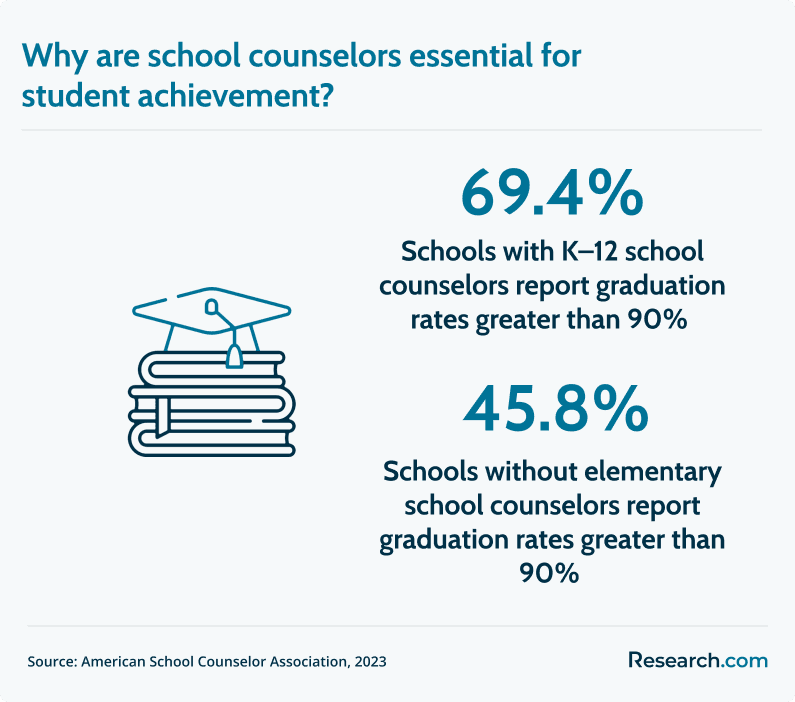
ASCA reported in 2023 that 69.4% of schools with K–12 school counselors report graduation rates greater than 90%, compared to only 45.8% in schools without elementary school counselors. These figures suggest that access to counseling support is associated with important school outcomes, although individual results vary by district, staffing levels, student needs, and school resources.
What student support services are available in online Master’s in School Counseling programs?
Strong online counseling programs do more than post lectures. They provide advising, field placement guidance, technology support, faculty access, licensure information, library resources, tutoring, writing assistance, and career services. These supports are especially important in accelerated programs because students move quickly and delays in internship approvals or licensure planning can push back graduation.
When comparing schools, ask whether the program assigns a dedicated advisor, helps locate practicum and internship sites, offers exam preparation, and provides clear state-by-state licensure guidance. Students comparing support structures in related fields may also review how online student services appear in the most affordable online psychology degree options.
Can supplemental certifications boost my career in school counseling?
Supplemental credentials can strengthen a school counselor’s toolkit, but they should be chosen strategically. A certification may be useful if it supports a specific career goal, such as behavior intervention, college advising, trauma response, substance abuse prevention, or special education collaboration. It should not be used as a substitute for the master’s degree and state licensure required for school counseling roles.
For counselors who want deeper behavioral intervention skills, behavior analysis training may be relevant. Students exploring this direction can compare cost-conscious pathways through the cheapest BCBA online programs. Before enrolling in any supplemental credential, confirm whether it is recognized by your employer, district, state, or target role.
How can I verify the quality and accreditation of my accelerated online Master’s in School Counseling program?
Start by checking institutional accreditation, then review whether the counseling program has programmatic accreditation or state approval relevant to school counseling. Commonly discussed accreditors and approval bodies include CACREP and CAEP, but requirements vary by state and by role.
Students should also review licensure exam pass information when available, graduation outcomes, field placement policies, faculty qualifications, student support services, and whether the program publicly explains which state requirements it is designed to meet. The same quality-checking mindset applies across online human services degrees, including an accelerated online psychology degree.
Questions to ask before applying
| Question | Why it matters |
| Is the institution regionally or nationally accredited? | Accreditation can affect financial aid, licensure review, transferability, and employer acceptance. |
| Is the program CACREP, CAEP, state-approved, or otherwise aligned with school counseling licensure? | Program-level recognition can be important for certification, depending on your state. |
| Does the program meet licensure requirements in my state? | An online degree may not automatically qualify graduates in every state. |
| How are practicum and internship placements arranged? | Placement delays are one of the most common reasons students do not finish as quickly as expected. |
| Are online students eligible for the same advising and career services as campus students? | Accelerated online learners need timely support to stay on track. |
| What are the total tuition and required fees? | The lowest cost per credit is not always the lowest total cost. |
Do Employers Value Fast-Track Online Master’s in School Counseling Degrees?
Employers generally focus less on whether a degree was online or accelerated and more on whether the graduate is eligible for licensure, completed meaningful fieldwork, attended an accredited or state-approved program, and can demonstrate professional competence. A fast program can be credible if it maintains the same academic and field training standards expected of traditional programs.
Hiring teams may look for experience with crisis response, student planning, family communication, classroom collaboration, documentation, confidentiality, and culturally responsive practice. For broader context on online degree perceptions in a related field, see Research.com’s discussion of whether online psychology degrees are legitimate and respected.
Will a fast-track online degree qualify me for school counselor licensure in my state?
Yes, a fast-track online degree can qualify you for school counselor licensure if the program is accredited, state-approved where necessary, and aligned with the requirements of the state where you plan to work. Many states require a master’s degree from CACREP accredited programs, CAEP-accredited programs, or programs otherwise approved by the state education agency.
Licensure pathways differ across counseling fields. For example, fast track MFT online master's programs may prepare students for family therapy-focused licensure rather than school counseling certification. If your goal is to work in K–12 schools, confirm the exact school counseling credential pathway before choosing a degree.
Most school counseling candidates must document graduate coursework, supervised field hours, a 100-hour practicum, a 500–700 hour internship, and a passing score on an approved licensure exam such as the Praxis II: School Counseling. Some states add teaching experience, state-specific coursework, or additional assessments.
For example, the Texas Education Agency states that candidates must hold a valid teaching certificate and have two years of classroom teaching experience before becoming certified as a school counselor in Texas. California, by contrast, does not require prior teaching experience but does require completion of a program approved for the Pupil Personnel Services (PPS) Credential in School Counseling.
This variation is the reason students should contact the state department of education or licensing board before enrolling. Do not rely only on a university’s general marketing language. Ask the program to confirm, in writing if possible, whether it meets requirements in your state.
Students evaluating location and earning potential should also consider state-level salary differences. California, Washington, and Massachusetts are noted for higher average school counselor earnings. According to the data below, school counselors in California earn an average of $85,820, followed by $81,280 in Washington and $79,670 in Massachusetts. These states are also often discussed in connection with other fast workforce pathways, such as fast-track medical billing and coding certificate online programs, because location can strongly affect labor market outcomes.
How can I further accelerate my Online Master's in School Counseling degree completion?
You can often shorten your timeline by choosing the right program structure and planning fieldwork early. The goal is not to rush through training; it is to avoid preventable delays. Similar completion strategies are used in other intensive graduate pathways, including fast track sustainability master’s programs online, but school counseling students must also account for placement availability and state documentation rules.
- Choose short terms and year-round scheduling. Programs with 6- to 8-week courses and minimal long breaks may allow faster progression.
- Take the maximum manageable course load. A heavier schedule can shorten completion time, but it must be realistic alongside work, family, and field hours.
- Ask about transfer credits. Some schools accept prior graduate coursework that matches program requirements.
- Check whether prior learning credit is available. Prior Learning Assessment (PLA) is uncommon in licensure-focused graduate counseling programs, but some institutions may consider relevant training or certifications.
- Start field placement planning immediately. Internship site approvals, background checks, and district paperwork can take time.
- Stay in close contact with advisors. Accelerated students should confirm course sequencing, graduation requirements, and licensure documents every term.
Common mistakes that slow students down
| Mistake | Better approach |
| Choosing the shortest program without checking licensure alignment | Verify state requirements before applying, especially if the school is located in another state. |
| Looking only at tuition per credit | Calculate total program cost, fees, books, fieldwork expenses, and exam-related costs. |
| Assuming online means self-paced | Confirm deadlines, live class requirements, internship schedules, and cohort policies. |
| Waiting too long to arrange internship placements | Ask about field placement support during the admissions process and begin paperwork early. |
| Assuming salary outcomes are guaranteed | Review local district salary schedules, state certification rules, and available job postings. |
| Relying only on rankings | Use rankings as a starting point, then compare accreditation, licensure fit, cost, support, and fieldwork quality. |
What career paths are available for graduates of an Online Master's in School counseling programs?
Graduates of online Master’s in School Counseling programs usually pursue roles centered on student development, academic planning, social-emotional support, and career readiness. Some positions require school counselor licensure or certification, while others may be available in advising, nonprofit, or youth development settings.
| Career path | Typical focus | Important credential note |
| K–12 School Counselor | Academic support, student wellness, crisis response, family communication, and college or career planning | Usually requires state school counselor licensure or certification |
| College and Career Counselor | College applications, scholarship guidance, vocational planning, career exploration, and transition planning | Requirements vary by employer and school level |
| Academic Advisor | Course planning, degree progress, retention support, and student success strategies | Common in higher education; licensure may not be required |
| Behavior Intervention Specialist | Student behavior plans, emotional support, collaboration with special education teams, and intervention tracking | Additional training or district-specific qualifications may be expected |
| Youth Program Counselor or Nonprofit Advocate | Youth development, family support, prevention programming, and community-based services | Requirements vary widely by organization |
| Mental Health Counselor | Clinical counseling in mental health settings or private practice | Requires additional licensure and supervised clinical experience |
The communication, assessment, problem-solving, advocacy, and documentation skills developed in school counseling programs can transfer across education and youth-focused roles. In the same way that graduates of a fast track online nutrition degree may move into specialized health and wellness settings, school counseling graduates can find opportunities in schools, advising offices, community programs, and support services.
BLS data below shows that elementary and secondary schools employ approximately 162,610 educational, guidance, and career counselors and advisors, making this the largest employment setting for the occupation. Other employment sectors include colleges, universities, and junior colleges with 25,790 positions, vocational rehabilitation services with 8,180, and individual and family services with 6,640.
What is the job market for graduates with an Online Master's in School Counseling?
The job market for online Master’s in School Counseling graduates is shaped by student mental health needs, counselor staffing shortages, state budgets, and district hiring priorities. Online graduates can be competitive when their programs meet licensure standards and include strong field experience. Similar to professionals pursuing a fast track master's in nutrition online to respond to workforce demand in health and wellness, school counseling students are preparing for a field where trained support professionals remain important.
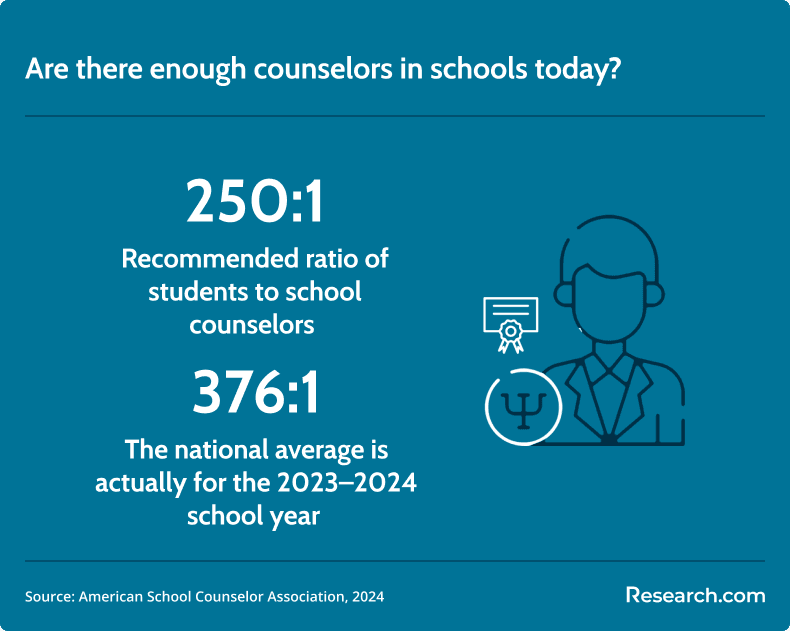
The American School Counselor Association recommends a 250-to-1 student-to-counselor ratio, but the national average remains 376-to-1 for the 2023–2024 school year. This gap suggests continued need for qualified school counselors, especially in districts with limited student support staffing.
Career education counseling is also expanding as schools place more emphasis on college planning, workforce readiness, and postsecondary transitions. The global career education counseling market was valued at $2.81 billion in 2024 and is projected to rise to $5.64 billion by 2033, with a compound annual growth rate (CAGR) of 8.03% (Business Research Insights, 2024).
Who should choose a fast online Master’s in School Counseling?
- Working educators who want to move into counseling and can handle a rigorous graduate schedule.
- Career changers with strong interpersonal skills and a clear commitment to supporting students.
- Students with local placement access who can complete practicum and internship hours without relocating.
- Organized learners who can manage deadlines, documentation, advising, and licensure steps independently.
- Applicants who already know their target state and can verify that the degree meets that state’s requirements.
Who should consider a slower or different path?
- Students who need maximum schedule flexibility. Accelerated programs can be demanding and may not be ideal for those with unpredictable work or caregiving responsibilities.
- Applicants unsure about working in schools. If your goal is private clinical practice, a mental health counseling or marriage and family therapy program may be more appropriate.
- Students in states with strict teaching requirements. If your state requires a teaching certificate or classroom experience, an accelerated master’s alone may not be enough.
- Applicants without placement options nearby. If local schools cannot host you, your timeline may extend regardless of the program’s advertised speed.
- Students choosing only by price or speed. The cheapest or shortest program is not the best choice if it does not support licensure.
Key Insights
- A fast online Master’s in School Counseling is valuable only if it preserves the essentials: accreditation, state licensure alignment, supervised fieldwork, and strong advising.
- Many accelerated programs take 12–18 months, but several reputable options take 2 years or more because practicum, internship, and credit requirements cannot be skipped.
- School counseling licensure is state-specific. Always confirm whether an online program meets the requirements where you plan to work.
- Total tuition often ranges from $20,000 to $40,000, but students should also budget for fees, books, background checks, travel, and licensure-related expenses.
- Career outcomes are strongest when graduates combine the degree with state certification, school-based field experience, crisis-response skills, and college and career readiness training.
- The fastest path is not always the best path. Choose the program that gets you licensed, prepared, and employable—not simply the one with the shortest advertised timeline.
References:
- American School Counselor Association. (2023). Student-to-school counselor ratios & student outcomes infographic. https://www.schoolcounselor.org/getmedia/a07648aa-5e94-4601-8341-9824ad782985/Ratios-Student-Outcomes-Infographic.pdf
- Bureau of Labor Statistics. (2024). Occupational outlook handbook: School and career counselors and advisors. U.S. Department of Labor. https://www.bls.gov/ooh/community-and-social-service/school-and-career-counselors.htm
- Bureau of Labor Statistics. (2024). Occupational employment and wage statistics: Educational, guidance, and career counselors and advisors. U.S. Department of Labor. https://www.bls.gov/oes/2023/may/oes211012.htm
- National Center for Education Statistics. (2025). School Pulse Panel: Interactive results. U.S. Department of Education. https://nces.ed.gov/surveys/spp/results.asp
- Salary.com. (2024). School counselor salary. https://www.salary.com/research/salary/benchmark/school-counselor-salary
- YouScience. (2025). The state of the school counselor profession report. https://resources.youscience.com/rs/806-BFU-539/images/2025_SchoolCounselorReport.pdf
- ZipRecruiter. (2024). LPC salary. https://www.ziprecruiter.com/Salaries/Lpc-Salary
Other Things To Know About Online Master's in School Counseling
Yes. Programs accredited by CACREP require at least 100 clock hours of practicum and 600 clock hours of internship, completed in approved school settings. These supervised field experiences cannot be skipped, even in accelerated online formats, because state licensure boards use them to verify counseling competence.
In 2027, the average duration for fast online Master's in School Counseling programs ranges from 12 to 18 months. These accelerated programs are designed to expedite coursework while maintaining comprehensive training, allowing students to enter the field more quickly than traditional two-year options.