2027 Fastest Online Bachelor's Degree in Sustainability Programs

Co-Founder and Chief Data Scientist
If you want a career tied to climate action, responsible business, conservation, environmental policy, or social impact, an online bachelor’s in sustainability can turn broad motivation into marketable skills. The challenge is choosing a program that is fast, legitimate, affordable, and aligned with the kind of work you actually want to do.
This guide explains what accelerated online sustainability bachelor’s programs teach, how long they can take, what they cost, which careers they can lead to, and how to compare schools without relying only on rankings. It is designed for first-time college students, transfer students, working adults, and career changers who want a practical path into the green economy.
Demand is one reason this degree matters now. In the U.S., job seekers with green skills have a hiring rate over 80% higher than the general workforce. That does not guarantee a job, but it does show that employers increasingly value candidates who can connect environmental goals with business, policy, data, and operations.
Quick answer: Is an online bachelor's in sustainability worth it?
An online bachelor’s in sustainability can be worth it if you want an entry-level role in sustainability coordination, environmental compliance, ESG reporting, community development, renewable energy, sustainable supply chains, or policy support. The strongest programs combine environmental science, business, policy, data analysis, and systems thinking, while giving you enough flexibility to keep working or apply transfer credits.
- Best fit: Students who want a career solving environmental and social problems across business, government, nonprofit, or community settings.
- Main benefit: The degree prepares you for roles such as sustainability coordinator or analyst, where you can support measurable environmental and organizational goals.
- Salary context: Related roles such as environmental manager report an average salary of over $67,000, while senior roles in certain industries may pay substantially more.
- Online advantage: A flexible format can help you study while maintaining work, family, or location commitments.
What can I expect from an online bachelor's in sustainability program?
An online bachelor’s in sustainability teaches you how environmental, economic, and social systems interact. Instead of studying environmental issues only as isolated scientific problems, you learn how decisions about energy, food, transportation, land use, supply chains, regulation, and corporate strategy affect people, ecosystems, and organizations.
Most programs are interdisciplinary. You may study environmental science, economics, public policy, ethics, project management, data analysis, sustainable business, and community planning. Many programs also introduce professional frameworks such as systems thinking and the Triple Bottom Line, which examines decisions through people, planet, and profit.
| What you study | Why it matters professionally |
| Environmental science fundamentals | Helps you understand climate, ecosystems, pollution, water, energy, and resource use. |
| Policy and regulation | Prepares you to interpret environmental rules, compliance needs, and public-sector decision-making. |
| Sustainable business | Builds skills for ESG reporting, supply chain initiatives, operations, procurement, and corporate responsibility. |
| Data and metrics | Supports work involving emissions tracking, waste reduction, reporting, benchmarking, and program evaluation. |
| Ethics and social impact | Helps you evaluate how sustainability decisions affect communities, equity, health, and long-term resilience. |
The best programs do more than award a credential. They help you become a practical problem-solver who can communicate with scientists, executives, policymakers, engineers, community leaders, and customers.
Where can I work with an online bachelor's in sustainability degree?
Sustainability graduates can work in organizations that are explicitly environmental, but many opportunities are inside traditional industries trying to reduce risk, meet reporting expectations, improve resource efficiency, or respond to customer and regulatory pressure.
Common employment settings include corporations, local governments, consulting firms, nonprofits, utilities, construction companies, manufacturers, universities, transportation organizations, food systems, and community development agencies. Sustainability work is also moving into departments that may not have historically used the word “sustainability,” including supply chain, procurement, finance, facilities, compliance, and operations.
| Work setting | How sustainability skills are used |
| Corporations | ESG reporting, resource efficiency, supplier standards, waste reduction, and stakeholder communication. |
| Government agencies | Policy support, climate planning, environmental compliance, grants, and community resilience projects. |
| Nonprofits | Advocacy, program coordination, conservation projects, public education, and environmental justice work. |
| Consulting firms | Client research, sustainability audits, reporting support, carbon accounting assistance, and project analysis. |
| Built environment and construction | Green building, energy efficiency, materials selection, land-use planning, and sustainable design support. |
How much can I make with an online bachelor's in sustainability degree?
Earnings vary widely because sustainability is not one single occupation. Your salary will depend on the role, industry, location, employer size, technical skills, internships, certifications, and prior work experience.
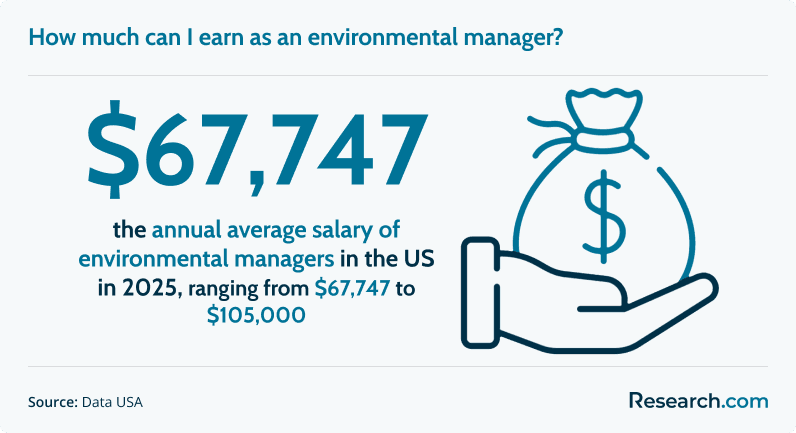
As a reference point, an environmental manager role might have an average starting salary around $67,747. Senior positions in high-demand industries such as petroleum manufacturing or chemical manufacturing can command salaries well over $140,000. These figures should be used as context, not as a guaranteed outcome for every graduate.
The financial value of the degree is strongest when the program helps you build job-ready skills: data analysis, ESG reporting, compliance knowledge, project coordination, communication, and sector-specific expertise.
- Fastest Online Bachelor's Degree in Sustainability Programs for 2027
- Online vs. On-Campus Bachelor's in Sustainability: Key Differences
- Average Cost of a Fast Online Bachelor's in Sustainability Program
- Financial Aid Options for Online Sustainability Students
- Admission Requirements for Fast Online Sustainability Programs
- Common Courses in an Online Bachelor's in Sustainability
- Sustainability Specializations and When to Choose Them
- How to Choose the Fastest Online Bachelor's in Sustainability Program
- How Interdisciplinary Sustainability Skills Expand Career Options
- Advanced Credentials That Can Complement a Sustainability Bachelor's
- Sustainability vs. Environmental Science Degrees
- Career Paths for Graduates of Fast Online Sustainability Programs
- Job Market for Online Bachelor's in Sustainability Graduates
Fastest Online Bachelor's Degree in Sustainability Programs for 2027
The fastest online bachelor’s in sustainability programs typically use accelerated terms, generous transfer policies, prior learning credit, year-round enrollment, or flexible course loads to help students finish sooner. Some follow academic structures similar to accelerated online bachelor’s in mathematics programs, where shorter sessions and focused scheduling can reduce time to completion for prepared students.
Use the list below as a starting point, not the only factor in your decision. A fast program is only valuable if it is accredited, affordable for your situation, realistic with your schedule, and connected to the sustainability careers you want.
How do we rank schools?
Research.com rankings are built to help students compare degree options using transparent information rather than marketing claims alone. The ranking process draws from sources including the IPEDS database, Peterson's database, the College Scorecard database, and The National Center for Education Statistics.
These sources help evaluate DEGREE programs using institutional and student outcome data. For additional details, readers can review Research.com’s methodology page.
1. Northwest Indian College
Northwest Indian College offers an online Bachelor of Science (BS) in Native Environmental Science. The program stands out because it brings together contemporary environmental science and Indigenous ecological knowledge. It may be especially relevant for students who want to work with Native communities, tribal governments, land stewardship programs, or environmental projects grounded in place-based knowledge.
- Program Length: Flexible, self-paced
- Required Credits to Graduate: 180 quarter credits
- Total Tuition: $6,600
- Accreditation: Northwest Commission on Colleges and Universities (NWCCU)
2. Bellevue University
Bellevue University offers a BS in Sustainability Management that focuses on applied sustainability in organizational settings. The curriculum emphasizes areas such as water, energy, and green technology, and it prepares students to sit for the LEED Green Associate Exam. It is a practical choice for students interested in project-based sustainability work in business, government, or facilities-related roles.
- Program Length: Accelerated options available
- Required Credits to Graduate: 127 semester credits
- Total Tuition: $6,349
- Accreditation: Higher Learning Commission (HLC)
3. University of Wisconsin-Stout
The online BS in Sustainable Management at UW-Stout is designed for students who want to apply sustainability principles inside organizations. The program focuses on how businesses can reduce environmental impact while managing cost, compliance, operations, and stakeholder expectations. It may fit students aiming for corporate sustainability, operations, compliance, or sustainability reporting roles.
- Program Length: Flexible, designed for working professionals
- Required Credits to Graduate: 120 semester credits
- Total Tuition: $14,038
- Accreditation: Higher Learning Commission (HLC)
4. Arizona State University
Arizona State University offers an online Bachelor of Science with a strong interdisciplinary and solutions-oriented structure. Students can choose tracks such as Economics of Sustainability or Sustainable Energy, making it a good option for learners who want to tailor their degree toward a specific sector. ASU’s sustainability reputation may also appeal to students who value institutional visibility and broad academic resources.
- Program Length: 40 classes, 7.5 weeks per class (can be completed in about 3 years if accelerated)
- Specializations/Concentrations: Economics of Sustainability, Sustainable Ecosystems, Sustainable Energy, Materials, and Technology
- Required Credits to Graduate: 120 credit hours
- Total Tuition: $13,007
- Accreditation: Higher Learning Commission (HLC)
5. Florida International University
Florida International University offers an online BA in Sustainability and the Environment. The program combines flexibility with student support, including a personal success coach for each student. It may be a strong fit for students who want a broad sustainability degree that can support work in policy, consulting, program coordination, environmental communication, or public-facing initiatives.
- Program Length: Flexible, fully online
- Required Credits to Graduate: 120 semester credits
- Total Tuition: $12,966
- Accreditation: Southern Association of Colleges and Schools Commission on Colleges (SACSCOC)
6. Maryville University
Maryville University offers an online BS in Sustainability with a modern, customizable structure. Students can choose from Environmental Science, Business, or Policy tracks. Because the program is transfer-credit friendly, it may work well for adult learners, degree completers, and career changers who already have college coursework and want a faster route to graduation.
- Program Length: Flexible, self-paced
- Specializations/Concentrations: Environmental Science, Business, Policy
- Required Credits to Graduate: 128 semester credits
- Total Tuition: Not specified, but financial aid and transfer credits available
- Accreditation: Higher Learning Commission (HLC)
7. University of Massachusetts Amherst
UMass Amherst offers a BA in Sustainability Studies with substantial flexibility for students who bring prior experience. The program allows students to earn up to 105 credits for prior learning, including professional work and life experience, which can significantly shorten the path to a degree. It is especially relevant for adult learners who want their existing knowledge evaluated for credit.
- Program Length: Highly accelerated with prior learning credits
- Required Credits to Graduate: 120 semester credits
- Total Tuition: $20,093
- Accreditation: New England Commission of Higher Education (NECHE)
8. Southern New Hampshire University
Southern New Hampshire University offers an online environmental science degree with a sustainability focus. The program is structured for flexibility, making it a practical option for students balancing coursework with employment, caregiving, or other responsibilities. It may appeal to learners who want an accessible online format and a broad environmental foundation.
- Program Length: Flexible, self-paced
- Required Credits to Graduate: 120 semester credits
- Total Tuition: Not specified, but ranked among the most affordable
- Accreditation: New England Commission of Higher Education (NECHE)
9. Oregon State University
Oregon State University offers a BS in Sustainability as a double-degree program that can be paired with another OSU major. This structure lets students combine sustainability with another field, such as business, agriculture, natural resources, engineering-related interests, or policy. It is a strong fit for students who want a customized academic profile rather than a single-discipline credential.
- Program Length: Flexible, can be completed alongside another bachelor’s
- Required Credits to Graduate: 180 quarter credits (double degree)
- Total Tuition: $19,484
- Accreditation: Northwest Commission on Colleges and Universities (NWCCU)
10. Roosevelt University
Roosevelt University offers a program focused on urban sustainability and social justice. The curriculum is well suited to students interested in cities, environmental equity, community engagement, policy advocacy, and metropolitan planning challenges. It may be a good match for learners who want sustainability work connected to people, neighborhoods, and public systems.
- Program Length: Flexible, online
- Required Credits to Graduate: 120 semester credits
- Total Tuition: $24,794
- Accreditation: Higher Learning Commission (HLC)
How long does it take to complete a fast online bachelor's in sustainability program?
A traditional bachelor’s degree is commonly designed around a four-year schedule, but accelerated online sustainability programs can shorten that timeline for students who take more credits per term, enroll year-round, transfer previous credits, or qualify for prior learning credit. Some students may finish in three years or even less, depending on the program and their personal circumstances.
These accelerated structures resemble the scheduling models used in some fast online elementary education master’s programs, where condensed terms and continuous enrollment can help motivated students progress more quickly. Speed, however, should not come at the expense of academic quality, accreditation, or your ability to learn the material well.
Accredited accelerated programs are expected to meet the same academic standards as traditional programs. The difference is usually format: shorter sessions, more frequent start dates, heavier course loads, or expanded credit-transfer options.
What “fastest” really means
The fastest program for one student may not be the fastest for another. Your timeline depends on transfer credits, work schedule, family responsibilities, course availability, tuition budget, and how many classes you can handle without reducing performance.
In that sense, speed works much like the flexibility found in some accelerated online artificial intelligence programs: the structure can support faster completion, but the student’s background and capacity determine the actual pace.
| Factor | How it can affect completion time |
| Transfer credits | Previously earned college credits may reduce the number of courses you still need. |
| Prior learning credit | Some schools evaluate work, military, professional, or life experience for possible credit. |
| Term length | Shorter terms can let you complete more courses during the year. |
| Course load | Taking more classes can speed up graduation but may increase stress and reduce study time. |
| Course availability | Required courses must be offered often enough for you to maintain an accelerated plan. |
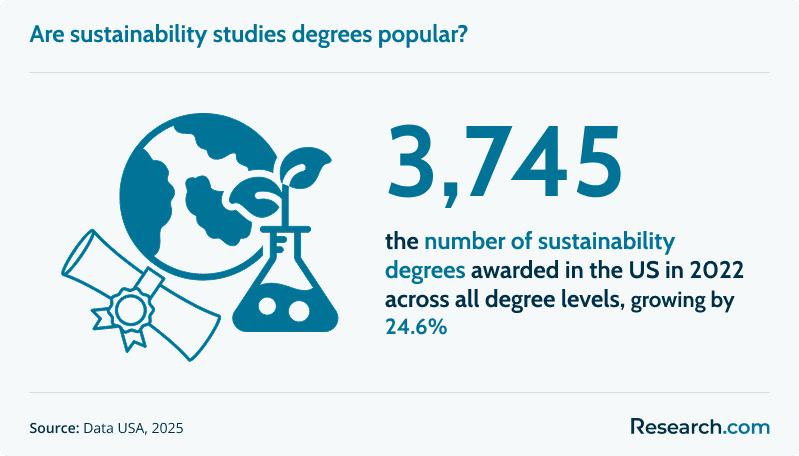
The growing number of sustainability degrees awarded in the U.S., which reached 3,745 in 2022, shows that this is no longer an obscure academic path. It is an established route for students who want to enter sustainability-related fields.
How does a fast online bachelor's in sustainability program compare to an on-campus program?
At an accredited university, an online bachelor’s in sustainability should meet the same academic standards as the campus version. Online students often study comparable course material, complete similar assignments, and earn the same institutional credential. Employers and graduate schools generally focus on the school, degree, accreditation, skills, experience, and portfolio rather than whether every class was completed in person.
Online learning can be rigorous when it is designed well. Programs in other fields, such as a fast online data analytics degree, show how digital delivery can still support demanding, career-focused coursework.
| Factor | Online sustainability bachelor's | On-campus sustainability bachelor's |
| Schedule | Often better for working adults, parents, and students outside commuting range. | Usually follows fixed class times and campus calendars. |
| Networking | Can connect students from different regions and industries through virtual discussions and projects. | Offers face-to-face clubs, events, labs, and local campus networks. |
| Costs | May reduce housing, commuting, and relocation expenses. | May involve additional campus-based living and transportation costs. |
| Learning style | Requires self-direction, written communication, and strong time management. | Provides more in-person structure and immediate classroom interaction. |
| Best for | Students who need flexibility and can stay organized independently. | Students who prefer daily campus life, in-person support, or hands-on local activities. |
Career advantages of studying online
Online learning can strengthen skills that sustainability employers often value: independent planning, digital collaboration, remote communication, documentation, and comfort using online tools. These abilities matter because many sustainability roles require coordinating with vendors, departments, executives, regulators, and community partners across different locations.
The main risk is isolation. Before enrolling, ask how the program supports virtual networking, internships, applied projects, faculty access, and career advising.
What is the average cost of the fast online bachelor's in sustainability program?
The cost of a fast online bachelor’s in sustainability varies by school, tuition structure, residency status, transfer credit, fees, and whether the institution is public or private. Some programs may have a total estimated tuition around $16,395, while others cost more or less.
Do not compare programs only by tuition. The true cost includes fees, books, technology requirements, transcript fees, course materials, possible proctoring costs, and the number of credits you still need to complete. Online students may save on housing, meal plans, relocation, and commuting, but those savings depend on their personal situation.
If cost is your top concern, comparing affordable online bachelor’s in sustainability programs can help you identify lower-tuition options before narrowing your list.
How to estimate your real cost
| Cost question | Why it matters |
| How many credits will transfer? | Accepted credits can reduce both tuition and time in school. |
| Is tuition charged per credit or per term? | The pricing model affects whether accelerated enrollment saves money. |
| Are online students charged extra fees? | Technology, distance learning, and course fees can change the final bill. |
| Can you keep working while enrolled? | Maintaining income can improve affordability and reduce borrowing. |
| Does the school offer scholarships for online students? | Institutional aid can significantly change your net price. |
Calculating return on investment
Return on investment is not just a salary calculation. It also includes the time required to finish, the amount borrowed, the strength of the school’s career support, the relevance of the curriculum, and whether the degree helps you qualify for roles you could not access before.
Related positions such as environmental manager have an average annual salary of over $67,000, but graduates should evaluate program outcomes carefully. Ask schools for career placement support, internship access, employer partnerships, alumni examples, and graduate school pathways.
What are the financial aid options for students enrolling in a fast online bachelor's in sustainability programs?
Students in accredited online bachelor’s programs are typically eligible for many of the same financial aid options available to campus students. The key requirement is usually accreditation and enrollment in an eligible program. The first step for U.S. students is completing the Free Application for Federal Student Aid (FAFSA).
Accelerated online programs in other disciplines, such as a fast online master’s in mathematics, often rely on similar financial aid processes: federal aid eligibility, institutional aid, employer support, and private scholarships depend on program and student qualifications.
- Federal grants and loans: FAFSA results may determine eligibility for options such as Pell Grants, Direct Subsidized Loans, and Direct Unsubsidized Loans. Grants generally do not require repayment, while loans do.
- School scholarships and grants: Universities may offer awards based on academic performance, financial need, transfer status, major, or online enrollment.
- Private scholarships: Environmental nonprofits, foundations, professional associations, and companies may fund students pursuing sustainability, climate, conservation, or environmental studies.
- Employer tuition assistance: Working students should ask HR whether tuition reimbursement or education benefits apply to sustainability-related degrees.
- Transfer and prior learning credit: Although not financial aid, accepted credits can lower your total tuition by reducing the number of classes you must take.
Before borrowing, ask each school for a written cost estimate based on your transfer evaluation and expected enrollment pace. A lower advertised tuition does not always mean a lower total price.
What are the prerequisites for enrolling in a fast online bachelor's in sustainability program?
Admission requirements vary, but many online bachelor’s in sustainability programs use standard undergraduate criteria. Applicants typically need a high school diploma or GED and official transcripts from previous schools. Transfer students must usually submit transcripts from every college attended.
The process can be similar to admission for programs such as a fast online bachelor’s in history: schools may request transcripts, an application form, a personal statement, and sometimes SAT or ACT scores. Many universities have test-optional policies, but requirements differ by institution.
Do you need a science background?
Usually, no. Sustainability includes science, but it also includes economics, ethics, communication, policy, business, and social systems. Students with backgrounds in social science, business, public service, agriculture, community work, operations, or advocacy may bring useful perspectives.
If you have limited science experience, look for programs with clear introductory coursework, tutoring, advising, and quantitative support. If you already have science credits, ask whether they can transfer into major or general education requirements.
For returning students, the most important “prerequisite” may be the transfer credit policy. A school that accepts more of your prior coursework may be faster and cheaper than a school with a stronger brand but fewer accepted credits.
It is also helpful to understand the field’s education pattern. About 70% of sustainability professionals hold some form of advanced degree. That does not mean every entry-level applicant needs graduate school, but it does mean a bachelor’s degree can serve as the first major credential in a longer professional pathway.
What courses are typically in a fast online bachelor's in sustainability program?
Course titles differ by school, but online sustainability programs usually combine environmental foundations with applied courses in policy, economics, management, and analysis. The goal is to help students understand problems from multiple angles and recommend realistic solutions.
Well-designed online curricula, including fields such as accelerated online ESL programs, use structured modules, projects, discussions, and assessments to build skills efficiently. Sustainability programs often do the same through case studies, data projects, policy analysis, and applied sustainability planning.
| Common course area | What you learn |
| Introduction to Environmental Science | Basic ecological systems, environmental problems, resource use, pollution, and climate-related concepts. |
| Principles of Sustainability | Core sustainability frameworks, trade-offs, systems thinking, and long-term planning. |
| Environmental Ethics | How values, responsibility, justice, and human behavior shape environmental decisions. |
| Environmental Economics | Costs, benefits, incentives, externalities, and economic tools used in sustainability decisions. |
| Environmental Policy | How laws, regulations, agencies, and political processes influence environmental outcomes. |
| Corporate Social Responsibility | How organizations manage environmental, social, and governance expectations. |
| Global Environmental Issues | Large-scale challenges such as climate, biodiversity, water, food systems, and development. |
Skills you should expect to build
A sustainability degree is not simply an environmental science degree with a different name. It should help you learn how to frame problems, weigh trade-offs, use data, write clearly, communicate with different audiences, and design solutions that can work inside real organizations or communities.
Communication is especially important. Sustainability professionals often translate technical information into plans that decision-makers can understand. That same skill is central in education-focused programs, including affordable online master’s in science education programs, where complex scientific ideas must be explained clearly to different audiences.
What types of specializations are available in a fast online bachelor's in sustainability program?
Specializations help you connect a broad sustainability degree to a more specific career direction. Not every school offers concentrations, but many let students choose electives, projects, minors, or tracks that shape their expertise.
This is similar to career-aligned programs such as a fast online health education degree, where students may use focused coursework to prepare for particular roles. In sustainability, the right specialization can help employers understand what kind of work you are prepared to do.
| Specialization | Best for students interested in | Possible career direction |
| Sustainable Business/Corporate Social Responsibility (CSR) | Business strategy, ESG, reporting, supply chains, and organizational change. | Sustainability coordinator, ESG analyst, corporate responsibility associate. |
| Renewable Energy and Technology | Energy transition, solar, wind, clean technology, and energy policy. | Energy program assistant, renewable energy analyst support, sustainability project coordinator. |
| Environmental Policy and Governance | Law, regulation, government, advocacy, and public decision-making. | Policy assistant, environmental program coordinator, nonprofit advocacy associate. |
| Sustainable Agriculture and Food Systems | Food security, agriculture, soil, water, supply chains, and resilient communities. | Food systems coordinator, agricultural sustainability assistant, nonprofit program associate. |
| Green Building and Community Development | Urban sustainability, built environments, land use, design, and local resilience. | Green building assistant, community sustainability coordinator, urban sustainability support role. |
Sustainability can also overlap with scientific innovation fields. Students exploring broader science-based career options may find useful context in guides to biotechnology careers, especially when comparing how different applied science pathways connect to industry needs.
Specialized knowledge can affect earning potential over time. For instance, roles within petroleum and coal products manufacturing can offer average salaries $140,970, while positions in chemical manufacturing command over $134,920. These examples show why industry context matters when evaluating long-term compensation.
How to choose the fastest online bachelor's in sustainability program?
The best fast online sustainability program is not automatically the cheapest, shortest, or most recognizable. It is the program that lets you graduate efficiently with a respected credential, useful skills, manageable debt, and a realistic path toward your target roles.
| Decision factor | What to check before enrolling |
| Accreditation | Confirm that the institution is regionally accredited and eligible for federal financial aid. |
| Transfer policy | Request an official transfer credit evaluation before assuming how quickly you can finish. |
| Curriculum fit | Compare required courses, electives, projects, and concentrations against your career goals. |
| Career support | Ask about internships, career coaching, employer connections, alumni outcomes, and portfolio support. |
| Faculty background | Look for instructors with relevant academic expertise, field experience, or applied sustainability work. |
| Flexibility | Review start dates, weekly workload, synchronous requirements, part-time options, and course sequencing. |
| Total cost | Compare net price after aid, transfer credits, fees, and the number of credits remaining. |
Questions to ask admissions advisors
- How many of my previous credits will apply directly to this degree?
- Can the program be completed fully online, or are there any campus or field requirements?
- How often are required major courses offered?
- Does the program include a capstone, internship, practicum, or applied project?
- What sustainability software, data tools, or reporting frameworks are taught?
- What career services are available to online students?
- Are online students eligible for the same scholarships as campus students?
- What percentage of students finish within the advertised accelerated timeline?
Common mistakes to avoid
- Choosing speed over legitimacy: A very fast timeline is risky if the school lacks recognized accreditation.
- Comparing only tuition: Fees, transfer policies, and lost credits can make a “cheap” program more expensive.
- Ignoring career fit: A program focused on policy may not be the best match if your goal is corporate ESG reporting.
- Assuming online means easy: Accelerated courses can be demanding because the same material is compressed into a shorter period.
- Skipping transfer evaluation: Unofficial estimates can differ from the credits actually applied after admission.
- Relying only on rankings: Rankings can help you start research, but your best choice depends on cost, transfer credits, support, and goals.
Some sustainability professionals later pursue graduate education to qualify for leadership, consulting, specialized technical, or policy roles. If that is part of your long-term plan, compare bachelor’s programs with an eye toward graduate preparation, including pathways such as a low-cost online master’s in sustainability.
How can interdisciplinary skills from an online sustainability program enhance broader career opportunities?
Sustainability programs develop cross-functional skills because real environmental and social problems rarely fit neatly into one department. Graduates may learn to interpret data, understand regulations, communicate with stakeholders, evaluate business trade-offs, and support projects across operations, procurement, facilities, finance, public policy, and community programs.
That interdisciplinary base can make the degree useful beyond job titles that include the word “sustainability.” Students with strong science and analysis interests may also compare related pathways, including some of the best-paying careers for biology majors, to understand how environmental, biological, and applied science skills can lead to different employment options.
What advanced credentials can complement your online bachelor's in sustainability?
A bachelor’s degree can open the door to entry-level roles, but additional credentials may help you move into specialized or senior positions. Depending on your goals, useful next steps may include graduate study, industry certifications, project management training, data analytics coursework, GIS skills, LEED-related credentials, or ESG reporting experience.
Some professionals also combine sustainability with other fields such as public health, food systems, nutrition, business, or policy. For example, students interested in the relationship between environment, food, and wellness may compare sustainability graduate options with programs such as accelerated online master’s programs in nutrition. The right credential depends on whether you want to work in corporate sustainability, environmental management, food systems, consulting, policy, or community health.
How does an online bachelor's in sustainability differ from an online bachelor's in environmental science?
An online bachelor’s in sustainability is usually broader and more systems-oriented. It examines environmental problems alongside economics, policy, ethics, business, and social impact. An online bachelor’s in environmental science is typically more focused on natural science, research methods, field or lab-based inquiry, and technical understanding of ecosystems and environmental processes.
| Degree | Main focus | Best fit |
| Bachelor’s in Sustainability | Systems thinking, applied solutions, business, policy, social impact, and environmental strategy. | Students interested in ESG, sustainability coordination, policy support, consulting, operations, or community programs. |
| Bachelor’s in Environmental Science | Scientific study of environmental systems, data collection, ecology, pollution, and natural processes. | Students interested in research, fieldwork, environmental monitoring, technical analysis, or science-heavy roles. |
If you want a more science-centered route, reviewing affordable online bachelor’s programs in environmental science can help you compare the curriculum and career differences before committing to sustainability.
What career paths are available for graduates of a fast online bachelor's in sustainability programs?
A bachelor’s in sustainability can qualify graduates for entry-level and early-career roles that support environmental, social, and operational goals. The degree is usually the starting point rather than the final credential for senior leadership, but it can help you build the experience needed for advancement.
Sustainability jobs are appearing in both green-focused organizations and mainstream business departments. Demand is especially visible in operational functions: 39% of companies are adding sustainability professionals to supply chain departments, and 38% are adding them to procurement.
Common entry-level roles
| Role | Typical responsibilities | Skills that help |
| Sustainability Coordinator | Supports programs, gathers data, organizes initiatives, communicates progress, and assists with reports. | Project coordination, writing, stakeholder communication, spreadsheets, sustainability basics. |
| Sustainability Analyst | Tracks metrics, reviews environmental or social data, supports ESG reporting, and identifies improvement opportunities. | Data analysis, reporting, research, Excel or analytics tools, attention to detail. |
| Environmental Specialist (Entry-Level) | Assists with compliance, environmental monitoring, documentation, site assessments, or impact reviews. | Environmental science, regulatory awareness, documentation, field or technical skills. |
| Corporate Responsibility Associate | Supports CSR initiatives, stakeholder communications, supplier questionnaires, and reporting projects. | Business writing, ESG concepts, research, communication, organization. |
| Community Sustainability Program Assistant | Helps manage local resilience, conservation, waste, transportation, or education programs. | Community engagement, public communication, grant support, program coordination. |
Long-term advancement
With experience, graduates may move from coordinator or analyst roles into sustainability manager, environmental manager, ESG manager, program manager, consultant, director, or VP-level positions. Advancement often depends on technical specialization, leadership experience, industry knowledge, measurable project results, and sometimes graduate education.
Women currently make up 64% of the sustainability workforce, reflecting one demographic feature of this professional field. Students who want to explore more titles, industries, and pathways can review Research.com’s guide to sustainability careers.
What is the job market for graduates of a fast online bachelor's degree in sustainability programs?
The sustainability job market is expanding across industries, but competition still varies by role and location. A degree alone is rarely enough. Employers often look for candidates who can show applied skills through internships, projects, reporting experience, data work, certifications, or sector-specific knowledge.
Current labor market indicators are favorable for people with green skills. Globally, green jobs accounted for 7.7% of all postings on LinkedIn in 2024. In the United States, people with green skills on their profiles experience a hiring rate that is 80.3% higher than that of the overall workforce.
Why demand is growing
- Regulation and reporting: Organizations need employees who understand compliance, disclosure, environmental risk, and ESG expectations.
- Cost and efficiency pressure: Energy, water, waste, and supply chain improvements can affect operations and budgets.
- Investor and customer expectations: Many organizations are asked to document environmental and social performance.
- Climate and resilience planning: Public and private organizations need workers who can support adaptation, mitigation, and emergency planning.
- Talent shortage: The shortage of green talent is projected to reach 18.7% by 2030.
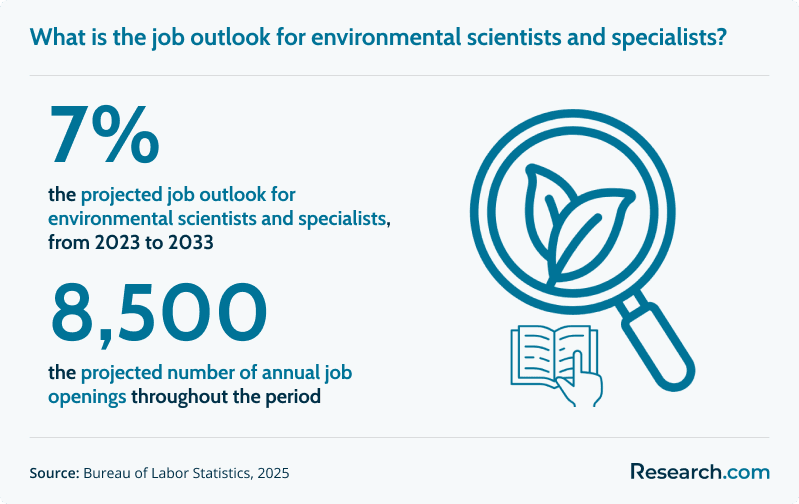
The U.S. Bureau of Labor Statistics projects 7% employment growth for environmental scientists and specialists between 2023 and 2033. That outlook supports the case for environmental and sustainability-related training, though individual outcomes depend on role, geography, industry, and experience.
How AI and technology are changing sustainability work
Technology is increasing the demand for sustainability professionals who can work with data. AI tools, dashboards, sensors, reporting platforms, GIS, lifecycle assessment tools, and emissions-tracking systems can help organizations measure impact more efficiently. However, these tools still require people who understand context, data quality, ethics, stakeholder needs, and regulatory expectations.
Students should look for programs that build analytical confidence, not just environmental awareness. Courses or projects involving data interpretation, reporting, mapping, research methods, or business analysis can strengthen your employability.
Here’s what graduates have to say about their online bachelor's in sustainability programs
- I knew I cared about environmental work, but I did not know how to turn that interest into a job. My online program helped me learn how to analyze information, understand policy, and communicate recommendations. Being able to study without relocating made the degree possible for me. I now work as a sustainability analyst, and the best part is seeing real numbers tied to the work I support. Chloe
- I expected mostly science classes, but the business, economics, and ethics courses ended up being just as useful. The program taught me how to explain sustainability goals to different teams. That ability to connect with engineers, finance staff, and managers helped me get hired as a sustainability coordinator. Hannah
- My biggest concern was whether the degree would be worth the money. The online format let me keep working full time, and the school accepted many of my older credits, which saved me a full year of tuition. Skills like ESG reporting and lifecycle analysis were directly useful in my current role, and the salary increase made the decision worthwhile. Ben
Key Insights
- An online bachelor’s in sustainability is best for students who want to solve environmental and social problems through business, policy, data, operations, or community work.
- Speed depends heavily on transfer credits, prior learning credit, term length, course load, and course availability. The fastest advertised program may not be the fastest for your transcript.
- Accreditation is non-negotiable. It affects credit transfer, federal financial aid eligibility, graduate school options, and employer confidence.
- U.S. professionals with green skills see an 80.3% higher hiring rate than the overall workforce, but students still need applied experience, projects, and job-ready skills.
- The field has long-term demand signals, including a projected 18.7% shortage of green talent by 2030 and 7% projected growth for environmental scientists and specialists between 2023 and 2033.
- Career opportunities are no longer limited to environmental nonprofits. Sustainability skills are increasingly used in supply chain, procurement, finance, facilities, compliance, consulting, and corporate strategy.
- Cost should be evaluated by net price, not sticker price. Transfer credits, fees, scholarships, employer tuition benefits, and the ability to keep working can significantly affect affordability.
- Sustainability and environmental science degrees overlap, but they are not identical. Sustainability is broader and more systems-focused, while environmental science is usually more technical and science-centered.
- Related roles such as environmental manager offer an average salary of over $67,000, and senior positions in specialized industries can exceed $145,000, but salaries vary by role, industry, location, and experience.
References:
- Data USA. (2025). Sustainability studies. Retrieved May 24, 2024, from Data USA.
- LinkedIn. (2024). Global green skills report 2024. Retrieved May 24, 2024, from LinkedIn.
- National Registry of Environment Professionals. (2025). 10 compelling reasons why an environmental career is for you. Retrieved May 24, 2024, from NREP.
- Trellis. (2024). The state of the sustainability profession 2024. Retrieved May 24, 2024, from Trellis.
- U.S. Bureau of Labor Statistics. (2025). Occupational outlook handbook: Environmental scientists and specialists. Retrieved May 24, 2024, from BLS.
- Zippia. (2025). Environmental manager demographics and statistics in the US. Retrieved May 24, 2024, from Zippia.
Other Things You Should Know About The Fastest Online Bachelor's Degree in Sustainability Programs
In 2027, accelerated online bachelor's degree programs in sustainability typically take 12 to 24 months to complete. These programs are designed to provide comprehensive coverage of sustainability concepts and practices at a faster pace, accommodating students seeking to enter the workforce or advance their careers swiftly.
Accelerated online sustainability bachelor's degree programs can be demanding due to condensed timelines. Students might face challenges like managing intense coursework, staying disciplined in a self-paced environment, and balancing work or personal commitments. Strong time-management skills and organizational abilities are crucial for success in these programs.