
2027 Best Online Master's in Mathematics Degree Programs

Co-Founder and Chief Data Scientist
Earning a master’s in mathematics online offers a flexible and rigorous path for advancing your career in data science, education, finance, or research. These programs are designed for students who want to deepen their mathematical expertise while balancing work or personal commitments. With options ranging from pure to applied math, and specializations in areas like statistics and computational modeling, online programs provide the same academic quality as on-campus alternatives.
In this guide, we’ll highlight the best online master’s in mathematics degree programs, explain what to expect from the curriculum, and help you compare costs, admissions, and career outcomes. Whether you're aiming to teach, analyze data, or pursue a PhD, this article will help you find the right program to match your goals.
What are the benefits of getting an online master's in mathematics degree?
- Diverse career paths: An online master’s in mathematics can lead to high-demand roles like data scientist, actuary, statistician, quantitative analyst, and math educator.
- Strong earning potential: According to the U.S. Bureau of Labor Statistics, mathematicians and statisticians earn a median salary of $104,350 per year.
- Flexible learning format: Online programs allow students to study from anywhere and often offer part-time or self-paced options—ideal for working professionals.
- Same academic quality: Online degrees from accredited institutions offer the same rigorous curriculum and faculty as their on-campus counterparts, ensuring credibility with employers.
What can I expect from an online master's in mathematics degree?
An online master’s in mathematics is a graduate-level program designed to deepen your knowledge of advanced mathematical theory and its real-world applications. These programs typically cover core subjects like real analysis, abstract algebra, statistics, and numerical methods, while offering specializations in areas such as applied mathematics, data science, or math education.
Whether you're looking to advance in your current role or pivot into a new career, this degree equips you with strong analytical, problem-solving, and quantitative skills valued across industries.
Online programs offer the flexibility to study on your schedule without sacrificing academic rigor, making them ideal for working professionals or those with other commitments. Graduates are well-positioned for roles in data analytics, finance, software development, research, and education. Many programs also offer a thesis or capstone option, which can serve as a bridge to doctoral study or high-level industry positions.
Where can I work with an online master's in mathematics degree?
Graduates of an online master’s in mathematics degree work in a wide range of industries that value strong analytical and quantitative skills. Common sectors include finance, technology, government, education, and healthcare. In these fields, professionals apply mathematical models, statistical methods, and computational techniques to solve complex problems.
For example, in finance, they may work as actuaries or quantitative analysts developing risk models. In tech, they often become data scientists or algorithm developers supporting machine learning and AI projects.
Types of employers hiring math master’s graduates include:
- Tech companies
- Financial institutions
- Government agencies
- Universities and schools
- Research organizations
Graduates with teaching interests may also work in K–12 or postsecondary education, often in advanced or leadership roles.
How much can I make with an online master's in mathematics degree?
Graduates with an online master’s in mathematics can earn strong salaries, often exceeding six figures depending on their role and industry. According to the U.S. Bureau of Labor Statistics (BLS), mathematicians and statisticians earn a median annual salary of $104,350 as of 2024.
Professionals working in federal government roles tend to earn more, with median salaries around $119,000, while those in research and development average about $111,000. Actuaries, another popular career path for math graduates, earn a median salary of $125,770, according to BLS data.
In the private sector, especially in finance and tech, salaries can climb even higher. Data scientists and quantitative analysts with a math master’s degree often start around $95,000 to $110,000, with experienced professionals earning $130,000 or more. Salaries can also vary by region, company size, and level of experience. Overall, the degree offers strong return on investment, particularly in fields where advanced mathematical and statistical skills are in high demand.
- 10 Best Online Master's in Mathematics Degree Programs for 2027 List of Programs
- How long does it take to complete an online master’s in mathematics degree program? Completion Time
- How does an online master’s in mathematics degree program compare to an on-campus program? How does an online master’s in mathematics degree program compare to an on-campus program?
- What is the average cost of an online master’s in mathematics degree program? Program Cost
- What are the financial aid options for students enrolling in an online master’s in mathematics degree program? Financial Aid
- What are the prerequisites for enrolling in an online master’s in mathematics degree program? Program Requirements
- What courses are typically in an online master’s in mathematics degree program? What courses are typically in an online master’s in mathematics degree program?
- What types of specializations are available in online master’s in mathematics degree programs? What types of specializations are available in online master’s in mathematics degree programs?
- How do you choose the best online master’s in mathematics degree program? How do you choose the best online master’s in mathematics degree program?
- What career paths are available for graduates of online master’s in mathematics degree programs? Career Paths
- What challenges might students face in an online master’s in mathematics program? What challenges might students face in an online master’s in mathematics program?
- How can interdisciplinary studies enhance an online master’s in mathematics degree? How can interdisciplinary studies enhance an online master’s in mathematics degree?
- What is the job market like for graduates of an online master’s in mathematics degree? Job Outlook
- How can digital resources and research platforms boost academic excellence? How can digital resources and research platforms boost academic excellence?
10 Best Online Master's in Mathematics Degree Programs for 2027
Choosing an online master’s in mathematics is not just a question of finding a program with advanced math courses. The better question is whether the degree fits your career goal: teaching mathematics, moving into analytics or data science, preparing for doctoral study, or strengthening quantitative skills for work in finance, government, research, or technology.
This guide is designed for working professionals, educators, recent math graduates, and career changers who want a flexible graduate program without relocating. You will find a ranked list of online mathematics master’s programs, a practical comparison of formats and costs, admissions expectations, common courses, career outcomes, and the questions to ask before enrolling. If you are also comparing interdisciplinary quantitative programs, options such as the shortest sports analytics master's degree online can help you understand how math-heavy graduate study may connect with specialized career paths.
Quick answer: Is an online master’s in mathematics worth considering?
An online master’s in mathematics can be worth it if you need graduate-level quantitative training and want flexibility while continuing to work. It is especially useful for current teachers seeking advanced mathematics education credentials, professionals moving toward analytics or computational roles, and students preparing for doctoral study. The best choice depends on the program’s accreditation, curriculum focus, cost, thesis requirements, faculty expertise, and whether the coursework builds the applied skills employers expect.
How this ranking was developed
This ranking uses a transparent methodology that considers institutional and program-level information from reliable education data sources. Those sources include the Integrated Postsecondary Education Data System database, Peterson's databases and its Distance Learning Licensed Data Set, the College Scorecard, and the National Center for Education Statistics.
Use this list as a starting point rather than a final decision. A program ranked highly may still be the wrong fit if it emphasizes mathematics education when you want computational mathematics, or if it requires a thesis when you prefer an applied capstone.
| School | Online mathematics program focus | Typical completion time | Credits | Accreditation |
| Fresno Pacific University | Mathematics education | 2-3 years | 30+ credits | WASC Senior College and University Commission (WSCUC) |
| University of Washington-Seattle Campus | Applied and computational mathematics | 2-3 years | 45 credits | Northwest Commission on Colleges and Universities (NWCCU) |
| East Texas Baptist University | Mathematics education | 2 years | 36 credits | Southern Association of Colleges and Schools Commission on Colleges (SACSCOC) |
| Ball State University | Mathematics education | 2-3 years | 30-36 credit hours | Higher Learning Commission (HLC) |
| Emporia State University | Mathematics with thesis or non-thesis options | 2 years | 30 credit hours | Higher Learning Commission (HLC) |
| University of North Alabama | Pure mathematics, applied mathematics, or mathematics teaching | 2 years | 30 credits | Southern Association of Colleges and Schools Commission on Colleges (SACSCOC) |
| Western Illinois University | Mathematics or teaching mathematics | 1.5 to 2 years | 30 credit hours | Higher Learning Commission (HLC) |
| Texas A&M University-Central Texas | Mathematics with thesis and non-thesis options | 2-3 years | 30-36 credits | Southern Association of Colleges and Schools Commission on Colleges (SACSCOC) |
| Youngstown State University | Mathematics with thesis and non-thesis tracks | 18 to 24 months | 30 credits | Higher Learning Commission (HLC) |
| North Carolina Central University | Mathematics with concentration options | 2 years (6 semesters, part-time basis) | 30-36 credit hours | Southern Association of Colleges and Schools Commission on Colleges (SACSCOC) |
1. Fresno Pacific University
Fresno Pacific University offers a Master of Arts in Mathematics Education with separate pathways for elementary/middle school teachers and secondary school teachers. This is a strong match for educators who want graduate-level mathematics content while also improving curriculum design, instructional strategy, and classroom application.
- Program Length: 2-3 years
- Program Cost: $681 per credit hour
- Required Credits to Graduate: 30+ credits
- Accreditation: WASC Senior College and University Commission (WSCUC)
2. University of Washington-Seattle Campus
University of Washington-Seattle Campus offers an online Master of Science in Applied and Computational Mathematics through UW Continuum College. The program is built for working professionals and students outside the Seattle area who want advanced quantitative training for scientific, engineering, computational, or interdisciplinary applications. Courses are delivered online with live-streamed and on-demand options, and students typically complete a minimum of nine courses.
- Program Length: 2-3 years
- Program Cost: Starts at $19,584 per year
- Required Credits to Graduate: 45 credits
- Accreditation: Northwest Commission on Colleges and Universities (NWCCU)
3. East Texas Baptist University
East Texas Baptist University offers a Master of Arts in Mathematics Education rather than a general online master’s in mathematics. The degree is aimed at K-12 mathematics teachers who want stronger mathematical content knowledge and more effective instructional methods. The fully online format centers on pedagogy, teaching practice, and mathematics learning in school settings.
- Program Length: 2 years
- Program Cost: $561.80 per credit
- Required Credits to Graduate: 36 credits
- Accreditation: Southern Association of Colleges and Schools Commission on Colleges (SACSCOC).
4. Ball State University
Ball State University provides an online Master of Arts in Mathematics Education for elementary, middle, and secondary school teachers. Students can select from three concentrations and complete the 30-36 credit hour curriculum in a flexible asynchronous format. Weekly assignments allow students to manage coursework around school-year responsibilities and personal schedules.
- Program Length: 2-3 years
- Program Cost: Estimated cost per semester is $2,784
- Required Credits to Graduate: 30-36 credit hours
- Accreditation: Higher Learning Commission (HLC)
5. Emporia State University
Emporia State University offers an online Master of Science in Mathematics designed for students with different goals, including industry work, further graduate study, and deeper mathematical preparation. The program combines theoretical and applied coursework, is available online and on campus, and gives students thesis and non-thesis options. Coursework may be shaped around areas such as algebra, analysis, and statistics.
- Program Length: 2 years
- Program Cost: Starts at $266.41 per credit hour
- Required Credits to Graduate: 30 credit hours
- Accreditation: Higher Learning Commission (HLC).
6. University of North Alabama
University of North Alabama offers a fully online Master of Science in Mathematics for students interested in pure mathematics, applied mathematics, or mathematics teaching. The curriculum includes a five-course core and elective choices across multiple mathematical areas. Most students complete the program in about two years.
- Program Length: 2 years
- Program Cost: $495 per credit
- Required Credits to Graduate: 30 credits
- Accreditation: Southern Association of Colleges and Schools Commission on Colleges (SACSCOC).
7. Western Illinois University
Western Illinois University offers two fully online graduate options: a Master of Science in Mathematics and a Master of Science in Teaching Mathematics. The M.S. in Mathematics fits students preparing for work in business, industry, government, or doctoral study, while the teaching-focused option is intended for current secondary mathematics teachers. Both programs combine required core coursework with specialized focus areas.
- Program Length: 1.5 to 2 years
- Program Cost: Starts at $386.18 per credit hour
- Required Credits to Graduate: 30 credit hours
- Accreditation: Higher Learning Commission (HLC)
8. Texas A&M University-Central Texas
Texas A&M University-Central Texas offers an online Master of Science in Mathematics for students interested in fields such as data science, machine learning, and higher education. The program is delivered asynchronously, which gives students more control over when they complete coursework. Students may choose a thesis or non-thesis route, and the degree requires a total of 30 credits.
- Program Length: 2-3 years
- Program Cost: Total is approximately $3,669
- Required Credits to Graduate: 30-36 credits
- Accreditation: Southern Association of Colleges and Schools Commission on Colleges (SACSCOC).
9. Youngstown State University
Youngstown State University offers an online Master of Science in Mathematics for students who already have a mathematics background and want stronger analytical and computational preparation. The program supports career goals in education, research, and industry and includes both thesis and non-thesis tracks. Students may complete the degree in 18 to 24 months.
- Program Length: 18 to 24 months
- Program Cost: Starts at $538 per credit hour
- Required Credits to Graduate: 30 credits
- Accreditation: Higher Learning Commission (HLC).
10. North Carolina Central University
North Carolina Central University offers an online Master of Science in Mathematics with concentration areas such as pure and applied mathematics, computing science, and statistics. The fully online format works well for students who need a part-time option or cannot attend campus-based classes. The program is generally completed in about two years.
- Program Length: 2 years (6 semesters, part-time basis)
- Program Cost: Starts at $297.62 per credit hour
- Required Credits to Graduate: 30-36 credit hours
- Accreditation: Southern Association of Colleges and Schools Commission on Colleges (SACSCOC).
How long does an online master’s in mathematics take?
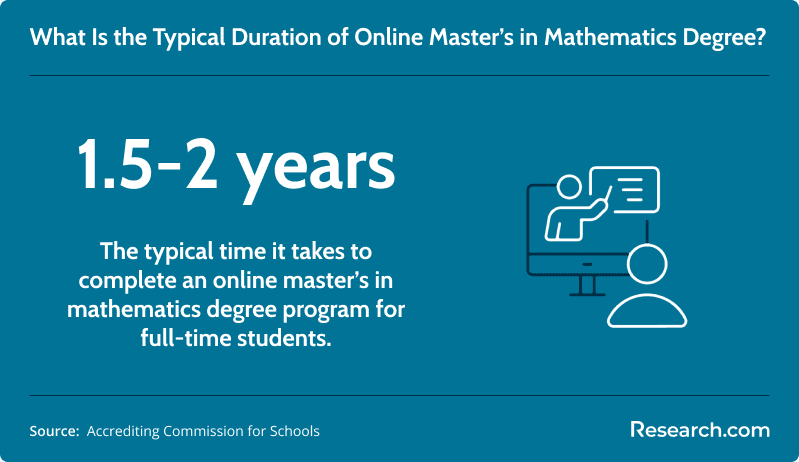
Most online master’s in mathematics programs take 1.5 to 2 years for full-time students. Many require 30 to 36 credit hours, although requirements vary by institution, concentration, and whether the curriculum includes a thesis, capstone, or additional electives. Accelerated full-time students may finish in as little as 18 months, while part-time students balancing work, teaching, family responsibilities, or military service may take 3 to 4 years.
Program pacing depends on course availability, semester length, transfer credit policies, and final project requirements. Some schools use traditional semesters, while others offer shorter terms that allow students to move faster. Shorter formats can be convenient, but they usually require more weekly study time. If speed is a major priority, compare mathematics programs the same way you would evaluate other accelerated online options, such as the shortest urban planning degrees online: look beyond advertised completion time and confirm workload, course sequencing, and graduation requirements.
| Enrollment path | Typical timeline | Best for | Potential trade-off |
| Accelerated full-time | As little as 18 months | Students who can prioritize school heavily | High weekly workload and limited schedule flexibility |
| Standard full-time | 1.5 to 2 years | Students who want steady progress | May be difficult with demanding full-time work |
| Part-time | 3 to 4 years | Working professionals and current teachers | Longer time before completing the credential |
Online vs. on-campus master’s in mathematics: What is different?
An online master’s in mathematics can be academically comparable to an on-campus program when it is offered by an accredited institution, uses graduate-level faculty, and requires the same level of mathematical proof, modeling, computation, and assessment. Many online students complete advanced coursework in areas such as real analysis, algebra, numerical methods, probability, statistics, and mathematical modeling.
The major difference is how students interact with faculty, classmates, and research resources. Online programs are often better for working adults because course materials may be available asynchronously, while campus programs may provide easier access to in-person research groups, seminars, tutoring, and faculty mentoring. Students comparing formats should verify that the school’s online offerings are part of properly accredited online degree options and not unaccredited certificate-style coursework marketed as a graduate degree.
| Factor | Online master’s in mathematics | On-campus master’s in mathematics |
| Scheduling | Often asynchronous or designed for working adults | Usually tied to campus meeting times |
| Networking | Depends on discussion boards, group projects, virtual office hours, and alumni networks | More frequent face-to-face interaction with peers and faculty |
| Research access | May be strong, but students must confirm remote access to advisors, software, and databases | Often easier access to seminars, labs, and departmental events |
| Best fit | Teachers, remote professionals, military students, and adults who cannot relocate | Students seeking immersive campus life, frequent mentoring, or research assistantship opportunities |
How much does an online master’s in mathematics cost?
The average cost of an online master’s in mathematics degree program typically ranges from $10,000 to $30,000 in total tuition. Public universities are often less expensive, particularly for in-state students, and some programs charge around $300 to $600 per credit hour. Private institutions may charge more, sometimes exceeding $800 per credit hour.
Total cost depends on more than tuition. Students should calculate required credits, technology fees, course materials, exam fees, residency status, and any travel requirements for orientations or exams. A student who completed an accelerated online Bachelor's in Mathematics may already have the prerequisites needed to move directly into graduate study, which can reduce the need for extra undergraduate bridge courses.
Cost factors to compare before enrolling
- Per-credit tuition: Multiply the tuition rate by the number of required credits rather than relying only on annual estimates.
- Fees: Online programs may charge technology, distance learning, proctoring, or graduation fees.
- Transfer credits: Some schools accept graduate transfer credit, but limits vary.
- Residency pricing: Ask whether online students pay in-state, out-of-state, or a flat online rate.
- Course availability: A low-cost program may become more expensive if limited course offerings delay graduation.
Mathematicians held about 2,500 jobs in 2023. Employment is spread across several industries, but the federal government employs 49% of the workforce. The chart below shows the largest employers of mathematicians based on the latest available data.
What financial aid is available for online master’s in mathematics students?
Online graduate students may qualify for several forms of financial aid if they enroll in an eligible accredited program. The first step is usually completing the Free Application for Federal Student Aid (FAFSA). Graduate students may be eligible for Direct Unsubsidized Loans and Graduate PLUS Loans. Grants are less common at the graduate level, but some students may find work-study options, teaching assistantships, or institutional awards depending on the school.
Students should also look for university scholarships, STEM scholarships, mathematics department awards, private scholarships, and employer tuition reimbursement. A mathematics degree can support careers in analytics, software-adjacent quantitative work, and other technical roles; students exploring that broader market may also want to review pathways connected to the highest paying jobs in computer science field.
Smart ways to reduce graduate school costs
- Ask whether online students qualify for in-state or special online tuition rates.
- Check whether your employer reimburses tuition for job-related quantitative training.
- Compare total program cost, not just the per-credit rate.
- Prioritize accredited schools so federal aid eligibility and employer recognition are less likely to become problems.
- Avoid private loans until you have compared federal loan terms and school-based aid.
What are the admissions requirements for an online master’s in mathematics?
Most online master’s in mathematics programs expect applicants to hold a bachelor’s degree in mathematics or a closely related field such as physics, engineering, or computer science. Common prerequisite courses include calculus, linear algebra, differential equations, and real analysis. Applicants without enough math preparation may be asked to complete bridge courses before starting graduate-level work.
An affordable online Bachelor's in Math can be a practical route for students who still need foundational coursework before applying to a master’s program. Some graduate programs also require a minimum GPA, often 3.0 or higher.
Application materials often include transcripts, letters of recommendation, a statement of purpose, and a resume or CV. GRE scores may be required by some schools, while others are test-optional. International applicants may need TOEFL or IELTS scores to demonstrate English proficiency.
| Requirement | What schools usually look for | Why it matters |
| Bachelor’s degree | Mathematics or a related quantitative field | Shows readiness for proof-based and computational graduate work |
| Math prerequisites | Calculus, linear algebra, differential equations, real analysis | Prepares students for advanced theory and applications |
| Statement of purpose | Clear academic and professional goals | Helps programs evaluate fit with available tracks and faculty expertise |
| Recommendations | Academic or professional references | Provides evidence of analytical ability, discipline, and graduate readiness |
| GRE | Required by some programs; waived or optional at others | May strengthen an application, but policies vary |
What courses do online master’s in mathematics programs include?
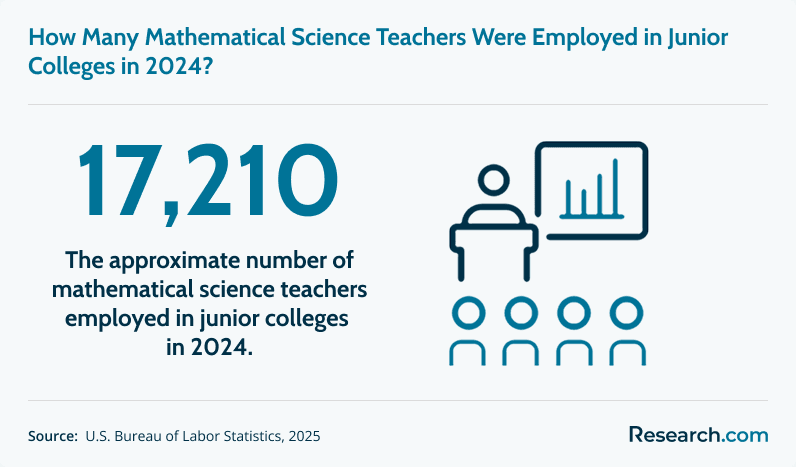
Online master’s in mathematics programs usually combine advanced theory, applied problem-solving, and electives that support a student’s career direction. Students preparing to teach at postsecondary institutions should pay close attention to the amount of graduate mathematics content in the curriculum. Junior colleges employed around 17,210 mathematical science teachers in 2024.
Common core courses may include:
- Real Analysis
- Abstract Algebra
- Linear Algebra
- Numerical Analysis
- Probability and Statistics
- Complex Variables
- Topology
Electives and concentration courses may include:
- Applied Mathematics
- Mathematical Modeling
- Partial Differential Equations
- Combinatorics
- Optimization
- Machine Learning or Data Science (in more tech-focused programs)
Many programs conclude with a thesis, capstone project, final exam, or research paper. Students planning to apply to doctoral programs may benefit from a thesis track, while students targeting industry may prefer applied electives, computational coursework, and projects that demonstrate practical skills. If salary potential is a major consideration, compare mathematics with other master degrees that pay well, but remember that outcomes depend heavily on skills, industry, geography, and experience.
What specializations are available in an online master’s in mathematics?
Specializations help students align advanced mathematics study with a specific professional direction. Not every program offers every track, so review the course catalog before applying.
| Specialization | What it emphasizes | Good fit for |
| Applied Mathematics | Mathematical tools for practical problems in science, engineering, biology, and industry | Students who want industry-facing quantitative roles |
| Pure Mathematics | Abstract theory, proofs, algebra, topology, number theory, and analysis | Students considering doctoral study or theory-heavy teaching roles |
| Statistics or Data Science | Statistical modeling, machine learning, inference, and large-scale data analysis | Students targeting analytics, technology, finance, or research roles |
| Computational Mathematics | Numerical methods, algorithms, simulation, and computer-based problem-solving | Students interested in scientific computing or technical modeling |
| Mathematics Education | Mathematics pedagogy, curriculum development, assessment, and classroom practice | Current teachers seeking deeper content and instructional expertise |
| Financial Mathematics or Quantitative Finance | Risk modeling, investment mathematics, probability, and finance-focused computation | Students pursuing banking, investing, insurance, or risk roles |
| Operations Research | Optimization, decision analysis, logistics, and systems modeling | Students interested in supply chain, manufacturing, transportation, or service operations |
The best specialization depends on your target job. A teacher may benefit most from mathematics education, while a future data scientist should prioritize statistics, programming, and machine learning. Specialized online programs in other fields, such as the shortest online MSN pediatric nurse practitioner programs, show the same general principle: the narrower the career goal, the more important curriculum alignment becomes.
How should you choose the best online master’s in mathematics program?
Start with your end goal. A program designed for K-12 teachers is not the same as a computational mathematics program for data science or a research-oriented curriculum for doctoral preparation. Once you know the outcome you want, compare accreditation, curriculum depth, tuition, format, faculty expertise, student support, and graduate requirements.
Regional accreditation should be treated as essential. Reviewing accredited online schools can help you understand why institutional recognition matters for financial aid, transfer credit, employer review, and future doctoral admission. Discipline-specific accreditation may be relevant in technical or engineering-adjacent programs, but mathematics master’s programs are most commonly evaluated through institutional accreditation and departmental reputation.
Questions to ask before applying
- Does the program focus on mathematics, mathematics education, applied mathematics, statistics, or computation?
- Are courses asynchronous, synchronous, or a mix of both?
- Can working students realistically take one course at a time?
- Is there a thesis option, and is it required for doctoral preparation?
- What software, programming languages, or computational tools are used?
- Are faculty available for virtual advising and research supervision?
- Does the school publish graduation, retention, or career support information?
- Will the diploma or transcript identify the program as online?
- Are there additional fees beyond tuition?
- Does the program meet requirements for your intended teaching or professional pathway?
Mathematicians in the aerospace product and parts manufacturing industry earn the highest salaries, with an annual wage of approximately $179,630. The chart below compares median annual wages for mathematicians across industries and shows where compensation tends to be strongest.
What can you do with an online master’s in mathematics?
Graduates of online mathematics master’s programs may pursue career paths in education, government, technology, finance, research, logistics, and analytics. The degree can be especially powerful when paired with programming, statistical software, domain knowledge, and a portfolio of applied projects.
| Career path | Typical work | Skills that strengthen employability |
| Data Analyst or Data Scientist | Analyze data, build models, interpret patterns, and support business decisions | Python, R, SQL, statistics, visualization, machine learning |
| Mathematician or Statistician | Use mathematical and statistical methods to solve research, government, or industry problems | Modeling, proof, statistical inference, research design |
| Operations Research Analyst | Improve systems, logistics, scheduling, and resource allocation | Optimization, simulation, decision analysis, programming |
| Actuary | Evaluate financial risk for insurance, consulting, pensions, or related industries | Probability, statistics, finance, actuarial exam preparation |
| Quantitative Analyst | Develop financial models, algorithms, and risk tools | Stochastic processes, programming, finance, statistical modeling |
| Software Developer or Algorithm Engineer | Design systems that rely on logic, optimization, algorithms, or computation | Algorithms, discrete math, data structures, software development |
| Math Educator or College Instructor | Teach mathematics at the high school, community college, or university level | Graduate math credits, pedagogy, curriculum design, communication |
Some graduates continue into PhD programs in mathematics, statistics, applied mathematics, or related fields. Students considering doctoral study should prioritize research opportunities, faculty fit, thesis options, and rigorous proof-based coursework.
What challenges should online mathematics students expect?
Online mathematics programs require strong self-management. Advanced math is cumulative, proof-heavy, and often time-intensive, so falling behind can quickly make later topics harder. Students in asynchronous courses must be proactive about office hours, peer study groups, tutoring, and professor communication.
Common challenges include limited face-to-face mentoring, fewer spontaneous research conversations, technology problems, and the difficulty of balancing graduate coursework with work or teaching. Students considering accelerated academic options, including the fastest online EdD degree, should use the same caution here: speed is helpful only if the support structure and weekly workload are realistic.
Common mistakes to avoid
- Choosing by tuition alone: A cheaper program may not offer the specialization, advising, or course rotation you need.
- Ignoring accreditation: Unaccredited programs may create problems for aid, employment, transfer credit, or doctoral admission.
- Assuming all math degrees serve the same goal: Mathematics education, pure math, applied math, and statistics can lead to different outcomes.
- Overlooking programming: Many industry roles expect practical experience with tools such as Python, R, SQL, or statistical software.
- Skipping the thesis question: A thesis may matter for doctoral study, while a non-thesis project may be better for applied career goals.
- Relying only on rankings: A ranked program still needs to fit your schedule, budget, prerequisites, and career target.
How can interdisciplinary study strengthen a mathematics master’s degree?
Mathematics becomes more valuable when students can apply it to real problems in another field. Interdisciplinary study can help students translate theory into policy analysis, finance models, public health data, education assessment, engineering systems, social science research, or business decision-making. For example, pairing mathematical methods with social science perspectives from an anthropology online degree can broaden how students frame data, culture, behavior, and human-centered research questions.
The key is intentional course selection. Choose electives, projects, and tools that support a clear professional use case rather than collecting unrelated credits.
What is the job market like for graduates with an online master’s in mathematics?
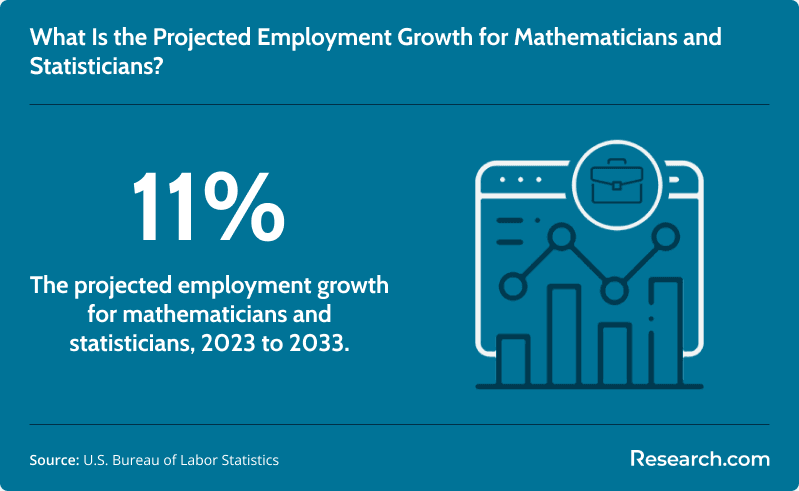
The labor market is strongest for graduates who combine advanced mathematics with applied technical skills. According to the U.S. Bureau of Labor Statistics, employment for mathematicians and statisticians is projected to grow by around 11% from 2023 to 2033, with approximately 2,500 openings per year on average. The median annual wage for these roles was about $104,350 in May 2024.
Demand is strongest in areas such as data science, quantitative finance, operations research, and AI-related work. Reported wages include actuaries at roughly $125,770, data scientists around $112,590, and operations research analysts about $91,290. These figures show the value of quantitative expertise, but they do not guarantee individual earnings. Location, experience, industry, employer, and technical skill depth matter.
AI is changing entry-level expectations. Employers may automate routine reporting or basic analysis, which can make it harder for graduates who have theory but little applied experience. Students should build evidence of practical ability through projects, coding, internships, research, teaching experience, or domain-specific work. This mirrors trends in other online career-preparation fields, including associate of science in nursing online programs, where hands-on readiness often affects employability.
What graduates say about online master’s in mathematics study
- : "Completing my mathematics master’s online let me continue working full time while building stronger skills in modeling and data analysis. The schedule flexibility mattered, but the coursework still required serious commitment and consistent planning. Rachel"
- : "After ten years away from graduate study, the online format gave me a realistic way back. Applied mathematics courses pushed me to think more deeply, and the faculty expertise made the experience feel rigorous rather than watered down. Marc"
- : "I expected online classes to feel isolated, but the discussions, group work, and fast feedback helped me stay connected. The program gave me the confidence to pursue a data science transition. Aisha"
How can digital resources improve online mathematics learning?
Strong online mathematics programs rely on more than recorded lectures. Students need access to digital libraries, research databases, mathematical software, collaboration tools, statistical packages, and data visualization platforms. These resources help connect abstract concepts with real applications and support thesis, capstone, and independent research work.
Students should ask whether the program provides remote access to journals, technical reports, tutoring, statistical software, and faculty research support. Learning how to use academic databases effectively can also strengthen research skills; curated digital resource models, such as those associated with affordable MLIS online degree programs, show why information access and research literacy matter in graduate education.
References
- National Center for ONET Development. (n.d.). Mathematicians. ONET OnLine.
- National Center for ONET Development. (n.d.). Statisticians. ONET OnLine.
- U.S. Bureau of Labor Statistics. (n.d.). Actuaries. Occupational Outlook Handbook.
- U.S. Bureau of Labor Statistics. (2023, May). Occupational employment and wages, May 2023: 25-1022 Mathematicians.
- U.S. Bureau of Labor Statistics. (n.d.). Mathematicians and statisticians. Occupational Outlook Handbook.
Key Insights
- An online master’s in mathematics is most valuable when the curriculum matches a specific goal: teaching, applied mathematics, statistics, data science, finance, operations research, or doctoral preparation.
- Most programs take 1.5 to 2 years full time, while part-time students may need 3 to 4 years. Thesis requirements, course sequencing, and transfer policies can change the timeline.
- Total tuition commonly ranges from $10,000 to $30,000, but students should calculate fees, required credits, residency rules, and possible delays before deciding a program is affordable.
- Accreditation is non-negotiable. It affects financial aid, employer recognition, transfer credit, and future academic options.
- Mathematics education programs are not the same as general mathematics or applied mathematics programs. Teachers, data professionals, and future PhD students should choose different course paths.
- The job outlook is strongest for graduates who pair mathematical depth with programming, statistics, modeling, and applied project experience.
- AI is raising expectations for entry-level quantitative workers. A portfolio, thesis, capstone, internship, or demonstrable coding experience can help graduates stand out.
Other Things You Should Know About the Best Online Master's in Mathematics Degree Programs
The typical duration to complete an online master's in mathematics program in 2027 is around two years. Many programs require approximately 30–36 credit hours, allowing for both full-time and part-time study options to accommodate diverse student needs.
Most programs require three to five semesters of calculus, linear algebra, and differential equations before admission. Many also expect proof-based coursework in abstract algebra or real analysis, plus a minimum 3.0 GPA and official transcripts for review.
Admission requirements typically include a bachelor's degree in mathematics or a related field, a minimum GPA of 3.0, and GRE scores. Some programs may also require prerequisites in advanced calculus and linear algebra for 2027 entry.


