2027 Fastest Online Urban Planning Degree Programs

Co-Founder and Chief Data Scientist
By 2035, 812.2 million people worldwide will live in urban areas with populations of 10 million or more (Statista, 2025), underscoring the urgent need for well-trained urban planners.
As cities grow rapidly, professionals who can design sustainable infrastructure, manage urban sprawl, and improve quality of life will be in high demand. Fast-track online urban planning programs are ideal for students who want to enter the field quickly, especially those with backgrounds in architecture, public policy, or environmental studies.
In this guide, my team and I will explore the fastest online urban planning degrees, covering admission requirements, available specializations, career paths, and more.
What are the benefits of opting for fast degrees in online urban planning?
- A fast online degree lets you quickly enter roles like city planner, transportation analyst, or environmental consultant, with the field projected to grow by 3% from 2024 to 2034 (Bureau of Labor Statistics, 2025).
- Urban and regional planners earn a median salary of $83,720 annually, offering strong financial stability (Bureau of Labor Statistics, 2025).
- Accelerated online urban planning programs let you enter the workforce sooner, save on costs, and are ideal for career changers or professionals seeking to upskill quickly.
What can I expect from an accelerated online urban planning degree program?
An accelerated online urban planning degree program offers a condensed yet comprehensive curriculum designed for individuals seeking to enter or advance quickly in the field of urban planning. You can expect a rigorous academic experience covering topics such as sustainable development, geographic information systems (GIS), zoning laws, public policy, and transportation planning.
These programs often take 12 to 24 months to complete, depending on the degree level and your pace. The coursework is delivered online, usually in asynchronous or hybrid formats, allowing flexibility for working professionals. Many programs include applied learning experiences, such as virtual simulations, planning studios, or capstone projects, to prepare you for real-world planning challenges.
Where can I work with an accelerated online urban planning degree?
With an accelerated online urban planning degree, you can pursue careers in a variety of sectors. Graduates commonly find employment with city, county, or state governments as urban planners, zoning specialists, or community development officers. Others work for federal agencies like the US Department of Housing and Urban Development (HUD), the Environmental Protection Agency (EPA), or the Department of Transportation.
There are also opportunities in the private sector, such as planning and design consulting firms, real estate development companies, and nonprofit organizations focused on housing, environmental justice, or urban revitalization. Your role may involve analyzing land use, preparing policy reports, managing public engagement, or designing more sustainable and livable communities.
How much can I make with an online urban planning degree?
Your salary as an urban planner can vary based on factors like your location, experience level, and area of specialization. Government roles may offer stable pay and benefits, while private sector jobs or consulting positions can lead to higher earnings. Advanced certifications or skills in GIS and sustainability can also boost your income potential.
Below are some of the most common urban planning jobs and their corresponding average annual income, according to data from ZipRecruiter (2025):
- Urban Planner: $75,033
- Transportation Planner: $74,255
- Environmental Planner: $79,834
- GIS Analyst: $75,010
- Urban Design Consultant: $71,974
- Top Accelerated Online Urban Planning Degree Programs for 2027 List of Programs
- How quickly can I complete an online urban planning degree? How quickly can I complete an online urban planning degree?
- What are the different types of online urban planning degrees? What are the different types of online urban planning degrees?
- What is the average cost of a fast-track online urban planning degree? Average Cost
- What are the admission requirements for accelerated online urban planning degree programs? Program Requirements
- What courses are covered in an accelerated online urban planning degree? What courses are covered in an accelerated online urban planning degree?
- Do fast-track online urban planning degree programs include hands-on experiences like internships or projects? Do fast-track online urban planning degree programs include hands-on experiences like internships or projects?
- What are the most common specializations offered in online urban planning degree programs? What are the most common specializations offered in online urban planning degree programs?
- Are there certifications and licenses required for graduates of online urban planning degree programs? Certifications & Licenses
- What kinds of jobs can you get with an online urban planning degree? Career Paths
- How do I choose the right online urban planning program? How do I choose the right online urban planning program?
- What is the job outlook for graduates of an online urban planning degree? Job Outlook
- What challenges might you encounter with an online urban planning degree? What challenges might you encounter with an online urban planning degree?
- How are emerging digital trends influencing online urban planning education? How are emerging digital trends influencing online urban planning education?
- What are my financing options for an online urban planning degree? What are my financing options for an online urban planning degree?
Top Accelerated Online Urban Planning Degree Programs for 2027
Choosing an accelerated online urban planning degree is usually a time-versus-credential decision. You want to move into planning, GIS, transportation, housing, sustainability, or public-sector work faster, but you also need a program that employers and graduate schools will take seriously. This guide is for transfer students, working professionals, career changers, and recent graduates comparing online planning programs by speed, cost, accreditation, curriculum, and career fit.
Urban planning education matters because cities and regions are dealing with housing pressure, climate resilience, transportation redesign, land-use conflicts, and data-driven infrastructure decisions. A strong online program should do more than offer convenience. It should teach planning law, community engagement, GIS, environmental analysis, policy evaluation, and applied project work in a format you can realistically complete.
If you are also comparing adjacent fields, programs such as the fastest online geography degree programs can be useful alternatives for students who want a spatial-data or earth-systems focus rather than a planning-centered curriculum.
Quick answer: What is the fastest online urban planning degree option?
The fastest online urban planning pathways are usually master’s programs designed for full-time study, executive formats, or transfer-friendly bachelor’s degrees. Some graduate options can be completed in 12–18 months, while bachelor’s programs typically require 120 credits but may be shortened with transfer credits. The best choice depends on your current education level: bachelor’s programs work for students entering the field, while master’s programs are better for those seeking professional planner, policy, GIS, or leadership roles.
| Best fit | Degree level to consider | Typical advantage | Watch for |
| First-time or transfer undergraduate students | Bachelor’s degree | Builds broad planning, GIS, policy, and urban studies foundations | Program length depends heavily on accepted transfer credits |
| Career changers with a bachelor’s degree | Master’s degree | Can provide stronger access to professional planning roles | Check whether the program is PAB-accredited or PAB-aligned |
| Mid-career public-sector or consulting professionals | Executive or professional master’s | Often built around leadership, policy, and applied projects | Higher tuition and intensive pacing may be difficult while working |
| GIS-focused students | Planning degree with GIS concentration or geospatial master’s | Supports technical roles in mapping, analytics, and spatial intelligence | May be less planning-specific if the curriculum is mostly geospatial |
How do we rank schools?
Research.com rankings are built to help readers compare programs using transparent, education-focused criteria rather than marketing claims. Our ranking process considers available institutional data, program structure, online learning availability, affordability signals, accreditation, and student-relevant outcomes. You can review our broader methodology for more detail on how Research.com evaluates schools and programs.
For this guide, our research draws from the IPEDS database, Peterson’s database, including the Distance Learning Licensed Data Set, the College Scorecard database, and the National Center for Education Statistics. Program details can change, so students should confirm tuition, accreditation status, online format, and completion timelines directly with each institution before applying.
1. Arizona State University – Bachelor of Science in Planning (Urban Planning)
Arizona State University offers a 100% online BS in Planning for students who want an undergraduate route into urban planning without relocating. The program uses asynchronous 7.5-week courses and covers core topics such as land use, sustainable design, transportation systems, and GIS. Because it follows the same academic expectations as the campus version, it is a strong option for students who need flexibility but still want a structured planning curriculum. Multiple start dates and transfer-credit recognition may help motivated students finish faster.
- Program Length: 2.5–4 years (can be accelerated with transfer credits)
- Tracks/Concentrations: Flexible Electives In Transportation; Community Development; GIS
- Cost per Credit: Up to $530/credit for non-residents
- Required Credits: 120
- Accreditation: Higher Learning Commission (HLC)
2. University of Florida – Master of Urban & Regional Planning
The University of Florida online MURP is designed for students who want graduate-level planning training with strong GIS, theory, and studio components. The curriculum works for remote learners and can support an accelerated pace through summer and fall coursework. Students may also pair the degree with GIS certificate options, which can be valuable for roles involving spatial analysis, environmental planning, and land-use decision-making. The program can work for both full-time and part-time students.
- Program Length: 2 years (acceleration possible with full-time load)
- Tracks/Concentrations: Land Use; Transportation; Environmental/GIS
- Cost per Credit: $553 (in-state); $1,295 (out-of-state)
- Required Credits: 48–54
- Accreditation: Planning Accreditation Board (PAB)
3. University of Southern California – Executive Master of Urban Planning
University of Southern California offers an Executive MUP aimed at professionals who already have work experience and want a faster, leadership-oriented graduate program. Its cohort structure emphasizes policy, urban sustainability, and executive decision-making, with occasional live workshops supporting interaction and networking. Students who can manage an intensive schedule may finish in under 18 months. The program is best suited for planners, public administrators, consultants, and urban policy professionals seeking advancement rather than a slow career-entry pathway.
- Program Length: 16–18 months
- Tracks/Concentrations: Executive Leadership; Policy; Sustainable City Design
- Cost per Credit: $2,300
- Required Credits: 32–36
- Accreditation: PAB
4. University of Arizona – MS in Urban Planning
The University of Arizona online MS in Urban Planning gives students a flexible graduate option with sustainability, policy, research, and GIS coursework. Full-time students may complete the degree in as little as 18 months, while part-time enrollment offers more breathing room for working professionals. The curriculum is appropriate for students aiming for planning leadership, policy analysis, or applied research roles. Online students receive the same diploma and accreditation status as campus-based students, which can matter when presenting credentials to employers.
- Program Length: 18–24 months (can be accelerated full-time)
- Tracks/Concentrations: Urban Design; Environmental Planning; GIS; Policy
- Cost per Credit: $1,275 (resident); $2,100 (non-resident)
- Required Credits: 40–45
- Accreditation: PAB
5. Johns Hopkins University – MS in Geospatial Intelligence or Sustainable Urban Planning
Johns Hopkins University offers graduate study that connects geospatial intelligence, remote sensing, GIS, and sustainable urban planning. This option is especially relevant for students interested in government, defense, nonprofit, NGO, or analytics-heavy planning work. Full-time students may complete the program within a year, making it one of the faster technical pathways on this list. It is strongest for students who want spatial intelligence and data skills tied to urban challenges.
- Program Length: 12–18 months
- Tracks/Concentrations: Geospatial Intelligence; Urban Sustainability
- Cost per Credit: $1,925–$2,130
- Required Credits: 30–36
- Accreditation: Middle States Commission on Higher Education (MSCHE)
6. Liberty University – Master of Urban Planning
Liberty University provides an online MUP with coursework in planning policy, GIS, and community development. The program uses accelerated modules and rolling admissions, which can help students begin sooner and move through classes more quickly. Its faith-based academic environment may appeal to students who want that institutional context. The degree includes a capstone project, giving students an opportunity to apply planning concepts to a practical issue.
- Program Length: 18 months (fast-track available)
- Tracks/Concentrations: Urban Policy; Community Planning; GIS
- Cost per Credit: $565
- Required Credits: 39
- Accreditation: Southern Association of Colleges and Schools Commission on Colleges (SACSCOC)
7. East Carolina University – MS in Planning & Development
East Carolina University offers a 100% online MS in Planning & Development that is built for flexibility. The non-cohort format, no GRE requirement, and option to take courses in different sequences can help working adults plan around job and family obligations. Students may transfer up to half of the required credits, which can reduce both time and cost for eligible applicants. Instead of a traditional thesis, the program uses professional papers, making it practical for students focused on applied planning careers.
- Program Length: 10–15 months (30 credits)
- Tracks/Concentrations: Coastal/Environmental; Urban/Community; Rural/Regional
- Cost per Credit: $362 (in-state); $1,020 (out-of-state)
- Required Credits: 30
- Accreditation: SACSCOC; BS PAB-accredited
8. Georgetown University– Master of Professional Studies in Urban & Regional Planning
Georgetown University offers an MPS in Urban & Regional Planning that follows a professional, PAB-aligned structure. Full-time students can complete the program in 15 months, while part-time students may extend the timeline. The format combines live online sessions, self-paced coursework, and a final capstone defense. The cohort model and optional internships may be helpful for students who want professional networking and applied experience while studying online.
- Program Length: 15 months full-time; up to 24 months part-time
- Tracks/Concentrations: Urban Design; Community Development; Policy; GIS
- Cost per Credit: $1,800
- Required Credits: 42
- Accreditation: MSCHE regional; PAB-compliant curriculum
9. University of Pittsburgh GSPIA – MPPM (Urban Affairs & Planning)
The University of Pittsburgh GSPIA online Master of Public and Professional Management with an Urban Affairs & Planning focus is a good fit for students who want planning knowledge through a public management lens. Coursework connects municipal finance, community engagement, public policy, and spatial planning tools. Full-time students may finish in about 16 months, while part-time study is available for those balancing professional commitments. This option is especially relevant for students interested in local government, public agencies, community development, or urban policy administration.
- Program Length: 16 months full-time; 24 months part-time
- Tracks/Concentrations: Urban Affairs; Public Policy; Community Development
- Cost per Credit: $1,100
- Required Credits: 36
- Accreditation: NASPAA; PAB-aligned curriculum
10. University of Arizona – BS in Urban & Regional Development
The University of Arizona online BS in Urban & Regional Development is a planning-adjacent bachelor’s option for students interested in how cities grow socially, economically, environmentally, and spatially. It includes research methods, GIS, economics, and community planning theory. Because it is transfer-friendly, it may work well for students who already have college credits and want an online route into planning-related work. Students should note that it is not PAB-accredited, though it can support future graduate study in planning.
- Program Length: 2–3 years (transfer-friendly)
- Tracks/Concentrations: Population Studies; Economics; Environment; GIS
- Cost per Credit: $560–$1,020 depending on residency
- Required Credits: 120
- Accreditation: HLC; not PAB-accredited
How quickly can I complete an online urban planning degree?
Your completion time depends mainly on your degree level, accepted transfer credits, course load, and whether the school offers short terms throughout the year. Accelerated online graduate programs may take 12 to 18 months, while transfer-friendly bachelor’s programs may take 2–3 years for students entering with substantial prior credits. This timeline logic is similar to other accelerated graduate options, including the fastest bioinformatics master’s programs online, where pace depends on course sequencing and full-time enrollment.
| Strategy | How it can shorten your timeline | Best for |
| Pick 8-week, 10-week, or year-round formats | Allows more course starts and fewer long breaks between terms | Students who can handle compressed workloads |
| Transfer prior college credits | Reduces the number of remaining credits required for graduation | Bachelor’s students and some master’s students with eligible credits |
| Take summer or intersession courses | Keeps academic momentum moving when traditional students pause | Students trying to graduate as quickly as possible |
| Use credit for prior learning when available | May convert professional, military, or certification experience into credit | Adult learners with relevant experience |
| Meet regularly with an advisor | Helps avoid unnecessary courses, missed prerequisites, and scheduling delays | Any accelerated student |
To finish quickly without weakening your learning, choose an accelerated format only if you can commit consistent weekly time to reading, mapping assignments, policy analysis, discussion boards, and project work. Fast online degrees require discipline; they are not easier simply because they are remote.
- Choose an accelerated calendar carefully. Short terms can help you graduate faster, but they compress the same amount of work into fewer weeks.
- Submit every prior transcript early. Transfer evaluation can take time, and late transcript review may delay your first course plan.
- Ask about maximum course loads. Some programs limit how many credits you can take each term, even if you want to move faster.
- Check prerequisite chains. GIS, research methods, studio, and capstone courses may need to be taken in a specific order.
- Use breaks strategically. Summer and short sessions can be useful, but avoid overloading if you are also working full time.
Employment settings also affect how students should think about career preparation. According to the chart below, local governments are the largest employers of urban and regional planners, accounting for 71% of positions. State governments employ 10%, while architectural, engineering, and related services make up 9%. Smaller shares are found in self-employment (2%) and consulting services (2%), which may appeal to planners interested in independent, specialized, or project-based work.
What are the different types of online urban planning degrees?
Online urban planning programs are offered at several academic levels. The right option depends on where you are starting, how quickly you want to enter the field, and whether your target job expects graduate-level preparation.
| Degree type | Typical length | What it covers | Best use |
| Associate degree | About 2 years | Introductory geography, sustainability, public administration, environmental studies, and land-use concepts | Starting point for transfer into a bachelor’s program |
| Bachelor’s degree | Typically 4 years; accelerated online formats may reduce this to 2–3 years | Planning theory, GIS, urban design, environmental policy, land use, and public participation | Planning assistant, junior planner, nonprofit, local government, or consulting support roles |
| Master’s degree | Usually 1.5 to 2 years full-time, with longer part-time options | Advanced planning methods, policy, studio work, transportation, housing, sustainability, GIS, and leadership | Professional planner, senior analyst, policy, transportation, environmental, or leadership roles |
Associate Degree
Online associate programs rarely carry the exact title “urban planning,” but related programs in geography, environmental studies, sustainability, or public administration can help students build a foundation. This route is most useful if you plan to transfer into a bachelor’s degree and want to complete lower-division coursework at a lower cost.
Bachelor’s Degree
A bachelor’s degree in urban planning, urban studies, sustainable planning, or a closely related field gives students the broad academic base needed for entry-level planning work. Coursework often includes GIS, planning history, land-use policy, environmental issues, research methods, and community engagement. Students with previous college credit may be able to finish faster through online transfer pathways.
Master’s Degree
A master’s degree, such as an MURP, MSUP, or MUP, is often the stronger choice for students seeking professional planning roles, specialization, or advancement. Online master’s programs may include concentrations in transportation, housing, sustainability, GIS, policy, or urban design. A master’s degree may also support the educational pathway toward American Institute of Certified Planners certification, much as the fastest online master of divinity degrees are designed as rigorous graduate credentials for a specific professional field.
The education profile shown below indicates that many urban and regional planners have advanced education: 22,214 professionals hold a graduate degree and 19,073 hold a bachelor's degree. This does not mean every planning job requires a master’s degree, but it does show why graduate study can be important for competitiveness in professional planning roles.
What is the average cost of a fast-track online urban planning degree?
The cost of an accelerated online urban planning degree depends on the school, degree level, residency status, transfer credits, fees, and pace of completion. Tuition commonly ranges from $300 to $900 per credit hour, with total program costs falling between $10,000 and $40,000. Accelerated formats may reduce indirect costs because students spend less time enrolled, but they are not automatically cheaper if tuition is charged per credit and the credit requirement stays the same.
| Cost factor | Why it matters | Question to ask |
| Per-credit tuition | Determines the main instructional cost | Is online tuition different for in-state and out-of-state students? |
| Required credits | A lower per-credit rate may still be expensive if the program requires more credits | How many credits are required after transfer evaluation? |
| Fees | Online, technology, graduation, and course fees can add to the final bill | What is the full estimated cost, not just tuition? |
| Transfer credits | Accepted credits can reduce both time and total cost | How many credits can I transfer, and which requirements will they satisfy? |
| Scholarships and aid | Institutional, state, federal, and external aid may reduce out-of-pocket cost | What planning, sustainability, GIS, or public-service scholarships are available? |
Some institutions offer scholarships connected to planning, sustainability, or public service. For example, Arizona State University offers scholarships to US and international undergraduate students through the Brian & Leah Swanton Urban Planning Scholarship program.
Students should also review federal grants such as the Pell Grant, state aid, institutional grants, employer tuition reimbursement, and scholarships from professional organizations such as the American Planning Association. If affordability is your highest priority, compare the total cost structure as carefully as students do when reviewing the fastest medical billing and coding associate degree online options, where speed and credential cost both influence ROI.
What are the admission requirements for accelerated online urban planning degree programs?
Admission requirements vary by degree level, but accelerated online programs often expect students to be academically prepared and organized enough to manage a faster pace. Before applying, review each school’s requirements for transcripts, GPA, prerequisite coursework, test scores, and professional materials.
| Requirement | Common expectation | Applies most often to |
| High school diploma or GED | Proof of completed secondary education | Associate and bachelor’s applicants |
| Official transcripts | High school, prior college, or undergraduate records depending on degree level | All applicants |
| Minimum GPA | Associate programs may accept a 2.0 GPA, bachelor’s programs often expect 2.5 to 3.0, and master’s programs usually expect at least 3.0 | All levels, especially bachelor’s and master’s programs |
| Personal statement or statement of purpose | Explanation of your planning interests, goals, and preparation | Many bachelor’s programs and most master’s programs |
| Letters of recommendation | Usually two to three letters for graduate applicants | Master’s applicants |
| Résumé or CV | Summary of education, work experience, planning exposure, GIS skills, or public-service experience | Mostly master’s applicants |
| Standardized test scores | Some programs may accept SAT, ACT, or GRE scores, but many online programs are test-optional or offer waivers | Program-specific |
| English proficiency | TOEFL or IELTS scores are commonly accepted for international applicants | International applicants |
| Prerequisite coursework | Some programs prefer or require prior study in statistics, GIS, planning, or related areas | Master’s applicants and some transfer students |
Students entering from related undergraduate fields should ask whether previous coursework will satisfy prerequisites. For example, students comparing planning with the fastest online bachelor's degree in sustainability programs may already have environmental policy, data, or systems-thinking courses that could support an urban planning application.
What courses are covered in an accelerated online urban planning degree?
Urban planning curricula combine policy, design, data, law, environmental analysis, and community engagement. Accelerated programs usually cover the same core topics as traditional programs, but they compress the schedule, requiring students to move quickly from theory to applied assignments.
- Geographic Information Systems (GIS). Students learn to use mapping software and spatial data to analyze land use, transportation access, demographics, environmental risk, and development patterns.
- Zoning Analysis. Coursework explains how zoning codes, land-use regulations, design standards, and public processes shape development decisions.
- Environmental Planning. Students study sustainable development, impact assessment, climate adaptation, conservation, and strategies for integrating environmental priorities into city and regional plans.
- Urban Economics. Similar to students in the fastest online economics degree programs, planning students examine housing markets, infrastructure investment, labor patterns, transportation costs, and the financial forces that shape urban growth.
- Planning Theory and Ethics. This area examines the values, legal responsibilities, equity concerns, and professional standards that guide planning decisions.
- Community Development. Students learn how planners work with residents, nonprofits, agencies, and local leaders on neighborhood revitalization, housing access, and equitable development.
- Public Policy and Urban Governance. As in the fastest online DBA in management degree programs, students study decision-making systems, organizational leadership, public administration, and policy implementation, but through a city and regional planning lens.
Do fast-track online urban planning degree programs include hands-on experiences like internships or projects?
Many accelerated online urban planning programs include applied learning through internships, practicums, studio courses, simulations, client projects, or capstones. These experiences are important because planning is not only an academic field; it requires public communication, data interpretation, policy judgment, and the ability to work with real communities and agencies. This practical emphasis is also common in programs such as an accelerated MBA environmental management online, where students connect coursework to applied sustainability and management problems.
Online programs may allow students to complete fieldwork locally, virtually, or through employer-based projects. A student working for a city agency, nonprofit, consulting firm, or transportation organization may be able to use a workplace challenge as part of a capstone, depending on program rules.
Capstones are especially common at the bachelor’s and master’s levels. A typical project might involve analyzing a housing affordability issue, designing a redevelopment proposal, mapping transportation access, evaluating environmental risk, or recommending policy changes for a community plan. These assignments can become portfolio evidence for job applications.
The strongest online programs make applied learning visible. Before enrolling, ask whether internships are required, optional, locally arranged, or replaced by studio and capstone work.
What are the most common specializations offered in online urban planning degree programs?
Specializations help students connect a planning degree to specific career goals. Not every online program offers every concentration, so compare the curriculum against the jobs you want rather than choosing based only on program speed.
| Specialization | What you study | Career direction |
| Environmental and Sustainability Planning | Climate resilience, sustainable land use, environmental policy, ecological protection, and adaptation planning | Environmental planner, resilience planner, sustainability analyst |
| Housing and Community Development | Affordable housing, neighborhood revitalization, equity, displacement, and community engagement | Community development specialist, housing policy analyst |
| Urban Design | Public spaces, spatial design, built environment quality, design review, and placemaking | Urban designer, planning consultant, development review analyst |
| GIS and Spatial Analysis | Mapping, spatial data, visualization, remote sensing, and analytics | GIS analyst, planning data analyst, transportation analyst |
| Land Use and Zoning | Zoning codes, comprehensive plans, subdivision rules, growth management, and development regulation | Land use planner, zoning analyst, municipal planner |
| Economic Development Planning | Local economic strategy, workforce development, business attraction, infrastructure, and investment planning | Economic development coordinator, regional development analyst |
| Disaster and Emergency Management | Risk reduction, hazard mitigation, recovery planning, and resilient infrastructure | Disaster planner, resilience coordinator, emergency planning analyst |
| Transportation and Infrastructure Planning | Transit, traffic analysis, mobility systems, accessibility, infrastructure networks, and transportation policy | Transportation planner, mobility analyst, infrastructure planning specialist |
Students interested in the design side of cities may also compare urban design coursework with the fastest online architecture degree programs, though architecture programs usually focus more directly on building design, structures, and design studios.
Are there certifications and licenses required for graduates of online urban planning degree programs?
Most US states do not require a state-issued license to work as an urban planner. However, professional certification can matter for advancement, credibility, and competitive public-sector or consulting roles. The best-known planning credential is the AICP certification from the American Institute of Certified Planners, offered through the American Planning Association.
To qualify for the AICP exam, candidates typically need a planning-related degree and professional experience. The experience requirement is commonly two years for those with a master’s degree and more for those with a bachelor’s degree. Students should confirm current eligibility rules directly with the certifying body before planning their timeline.
Other credentials may be useful depending on your specialization. GIS certificates can support spatial analysis roles, PMP can help with project management positions, and LEED can be useful for sustainability and green-building-related planning work. These certifications are optional, but they can help signal focused expertise.
| Credential area | When it helps | Best paired with |
| AICP | Professional planning credibility and advancement | PAB-accredited or planning-focused master’s programs |
| GIS certification | Mapping, spatial analytics, transportation, environmental, and land-use roles | GIS coursework and portfolio projects |
| PMP | Managing planning studies, infrastructure projects, consultants, or public programs | Planning, public administration, or management experience |
| LEED | Sustainable development, green building, and environmental planning work | Sustainability or environmental planning concentrations |
What kinds of jobs can you get with an online urban planning degree?
An online urban planning degree can lead to entry-level, technical, policy, or advanced planning roles depending on the degree level and your experience. Local governments, regional agencies, transportation organizations, nonprofits, consulting firms, architecture and engineering firms, and research organizations all hire planning-trained graduates.
| Job title | What the role does | Typical preparation |
| Urban Planner | Develops long-range plans for land use, zoning, transportation, housing, and community growth | Bachelor’s or master’s in planning; public engagement and policy skills |
| Transportation Planner | Studies traffic, transit, mobility, infrastructure, and access to improve transportation systems | Planning degree with transportation, GIS, or data coursework |
| Community Development Specialist | Works with residents, nonprofits, agencies, and stakeholders on neighborhood improvement and equity projects | Planning, public administration, nonprofit, or community development background |
| GIS Analyst | Uses spatial data, mapping tools, and visualization to support planning decisions | GIS concentration, portfolio, and technical mapping skills |
| Environmental Planner | Evaluates environmental impacts and supports sustainable development and regulatory compliance | Environmental planning, sustainability, or policy coursework |
| Land Use Planner | Analyzes zoning, subdivision, growth management, and development proposals | Planning law, zoning, policy, and municipal process knowledge |
| Housing Policy Analyst | Studies housing markets and recommends policies to improve affordability, access, and development strategy | Planning, economics, policy, or community development training |
| Economic Development Coordinator | Supports business attraction, workforce strategy, redevelopment, and regional economic growth | Planning, public policy, economics, or regional development coursework |
| Resilience or Disaster Planner | Helps communities prepare for hazards, reduce risk, and recover after disasters | Environmental planning, emergency management, GIS, or resilience training |
Some graduates combine planning with public-sector leadership training, such as a fast-track public administration master's degree online, to prepare for management roles in agencies, nonprofits, regional authorities, or urban policy organizations.
How do I choose the right online urban planning program?
The best online urban planning program is not always the fastest or the cheapest. It is the program that matches your career goal, gives you credible credentials, fits your schedule, and provides enough applied experience to help you compete for planning jobs.
| Selection factor | Why it matters | What to verify |
| Accreditation | Supports academic credibility and may affect professional certification pathways | Regional accreditation and whether the planning program is PAB-accredited, PAB-compliant, or not PAB-accredited |
| Online format | Determines how much live attendance, independent work, and scheduling flexibility you will have | Asynchronous, synchronous, hybrid, cohort, or self-paced structure |
| Curriculum fit | Planning is broad; your courses should align with your target job | GIS, transportation, housing, sustainability, zoning, policy, or community development options |
| Applied experience | Employers value practical work, project evidence, and communication skills | Internship, studio, capstone, portfolio, or client-based project requirements |
| Total cost | Tuition alone does not show the real price | Fees, books, technology costs, transfer credits, financial aid, and time to completion |
| Student support | Accelerated online students need strong advising and career help | Advisor access, career services, alumni network, internship support, and technical support |
Students balancing school with full-time work should compare affordability and flexibility together. Research.com resources on the most affordable online schools for working adults can help you think through cost, schedule, and support services before committing.
- Ask whether the online diploma differs from the campus diploma. Many schools award the same credential, but confirm this directly.
- Check whether online students can access the same career services. Internship help, portfolio reviews, and alumni connections can matter as much as course content.
- Review faculty expertise. Look for instructors with experience in transportation, GIS, housing, environmental planning, community development, or public policy.
- Request a degree plan before enrolling. A clear plan helps you see whether the advertised timeline is realistic for your situation.
- Compare outcomes cautiously. Rankings and employment claims are useful starting points, but they do not guarantee salary or job placement.
What is the job outlook for graduates of an online urban planning degree?
The job outlook for urban planning graduates is steady rather than explosive. The US Bureau of Labor Statistics projects 3% job growth for urban and regional planners from 2024 to 2034, which is as fast as the average, with approximately 3,400 job openings expected each year.
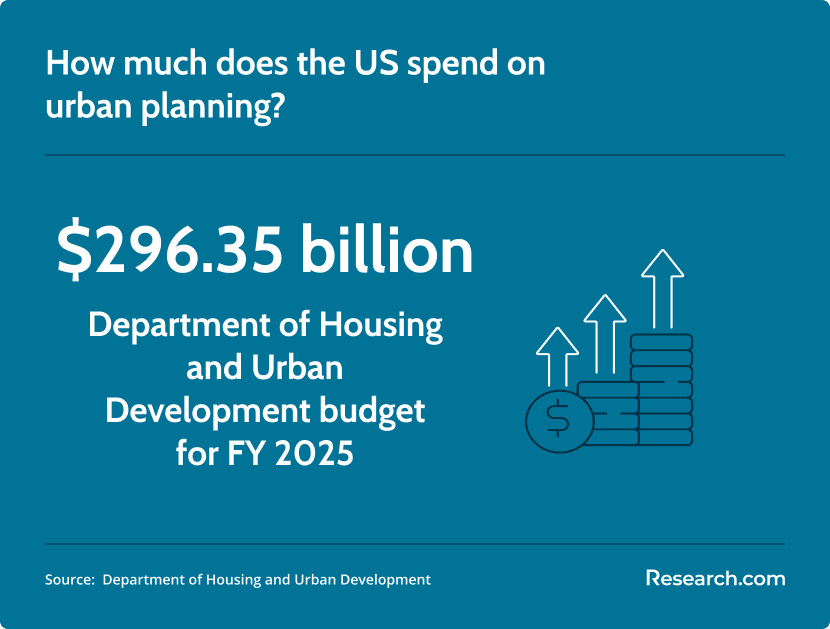
Public spending and urban development needs also support demand for planning skills. The Department of Housing and Urban Development manages over $296.35 billion in budgetary resources, and many funded projects require expertise in housing, land use, infrastructure, community development, and policy implementation. Graduates may find opportunities in local government, state agencies, regional planning organizations, consulting firms, nonprofits, and development-related organizations.
Technology is changing the skill mix for planners. Employers increasingly value GIS, data visualization, scenario modeling, public engagement tools, and the ability to explain complex spatial data to nontechnical audiences. An online program that includes GIS, applied projects, and policy communication can help students prepare for these expectations.
What challenges might you encounter with an online urban planning degree?
Online urban planning programs can be convenient, but they are not challenge-free. Planning is collaborative and community-based, so online students must be intentional about networking, discussion, project work, and professional exposure.
| Common challenge | Why it happens | How to manage it |
| Limited in-person networking | Online students may have fewer informal conversations with classmates, faculty, and local practitioners | Attend virtual events, join APA student groups, request informational interviews, and build a LinkedIn presence |
| Compressed workload | Accelerated terms require quick turnaround on readings, maps, memos, and group projects | Block weekly study time before the term starts and avoid taking too many intensive courses together |
| Technical learning curve | GIS, visualization, and online collaboration tools can require practice | Use tutorials, tech support, office hours, and low-stakes practice datasets early |
| Local internship access | Some online students live far from planning agencies or partner organizations | Ask whether remote, employer-based, or locally arranged placements are accepted |
| Unclear accreditation fit | Not all planning-related online degrees have the same professional status | Verify regional accreditation and PAB status before applying |
Students considering very fast formats, including the fastest bachelor degree options, should be realistic about time management. A shorter program can be valuable, but only if you can keep up with the work and still produce strong projects for your portfolio.
Here’s What Graduates Have To Say About Their Online Urban Planning Degree
- : "Studying urban planning online changed what I thought was possible. I was able to keep working part-time, stay involved in my own neighborhood, and still complete the program in under two years. One of my favorite experiences was contributing to a local improvement project while I was still enrolled. The format was flexible, but it never felt disconnected. — Kai"
- : "After earning my bachelor’s degree in urban planning, I moved into a junior planner position with a regional development firm. The program helped me build confidence in GIS, land-use policy, and public engagement. Those skills matched the work I was asked to do right away, which made the transition into the field much smoother. — Zeny"
- : "My online master’s in urban planning helped me move up at a transportation consulting agency. I now manage sustainability-focused projects that affect several cities. The advanced coursework in smart growth and policy analysis pushed me to think more strategically and prepared me for leadership responsibilities sooner than I expected. — Juno"
How are emerging digital trends influencing online urban planning education?
Digital tools are becoming central to online planning education. Strong programs increasingly use GIS platforms, mapping assignments, data dashboards, scenario modeling, smart city case studies, and virtual collaboration tools to approximate the kinds of decisions planners face in practice.
These technologies are especially important because planning work now often involves interpreting spatial data, modeling development impacts, evaluating climate and transportation scenarios, and presenting findings to public officials or community members. Online students should look for programs that teach both the software and the judgment needed to use data responsibly.
Accelerated options such as 1 year online masters programs show how digital learning can support shorter graduate timelines, but students should still check whether the curriculum includes enough applied planning work, not just fast course delivery.
What are my financing options for an online urban planning degree?
Students can use several funding sources to reduce the cost of an online urban planning degree. Common options include federal financial aid, state aid, institutional scholarships, planning-related scholarships, employer tuition reimbursement, payment plans, and student loans. The right mix depends on your citizenship or residency status, degree level, enrollment intensity, employer benefits, and school policies.
| Financing option | How it may help | Action step |
| Federal grants and loans | Can help eligible students pay tuition and fees | Submit the FAFSA and confirm the program is eligible for federal aid |
| State aid | May reduce costs for residents attending eligible institutions | Check state deadlines and residency rules |
| Institutional scholarships | Can target planning, sustainability, public service, or academic merit | Ask the department and financial aid office about program-specific awards |
| Professional scholarships | May be available through planning or related professional organizations | Search early, since external awards often have separate deadlines |
| Employer tuition reimbursement | Can reduce out-of-pocket cost for working adults | Ask HR whether planning, GIS, policy, or public administration coursework qualifies |
| Payment plans | Spread tuition over installments rather than one lump sum | Compare fees and due dates before relying on this option |
If minimizing cost is your main concern, compare online planning programs against broader affordable options such as the cheapest online college pathways that accept federal aid. Just make sure a lower-cost program still offers the accreditation, planning coursework, and applied experience you need.
Common mistakes to avoid when choosing an accelerated online urban planning degree
- Choosing only by speed. A fast program is not helpful if it lacks the planning courses, accreditation, or applied work required for your goals.
- Ignoring PAB status. Not every planning-related degree is PAB-accredited. This may matter for professional recognition and certification planning.
- Looking only at tuition per credit. Total cost also depends on required credits, fees, transfer credits, residency rules, and time to completion.
- Assuming online means self-paced. Many online programs have fixed weekly deadlines, live meetings, group projects, or cohort schedules.
- Overloading accelerated terms. Planning courses often include mapping, writing, analysis, and collaboration. Too many short-term courses can hurt performance.
- Skipping career services questions. Ask about internships, capstones, alumni access, portfolio support, and employer connections before enrolling.
- Assuming salary outcomes are guaranteed. Degree level, location, experience, sector, technical skills, and local job markets all affect career results.
References:
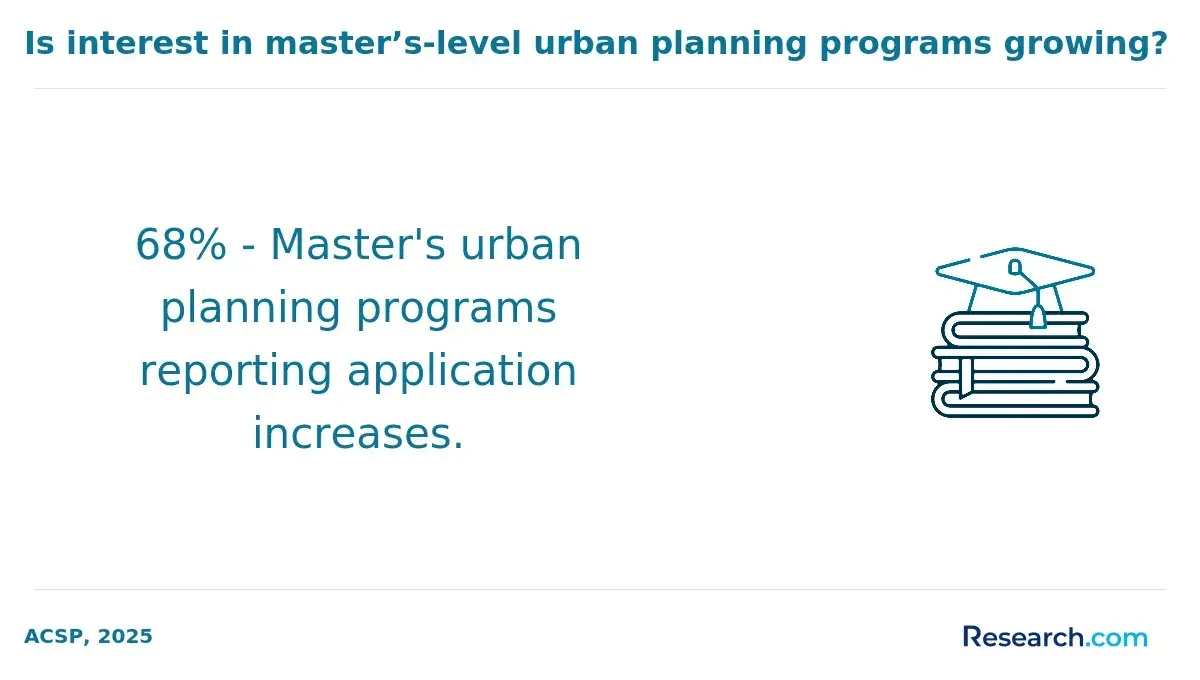
- Association of Collegiate Schools of Planning. (2025, October 8). University enrollment and graduate trends. https://journals.acspublisher.com/index.php/sajssh/article/view/22342
- ASU School of Geographical Sciences and Urban Planning. (n.d.). Undergraduate funding opportunities. Arizona State University. https://sgsup.asu.edu/undergrad-funding
- Bureau of Labor Statistics. (2025). Urban and regional planners. U.S. Department of Labor. https://www.bls.gov/ooh/life-physical-and-social-science/urban-and-regional-planners.htm
- ZipRecruiter. (n.d.). Entry level environmental planner salary. https://www.ziprecruiter.com/Salaries/Entry-Level-Environmental-Planner-Salary
- ZipRecruiter. (n.d.). GIS analyst salary. https://www.ziprecruiter.com/Salaries/Gis-Analyst-Salary
- ZipRecruiter. (n.d.). Transportation planner salary. https://www.ziprecruiter.com/Salaries/Transportation-Planner-Salary
- ZipRecruiter. (n.d.). Urban design salary. https://www.ziprecruiter.com/Salaries/Urban-Design-Salary
- ZipRecruiter. (n.d.). Urban planner salary. https://www.ziprecruiter.com/Salaries/Urban-Planner-Salary
Key Insights
- Accelerated does not always mean cheaper. A shorter timeline can reduce indirect costs, but total tuition still depends on credit requirements, fees, transfer credits, and residency pricing.
- Graduate study is often the stronger professional route. Many planning roles favor advanced education, and the field includes 22,214 professionals with a graduate degree and 19,073 with a bachelor’s degree.
- Accreditation should be checked before applying. Regional accreditation is essential, and PAB accreditation or PAB-aligned coursework may matter for professional planning pathways.
- GIS and applied projects are major value drivers. Employers increasingly expect planners to work with spatial data, communicate findings, and apply policy knowledge to real community problems.
- The best program depends on your goal. Bachelor’s degrees are useful for entry-level and transfer students, master’s degrees support professional planner roles, and executive formats fit experienced professionals seeking advancement.
- The job market is steady. BLS projects 3% growth from 2024 to 2034, with approximately 3,400 openings expected each year, so students should strengthen their competitiveness through internships, capstones, GIS skills, and networking.
Other Things to Know About the Fastest Online Urban Planning Degree
Entry requirements for online urban planning degree programs in 2027 typically include a high school diploma or equivalent, proficiency in English, and submission of standardized test scores such as the SAT or ACT. Some programs may also require a personal statement or portfolio showcasing relevant experience.
Online urban planning programs in 2027 typically require proficiency in geographic information systems (GIS) software, urban design tools, and statistical analysis techniques. Students must be able to conduct spatial analysis and interpret complex data sets relevant to urban development projects.
Accelerated online urban planning degrees usually require 30 to 36 credits for a master’s and about 120 credits for a bachelor’s, including general education. Programs built for speed may accept up to 12 transfer credits and use seven-week terms to shorten completion time.